For five years, Dominic Vane searched for a woman he believed had sold their love for five million dollars.
He searched anyway.
Every year, he returned to Parsons School of Design and asked whether anyone had heard from Aria Bennett. He wrote to small jewelry studios across Brooklyn. On her birthday, he sent lavender to the apartment where they had once planned a future. Every bouquet came back unopened.
He told himself he wanted an explanation. The truth was harder: hatred would have been easier if he had ever stopped loving her.
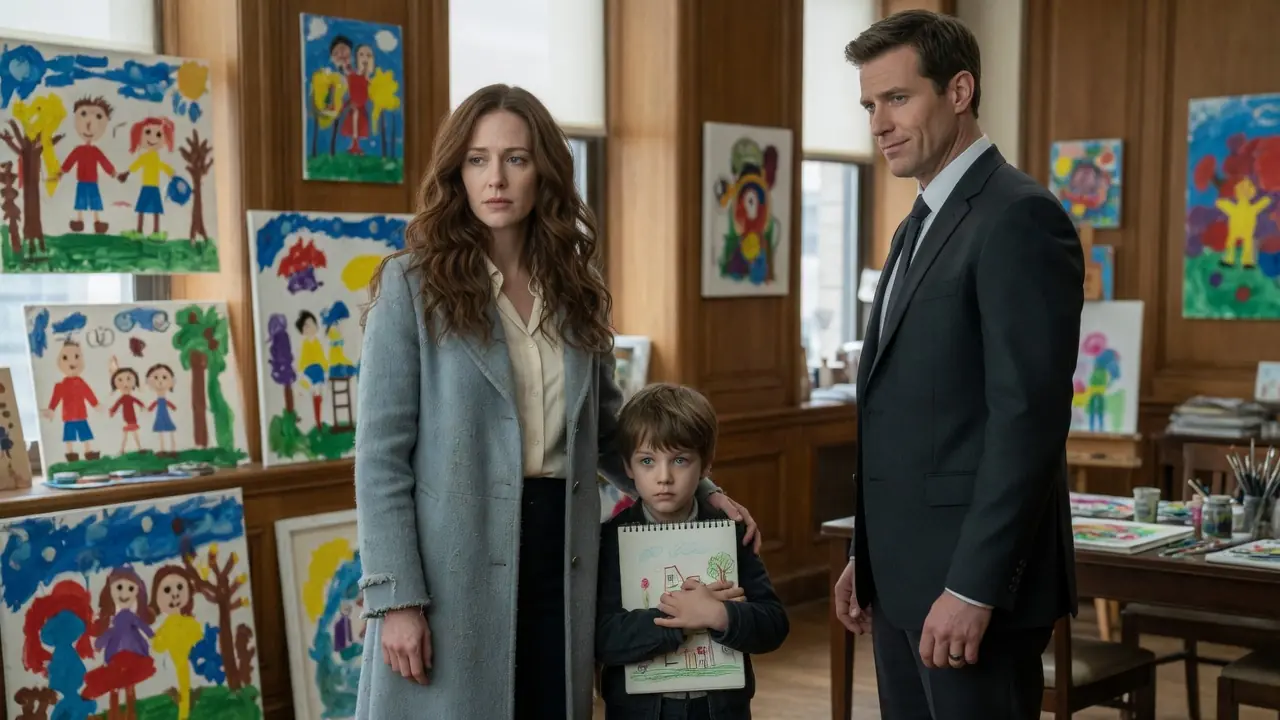
Then, at a charity exhibition funded by the Vane Foundation, Dominic saw a five-year-old boy drawing alone beneath a window.
The child had one blue eye and one green eye—the same rare combination that ran through Dominic’s family. He did not speak when Dominic approached. Instead, he turned his sketchbook around.
On the page stood a tall man made from dark blue strokes. His shadow stretched toward a woman and a little boy beneath a sky filled with silver stars.
“Who is that?” Dominic asked.
The boy studied his face, then wrote three words beneath the picture.
My dad’s eyes.
Before Dominic could ask more, a woman hurried across the gallery.
Aria Bennett stopped several feet away.
Five years disappeared in a single breath.
She looked older, not in years but in the way people look after learning that rescue may never come. Her clothes were modest, her hands stained faintly with graphite, and her expression hardened the moment she saw him.
“Leo,” she said gently. “We’re leaving.”
The boy gathered his drawings and slipped his hand into hers.
Dominic noticed the name on his therapy badge: LEO BENNETT, AGE FIVE. His mother was listed as jewelry designer Aria Bennett. He was enrolled in the foundation’s art-therapy program for children with selective mutism.
“Aria, wait.”
She did not.
Five years earlier, Aria had been a scholarship student with extraordinary talent and no influential family. Dominic had been the heir to the Vane empire, though with her he had simply been a young man fascinated by the way she could turn grief into metal and stone.
They fell in love over unfinished sketches and late-night coffee. Aria designed a pendant made of two incomplete circles that became whole only when placed together. Dominic called it their covenant. Neither signed anything. Neither believed they needed to.
Then Victoria Ashford intervened.
Victoria had been raised inside the Vane household after her father, the company’s former chief financial officer, died under disgrace. Dominic’s father treated her as a daughter and expected her to become Dominic’s wife. Victoria viewed Aria as both an obstacle and an insult.
One night, Victoria summoned Aria to a law office. She placed a nondisclosure agreement on the table and threatened to expose a fabricated academic-fraud case that would cost Aria her degree. Worse, she threatened to release information about a family scandal that could strip Dominic of his inheritance and destroy the company employees who depended on him.
Aria had just learned she was pregnant.
Terrified and alone, she signed. The agreement required her to leave New York, never contact Dominic, and remain silent about the pregnancy and the threats. Victoria then forged an email in Aria’s name demanding five million dollars to disappear. The money was transferred into an offshore account controlled by one of Victoria’s shell companies.
Dominic saw the email and the signed agreement. He did not believe Aria was greedy, but his father warned that if she remained, he would ruin her career. Dominic thought letting her go was the only way to keep her safe.
Neither of them asked the other for the truth.
Fear completed what Victoria had begun.
Aria raised Leo in Brooklyn, supporting them with freelance design work. Leo was observant and affectionate, but outside the safety of home, words seemed to lock inside him. Doctors diagnosed selective mutism. Art became his language.
When his therapist recommended the Vane Foundation’s specialized program, Aria resisted. Her friend Amy secretly submitted the application because the treatment cost more than Aria could afford.
“Are you ready to face him?” Amy asked when Leo was accepted.
Aria looked at her son. “For Leo, she would face anything.”
She had not expected Dominic to recognize them on the first day.
Within two hours of the exhibition, Dominic ordered his chief of staff, Ethan, to investigate Aria’s life after she left. He also studied the jewelry sketches displayed beside Leo’s therapy room. The lines were unmistakable. Aria still used the same hidden geometry she called soul design—the style Dominic had searched for in every studio for five years.
Aria, meanwhile, discovered that Amy had also entered her in the Vane Group’s emerging-designer program. Winning would fund Leo’s treatment and give Aria access to manufacturing she could never afford independently.
She nearly withdrew when Dominic confronted her.
“Did you spend all five million?” he asked, anger masking pain. “Or did you come back for more?”
Aria stared at him. “I never took a penny from you.”
Dominic showed her the transfer record. She recognized neither the company nor the account.
Ethan traced it that night. The money had gone to an offshore company under Victoria Ashford’s control.
For the first time, Dominic understood that the story he had lived with for five years might be a construction.
The designer program required Aria and Leo to spend several weeks at Vane Apartments near the foundation. Victoria greeted them by announcing that she would soon be Mrs. Vane. Dominic publicly corrected her: he was single, and there was no wedding date.
Victoria answered by attacking Aria’s reputation.
A reporter accused Aria of using her child to gain access to Dominic. Anonymous accounts claimed she had slept her way into the program. Aria responded with her design archive—hundreds of dated sketches, cloud backups, invoices, and technical studies stretching back years.
“Someone who relies on a man’s bed does not stay awake making two hundred eighty-seven revisions to one setting,” she told the press.
Dominic traced the leak to Victoria’s assistant. He also proved that the five-million-dollar email had been forged.
At a crowded press conference, he stood beside Aria and Leo.
“Aria Bennett was my partner five years ago,” he said. “She is the mother of my son. She never took money from me, and every defamatory claim will be answered with evidence.”
Aria did not thank him. Public protection could not restore the five years in which she had given birth alone, counted coins for rent, and comforted a child who asked why other families had fathers.
When Dominic requested a DNA test, she refused at first. Leo’s eyes, birthday, and medical history already told him what he needed to know. Yet Aria understood that legal certainty would protect Leo, so she agreed on one condition: Dominic would not seek custody.
The result confirmed paternity.
“Leo is my son,” Dominic whispered.
“He is not an inheritance,” Aria replied. “You were absent for five years. You do not get to arrive as a father simply because a laboratory says you are one.”
Dominic offered unconditional funding for Leo’s treatment and asked for a trial period—no court fight, no change of residence, and no claim against Aria. They agreed that he could see Leo twice a week.
Dominic asked for every day.
Aria gave him twice a week.
He accepted.
That restraint mattered more to her than he understood.
Leo began drawing Dominic constantly. He drew the shape of his shadow at the museum, the way his hand rested beside Aria’s without touching, and a blue-green pair of eyes floating above three stick figures. He remembered details with startling precision: the angle of sunlight, dates on calendars, even objects seen months earlier.
His therapist called it unusually strong visual recall. Victoria called it dangerous.
She bribed the therapist to destroy Leo’s drawings. The woman complied with several folders but secretly preserved one image because she could not bear to erase a child’s work completely.
Dominic confronted Victoria with the forged email and traced payment records.
“I did it to protect you,” she said. “Aria came for money.”
“The money went to your account.”
Victoria’s composure cracked. She mocked Leo’s condition and hinted that the NDA concealed more than Dominic knew.
Aria finally told him part of the truth. Victoria had threatened his inheritance and her education. She had believed that if Dominic hated her, he would let her disappear safely.
“You searched for five years,” Aria said. “Why are you asking only now?”
Dominic had no defense.
Her next collection was titled Wings of Freedom. Each piece featured linked metal bands that appeared closed from a distance but could open with a light touch. Tiny marks on the links formed a message in Morse code: I NEVER SURRENDER.
Victoria stole the designs and registered altered versions first. Using artificial intelligence and manipulated metadata, she created false development records suggesting Aria had copied her. The scandal threatened to end Aria’s career.
The decisive evidence came from Leo.
One of his surviving drawings showed Aria at her desk working on Wings of Freedom. A calendar on the wall read March 3. The angle of the sunlight matched surveillance footage from their building. Victoria’s earliest legitimate access to the files occurred on March 17.
Leo had drawn the scene weeks before the theft became public.
In court, he froze when asked to speak. Aria knelt beside him but did not answer for him. Dominic stood behind them, close enough to reassure but far enough not to pressure.
Leo lifted the drawing.
“Bad woman stole Mom’s stars,” he said.
It was the first full sentence he had ever spoken outside therapy.
The court invalidated Victoria’s copyright registration, recognized Aria as the original creator, and upheld counterclaims for commercial fraud and falsified evidence.
Outside, Dominic promised to spend the next fifty years repairing what one apology could not.
Aria gave him no promise in return.
Victoria was removed from every Vane Group position, but she still had allies. Her father had once served as the company’s CFO before being accused of embezzlement and dying soon afterward. Ethan’s investigation revealed that the accusation had been arranged. Dominic’s father had used Victoria’s adoption as part of a bargain: her father would carry the blame for crimes committed higher in the company, and the Vane family would raise his daughter.
Victoria had entered the household with gratitude on the surface and revenge underneath. Over time, revenge became obsession. She wanted control of the empire and Dominic himself, believing both were owed to her.
After the copyright ruling, Victoria kidnapped Leo and demanded a recording Aria had obtained of the original threats. Aria went to an abandoned dock despite being told to come alone. Dominic and law enforcement followed at a distance.
Victoria intended to force Leo to watch his mother die.
But Leo had hidden a micro-camera inside the compartment of his drawing board. While Victoria gloated, the device streamed her confession. She admitted forging the email, coercing the NDA, altering the design records, bribing the therapist, and arranging the kidnapping.
When Dominic entered with police, Victoria’s expression collapsed.
“Game over,” he said.
Aria reached Leo first. She held him so tightly that his crayons broke between them.
“Mommy is here,” she repeated. “Mommy will never leave you.”
Dominic knelt beside them and apologized for arriving late.
“A place without you and Leo is not my home,” he said. “Without both of you, Vane Group means nothing.”
Victoria was charged with kidnapping, extortion, fraud, evidence tampering, and multiple financial crimes. Her confession exposed another secret before trial.
Dominic had been told that his mother, a gifted jewelry designer who suffered from depression, died by suicide. Records and a letter preserved by Victoria suggested otherwise. Dominic’s father had manipulated her treatment and arranged the circumstances of her death, while Victoria’s father carried out parts of the plan under pressure. Victoria had witnessed enough to know the truth.
Dominic confronted his father before the board.
“You destroyed my mother and almost destroyed Aria. From this day forward, you are not my father.”
His father admitted he had approved Victoria’s plan to drive Aria away. After Dominic’s older brother ran away for love and died in a car accident, the old man had convinced himself that attachment made Vane heirs weak. He chose power over grief, then called the choice protection.
Dominic removed him from control and referred the evidence surrounding his mother’s death to prosecutors. He also cleared executives connected to the old regime, despite warnings that the company’s stock would collapse.
It nearly did.
A bloc of shareholders demanded that Dominic remove Aria or resign. Suppliers withdrew. Victoria’s remaining allies leaked confidential data and tried to paralyze operations.
Aria refused Dominic’s offer of two million dollars.
“I do not need to be rescued with your money,” she said. “I need a fair battlefield.”
Dominic gave her one.
Aria rejected a fifty-million-dollar acquisition offer from a luxury conglomerate and instead proposed an exclusive partnership between her independent studio and Vane Group. Her award-winning collection restored market confidence and brought outside suppliers back. Dominic handled the financial crimes; Aria rebuilt the creative division through contracts that preserved her ownership and authority.
“I was not saving your company,” she told him. “I was proving that I can stand beside you, not behind you.”
“That is where I always should have asked you to stand,” he replied.
Their relationship changed slowly. Dominic took Leo to museums and remembered which snacks were safe for his almond allergy. He learned that fatherhood was not a title granted by blood but a pattern of showing up.
Aria allowed him into their life without allowing him to take it over.
When Dominic offered to invest in her studio without taking shares, she asked why.
“Because I am waiting for you,” he said. “I am not trying to own you.”
That was the beginning of trust.
Leo drew the home in his heart: Aria, Dominic, and himself beneath one roof. When he asked why his father did not live with them, Aria admitted the truth she had avoided.
“I am afraid this happiness will break the way it did before.”
Dominic did not tell her fear was foolish. “Five years ago, I did not protect you. Now I have the power to do it, but I will not use that power to control you. I only want to stand beside you.”
“Give me time.”
“I waited five years. I can wait longer.”
Then a fire broke out in Aria’s studio. Dominic entered before firefighters cleared the building and carried out her original design archives. He suffered smoke inhalation and burns.
When Aria saw him unconscious, fear stripped away the last lie she had been telling herself.
“I can redraw jewelry,” she said when he woke. “I cannot redraw you.”
She chose to try again—not because Leo needed a father and not because Dominic had saved her work, but because she wanted to wake beside him and build something neither of them had to fear.
Dominic gave Aria his mother’s locked sketchbooks. Inside were designs no one had seen since her death and a note saying that design was not decoration; it was the language of the soul. Aria had once said the same words.
His father later came to her with the dead woman’s ring.
“My wife left this for Dominic’s future partner,” he said. “She told me to give it to the person who made him draw again.”
The apology did not absolve him. Aria accepted the ring as something that belonged to Dominic’s mother, not as forgiveness for the man who had silenced her.
Dominic proposed without cameras, lawyers, or company letterhead.
“I am not asking with Vane power,” he said. “I am asking with Dominic’s heart. Be my wife—not through a contract, but through a promise.”
Aria was not ready that day. Dominic accepted her answer and continued showing up.
When she finally said yes, it was on her own terms.
“Not because you need me,” she said. “Not because Leo needs a father. Because I love you.”
Dominic then knelt before Leo.
“May I be your dad? The forever kind?”
Leo placed both hands around Dominic’s face. “You already are.”
Their wedding followed Leo’s drawings rather than society rules. He chose the garden where Aria had felt herself begin again, designed the ring box, and filled the ceremony with stars because his mother drew them whenever she felt free.
At the reception, Leo read a short passage he had written himself.
“My mom is Aria. She draws stars. My dad is Dominic. He draws love. Today they draw a family, and I am the color between them.”
Aria burned the old NDA in a small metal bowl. Dominic burned his copy of the agreement that had once allowed him to let her go.
Five years earlier, paper had separated them because both believed fear was a form of protection. Now they understood that love required truth, choice, and the courage to remain visible to each other.
Victoria sent Aria a letter from prison. She did not ask for forgiveness. She wrote that hatred had given her purpose, money, and influence, then taken away every possibility of being loved. Aria had won not by becoming stronger or crueler, but by refusing to become her.
Maybe in another life, Victoria wrote, I will choose love too.
Aria burned the letter after reading it. She did not hide it from Dominic out of fear. She simply refused to let Victoria occupy another room in their future.
Her studio became an independent international brand. Half of its profits funded art therapy for children who, like Leo, found images before words. Vane Group became a family enterprise with a social foundation rather than an empire built only for inheritance.
At a foundation event, six-year-old Leo stood before a display of children’s paintings.
“My name is Leo,” he said. “I used to draw because I could not speak. Now I can speak, but I still draw, because drawing is how I love.”
The board announced that a place would be available for him in the company’s creative division when he grew older—if he wanted it.
“Then keep the seat open,” Dominic said. “The choice will be his.”
That condition mattered. Their son would inherit possibilities, not obligations.
Later, the family returned to Brooklyn and stood on the small balcony where Aria had held Leo after his birth. Dominic saw the height marks she had recorded on the fifteenth of every month. Beside each line was a space she had unconsciously left blank.
“I kept thinking,” Aria admitted, “that maybe one day someone else would measure him with me.”
Dominic placed a new mark above Leo’s head. This time, both parents wrote the date.
He bought a modest home nearby—not to erase the apartment where Aria survived, but to give them another place to return to. Leo drew all three of them beneath the night sky and wrote, Home is not a place. Home is Mom, Dad, and me.
Months later, Leo handed Dominic a new drawing. Four figures stood beneath the stars.
Dominic looked at Aria. She rested one hand over her abdomen and smiled.
“I planned to tell you tonight,” she said, “but our little artist found out first.”
Leo added one final line beneath the picture:
My family is growing.
Five years earlier, Aria and Dominic had believed that a forced agreement was powerful enough to decide their lives. In the end, the contract survived only as ash.
What remained was the covenant they had never signed: to tell the truth, to choose each other freely, and to build a home where no one had to surrender in order to belong.
Love was the only design that mattered.
THE END