The diner sat at the intersection of Route 11 and a county road that hadn't had a proper name since the sawmill closed in 1987. A crooked neon sign out front read Mabel's in letters that buzzed and flickered like a dying heartbeat. One of the B's had gone dark three winters ago and nobody bothered to fix it. The parking lot was cracked asphalt and frozen puddles. And the only vehicles sitting in it at 11:40 on a Tuesday night were a rusted Ford pickup with Wyoming plates and four motorcycles parked in a tight row near the side entrance, their chrome catching the sick orange glow of a sodium lamp.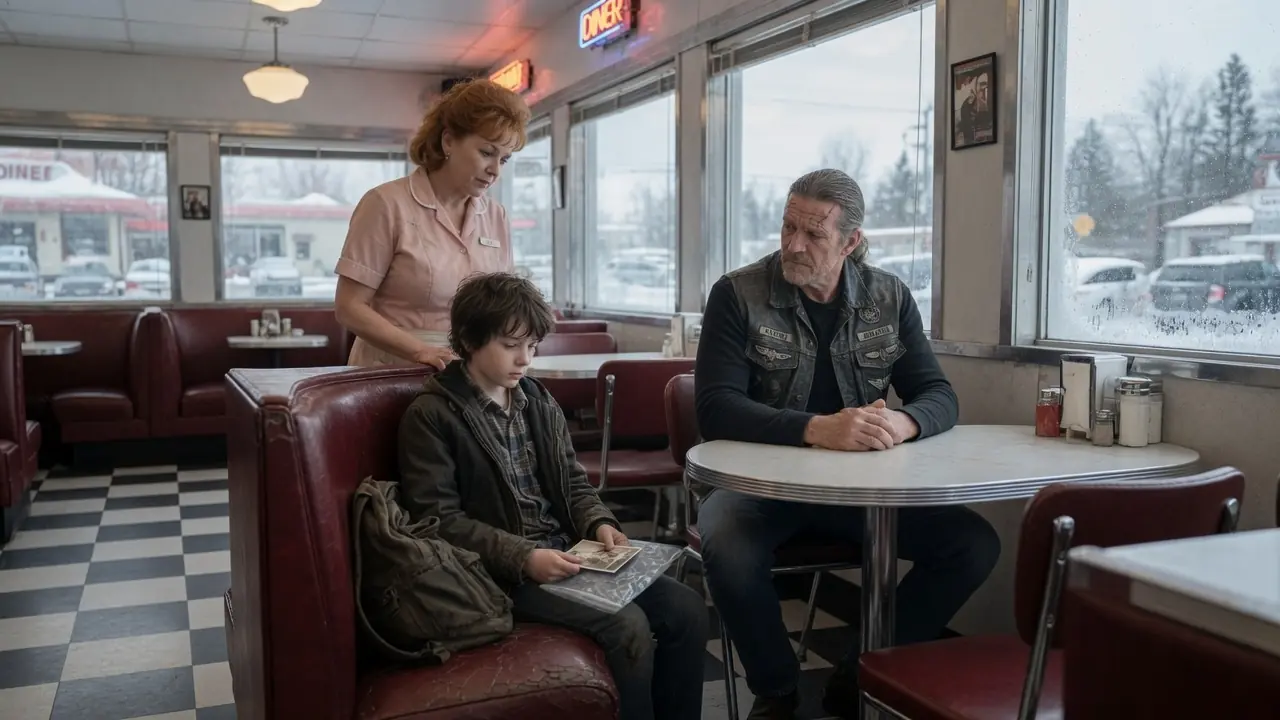
Inside, the air smelled like burnt coffee and bacon grease that had soaked into the ceiling tiles over decades. A jukebox in the corner played something slow and steel guitar sad, barely audible over the hum of a refrigerator case that shuddered every 40 seconds like it was trying to cough something up. Two overhead fluorescent tubes cast the kind of light that made everyone look 10 years older and 5 years more tired than they actually were. Noah Mercer pushed through the front door at exactly 11:43. He knew the time because he'd been watching the clock on the gas station across the road for 20 minutes, working up the nerve to cross.
Not because the diner scared him, because everything scared him now. He was 14, but looked 12. Thin in a way that wasn't natural. The kind of thin that came from skipping meals, not by choice, but by mathematics. His jacket was a hand-me-down from a cousin who'd outgrown it 2 years ago, and the zipper had been broken since October.
Beneath it, he wore a flannel shirt buttoned to the throat and a t-shirt underneath that. And he was still cold. The kind of cold that lived in your bones and whispered to you at night that warmth was something that happened to other people. His sneakers were wet. His backpack hung off one shoulder, heavy with everything he owned in the world, which wasn't much.
A change of clothes, a phone with 11% battery, and no service plan. A composition notebook filled with handwriting that alternated between desperate and meticulous and a photograph sealed inside a plastic sandwich bag. The photograph was the reason he was here. The photograph was the reason he was anywhere. He slid into a booth near the window.
The vinyl seat cracked and patched with duct tape that stuck to his jeans. A laminated menu stood wedged between a napkin dispenser and a bottle of hot sauce. He didn't reach for it. He stared at the tabletop. Someone had carved initials into the Formica years ago and someone else had tried to scratch them out and he tried to make his hand stop shaking.
The waitress appeared after 2 minutes. Her name tag said Donna. She was somewhere between 45 and 60 with reading glasses pushed up into hair that had been dyed auburn so many times it had surrendered to a flat copper. She held a coffee pot in one hand and a pad in the other. And she looked at Noah the way people in small towns look at things that don't belong.
Kitchen closes in 20, she said. Not unkind. Not warm either. Just water, Noah said. You sure?
Got pie, cherry, baked it myself. Just water, please. She studied him for a beat longer than comfortable. Then she turned and walked back behind the counter. Noah exhaled.
The air that came out of him was visible in the drafty corner of the booth, a thin ghost that dissolved into nothing. He didn't notice the bikers at first. They occupied a large round table near the back, the kind of table diners keep for groups of six or eight, but that four men could fill just by existing. They were big in the way that working men are big. Not gym sculpted, not performative, but thick through the shoulders and forearms with hands that looked like they'd been built to grip things that fought back.
Their leather vests, cuts they called them, were black and weathered, stitched with patches that told stories Noah couldn't read from across the room. The insignia on the back was a winged iron cross with a single closed fist at its center. Beneath it, in blocky letters, Iron Verdict MC. They weren't loud. That was the thing. Four men that size, that rough-looking, and they spoke in low tones, leaning into the table like the conversation was something private and loadbearing.
One of them laughed, a short gravel sound that died quickly. Another dragged a French fry through ketchup with the focus of a man diffusing a bomb. And then there was the one at the head of the table. Cole Raven Maddox sat with his back to the wall because men like Cole always sat with their backs to the wall. 41 years old, six-foot-three, 230 pounds distributed across a frame that had been tested by three combat tours, a shattered femur that never healed right, and 17 years on the road with a club that didn't ask questions it didn't want answered.
His face was hard angles in old weather, a jaw that looked carved from bridge cable, a nose that had been broken twice and set once, eyes the color of creek water in January. Gray threaded through his dark hair at the temples, and a scar ran from his left ear to the corner of his mouth, like someone had tried to unzip his face a long time ago. He wore his cut over a black thermal, and his gloves, thick leather, lined, the kind a man wears when he rides in December, because the cold on handlebars at 60 miles an hour, will strip the feeling from your fingers in under a minute, sat on the table beside his coffee cup. His left hand was wrapped around the mug. His right hand rested flat on the table, and that's where the tattoo lived.
It was partially visible, a faded eagle, wings spread wide, talons clutching something too worn to identify clearly. The ink had aged the way skin embedded ink does. Blurred at the edges, the ink gone slightly blue-green, the details softened by years of sun and oil and road grit. It wrapped around the space between his thumb and forefinger, extending up past his wrist where the sleeve covered it. Noah didn't see it.
Not yet. Donna brought his water. No ice. She set it down and hesitated, one hand still on the glass. You waiting for someone, honey?
No, ma'am. You got a ride? I'm fine. She looked at him the way adults look at kids they're about to walk away from, even though every instinct says not to. Then she walked away.
That was the whole transaction. That was always the whole transaction. Noah had learned that about adults a long time ago. They saw the trouble. They registered it.
And then they did the math on what getting involved would cost, and they chose the cheaper option. He pulled the backpack onto his lap and unzipped the front pocket. His fingers found the plastic bag by touch, and he pulled it out carefully, the way you'd handle something irreplaceable, because it was. Inside the bag was a photograph four-by-six printed on matte paper that had gone slightly yellow at the edges. It showed two men standing beside a motorcycle on a dirt road.
One of them was tall and lean with a hard smile and a military bearing. Staff Sergeant Elias Mercer of the 35th Infantry, discharged with honors and a medical file three inches thick that nobody at the VA ever read. The other man was blurred, half turned, captured mid-motion the way people are when they don't want to be photographed. But the tattoo on Elias's right hand was sharp and clear. An eagle wings spread.
Talons gripping a compass rose. Noah stared at the photograph the way drowning people stare at the surface. 6 years. Six years since Elias walked out of his brother's house in Harlem, Montana, told 8-year-old Noah he'd be back before breakfast and never came home. 6 years since the phone calls started and stopped.
The police, the FBI field office in Billings, the private investigator Noah's father hired and then couldn't afford and then drank himself into a stupor trying to forget he'd ever called. 6 years since Noah's father told him, flat and final, sitting at the kitchen table at 2:00 in the morning with a bottle of Jim Beam and eyes that had stopped seeing anything worth looking at. He's gone, kid. People go. That's what they do.
But Noah hadn't believed it. Not at 8, not at 10:00, not at 12 when his father died. Liver quiet, no fanfare, a Tuesday, and he'd been shuffled into the foster system like a piece of furniture nobody wanted but couldn't legally throw away. Not at 13 when the second foster home turned out to be a house where the locks were on the outside of the bedroom doors. And the man who was supposed to be taking care of him smelled like cheap vodka and looked at Noah's younger foster sister in ways that made Noah's stomach turned to ice.
He'd reported it. Of course he had. Called the case worker, left messages, filled out a form at school. The case worker came 3 weeks later, talked to the foster father in the living room for 11 minutes while Noah and the girl sat on the back porch in the cold, and then left. Nothing changed.
Nothing ever changed. Noah got the girl out himself and walked her to the fire station at 4:00 in the morning, and told the paramedic on duty everything. The paramedic believed him. The state did not move fast, but they moved. The girl was relocated.
Noah was relocated too to a group home in Ridgerest, Idaho that was clean and safe and staffed by people who were trying their best but were outnumbered 5 to one and couldn't remember his last name half the time. He ran 6 weeks later, not because they were cruel, because the photograph was burning a hole in his chest and nobody was looking for Elias Mercer and nobody was ever going to look for Elias Mercer. And if nobody was going to look, then Noah would look himself. Three months on the road, buses when he could afford them, walking when he couldn't. He followed the only trail he had, the photograph, a silver compass Elias had left in a shoe box in Noah's father's closet and a series of entries in his uncle's old journal that mentioned a diner on Route 11 near a town called Ridgewater, Oregon.
And now he was here in the diner at the end of a road that might be the end of everything. He took a drink of water, set the glass down, looked at the photograph one more time, and then he looked up. Cole Maddox was reaching for his coffee mug with his right hand, and the sleeve of his thermal had ridden up past the wrist, and the tattoo was fully visible for exactly 3 seconds. Eagle wings spread. Talons gripping a compass rose.
The same design, the same placement, the same faded ink that looked like it had been applied by the same needle in the same century by someone who knew exactly what that image meant. Noah's blood went cold. Not the cold of winter, not the cold of hunger, the cold of recognition, the cold of a door opening that had been locked for 6 years. He turned to Donna, who was wiping down the counter 4 ft away. His voice came out as a whisper, and later he wouldn't even remember deciding to speak.
The words just fell out of him like something that had been waiting behind his teeth for 2,000 days. Only my missing uncle had that eagle tattoo. Donna's hand stopped moving. She looked at Noah. Then she looked at the table of bikers.
Cole Maddox heard it. He heard it the way a man hears a gunshot in a quiet room. Total immediate, everything else falling away. His hand froze on the mug. His eyes moved to the boy in the booth by the window.
And for a full 5 seconds, neither of them blinked. The other three bikers noticed. Of course they did. Men who ride together long enough develop a kind of peripheral awareness that borders on animal instinct. They feel the shift in a brother's posture the way wolves feel a change in wind.
A thick-necked man with a braided beard and sergeant-at-arms patches on his cut. They called him Dutch. Set down his fork and looked at Cole with a question in his eyes that he didn't ask out loud. Cole stood up slowly. The chair scraped against the floor, and the sound was enormous in the sudden quiet.
He picked up his coffee mug, crossed the diner in four strides, and stopped at Noah's booth. He didn't sit down. He stood there looking down at the boy, and Noah looked up at him. And what passed between them was not a conversation, but a collision. Two people holding pieces of the same broken thing and realizing it at the same time.
"Say that again, " Cole said. His voice was low and rough, like gravel being dragged across concrete. Noah's jaw tightened. He held up the photograph. His hand was trembling.
Cole took the photograph, looked at it, and something happened to his face that Noah would think about for years afterward. A cracking, a fissure, as if the hard surface was a mask, and beneath it was something raw and unfinished and in pain. He stared at the image of Elias Mercer, the way a man stares at a face he's been trying to forget. "Where did you get this? " Cole said. "Not a question.
A demand wrapped in something that sounded almost like fear. " "He's my uncle, Elias Mercer. He disappeared 6 years ago. Everyone says he's dead. " Noah paused, swallowed. "But you have his tattoo. " Cole sat down across from him. The booth groaned under his weight.
He set the photograph on the table between them and for a long moment he just looked at it. His jaw working, his eyes doing something complicated that Noah couldn't decode. I didn't get this tattoo from your uncle kid. Then where? I got it from the same place he did a long time ago in a room with no windows and a promise that if I ever talked about it, people would die.
He looked up. People did die. The jukebox changed songs. Something with a fiddle and a voice that sounded like it was singing from the bottom of a well. Outside, the wind picked up and threw a handful of sleet against the window, and the neon sign buzzed louder.
And somewhere in the kitchen, a timer went off, and nobody answered it. Dutch appeared at the edge of the booth. He didn't speak. He just stood there, arms crossed, watching the door in the parking lot beyond it, with the calm, continuous vigilance of a man who'd been watching doors and parking lots for most of his adult life. You're Elias's blood.
Cole said it wasn't a question anymore. Yes, sir. And you came here looking for him? I came here because his journal mentioned this diner, this road. He wrote about it three times.
Said if anything ever happened, the answer would be on Route 11. Cole's expression didn't change, but something behind his eyes shifted. A recalculation, a reassessment. The kind of mental adjustment that happens when new information doesn't just change the picture, but reveals that the picture was never what you thought it was. How old are you?
Where are your parents? Dead. The word landed on the table like a stone. Cole didn't flinch. He'd heard the word before from mouths younger than this one in places worse than this one.
But he registered it, filed it, added it to the equation he was already building in his head. Foster system ran. How long? 3 months. Jesus.
The word was barely audible. Cole ran a hand over his face and stared at the photograph again. You've been on the road for 3 months alone at 14. I'm not looking for sympathy. I'm looking for my uncle.
Something flickered in Cole's expression. Respect maybe. Or recognition of a stubbornness he'd seen before in another face. Another lifetime. He was about to speak when Dutch shifted his weight and said quietly, "Raven, parking lot. " Cole turned his head.
Through the window, past the neon in the sleet, a black SUV had pulled into the far end of the lot. Its headlights were off. Its engine was running. Two silhouettes sat in the front seats, motionless, watching. They hadn't been there 2 minutes ago.
That locked? Hasn't been locked since Carter was president. Cole looked at Noah. The boy had seen the SUV, too. His face had gone white, but his eyes were steady, and his hand had moved instinctively to his backpack, clutching the strap like it was the only solid thing in a world that had just gone liquid.
"You know those people? " Cole asked. "No. " "You sure? " "I'm sure I don't know them. I'm not sure they don't know me. " Cole stared at him for one more second, then he stood up. The decision had been made somewhere in the space between the boy's answer and the SUV's darkened headlights. And once Cole Maddox made a decision, it was made the way concrete sets.
Permanent, loadbearing, and not open for discussion. Dutch, get the others. Bikes out the side. I want Hawkins on the road in 2 minutes. And Jessup watching the tree line.
Dutch moved without a word. Not fast. Fast draws attention. Deliberate. The other two bikers at the table were already reaching for their gloves, reading Dutch's body language the way musicians read a conductor.
No one asked what was happening. No one needed to. Cole turned back to Noah. Get your bag. Stay behind me.
Don't talk. Don't run unless I tell you to run. And if I tell you to run, you run east toward the gas station. And you don't stop until you're inside. And you tell whoever's working the counter to call the sheriff.
You understand? I'm not leaving without kid. Cole's voice dropped to something barely above a whisper, and there was a weight in it that stopped Noah's words in his throat. Your uncle rode beside me 8 years ago. I watched him take a bullet meant for someone else and keep riding for 30 miles before he told anyone he was bleeding.
If he's alive, and I'm starting to think he might be, then the people sitting in that parking lot right now are the reason he had to disappear. And that means they are not here to talk. Noah's mouth closed. He picked up his backpack and stood. The four motorcycles fired up simultaneously in the side lot, a sound like thunder being born in a steel drum, vibrating through the diner's walls and rattling the salt shakers on every table.
Donna didn't flinch. She'd been serving bikers for 30 years. She just moved the coffee pot to a different burner and turned off the kitchen lights one by one until the diner was lit only by the neon outside and the pale blue glow of the jukebox. Cole led Noah through the kitchen, past the flattop grill still radiating heat, past shelves of industrial cans and a walk-in cooler with a handle worn smooth by decades of hands. The back door was steel, painted over so many times the layers had built up around the hinges like geological strata.
Cole pushed it open with one arm, and the cold hit them like a wall. Not the moderate chill of the dining room, but the full brutal December air of the Oregon high desert at midnight, dry and sharp, and laced with the smell of frozen sage. The alley was narrow and dark. A single security light mounted on the building next door threw a cone of yellow onto wet concrete. Beyond it, shadows.
Cole stopped, listened. The night was full of small sounds. The tick of cooling engines, the creek of a metal sign somewhere down the block, the distant hum of the interstate five miles north. But beneath it all, something else. Footsteps.
Careful ones. The kind of footsteps made by people who didn't want to be heard. Stay, " Cole said. He reached into his cut and pulled out a phone. Not a smartphone, a battered flip phone, the kind that still worked in dead zones because it didn't need a cell tower within line of sight.
He punched a number from memory and held it to his ear. It's Raven. I need a full table at the Bridgewater Chapter House tonight, and I need a sweep on Route 11 between mile markers 8 and 14. A pause. Yeah, it's that kind of night.
He closed the phone, looked at Noah. You're going to ride with me. You ever been on a motorcycle? You're going to hold on and you're not going to let go. Not when we accelerate.
Not when we lean. Not when you hear things behind us that sound bad. You hold on until I say stop. Clear. Clear.
Cole's Harley was waiting at the end of the alley, engine idling, Dutch standing beside it with his hand on the handlebar. He gave Cole a look, the kind of look that carried 20 years of brotherhood in every conversation they'd never needed to have, and then swung onto his own bike and pulled out first, headlight cutting a white path through the dark. Noah climbed on behind Cole. The seat was cold through his jeans. The machine vibrated beneath him, a low, constant tremor that felt like sitting on top of something alive.
He put his arms around Cole's torso, and his hands met leather. And beneath the leather, muscle that felt like braided cable. The man was solid the way a bridge abutman is solid. Engineered for load, built to stand. Cole didn't say anything else.
He kicked the stand, rolled the throttle, and the bike surged forward with a sound that split the night like a blade through silk. Behind them, two more headlights fell into formation. Ahead Dutch's tail light was a red dot moving fast through the darkness. They hit the county road at 60, and the wind was immediate and merciless, tearing at Noah's jacket, watering his eyes, pushing the cold through every gap in his clothing until he felt like he was wearing nothing at all. He pressed his face against Cole's back and held on.
The leather smelled like oil and road dust and something older, something that reminded him of his uncle's jacket hanging in the hallway closet of the house in Harlem. The jacket his father had never moved, never cleaned, never touched, as if touching it would make the disappearance real in a way that leaving it alone did not. They rode for 14 minutes. Noah counted because counting was the only thing keeping him from thinking about the SUV and the footsteps in the alley, and the look on Cole's face when he'd said people did die. The chapter house appeared out of the darkness like a ship emerging from fog.
A low, sprawling building that had been a lumber warehouse in another life with a corrugated metal roof and walls that had been reinforced with steel plate at some point in the past. A row of motorcycles lined the front like sleeping animals. Light leaked from behind blacked out windows. A metal gate stood open and a man in a cut stood beside it, watching the road with a shotgun resting in the crook of his arm the way a farmer holds a rake. Cole pulled through the gate and killed the engine.
The sudden silence was enormous. A pressure on the ears after 14 minutes of wind and thunder. Noah's arms were locked around Cole's torso. He had to consciously tell his fingers to let go. They walked inside.
The chapter house was warm, almost too warm after the ride. The heat coming from a wood stove in the corner and the sheer density of bodies. 15 maybe 18 men occupied the main room, most of them in cuts, most of them large. All of them looking at Noah with expressions that ranged from curiosity to suspicion to the particular blankness that hard men wear when they haven't decided yet whether the thing in front of them is a problem or a project. Cole guided Noah to a chair near the stove.
Someone put a cup of coffee in the boy's hands without being asked. It was black and bitter and scalding, and Noah drank it like water. "Sit, " Cole said. "Don't move. I need to make some calls. " He disappeared through a door at the back of the room.
Dutch took up a position near Noah, not hovering, not smothering, just present. A wall of denim and leather and quiet attention that told everyone in the room the kid was accounted for. Noah sat. He held the coffee. He felt the warmth creep back into his fingers, his wrists, his chest.
And for the first time in 3 months, for the first time since he'd walked out of the group home in Ridgerest with nothing but a backpack and a dead man's photograph, he felt something he didn't recognize at first because it had been absent so long. He felt like someone was standing between him and the dark. 20 minutes passed. Voices filtered through the closed door. Cole's low rumble and others, some calm, some heated.
Noah caught fragments. Can't bring a civilian kid into a chapter house. And Mercer is a dead name, Raven. You know what happened to the last person who And then Cole's voice cutting through like a sawblade. I know exactly what happened.
I was there. That's why the kid stays. The door opened. Cole came out. Behind him, a woman.
She was maybe 50, sharp featured with iron gray hair pulled back tight and a leather jacket that didn't carry club patches but fit her like a second skin. Her eyes swept the room, landed on Noah, and stayed. "This is Moraon Clare, " Cole said. "She runs logistics for three chapters across Oregon and Washington. She's also the only person I know who saw your uncle alive after he disappeared. " Noah's coffee cup stopped halfway to his mouth.
Mora pulled a chair across the floor. The legs shrieked against the concrete, and she sat down facing him close enough that he could see the lines around her eyes, the way her jaw was set, the faint tremor in her left hand that she controlled by pressing it flat against her thigh. I need to see the photograph, she said. Noah pulled it out, handed it over. Mora studied it under the light, tilting it, bringing it close, and something happened to her face that was similar to what had happened to Cole's, but different.
Less shock, more grief. The kind of grief that comes not from loss, but from confirmation of something you already feared. This was taken at a supply drop outside Dalton Ridge, she said quietly. Summer, 8 years ago, I was there. The man standing next to Elias, the blurred one, that's a man named Vincent Hargrove.
He ran the extraction network. Got people out of trafficking operations along the old highway corridors between Nevada and British Columbia. She looked up. Your uncle was part of that network. They called themselves the Iron Wing.
Not a club, not military, something else. Something that didn't have a name anyone was supposed to say out loud. Is he alive? Noah's voice was steady, but his eyes were not. Mora looked at Cole.
Cole looked at Mora. And in that look, Noah saw the thing that adults think they hide from children but never do. The calculation, the weighing of truth against protection, the question of how much reality a 14-year-old can carry. Tell me, Noah said, I didn't walk 3 months to get lied to. Mora exhaled, set the photograph on the table.
The last confirmed sighting of your uncle was nineteen months ago at a gas station in Bend. He was alone. He looked different, thinner, older, a beard. He paid cash for fuel and a prepaid phone. The security camera caught 4 seconds of his face before he turned away.
She paused. That footage was intercepted by people who have been hunting the Iron Wing since your uncle helped shut down their pipeline. They've spent 6 years trying to find him. And now, she stopped, looked at the door, then at Cole. And now, Cole finished, his voice hard as rebar.
A 14-year-old kid just walked into a diner on Route 11 and said his name out loud. The room went silent. The wood stove crackled. Somewhere outside, an engine turned over and died. Noah understood.
The realization hit him like a fist to the sternum. Not dramatic, not cinematic, just a cold, nauseating clarity that settled into his gut and sat there like a stone. He hadn't just been looking for his uncle. He'd been leading them straight to him. And the men in the black SUV, the men with the darkened headlights and the careful footsteps.
They hadn't been following Noah because they knew where Elias was. They'd been following Noah because they knew that eventually the boy would find him. The silence in the chapter house lasted 11 seconds. Noah counted them the way he counted everything, compulsively, mechanically, because numbers were the one thing in his life that didn't lie or leave or change their mind. Then the room detonated.
A biker near the far wall, broad, bald, with a neck like a fire hydrant, and VP patches stitched above the left pocket of his cut, pushed off the wall he'd been leaning against, and crossed the floor in three heavy strides. His boots hit the concrete like hammer blows. His name was Garrett Forge Stills, and he'd been vice president of the Ridgewater chapter for 9 years, and every man in the room knew the sound of his walk the way sailors know the sound of an anchor chain being pulled. Outside, he said to Cole. Not a request.
Now, Cole didn't move. He stood between Forge and the boy the way a wall stands between weather and the thing it protects. Silent, structural, non-negotiable. I sat outside, Raven. I heard you.
Then move your feet. Say what you need to say right here. Forge's jaw tightened. The muscle in his cheek pulsed once, twice, like a piston misfiring. He looked at Noah, a long flat assessing look that carried no warmth and no cruelty, just the cold arithmetic of risk.
And then back at Cole, "You brought a civilian child into a chapter house. A child connected to a dead operation that got three of our brothers killed. A child who just admitted he's been leading a tale across two states. And you want me to have this conversation in front of 18 patched members? And a kid who doesn't even know what room he's standing in?
He knows exactly what room he's standing in. He's been surviving rooms worse than this since he was 12. That's not the point, and you know it. The point is, there are men in a parking lot fourteen miles east who are hunting this kid because of what his uncle carried. The point is, Elias Mercer didn't die in that ambush 8 years ago, which means everything we were told about the Iron Wing operation was a lie.
The point is, the point, Forge said, stepping close enough that his chest was six inches from Cole's, is that the last time you followed your gut on something like this, two brothers went into the ground, and one of them was 23 years old and had a daughter who still asks where her daddy is. The room went airless. Every man in it felt the words land. Some looked away, some didn't. Dutch, standing near the stove, uncrossed his arms and let his hands hang at his sides, ready for whatever came next.
Cole's face didn't change, but something behind his eyes and something deep and structural, something he'd spent years building walls around, cracked, just slightly, just enough for Noah to see it from five feet away, and understand that whatever Forge had just referenced was not history, but a wound, and it was still bleeding. "Kyle Redmond, " Cole said quietly. The name came out of him like a splinter being pulled from old wood. That what you're bringing up right now, Kyle, I'm bringing up the fact that you have a pattern. You find a cause, you make it personal, and then you drag this club into it without putting it to a table vote.
Kyle followed you into that warehouse in Clamoth Falls because he trusted you. He was 23, patched for 11 months, and they buried him in a box his family couldn't afford. I paid for that box. Yeah, you did. And that's the problem, Raven.
You paid for the box and then you moved on to the next war. But Kyle's daughter is seven now and she draws pictures of motorcycles because that's the only way she can remember her father. And every time I see those drawings, I think about the man who told Kyle it was safe to go through that door. Nobody breathed. The wood stove ticked.
Outside, the wind threw something metal against the corrugated roof, and the sound rang through the building like a bell struck with a wrench. Cole's hands were at his sides. They were shaking. Not from cold, not from anger, from the particular kind of tremor that comes when a man is holding something inside himself that weighs more than his body can carry, and the muscles have been doing the work so long they've started to fail. I think about it, too, Cole said.
His voice was barely above a whisper. Every night, every single night, Forge, I hear that door. I hear what was behind it. And I hear Kyle saying, "I got your six, Raven. " And I hear myself saying, "Go. " And I hear, he stopped, swallowed. The sound was audible in the silence.
I hear everything after that. Forge stared at him. The anger in his face was still there, but it was doing something complicated now, folding into itself, mixing with something else, something that looked like grief and exhaustion and the terrible weight of loving someone you can't forgive. Then don't do it again, Forge said. Don't bring another war into this house.
Don't make another Kyle. This isn't a war. This is a kid. It's always a kid or a woman or someone who needs saving. And we ride out and some of us don't ride back.
That's the pattern. That's your pattern. Noah sat in the chair by the stove and watched two men he didn't know tear each other apart over ghosts he couldn't see. And he understood with the clarity that only comes from growing up in rooms where adults fought about things that were never really about what they said they were about that this argument was not about him. It was about a 23-year-old named Kyle Redmond who died in a warehouse in Clamoth Falls.
And it was about every decision that led to that door. And it was about the particular kind of love that men in motorcycle clubs carry for each other. A love they never name, never acknowledge, never speak out loud, but that runs through everything they do like rebar through concrete. Mora stood up. She didn't raise her voice.
She didn't need to. Enough. Both men looked at her. Forge's jaw was still tight. Cole's hands were still shaking.
Mora stood between them the way a referee stands between fighters after the bell. Not because she was bigger or stronger, but because she occupied a space in the room that neither of them could challenge. The argument about Kyle is a real one. She said it deserves to happen. But not tonight.
Tonight, there's a 14-year-old boy sitting in this room who has been on the road alone for 3 months, who hasn't eaten a real meal in 2 days, and who just found out that he's been used as a tracking device by people who will kill him without hesitation the moment he stops being useful. She looked at Forge. You want to protect this club? Fine, protect it. But that starts with figuring out who's in the black SUV, not relitigating Clamoth Falls.
Forge held her gaze for a long moment. Then he exhaled through his nose. A sharp controlled sound like a pressure valve releasing, and turned away. He walked to the far end of the room, pulled out a chair, sat down, and stared at the wall. It was not agreement.
It was not surrender. It was the thing men like Forge did instead of both. A tactical withdrawal, a setting aside, a promise that the conversation was not over, only postponed. Cole sat down across from Noah. His face was gray.
The scar along his jaw looked deeper in the low light, like a crack in a foundation. "You heard all of that? " he said. "Yes, you understand what he's saying. He's saying people die around you. " Cole flinched. It was small, a micro movement, a tightening of the muscles around his eyes.
But Noah saw it and he filed it away the way he filed everything because information was the only currency he'd ever had. He's not wrong, Cole said. I don't care. You should. My uncle is alive somewhere, and the people who made him disappear are the same people who just found me.
You can tell me to leave. You can tell me this isn't your problem, but I'm not going back to a group home in Ridgerest to wait for a caseworker who can't remember my name while the only family I have left is out there hiding from something I don't understand. " Noah leaned forward. His voice didn't rise. It hardened. I'm not asking you to save me.
I'm asking you to help me find him. Cole looked at him for a long time. Then he reached into the inner pocket of his cut and pulled out something Noah didn't expect. A folded piece of paper, old, yellowed, soft from being handled hundreds of times. He unfolded it on the table.
It was a list, handwritten, six names arranged in a column with dates beside each one. Two of the names had been crossed out with a single black line. A third had a question mark beside it, and the fourth name, the fourth name on the list, was Elias Mercer. "Your uncle and I served together, " Cole said. "Not military. " After the Iron Wing was a network, maybe 30, 40 people total, spread across six states, we intercepted trafficking routes, pulled people out of transport vehicles on back roads, got them to safe houses, fed them, gave them new papers, disappeared them into new lives.
He tapped the list. These were the six core members, the ones who ran operations, the ones who knew every safe house, every route, every contact. What happened to them? Someone sold us out. Cole's voice went flat.
Mechanical. The voice of a man reciting facts he'd memorized against his will. Summer. 8 years ago. We had an extraction planned outside Dalton Ridge.
A semi-truck carrying 14 people, mostly women, mostly from Guatemala and Honduras. Someone tipped the syndicate. They were waiting for us. Three vehicles, eight armed men. They hit us on a logging road with no cell service and no exit.
He stopped, took a breath. The breath was ragged, and Noah heard in it the echo of a night that had never fully ended for the man sitting across from him. Kyle Redmond wasn't Iron Wing. He was club, my brother. He was riding backup because I asked him to.
I told him it was a supply run. I lied to him because I didn't want to put it to a vote and I knew the club would say no. He was 23 and he followed me through a door that I should have gone through alone. The room was very quiet. Forge at the far end hadn't turned around, but his shoulders had shifted.
He was listening. Two of the six names on this list died that night. A third, Vincent Hargrove, the man in your photograph, disappeared the same way your uncle did. Went underground, changed his name. Last I heard, he was somewhere in Montana, living off-grid, waiting for the day the syndicate found him.
Cole folded the list and put it back in his pocket. Your uncle was supposed to die that night, too. He didn't. And the reason he didn't is the reason everything after that went sideways. What reason?
Cole looked at Mora. Something passed between them. Not words, not even a look that Noah could fully read, but a negotiation conducted entirely in silence. The kind that happens between people who've shared a secret so long it's become structural. Mora pulled her chair closer.
She rested her forearms on her knees and looked at Noah. The way a doctor looks at a patient before delivering a diagnosis that will change the shape of their life. Your uncle didn't just survive the ambush. She said he planned for it. He knew the tip off was coming because he'd identified the leak weeks earlier.
A man named Silas Dorne, former border patrol, dirty from the day he was hired, embedded in the Iron Wing network by the syndicate to map every safe house and every operator. She paused. Let it land. Elias didn't tell anyone he'd found the leak. Not Cole, not Hargrove, not me.
He kept it to himself because he didn't know how deep the rot went, and he didn't know who else might be compromised. Noah's hands went cold. He didn't trust you. The words hit Mora like a slap. She blinked, recovered.
But the flinch was there, and the hurt beneath it was genuine. The kind of hurt that only comes from discovering that someone you were willing to die for had looked at you and seen a potential threat. No, she said he didn't. And I have spent 6 years trying to understand whether that was wisdom or cowardice, and I still don't know. Cole cut in.
What Elias did was stage his own disappearance. He used the ambush as cover. Let the syndicate think he was dead. Let us think he was dead. He took the evidence he'd been building, documents, recordings, financial records tracing the syndicate's money through three shell companies and into the accounts of two county judges and a state senator.
And he vanished completely. No contact, no trace. No word to his brother, his nephew, anyone. The fire in the wood stove popped. A log shifted and sent a shower of sparks against the glass door.
Noah stared at the orange glow and felt something happening inside his chest that he didn't have a name for. Something that was part rage and part grief and part a terrible, nauseating understanding. He could have told someone, Noah said. His voice cracked on the last word. Not much, just enough.
He could have told my dad. One phone call, one letter, anything. My dad spent four years drinking himself to death because he thought his brother was in a ditch somewhere. He died thinking that. He died believing he'd been abandoned.
I know. Cole said, "You don't know. You didn't watch it. You didn't sit at a kitchen table at midnight and watch a man drink himself blind because the one person he loved most in the world disappeared and nobody could tell him why. " Noah's eyes were wet, but his voice was steady and hard, forged by three months on the road and six years of a grief he'd never been allowed to express because there was nobody to express it to. My uncle let my dad die believing a lie.
That's not protection. That's cruelty. The word hung in the air. Cole didn't argue. Mora didn't argue.
Nobody in the room argued because the boy was right and they all knew he was right. And the truth of it sat in the room like smoke, visible, unavoidable, impossible to breathe through. A phone buzzed. Dutch pulled it from his pocket, read the screen, and his face changed. The shift was subtle, a tightening around the mouth, a narrowing of the eyes, but Cole caught it immediately.
Talk Hawkins on the service road. The SUV moved. It's not at the diner anymore. Where? Heading north on Route 11 toward us, the room reconfigured.
It happened fast, not panicked, not chaotic, but with the practiced efficiency of men who had prepared for exactly this kind of moment dozens of times before. Forge stood up from his chair. Two bikers near the entrance moved to the windows. Another disappeared and through a side door and came back carrying a duffel bag that clinked with metal. "How far out? " Cole asked.
Hawkins says 12 minutes, maybe 15 if they hit the curve slow. Anyone else on the road? Second vehicle, gray sedan, fell in behind the SUV at the Route 7 junction. Two occupants. Cole turned to Forge.
For a moment, the earlier conflict hung between them like a live wire, visible, dangerous, carrying voltage. Then Forge met his eyes, and something shifted. Not forgiveness, not reconciliation, but a recognition that whatever their differences, the approaching headlights didn't care about internal politics. Your call, Forge said. The words cost him.
Noah could see it in the way his jaw worked around them, grinding the syllables like gravel. But we do it by the book, table vote. There's no time for a There's time. There's always time. That's what separates us from the people driving toward this building right now.
Forge raised his voice, not shouting, commanding, "Patched members, show of hands. Do we shelter the boy and investigate the Mercer connection, or do we hand him to the authorities and walk clean? " The room froze. 18 men, 18 faces, some young, some old, some carrying scars that told stories longer than most novels. They looked at Noah, this thin, shivering 14-year-old kid in a broken jacket with a dead father and a ghost for an uncle, and they calculated, not cold-bloodedly, not carelessly, with the particular kind of weighted deliberation that comes from knowing that every hand raised in this room was a hand that might have to throw a punch or catch a bullet before the night was over. Dutch raised his hand first without hesitation, without looking at anyone else.
Then a man near the window, young, maybe 25, with a sleeve of tattoos and a fresh cut that still had its new leather shine, raised his. Then another, and another. Forge watched the hands go up. His face was unreadable. When the count reached 12, a clear majority, he exhaled through his nose and raised his own hand.
Not enthusiastic, not reluctant, dutiful. A man fulfilling the obligations of a system he believed in even when the system told him to do something he didn't want to do. Carried. Forge said the boy stays. But we do this smart.
Cole, I want a four-man perimeter. Two on the access road, two in the tree line. Rotating shifts. Nobody rides alone. And the kid doesn't leave this building without an escort.
He looked at Noah. You're not a guest. You're not a member. You're a responsibility. The difference matters.
Understand? Yes, sir. Don't call me sir. I work for a living. Despite everything, the fear, the exhaustion, the weight of 6 years pressing down on his chest, Noah almost smiled.
Almost. Cole was moving. He crossed to a corkboard on the far wall, pulled down a map of the surrounding area. Topographic, detailed, marked with handwritten annotations in three different colors of ink, and spread it on a table. Mora joined him.
Dutch joined him. Forge, after a moment, joined him, too. The access road is the only paved approach from the south, Cole said, tracing a line with his finger. But there's a logging trail here. Old growth, not on GPS, connects to the county road three miles west.
If they know about it, they can flank us. They won't know about it, Dutch said. Silas Dorne spent two years embedded in this region. If he mapped the safe houses, he mapped the back roads. The name Silas Dorne moved through the room like a cold draft.
Several of the older bikers shifted. One, a heavy man with a gray beard and hands like catcher mitts, muttered something under his breath that Noah couldn't hear, but that made the man next to him nod slowly. "Dorne is dead, " Mora said. "Confirmed. Body found in a storage unit in Reno March four years ago.
Single gunshot. No suspects. Dorne is dead, but his intel isn't. The syndicate has everything he gathered. Every map, every name, every route.
Cole straightened up from the table. That's how they knew to follow Noah. They've had a net out for 6 years waiting for anyone connected to Elias to surface. And a 14-year-old kid on a Greyhound bus asking questions about an eagle tattoo. That's not a hard signal to catch.
Noah felt the words land in his stomach like stones. He thought about every bus ticket purchased with crumpled bills. Every diner where he'd shown the photograph to a stranger and asked if they'd seen a man with that tattoo. Every truck stop and library and gas station where he'd left a trail as obvious as footprints in fresh snow. 3 months.
Three months of thinking he was being careful. Three months of thinking he was invisible. And the entire time he'd been a signal fire. I need air, Noah said. He stood.
His legs were unsteady. Sit down, Forge said. I need I need one minute outside. 1 minute. Cole looked at Dutch.
Dutch gave a slight nod. The economy of communication between men who'd been watching each other's back so long it had become autonomic. "I'll go with him, " Dutch said. They went out the side door. The cold hit Noah like a physical blow.
He walked three steps into the darkness, bent at the waist, and put his hands on his knees. His breath came in ragged gasps that crystallized in the air like small explosions. Dutch stood five feet away. He didn't say anything. He lit a cigarette, the flame from the lighter briefly illuminating his face, the braided beard, the deep set eyes that had seen enough to fill a hundred lifetimes.
And he waited. "I led them here, " Noah said. His voice was small. Everything I did, every question I asked. I thought I was looking for him, but I was pointing a gun at him the whole time.
Dutch took a drag, exhaled. The smoke curled upward and disappeared into the frozen sky. "You did what you did because you love him, " Dutch said. His voice was deeper than Cole's, slower, with a cadence that suggested he chose every word the way a carpenter chooses nails. Deliberately, one at a time, each one placed where it would hold.
Love makes you stupid. Love makes everyone stupid. The difference between a fool and a brave man is what they do after they realize how stupid they've been. Noah straightened up, wiped his eyes with the back of his hand, looked at the sky, clear black, thick with stars that nobody in cities ever got to see, and took one slow breath. What do I do now?
You go back inside. You let the men who know how to fight do the fighting. And you give us everything you have. The photograph, the compass, the journal, every piece of your uncle that you've been carrying. Because right now, those pieces are the only map to a man who spent 6 years making sure he couldn't be found.
They went back inside. Noah sat down. He opened his backpack and placed its contents on the table one at a time. The photograph in its plastic bag. The silver compass with the eagle engraved on the back, the composition notebook filled with entries copied from Elias's journal, and a folded gas station receipt on which Noah had written in small, precise handwriting every location he'd visited and every person he'd spoken to in 3 months of searching.
Mara picked up the compass, turned it over. Her thumb traced the eagle engraving, and her eyes went distant. Not unfocused, but deep, seeing something beyond the object. Something temporal, something lost. "He gave this to you, " she said.
"He left it in my dad's closet in a shoe box with his dog tags and a letter my dad never opened. " "A letter? Dad burned it 6 months after Elias disappeared. I came home from school and the kitchen smelled like lighter fluid and smoke and my dad was sitting at the table staring at the ashtray. Noah's voice was flat reporting clinical. The way trauma sounds when it's been lived with so long it calcifies into fact.
He said some things aren't worth reading. I think he was afraid of what it said. I think he was afraid it would explain everything and he'd rather live not knowing than know something that would make it worse. Mora set the compass down carefully, as if it might break. She unfolded the receipt and scanned Noah's handwritten list.
Her finger stopped halfway down. You went to Dalton Ridge 3 weeks ago. Talked to a woman at a feed store who said she remembered a man matching Elias's description buying supplies 5 or 6 years ago. She couldn't be sure. She said a lot of men pass through who look like they're running from something.
Did you give her your name? No, but I showed her the photograph. Mora closed her eyes just for a second. When she opened them, the look she gave Cole carried something heavy. Resignation maybe, or the specific weariness of a person who has watched the same mistake repeat across different decades with different faces.
The feed store in Dalton Ridge, she said to Cole, is one of three civilian waypoints that Dorne mapped before he was killed. If Noah showed that photograph there, the syndicate had it within 48 hours. Cole braced both hands on the table. His shoulders rose and fell with a breath that seemed to require his entire body. Then he turned to Noah and his face held something the boy hadn't seen there before.
Not anger, not pity, but a profound and weary tenderness, the kind that comes from recognizing in someone else the exact species of damage you carry yourself. You couldn't have known. Cole said that doesn't matter. It does. It's it matters because you're going to spend the rest of your life trying to carry this.
And you need to hear from someone who's carried the same thing. The guilt is real, but the fault is not yours. The fault belongs to the people who built the machine, not the kid who wandered into its gears. The phone buzzed again. Dutch read the screen.
His expression hardened into something Noah hadn't seen on his face before. Not concern, but a cold, coiled readiness. The look of a man who had just shifted from passive observation to active threat assessment. They stopped, Dutch said. Both vehicles pulled off Route 11 at the old sawmill turnout a mile and a half south.
A mile and a half. The number sat in the room like a held breath. Cole looked at Forge. Forge looked at Cole. And whatever had fractured between them an hour ago, the argument, the accusations, the ghost of Kyle Redmond, became irrelevant in the face of a simpler, older equation.
Something dangerous was close, and the brotherhood was the only thing standing between it and a boy who had no one else. Full lockdown, Forge said. His voice had changed. The anger was gone. The resentment was gone.
What was left was something stripped down and functional. The voice of a man who had been trained for exactly this kind of night. Nobody in, nobody out. Kill the exterior lights. I want Jessup and Reno on the logging trail with eyes on the turnout.
Radio check every 4 minutes. Men moved. Lights went out. The chapter house went dark except for the glow of the wood stove and a single lamp in the back room that threw long shadows across the concrete floor. Noah sat in the darkness and held the silver compass in both hands.
It was warm from Moira's touch. He pressed his thumb against the eagle engraving and felt the grooves, the wings, the talons, the compass rose they gripped, and he thought about his uncle's hands. Big hands, calloused hands that had lifted Noah onto his shoulders at a Fourth of July parade when he was 6 years old and pointed at the sky and said, "Watch this, buddy. Watch this and remember. " He remembered. That was the problem.
He remembered everything. Outside, somewhere in the frozen darkness a mile and a half south, engines idled, men waited, and the trap that had been six years in the making tightened another notch around a boy who had walked into it willingly, driven by the only force strong enough to make a 14-year-old cross two states alone in winter. "The force that makes you stupid, " Dutch had said. "Love. " And now that love had brought the war to the only doorstep left standing, Cole appeared beside him in the dark. He didn't speak.
He just put one heavy hand on Noah's shoulder, a hand that smelled like leather and engine oil and coffee, and stood there, a silhouette against the fading glow of the stove, watching the windows, watching the dark, watching everything the way men like him always watch. Not because they expect the worst, but because they've seen it, and the scene never stopped. Moira's voice came from the back room, low and urgent, speaking into a phone Noah couldn't see. I don't care what protocol says. Get me the bend contact, the gas station footage from 19 months ago.
I need the timestamp, the plate number, and whatever direction he was heading when he left the frame. A pause because a 14-year-old boy just walked 3 months to find a man we all gave up on. And if Elias Mercer is alive, he's about to find out that the people who want him dead just found his nephew. She hung up. Silence filled the space where her voice had been.
Then from outside, faint but unmistakable, the sound of an engine starting, not a motorcycle, something heavier, something moving, coming closer. Dutch's radio crackled. Jessup's voice tight and clipped. Movement on the logging trail. Headlights off.
Two hundred yards and closing. They hadn't taken the main road. They' taken the back way. The one Cole said they'd know about only if they had Dorne's maps. Cole's hand tightened on Noah's shoulder.
Not a squeeze of reassurance, a squeeze of preparation. The kind of grip a man uses when he's about to move fast and needs to make sure what he's holding doesn't fall. Forge, Cole said into the dark. I see it. They have the maps.
I know. Which means they have everything. Forge's voice came back steady, hard, carrying the weight of a decision that had just become irreversible. Which means we're not hiding anymore. Nobody is.
And in the silence that followed, Noah heard it. Distant, muffled, but growing. The sound of tires on frozen gravel rolling through the darkness toward the only light left burning in a building full of men who had just voted to stand between a boy and the thing coming for him. There was no going back now, not for any of them. The headlights never came on.
That was the first thing Cole registered. Not the sound of the tires on frozen gravel, not the low growl of the engine approaching through the tree line, but the absence of light. Whoever was coming down the logging trail was driving blind, navigating by memory or GPS or something worse. And that meant they'd done this before. That meant they knew the road.
That meant Forge had been right about the maps, and Cole had been right about Dorne. And every worst case scenario they'd constructed in the last hour was not a scenario at all, but a schedule, and they were behind it. Positions, Forge said. The word moved through the dark chapter house like a current through water. Silent, fast, touching everything.
Men shifted. Bodies arranged themselves with the economy of practice movement. Each one finding a station that had been drilled and rehearsed in quieter times. Two at the front windows, two at the side door. Dutch near the back exit with his hand inside the duffel bag, fingers wrapped around something heavy.
Mora pulled Noah out of the chair and moved him toward the back room with a grip on his arm that was firm enough to leave marks. Stay low. Stay quiet. Do not come out until someone you trust tells you to. I don't know who I trust.
Then don't come out at all. She closed the door. Noah stood in the dark of the back room, a narrow space that smelled like motor oil and old paper lined with metal shelving and file boxes and a workbench cluttered with tools, and pressed his ear against the door. His heart was so loud in his chest, he was afraid the men on the other side could hear it. Through the door, muffled but distinct, he heard Cole's voice.
Jessup, distance. The radio crackled. One hundred yards stopped. Engine still running. How many?
Can't tell. Windows are tinted. But the second vehicle, the sedan, just pulled in behind it. They're staging. Staging.
The word carried a specific kind of dread. Not rushing, not attacking, positioning the patience of predators who had done the math and knew the numbers were in their favor. Cole moved to the window nearest the logging trail side of the building. He didn't look through it. Looking through a lit window into darkness was a good way to silhouette yourself for someone with a scope, but he pressed himself against the wall beside it and listened.
The frozen air leaked through gaps in the window frame, carrying the smell of pine needles and diesel exhaust, and something metallic that might have been fear or might have been the taste of adrenaline hitting the back of his tongue. 30 seconds passed. A minute. The silence was wrong. Not empty, loaded.
The kind of silence that happens when multiple people are holding their breath at the same time. Then a voice, not from the radio, from outside, amplified. A bullhorn or a vehicle-mounted speaker. The words distorted by cold air and distance, but clear enough. Cole Maddox, we know who you have in there.
Send the boy out, and this ends clean. Nobody moved. Nobody breathed. The voice came again. You've got 5 minutes to make a smart decision.
After that, decisions get made for you. Cole looked at Forge across the darkened room. Forge's face was invisible, but his posture was not rigid, coiled, the silhouette of a man who had just heard confirmation that the people outside knew names, which meant they had intelligence, which meant this was not improvised. This was operational. "They know my name, " Cole said quietly.
"That means they've had eyes on the club. " Or they have a source. The word source landed in the room like a dropped blade. Cole turned, Forge turned, Dutch turned, and in the turning, in the shifting of bodies and the tightening of breath, Noah pressed against the backroom door. Heard the thing that no one wanted to say out loud. Someone might have told them.
Don't start, Forge said. Don't even start with that. Every man in this room was vetted. Every patch was earned. Dorne was vetted, too.
Dorne had a patch, too. Different club, same principle. People get compromised, Forge. It happens. Not here.
Then explain to me how they know my name. Explain how they found the logging trail. Explain how they're sitting one hundred yards from a chapter house that isn't on any map with tinted windows and a bullhorn and the kind of patience that comes from knowing exactly what they're walking into. Forge didn't answer. The silence that followed was different from the tactical silence of a few minutes ago.
This was the silence of doubt, corrosive, spreading, eating through the truss that held 18 men together like acid through metal. Dutch broke it. Could be the kid. Every head turned toward the backroom door. Noah's blood went cold.
The kid's been on the road for 3 months, Dutch continued. His voice was level, analytical. The voice of a man doing math he didn't want to do asking questions showing photographs if the syndicate's been tracking him they don't need a source inside this club they just need to follow the trail he left he told us himself he showed the photograph at the Dalton Ridge feed store that's a mapped waypoint from there it's triangulation route 11 the diner us that's not a source Cole said that's a trail or source the result is the same they're here. Cole crossed to the back room door and opened it. Noah stood on the other side, pale, rigid, his hands balled into fists at his sides.
He'd heard everything. Of course, he had. Thin doors and fear make excellent conductors. "You're not the source, " Cole said, looking at the boy, saying it like a verdict. "I know I'm not, but I'm the reason they're here, and we all know that. " Being a trail and being a traitor are two very different things.
Not to the people in this room. Cole studied him. The boy's face was doing something complicated. Holding together, but barely. The way a dam holds together when the water is an inch from the top and every crack is weeping.
14 years old and already fluent in the grammar of blame. The bullhorn again. Closer this time. Or maybe the wind had shifted. 4 minutes.
Maddox. The boy and whatever Mercer left with him. That's all we want. Walk away after. Cole closed the back room door, turned to face the room.
Nobody walks away after. He said anyone who's been in this long enough knows that they want Noah because Noah leads to Elias. They want Elias because Elias has the evidence. And once they have both, they don't leave witnesses. You don't know that, said a voice from near the window.
Young, the 25-year-old with the sleeve tattoos and the new cut. His name was Parker, and he'd been patched for 8 months. And his voice carried the particular tremor of a man who'd signed up for Brotherhood and was now standing in the middle of something that looked a lot more like war. I do know that, Cole said. Because I've seen what these people do.
I saw what they did at Dalton Ridge. I saw what was left of the women in that transport truck after the ambush, and I saw what they did to the two Iron Wing members they caught. He paused. Let the silence fill with the weight of what he wasn't describing. They don't negotiate, they acquire.
And once they've acquired, they erase. Parker's hand was shaking. He pressed it against his thigh to stop it. The gesture was identical to the one Mara had made hours earlier, and the symmetry of it, the shared vocabulary of suppressed tremor, was something only Noah noticed, because Noah noticed everything. Forge stepped into the center of the room.
The darkness carved his features into something monumental. Broad shoulders, heavy jaw, the thick neck that carried the weight of nine years of decisions made on behalf of other men's lives. Options, he said, not speeches. Options. We send two riders north on the county road, Dutch said.
Draw their attention. Create a gap. Move the kids south through the propane yard to the Hutchkins Ranch. It's three miles through open land, but it's off any road. Three miles in the open with a 14-year-old in December.
He won't make it. Then we call the sheriff. Parker said, "The sheriff's department in this county has five deputies covering 12,200 square miles. Response time out here is 45 minutes on a good night. This is not a good night.
Then we stand. " Forge's voice was flat. Final. We hold this building. We make it clear that whatever they want, the cost of taking it is higher than they're willing to pay. He looked around the room.
That's what we do. That's what this club has always done. We don't run. We don't hand over a child. We stand.
A murmur moved through the room. Not agreement exactly, but the sound of men adjusting themselves to a reality they'd hoped to avoid. Hands checked pockets, shoulders squared. The energy in the space shifted from defensive to something harder, something with an edge. The collective transformation that happens when a group of individuals decides to become a single organism with a single purpose.
And then Mara's phone rang. The sound was obscene in the taught silence. A standard ringtone, generic, the kind of sound that belongs in grocery stores and waiting rooms, not in a darkened chapter house surrounded by armed men. Mora pulled it from her jacket, looked at the screen, and her face did something that Noah, watching through the cracked door he'd opened an inch, had never seen a face do before. It emptied, not shock, not fear, something beyond both, a draining, a voiding, as if every emotion she'd ever held had been pulled out of her like a thread from a seam, leaving nothing but the structure.
It's a bend area code, she said. Her voice was flat, mechanical. The number I called the contact who was supposed to pull the gas station footage, she answered. Put it on speaker. The sound filled the room, static, then breathing, not panicked breathing, slow, controlled, the breathing of someone who knew they were being listened to and wanted every breath to be heard.
Than a voice male calm. The kind of calm that comes from absolute power. Not physical power, not volume, but the calm of a man who knows the outcome of every conversation before it begins. Miss Sinclair, thank you for making this easy. Mora's jaw locked.
Who is this? You just called a number that hasn't been active in 19 months. A number that was set up specifically to identify anyone still looking for Elias Mercer. And you called it from an unencrypted phone, which means I now have your location, your device ID, and the cell tower you're pinging. A pause.
You're at the Iron Verdict Chapter House on the old lumber warehouse road. My people are already outside, but you knew that. Cole's hand found the edge of the table and gripped it. His knuckles went white. The gas station footage was bait, Mora said.
Not a question. The gas station footage was real. Elias was in Bend 19 months ago. But the phone number we left at the scene, the prepaid he bought, that was ours. We sold it to him.
He didn't know. He thought he was buying clean communication. Instead, he was buying a trip wire. And tonight, you tripped it. The room was so quiet.
Noah could hear the wood stove consuming itself. The soft continuous crumble of combustion, the hiss of sap in old pine. "What do you want? " Cole said. He stepped closer to the phone. His voice was stripped of everything but function.
"I want the boy. I want the compass. And I want whatever documentation he's carrying, " the journal entries, the photographs, the list of locations. Those items contain the last pieces of a trail that leads to Elias Mercer. And I've spent 6 years and considerable resources waiting for someone to assemble them.
And if we don't hand them over, then I use the other method, the one that involves the 18 men in that building and the families they go home to. I have names, Mr. Maddox, addresses. I know where your sergeant-at-arms daughter goes to school. I know which hospital your vice president's wife works at. I know the route your youngest member takes to his mother's house every Sunday morning.
A pause. I am not a violent man by preference, but I am a thorough one. Parker's face went white. He looked at the phone and then at the door and then at his own hands as if checking whether they still belonged to him. The mention of his mother, because it had to be his mother, the youngest member, the Sunday morning route, had hit him somewhere below the level of thought in the place where instinct lives and reason doesn't reach.
Forge moved. He crossed the room in two strides, took the phone from Mora's hand, and held it close to his face. You're making threats against the families of patched members of Iron Verdict. I want you to understand what that means. Not in terms of the law, in terms of what happens next.
Mr. Stills, I'm aware of your club's reputation. I'm also aware of your club's limitations. You're a motorcycle club in rural Oregon with 18 members and a modest arsenal. I represent an organization with resources that dwarf your entire operation. This is not a fight you can win.
We're not trying to win. We're trying to make sure you bleed enough that winning costs you more than walking away. A long silence. Then the voice again, and this time there was something different in it. A shift, a modulation, the sound of a man recalculating.
There is a third option, one that doesn't involve blood or threats or the families of men who are simply in the wrong place at the wrong time. I'm listening. Elias Mercer has something I need. Evidence that if released would dismantle an operation that spans four states and generates revenue that would make your eyes water. I don't need Elias dead.
I need him silenced. And the most efficient way to silence him is to remove the evidence from his possession. You want the evidence? I want the evidence. And I believe the boy Noah is carrying pieces of it without knowing what he has.
The compass, the journal entries, the photograph. These aren't sentimental keepsakes. They're components. Assembled correctly. They form a map.
Not to Elias himself, but to the location where he hid the original documentation. Noah's hand went to his backpack. The compass, the journal entries, the photograph. He'd been carrying them for 3 months like talismans, like the last physical remnants of a man he loved. And now he was being told they were something else entirely.
Not memories, coordinates. Mora took the phone back from Forge. Her face had regained something. Not color, not composure, but a hardness, a vitrification, the look of glass that has been heated beyond its tolerance and cooled into something that will shatter before it bends. If the items are components, she said, then Elias designed them that way.
He split the map, left pieces with people he trusted, the compass with his brother, the journal with his house. The photograph? She stopped. Her eyes moved to Cole. The photograph.
Cole. Who took that photograph? Cole's face changed. The realization hit him visibly. A physical impact.
His head pulling back half an inch, his eyes widening, his breath catching in a way that was audible across the room. I did, he said. I took that photograph. Dalton Ridge 8 years ago. Elias asked me to take it.
He specifically asked me to make sure the tattoo was visible. He positioned his hand. I thought he wanted a record, a keepsake. He wanted a reference image, a key. The tattoo isn't just a symbol.
It's a cipher. Combined with the compass rose engraving and whatever is in those journal entries, it decodes something. A location, a set of coordinates, a dead drop. Moira's voice was accelerating now, the words coming faster as connections fired in her mind like synapses. He planned this, all of it.
Before the ambush, before he disappeared, he knew he might have to run. And he built a recovery system, split the key into three pieces and distributed them to the only people he trusted to eventually bring them together. His brother, Cole said, his nephew and me. His brother is dead, Mora said quietly. Which means the system is broken.
The compass went to Noah instead. And the journal? Noah copied entries by hand. Did you copy all of them? The backroom door opened.
Noah stood in the frame, backpack on his shoulder. The composition notebook in his hand. I copied everything I could read, he said. Some pages were water damaged. Some were in a code I didn't understand.
Numbers and letters that didn't make words. That's it. Mora took the notebook, opened it, flipped pages. Her fingers moved across Noah's careful handwriting, searching for the coded entries. She found them.
Three pages of alpha numeric sequences that looked like random noise to anyone who didn't know what they were looking at. The tattoo is the key. The compass is the grid. And this, she held up the notebook, is the encrypted location. Elias built a three-part lock and gave each piece to someone who would never stop looking for him.
The phone was still live. The voice on the other end had been listening. Clever woman, it said. Now you understand why I need all three pieces and why I'm willing to negotiate rather than simply take them. Cole stepped forward.
You said Elias is alive. You said the gas station footage was real. If he's alive, where is he? If I knew where he was, Mr. Maddox, I wouldn't need the map. But you've been looking for 6 years.
He is remarkably good at disappearing. The Iron Wing trained its members well. Counter surveillance, identity erasure, off-grid survival. Elias Mercer is, by any practical measure, a ghost, but ghosts have anchors, and the boy is his. Noah felt the words wrap around him like a chain.
Anchor. He was an anchor, not a person, not a nephew, a mechanism, a pressure point designed to draw a ghost out of hiding. And suddenly, with a clarity that burned through his exhaustion, and his fear like a flare through fog, he understood the real trap. Not the men outside, not the bullhorn, not the threats against families. The real trap was this phone call.
They're stalling, " Noah said, every head turned. "They're stalling, " he repeated. His voice was thin but certain, vibrating with the particular frequency of a mind that had spent 3 months thinking in terms of survival, he said. 5 minutes on the bullhorn. That was how long ago?
10 minutes? They haven't moved. They haven't breached. They're talking. Why are they talking?
Cole looked at Dutch. Dutch looked at Forge and the answer arrived simultaneously in all three men. A shared realization that hit like a concussion wave. Because they're not all outside, Forge said. Jessup.
Cole grabbed the radio. Jessup, report. Static. Jessup, come in. Static.
Reno, report. Nothing. Dead air. The radio hissed like a snake in tall grass. Dutch moved first.
He crossed to the window on the north side of the building, the side facing away from the logging trail, the side nobody had been watching because the threat was supposed to be south, and pressed his face to the glass. Movement, he said. Three figures, east tree line, seventy yards. Cole was already at the opposite window. Two more west side.
They flanked us. The phone voice spoke one last time, and now the calm was gone, replaced by something leaner, something with teeth. I gave you the option to negotiate, Mr. Maddox. You chose to stall. So did I.
The difference is that while you were debating in the dark, my people were moving. The line went dead. For three seconds, the only sound in the chapter house was the breathing of 18 men and one boy. Then everything happened at once. The front window shattered inward, not from a bullet, but from a canister that trailed white smoke as it skittered across the concrete floor, spinning and hissing and filling the air with a chemical burn that hit the back of the throat like swallowed glass.
Tear gas. A second canister came through the side window. A third rolled under the front door. Men scattered, coughing, eyes streaming. The careful formation they'd held for 15 minutes dissolved into chaos as the gas turned the air opaque and every breath became an act of violence against your own lungs.
Cole grabbed Noah, not gently. He hooked one arm around the boy's chest and lifted him off the ground and moved not toward the back door, not toward the front, but toward the floor. He dropped them both behind the workbench in the back room and pulled his jacket off and pressed it against Noah's face. Breathe through this. Don't open your eyes.
Noah couldn't have opened his eyes if he'd wanted to. They were burning. His nose was burning. His throat was closing. And his chest was heaving.
And every instinct in his body was screaming at him to run, to get out, to find air that didn't taste like it was trying to kill him. Through the jacket, through the chaos, through the roar of coughing and shouting, and the crash of furniture being overturned, he heard Cole's voice. Not shouting, not panicking, but issuing commands with the mechanical precision of a man who had operated in worse conditions and survived. Dutch, north exit. Clear it.
Forge. Rally point the propane yard. Move. Hands lifted Noah. He was being carried.
The cold hit him like salvation. Brutal, freezing, December air that seared his lungs, but was clean. Blessedly clean, free of the chemical burn that had turned the chapter house into an unbreathable box. He gasped, coughed, opened his eyes, and saw stars and darkness and the shapes of men moving fast across frozen ground. They were outside, behind the building.
The propane yard was ahead, a fenced area with six industrial tanks squatting in the dark like sleeping animals. Beyond it, open land, black and flat, and stretching toward a horizon Noah couldn't see. Cole set him down. Noah's legs buckled. He caught himself against a propane tank, the metal so cold it burned his palms through his thin gloves.
"Count, " Cole said. He was scanning the darkness, turning his head in slow arcs, reading the night the way a predator reads terrain. "Who's here? " Dutch, Parker, Forge. Names came out of the dark, each one accompanied by a body materializing from the gas clouded chaos behind the building. Hawkins, Briggs, Cutter.
That's seven. Where are the rest? Still inside or scattered? Radios dead. They're jamming.
Cole's jaw tightened. 11 men unaccounted for. Jessup and Reno had gone silent on the logging trail. The chapter house was compromised. The radios were jammed.
And somewhere in the darkness, an unknown number of armed professionals were closing a perimeter around a propane yard in rural Oregon at 1:00 in the morning. Forge appeared at Cole's shoulder. His eyes were red and streaming from the gas, and there was a cut on his forehead where something, glass, debris, a fist, had opened a gash that was bleeding freely down the side of his face. He didn't seem to notice. The truck, Forge said.
My truck behind the east fence. Keys are in it. You want to put the kid in a truck and drive through a perimeter we can't see. I want to put the kid in the bed of the truck under a tarp with two armed riders and get him to the Hutchkins ranch where we can call in support from the Portland chapter. That's 40 members and resources these people haven't planned for.
Cole hesitated. The hesitation lasted less than a second, but Forge saw it. And what he saw in it was not indecision, but calculation. The same cold, rapid processing that had made Cole the most effective operator in the Iron Wing network and the most dangerous decision maker in Iron Verdict. Do it.
Cole said, "Dutch, go with Forge. Take Parker. Get Noah to Hutchkins. I'll hold here with whoever I've got and buy you time. You'll hold with five men against a tactical team.
I'll hold long enough. " Forge grabbed Noah's arm. Noah pulled back. "The compass, " Noah said. "The notebook. If they get those, they're in your backpack.
Keep the backpack. Don't let go of it. " Noah's hand tightened on the strap. The weight of the bag, the photograph, the compass, the notebook, the entire fragmented map to a man who might be alive or might be a ghost, settled against his spine like a second skeleton. They moved. Forge in front, Dutch behind, Parker on the flank, his hands shaking so badly that Noah could hear his keys rattling in his pocket.
They crossed the propane yard in a low crouch, weaving between tanks, boots crunching on frozen dirt. The truck was where Forge said it would be, an old Dodge Ram, dark blue, parked behind a chainlink fence with a gate that Forge opened with a key from a ring that held a dozen others. Dutch dropped the tailgate. Parker climbed in first and pulled back the heavy canvas tarp. Noah climbed in after.
The truck bed was cold, brutally, bone deep cold, and the tarp smelled like mildew and chainsaw oil. "Stay flat, " Dutch said. "Don't move. Don't speak. " The tarp came down. Darkness.
Total absolute suffocating darkness. Broken only by the sound of Noah's own breathing and the distant muffled chaos still unfolding somewhere behind them. Shouts the crash of something heavy and then cutting through it all like a blade. The sound of a single motorcycle engine firing up. Cole buying time.
The truck started. The engine was loud and rough. The sound of a machine that had been maintained for function rather than comfort. Forge put it in gear. The truck lurched forward, bouncing over frozen ruts, and Noah pressed his face against the cold metal of the truck bed and held the backpack against his chest and thought about his uncle.
Elias had built this, all of it, the compass, the journal, the photograph, not keepsakes, but components, not love letters, but coordinates. He had planned for the day everything fell apart, and his plan had been to split the key into three pieces and trust that the people who carried them would eventually find each other. But he hadn't planned for his brother to die. He hadn't planned for his nephew to be 14 and alone and running. And he hadn't planned for the people hunting him to turn his nephew into bait.
Or had he? The thought hit Noah like a wave of nausea. Had Elias known? Had he calculated the possibility that Noah, driven by love, by grief, by the particular stubbornness that ran through the Mercer bloodline like iron through bedrock, would eventually pick up the pieces and start walking? Had he counted on it?
Had the entire three-part system been designed not just as a safety measure, but as a trigger, a mechanism that would only activate when someone cared enough to assemble it? Had his uncle used him? The truck hit a pothole. Noah's head bounced against the metal. Pain flared behind his eyes and then faded into the general background noise of everything else that hurt.
He tasted blood. He'd bitten his tongue, and the copper tang mixed with the chemical residue still coating the inside of his throat and made him gag. Under the tarp, in the dark, in the freezing bed of a stranger's truck headed toward a ranch he'd never heard of, Noah Mercer felt something inside him shift, not break. Shift like tectonic plates moving slow, deep, irreversible. The boy who had walked into that diner 6 hours ago carrying a photograph in a dead man's compass and the unshakable belief that finding his uncle would fix everything.
That boy was dying, not physically, structurally. The architecture of belief that had sustained him for 3 months and 6 years was collapsing under the weight of a single terrible possibility. That Elias Mercer had not disappeared because he was protecting his family. That Elias Mercer had disappeared because the mission was more important than his family. And that every piece of the puzzle he'd left behind was not a breadcrumb trail back to love, but a dead man's switch designed to protect evidence at any cost, including the cost of a brother who drank himself to death, and a nephew who walked 3 months through winter to find a man who had already chosen something else.
The truck drove on. The darkness held, and Noah lay in the cold, holding the backpack that might contain a map to his uncle, or a map to nothing, and felt the last warm thing inside him, the belief that he mattered more than the mission, flicker like a candle in a room where someone had just opened every window to the winter. Behind them, miles away now, the sound of Cole's motorcycle grew faint, and then vanished entirely, swallowed by distance and darkness, and the vast indifferent silence of the Oregon night. And ahead of them, ahead of them was something none of them could see yet. Something waiting at the end of a road that Noah was only beginning to understand.
He had been walking his entire life. The truck made it four miles before they hit the roadblock. Forge saw at first, a line of headlights stretched across the county road like a chain of bright, unblinking eyes. Three vehicles parked bumper to bumper, high beams on, aimed directly at the approaching truck, turning the windshield into a wall of white that erased everything beyond it. He braked hard.
The Dodge slid on frozen gravel, fishtailing, the back end swinging wide before the tires found grip, and the truck shuttered to a stop. In the bed, Noah slammed against the wheel well. Pain exploded through his shoulder. He bit down on his tongue to keep from crying out. Reverse, " Dutch said from the passenger seat.
Forge was already shifting the transmission. The truck lurched backward thirty yards, then fifty. Then a fourth set of headlights appeared behind them, coming up the road they just traveled, closing the gap with the steady, unhurried pace of something that didn't need to rush because the math had already been done. Forge killed the engine. The silence that followed was total.
No wind, no engine noise, just the tick of the cooling motor and the rapid, shallow breathing of four people who had just run out of road. Out, Forge said. His voice was calm, terrifyingly calm. The calm of a man who had processed every available option, eliminated the ones that didn't work, and arrived at the one that remained into the tree line east. Now the tailgate dropped.
Noah rolled out. His legs hit frozen ground and buckled, and Dutch caught him by the collar and hauled him upright with one hand the way you'd lift a bag of feed. Parker was already moving, crouched low, heading for the dark wall of pine trees 30 yards off the road. They ran, not sprinting, the terrain wouldn't allow it. Frozen ruts and dead grass and patches of ice that could snap an ankle in the dark.
But moving fast, bodies low, breathing hard, Noah clutched the backpack against his chest with both arms. The compass dug into his ribs through the fabric. The notebook pressed against his sternum like a second heart. Behind them, car doors opened and closed. Voices carried across the frozen air, clipped, professional, the language of men operating on a plan.
Flashlight beams sliced through the darkness, sweeping the road, the shoulders, the tree line. They made the trees. The pines closed around them like a dark fist, blocking the flashlights, swallowing the sound. The ground here was carpeted with dead needles and frozen mud, and every footstep crunched no matter how carefully they placed their feet. Forge stopped, held up a fist.
Everyone froze, listening. The flashlights were still on the road. The voices were still distant, but there was another sound now, a low, rhythmic thumping that Noah felt in his chest before he heard it with his ears. Rotors, a helicopter somewhere to the north, invisible in the black sky, running dark. They have air, Dutch said.
The words carried no emotion, just data. Night vision. Assume yes. Forge looked at the canopy above them. The pines were dense, old growth, thick enough to block most overhead observation, but the canopy had gaps, and if the helicopter had thermal imaging, the trees wouldn't matter.
Four warm bodies in a frozen forest would light up like flares. We split. Forge said, "Dutch, take the kid. Head for the creek bed. Follow it south to the Hutchkins property line.
The water will mask your thermal signature. " Parker with me. We go north. Draw the air. Make noise. Give them something to chase.
"No, " Noah said, every head turned. "I'm done splitting up. I'm done being moved around like a package. Every time someone puts me in a car, behind a door, or under a tarp, the situation gets worse. He pulled the backpack off his shoulders.
His hands were shaking, but his voice was not. The compass, the notebook, the photograph. They want these, so we use them. Use them how? Dutch said.
We go where they point. The sentence hung in the frozen air. Forge stared at him. Dutch stared at him. Parker, whose face was barely visible in the darkness, made a sound that might have been a laugh or might have been a sob.
Kid, Forge said slowly. We don't even know what the code means yet. Mora was decoding it when the gas hit. She had the compass open and the notebook next to it. She said the eagle engraving is a cipher key.
She said the compass rose has degree markings that don't match standard navigation. Noah's voice was speeding up now, the words tumbling out with the frantic precision of a mind that had been processing information in the background while his body ran through the dark. I know the codes in my notebook. I copied them myself. I've stared at those numbers for 3 months.
I didn't know what they meant, but I memorized them. Every sequence, every grouping. If the compass is the grid and the tattoo is the key, I just need time. An hour, maybe less. Give me light and a flat surface and I can work it.
You're 14 and I've been solving puzzles my uncle left me since I was eight. It's what he did every birthday, every visit. He'd hide something and leave a trail and make me find it. He called them treasure hunts, but they weren't. They were training.
Noah's voice cracked on the last word. And the crack held everything. The realization that his uncle had been preparing him for this, that every birthday game had been a rehearsal, that love and manipulation had been braided together so tightly he might never separate them. He trained me for this. I just didn't know it.
Silence. The helicopter thumped somewhere to the north. Flashlights still swept the road. The cold was getting worse, settling into Noah's joints, stiffening his fingers, turning his breath into small white detonations in the dark. Dutch made the decision not with words, with movement.
He put his hand on Noah's shoulder, turned him south, and started walking. Creek bed, he said over his shoulder to Forge. 40 minutes to Hutchkins. The kid works the code on the way. Forge watched them go.
Then he looked at Parker. The young biker was pale, shivering, his hands buried in his pockets. But when Forge caught his eye, something passed between them. Not courage exactly, but the agreement to act as if courage were present, which in the end amounts to the same thing. North, Forge said.
They went north, and within 2 minutes, the sound of engines starting and men shouting told Noah that the diversion had worked. The flashlight swung away from the tree line. The helicopter banked for a narrow, fragile window. The path south was clear. Dutch moved fast.
Noah followed, stumbling over roots and frozen earth, the backpack bouncing against his spine. They hit the creek bed in 12 minutes. A shallow cut in the landscape 3 ft deep, lined with smooth stones and a trickle of ice crusted water that soaked through Noah's sneakers instantly. The cold was breathtaking, literal. It stole the air from his lungs and replaced it with something that felt like swallowing needles.
"Move, " Dutch said. "Keep moving. Your body heat will keep you functional as long as you keep moving. Stop and you're done. They walked.
The creek bed wound through the trees like a dark vein, curving south, the stones underfoot slick and treacherous. Dutch walked ahead, one hand trailing along the embankment for balance, his bulk somehow navigating the narrow space with the grace of a man who'd spent decades moving through places he wasn't supposed to be. Noah worked the code as they walked. He had the compass in one hand, tilting it toward whatever ambient light the sky provided. Starlight, mostly thin and cold, barely enough to read by.
The degree markings on the compass rose were wrong. Not randomly wrong, deliberately wrong. Standard compass markings run from 0 to 360 in even increments. Elias's compass had markings that were offset, shifted by a number of degrees that corresponded, Noah was beginning to realize, to the numerical sequences in the coded journal entries. It was a substitution cipher built on angular displacement.
Each number in the journal represented a degree on the modified compass rose. Each degree corresponded to a letter. The eagle tattoo, the specific arrangement of feathers, talons, the compass rose clutched in its grip provided the offset key, the number of primary feathers on the left wing, the number of talons, the angle of the spread. Elias had built a cryptographic system out of body art and a silver compass and the handwriting of a 14-year-old boy who didn't know he was carrying a weapon. Noah's fingers were numb.
His eyes were streaming from the cold. He stumbled twice, caught himself, kept working. The numbers resolved into letters. The letters resolved into words. The words resolved into coordinates.
Dutch. The big man stopped. Turned. I have it. Latitude and longitude and a name.
Noah's voice was shaking. Not from cold this time. From something else, something electric and terrifying and close to tears. Black Ridge Foundry. Abandoned steel mill.
Seventeen miles northeast of Ridgewater. Dutch stared at him for 3 seconds. Then he pulled out his phone. The signal was weak, one bar, flickering, and punched a number. The line connected on the fourth ring.
Cole's voice, ragged, breathing hard, the sound of wind and engine noise behind him. Dutch alive, kids alive. We're in the creek bed south of the roadblock. Forge and Parker went north as a diversion. A pause.
Kid cracked the code. Silence on the line. Then Cole's voice strained, carrying pain. Say again. The cipher, the compass, and the journal entries.
It's a location. Black Ridge Foundry, seventeen miles northeast of your position. More silence. When Cole spoke again, his voice had changed. Something had broken open in it.
Not hope exactly, but the space where hope lives when it's been locked in a box for 8 years. And someone has just handed you the key. Black Ridge, Cole said. I know it. Closed in 2009.
Federal Super Fund site. Nobody goes there. Nobody monitors it. A pause. The engine noise changed.
Cole was accelerating. Elias hid the evidence at Black Ridge. That's why he chose it. Contaminated ground. No foot traffic.
No oversight. A building the world forgot. Coal. Dutch's voice dropped. Where are you?
Are you hit? Took a graze on the left side when I broke through their line at the chapter house. It's nothing. Ribs, maybe. I can breathe.
That's not nothing. I've had worse. You've had exactly this bad twice before, and both times you rode 12 hours before you told anyone you were bleeding. Dutch. Yeah.
Call Mora. If she's clear, tell her Black Ridge. Tell her to contact the Portland chapter and get every rider she can to that foundry because if I figured out the location, they will too. The man on the phone, he heard everything Mora said about the three-part cipher. He knows the compass is the grid.
He knows the journal has the code. The only piece he's missing is the tattoo offset. And if he has any photographs of Iron Wing members, he'll solve it. He'll solve it. And when he does, he'll send everything he has to Black Ridge to destroy that evidence before Elias or anyone else can deliver it.
Dutch closed his eyes. Open them. The creek water trickled past his boots, black and cold and indifferent. How fast can you get there? 40 minutes, maybe 30, if the road stays clear.
We're on foot. No vehicle. 3 miles to Hutchkins. Then we need a ride. I'll send someone.
Stay on the creek. Stay off the roads. A pause. The engine roared. And Dutch.
Yeah. Keep the kid alive. Whatever it takes. Whatever it costs. He cracked a code that 30 adults couldn't break in 8 years.
He's the only person left who understands how Elias thinks. If we lose him, we lose everything. The line went dead. Dutch pocketed the phone and looked at Noah. The boy was standing in ankle deep ice water holding a silver compass and a composition notebook.
His face blew white in the starlight, shivering so hard his teeth were audible. Can you walk three more miles? I can walk 30 if it gets me to that foundry. Dutch almost smiled. Almost.
The expression flickered across his face like heat lightning. There and gone. Too fast to catch, but real. They walked. The three miles to the Hutchkins ranch took 57 minutes.
Noah stopped feeling his feet after the first mile. He stopped feeling his hands after the second. By the third mile, he was operating on something beyond physical capability, a reserve that existed below the level of sensation, fueled by adrenaline and fury, and the coded coordinates burning in his memory like a brand. The ranch materialized out of the darkness, a low farmhouse, a barn, a gravel drive. Lights on inside.
A dog barked once and went silent. Dutch knocked on the door. An old man in a flannel robe answered. He looked at Dutch, looked at Noah, and stepped aside without a word. There was a history between them, Dutch and the rancher, the club and this land.
That required no explanation and no negotiation. The rancher pointed at the kitchen. Dutch put Noah in a chair. A blanket appeared. Coffee appeared.
Heat appeared, radiating from a cast iron stove that had been burning since sunset. Noah drank the coffee and felt his hands come back to life in stages. First pain, then tingling, then the slow return of sensation that felt like being reassembled from the inside out. 12 minutes later, headlights appeared on the ranch road. Two motorcycles, Hawkins and a rider Noah hadn't met.
A woman named Vera, mid-thirties, lean and hard-eyed, with a medic's bag strapped to the back of her bike and a patch on her cut that read, "Road captain. " "Forge and Parker, " Dutch asked. "Clear. " They pulled the air unit north and ditched in a salvage yard outside Milpoint. Parker shaken but functional. Forge took a hit. Flashbang.
Caught him in the left hand. Might have broken fingers. He's refusing medical. Of course he is. Mo is on route to Black Ridge with eight riders from the Ridgewater chapter.
Portland chapter is mobilizing. ETA 90 minutes. Cole's already on the road. Dutch looked at Noah. You heard?
I heard. This is the part where I'm supposed to tell you to stay here. Stay safe. Let the adults handle it. Is that what you're going to tell me?
Dutch studied him for a long time. The old rancher stood in the doorway, watching, his face unreadable. The dog had come inside and was lying at Noah's feet, pressing its warm body against his frozen ankles with the instinctive empathy of an animal that understood damage. No, Dutch said, because the evidence at Black Ridge is locked behind a system your uncle built for you. If there are secondary ciphers, secondary locks, dead drops inside the foundry that require the compass or the codes to access.
And knowing Elias, there are, then you're not optional. You're essential. Noah stood up. The blanket fell from his shoulders. He zipped his broken jacket as far as it would go and pulled the backpack on.
Then let's go. They rode. Noah behind Vera, his arms locked around her torso, the medic's bag pressing into his hip. The motorcycle tore through the night at speeds that turned the cold from discomfort into assault. A physical battering, relentless, stripping heat from his body faster than his metabolism could produce it.
He buried his face against Vera's back and held on. The roads were empty. The forest was dark. And somewhere ahead, growing closer with every mile, the Black Ridge Foundry waited. A dead building holding a dead man's secrets, surrounded by contaminated earth, and the accumulated silence of 17 years of abandonment.
They saw it from two miles out. A silhouette against the sky, massive, angular, the skeleton of an industrial complex that had once employed 400 people and now employed nothing but rust and memory. Smoke stacks like black fingers pointing at the stars. A water tower with no water. Catwalks and conveyor structures that connected buildings like the ribs of some enormous mechanical animal that had laying down and died.
Cole was already there. His Harley sat at the perimeter fence, engine ticking, steam rising from the pipes into the frozen air. He stood beside it with one hand pressed against his left side. Even in the dark, Noah could see the dark stain spreading across his thermal beneath the cut. The graze Dutch had asked about was not a graze.
It was a furrow, four inches long, deep enough to expose tissue, bleeding steadily through the makeshift bandage Cole had fashioned from a strip of his own shirt. "You need a hospital, " Vera said. "After. " Cole after. The word was a door closing. He looked at Noah.
You have the compass? Yes. And you remember the codes? Every number, every sequence. Cole nodded.
Turned toward the foundry. The main gate, a rusted chain link affair topped with barbed wire that had long since collapsed under its own oxidation, hung open, not recently forced. The lock had been cut years ago. Elias's work, maybe, or someone else's. Mora's 10 minutes out with eight riders.
Portland chapter is an hour behind them. We don't have an hour. Cole started walking. His gate was wrong. Said, favoring the left side each step of negotiation with pain.
But he moved with the determination of a man for whom stopping was not a category that existed. The syndicate monitored the same phone call we did. They heard Mora describe the three-part cipher. If they have anyone with cryptographic training, and an organization this size has someone, they're working the problem right now. The only advantage we have is that the kid already solved it.
They entered the foundry through a loading bay on the east side. The space inside was cavernous, a main floor the size of a football field, lined with abandoned machinery that loomed in the darkness like the fossils of mechanical giants. Overhead, steel beams and catwalks formed a lattice that disappeared into shadow. The air smelled like rust and standing water, and the cold mineral breath of concrete that hadn't been heated in two decades. Dutch had a flashlight.
The beam cut through the dark, illuminating sections of floor, cracked concrete, puddles of rainwater that had leaked through the failing roof, scattered debris. Rats moved at the edges of the light, quick and dark, their claws clicking on the floor. Where? Cole said to Noah. Noah held up the compass.
The coordinates he decoded pointed to a specific location within the foundry. Not GPS coordinates to the building, but internal measurements, distances from reference points. Elias had used the foundry's own structural geometry as a grid. The main smelting chamber, Noah said, northwest corner, forty-seven feet from the north wall, twenty-three feet from the west wall. He looked at Cole.
He used the building as the map. The external coordinates get you to the foundry. The internal codes get you to the exact spot. They moved through the foundry like ghosts. The main floor gave way to narrower corridors, then to the smelting chamber.
A massive room with a ceiling four stories high and walls blackened by decades of industrial heat. The furnaces stood along the far wall like open mouths, dark and cold and lined with crumbling refractory brick. Noah counted paces, forty-seven feet north, twenty-three feet west. The spot was unremarkable. A section of concrete floor identical to every other section, stained and cracked and covered with a thin layer of dust that hadn't been disturbed in years.
Except Noah knelt, ran his fingers along the floor, found the edge. A seam, not a natural crack, but a cut precise, made with a concrete saw, forming a rectangle approximately eighteen inches by twelve inches. Nearly invisible under the dust and debris. The kind of thing you'd walk over a thousand times and never notice unless you were looking for exactly this. Here, he said, Dutch produced a knife, worked the blade into the seam, levered The concrete section lifted.
It was a cap three inches thick, fitted precisely into the cut, heavy, but manageable. Beneath it was a cavity, a hole in the floor approximately two feet deep, lined with a waterproof plastic container, the kind used for ammunition storage, military-grade, airtight, designed to survive decades underground. Cole dropped to his knees beside Noah. His hand was shaking from blood loss, from pain, from something else. He reached into the cavity and lifted the container out.
It was heavy, twenty pounds, maybe more. He set it on the floor and unlatched the clasps. Inside, sealed in vacuum bags organized with military precision, was the evidence Elias Mercer had spent 6 years protecting folders, photographs, financial records, bank statements, wire transfer confirmations, shell company registrations, USB drives, recording devices, small digital professional grade, and beneath it all, a thick manila envelope with a single word written on it in handwriting that made Noah's throat clothes. The word was Noah. He reached for it.
Cole's hand caught his wrist. Not yet. That's my name. He wrote my name. And we will open it, but not yet.
Right now, we need to secure this container and get it out of this building before the sound came from above. Not loud. A single metallic click. The sound of a boot striking a catwalk grading. Then another.
Then a third. Dutch's flashlight swung upward. The beam caught movement on the catwalk three stories above. A figure, then two, then four, moving along the elevated walkway toward the staircase at the far end of the smelting chamber. They weren't alone.
Cole stood. The movement cost him. He grimaced, his hand going to his side, coming away wet and dark. He looked at Dutch. Dutch looked at the container.
The container looked like what it was, the most dangerous collection of documents in four states, sitting on a concrete floor in an abandoned steel mill while armed men descended from the catwalks above. How many exits? Cole said. Two. The way we came in and the south loading dock.
The south dock is where they'll have people. They watched us enter from the east. Then we go back the way we came with a twenty pounds container and a wounded operator and a 14-year-old. Yes. Cole looked at Noah.
The boy was holding the manila envelope with his name on it. He hadn't opened it. He was holding it against his chest the way he'd held the photograph in the diner. Like something sacred, something irreplaceable, something that might evaporate if he loosened his grip. Put it in the backpack, Cole said.
All of it. Everything in that container goes in the backpack. It won't all fit. The drives, the envelope, the recording devices. Those are the critical pieces.
The paper can be reconstructed. The digital evidence can't. He grabbed two USB drives and the recording devices and stuffed them into the outer pocket of Noah's backpack. The manila envelope went inside, pressed flat against the notebooks in the photograph. If we get separated, Noah, if anything happens, you run.
You find the first federal building you can. FBI field office, US Marshall, Federal Courthouse. You hand them the backpack and you say one name. Elias Mercer. You say it loud.
You say it to everyone. Do you understand? I understand. Say it back to me. FBI field office.
US Marshall. Federal courthouse. Backpack. Elias Mercer. Loud.
Good. Cole turned to Dutch. Get him out. I'll hold the smelting chamber. You can barely stand.
I can stand long enough. Cole, this is not a discussion. Cole's voice broke for the first time. Not from pain. From something deeper.
The accumulated weight of 8 years of guilt. Of a dead brother he'd sent through the wrong door. Of a missing friend whose silence he'd accepted because accepting it was easier than questioning it. Of a 14-year-old boy who'd walked 3 months through winter carrying puzzle pieces that nobody else had bothered to assemble. I let Kyle walk through a door.
I let Elias disappear. I am not letting this kid die in a building that smells like rust because I wasn't willing to stand between him and the thing that's coming. Get him out now. Dutch didn't argue. There was nothing to argue with.
He grabbed Noah by the arm, picked up the container. Leaving it behind was not an option. Even the paper records had value. And moved toward the east corridor. Behind them, Cole stood in the center of the smelting chamber.
Alone. The flashlight lay on the floor at his feet, pointed at the ceiling, casting a column of white light that made him visible from every angle. So, a deliberate choice. A man making himself a target, drawing every eye in the building toward a single point so that a boy with a backpack could disappear into the dark. The figures on the catwalk stopped.
One of them spoke, amplified, echoing through the cavernous space. Mr. Maddox, you're bleeding. I've been bleeding for hours. You'll have to do better than that. The evidence.
Where is it? Gone. Out the door. On its way to people who will know exactly what to do with it. You're too late.
A pause. Then the voice again colder. We have 37 men at this facility. Mr. Maddox. Every exit is covered.
Nothing has left this building. Cole smiled. The expression looked wrong on his face. Too sharp. Too knowing.
The smile of a man holding a card that nobody else knew existed. I didn't say it left through an exit. And in that moment, as if choreographed, as if the night itself had been waiting for this exact cue, the sound came. Not from inside the foundry, from outside. From every direction at once, a sound Noah heard even as Dutch pulled him through the east corridor toward the loading bay.
Motorcycles. Not four, not eight, dozens. The roar of engines, Harley's, Indians, big twin V engines converging on the Black Ridge Foundry from every road, every trail, every dirt path that led to the dead building at the edge of the world. The Portland chapter, Mora's riders and others, chapters Noah didn't know, writers Cole had called from roads he'd never traveled, men and women who'd been rolling through the night toward this place because a phone call had gone out on a frequency that only Brotherhood could hear. The sound was enormous.
It filled the foundry the way water fills a basin, rising, expanding, pressing against every wall and window and crack until the building itself seemed to vibrate with it. The steel beams humming, the catwalks trembling, the very air thickening with the combined thunder of machines ridden by people who had chosen to show up. Cole stood in the column of light and listened to the sound and felt something he hadn't felt since the night Kyle Redmond died in a warehouse in Clamoth Falls. He felt like he wasn't alone. The figures on the catwalk froze.
The voice didn't come again. And outside, growing louder with every second, the engines converged. 40, 50, more. Headlights cutting through the darkness, turning the abandoned parking lot into a sea of light, surrounding the foundry like an army that had materialized from the night itself. But Cole's knees buckled.
The blood loss. Hours of it, steady, relentless, ignored, had finally presented its bill. He dropped to one knee, then both. His hand found the floor and pressed flat, holding himself upright by Will alone, and his vision narrowed to a tunnel with the flashlight beam at its center. The last thing he saw before the darkness took him was a shadow descending the far staircase.
Not one of the men from the catwalk, not a syndicate operative, but a figure moving alone, moving slowly, moving with the deliberate care of a man who had been hiding for six years, and had just heard the sound that told him hiding was over. A figure with an eagle tattoo on his right hand. A figure who stopped at the base of the stairs looked across the smelting chamber at Cole Maddox's bleeding on the floor and said in a voice that was older and rougher and broken in ways that six years of silence had made permanent a single word, "Brother. " and Cole on his knees, bleeding, surrounded by the thunder of 50 motorcycles, and the collapsing architecture of a conspiracy that had held for nearly a decade, looked up at the ghost of Elias Mercer, and whispered back the only thing left to say, "About damn time! " Then the darkness took him, and the foundry erupted, and the battle that had been 6 years in the making finally arrived at the only door left standing. Elias Mercer caught Cole before he hit the floor. It was a motion born of muscle memory.
The same instinct that had made him catch wounded operators in transit corridors and drag bleeding strangers out of overturned vehicles on back roads in the dark. His arms went under coals, hooking beneath the armpits, absorbing the weight, and for a moment the two men existed in a configuration that was older than language, one man falling, one man holding, and the gravity between them carrying the accumulated mass of 8 years of silence. "Stay with me, " Elias said. His voice was wrecked. Sandpaper and smoke.
The voice of a man who had spent six years talking to no one. Stay with me, Cole. Don't you dare. Cole's eyes were half open. His mouth moved.
The word that came out was barely audible over the roar of engines outside, but Elias heard it because he was inches away, and because some words don't need volume to carry weight. Bleeding. I know you're bleeding. I can feel it. Bleeding for hours.
Dutch said, "I don't care what Dutch said. You're not dying in this building. Not tonight. Not on my floor. " The possessiveness of that my floor landed somewhere between absurd and heartbreaking. As if a man who'd been hiding in the walls of an abandoned steel mill for months, had earned ownership of the concrete through sheer stubbornness and solitude.
Outside, the convergence was complete. 53 motorcycles occupied the Black Ridge lot. A wall of chrome and steel and human intent that had materialized from the Oregon night like something summoned rather than assembled. Riders dismounted. Some carried tools.
Some carried medical kits. All of them carried the particular energy of men and women who had ridden hard through darkness because a call went out and the call was answered because that is what brotherhood means when it is not a word but a verb. Mora was first through the east loading bay. She came in fast, her boots echoing through the corridor, and when she saw Elias, alive, real, physical, kneeling on the smelting chamber floor with Cole's blood on his hands, she stopped 3 ft away. Just stopped.
6 years collapsed into 3 ft of distance. "You son of a bitch, " she said. Her voice broke on the last word, and the break was not anger, but the sound of a dam failing. Everything she'd held back, every question she'd swallowed, every night she'd spent wondering whether the man she'd built a network with was dead in a ditch or alive and choosing silence. It all came through that crack.
Mora 6 years, not a word, not a signal, nothing. She was crying now, not sobbing. Mora Sinclair did not sob, but tears were running down her face with the steady, unremarkable persistence of water finding its natural course. We mourned you. Cole nearly drank himself into Kyle's grave mourning you and you were here in this building hiding.
I was protecting. Don't Don't say it. Don't say you were protecting us because your brother is dead and your nephew just walked 3 months through winter to find you and Cole is bleeding on the floor because he stood in a room alone to buy a child time to escape. That is what your protection cost. That is the price.
Elias didn't argue. He looked down at Cole in his arms, and his face held everything Mora had just described. The cost, the price, the ledger of damage that 6 years of silence had produced. And he absorbed it the way a man absorbs a blow he knows he deserves. Vera arrived with her medic's bag.
She dropped to her knees beside Cole, unzipped the bag, and went to work with the focused efficiency of someone who treated roadside injuries in worse conditions than this. She cut away the thermal shirt, exposed the wound, a long furrow along the left rib cage, deeper than Cole had admitted, still bleeding, but not arterial, packed it with hemostatic gauze, and wrapped it tight. "He needs a hospital, " she said without looking up. "Pressure is dropping. He's lost too much.
Ambulance is 12 minutes out, someone said from the corridor. Hawkins called it in. Then he lives for 12 more minutes. Vera's hands didn't stop moving. Cole, can you hear me?
Stay awake. Talk to me. Cole's eyes found Elias. You look terrible. You look worse.
Been a long night. Been a long 6 years. Cole almost smiled. The expression was ghastly. Blood on his teeth, skin the color of old ash, but it was real and Elias saw it and something in the older man's face shifted.
Not forgiveness. Not yet. But the precondition of forgiveness, the recognition that the person in front of you is still the person you knew changed and damaged and wrong about things that mattered, but still fundamentally the same human being who once rode 30 m with a bullet in his shoulder because people were counting on him. The syndicate's men on the catwalks had not descended. They stood in the elevated darkness and watched 53 bikers fill the foundry floor and understood with the particular clarity that comes to professional operators when the operational math flips that the numbers had changed.
Whatever authority the voice on the bullhorn had projected, whatever resources the organization commanded, the immediate tactical reality was 18 against 53 in a confined space. And the 53 were not leaving. Forge came in through the south loading dock. His left hand was wrapped in a makeshift splint, two fingers broken by the flashbang, swelling already turning the skin purple black, and his face was stre with dried blood from the cut on his forehead. He surveyed the room, saw Cole on the floor, saw Elias, and his expression did something that Noah, watching from the corridor where Dutch had positioned him, would remember for the rest of his life.
Forge's face broke. Not dramatically, not cinematically. It just let go. The hardness, the anger, the nine years of vice presidential authority, and the weight of every decision made on behalf of other men's safety. All of it released at once.
And what was left was the face of a man who was very, very tired and very, very relieved, and who had just seen proof that some stories don't end the way you expect them to. He crossed to Cole, knelt, looked at Vera. You going to make it if the ambulance gets here in 12 minutes? Yes. Forge looked at Cole.
You stubborn piece of work. Learned from you. You learned nothing from me. That's been the problem since day one. Cole reached up.
His hand. Blood stre's forearm and gripped it. Not hard. He didn't have the strength for hard, but the grip said everything the words couldn't. I'm sorry about Kyle.
I'm sorry about tonight. I'm sorry about every door I walked through without asking if you were ready to follow. Forge put his unbroken hand over Cole's. Held it there. Didn't speak.
Didn't need to. And then Noah walked in. He came out of the corridor slowly, not because he was afraid, because the room held a gravity that demanded slowness, a density of emotion and exhaustion and blood and reunion that you couldn't push through its speed. He walked past Mora, past Vera, past the cluster of bikers who parted for him without being asked, clearing a path the way water parts around a stone. Elias saw him from across the smelting chamber.
And the sound he made, the sound Elias Mercer made when he saw his 14-year-old nephew standing in the ruins of a steel mill at 3:00 in the morning alive, carrying a backpack full of evidence that the boy had decoded himself using a cipher built from birthday treasure hunts. That sound was not a word. It was something before language. A sound that came from the basement of the human chest where the furnace lives, where the things we can't name burn continuously and without mercy. Noah stopped 6 feet away, close enough to see his uncle's face, close enough to catalog the changes.
The beard, gray streaked and unkempt, the weight loss, sharp enough to redefine the geometry of his jaw and cheekbones. The eyes, which were the same and not the same, carrying something they hadn't carried eight years ago at a Fourth of July parade when he'd put a little boy on his shoulders and said, "Watch this and remember the eyes carried the cost. " "You let him die, " Noah said. "Not an accusation, a fact. " Delivered with the flat precision of a boy who had spent six years learning to strip emotion from truth because emotion made truth harder to use. Elias didn't flinch. Yes, you could have called.
One call. You could have told him you were alive. You could have kept him from drinking himself into that hospital bed. You chose not to. Yes.
Why? Because if I called, they'd trace it. If they traced it, they'd find your father. And if they found your father, they'd find you. Elias's voice cracked on the last word.
I chose between my brother's pain and my nephew's life. I chose wrong. I know I chose wrong. I knew it every day for 6 years. But I chose.
Noah stared at him. The smelting chamber was silent except for the distant sound of engines idling outside and the soft rhythmic tear of medical tape as Vera continued working on Cole's wound. 53 bikers and one boy and one ghost arranged in a tableau of damage and survival and the terrible arithmetic of love. You built the cipher for me, Noah said. The treasure hunts, the compass, the codes.
You knew I'd come looking. I hoped you wouldn't have to. But you built it anyway. I built it because if everything else failed, if I died, if the evidence was lost, if every adult who knew about it was gone, there would still be one person in the world who could find what I hid. And that person would be someone who came looking not because they were paid to or ordered to or threatened into it, but because they loved me enough to walk.
Noah's jaw worked. His eyes were wet, but nothing fell. 14 years old and already an expert in the architecture of held back tears. You used me, he said. Yes.
And you loved me more than anything I've ever done or built or fought for. More than the evidence, more than the network, more than my own life in this building. Elias took one step closer than another. Close enough to touch. He didn't touch.
He stood there, hands at his sides, presenting himself for whatever judgment his nephew chose to deliver, because that was the only honest thing left to do. I loved you enough to disappear and I am sorry. I am sorry with every broken thing in me. That disappearing was the best I could do. Noah looked at him for a long time.
The kind of long time that exists outside of clocks, measured not in seconds, but in the internal recalibration of a human being deciding whether to let someone back in. Then he stepped forward and put his arms around his uncle and pressed his face into the man's chest and held on. Elias's arms came up slowly, carefully, as if he'd forgotten how to do this, or as if he was afraid that doing it too fast would reveal how desperately he needed it. His hands settled on Noah's back, one between the shoulder blades, one at the base of the skull, and he held the boy and closed his eyes and breathed. It was not forgiveness.
Forgiveness would take years, maybe longer, maybe a lifetime of conversations in kitchens and arguments on porches and the slow patient work of rebuilding trust that had been shattered by good intentions and terrible choices. But it was a beginning, a door opening, a hand extended across a gap that had seemed permanent and finding another hand reaching back. The ambulance arrived 11 minutes later. Paramedics loaded Cole onto a stretcher while he protested with the diminishing energy of a man whose body was finally overruling his will. Vera rode with him, one hand on the IV bag, the other on his wrist, counting his pulse against her watch.
Before they took him out, Cole looked at Elias. The evidence Noah has it. The digital files, the recordings, everything the bureau needs. And the men upstairs, Forge answered. Gone.
Pulled out when the Portland chapter arrived. Scattered into the woods, Hawkins has riders on the access roads. They'll regroup. They'll try. Forge's voice carried a hardness that was not bravado, but certainty.
The certainty of a man who had just seen his club mobilize 53 riders in under two hours across three chapters and 200 m of winter road. But they won't have the evidence. And without the evidence, they've got nothing to protect and no leverage to use. It's over. Cole looked at Noah one more time.
The boy was standing beside his uncle, the backpack still on his shoulders, looking smaller and older than any 14-year-old should look. Cole wanted to say something, something meaningful, something that would carry the weight of what had happened tonight. The diner, the ride, the chapter house, the gas, the creek bed, the foundry, the blood. But his vision was dimming and the morphine was starting to pull him under. And the only thing that came out was, "Good kid. " Noah nodded and Cole was gone, carried through the loading bay into the back of an ambulance that pulled away with lights flashing and no siren because there was no traffic to clear and the night had been loud enough already.
The hours that followed were procedural and necessary and felt nothing like the hours that preceded them. Mora made calls encrypted this time on a phone provided by the Portland chapter's intelligence officer, a former signals analyst who knew how to route a call through enough relays to make tracing at a project measured in months rather than minutes. She reached a contact at the FBI field office in Portland. Described the evidence, described its provenance, described the six-year operation and the syndicate and the trafficking network and the names of two county judges and a state senator whose financial records were sitting in a teenager's backpack. The federal response was swift and absolute.
By dawn, three vehicles carrying agents from the Portland field office arrived at Black Ridge. Elias met them at the loading bay. He was calm, methodical, the voice of a man who had rehearsed this handover in his head 10,000 times during 6 years of solitude, refining it, perfecting it, waiting for the moment when the evidence could be delivered to people with the authority and the will to use it. Noah handed over the backpack, the USB drives, the recording devices, the folders of financial records, and the vacuum-sealed photographs. He kept one thing, the manila envelope with his name on it.
The agent who received the evidence didn't object. It was a personal item. It had no evidentiary value. They opened it together. Noah and Elias sitting on the tailgate of Forge's Dodge Ram in the parking lot of the Black Ridge Foundry while the sun came up over the Oregon mountains and turned the frost on the dead grass into a field of tiny diamonds.
Inside the envelope was a letter, handwritten, three pages, and a photograph, not the one Noah had been carrying, but a different one. Noah at eight years old, sitting on Elias's shoulders at the Fourth of July parade, both of them laughing, the sky behind them white with light. Noah read the letter silently. Elias sat beside him and didn't look. He knew what it said because he'd written it 6 years ago on the first night of his disappearance, sitting in this very building by flashlight with hands that wouldn't stop shaking.
The letter said what letters like that always say and what they never say well enough. It said I'm sorry. It said I love you. It said I did this wrong. It said you deserved better.
It said if you're reading this, it means you found me. And if you found me, it means you are braver than anyone I have ever known. And if I could take it back, I would. All of it. Every silent year, every missed birthday, every morning, your father woke up and I wasn't there.
It said, "The compass is yours. " It was always yours. Not because it's a key or a cipher or a piece of a puzzle, because it belonged to our grandfather and he carried it through a war. And he gave it to me because I was the eldest. And I am giving it to you because you are the last of us and the best of us. And you have already survived things that no one your age should have to survive. " Noah folded the letter, put it back in the envelope, put the envelope inside his jacket against his chest where the cold couldn't reach it.
"You're not going back to the group home, " Elias said. "Not a question. " "No, I'm going to have to talk to a lot of people, federal investigators, lawyers. It might take months. They might want me in protective custody. I don't know what it looks like yet.
I don't care what it looks like. I'm not going back. Elias looked at him. And in that look, in the specific quality of attention that Elias Mercer turned on his nephew in the first light of a December morning, Noah saw something he recognized from a very long time ago. From before the disappearance, from before his father's decline, from a time when being looked at by an adult meant being seen, and being seen meant being safe.
You won't have to, Elias said. Whatever happens, whatever it takes, you won't have to. Forge drove them to the hospital. The truck rattled over county roads that were starting to thaw in the early sun, the frozen mud softening, the landscape shifting from the black and white of night to the muted browns and greens of an Oregon winter morning. Noah sat in the back seat with Elias beside him.
Neither spoke. The silence between them was not the loaded silence of the chapter house or the tactical silence of the foundry. It was the silence of two people who had found each other and were still learning what that meant. Cole was in surgery when they arrived. The furrow in his ribs had nicked an intercostal artery, not life-threatening with treatment, but he'd lost enough blood to put him in a precarious gray area that required transfusion and repair.
Vera sat in the waiting room with a cup of vending machine coffee, still wearing her cut, still carrying the medic's bag, her face composed into the patient blankness of someone who had waited in rooms like this before and knew that waiting was its own form of endurance. Dutch was there. Parker was there, pale, quiet, his hands finally still, sitting in a plastic chair and staring at the floor with the expression of a man who was replaying the night and trying to locate the exact moment when everything became real. Forge sat apart, his broken hand resting on his knee, his good hand holding his phone, texting updates to chapter presidents across three states. Mora arrived an hour later.
She looked like she hadn't slept in 30 hours, which she hadn't. She sat down next to Elias and for a long time they just existed in the same space. Two people who had built something together and watched it burn and were now sitting in the ashes trying to figure out what, if anything, could be rebuilt. The bureau is moving, she said finally. They're executing warrants this morning.
The two judges, the state senator, 14 members of the syndicate's operational network. It's going to be on the news by noon. Good. The Iron Wing is going to come out. The whole story, what we did, how we did it, the extractions, the safe houses, all of it.
I know some people will call us heroes. Some people will call us vigilantes who should have gone to the authorities instead of running our own operation. She paused. They'll both be right. Elias nodded slowly.
We did what we could with what we had. It wasn't enough and it wasn't clean and people got hurt who shouldn't have. That's the truth. The whole truth and it's the only version I'm going to tell. Cole came out of surgery at 9:14 in the morning.
The doctor, a tired woman with kind eyes and surgical scrubs that had seen better decades, told them he'd lost a significant amount of blood, but the repair was clean and the prognosis was excellent, provided he actually stayed in bed for more than 6 hours, which she said with the weary wisdom of a physician who had treated stubborn men before, she did not consider likely. Noah went in to see him alone. The room was small and white and smelled like antiseptic and the particular sterility of places where bodies are repaired. Cole lay in the bed with an IV in his right arm and a monitor beeping steadily beside him and his cut draped over the back of a chair in the corner like a sleeping animal. He looked diminished, smaller, the hard angles of his face softened by exhaustion and blood loss and the fluorescent light that made everyone look like they were recovering from something.
But his eyes were open. And when he saw Noah, they did the thing they'd done in the diner 12 hours ago. Focused, sharpened, became present in a way that excluded everything else. You made it, Cole said. You made sure I could.
Dutch made sure. Forge made sure. Vera made sure. 53 riders from three chapters made sure. I just bled on a floor.
You stood in a room alone so I could get out. Cole looked at the ceiling. His jaw worked. When he spoke again, his voice was rough in a way that had nothing to do with his injury. Kyle Redmond stood in a room alone, too.
I told him to go through a door, and he went, and he didn't come back. I've spent 5 years trying to figure out how to live with that, and I haven't figured it out yet, and I don't think I ever will. He looked at Noah. But tonight, standing in that smelting chamber, hearing those engines for the first time since Kyle, I felt like maybe the standing means something. Not redemption, I don't believe in that word, but maybe continuation, the chance to stand again and have it turn out different.
Noah sat in the chair beside the bed. He was exhausted in a way that transcended physical fatigue, a bone deep weariness that came from having lived more in 12 hours than most people live in a year. But beneath the exhaustion, something else, something quiet and warm and steady, like a pilot light that had been ignited in a furnace he didn't know he had. Forge was wrong about one thing, Noah said. He said, "You have a pattern.
Find a cause. Make it personal. Drag the club into it. But that's not a pattern. That's just who you are.
And the club followed you tonight, not because you dragged them, but because they chose to. Every hand that went up in that vote was a choice. Forge's hand went up, too. Cole closed his eyes. The monitor beeped.
The IV dripped. Outside the window, the sun was fully up now. Pale December light pouring across the hospital parking lot where a row of motorcycles sat cooling in the morning air. Their chrome catching the light like a line of small fierce stars. You should eat something, Cole said.
There's a cafeteria downstairs. The food is terrible. I'll manage. And call someone, a case worker, a lawyer, someone who can make sure the system knows where you are before they start looking for you and make this more complicated than it needs to be. Elias is handling it.
Good. Cole opened his eyes, looked at Noah with an expression that was equal parts warmth and warning. You did something tonight that most grown men couldn't do. You cracked a cipher in a frozen creek bed in the dark while people hunted you. Don't let that become the thing that defines you.
Don't let tonight turn you into someone who thinks they have to solve everything alone because they solved this one thing. You have people now. Use them. Noah nodded. He reached into his jacket and pulled out the silver compass.
Held it for a moment. Felt its weight, its warmth, the grooves of the eagle engraving against his thumb. Then he set it on the bedside table next to Cole's water cup. "Hold on to this for me, " Noah said, until I come back. Cole looked at the compass, then at Noah, and something passed between them that was neither words nor silence, but a third thing, a compact, an understanding, the kind of agreement that two people make when they have been through something together that nobody else will ever fully comprehend.
I'll be here, Cole said. Noah walked out down the corridor, past the waiting room where Dutch sat like a mountain in a plastic chair, and Forge was still texting with his unbroken hand, and Parker had finally fallen asleep with his head against the wall. Past Mora, who looked up as he passed, and gave him a nod, small, precise, carrying the weight of everything she hadn't said, and everything she didn't need to. Outside, the December air was cold and clean and tasted like pine and frozen earth and the particular freshness that comes after a long night when the world has been rung out and hung up to dry. Noah stood on the hospital steps and breathed in, out, in, out.
Elias was standing by Forge's truck in the parking lot, waiting, patient, his hands in his pockets, his beard catching the morning light, his eyes on his nephew. Noah walked to him. They stood together in the pale sun, a man who had disappeared and a boy who had searched and the six years of damage between them that would take more than one morning to repair, but that had at least stopped growing. There's a diner, Noah said, on route 11. They have pie.
Elias looked at him. A smile started somewhere deep in his face. Not on his mouth, not in his eyes, but in the infrastructure, in the bones, in the place where smiles live before they reach the surface, and it climbed slowly, like dawn, until it arrived. Cherry. The waitress baked it herself.
They got in the truck. Elias drove. The county roads unwound before them in the winter light, and behind them the hospital shrank, and the motorcycles gleamed, and the world, cold, damaged, imperfect, scarred, turned slowly towards something that was not quite warmth, but was no longer the absence of it. And 6 mi east, at the intersection of Route 11 and a county road that hadn't had a proper name since the sawmill closed in 1987, a neon sign buzzed and flickered in the morning air. One of the bees was still dark.
The parking lot was empty. Inside, Donna was wiping down the counter and starting a fresh pot of coffee, the way she did every morning, the way she would keep doing every morning. Because the world is held together not by the people who fight its wars, but by the people who make the coffee afterward. The truck pulled into the lot. Two doors opened.
Two sets of boots hit cracked asphalt. And for the first time in 6 years, Noah Mercer walked into a room with family beside him. And the door closed behind them, and the coffee was hot, and the pie was waiting. And outside, somewhere on a road that led to everywhere and nowhere, the sound of a single motorcycle engine faded into the distance, growing fainter, growing quieter, until it was nothing but a memory and a promise, and the particular kind of silence that follows when someone dangerous and gentle rides away, knowing that the people they protected are at last home.