One Hundred Bikers Shut Down Interstate 15 for a Burlap Sack — Then the Bag Moved
The burlap sack struck Interstate 15 at nearly sixty miles an hour.
It bounced once.
Twice.
Then rolled directly into the center lane in front of a family minivan.
The driver jerked the steering wheel.
Tires screamed against the sun-baked asphalt. The minivan swerved left, missing the sack by inches, while a semi-truck behind it blasted its horn and drifted toward the shoulder.
For several seconds, the desert highway dissolved into chaos.
Brake lights flashed.
Cars changed lanes without warning.
A pickup truck clipped the gravel shoulder and sent a wall of yellow dust into the air.
Through it all, the sack kept rolling.
When it finally stopped, it lay across the faded white line between two lanes, dark and motionless beneath the July sun.
Then something moved inside.
Graham Callahan saw it from nearly two hundred yards away.
He was riding at the front of the Iron Mesa Riders, a motorcycle club traveling north from Baker, California, toward Las Vegas.
There were ninety-eight motorcycles behind him.
The temperature display on Graham’s Harley showed 112 degrees. The wind against his face felt less like air than heat pouring from an open furnace.
Graham had been watching the gray pickup long before the sack appeared.
The vehicle was an aging Chevrolet with primer-colored doors, a crushed rear bumper, and black smoke spilling from beneath the tailgate. It had been weaving between lanes, cutting off motorists and braking aggressively for no visible reason.
Beside Graham rode his longtime friend, Calvin “Dutch” Monroe.
Dutch pointed toward the truck.
“That driver’s looking for trouble.”
Graham nodded.
He had spent thirty years riding motorcycles across the country. He knew the difference between an inexperienced driver, a distracted one, and an angry one.
The person behind the wheel of that Chevrolet was angry.
The passenger window lowered.
A thick arm appeared.
The hand held a burlap sack tied shut with yellow rope.
At first, Graham assumed it contained garbage.
Then the bag began thrashing.
Not moving with the wind.
Fighting.
Something inside was alive.
The passenger released it.
The sack struck the road.
The gray pickup accelerated toward the next exit and disappeared behind a cloud of exhaust.
Dutch pointed after it.
“We should follow.”
Graham looked at the bag lying between the lanes.
Traffic was still coming.
“No.”
He raised his left hand above his helmet and closed it into a fist.
Every rider behind him recognized the signal.
Emergency stop.
Blocking a rural road would have been simple.
Stopping a four-lane interstate filled with vehicles traveling seventy miles an hour could kill dozens of people.
But the Iron Mesa Riders had crossed deserts, mountains, and winter highways together. They understood one another’s movements and trusted the signals traveling down the line.
Dutch moved into the left lane and began reducing speed.
Two riders spread toward the right shoulder.
Others positioned themselves across the remaining lanes, creating a gradual wave rather than an abrupt stop.
Engines downshifted.
Brakes screamed.
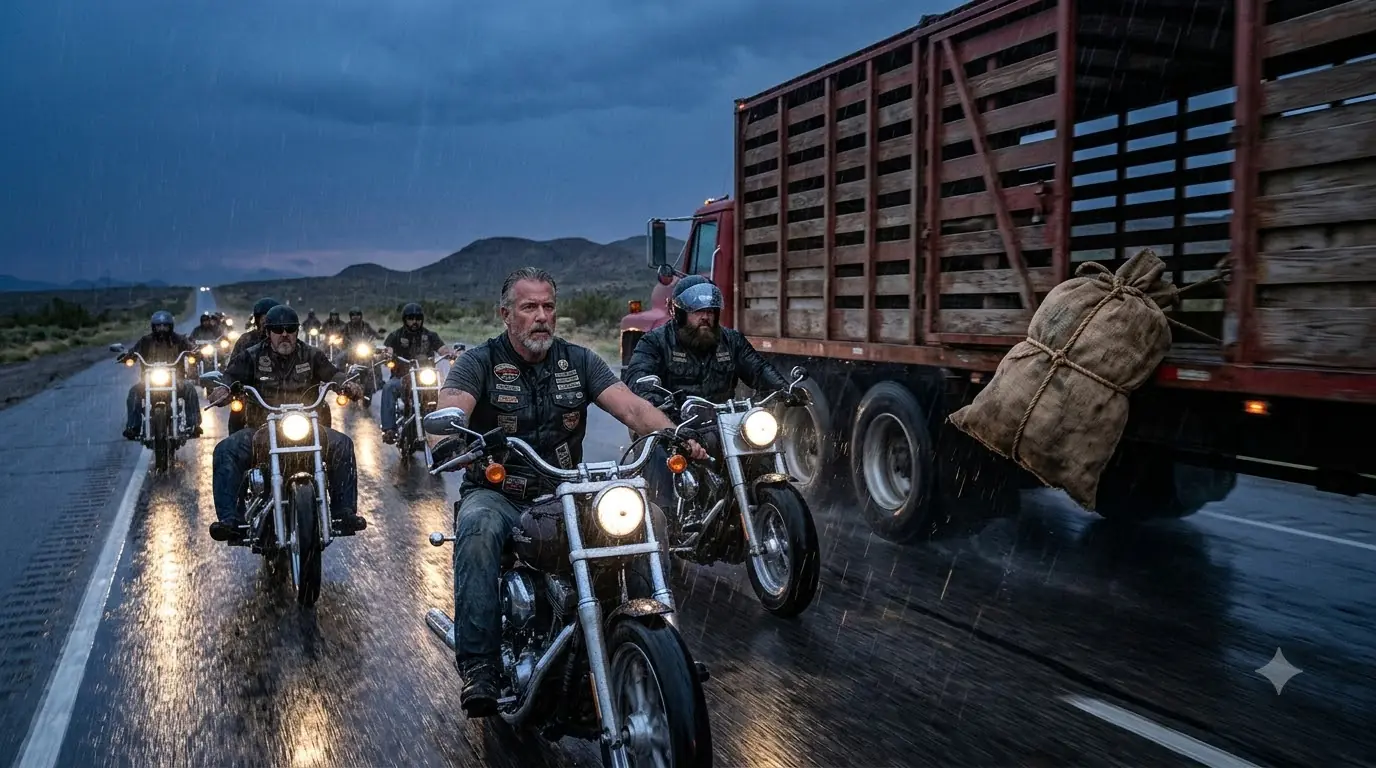
Motorcycles filled the width of Interstate 15.
To the drivers trapped behind them, it looked like a highway takeover.
A hundred people in dark leather had formed a wall across the desert interstate.
Motorists locked their doors.
A man in a silver sedan shouted through his window.
Another driver raised a phone and began recording.
Graham ignored them.
The sack moved again.
He parked near the center lane and dismounted.
The pavement burned through the soles of his boots.
Dutch stopped beside him.
“What do you think is in there?”
“I don’t know.”
The bag shuddered weakly.
Graham began walking faster.
Several riders positioned their motorcycles behind him, forming a protective barrier against the stopped traffic.
He knelt beside the sack.
The asphalt burned through his jeans immediately.
A dark red stain was spreading across the burlap.
Graham pulled a folding knife from his belt and cut the yellow rope.
The sack opened.
A tiny brown-and-white puppy lay at the bottom.
It could not have been more than eight weeks old.
Its ribs stood out beneath its skin. Black motor oil coated its back, ears, and face. A deep wound ran across one rear leg, and several paws had been burned by contact with the highway.
The puppy’s breathing came in shallow, uneven gasps.
Dutch removed his sunglasses.
“My God.”
Graham reached toward the animal.
The puppy flinched.
It did not bite or attempt to escape.
Instead, it curled its injured body more tightly around something beneath it.
Graham carefully lifted the puppy.
At the bottom of the sack lay a faded Army patrol cap.
Attached to the cap was a clear plastic pouch containing a Purple Heart medal and a folded sheet of notebook paper.
Even after being thrown onto the highway, the puppy had protected them with its body.
Graham removed the pouch.
The note inside had been written in blue crayon. The letters were uneven, and several strokes pressed so deeply into the paper that they had torn through it.
He unfolded the page.
Dutch crouched beside him.
Graham read the note silently.
His expression changed.
“What does it say?” Dutch asked.
Graham handed it to him.
Dutch began reading aloud.
“My daddy didn’t come home from the desert.
“This is Scout. Scout was my daddy’s best friend before he left.
“My mom’s new boyfriend gets angry when Scout cries at night. He kicks him and says he is useless.
“Today he said he was taking Scout away forever.
“I tried to hide him, but I am too small.
“If somebody finds him, please tell Scout he is a good boy.
“Please don’t let him think I stopped loving him.
“Noah, age nine.”
Dutch lowered the paper.
The horns behind the motorcycles continued, but they sounded far away now.
Graham looked at the puppy.
Scout’s eyes were barely open.
One small paw remained pressed against the dead soldier’s cap.
Graham had seen grown men abandon friends under less painful circumstances.
This dying animal had used its final strength to protect a medal and a child’s message.
Scout lifted his head.
His eyes met Graham’s for one brief second.
Then the puppy rested his chin against the biker’s forearm.
A line of blood crossed the Iron Mesa patch on Graham’s sleeve.
Graham removed his leather vest and wrapped the puppy inside.
“We need help immediately.”
Dutch looked toward the exit where the Chevrolet had disappeared.
“What about the men in the truck?”
“Send six riders.”
“To bring them back?”
“To observe only.”
Several club members looked disappointed.
Years earlier, the Iron Mesa Riders might have handled the situation differently. Many had criminal records, and some still believed justice was most effective when delivered without courts or attorneys.
Graham had spent too many years watching friends disappear into prison.
“Get the license plate,” he said. “Keep them in sight and call highway patrol. No contact.”
Dutch nodded.
“Who takes the puppy?”
“I do.”
“You can’t ride with him.”
“Get Earl’s support trailer.”
Earl “Doc” Ramsey traveled with the group on long rides.
He had served as an Army medic and later worked as a veterinary technician. Alcohol addiction eventually cost him his license and nearly his life.
The club helped him enter treatment.
In return, Doc became the person riders trusted with injuries, roadside emergencies, and animals no one else would help.
Dutch called the support vehicle.
Graham stayed kneeling on the highway with Scout held against his chest.
The puppy’s heartbeat was weak and irregular.
“Stay with me,” Graham whispered. “You held on this long.”
A California Highway Patrol cruiser arrived before the trailer.
Officer Leah Warren stepped out expecting a confrontation.
She saw motorcycles blocking every lane.
Then she saw the bloodstained sack.
Graham slowly stood with Scout wrapped in leather.
“What happened?” Warren asked.
Dutch pointed toward the exit.
“Gray Chevrolet threw him from the passenger window.”
“You sent riders after it?”
“To obtain the plate and location.”
“Are they confronting the occupants?”
“Not unless your people take too long.”
Warren looked at Graham.
“We will handle the truck.”
“Then handle it quickly.”
She moved closer and saw the puppy.
Her professional expression softened.
“He’s alive?”
“Barely.”
“The nearest emergency animal hospital is in Barstow.”
“Our medic is coming.”
Graham handed her the child’s note.
Warren read it once.
Then again.
Her jaw tightened.
“There is a child in that home.”
“Yes.”
“I’ll contact child protective services.”
“And local law enforcement.”
“I understand.”
Graham held her gaze.
“The boy may still be with whoever did this.”
“I said I understand.”
The enclosed support trailer arrived moments later.
Doc opened the rear doors before the vehicle completely stopped.
Inside, a stainless-steel table had been secured to the floor. Cabinets contained bandages, sterile fluids, antibiotics, oxygen equipment, and instruments for treating both people and animals.
Graham carried Scout inside.
Doc saw the puppy and swore under his breath.
“What happened?”
“Thrown from a moving truck.”
“Onto the interstate?”
“Yes.”
Doc pulled on gloves.
“Put him here.”
Scout released a weak sound when Graham placed him on the table.
“Stay close,” Doc said. “He’s holding onto you.”
As the highway patrol documented the sack and the tire marks, the riders gradually reopened the interstate.
Vehicles passed slowly.
Some drivers continued filming.
Others looked ashamed after seeing the tiny injured animal through the trailer’s open doors.
The man in the silver sedan lowered his phone.
The support vehicle moved toward a warehouse the club used outside Henderson.
Doc began working immediately.
He started an intravenous line and administered medication for shock. He used cool cloths to reduce Scout’s temperature without lowering it too quickly.
“The oil concerns me,” he said.
“How bad?”
“If he swallowed or inhaled enough, we may be dealing with lung or organ damage. The leg can probably be repaired. He’s badly dehydrated.”
“Will he survive?”
Doc paused.
“The next few hours will decide that.”
Graham sat on the floor beside the table.
Scout’s front paw moved weakly until it found his hand.
Graham left it there.
For the next two hours, nearly one hundred bikers waited in and around the warehouse.
Men who rarely remained quiet stood beneath the industrial lights without speaking.
Doc removed the motor oil from Scout’s fur.
He cleaned the torn leg.
Twenty-six small stitches closed the wound.
He treated the burns on the puppy’s paws and monitored his breathing for signs of internal injuries.
Graham never left.
At one point, Doc looked toward him.
“You should step outside.”
“No.”
“He may not make it.”
“Then he will not die alone.”
Doc returned to his work.
Near sunset, Scout’s heartbeat became steadier.
His breathing remained weak but regular.
Doc sat back and removed his gloves.
“He’s still critical.”
“But?”
“He has a chance.”
The news passed through the open warehouse door.
No one cheered.
The relief felt too fragile for noise.
Graham looked at Scout.
“You heard him. You have a chance.”
The puppy’s tail moved once against the blanket.
Forty miles away, the gray Chevrolet had stopped behind a run-down motel near Baker.
The six riders had followed it without approaching.
Dutch photographed the license plate, the strands of burlap caught in the truck bed, and the yellow rope lying beside the tailgate.
He called Officer Warren and provided the location.
Highway patrol officers and county deputies arrived thirty minutes later.
The truck was registered to a man named Russell Pike.
He occupied Room Eleven.
When officers knocked, Russell attempted to crawl out through the bathroom window.
He did not get far.
Inside the room, investigators found yellow rope, motor oil, and a child’s missing backpack.
Russell’s phone contained a message sent to his girlfriend, Emily Foster.
The dog is gone. Tell the boy it ran away.
Maybe now he’ll learn to quit whining and listen to me.
Russell denied throwing the animal onto the highway.
Then officers showed him recordings from passing vehicles.
His truck.
His cousin Raymond in the passenger seat.
The bag leaving the window.
Both men were arrested for animal cruelty, reckless endangerment, obstruction, and related offenses.
But catching the men was only part of the problem.
The note inside the sack meant a frightened child remained somewhere without his dog.
Child protective services reached a small Henderson house shortly after midnight.
Nine-year-old Noah Foster sat on the front porch when the caseworker arrived.
His mother had only recently returned from an evening shift at a restaurant.
Emily believed Russell had taken Scout to a ranch after claiming the dog had become aggressive.
Noah knew the truth.
He had seen the sack in the driveway.
While Russell and Raymond argued near the truck, Noah slipped his father’s military cap, Purple Heart, and note inside.
“I thought whoever found him would know he belonged to my dad,” Noah explained.
Emily covered her mouth.
“What medal?”
Noah pointed toward a photograph on the living-room shelf.
The man in the photograph wore an Army uniform.
Staff Sergeant Daniel Foster had been killed during an attack on a convoy two years earlier.
Before his final deployment, Daniel brought Scout home for Noah.
The puppy had not belonged to the military.
He was simply the final gift a father had chosen for his son.
After Daniel died, Scout slept beside Noah each night.
Whenever the child cried, the dog rested his head on Noah’s chest.
Russell hated the animal.
He complained about the food, the barking, and the way Scout placed himself between Russell and the boy whenever Russell raised his voice.
Emily had seen some of the tension but not the worst of it.
Russell behaved differently when she was present.
The investigator photographed bruises across Noah’s upper arm.
Emily’s face collapsed.
“I didn’t know.”
Noah looked down.
“I tried to tell you.”
“When?”
“When I said Scout was afraid of him.”
Emily closed her eyes.
She had interpreted it as a grieving child rejecting her new relationship.
She had been exhausted.
Working long shifts.
Trying to keep the rent paid.
Desperate to believe Russell’s confidence represented security.
None of that changed what Noah had experienced alone.
She knelt in front of him.
“I should have listened.”
“Is Scout dead?”
The caseworker had already spoken with Officer Warren.
“No. He was found.”
Noah lifted his head.
“Where?”
“Some people are helping him.”
“Can I see him?”
“When the doctor says it is safe.”
The boy began crying.
He did not scream.
He simply folded inward, as if he had spent days holding his breath and had finally been given permission to release it.
Emily held him.
That night, neither of them slept.
At the warehouse, Graham dozed in a chair beside Scout.
The following morning, he woke to a wet nose touching his fingers.
Scout’s eyes were open.
The puppy tried to lift his head.
Graham supported him.
“Take it easy.”
Doc approached carrying coffee.
“He survived the night.”
“You sound surprised.”
“I am.”
Scout attempted to stand.
His injured leg gave way immediately.
“The joint looks intact,” Doc said. “He may need surgery later, but he should walk again.”
“When can Noah see him?”
“Not today.”
“How long?”
“Two or three days, assuming there’s no infection.”
Graham nodded.
“Then he stays here.”
Videos of the highway blockade began spreading online.
Early recordings showed motorcycles across every lane and angry drivers trapped behind them. Several posts accused the Iron Mesa Riders of attacking motorists or staging a robbery.
Then Officer Warren released a statement explaining the rescue.
Public anger shifted.
People wanted to identify the men in the truck.
They offered money for Scout’s veterinary care.
They asked how to help Noah.
Graham declined interviews.
He also refused most donations.
“The treatment is covered,” he told the club treasurer.
“By who?”
“By us.”
The Iron Mesa Riders maintained a relief fund funded by charity rides and member contributions. It usually covered funeral expenses, emergency housing, and medical travel.
Graham authorized Scout’s treatment.
Then he reviewed the child protective services report.
Emily was behind on rent and would need time away from work to attend hearings and counseling appointments with her son.
“How much money is in the fund?” Graham asked.
“Enough for the dog.”
“That wasn’t my question.”
The treasurer gave him the total.
“Cover the family’s rent for six months.”
“That requires a club vote.”
“Call one tonight.”
The vote was unanimous.
Three days later, the riders prepared to return Scout home.
Doc fitted the puppy with a protective bandage and warned everyone against loud noises.
Graham looked toward the nearly one hundred motorcycles outside.
“That may be difficult.”
“Stop before you reach the house.”
The military cap, Purple Heart, and Noah’s note had been cleaned and sealed inside a waterproof pouch.
Scout traveled inside a padded carrier secured against Graham’s chest.
Officer Warren arranged to meet them at the Foster home.
The riders entered Henderson in pairs.
Residents heard the motorcycles before seeing them.
People came onto porches.
Curtains moved.
Children pressed their faces against windows.
The long line of black leather and chrome entered the residential street.
Two blocks from Noah’s house, Graham raised his fist.
The riders stopped.
Engines shut down one after another.
Graham walked the remaining distance with Scout.
Noah sat on the porch steps with his knees pulled against his chest.
Emily stood behind him.
When Noah noticed the carrier, he stopped breathing.
Graham opened it.
Scout’s head appeared.
“Scout?”
The puppy’s ears lifted.
“Scout!”
The sound changed the dog.
He began whining and struggling to leave the carrier.
Graham knelt and carefully placed him on the walkway.
His injured leg remained stiff, but he moved toward Noah as quickly as he could.
The boy dropped to his knees.
Scout climbed into his arms.
Noah buried his face against the dog’s neck and sobbed.
Scout licked his cheek.
Several riders turned away.
Dutch removed his sunglasses and wiped beneath one eye.
No one mentioned it.
Emily approached Graham.
“How did you find him?”
“We saw the sack thrown from a truck.”
Her face went pale.
“He was inside it?”
“Yes.”
She looked at Scout’s bandages.
“He’s going to recover,” Graham said.
Emily began crying.
“I let that man into our home.”
“You didn’t put Scout in the sack.”
“I failed to listen.”
Graham looked toward Noah.
“Then listen now.”
Emily nodded.
“I will.”
Graham removed the waterproof pouch from his vest.
He handed Noah the military cap, Purple Heart, and blue-crayon note.
“Scout kept these safe.”
Noah touched the medal.
“He did?”
“He wrapped himself around them.”
Graham crouched to the boy’s level.
“You wrote that your father was a hero.”
Noah nodded.
“You also wrote that Scout was a good boy.”
Another nod.
“You were right about both.”
Noah held the Purple Heart against his chest.
“Did Scout think I stopped loving him?”
“No.”
“How do you know?”
“Because he protected everything you gave him.”
Graham touched the folded note.
“He knew you wanted him found.”
Noah looked toward the motorcycles lining the road.
“Did all those people help him?”
“Yes.”
“Why?”
Graham could have answered in many ways.
Because the club believed loyalty meant never leaving the helpless behind.
Because many of those men had been abandoned themselves.
Because several had children.
Because sometimes the hardest-looking people needed permission to care about something vulnerable.
Instead, he chose the simplest truth.
“Because we saw him.”
“That’s all?”
“That’s where helping usually begins.”
Officer Warren handed Emily a folder containing Scout’s veterinary records, microchip information, and the assistance documents.
“The treatment has been paid,” she explained.
Emily stared at the papers.
“This is too much.”
Graham shook his head.
“No.”
“You don’t know us.”
“We know enough.”
Warren continued.
“Your rent has been covered for six months.”
Emily looked at Graham.
“You did what?”
“You need time.”
“I cannot accept charity.”
“Then don’t call it charity.”
“What should I call it?”
Graham glanced toward the riders.
“People helping because they can.”
Noah studied the desert-hawk emblem on Graham’s vest.
“Are you soldiers?”
“Some of us were.”
“Police officers?”
“No.”
“What are you now?”
Dutch spoke from behind Graham.
“Mostly difficult.”
Several riders laughed.
Noah smiled.
It was the first smile Emily had seen since Scout disappeared.
Graham stood.
“We should leave. The dog needs rest.”
Noah held Scout tightly.
“He can stay?”
“He belongs with you.”
Graham turned toward his motorcycle.
“Mr. Callahan?” Noah called.
Graham looked back.
“Thank you for stopping.”
He looked at the child, the wounded puppy, and the Purple Heart shining in Noah’s hand.
He remembered the traffic, the horns, and the risk of blocking the interstate before knowing what was inside the sack.
“Sometimes stopping is the most important thing a person can do.”
The Iron Mesa Riders returned to their motorcycles.
They started the engines gradually so the noise would not frighten Scout.
Noah and Emily waved as the riders left the street in pairs.
Over the following months, Scout attended physical therapy.
The injured leg healed with slight stiffness, but he eventually learned to run again.
Emily ended all contact with Russell and cooperated fully with prosecutors. Counseling helped Noah understand that none of what happened had been his fault.
Russell and Raymond eventually accepted plea agreements.
The highway recordings made denial impossible.
Animal-cruelty charges were combined with reckless-endangerment counts for throwing a living creature into active traffic. Russell also faced charges related to the abuse inside the home.
Graham attended the sentencing.
He sat quietly in the rear row.
Noah did not attend.
He was at a park with Scout.
One year after the rescue, the Iron Mesa Riders organized a charity event supporting children of fallen service members and local animal shelters.
Noah and Emily waited at the starting line.
Scout wore a red vest with two embroidered words:
GOOD BOY.
The Purple Heart rested at home inside a display case beside Daniel Foster’s photograph.
Before the engines started, Noah unfolded another note.
This one was not hidden inside a sack.
He read aloud.
“My dad told me heroes are people who go toward trouble when everyone else goes away.
“I thought heroes always wore uniforms.
“Then one day, almost one hundred bikers stopped an entire highway for my dog.
“They didn’t know Scout.
“They didn’t know me.
“They stopped anyway.
“My dad was right.”
The riders remained silent.
Graham stood beside the boy with one hand resting on Scout’s head.
Noah looked up.
“Did I read it okay?”
“You read it perfectly.”
He handed Graham the paper.
“This is for your clubhouse.”
Graham folded it carefully.
The note was later framed beside a piece of the yellow rope recovered from the highway.
Visitors often asked why a motorcycle club displayed a child’s handwriting among old riding photographs, memorial patches, and trophies.
Dutch always gave them the same answer.
“It reminds us why we stopped.”
Years passed.
Noah grew taller.
Scout’s muzzle turned gray.
Emily eventually became manager of the restaurant where she had once worked evening shifts. She volunteered with military families and spoke openly about recognizing emotional abuse before it became physical violence.
Graham continued leading the Iron Mesa Riders.
His beard became more silver than black.
He never forgot seeing the sack move between the lanes.
Sometimes, during long desert rides, he noticed discarded objects on the shoulder and felt his chest tighten before realizing they were only cardboard boxes or pieces of torn fabric.
The highway remained much the same.
Heat still distorted the horizon.
Drivers still moved aside when large groups of motorcycles approached.
People saw leather, tattoos, and club patches and formed immediate conclusions.
Graham did not entirely blame them.
Some reputations were deserved.
Some caution was sensible.
But people were rarely only the most frightening thing they appeared capable of becoming.
A hundred bikers could block a highway and resemble a threat.
Those same riders could be the only reason a puppy survived long enough to return to a grieving child.
On Scout’s tenth birthday, Noah brought him to the Iron Mesa clubhouse.
The old dog moved slowly now.
His damaged leg had developed arthritis, so Noah lifted him from the vehicle.
Graham sat beneath the shade of an awning.
Scout recognized him immediately.
The dog pulled gently against the leash, crossed the gravel, and placed his head on Graham’s knee.
Graham stroked the white fur around his face.
“You still remember me?”
Scout’s tail moved.
Noah sat beside them.
“He remembers everyone who helped him.”
“Dogs are better at that than people.”
Noah looked through the clubhouse window at the framed crayon note.
“I used to feel guilty.”
“For what?”
“For not stopping Russell.”
“You were nine.”
“I hid the medal, but I couldn’t protect Scout.”
Graham faced him.
“You did protect him.”
“How?”
“You wrote the note.”
“But you found him.”
“We knew where he belonged because you told us.”
Noah remained quiet.
“You were small,” Graham continued. “You used what you had.”
The young man rested one hand on Scout’s back.
“I’m studying veterinary medicine.”
Graham smiled.
“That makes sense.”
“I want to work with abused animals. Maybe emergency rescue.”
“Your father would be proud.”
Noah looked toward the desert beyond the clubhouse.
“I hope so.”
Graham touched the faded Army cap Noah had brought.
“He already was.”
That afternoon, the Iron Mesa Riders escorted Noah and Scout home.
They did not block an interstate.
They did not chase anyone.
They simply traveled slowly behind a young man carrying an old dog that had survived because strangers refused to pass by.
Drivers pulled aside to let them through.
Some recorded.
Others waved.
A little girl in the back seat of an SUV pressed her face to the window and lifted one hand.
Graham waved back.
Years earlier, a man had thrown a living creature onto a highway because he believed no one would stop.
He counted on speed.
Fear.
Indifference.
He assumed the world would keep moving and erase the evidence of his cruelty beneath tires and desert heat.
He was wrong.
Nearly one hundred motorcycles stopped.
Nearly one hundred riders stood between the sack and the traffic.
One former combat medic refused to surrender a weak heartbeat.
One officer followed the evidence instead of judging the people who delivered it.
One mother finally listened when her son told her the full truth.
And one injured puppy returned home carrying a fallen soldier’s medal and proof that a nine-year-old child had never stopped loving him.
Scout had been thrown away as though his life meant nothing.
Before the desert sun went down, an entire highway had learned otherwise.