It was April 12th, 1999, and Robert Hendricks was 61 years old when he made the decision that would define the next 23 years of his life. He was standing in front of a 1984 Case IH 1896 tractor in the back corner of Miller's equipment yard just outside of Rapid City, South Dakota. The paint was faded. The hydraulics leaked slow. The cab glass had a crack running corner to corner like a frozen river. The salesman had already walked away. 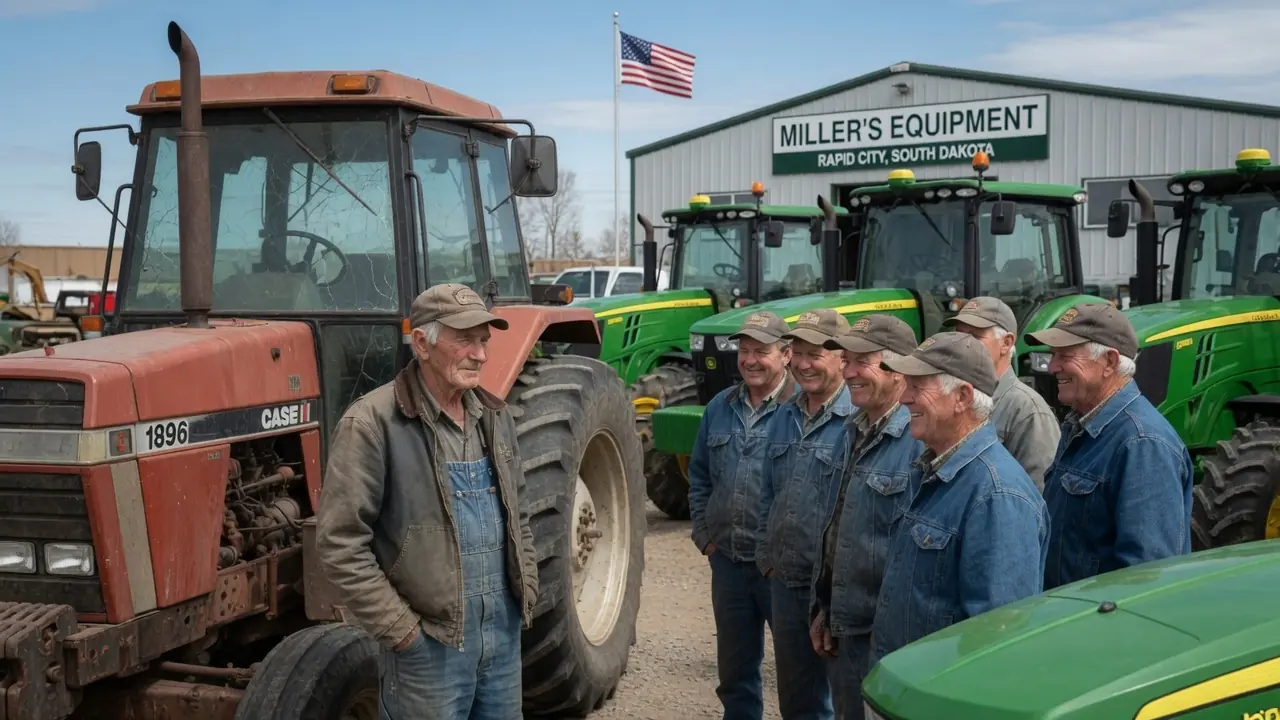
Robert had come to the lot that morning with a budget of $14,000 and the understanding that it would not be enough. All around him sat rows of new John Deere 7000 series tractors, quiet, computerized, clean lines, digital displays, financing plans printed on glossy paper. Everyone he knew was buying them. His neighbor to the east had traded in three old machines for one 7810. His brother-in-law had financed a 7710 with a five-year dealer service agreement.
Even the Miller family, known for running equipment into the ground, had gone green that spring. But Robert was looking at the Case IH. It had been sitting on the lot for 11 months. The dealer had dropped the price twice. No one wanted it. It was red in a green year. It was analog in a digital transition. It was a tractor you fixed yourself in a time when everyone was signing up to let someone else do the fixing.
Robert bought it for $11,200. He drove it home in third gear with the windows down because the air conditioning did not work. By the time he backed it into his shed, three people had already called his wife to ask if he was doing okay. Robert Hendricks had been farming since 1961. His father had run a small wheat and cattle operation on 480 acres south of the Cheyenne River, and Robert had taken it over in full by the time he was 26.
He had learned early that the margin between survival and failure in farming was thinner than most people understood, and that the difference often came down to what you could fix yourself and what you could not. He did not buy new equipment. He did not take loans unless the math was clear and the payment could survive two bad years in a row. He believed that a machine was a tool, not a symbol, and that the most expensive part of any tool was the part you could not reach with your own hands.
He talked about GPS guidance, variable rate planting, diagnostic computers that could tell you which cylinder was misfiring before you even heard the skip. He made it sound easy. And in a way, it was. You bought the tractor. You signed the service plan. When something went wrong, you called the dealer. A technician came out with a laptop and fixed it in your field. No grease. No guessing.
No three days spent pulling a transmission apart in your shed while the planting window closed. It was a new kind of deal. And for a lot of farmers, it felt like relief. Robert understood the appeal. He had spent enough nights lying awake doing math in his head to know what it cost in time and in worry to keep old equipment running. But he also understood what it cost to be dependent.
When you signed that service agreement, you were not just buying convenience. You were buying a relationship you could not end. The 1984 Case IH 1896 was not a complicated machine. It had a six-cylinder turbocharged diesel engine that made 160 horsepower on a good day and 140 when the turbo was tired. It had a 12-speed transmission with a mechanical shuttle shift that required two hands and a sense of timing.
The cab was basic, a seat, a heater that worked intermittently, and a single gauge cluster that told you RPM, oil pressure, and coolant temperature. There was no computer. No sensors. No diagnostic port. If something broke, you could see it, hear it, or smell it. And most of the time, you could fix it with hand tools and a parts catalog.
Robert had rebuilt the injector pump in 1996. He had replaced the clutch in 1998. He had welded a cracked loader mount and re-gasketed the rear axle housing and run three different sets of tires as he found deals at auctions. The tractor was not beautiful, but it was known. And in the spring of 1999, when everyone else was learning new systems, Robert went back to work with a machine he understood completely.
The comments started almost immediately. At the co-op in May, a man named Carl Dietrich asked Robert if he was planning to upgrade anytime soon. And when Robert said no, Carl nodded slowly and said, Well, I guess some of us like doing things the hard way. At a farm auction in June, Robert ran into his brother-in-law, Dennis, who was there to sell off his old equipment before his new John Deere arrived.
Dennis walked Robert past a 1991 Magnum that was going on the block and said, You should grab this one while you can. Pretty soon nobody's going to know how to work on these anymore. Robert did not bid. In August, at a meeting of the county soil conservation board, the John Deere service manager gave a presentation on the benefits of telematics and remote diagnostics.
Afterward, he walked up to Robert and said, You know, we could get you into a 7810 for less than you think. Trade-in value's still decent on those old cases if you move fast. Robert thanked him and left. By the end of that first year, the jokes had become routine. People called him old school. They called him stubborn.
One man, after a few drinks at a wedding, called him cheap. Robert did not argue. He just kept farming. The first breakdown came in the spring of 2001. Robert was running a disc harrow across a quarter section of winter wheat stubble when the hydraulic pump on the 1896 started whining. The sound was high and thin, like a bearing going dry, and within an hour, the loader would not lift and the three-point hitch had lost half its pressure.
He shut down in the field and pulled the pump that night by headlamp. The seals were blown and the housing was scored. He called three parts suppliers the next morning. The pump was discontinued. No one had new stock. The best he could find was a rebuilt unit out of Nebraska for $640 plus shipping, and it would not arrive for eight days.
Robert bought it. He installed it himself in his shop, bled the system, and was back in the field on day nine. Total cost, $712. Two weeks later, Dennis called to say his new John Deere had thrown a hydraulic fault code and wouldn't start. The dealer sent a tech out the same day. The issue was a sensor. It took 40 minutes to replace. Dennis paid nothing out of pocket.
But he also did not touch the machine. By 2003, the divide was clear. The farmers who had gone with John Deere were operating inside a system. Their equipment was clean, efficient, and increasingly complex. When something failed, they made a phone call. A technician arrived. The problem was solved. But the cost was accumulating in ways that were not always visible.
Service calls were frequent. Parts were expensive. And the equipment itself was designed in a way that made independent repair difficult or in some cases impossible. You could not just pull a module and bench test it. You could not bypass a failing sensor with a jumper wire. The machines were integrated, locked, proprietary.
If you were inside the dealer network, that was fine. But if you ever stepped outside, you were on your own in a way that was more final than it had ever been before. Robert saw it happening, but he did not speak about it much. He just kept running the 1896. The drought of 2006 changed the math for a lot of farms. It started in early June with hot winds and no rain.
And by the time August arrived, the topsoil was blowing across the fields in sheets. Wheat yields were down 40%. Hay was short. Cattle prices dropped as ranchers liquidated herds they could not feed. Robert lost money that year, but he survived it. Others did not. Three families in the county sold out.
Two more took on debt to cover operating costs and rolled it into their equipment loans. Dennis, who had been making payments on his 7710 since 1999, called the dealer in September to ask about extending his service agreement. He was told that extended terms were available, but the monthly payment would increase. He signed.
Robert, meanwhile, was nursing the 1896 through another season. The turbo had started smoking in July. The starter solenoid had failed in August. The air conditioning, which had never worked well, stopped working entirely. But the tractor ran. And because Robert owned it outright, because he could fix it with his own tools, and because it did not require software updates or dealer authorization to operate, it kept running.
The price of independence is vigilance. That is something Robert understood long before most people had to think about it. In 2008, the fuel injection pump began to drift. The tractor would start cold, run rough for 5 minutes, then smooth out. By mid-season, it was losing power under load. Robert pulled the pump in October and sent it to a specialist in Sioux Falls.
The return estimate was $900. Robert paid it. In 2010, the clutch started slipping again. He replaced it himself over a weekend using the same flywheel he had resurfaced in 1998. In 2012, the rear axle seals went out. He pulled both hubs, replaced the seals, and refilled the housing with 90 weight.
Every repair took time. Every part cost money. But every repair was something Robert controlled. And in a landscape where control was becoming rare, that mattered more than convenience. By 2015, the John Deere network had tightened. Software locks were now standard. Diagnostic tools were proprietary.
Repair manuals were no longer printed. If you wanted to fix your own tractor, you needed access to the dealer's computer system, and access was not freely given. Farmers began to notice. There were stories about machines that would not start because a sensor calibration had expired. Stories about error codes that could only be cleared by a dealer technician.
Stories about farmers who had purchased $10,000 parts and installed them correctly, only to discover the tractor would not recognize the part without dealer software authorization. The system worked as long as the dealer was there. But it was a different kind of farming than the one Robert had grown up in. Dennis called Robert in June of 2016.
He was frustrated. His 7710 had developed a DEF system fault, and the tractor had derated to half power. He had called the dealer. They were booked out 4 days. When the tech finally arrived, the fix took 20 minutes, but the service call cost $380. Dennis asked Robert how much he had spent on repairs that year. Robert said about 1,400 parts and fluids.
Dennis was quiet for a while. Then he said, I'm paying more than that every quarter, and I don't even own the damn thing yet. Robert did not say anything. There was nothing to say. The dealer closure happened fast. It was March of 2022, and the announcement came in the form of a letter. Miller's Equipment, which had served the Rapid City area since 1973, was shutting down.
The parent company had consolidated territories. Service would now be handled out of a regional hub 220 miles east. Parts could be ordered online. Technicians would be dispatched as availability allowed. The physical lot would close in 30 days. For the farmers who had built their operations around the assumption that the dealer would always be there, the news landed like a sinkhole.
Service calls that used to take a day now took a week. Parts that used to be on the shelf now took 2 weeks to ship. And the cost? The cost went up. Emergency calls were billed at a premium. Travel time was added to labor. The convenience that had justified the entire system was suddenly gone, but the dependency remained.
Robert heard about it from Dennis. They were standing in the co-op parking lot on a cold morning in April when Dennis told him the dealer had locked the gate. They just left, Dennis said. No transition. No local contact. Just a phone number and a website. Robert asked what he was going to do. Dennis shook his head. I don't know.
I've got a payment on a machine I can't fix and a service contract with a company that's not here anymore. Robert thought about that for a moment. Then he said, What happens when something breaks? Dennis looked at him. I call the number, and I wait. The first major test came 6 weeks later.
Dennis was planting corn when his 7710 threw a transmission fault code and stopped moving. He called the service line. They said a technician would be dispatched within 72 hours. It took 5 days. When the tech finally arrived, he diagnosed a failed solenoid pack in the transmission controller. The part was not in stock.
It had to be ordered from the regional warehouse. It arrived 9 days later. Total downtime, 2 weeks. By the time Dennis was back in the field, his planting window had closed, and the soil moisture was gone. He planted anyway, late and dry, and spent the rest of the season watching his neighbor's corn grow taller than his. Robert had finished planting 3 days after Dennis went down.
The 1896 had not stopped once. That summer, the jokes stopped. No one called Robert old school anymore. No one asked when he was going to upgrade. Because what had seemed like stubbornness in 1999 now looked like foresight, and what had seemed like independence now looked like survival. The farmers who had bought into the system were still inside it, but the system had changed.
The dealer was gone. The service was slow. The cost was higher. And the machines? The machines were more capable than ever, but only if they worked, and only if someone else agreed to fix them. By the fall of 2022, Robert had been running the same Case IH 1896 for 23 years. It had turned over 14,680 hours. The engine had been rebuilt once.
The transmission had been serviced six times. The cab was louder than it used to be, and the paint was worn down to primer in places. But the tractor still started on cold mornings and still pulled steady under load. It was not modern. It was not connected. It was not part of any network. But it was Robert's, completely.
And that meant something different now than it had in 1999. In November, Dennis sold his farm. He told Robert it was not just one thing. It was the debt. It was the weather. It was the late planting and the equipment payments and the service costs that kept climbing. But part of it, part of it was the feeling that he was farming inside a system he did not control, and that the system had started to fail him in ways he could not fix.
Robert helped him load equipment the day of the auction. The 7710 sold for less than Dennis owed on it. The alternative outcomes were never loud. There was no single moment when one path proved better than the other. But over 23 years, the distance between them had grown. The farmers who had bought new and signed service agreements had enjoyed years of cleaner, quieter, more efficient work.
They had not spent weekends in the shop. They had not waited on parts shipments. They had not nursed old equipment through droughts and breakdowns. But they had also built their operations on a foundation that required someone else to remain present, reliable, and affordable. And when that foundation shifted, they had no fallback.
Robert, on the other hand, had never stopped being his own fallback. Every repair he made was a skill he kept. Every part he sourced was a network he maintained. Every hour he spent in the shop was an investment in his own capacity to continue. It had cost him time. It had cost him money. But it had never cost him control.
By the spring of 2023, the regional service hub was struggling to keep up. Wait times for technician visits were running 3 weeks. Some farmers had begun trailering tractors 200 miles each way just to get a diagnostic scan. Others had begun looking for independent repair shops, but the equipment was so locked down that most shops could not do anything beyond basic maintenance.
A few had started searching online for software cracks and diagnostic workarounds, trading files and forums, and trying to reverse engineer the systems they had paid for but did not own. It was a strange kind of farming. High-tech and desperate at the same time. Robert kept working. In March, he replaced the alternator on the 1896.
In May, he rebuilt the hydraulic valve bank. In July, he pulled the radiator and had it recored after a crack developed in the upper tank. None of it was easy, but all of it was possible. And that was the difference. There is a lesson in this, though it is not a simple one. The choice Robert made in 1999 was not objectively right.
It was right for him in his situation, with his skills and his tolerance for risk. For another farmer, with different resources and different goals, the decision might have gone the other way and worked out fine. But what happened in 2022 revealed something that had been invisible in 1999. The new system was not just more efficient. It was more dependent.
And dependency has a cost that does not show up until the thing you depend on changes. The Case IH 1896 is still running. It sits in Robert's shed between planting and harvest, older now, slower, patched in a dozen places. It is not the tractor anyone would choose if they were starting over. But it is the tractor that kept running when the dealer locked the gate.
And in the end, that is what mattered. Robert is 77 now. He still farms, though he has cut back his acres. He still fixes his own equipment. And when people ask him about the decision he made in 1999, he does not say much. He just says he bought what he could afford to keep. And he kept it.