The smell of burned oil never washes out. It burrows into the creases of your palms and stays there until you die. Christian knew this. He also knew his garage was 3 weeks away from the bank chaining the doors shut forever. He didn't expect salvation.
He certainly didn't expect it to arrive bleeding oil on a chopped Harley Davidson wearing the winged death head of the Hells Angels. Sometimes the universe doesn't send an angel of mercy. It sends a thousand from hell. Christian dragged the shop broom across the cracked concrete. The bristles were stiff with years of absorbed grease sweeping up the same piles of Nevada dust that blew in under the warped bay doors every afternoon.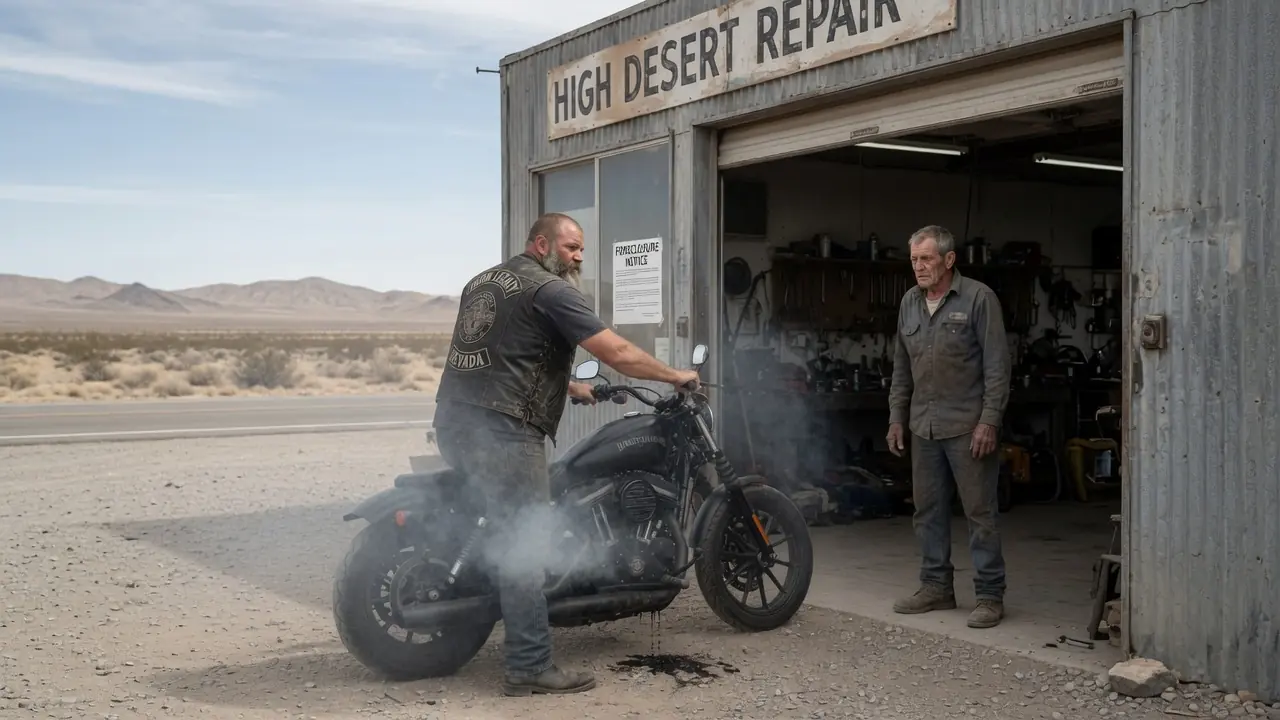
It was a pointless exercise. The shop was dying. Sweeping its floor felt like combing the hair of a corpse. His knees popped, a dry brittle sound, as he bent to scoop the dirt into a rusted dustpan. Christian was 68, but his skeleton felt a hundred.
The knuckles on his right hand were permanently swollen, a parting gift from a slipped wrench on a stubborn tie rod back in '98. He dumped the dirt into a plastic bin by the front office. Through the grimy glass of the office window, the foreclosure notice sat dead center on his cluttered desk printed on stark unforgiving legal paper. The bank wasn't calling anymore. They were done negotiating.
3 weeks. That was all the oxygen left in Artie's Automotive. Christian walked over to the coffee pot. It had been sitting on the warming plate for 6 hours. The liquid inside was dark and sludgy, and smelled like burnt pennies.
He poured a mug anyway, taking a sip. It coated his tongue in bitterness. He welcomed it. It matched his mood. Outside, the cicadas hummed their abrasive, rising drone.
The highway was a shimmering ribbon of asphalt baking under the 2:00 sun. Nobody stopped here anymore. The new interstate had bypassed this stretch of county road a decade ago, bleeding the town dry business by business. Christian was just the last one too stubborn or too tired to close his doors. Then he heard it, a sound cutting through the thick, heavy heat.
It wasn't the smooth, aerodynamic hum of a passing sedan. It was an uneven, violently loud clatter. A heavy V-twin engine tearing itself apart. Christian stepped out of the shadow of the bay. He squinted against the glare.
A motorcycle was limping down the shoulder, kicking up a trail of pale dust and gray smoke. The engine sounded like a handful of bolts rattling inside an empty coffee can. It was running dangerously lean, the cadence erratic. Pop. Hiss.
Crunch. The rider guided the dying machine off the asphalt and onto Christian's gravel lot. The bike coasted to a halt right in front of bay two. The engine gave one final, agonizing shudder, spat a jet of foul-smelling steam from the crankcase, and died. Silence slammed back down onto the lot, broken only by the sharp ping ping ping of the overheated metal cooling down.
Christian didn't move. He took in the rider. The man was massive. Shoulders like a storm door, clad in heavily worn dark leather. As the man swung a heavy, steel-toed boot over the saddle and stood up, Christian saw the back of the vest.
The red and pale rocker patches. The winged skull. Hells Angels, California. Christian's stomach gave a dull, involuntary twist. He wasn't a coward, but he wasn't stupid either.
You didn't survive 40 years on a lonely stretch of highway by inviting trouble into your shop. And trouble was currently taking off a scratched, matte charcoal helmet, revealing a shaved head, a thick salt and pepper beard, and eyes that looked like they hadn't slept since Thursday. The biker didn't say a word. He just stared at the engine. A pool of hot oil was already beginning to spread across the gravel beneath the primary drive.
Christian sighed, setting his coffee mug down on an empty oil drum. He wiped his greasy hands on his greasier jeans and walked over. He didn't offer a greeting. He didn't ask how the rider's day was going. He stopped 2 ft from the bike, crossed his arms, and looked down at the smoking metal.
The smell of vaporized oil and scorched gaskets stung his nostrils. A piston ring gave out. Christian said, his voice raspy from disuse. Crankcase pressure spiked and blew your base gasket straight to hell. Probably scored the cylinder wall, too.
The biker slowly turned his head to look at Christian. His eyes were flat, dead. You telling me you can't fix it? The voice was a low rumble, rougher than the gravel under their boots. I'm telling you it's a teardown.
Christian corrected, keeping his tone flat. He wasn't going to let this guy intimidate him in his own driveway. And I don't have parts for a 90-inch Evo just sitting on a shelf. "Make it work," the biker said. It wasn't a request.
"Roll it into the bay. " Christian muttered, turning his back. ""Before it permanently stains my driveway. Not that anyone would notice. "" The shop bay was ten degrees cooler than the outside air, but the stagnant humidity made it feel like a swamp. Christian directed the biker, who mumbled that his name was Dutch, to push the heavy Harley onto the center lift. Dutch kicked the kickstand down with a loud metallic clack. He didn't hover, but he didn't leave, either.
He dragged a torn vinyl chair from the corner of the shop, sat down, and pulled a pack of crushed Marlboros from his leather cut. He lit one, the sharp smell of sulfur and cheap tobacco mixing with the heavy scent of motor oil. Christian ignored him. He hated being watched while he worked, but he wasn't about to tell a Hells Angel to go wait by the vending machine. Instead, he let the familiar rhythm of the job take over.
He strapped the bike down to the lift and hit the air compressor. The sudden, violent rattling of the compressor shattered the quiet, making Dutch flinch ever so slightly. A micro-expression Christian caught in his peripheral vision, but chose to ignore. Christian rolled his tool cart over. He picked up a 3/8-inch drive ratchet.
The cold, knurled steel felt solid in his hand. It was the only thing in his life that still made sense. You turn a bolt left, it loosens. You turn it right, it tightens. Cause and effect.
No hidden clauses, no bank fees, no empty houses. He started tearing into the top end of the engine. The rocker boxes came off first. Hot oil dripped onto Christian's forearms, burning the gray hairs, but he didn't stop to wipe it off. He worked with a grim, practiced efficiency.
Hours passed. The sun began its slow dip behind the barren Nevada hills, casting long, bruised shadows across the shop floor. Christian wrestled the cylinder jug off the engine block. It fought him, sealed tight by heat and carbon build-up. He grabbed a rubber mallet and gave it three sharp, vicious whacks.
It broke loose with a heavy shuck. He carried the heavy piece of cast iron over to the workbench under the harsh, buzzing fluorescent light. Dutch stood up from his chair, his heavy boots scuffing the concrete, and walked over to look over Christian's shoulder. Well? Dutch asked, his voice thick with smoke.
Christian ran a calloused, grease-stained thumb inside the cylinder wall. He felt the deep groove cut into the metal. "Scored," Christian said. "Deep. Ring snapped, dragged right up the wall. " Dutch swore, a short, sharp expletive. ""Need it running tonight. "" Christian let out a dry, humorless laugh.
"Unless you've got a spare jug in your saddlebag, you're sleeping in a motel, Dutch. I have to hone this out, and I have to find a set of oversized rings that'll fit. Which means digging through my scrap bins. " Dutch stepped closer. The sheer mass of the man blocked out the light from the overhead bulbs. "I ain't sleeping in a motel.
I'm riding out tonight. Do what you have to do. " Christian felt a spike of anger push through his exhaustion. He dropped his rag onto the bench, turned around, and looked dead into the biker's chest. He was too short to look him in the eye without craning his neck. "Listen to me! " Christian snapped, surprised by his own venom.
I don't care what patch is on your back. I don't care who you are. Metal doesn't negotiate. You want this engine to run without blowing a hole through the crankcase 10 miles down the road, you sit back down and let me work. Or you can push this 600-pound paperweight back out onto the highway.
The silence that followed was suffocating. The only sound was the ticking of the cooling metal from the bike on the lift. Dutch stared down at the old mechanic. Christian's heart hammered against his ribs, a cold sweat breaking out on the back of his neck. Stupid, he thought.
You're an old broke man, and you just yelled at a killer. Dutch's jaw clenched. The muscles in his neck jumped. Then slowly, the tension bled out of his shoulders. He took a step back.
"Just get it done," Dutch muttered, turning and walking back to the torn vinyl chair. Christian let out a breath he didn't know he was holding. His hands were shaking slightly. He turned back to the workbench, picked up the cylinder hone, and chucked it into his power drill. The night dragged on.
Christian worked through the pain in his knuckles and the dull ache in his lower back. He found an old set of rings in a dusty cardboard box under a shelving unit. They weren't perfect, but with enough filing and a prayer to whatever God watched over broke mechanics, they'd seal. He soaked the abrasive stones of the hone in oil and ran them up and down the cylinder wall. The sharp screeching grind of stone on metal echoed through the empty shop.
The smell of aerosol solvent and raw fuel hung thick in the air, a toxic perfume that Christian breathed in like oxygen. By 3:00 a.m. the engine was back together. Christian wiped his face with a rag, leaving a streak of dark grease across his forehead. He tightened the final bolt on the exhaust flange. He stepped back, his back screaming in protest.
"Try it," Christian said. Dutch woke up from a doze in the chair. He walked over, swung his leg over the bike and turned the ignition. He hit the starter button. The starter whined, engaged, and the heavy V-twin roared to life.
It was deafening inside the enclosed bay. The exhaust blew a cloud of unburned hydrocarbons and dust toward the closed bay doors. But the rhythm was steady. The terrifying metallic clatter was gone. It sounded like an angry mechanical heartbeat.
Dutch killed the engine. The silence was ringing. He looked at Christian. "What do I owe you? " Christian looked at the clock. It was 3:45 a.m. He looked at his swollen bleeding hands.
He looked at the office where the foreclosure notice sat in the dark. He was too tired to calculate labor hours. He was too defeated to care. "Two hundred for the labor, fifty for the parts," Christian said, staring at the floor. It was a fraction of what a dealership would charge.
It was barely enough to cover the electricity he'd used tonight. Dutch reached into his leather cut, pulled out a thick roll of bills, and peeled off three crumpled hundred-dollar bills. He held them out. Christian took them. The paper felt damp with sweat.
I don't have 50 in change. Keep it. Dutch said. He kicked the bike into gear and rolled it toward the bay door. Christian hit the button to raise the aluminum door.
The cool night air rushed in smelling of sagebrush and desert sand. As Dutch rolled the bike out, he paused. He looked back into the dim shop, his eyes lingering on the small office window. From where he sat on the bike, the street lamp outside illuminated the desk. The foreclosure notice, with its bold red final warning stamp, was clearly visible.
Dutch stared at it for a long 5 seconds. Then he looked at Christian. He didn't say thank you. He didn't nod. He just dropped the bike into first gear, dumped the clutch, and tore out onto the highway, the red tail light shrinking into the darkness until it was swallowed by the night.
Christian stood in the bay door, the cool wind chilling the sweat on his shirt. He looked at the $300 in his hand. It was a drop of water in a burning house. He walked to the office, shoved the money into the drawer, and collapsed onto the ancient cot in the corner of the room. He didn't even take his boots off.
Christian woke up with a taste like battery acid in his mouth. His eyes cracked open, the sunlight stabbing through the grimy office window was blinding, vicious. Every joint in his body screamed as he pushed himself upright off the cot. The cot springs groaned in sympathy. He rubbed his face, his rough hands catching on a day's worth of gray stubble.
He glanced at the clock on the wall, 7:30 a.m. He had slept for less than 3 hours. The shop outside the office felt completely dead. The lingering smell of exhaust from Dutch's bike was gone, replaced by the familiar scent of old dust and hopelessness. Christian stood up, his right knee buckling slightly before catching his weight. He walked out into the bay.
The oil stain where the Harley had bled was still there, a dark, permanent scar on the concrete. He stared at it for a moment, feeling the crushing weight of reality settling back onto his shoulders. Last night was a distraction. Today was the end. He needed to start packing.
The bank hadn't explicitly said he needed to clear out today, but he knew the routine. Once the padlock went on the doors, whatever was inside belonged to them. He had 40 years of tools, parts, and memories to cram into the back of his beat-up Chevy truck. It was impossible. He shuffled toward the coffee maker to brew another batch of sludge.
Then he felt it. Before he heard anything, he felt a vibration in the soles of his boots. It was subtle at first. A faint rhythmic tremor coming through the cracked concrete foundation. He froze, the coffee filter dangling from his hand.
The tremor grew. Dust that had settled onto the steel beams of the roof began to shake loose, raining down in slow, microscopic clouds. Then came the sound. It started as a low, distant drone, like a hive of hornets waking up beneath the earth. Within seconds, it amplified into a heavy, localized thunder.
The air pressure in the shop seemed to change, pressing against Christian's eardrums. The small tools hanging on his pegboard began to rattle against the metal backing. Christian dropped the coffee filter. Panic spiked in his chest, cold and sharp. An earthquake?
No, it was too sustained, too mechanical. He limped toward the open bay door and stepped out into the morning glare. Down the highway, the horizon was vibrating. A heat mirage warped the asphalt, but through the distortion, Christian saw a dark tide rolling toward him. Motorcycles.
They were riding two abreast, an endless staggered formation stretching back as far as the eye could see. The noise was apocalyptic. A thousand high-compression engines firing simultaneously, drowning out the cicadas, the wind, and Christian's own racing thoughts. The lead bikes began to slow, downshifting with sharp, aggressive barks of exhaust. They were pulling into his lot.
Christian's heart slammed against his ribs. Terror, absolute and primitive, seized him. Had he messed up the engine? Had the bike locked up and killed the rider? Were they coming to burn the shop down in retaliation?
He backed up until his shoulder blades hit the cinder block wall of his garage. He grabbed a heavy two-foot crowbar that sat leaning against the doorframe. His knuckles went pale as he gripped the cold iron, his hands shaking so badly the tool vibrated. It was a pathetic defense, but he wasn't going to die on his knees. The bikes flooded the lot.
They parked on the gravel, on the dead grass, on the shoulder of the highway. red and cream patches flashed in the morning sun. Deadheads, rockers, nomads, Oakland, Vallejo, Nevada. The sheer physical mass of the men dismounting was overwhelming. The air grew thick with the smell of hot chrome, burning oil, and raw gasoline. The engines were cut one by one, rippling backward through the pack until an eerie, heavy silence descended on the lot.
The only sound was the ticking of a thousand cooling exhaust pipes. The crowd of men parted at the front. Walking through the center was Dutch. He looked exactly as he had the night before, exhausted, massive, and unreadable. But he wasn't wearing his helmet.
He stopped 10 ft from where Christian stood trembling against the wall. Christian swallowed hard, his throat dry as sandpaper. He tightened his grip on the crowbar. "If the engine blew," Christian yelled, his voice cracking, "I'll give you your money back. I told you it was a patch job. " Dutch stared at him.
He looked down at the crowbar in Christian's hands, then back up to his face. Dutch didn't reach for a weapon. He didn't signal the mob to attack. Instead, he reached into his pocket and pulled out a rolled-up piece of paper. He flicked it open.
Christian squinted. It was a copy of the foreclosure notice from his desk. Dutch held it up in the air. ""The bank says this place is rotting. "" Dutch's heavy voice boomed, carrying easily over the quiet crowd. He pointed a thick, calloused finger at the sagging, water-damaged roof of the garage. Then he pointed at the peeling paint, the broken windows, and the cracked asphalt.
Dutch turned back to Christian. ""We owe you a debt, old man. The machine you saved last night belonged to my brother. He died a week ago. That bike is his ashes. I was riding it to the coast to scatter him when the motor grenaded. " Christian's breath hitched.
He slowly lowered the crowbar. Dutch crushed the foreclosure notice in his fist. "The bank says this shop isn't worth saving. The bank doesn't know a damn thing about respect. "" Dutch turned to the sea of leather and denim behind him. He didn't shout.
He just nodded. The front row of Angels moved. Christian braced himself, still expecting violence. But as the men approached, he realized what they were carrying. They weren't holding chains or baseball bats.
They were holding hammers, crowbars, tool belts, stacks of two-by-fours pulled from custom trailers attached to the back of their bikes, rolls of roofing tar, buckets of exterior paint. One massive biker, his face scarred and tattooed, walked past Christian without a word, carrying two heavy sheets of plywood and headed straight for the rotting side wall of the shop. Another set up a gas-powered generator on the lawn. A group of four men climbed onto the roof, their heavy boots thumping against the sagging timber, and began ripping off the damaged shingles with terrifying efficiency. Dutch stepped closer to Christian.
He reached out and gently pushed the crowbar down until it touched the ground. "Make some coffee, Christian. " Dutch said quietly. ""We've got work to do. "" Christian retreated to the office. His hands shook as he scooped cheap pre-ground coffee into the plastic basket of the machine. He spilled half of it on the counter. He didn't bother wiping it up.
Outside, his world was being torn apart. It didn't sound like a rescue. It sounded like a demolition. The agonizing skirr and crackle of dry-rotted wood being ripped from the exterior walls echoed through the cinder blocks. Heavy impacts shook the floorboards beneath Christian's boots.
Dust drifted down from the acoustic ceiling tiles in the office, coating his desk, the phone, the foreclosure notice that Dutch had thrown back onto the linoleum. Christian watched through the grimy glass. The sheer volume of men in his lot was suffocating. They moved with a chaotic, aggressive energy. Yet, they weren't getting in each other's way.
A massive man with a thick red beard and a neck engulfed in a dark, sprawling tattoo of a serpent was operating a circular saw on the tailgate of a rusted pickup. The high-pitched scream of the blade biting into a sheet of 3/4-inch plywood set Christian's teeth on edge. The smell of vaporized pine sap and hot sawdust immediately flooded the open bay overpowering the permanent scent of 10W-30. Christian pressed his palms against the edge of his desk. He felt completely untethered.
For 40 years, he had been the sole dictator of this dying kingdom. He knew every crack in the concrete, every leak in the roof, every squeak of the bay door rollers. He had orchestrated the shop's slow, miserable decline in total isolation. Having a hundred men violently ripping away the decay felt invasive. It hurt.
That was the contradiction Christian couldn't quite swallow. He was watching his salvation, but it felt like watching strangers riffle through his dirty laundry. The coffee pot sputtered its final wheezing breath. Christian poured a mug, the dark liquid swirling with floating grounds, and stepped out of the office. He didn't know what to do with his hands.
He stood by the center lift, a ghost in his own machine shop. Two angels brushed past him carrying a massive steel I-beam. They smelled of stale sweat, leather, and cheap deodorant. They dropped the beam near the back wall with a deafening metallic clang that sent a shockwave up Christian's shins. A younger biker, maybe late 20s, with a fresh prospect rocker on his vest, was aggressively attacking the drywall near the bathroom with a crowbar.
He swung it like a baseball bat, burying the iron hook into the crumbling gypsum and ripping backwards. pale dust exploded into the air, settling on the kid's dark boots. Christian stepped forward. "Hey, hey. " The prospect didn't hear him over the din of the circular saws and the thud of hammers on the roof. Christian reached out, grabbing the kid's leather shoulder. The prospect spun around, his eyes wide, the crowbar raised instinctively.
Christian flinched, his own hands coming up in a pathetic defensive posture. The prospect blinked, lowering the iron bar. He wiped a streak of pale drywall dust across his forehead. "Yeah? What's up, pops? " "There's a live 220-V line running right behind that stud. " Christian rasped, pointing a shaky finger at the ragged hole in the wall.
"Go swinging blind in there, you're going to cook yourself from the inside out. " The kid looked at the wall, then back at Christian. The bravado melted off his face, replaced by a sudden, very young realization of his own mortality. "Right. Thanks. " He turned back to the wall, this time using his hands to carefully pull the chunks of plaster away, exposing the thick dark sheathing of the electrical wire, exactly where Christian said it would be. "Don't hover, Christian. " Christian jumped.
Dutch had appeared beside him. The massive biker was holding a sledgehammer in one hand, resting the heavy steel head on the floor. "I'm not hovering. " Christian said defensively, clutching his coffee mug to his chest. ""It's my shop. "" "It was a coffin. " Dutch corrected, his voice a low, gravelly rumble that barely carried over the noise. ""We're turning it back into a shop. Go sit down. " "I can't just sit here. " Christian's voice cracked. He hated how weak he sounded.
"I work here. Let me do something. " Dutch stared down at him. The flat, dead eyes from the night before held a different weight in the daylight. They were tired, profoundly tired, but they weren't empty. Dutch looked around the bay.
He pointed his chin toward a massive, grease-caked engine block sitting on a wooden pallet in the corner. It belonged to an old Chevy C10 that Christian hadn't had the strength or the funds to rebuild for 3 years. "Clean the block," Dutch said. "Get it ready for machining. We'll handle the walls. " Christian looked at the rusted hunk of iron.
It was a familiar, manageable problem. He nodded slowly. He set his coffee down, grabbed a wire brush, and a can of heavy-duty degreaser, and went to his corner. As he began to scrub the thick layer of oxidized oil off the cast iron, the rhythmic scraping sound of bristles on metal grounded him. He wasn't useless.
He was just part of a much larger crew today. By 1:00 in the afternoon, the temperature inside the shop had spiked to 95°. The air was thick, choked with the smell of wet concrete, roofing tar, and the metallic tang of sweat. The front of Artie's Automotive was unrecognizable. The sagging, waterlogged fascia had been stripped bare.
A crew of six men on scaffolding were currently hammering up fresh, pressure-treated lumber. The rhythmic thwack, thwack, thwack of their framing hammers was a relentless heartbeat. Christian stood by his workbench, his forearms dark with grease, wiping down a freshly cleaned piston. He paused, rubbing the sweat from his eyes with the back of a relatively clean wrist. Through the open bay doors, he saw the dust cloud kicking up off the highway before he saw the car.
It was a light-colored Ford Taurus, moving slow, hesitant. It pulled onto the gravel lot, its tires crunching loudly. It looked completely out of place, a sterile plastic toy adrift in a sea of heavy American iron and dark leather. The car stopped near the edge of the property line. Christian's stomach dropped.
He knew that car. He knew the cheap gray suit of the man sitting behind the wheel. It was Miller, the field agent for the regional bank holding Christian's mortgage. Miller stepped out of the car. He clutched a leather folio to his chest like a ballistic shield.
He stood by his open car door, staring at the swarm of heavily tattooed, heavily armed men crawling over the property. He looked like a man who had walked into the wrong room and found a pack of wolves eating a carcass. The noise on the lot began to die down. It wasn't instantaneous. It was a slow, rippling effect.
The circular saws whined to a halt. The hammers stopped falling. The men on the roof lowered their nail guns. Hundreds of heads turned, slowly, toward the light-colored Ford Taurus. The silence that fell over the sun-baked lot was heavier and far more terrifying than the noise of construction.
Christian dropped his rag. He started walking toward the front of the shop. This was his mess. He couldn't let these guys catch a felony over his bad debts. Before Christian could clear the bay doors, Dutch stepped out of the shadow of a parked Harley.
Dutch walked slowly across the gravel. His heavy boots crunched loudly in the quiet. Three other angels fell into step behind him. They didn't hurry. They moved with the terrifying unbothered confidence of apex predators.
Miller took a half step backward, bumping into the frame of his car. His knuckles were pale around his folio. Sweat was visibly pouring down his pale face, soaking the collar of his dress shirt. Dutch stopped 5 ft from the man. He didn't say anything.
He just looked down at him. I uh Miller stammered. His voice was shrill, completely lacking oxygen. He cleared his throat and tried again, trying to sound authoritative. I'm looking for Christian Vance.
I represent the bank. This property is currently in pre-foreclosure. Dutch pulled a crushed pack of Marlboros from his vest. He took his time tapping a cigarette out, placing it between his lips, and lighting it with a battered Zippo. The sharp clink of the lighter echoed across the lot.
He inhaled deeply, the cherry flaring bright orange, and blew a thick plume of gray smoke directly over Miller's head. Christian's busy. Dutch rumbled. This is an unauthorized work site. Miller said, his voice trembling so badly the words vibrated.
He gestured weakly towards the half-finished roof. You can't make structural changes to a collateral asset without bank approval. It's a breach of contract. I'm going to have to call the sheriff. Dutch took another slow drag of his cigarette.
He looked back at the shop, then down at Miller. You call the sheriff. Dutch said, his voice dropping a full octave, scraping against the dirt. And he's going to drive out here, and he's going to see a hundred citizens doing pro bono repair work for a struggling local business, putting a new roof on your collateral asset, pouring a new concrete apron, replacing the rotted drywall, increasing the property value of this dirt patch by about 50%. Dutch leaned in.
The smell of tobacco, sweat, and old blood rolled off him. Miller shrank back, pressing himself flat against the window of his Taurus. Now, Dutch continued softly, you can go back to your air-conditioned office and tell your boss you secured an upgrade on the property. Or you can stand here and try to hand a piece of paper to a man who is currently under my protection. Dutch didn't threaten to kill him.
He didn't raise his voice. He didn't have to. The unsaid words hung in the oppressive heat, backed by the silent, staring presence of a thousand men in leather. You are breathing because we are allowing it. Miller looked at Dutch's eyes, then at the patches on his vest.
He looked at the three massive men standing behind him. Their arms crossed, their faces completely void of expression. Miller swallowed hard. His Adam's apple bobbed. I I will note in my file that property improvements are underway.
He squeaked. He didn't wait for a response. He threw himself into the driver's seat, slammed the door, and jammed the car into reverse. The Taurus fishtailed slightly in the loose gravel, kicking up a cloud of dust as it desperately accelerated back onto the highway, the engine whining in protest. Christian let out a breath he hadn't realized he was holding.
His knees felt weak. He braced himself against the aluminum track of the bay door. Dutch stood watching the car disappear down the shimmering asphalt. He took one last drag of his cigarette, flicked the butt into the dirt, and crushed it beneath his steel toe. He turned around and looked at the men.
He didn't smile. He just nodded once. Instantly, the spell broke. The circular saws screamed back to life. The hammers began to fall.
The heavy rhythmic thud of construction resumed, drowning out the cicadas and the hum of the distant highway. Dutch walked back towards the shop. As he passed Christian, he didn't stop. Back to the engine block, Christian. Dutch muttered.
"Sun's burning daylight. " Christian looked at the massive man's back as he walked away. For the first time in 10 years, Christian felt a strange, tight sensation in his chest. It took him a moment to recognize it. It was safety. He went back to the corner of the shop, picked up his wire brush, and began to scrub the iron.
The violent noise of his rescue washed over him. The sun finally collapsed behind the Nevada ridges, dragging the brutal heat down with it. In its place came the desert chill, sharp and immediate. The work didn't stop. It just changed pitch.
As dusk settled, the screech of circular saws gave way to the steady, rhythmic thud of nail guns and the crackle of welding torches. Portable halogen work lights were dragged out of custom trailers and fired up, casting harsh, blinding beams against the newly framed walls. Shadows stretched long and jagged across the gravel, making the mob of bikers look like an army of giants moving through the dust. Christian's hands were cramping. He had spent 4 hours scrubbing, degreasing, and prepping the old Chevy engine block.
His knuckles throbbed with a dull, familiar ache. But he didn't stop. He couldn't. If he stopped, he would have to look around and acknowledge the sheer scale of the charity being forced upon him. He hated it.
That was the ugly, uncomfortable truth festering in his gut beneath the overwhelming relief. For 40 years, Christian Vance paid his own debts. He fixed his own leaks. He swallowed his own failures. Now he was a spectator in his own life, watching a gang of outlaws scrape the rot off his legacy.
It made him feel small. It made him feel useless. The sharp smell of lighter fluid cut through the scent of wet paint and ozone. Out by the edge of the highway, three men had taken a rusted 55-gallon steel drum, cut it in half lengthwise with an angle grinder, and filled it with charcoal. Flames licked up into the dark sky.
A massive cooler, big enough to hold a human body, was dragged off the back of a flatbed truck and dropped onto the dirt with a heavy thud. A biker named Smitty walked over to Christian's corner. Smitty was older than the rest, maybe late 50s, with a pronounced limp and a gray beard braided into two thick strands. He didn't wear a helmet. A faded bandana was tied tight across his skull.
Smitty held out a paper plate. It was bending in the middle under the weight of three charred hot dogs, a mound of generic potato chips, and a scoop of baked beans that was already bleeding through the thin cardboard. In his other hand, he held a sweating can of Coors Banquet. "Eat," Smitty said. It wasn't an offer.
Christian set his wire brush down. He wiped his greasy hands on his jeans, leaving dark smears across the denim. He took the plate. The heat of the beans seeped through the cardboard, burning his calloused palm. "Thanks. " Christian muttered, avoiding Smitty's eyes.
Smitty didn't leave. He leaned against the heavy iron of the center lift, popping the tab on his own beer. The crisp hiss crack sounded violently loud in the enclosed bay. Smitty took a long swallow, wiping his mouth with the back of his leather gloved hand. "You're fighting it. " Smitty observed, his voice raspy, like boots on gravel.
Christian took a bite of a hot dog. The casing snapped against his teeth. It tasted like ash and cheap meat, but his stomach cramped violently at the first sign of food. He hadn't eaten since yesterday morning. He swallowed it down, washing it back with a pull of the cold, metallic tasting beer.
"I don't know what you're talking about. " Christian said defensively. "Yeah, you do. " Smitty pointed the aluminum can at Christian's chest. "You're standing here scrubbing a dead block, pretending you're not drowning in guilt. You think taking a hand up makes you less of a man. " Christian's jaw tightened. "I didn't ask for any of this. " ""Nobody asks for salvation, old man.
It just shows up, usually looking like hell. "" Smitty chuckled, a dry rattling sound in his chest. "When my wife died 10 years ago, I locked myself in my garage. Drank antifreeze. Tried to, anyway. Dutch kicked the door off the hinges, dragged me out by my hair, and made me rebuild the transmission on his Shovelhead while my stomach was still getting pumped.
I hated him for it. I wanted to bleed out in peace. " Smitty looked around the brightly lit bay. The framing was done. The new electrical wire was being stapled to the fresh studs. The place smelled like pine and possibility.
"You don't get to choose who saves your life, Christian. " Smitty said quietly. ""You just say thank you. And you make sure the next time a broken machine rolls into your shop, you fix it. " Smitty pushed off the lift, his bad leg dragging slightly on the concrete, and walked back out into the cold night air. Christian stood alone in the corner. He looked down at the plate of cheap food. His eyes stung, a hot, sharp pressure building behind his tear ducts.
He blinked hard, furious at himself, and took another bite. By 11:00 p.m., the exhaustion in the camp was palpable. The frenetic energy of the afternoon had settled into a grim, mechanical endurance. The men worked slower, their movements heavy and deliberate. The booming laughter and shouting had faded into terse grunts and the sharp clatter of tools dropping on concrete.
Christian was finishing off his beer when a loud, sustained hiss erupted from the back of the shop. It wasn't the quick burst of an air tool. It was a massive, violent leak, loud enough to drown out the generator humming outside. Christian dropped his plate on the workbench and hurried towards the noise. In the utility closet at the rear of bay three sat the shop's air compressor.
It was an 80-gallon, two-stage, cast-iron beast from the 1970s. It was the lungs of the garage. Without it, the pneumatic lifts wouldn't rise, the impact wrenches wouldn't spin, and the shop was completely dead. A young, massively built biker named Caleb was standing over the compressor, coughing through a cloud of vaporized rust and condensation. Caleb was holding a massive pipe wrench, his face flushed dark red with anger.
The main brass manifold connecting the regulator to the tank had cracked. High-pressure air was screaming out of the fracture, blasting Caleb in the face. "Shut it off. " Christian yelled over the roar of the escaping air. Caleb slammed his hand against the red kill switch. The motor shuddered and died, but the 80 gallons of compressed air inside the tank continued to violently vent through the cracked brass.
Caleb swore, throwing the heavy pipe wrench onto the concrete. It bounced with a loud clang. "Damn thing is seized. " Caleb shouted, backing away from the hissing machine. "I tried to back the regulator off to run the new copper lines, and the fitting snapped. "It's rusted solid into the cast iron. " Several other bikers gathered around the utility closet, drawn by the noise. " Dutch pushed his way to the front of the crowd.
He looked at the cracked fitting, then at Caleb. "Can you extract it? " Dutch asked, his voice low. Caleb shook his head, wiping a mix of sweat and rusty water from his forehead. "No. The brass is too soft. The tank threads are iron, and they've been mating for 30 years.
I put an easy-out extractor in there, it'll just strip the brass and leave us with a plugged hole. We need a new tank. " "We don't have a new tank. " Dutch stated flatly. He looked at his watch. "And no supply house is open until Monday. " The silence that followed was heavy. The air slowly bled out of the compressor, a dying hiss that sounded entirely too much like defeat.
If they couldn't get the air system running, the rest of the renovation, the pneumatic painting, the lift repairs, came to a dead halt. Christian pushed past a heavily tattooed prospect. "Move. " He stepped into the cramped utility closet. The air smelled of stale water and oxidized metal. He ran his bare thumb over the cracked brass manifold.
Caleb was right. The brass was ancient, brittle, and fused entirely to the iron tank collar by decades of moisture and heat cycles. "I told you, Pops. " Caleb said, his voice tight with frustration. "It's fused. You could torque on that, the brass is going to shear off flush with the tank.
Then we're really screwed. " Christian ignored him. He didn't look at Caleb, and he didn't look at Dutch. For the first time all day, Christian was entirely in his element. This wasn't charity. This was an engine bay.
This was physics. "Go to my bottom drawer. " Christian said, his voice calm, steady, and carrying an absolute authority that made Caleb blink. ""Grab the MAPP gas torch, then go to the chemical cabinet and get the paraffin wax. " Caleb hesitated. He looked at Dutch. Dutch gave a microscopic nod. 30 seconds later, Caleb handed Christian the yellow cylinder of MAPP gas and a thick block of pale canning wax.
The crowd of bikers leaned in, silent, watching the old man. Christian sparked the torch. The blue flame roared to life, casting harsh, dancing shadows against the cinder block walls. He didn't aim the flame at the brass fitting. He aimed it at the cast iron collar of the tank surrounding the brass.
"Heat expands. " Christian muttered, mostly to himself. "If you heat the brass, it swells tighter into the hole. You heat the iron ring around it, the hole gets bigger. " He held the torch steady. 1 minute, 2 minutes. The sweat poured down Christian's face, stinging his eyes, but his hands, usually trembling with arthritis, were dead still.
The cast iron began to change color, taking on a dull, angry, grayish-blue hue. Christian killed the torch. He immediately grabbed the block of paraffin wax and pressed it directly against the seam where the hot iron met the old brass. The wax melted instantly upon contact, smoking violently. "Capillary action," Christian explained, his voice flat.
"The heat sucks the liquid wax down into the microscopic threads. Best lubricant in the world. " He dropped the remaining wax, picked up a breaker bar, and fit a six-point socket over the ruined brass fitting. He didn't yank it. He didn't use sudden, aggressive force like Caleb had. Christian gripped the steel handle.
He closed his eyes. He leaned his body weight into the bar, applying a slow, steady, relentless pressure. For three agonizing seconds, nothing happened. The silence in the shop was absolute. Then a sharp crack echoed like a gunshot.
Several bikers flinched. Caleb let out a breath. Christian didn't stop. He kept the pressure even. The wrench moved a quarter inch, then a half inch.
With the dry, screeching groan of protesting metal, the broken brass fitting slowly threaded out of the iron tank. Christian backed it all the way out by hand. The threads on the tank were perfectly intact, gleaming wetly with melted wax. He tossed the ruined brass piece onto the floor. It rolled and stopped at Caleb's boots.
Christian wiped his hands on a rag and looked up. The ring of heavily armed, terrifying men were staring at him in complete silence. Caleb looked down at the brass fitting, then up at Christian. The young biker slowly nodded. "I'll be damned," Caleb whispered.
Dutch stepped forward. He didn't smile, but the hard lines around his eyes softened just a fraction. He looked at the perfectly preserved threads on the tank. Caleb, Dutch said, not taking his eyes off Christian. Go plumb the new lines.
Hand tighten the first three threads. Dutch turned his gaze fully onto Christian. The towering Hells Angel extended a massive, grease-stained hand. Christian looked at it for a moment. Then he reached out and gripped it.
Dutch's hand was like a vice, but Christian squeezed back with everything he had left in his old bones. "You run a good shop, Christian," Dutch said quietly. Christian felt the tight knot of shame in his chest finally loosen, breaking apart like rusted iron under a steady flame. "Yeah," Christian replied, his voice thick. "I do. " The second dawn broke ugly.
The sky over the Nevada ridges didn't transition through a beautiful spectrum of pinks and oranges. It just bled from deep darkness into a bruised pale gray. The temperature plummeted in the hour before sunrise, leaving a thin film of condensation on the chrome pipes of a thousand parked motorcycles. Inside the shop, the air was entirely breathable for the first time in a decade. The heavy, suffocating odor of stale oil and despair had been forcibly evicted, replaced by the sharp, chemical bite of fresh primer and the earthy, wetstone smell of curing concrete.
Christian's body was running on pure toxic adrenaline. He hadn't slept. His joints felt like they were filled with crushed glass, and his right hand was locked in a permanent claw-like ache. But, he wasn't standing in the corner anymore. He was in the center of the bay directing traffic.
Once the air compressor was functional, the dynamic of the shop shifted. The Angels had the brute strength and the numbers, but Christian had the technical map of the garage burned into his brain. He barked orders over the hiss of pneumatic nailers. He showed Caleb how to route the new copper airlines so they wouldn't collect condensation. He stopped a heavily tattooed Nomad from painting over the emergency shutoff valves.
He stopped feeling like a trespasser. This was his house, and for the first time in years, he was actually maintaining it. At 6:30 a.m., a low mechanical grinding sound rumbled down the highway. Christian stepped out of the bay to look. A massive 10-yard concrete mixer truck was backing onto the gravel lot.
Dutch walked over to the driver's side window, handed the driver a thick stack of cash, and pointed toward the front of the shop where the old cracked asphalt apron had been torn out by a rented skid steer during the night. Christian watched as a crew of bikers in heavy boots waded into the wet gray slurry pouring down the truck's chute. They dragged it flat with two-by-fours, their leather cuts dusted in a fine mist of Portland cement. It was brutal, backbreaking labor. Dutch stood a few feet away from Christian watching his men work the concrete.
His eyes were bloodshot, the skin under them purple and bruised from exhaustion. He pulled his last cigarette from a crushed pack, lit it, and let the smoke drift out of his mouth. "My brother hated concrete. " Dutch said suddenly. Christian turned his head. It was the longest unprompted sentence the biker had spoken to him.
"Said it was too permanent. " Dutch continued, his voice rough and devoid of inflection. He stared at the men smoothing the wet gray slab. "He liked engines, metal, things you could tear apart and rebuild when they went bad. You pour concrete wrong, you're stuck with it. You have to break it with a sledge to fix it. " Christian looked down at his own grease-stained boots.
"He was a mechanic. He was an artist. " Dutch corrected quietly. "He could tune a carburetor by ear. He built the Evo I was riding. Screamed at me every time I rode it hard.
Told me I was treating his masterpiece like a rented mule. " Dutch took a slow drag. The cherry of the cigarette glowed dull orange in the morning shadow. "A drunk kid in a stolen pickup crossed the center line on highway 99. " Dutch said. The words were flat, completely stripped of emotion, which made them infinitely heavier. "Hit him head-on.
Bike was completely untouched. He got thrown 80 ft. " Christian didn't say, "I'm sorry. " Men like Dutch didn't want apologies from strangers. They just wanted the facts acknowledged. Christian nodded slowly, keeping his eyes on the wet cement. Dutch reached into his leather vest.
He pulled out a small heavy steel flask. It was battered, the metal scraped and dented. He unscrewed the cap. He didn't drink from it. He stepped forward out of the shadow of the roofline and walked towards the wet concrete.
The bikers working the screed board stopped. They stood up, wiping sweat from their foreheads, and stepped back. A heavy, absolute silence fell over the front of the shop. The idling rumble of the cement truck was the only sound. Dutch walked to the center of the fresh, wet apron.
He tipped the flask downward. A stream of fine, pale gray ash poured out, hitting the wet concrete. The morning breeze caught a fraction of it, swirling it into the air, but the bulk of it settled into the wet cement. Dutch tapped the flask against his palm, emptying the last of it. He screwed the cap back on and shoved it into his pocket.
He looked at the bikers holding the two-by-fours. "Trowel it in," Dutch ordered. The men stepped back into the slurry. They dragged the magnesium floats over the wet surface, working the ashes deep into the foundation of Artie's Automotive. Christian felt a sudden, heavy lump in his throat.
He swallowed hard. The contradiction of the moment struck him with physical force. These men were violent, dangerous, and lawless, but they were anchoring their grief into his dying shop, giving it a permanent foundation. They weren't just fixing his roof. They were burying their dead.
Dutch walked back to Christian. He didn't look at the wet concrete again. "The bank won't tear this down now," Dutch muttered. "And if they try, you call me. " "They won't," Christian said. His voice was raspy, but it didn't shake.
I own the land. The property value just tripled. I can refinance the debt by Friday. Dutch looked at the old mechanic. The hard, dead look in his eyes had retreated, replaced by a hollow kind of peace.
He nodded once. "Good. " By noon, the sun was a blazing-hot hammer beating down on the Nevada asphalt, but the heat no longer felt oppressive. It just felt like a Tuesday. The transformation was violent and complete. The rotting water-stained wood of the exterior was gone, replaced by fresh lumber painted a stark, clean cream.
The sagging roof lines were straight, capped with thick, dark shingles that soaked up the sun. The bay doors had been pulled off their tracks, the rusted rollers replaced, the aluminum sanded and sprayed matte charcoal. Inside, the pegboards were organized. The floor had been hit with a high-pressure power washer and industrial degreaser. The 40-year-old oil stains were still there.
Some scars never fade, but the grime was gone. It looked like a place where things were fixed, not where things went to die. The angels didn't linger to admire their work. There was no grand ceremony. As soon as the final tools were wiped down and thrown into the custom trailers, the atmosphere shifted from construction site back to motorcycle club.
Christian stood by the front office. He watched as the men packed up. There was a rough, aggressive efficiency to their movements. Heavy zippers being pulled up, straps being tightened over saddlebags, the sharp, metallic clatter of kickstands being kicked up off the gravel. Smitty limped past Christian carrying an empty cooler.
He paused, dropping it into the bed of a chase truck. "Drink some water, old man. " Smitty rasped, adjusting the bandana on his head. "You look like a dried-out sponge. " "I'll live. " Christian said. Smitty chuckled, a dry sound. "Yeah, you will. " He turned and walked toward his bike.
Engines began to fire. It didn't happen all at once. It was a staggered, rolling thunder. One heavy V-twin barked to life, then another, then a dozen. Within 60 seconds, the air was vibrating violently.
The noise was absolute, pressing against Christian's chest, rattling his teeth. It smelled of rich exhaust, hot metal, and unburned fuel. Dutch was the last to mount up. He swung his heavy boot over the matte charcoal Evo, the same bike that had bled out on Christian's gravel 36 hours ago. The engine Christian had rebuilt in the dark.
Dutch hit the starter. The bike roared instantly. It idled smoothly, a heavy, aggressive, perfect rhythm. No pinging, no hesitation, just raw torque waiting to be unleashed. Dutch pulled his helmet on and strapped it tight under his thick beard.
He looked over at Christian standing in the open bay door. Christian didn't wave. Waving felt stupid. He just met Dutch's eyes and gave a single, firm nod. Dutch stared at him for a second.
Then he raised his left hand off the clutch, two fingers extended in a brief, silent salute. He dropped his hand, kicked the heavy gear shift down with his steel toe, and rolled on the throttle. The departure was like a dark tide receding. The bikes merged onto the highway in staggered, disciplined formations. The noise was deafening as they accelerated, shifting through the gears, leaving long, dark rubber marks on the asphalt.
Christian walked out to the edge of the new concrete apron. He watched them go. The column of riders stretched for miles, a ribbon of chrome and dark leather cutting through the harsh desert landscape. He stood there for a long time. The roar of the engines slowly faded into a low drone, then a hum, and finally, it was swallowed entirely by the vast, empty expanse of the desert.
The silence that rushed back in to fill the void was heavy. Christian looked down at the concrete beneath his boots. It was still wet, curing slowly in the intense heat. He knew what was mixed into it. He knew the debt he carried now.
It wasn't to the bank. It was to the road. He turned and walked back into his shop. His knees still popped. His knuckles still throbbed.
The crushing fatigue in his muscles hadn't magically vanished. He was still 68 years old, and he was still alone. But as he walked past the freshly painted walls and the perfectly organized tool chests, the air felt different. It didn't feel like a tomb anymore. He walked into the front office.
The desk was clean. The foreclosure notice was gone. Caleb had used it to start the charcoal fire the night before. Christian walked over to the front window.
Hanging from a nail above the glass was the old neon open sign. It had been unplugged for 2 years. Christian reached out, his grease-stained fingers wrapping around the frayed power cord. He plugged it into the wall receptacle.
With a sharp crackle, the neon tubes buzzed to life. The red and blue gas flared bright, casting a warm colored glow against the clean glass and out onto the highway. Christian turned his back to the window. He walked over to the coffee maker, dumped the old sludge down the utility sink, and started brewing a fresh pot.
It was time to get to work. It's about respecting the craft. It's about the unexpected brotherhood born in grease, grit, and desperate hours. When a broken system tells you you're out of time, sometimes help arrives wearing the colors you feared most.