The old man's feet weren't even touching the ground. Two guys in khakis had him by the arms, dragging him down the walkway of his own house, the house he'd lived in for 41 years, while every curtain on the street shifted and nobody moved. I was on my Harley. I was supposed to keep riding. I always keep riding. But his hand was reaching back toward that front door like he was trying to hold on to something he knew he was about to lose forever. So, I killed the engine. And that one decision turned a quiet Tuesday on Peton Street into something none of us saw coming. 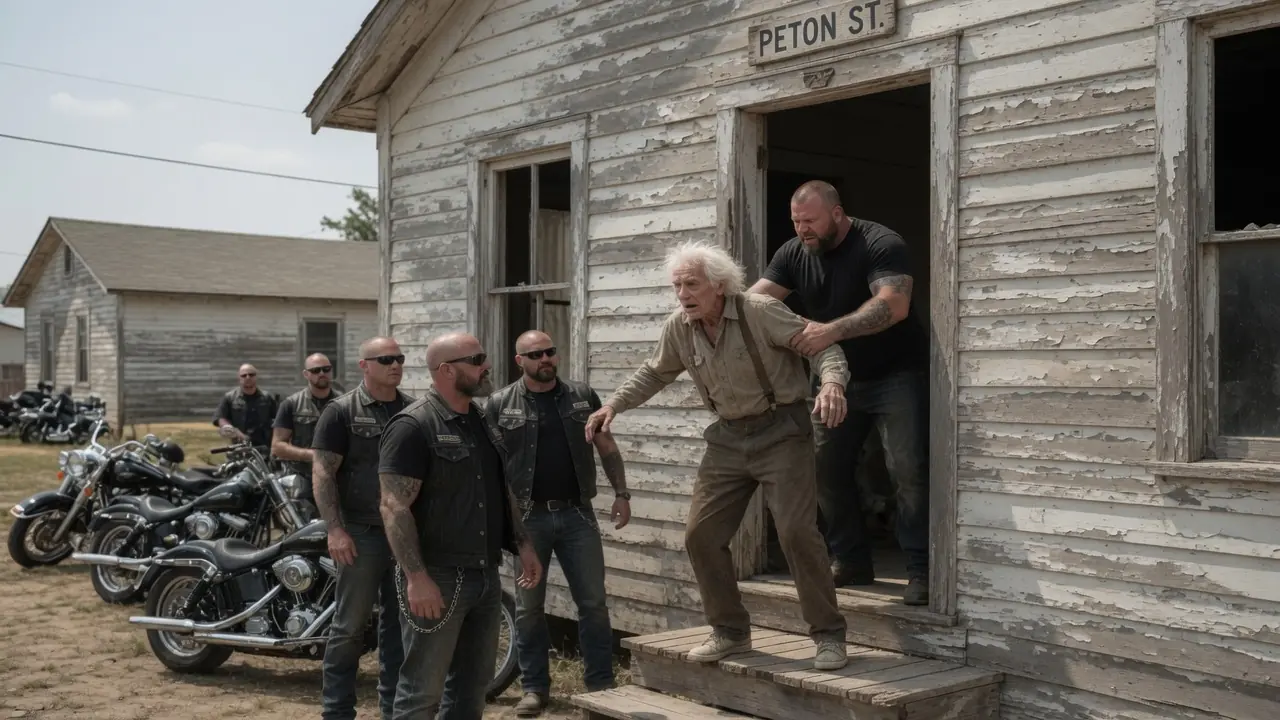
The first thing people noticed about Cole Merritt was the noise. The deep rolling thunder of his 2009 Harley-Davidson Road King announced him three blocks before he ever came into view. And by the time he rolled down Peton Street on that gray Tuesday morning in late October, most of the curtains on the block had already shifted. People in Clarksville, Tennessee, had a way of watching without wanting to be seen watching. Cole was 38 years old, with the kind of face that had been lived in rather than simply aged. A jaw covered in three days of dark stubble, a nose that had been broken twice. Once in a bar fight he'd rather forget, and once falling off a roof he'd been hired to fix. His arms were heavy with ink, a faded eagle on his right forearm, a banner across his left that read Meredith in old English script, the name of a woman who had packed her bag 6 years ago and driven north without a forwarding address.
He wore a black leather jacket that had seen 200,000 miles of American highway, scuffed boots, and dark jeans with a hole in the left knee. He did not look like a man who belonged on a quiet residential street. He looked like trouble passing through. He had stopped at the Sonoco on Route 41A to fill up, and the cashier, a teenager with acne and a Titans cap, had watched him from behind the counter like Cole might pocket the beef jerky display on his way out. Cole had paid in cash, nodded once, and said, Have a good one. The kid hadn't responded. That was fine. Cole was used to it.
He was in Clarksville for 3 days. His buddy Ray Dunar had a roofing job going on Tiny Town Road and needed an extra pair of hands. Cash work, no questions, 300 a day. Cole had been doing that kind of thing for 4 years now. Drifting between jobs, between towns, never staying long enough to start mattering to anyone. It was easier that way. Or at least that was what he told himself on the long stretches of highway when there was nothing to do but think. He was three blocks from Ray's place when he saw it.
Cole slowed the bike. His first instinct, the old instinct, was to keep moving. Not your business, Merritt. You don't know what's happening. Could be anything. Could be family. Could be nothing you want any part of. But his second instinct, the one that had been quietly growing for years, the one that had been trying to say something he hadn't wanted to hear, that instinct made him pull to the curb and kill the engine. He sat for a moment with his hands on the handlebars, watching. The man in the sport coat was speaking in a low, flat voice, not angry, worse than angry, dismissive, like the old man was a problem to be managed rather than a person to be spoken to. The other man, younger with a look of practiced patience, held a manila folder and glanced at his phone like he had somewhere better to be. A neighbor across the street, a heavy set woman in a cardigan, stood on her porch with her arms crossed and her jaw tight, but she was not moving, watching like the curtains like everyone.
The old man's free arm reached back toward the house, his fingers grasping at air. I've lived here 41 years, he said. 41 years. Cole got off the bike. The man in the sport coat noticed Cole first. His eyes moved from the Harley to the tattoos to the leather jacket in about 2 seconds, and whatever calculation he ran came up with a specific result, not relevant. He turned back to the old man and resumed talking in that same flat tone. Mr. Callaway, we've been through this. The paperwork is in order. The court approved the transfer last Thursday. I never signed anything, the old man, Mr. Callaway, said. His voice was shaking, but his eyes were sharp, lit with a kind of outrage that comes from being completely certain you're right, and completely powerless to prove it. I want to see a lawyer. I have the right to see a lawyer.
Your nephew arranged legal representation on your behalf, the younger man said, barely looking up from his phone. Cole walked to the edge of the property line and stopped there. He didn't cross onto the walk. He kept his hands loose at his sides and his voice even. What's happening here? The man in the sport coat finally gave him his full attention. He took in the jacket, the boots, the ink, and his expression settled into something between irritation and condescension. This is a private legal matter, sir. I'd ask you to move along. He's asking me to help him, Cole said. He's confused, the younger man said. He has a medical condition. We're acting in his best interest.
Mr. Callaway's head snapped toward that. I am not confused. I am 79 years old and I know exactly what day it is and I know exactly what you're doing. He looked at Cole then directly at Cole and there was something in his eyes that wasn't just desperation. It was recognition like he understood that this stranger in the leather jacket was the only person on the street who had actually stopped. Please, he said, they're taking my house. My nephew is trying to take my house. Cole pulled out his phone. I wouldn't do that, the man in the sport coat said. His tone had shifted now, not threatening exactly, but with an edge in it. I'm not doing anything, Cole said. I'm calling a friend.
He dialed Ray Dunar, who picked up on the second ring. You're late, Ray said. Ray, you know any lawyers in town? A beat of silence. What did you do? Nothing yet. I'm standing on Peton Street watching two guys in car keys drag an old man out of his house and telling him it's all been handled legally. You know anyone? Another silence. Longer this time. Then hold on. Cole lowered the phone but kept it in his hand. The man in the sport coat had released Mr. Callaway's arm which Cole noted without comment. The younger man was typing something on his phone now, his earlier patience fraying visibly at the edges. You're interfering with a legal process, the man in the sport coat said. I'm standing on a public sidewalk, Cole said. I haven't touched anyone or anything.
Mr. Callaway had taken the moment to straighten himself. He was breathing hard, his white hair disheveled, a red mark on his forearm where he'd been gripped. He moved closer to Cole, not hiding behind him exactly, but standing beside him the way you stand beside someone when the ground under you is uncertain. My name is Hank, he said quietly. Hank Callaway. I built half the furniture in that house with my own hands. Cole Merritt, Cole said. I don't know why you stopped, Hank said. Most people don't stop. Cole looked at him. I know, he said. Ray came back on the line. Okay, I've got someone. She's going to call you back in 10 minutes. Don't do anything stupid. Define stupid. Cole, I'm joking. Call me back.
He hung up and looked at the two men. Gentlemen, he said, I think we're going to wait right here for a few minutes. The man in the sport coat stared at him for a long moment. Then he took out his own phone and stepped away, speaking in a low, rapid voice. Ruth Elaine, the woman in the cardigan across the street, had come down off her porch. She was standing at the edge of her yard now, watching with an expression Cole couldn't quite read, not quite relief, not quite guilt, but something in between. She met his eyes briefly and gave a small, tight nod. He nodded back.
The call came back in 8 minutes. The voice on the other end was brisk and direct. Officer Tina Hargrove, Clarksville PD, who happened to be Ray Dunar's cousin-in-law, and who also, as it turned out, had received two prior complaints about the same address in the past 6 weeks. She told Cole to keep the parties separated, not to allow anyone to enter or exit the property, and that she was 4 minutes away. Cole relayed this to the two men in car keys who received the information with the specific kind of stillness that told him they hadn't expected anyone to call anyone.
Those four minutes were the longest Cole had spent standing still in a long time. Hank Callaway stood beside him and talked. Not nervously. The talking seemed to calm him like it was something to hold on to. He talked about the house, about the oak floors he'd refinished in 1987, and the back bedroom where his wife Dorothy had slept for the last 6 months of her life, because the stairs had become too much for her. About the garden he maintained in the sideyard, where he grew tomatoes every summer, even though his knees ached every time he knelt. He had been in that house since 1983. He had raised two children there, buried a wife there, and had fully intended to die there peacefully when the time came.
My nephew Brett showed up about 4 months ago, Hank said. His voice was measured, but something underneath it was very tired. I hadn't seen him in 6 years. He was real friendly at first, helpful, driving me to appointments, fixing things around the house. I thought I thought maybe he'd grown up some. Cole said nothing. He was listening in the way he listened on the road, not impatiently, not waiting for his turn to speak, but actually receiving what was being said. He had papers for me to sign. Said they were just power of attorney in case I got sick. I'm not going to lie to you, Mr. Merritt. I read them, but I didn't understand all of it. I signed some things I shouldn't have signed. Hank paused, his jaw tight. His lawyer, Douglas Ren, he was the one who handled the documents, presented everything very official like. Brett said it was just to protect me.
And the house transfer? Hank shook his head slowly. I never agreed to any house transfer. I asked for copies of everything I signed, and they kept saying they'd send them. Never did. He looked at the two men in khakis who were standing near the sport coat man's car now speaking quietly. I called the county clerk's office two weeks ago. They told me the deed had been changed. Just like that, my house of 41 years and my name was gone from the deed. Cole felt something clench in his chest. Not unfamiliar. He had felt it before, usually in situations where someone with less power than they deserved was being handled by someone with more. It was the kind of anger that didn't make noise. The kind that went cold and quiet and deliberate.
Did you tell anyone? Cole asked. I told Ruth. He nodded across the street. She called the police twice. They came both times, looked at the paperwork Brett's lawyer provided, said it all appeared legal. Last time the officer told me I should consider finding assisted living. Hank said the last two words with the flatness of someone who has been told something deeply insulting and has had time to sit with it. How's your memory, Hank? The old man looked at him evenly. Sharp as a tack, Mr. Merritt, and I'll thank you not to ask me that again. Cole almost smiled. Fair enough.
The police cruiser arrived without the siren, just the lights. A single car, Hargrove alone. She was in her mid 30s, compact and efficient, with the kind of face that had learned to give nothing away while taking everything in. She got out of the cruiser and surveyed the scene with quick, professional eyes. The two men by the car, the biker by the property line, the old man standing straight back beside him. Her gaze landed on Cole for just a moment longer than necessary. He had seen that look before, the brief recalculation, the flicker of assumption. He held her gaze without aggression and without performance. She looked away first. Mr. Callaway, she said. I'm Officer Hargrove. I need you to stay right here while I speak with these gentlemen. Can you do that for me? I've been doing it for 41 years, Hank said dryly.
She went to the two men. Cole watched the conversation. The man in the sport coat did most of the talking, and whatever he was saying came with documents. Hargrove was handed the manila folder, and she opened it and read, her expression professionally blank. The younger man showed her something on his phone. She nodded twice, asked a question, received an answer. Then she walked back to Cole and Hank. The paperwork they have appears to be in order, she said. Her voice was neutral, but her eyes were on Cole rather than on Hank, which told him something. Do you have documentation to counter it, Mr. Callaway? I have nothing, Hank said. Because everything I asked for, they never sent.
Hargrove was quiet for a moment. Then she said to Cole quietly, You said you were calling a lawyer. That's right. Make that call. The lawyer's name was Patricia Odum, and she arrived 40 minutes later in a silver Camry with a cracked bumper and a back seat full of file boxes. She was 60 some with silver hair worn short and reading glasses pushed up on her forehead. She had been a public interest attorney in Clarksville for 31 years and had the manner of someone who had long ago stopped being surprised by what people did to each other for money.
She spent 12 minutes sitting in the front seat of her car with the manila folder the other men had brought, reading through it page by page. Cole sat on the front porch steps with Hank. Hargrove had asked the two men to wait, and they were waiting in that still controlled way that told Cole they were deciding something, calculating whether the situation had become too visible to proceed. Brett Callaway arrived during those 12 minutes. He was 45, broad shouldered with Hank's eyes, but without whatever had made Hank's eyes honest. He drove a black pickup truck and got out with the confident stride of a man who expected the room to arrange itself around him.
He stopped when he saw the police cruiser, and the stride hitched just slightly, barely perceptibly, but Cole caught it. Brett looked at his uncle on the steps. He looked at Cole. His expression ran through several things in quick succession before settling on something like controlled frustration. What's going on? he said to Hargrove, and his tone was the tone of a man addressing subordinates. Sir, can I ask your name? Brett Callaway. Henry Callaway is my uncle. What's this biker doing on my property? It's not your property yet, Hank said from the steps. His voice was quiet, but carried like a stone dropped in still water. Brett's jaw tightened. Uncle Henry, don't. Hank said, Just the one word.
Patricia Odum got out of her Camry. She walked up to Hargrove with the manila folder under one arm and two pages she'd printed from her phone, a portable printer apparently she kept in the back seat in her hand. She introduced herself and began speaking in the calm, specific language of someone who knew exactly what she was looking at. Cole sat and watched Brett Callaway's face as the lawyer talked. She had found three things in her 40 minutes. The first, the power of attorney documents Hank had signed were overly broad in ways that were not typical of standard elder care arrangements. They had been drafted, she noted, to encompass property disposition in language that was buried in the fourth paragraph of the third addendum.
Second, the deed transfer had been executed using that power of attorney at a time when, according to Hank's own physician's records, which Ruth Elaine had apparently obtained copies of and kept, because Ruth Elaine was the kind of woman who kept things, Hank had been recovering from a knee surgery and had been on pain medication. Third, Douglas Ren, the attorney who had drafted the documents and supervised the transfer, had two prior complaints filed against him with the Tennessee Board of Professional Responsibility, both involving estate documents for elderly clients. None of this, Patricia explained to Hargrove, meant the transfer was automatically invalid. It did mean there was sufficient basis to challenge it in court. It also meant, she said carefully, that proceeding with a forced removal today before any court had actually ruled on the matter would be premature at minimum and potentially actionable.
The man in the sport coat had been listening to this with the careful attention of someone identifying risks. He glanced at Brett. Brett looked at the folder. Douglas Ren was not present. I want to speak with my attorney, Brett said. That's your right, Hargrove said. In the meantime, Mr. Callaway will remain in his home. She said it without inflection, but she said it. Brett looked at Cole, then really looked at him the way you look at something that disrupted a plan that had been working smoothly. You have no idea what you've walked into, he said. His voice had something in it that was more personal than the situation warranted, like Cole had offended him specifically. Old man being dragged out of his house, Cole said. Looked pretty clear to me.
He has dementia, Brett said. The word landed like a card being placed on a table. He does not, Ruth Elaine said from across the street loudly enough that everyone turned. She had come all the way to the edge of the road now, arms still crossed. I have coffee with Hank Callaway every Thursday morning, Brett, and he remembers everything, including the way your father never visited your grandparents when they were sick. And apparently that runs in the family. In 38 years, Cole Merritt had never heard anyone bring absolute silence to a street corner with one sentence. Ruth Elaine had just done it. Hank looked across at her. Something moved across his face. Too many things at once to name, but gratitude was in there and relief and something older and more private.
The two men in car keys exchanged a look. The man in the sport coat made a decision. We'll be in contact with Mr. Callaway through proper legal channels, he said, and picked up the manila folder. The younger man was already heading for the car. Brett stood for another moment. He was calculating. Cole could tell running numbers on something. Then he walked back to his truck, got in and drove away without saying anything further to his uncle.
Hargrove watched him go. She made a note in her pad. Patricia Odum handed Hank her card. Call me tomorrow morning, she said. I want to pull all of this into a filing and get it in front of a judge before the end of the week. This won't be an instant solution. These things take time. But you have a case, Mr. Callaway. Hank held the card in both hands and looked at it for a long moment. How much will this cost? he asked. His voice was steady, but the question carried the weight of a man who had learned to calculate every risk carefully. We'll work it out, Patricia said. Don't worry about that today.
By 2:00 in the afternoon, Peton Street had returned to its usual Tuesday quiet. The police cruiser was gone. The men in car keys were gone. Brett Callaway's truck was gone. And Patricia Odum had driven away with a trunk full of notes. Ruth Elaine had gone back inside, though not before crossing the street and clasping Hank's hand in both of hers for a long moment without saying a word. Cole was supposed to be at Ray's job site. He had sent a text two hours ago. Something came up. Be there soon. Ray had responded with a single question mark and then eventually a thumbs up. He was sitting on the porch steps when Hank came back out with two mugs of coffee. He handed one to Cole without asking if he wanted it in the manner of a man who had lived long enough to know that people sitting on your porch steps in October want coffee.
They sat there for a while without talking. The elm tree at the corner of the yard had gone fully amber, and the wind moved through it in slow, intermittent sighs. A dog barked somewhere down the block. A car passed. The neighborhood arranged itself back into its ordinary afternoon self, indifferent to what had happened in it. You do this kind of thing often? Hank asked eventually. Cole thought about that. No, he said. Usually I keep moving. What made you stop today? Cole wrapped both hands around the mug. The coffee was good. Strong real coffee, not the gas station variety he usually consumed. Honestly, I don't know. I saw you reaching back toward the house trying to get back to something. He paused. I know what that looks like.
Hank was quiet for a moment. Dorothy, my wife, she used to say I was too stubborn for my own good. Said it every year for 42 years of marriage. His voice had that particular warmth that comes not from happiness but from depth. The warmth of something fully known and fully mourned and still carried. She passed in 2018. Breast cancer. We had 9 months from the diagnosis. I'm sorry, Cole said. Don't be sorry. 9 months was 9 months. We used them. Hank wrapped his own hands around his mug. The house? It's not the house really. I know that. It's a building. It's wood and plaster and old oak floors that creak in the winter, but it's also it's the place where everything happened. You understand? All the things that made a life, they happened in that house. My daughter's first steps were in the hallway. My son broke his arm falling out of that elm tree and I carried him to the car from right where you're sitting.
He looked at the elm tree, its amber leaves. If I lose the house, I don't lose the memories. I know that. But I lose the place where I can still feel them. Cole said nothing for a while. The wind moved through the elm again. My ex-wife's name is on my arm, Cole said. Eventually, he held out the left forearm, the banner tattoo visible below his jacket cuff. Meredith, we were together for 8 years. I was not I was not always easy to be with. I worked too much, drank some, kept moving when I should have stayed put. He looked at the ink. She left and I thought, Well, that's what happens. And then I spent four years on the road figuring out that wasn't actually the lesson. What's the lesson? Hank asked. That staying put for something is harder than leaving. And harder usually means it's the right thing. He paused. I don't know if that applies to your situation. I just know you were right to fight for it.
Hank nodded slowly. The people across the street, he said, The ones who watched and didn't come down. I'm not angry at them. I understand it. When you don't know what you're walking into, it's easier not to walk in. He looked at Cole. You didn't know what you were walking into either. No, Cole agreed. I didn't. Why'd you really stop? Not the reaching toward the house part. The real reason. Cole thought about it for a long time. The coffee steamed faintly in the October air. Because everyone was watching and no one was doing anything, he said. And I've been the person everyone watches without anyone doing anything. And I know what that feels like. He set the mug down on the step beside him. I didn't want to be the guy who drove past.
They sat with that for a while. The wind moved through the elm again. Ray called at 3:15 to tell him the job was wrapping for the day and would he please come by tomorrow. Cole said yes. He stood, stretched, and set the empty mug on the porch railing. Hank stood too, and for a moment they were both just two men standing in the October afternoon, the Amber Elm turning slowly overhead. You know what I noticed? Hank said. What's that? Those two men, the ones Brett sent, the lawyer's assistant, the other one. They looked at you and they made a decision about you before you said a word, decided you were trouble, decided you didn't matter. He shook his head. They never thought you'd be the problem, so they didn't prepare for you. Cole considered this. That cuts both ways. It does, Hank agreed. But today, it cut in the right direction.
Cole picked up his helmet from the porch step. He turned it over in his hands, black, scuffed at the back, a long scratch across the visor from a road trip through Arkansas 3 years ago. He put it on and settled the chin strap. Hank extended his hand. Cole took it. The old man's grip was firm. The hand calloused with a strength in it that had not diminished. Call Patricia tomorrow, Cole said. First thing. First thing, Hank confirmed. You've got Ruth across the street. She'll show up. She always does, Hank said. I just never told her how much that meant. He paused. Maybe I'll tell her Thursday over coffee.
Cole walked to the Harley and swung his leg over. He started it, the deep rolling thunder of the engine filling the quiet street, the curtains probably shifting again along Peton, the neighbors returning to their windows. He looked back once at Hank Callaway, standing on the porch of the house he had lived in for 41 years, beside the hydrangeas he had trimmed himself, under the elm, where his son had broken an arm and grown up, and moved away to Knoxville. Hank raised one hand. Cole raised two fingers off the handlebar, the rider's wave, the small, quiet acknowledgement between strangers on the road. Then he rolled down Peton Street, the thunder of the engine fading, and by the time he reached the corner, the curtains had stopped moving, and the street had returned to its ordinary self.
But something had shifted in it invisibly, in the way that things shift when someone decides, against all expectation, against the easy path, against every quiet calculation that says keep moving to stop. 3 weeks later, Patricia Odum filed a motion to void the deed transfer on the grounds of undue influence and procedural irregularities in the power of attorney. Douglas Ren's license was referred to a disciplinary board. Brett Callaway did not contest the motion. The house on the corner of Peton and Greer remained as it always had in the name of Henry Callaway.
Cole Merritt was somewhere in Kentucky by then. A long stretch of highway unrolling ahead of him, the wind cold and the sky clear, and the road doing what roads do. Going somewhere and nowhere all at once. He thought about the house, the oak floors, the elm tree going amber in October. He thought about staying put. He didn't stop. Not yet. But for the first time in a long time, he thought about it differently. not as something he had failed at, but as something that was still, against all odds, possible somewhere, for someone who finally understood what it meant to turn around and go back. The Harley carried him forward through the November afternoon, and the road unwound ahead without end, and the name on his forearm caught the low winter sun, and held it there, warm and old and waiting.