You don't stand between a thief and a 300B piece of custom American steel because you're brave. You do it because your back aches, your coffee is cold, and the sound of a crowbar against a chrome exhaust pipe is the final insult in a week of petty annoyances.
Charles didn't want to be a savior. He just wanted his damn street to be quiet. But when you bleed for a Hell's Angel's ride, the silence that follows is deafening, and the roar that comes next changes everything. The porch boards under Charles's chair had a distinct, exhausted groan. 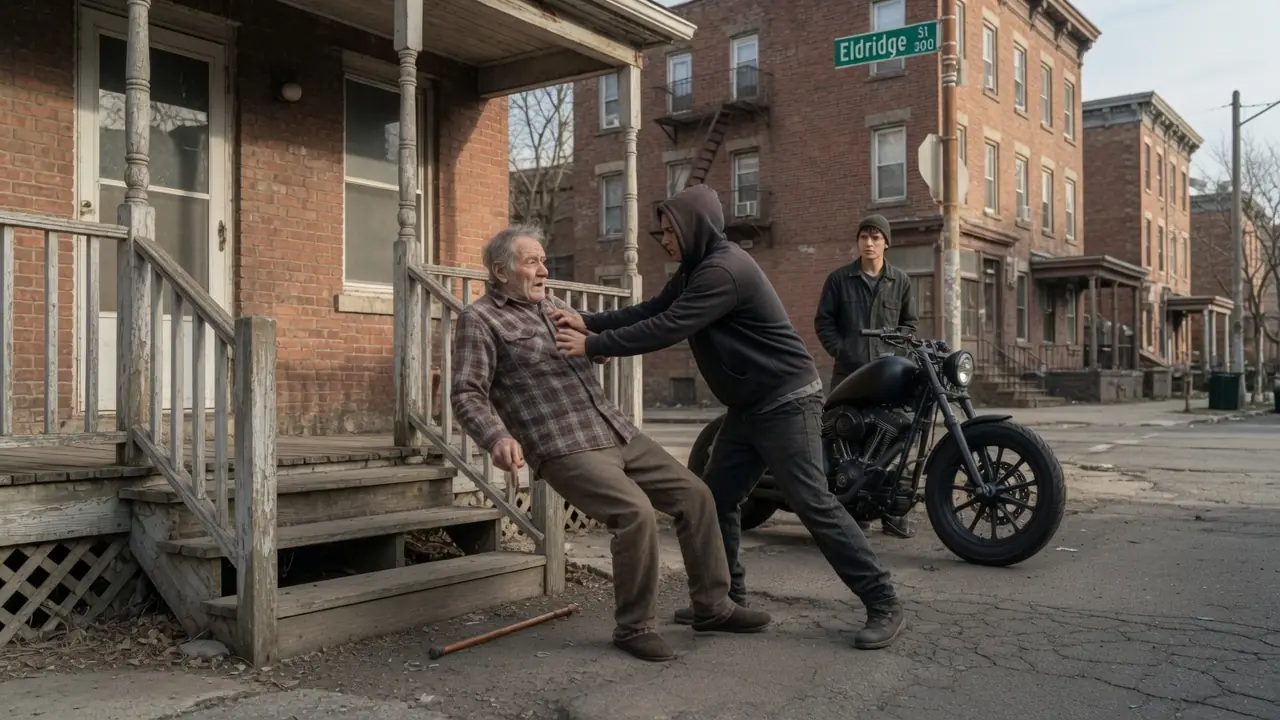
It was a sound he knew intimately, a friction of dry rot and rusted nails that mirrored the cartilage grinding in his own 72 year old knees. It was a Tuesday, or maybe a Wednesday. The days in the lower east side of the valley bled together in a haze of humidity and the constant abrasive hum of the distant interstate. Across the cracked asphalt of Elm Street sat the motorcycle.
It was an obnoxious piece of machinery, a sprawling, lowslung mass of matte black metal, and gleaming chrome leaking a single iridescent drop of oil onto the curb. Charles had watched the rider, a hulking mountain of faded denim, leather, and unwashed hair, park it there 3 hours ago before disappearing into the apartment building down the block. Charles hated the bike.
He hated the aggressive guttural idle it had made when it pulled up, rattling the loose paint in his front window, but he hated the two men currently circling the bike even more. They were young, jittery, and entirely too thin. Their movements were jerky, like marionettes pulled by amateur hands. One wore an oversized hoodie despite the stifling afternoon heat.
The other had a dirty baseball cap pulled low. Charles smelled them before he fully processed what they were doing. The wind shifted, carrying the sharp chemical stench of cheap methamphetamine sweat and stale tobacco. The one in the hoodie produced a rusted pry bar from his sleeve.
He jammed it towards the ignition housing, hands shaking. Metal scraped against metal. A high grating sound that drove an ice pick of irritation straight into Charles's temple. Charles didn't feel a surge of righteous indignation.
He didn't think about the sanctity of private property. He thought about the fact that his head hurt, his television was broken, and these two twitchy bastards were making a racket when he was trying to enjoy his one bitter cup of instant coffee and peace. He gripped the curved handle of his walking stick, solid, dense hickory, and pushed himself up.
His left knee popped, a loud, dry snap in the humid air. Hey! Charles barked. His voice was supposed to be a booming command, but it came out as a raspy, gravelly croak. He cleared his throat and started down the porch steps. Hey, get away from that damn thing.
The two men snapped their heads up. The one in the cap took a half step back, his eyes blown wide, pupils swallowed by black. Mind your business, Grandpa, he spat, his voice trembling with a frantic synthetic energy. Go back inside.
Charles's slippers scuffed against the asphalt as he crossed the narrow street. His chest felt tight. A cold, rhythmic pressure pushed against his ribs, making him acutely aware of the plaque he knew was thickening in his arteries. He shouldn't be doing this.
He was old, brittle, and tired. But a stubborn, cynical anger pushed him forward. I won't tell you again, Charles said, stopping 3 feet from the front tire. He planted his hickory stick on the ground. The bike smelled heavily of gasoline and hot rubber.
You're making a racket, and you're scratching the paint. Whoever owns this is going to snap your twig necks, and I don't want to hose the blood off my sidewalk. Hoodie sneered, revealing gums that were receding and inflamed. It's a free country, old man.
He yanked the pry bar, trying to snap the steering lock. Charles didn't think. The irritation boiled over. He swung the hickory cane. He didn't aim for the head or the hands.
It was a clumsy, sweeping arc that caught Hoodie square in the rib cage with a dull thwack. The kid let out a wet surprised gasp, dropping the pry bar. It clattered loudly against the pavement. Crazy old bastard! Cap yelled.
He lunged. Charles tried to pivot, but his bad knee buckled. Cap's shoulder slammed into Charles's chest. The impact wasn't even that hard.
But to a hollow-boned man of 72, it felt like being hit by a slow moving truck. Charles went backward. The world tilted violently. He hit the curb, his shoulder taking the brunt of the fall, followed by the side of his head scraping against the abrasive concrete.
A sharp coppery taste instantly flooded his mouth. He had bitten his tongue. His shoulder screamed in agony. Through the ringing in his ears, he heard Cap panicking. Come on, man.
Leave it. He's bleeding. The cops are going to come. Footsteps slapped rapidly against the asphalt, fading down the alley. Charles lay there for a moment, staring at the gray underbelly of the motorcycle engine.
It was quiet again. Fools, Charles muttered to himself, spitting a thick wad of blood onto the gray pavement. He rolled over onto his good side, his breath hitching as his bruised ribs protested. He didn't feel victorious.
He felt embarrassed, dirty, and utterly exhausted. He reached out with a trembling, liver spotted hand, grabbed the front wheel of the bike to steady himself, and slowly, painfully, hauled himself into a sitting position on the curb. He didn't go back to his porch.
He just sat there, leaning his back against the heavy front tire of the machine he despised, holding his hickory stick, waiting for his heart rate to drop back to a survivable rhythm. The sun began to dip behind the crumbling brick of the old textile mill, casting long, bruised purple shadows across Elm Street. Charles remained on the curb.
The bleeding from his scraped cheek had slowed to a sticky, drying crust, but his shoulder throbbed with a dull, unrelenting heat. Every time he drew a breath, it felt like cracked glass grinding in his chest. He should go inside.
The police, they'd show up 3 hours late, take a meaningless report, and look at him with that mixture of pity and annoyance reserved for the elderly. So he sat. He pressed his knuckles into his thighs, trying to massage the cramps out of his legs.
10 minutes later, the heavy, deliberate thud of boots sounded on the pavement. Charles didn't turn his head. It took too much effort. He just watched from his peripheral vision as a pair of scuffed oil stained engineer boots stepped into his line of sight.
They stopped inches from Charles's slippers. Charles looked up, tracking the dusty denim, the heavy silver chain hanging from a belt loop, the black leather vest. The man was massive, built like a brick wall that had been left out in the rain.
His beard was a tangled mess of gray and brown, and his eyes were hidden behind dark sunglasses despite the fading light. On the back of the vest, though Charles couldn't see it now, he knew the patch was there. The winged death head. Hell's Angels.
The biker looked at the pry bar resting in the gutter. He looked at the scratched chrome near the ignition. Finally, he looked down at Charles, taking in the blood on the old man's cheek, the swelling jaw, and the hickory stick gripped tightly in white knuckled hands.
The silence stretched. It was heavy, thick with unspoken questions. Charles stared back, refusing to break eye contact, largely because he was too tired to look away. You bleed on my white walls.
The biker's voice was a low, gravelly rumble. It wasn't angry. It was flat, analytical. I tried not to. Charles croaked.
He swallowed hard to moisten a throat that felt like sandpaper. Two junkies tried to pop your ignition. Told them to shut up. They didn't listen.
The biker slowly crouched down. Up close, he smelled of stale tobacco, highway wind, and strong black coffee. He reached out a massive calloused hand and picked up the rusted pry bar. He turned it over, inspecting it before tossing it casually into the storm drain.
It landed in the muck below with a hollow splash. He looked at Charles's face again. He reached into his leather vest and pulled out a bandana. It wasn't perfectly clean, but it was dry.
He held it out. Charles looked at the cloth, then at the man. I'm fine. You look like a run over dog shit.
The biker stated, his expression unchanging. He didn't withdraw the hand. Wipe your face. Charles snatched the bandanna with a scowl, pressing it against his cheek.
It stung. You shouldn't leave this loud piece of junk on the street, Charles muttered, wincing as he spoke. Brings the rats out. A faint, almost imperceptible twitch registered at the corner of the biker's mouth.
It might have been a smile. It might have been a grimace. Name's Wyatt, he said, standing back up to his full towering height. Charles.
Wyatt stepped over the bike, grabbing the heavy handlebars and righting the machine effortlessly. He flicked a switch and the engine roared to life, a deafening, chest rattling explosion of sound that made Charles flinch. Wyatt didn't rev it.
He just let it idle, the heavy thrum vibrating up through the soles of Charles's slippers. Wyatt looked down at the old man still sitting on the curb. Can you walk? I walked out here, didn't I?
Charles snapped, though his attempt to stand proved pathetic. He leaned heavily on his cane, his bad knee shaking violently under his weight. He made it halfway up before gravity threatened to pull him back down. A large hand grabbed him under his good arm.
Wyatt's grip was iron, steadying Charles with humiliating ease. He hauled the old man to his feet, holding him there until Charles found his balance. Get your hands off, Charles grumbled, though he didn't pull away immediately.
Wyatt let go. He swung his leg over the bike. Lock your doors tonight, Charles. Wyatt said over the rumble of the engine.
Charles frowned, wiping the drying blood from his chin. Why, because you're leaving your junk here again? No, Wyatt said, kicking the bike into gear with a loud clunk.
Because methheads got bruised egos. You embarrassed them. They come back. They don't look for the bike.
They look for the guy who hit them. Before Charles could reply, Wyatt released the clutch. The motorcycle surged forward, a loud, aggressive bark of exhaust echoing off the brick walls as he tore down Elm Street, disappearing around the corner. Charles stood alone on the curb, the bandanna still clutched in his hand.
The street was quiet again, save for the hum of the interstate. He looked at his small, peeling house. The porch light was flickering, casting long, nervous shadows across the overgrown lawn. Wyatt's words hung in the humid air, settling into Charles's bones alongside the deep, throbbing ache of his ribs.
Lock your doors. Charles spat another wad of metallic tasting saliva onto the pavement. He turned and began the slow, agonizing limp back to his porch. The inside of Charles's house smelled of old paper, dust, and faintly of the peppermint hard candies he kept in a glass bowl on the coffee table.
It was a stagnant smell. The air felt trapped, much like Charles himself. He didn't turn on the lights. The glow from the street lamp outside filtered through the yellowed lace curtains, casting prison bar shadows across the faded floral wallpaper.
Charles navigated the living room by memory, his cane thumping softly against the threadbare rug. Every movement was a calculated negotiation with pain. He managed to get into the bathroom, flicking on the harsh fluorescent light above the sink. He stared at the mirror.
The face looking back was a road map of bad decisions and hard years. Deeply lined, eyes watery and bloodshot. His left cheek was a raw weeping scrape, and a massive ugly bruise was already blossoming along his jawline, a deep plum color spreading into the sagging skin of his neck. He unbuttoned his flannel shirt with trembling, arthritic fingers.
His right shoulder was swollen, tight, and hot to the touch. Idiot, he whispered to his reflection. His voice sounded hollow in the small tiled room. Stupid, arrogant, old idiot.
He opened the medicine cabinet. The hinges squeaked. He pushed aside expired bottles of aspirin and Martha's old prescription bottles that he could never bring himself to throw away. He found a half empty tube of antiseptic ointment and smeared a thick stinging glob onto his cheek.
He didn't bother with a bandage. Charles shuffled into the kitchen. The refrigerator hummed loudly, a broken compressor rattling against the linoleum. He pulled out a bag of frozen peas, wrapped it in a dish towel, and pressed it against his ribs.
He sat down at the small formica table, staring out the window into the dark alleyway behind his house. The adrenaline had completely evaporated, leaving behind a cold, creeping dread. Wyatt's warning played on a loop in his mind.
They look for the guy who hit him. Charles wasn't a coward, but he wasn't delusional. He knew the ecosystem of his neighborhood. The junkies who haunted the alleys weren't criminal masterminds.
They were desperate, unpredictable animals driven by chemical hunger. They didn't have codes. They didn't fight fair. If they came back, they would come in the dark.
They would throw a brick through the window. They would kick in the flimsy back door. He looked at his hands resting on the table. They were shaking.
Not from the Parkinson's the doctor kept warning him about, but from a primal, deep-seated fear. He was completely, utterly defenseless. He stayed at the kitchen table for hours. The frozen peas thawed, turning into a mushy, lukewarm bag against his side.
The house settled around him, making its usual nighttime noises, the floorboards contracting, the plumbing groaning. But tonight, every sound was a threat. A scrape of a branch against the siding made his breath catch.
The distant siren of a police car made his heart hammer against his bruised ribs. Around 2:00 a.m., the fatigue finally outweighed the paranoia. Charles dragged himself to his bedroom.
He didn't undress. He just lay on top of the quilt, his walking stick placed deliberately on the mattress beside him. He stared at the ceiling, watching the headlights of passing cars sweep across the plaster. Sleep when it came was shallow and jagged, filled with the sounds of scraping metal and hollow laughter.
He woke up to silence. The heavy oppressive silence of late morning. Charles opened his eyes. The digital clock on the nightstand read 11:15 a.m.
He groaned as he tried to sit up. His body had stiffened overnight, locking his joints in place. His shoulder screamed and a sharp pain lanced through his side. It took him five agonizing minutes just to get his feet on the floor.
He hobbled into the kitchen to make coffee. The ritual grounded him. The scrape of the kettle, the hiss of the gas burner, the bitter burnt smell of the instant granules hitting the hot water. He stood by the sink, cradling the warm mug, and looked out the window.
The alley was empty, just trash cans and weeds pushing through the cracked concrete. He survived the night. The relief was a physical weight lifting off his chest. Wyatt had just been trying to scare him.
The junkies were probably three towns over by now, looking for an easier score. Charles took a slow sip of his coffee. It tasted like ash, but it was hot. He turned away from the window and headed towards the front door to grab the mail.
He unlocked the deadbolt, pulled open the heavy wooden door, and pushed the screen door open. He stepped out onto the porch. He stopped dead. The coffee mug slipped from his fingers, shattering against the wooden boards, sending dark liquid splashing across his slippers.
Elm Street was gone, or at least the pavement was. From the corner of Fifth Avenue all the way down to the old mill, the street was packed tight. Metal to metal, chrome reflecting the midday sun in a blinding glare. Leather, denim, motorcycles, dozens of them.
No, hundreds. They lined both sides of the street, parked at precise, identical angles. They filled the empty lot across the street. They idled in the intersections, blocking traffic.
Men stood beside the bikes. Massive bearded men. Men with tattoos scrawling up their necks and faces. Men in black leather vests, all bearing the same winged death head patch on the back.
They weren't yelling. They weren't revving their engines. They were just standing there quietly, smoking cigarettes, leaning against their machines, their eyes casually scanning the street, the alleyways, the surrounding rooftops. Charles couldn't breathe.
His heart stuttered in his chest. Had he called the cops? Had the neighborhood complained? Why were they here? Was this a retaliation?
Then the crowd of bikers directly across the street parted slightly. Wyatt stepped through the gap. He wasn't wearing his sunglasses today. His eyes were hard, dark, and entirely unreadable.
He carried a white paper bag in one hand. He crossed the street, his heavy boots making no sound over the low, collective rumble of 500 idling engines. He stopped at the bottom of Charles's porch steps. He looked down at the shattered coffee mug, then up at the old man's pale, bruised face.
Wyatt reached into the paper bag and pulled out a large steaming styrofoam cup. He walked up the steps and held it out. Black, Wyatt said, his voice carrying easily over the mechanical hum. Figured you could use a real cup.
Charles just stared at the cup. He looked out at the street. 500 Hell's Angels blocking every entrance, every exit, turning Elm Street into a fortress. What?
What is this? Charles's voice was a barely audible rasp. Wyatt took a slow sip from his own cup. He turned, looking over his shoulder at the sea of leather and steel.
You watched my back, Wyatt said, turning back to Charles. He didn't smile. He didn't emote. It was a simple statement of fact.
Nobody bleeds for the club without the club bleeding for them. Wyatt pointed a thick, calloused finger down the street. Those two rats from yesterday, they tried to come back this morning.
Couple of the prospects caught them two blocks over. They won't be coming back again. Charles's hand trembled as he reached out and took the styrofoam cup. It was warm.
He looked at the bikers. Some of them nodded in his direction. Just a slight respectful tip of the chin. So, Wyatt said, stepping back down the porch stairs.
We're going to hang out here for a few days. Make sure the neighborhood understands the new arrangement. He looked up at Charles, a glint of dark amusement finally showing in his eyes. Hope you don't mind the noise?
The styrofoam cup burned the palm of Charles's hand. He stood on the porch for a full minute after Wyatt turned away, the cheap, acidic coffee sloshing against the plastic lid. Out on the street, the occupation had already begun. It wasn't a chaotic takeover.
It was entirely too organized, which somehow made it worse. Men in heavy denim and scuffed leather were establishing perimeters. In the vacant lot next to Mrs. Gable's old boarded up duplex. Three enormous canvas tents were going up.
The sharp metallic clatter of stakes being driven into dry earth cut through the steady vibrating hum of idling engines. Someone wheeled a massive rusted barrel smoker out of the back of a beaten up pickup truck. Within 20 minutes, the thick acrid smell of burning charcoal and hickory chips smothered the usual neighborhood scent of stagnant storm drains and hot asphalt.
Charles hated it. He didn't feel like a protected king holding court. He felt like a hostage in his own living room. He turned, his shoulder giving a sharp throb of protest, and shoved the heavy wooden front door closed.
He twisted the deadbolt with a loud definitive clack. Inside the house was stifling. He hadn't opened the windows yet, and the stale air pressed against his face. He set the coffee on the hallway table, ignoring the brown ring it left on the dusty wood, and shuffled to the front window.
He nudged the yellowed lace curtain aside with one liver spotted finger. A man the size of a commercial refrigerator was leaning against Charles's chainlink fence. The fence groaned under his weight, leaning at a precarious 45 degree angle.
The man wore a cut off denim vest, his massive arms sleeved in intricate faded ink. He was casually smoking a cigarette, dropping the ashes into Mrs. Gable's overgrown hydrangeas. Charles's jaw tightened, the bruise on his cheek pulled tight, a hot, radiating ache.
He didn't ask for a private army. He didn't want 500 outlaws treating his street like a campground. He wanted silence. He wanted his broken TV, his cold house, and his isolated misery.
He marched back to the front door, grabbed his hickory stick, and yanked the door open. He stepped out onto the porch, the dry wood squeaking under his slippers. Hey! Charles yelled, his voice was stronger than yesterday, fueled by a surge of pure cynical irritation.
Get off the fence! You're bending the posts! The giant slowly turned his head. He looked at Charles through a pair of mirrored aviators, taking a slow, deliberate drag of his cigarette.
He didn't move. He didn't speak. He just stared. Charles gripped his cane tighter, his knuckles turning white.
He started down the steps, his bad knee buckling slightly, but he caught himself. Are you deaf? I said. A heavy hand landed on the giant's shoulder.
Wyatt stepped into view, his expression neutral. He murmured something low and guttural to the big man. The giant flicked his cigarette into the street, gave Charles a slow, deliberate nod, and stepped away from the fence. Wyatt walked up to the edge of Charles's yard.
He didn't open the gate. He rested his forearms on the top rail. Up close, Charles could smell the dust on Wyatt's vest, a dry mineral scent mixed with old sweat. Calm down, old man, Wyatt said.
Don't stroke out on us. We're just holding the line. Holding the line against who? Charles snapped, gesturing wildly with his free hand. The two skinny junkies you already chased off.
This is overkill. You're blocking the mail truck. You're blocking the garbage pickup. Mrs. Higgins across the street is probably having a coronary watching you thugs turn her sidewalk into a latrine.
Wyatt's eyes flicked to the house across the street. A tiny white-haired woman was peeking through her blinds. Wyatt raised her hand and gave her a polite two-fingered wave. The blinds snapped shut instantly.
The junkies are a symptom, Wyatt said, turning his attention back to Charles. Word gets out that some tweakers touched a club bike and didn't leave in an ambulance. It makes us look soft. Makes the whole neighborhood look like an easy mark.
We stay until the message is received. And when will that be? When I say it is. Wyatt's voice lost its conversational edge.
It dropped an octave, settling into a flat, hard authority. It wasn't a threat, but it was a boundary line drawn clearly in the dirt. Charles swallowed, the dry click in his throat sounding entirely too loud.
He realized then the sheer absurdity of his situation. He was a brittle 72 year old man arguing zoning laws with the president of a heavily armed motorcycle club. He glared at Wyatt for a long moment, refusing to drop his gaze, but knowing he had lost. Fix my fence before you leave.
Charles muttered, turning his back. He limped up the stairs. Every step a painful reminder of his own fragility. He went inside and slammed the door.
He didn't look out the window again. He retreated to the kitchen, fetched his bag of frozen peas, and sat at the formica table. The low, vibrating rumble of the engines seeped through the floorboards, traveling up the legs of the chair and settling into his aching bones. By nightfall, the oppressive heat of the day had finally broken, replaced by a thick, humid dusk that clung to the skin like a wet towel.
The roaring engines had mostly died down, replaced by a different kind of noise. It was a dense physical wall of sound, the clinking of beer bottles, the guttural bark of deep laughter, the heavy thud of boots on pavement, and the distorted bass heavy thumping of classic rock leaking from someone's saddle radio. Charles sat in his unlit living room.
He hadn't turned on a lamp, preferring the anonymity of the dark. He was trying to read a three-day old newspaper by the orange glow of the street lamp filtering through the curtains, but the words kept swimming on the page. His shoulder was a tight, agonizing knot.
He was hungry, but the thought of standing at the stove to boil pasta felt like climbing a mountain. He closed his eyes, leaning his head back against the worn fabric of his armchair. He was so tired.
A heavy, deliberate knock rattled the front door. Charles jumped, a jolt of adrenaline shooting through his chest. He grabbed his hickory cane and pushed himself up, suppressing a groan. He crept to the door and peered through the cloudy peephole.
It wasn't Wyatt. It was a younger man, maybe in his early 30s, with a shaved head and a thick, dark beard. He wore a plain black t-shirt under a denim vest that only had the bottom rocker patch. A prospect trying to earn his way in.
He was holding a paper plate covered in aluminum foil. Charles unlocked the deadbolt and opened the door 2 inches, leaving the chain attached. What? He barked through the crack.
The younger man shifted his weight awkwardly. He didn't have the cold, deadeyed stare of the older members. He looked tired. Wyatt said, You didn't leave the house today.
Told me to bring you a plate from the smoker. Charles looked at the foil covered plate. The smell hit him instantly. Rich smoky pork fat, tangy barbecue sauce, and baked beans.
His stomach let out a loud embarrassing growl. I didn't ask for charity, Charles said, though his voice lacked its usual bite. I ain't charity, the prospect said, his voice a low mumble.
Wyatt said you took a hit for the club. We feed our own. Take the plate, man. My arm's getting tired, and I've been pulling security duty since 4:00 a.m.
Charles hesitated. The pride was there, rigid and bitter, telling him to slam the door. But the sheer exhaustion and the intoxicating smell of hot food overruled it. He unhooked the chain and pulled the door open.
He took the paper plate. It was heavy and radiating heat. What's your name? Charles asked, looking at the kid's tired eyes.
Sullivan, the prospect said. He gave a quick, sharp nod. Lock your door, Charles.
He turned and jogged heavily down the steps, disappearing back into the sea of leather and metal. Charles closed the door, locked it, and carried the plate to the kitchen table. He peeled back the foil.
Two massive pork ribs, a pile of baked beans, and a thick slice of white bread. He didn't bother with a fork. He picked up a rib.
The meat was so tender it fell off the bone, coating his fingers in sticky, dark sauce. He ate in silence in the dark kitchen. The food was incredible. It was rich, heavy, and grounding.
As he chewed, the sharp pain in his jaw flared with every movement, a physical reminder of the violent chaos that had brought this bizarre army to his doorstep. He finished the ribs and wiped his hands on a paper towel. He felt full for the first time in days.
A strange, heavy lethargy settled over him. He stood up and walked to the back door, intending to make sure the deadbolt was thrown. As he reached for the lock, he noticed something strange. The back door had a loose hinge.
It had squeaked for 5 years, a loud, grating screech every time the wind pushed against the frame. Martha used to nag him to oil it, and after she died, he purposely left it squeaking. It was a familiar annoyance.
But tonight it was silent. Charles frowned. He pushed the door slightly. It moved smoothly, soundlessly.
He leaned closer. In the dim moonlight filtering through the kitchen window, he saw it. The hinge was slick with fresh dark grease.
He stepped back, his heart doing a strange flutter. They had been on his property. They had been in his backyard. Someone had walked up to his back door and oiled the hinges while he was sitting in the front room, a cold spike of violation hit him first.
They were intruding. They were touching his things. But then, as he stood in the quiet kitchen, listening to the muffled, distant laughter from the street, a second, deeply contradictory emotion washed over him. He wasn't afraid.
For the first time in a decade, Charles realized he wasn't bracing for the sound of breaking glass. He wasn't waiting for the shadows in the alley to move. He was surrounded by 500 violent, unpredictable criminals.
And yet, he was the safest man in the city. He hated it. He hated that he needed them. He hated that a gang of outlaws had done more to make his home secure in 24 hours than the city police had done in 10 years.
Charles walked slowly to his bedroom. He didn't lay on top of the quilt tonight. He pulled the covers back, laid his aching head on the pillow, and placed his walking stick on the floor. He closed his eyes, letting the low, rhythmic hum of the motorcycle engines out on Elm Street lull him into the first deep, dreamless sleep he had known since his wife passed away.
The fourth morning broke with a sickly, humid yellow light that seemed to trap the heat directly against the pavement. Charles woke up before the alarm. He didn't lie in bed waiting for his joints to loosen.
He sat up immediately, throwing his legs over the edge of the mattress. His shoulder was stiff, a dull ache rather than a sharp stabbing pain, and the bruise on his face had shifted from a furious plum to a nauseating mottled yellow. He didn't need the alarm because Elm Street had its own clock now.
It started at 5:30 a.m., not with engines. They were surprisingly disciplined about the noise before sunrise, but with the dense heavy friction of hundreds of men waking up on asphalt and dirt. It was the scrape of heavy boots, the metallic snick of Zippo lighters, the low gravelly murmur of voices thick with sleep and tobacco.
And underneath it all, the smell. Charles's neighborhood used to smell like wet cardboard and exhaust fumes from the interstate. Now it smelled like a strange aggressive summer camp. Foulers coffee boiling in aluminum percolators over camp stoves.
Leather baking in the early sun. The lingering greasy memory of yesterday's barbecue. He hobbled to the kitchen, filled his kettle, and turned the stove dial. Click, click, click, whoosh.
The blue flame flared. Charles leaned heavily against the counter, staring out the window. He was getting used to them. That was the most terrifying part.
The initial spike of panic had eroded into a cynical, weary acceptance. He watched Sullivan, the prospect from two nights ago, carrying a heavy trash bag down the alley, picking up crushed beer cans and discarded paper plates. Sullivan looked exhausted, dark bags dragging down the skin under his eyes, but he moved with a frantic, eager energy.
Charles poured his instant coffee, stirred it until the granules dissolved into a bitter sludge, and walked to the front door. He unbolted it, pushed the screen door open, and stepped out onto the porch. He didn't freeze this time.
He just dragged his woven lawn chair into the shade of the overhang, sat down, and rested his hickory stick across his lap. The street was alive. Two men were sitting on the curb directly across from Charles's house, meticulously polishing the chrome exhaust pipes of a massive metallic blue bagger.
A few houses down, a group of five men were throwing a worn football in the middle of the intersection. Nobody yelled. Nobody blasted music.
It was a terrifyingly structured occupation. A shadow fell over Charles's porch. He looked up. It was the giant from the first day, the one who had been leaning on his fence.
The man was holding a heavy steel wrench in one hand. He didn't wear sunglasses today. His eyes were small, dark, and hard. Charles tightened his grip on his cane.
He didn't speak. He just waited. The giant walked over to Charles's chainlink fence. The section he had leaned on was bowed outward, the top rail sagging.
The giant dropped to one knee. He grabbed the heavy steel post with one massive tattooed hand, planted his boots against the concrete footing and pulled. The metal groaned.
A loud high-pitched screech of straining steel echoed down the street. The giant's face flushed red, the veins in his thick neck bulging against his skin. With a final violent jerk, the post snapped back into a perfectly vertical alignment.
The giant stood up, dusting his hands on his denim jeans. He took the steel wrench, tapped the top rail to ensure it was seated correctly, and then looked at Charles. He gave that same slow, deliberate nod.
Didn't ask you to do that? Charles grumbled, taking a sip of his scalding coffee. The giant didn't reply. He just turned and walked back to his motorcycle.
Charles watched him go, a sour feeling pooling in his stomach. He didn't want their favors. Every fixed fence, every oiled hinge, every plate of food felt like a knot being tied around his neck. It was a debt he hadn't agreed to take on.
A new sound cut through the low hum of the street. It was a thin whining noise rising in pitch as it approached. A white Ford Explorer with city municipal plates turned onto Elm Street from Fifth Avenue. It was a parking enforcement vehicle.
A meter maid. The car rolled forward about 20 feet before the driver seemed to realize exactly what they had driven into. The brake lights flared violently red. Charles leaned forward in his chair.
The street didn't erupt into chaos. It simply stopped. The men polishing the chrome put their rags down. The football dropped to the asphalt and rolled into the gutter.
Every single head on the block turned slowly toward the white Ford. No one drew a weapon. No one shouted a threat. It was worse.
It was the collective silent weight of 500 violent men staring at a single unarmed city worker in a compact SUV. The silence was heavy enough to crush bone. Charles watched from his porch, his heart giving a strange, irregular thump.
He should be rooting for the city worker. He should be hoping they called the police, called the SWAT team, called the National Guard to clear this filth off his street. But he wasn't. Instead, Charles felt a dark, twisted surge of satisfaction.
The city hadn't cared when the junkies stripped copper wire from the abandoned duplex. They hadn't cared when the street lights burned out and stayed dark for 6 months. They didn't care about Charles.
The Ford Explorer slowly shifted into reverse. The transmission whined in protest as the driver backed up the entire length of the block, tires bumping frantically over the curb in their haste to escape. The car swung around the corner and disappeared. The street held its breath for 3 seconds.
Then a biker down by the intersection let out a single sharp whistle. The tension snapped. The rags went back to the chrome. The football was picked up.
The low rumble of conversation resumed. Charles sat back in his chair. His coffee was cold. He realized his hands were shaking, not from fear, but from the terrifying realization that he had enjoyed watching the city retreat.
He felt dirty. He rubbed a hand over his face, his fingers catching on the rough, unshaven stubble of his cheek. Damn it, he whispered to the empty porch. By late afternoon on the fifth day, the atmosphere on Elm Street shifted.
The oppressive static energy of the occupation broke, replaced by a restless, kinetic hum. Charles felt it before he saw it. He was in his living room watching the local news on a small static filled portable TV he had dragged out of the closet.
The anchor was talking about a sudden drop in property crime in the Lower East Side, attributing it to a proactive community watch initiative. Charles snorted, a harsh sound that aggravated his bruised ribs. He turned off the TV and went to the window.
The canvas tents in the vacant lot were gone. The rusted barbecue smoker had been loaded back into the beaten up pickup truck. Men were strapping heavy leather duffel bags to their sissy bars, checking tire pressures, and pulling on thick reinforced leather jackets despite the 90 degree heat.
They were leaving. A cold knot of anxiety formed in the pit of Charles's stomach. This was what he wanted. He had spent the last 5 days praying for this exact moment.
He wanted his quiet back. He wanted his miserable, isolated routine. He walked to the front door, his cane thumping heavily against the floorboards. He stepped out onto the porch.
Wyatt was standing at the bottom of the steps. He looked exactly as he had on the first day. The heavy denim, the silver chain, the dark sunglasses hiding his eyes. His massive black motorcycle was idling at the curb, the guttural thrum vibrating the dust on the pavement.
Wyatt looked up at Charles. He didn't walk up the steps. He just stood there, letting the silence stretch between them over the sound of the engine. Message received?
Charles asked. His voice sounded thin and frail in the thick, humid air. Loud and clear, Wyatt said. His voice was a deep rumble.
Word travels fast. Elm Street is a dead zone for bottom feeders. Nobody with half a brain is going to look twice at this block for a long, long time. Good.
Charles leaned both hands on his walking stick. He wanted to go back inside. He wanted to end this conversation before he said something stupid, but his feet wouldn't move. Wyatt reached into his leather vest.
Charles's grip tightened on his cane. A leftover instinct from a lifetime of expecting the worst. But Wyatt just pulled out a small folded piece of paper. He reached over the freshly straightened chainlink fence and tucked the paper securely under the metal flap of Charles's mailbox.
What's that? Charles asked, narrowing his eyes. A phone number? Wyatt said flatly. It's a burner, but it roots to the clubhouse.
You see anyone twitching around your property? You see anyone looking at your windows too long? You don't call the cops, you call that number. Charles stared at the mailbox. The white edge of the paper stark against the rusted black metal.
I'm not part of your club. I don't pay protection money. Wyatt let out a short, harsh breath through his nose. It was the closest thing to a laugh Charles had heard from him.
You already paid, old man. You bought a ticket. The second you took a swing at that tweaker. Wyatt adjusted his sunglasses.
He looked up at Charles's bruised face, his eyes dropping to the hickory cane and finally to the porch boards. Most people, Wyatt said, his voice dropping lower, cutting under the noise of the surrounding street. They lock their doors.
They look through the blinds. They wait for someone else to take the hit. You didn't. You were old.
You were half broken. And you still stepped off your porch. They were making a racket. Charles lied, his voice defensive.
I wanted to drink my coffee. Wyatt nodded slowly. Sure you did. Wyatt turned away.
He threw his heavy leg over the massive black motorcycle. He didn't look back. He kicked the kickstand up with the heel of his boot and settled his weight onto the leather seat. Down the street, someone revved an engine.
It was a sharp, aggressive crack that bounced off the brick buildings. It was immediately answered by another, then another. Within seconds, the air was torn apart by the deafening, chestcrushing roar of 500 American V twin engines running wide open.
The sound was a physical entity. It pushed against Charles's chest, vibrating his teeth, rattling the glass panes in his front window. The smell of raw, unburned gasoline and hot exhaust flooded the porch, choking the humid summer air. Wyatt raised his left hand, holding it high in the air for 3 seconds.
Then he dropped it. He dumped the clutch. The rear tire chirped against the asphalt, leaving a short black smear of rubber, and he shot forward. The rest of the street followed in a synchronized wave of chaotic noise.
They pulled out two by two a massive flowing river of black leather and gleaming chrome. The ground shook violently. Charles gripped the porch railing with his free hand, the vibrations traveling up his arm and into his bad shoulder.
He watched them go. He watched the massive giant pass by. He watched Sullivan, the prospect, struggling to keep his smaller bike in formation. Hundreds of men pouring out of Elm Street, turning right onto Fifth Avenue.
A relentless, deafening exodus. It took nearly 10 minutes for the street to clear. When the last straggler, a ratty chopped up shovel head, turned the corner and disappeared, the exhaust note fading into the distance. The silence slammed back into Elm Street.
It wasn't a peaceful silence. It was a heavy, suffocating vacuum. The air felt thin. Charles stood alone on his porch.
The street was empty. The vacant lot was just a patch of dirt again. Mrs. Gable's overgrown hydrangeas rustled in a weak, hot breeze.
He looked at his repaired fence. He thought about his greased back door. He thought about the piece of paper sitting in his mailbox. He slowly turned and walked back inside his house.
The stale smell of dust and peppermint candies greeted him. He locked the deadbolt. He leaned his cane against the wall. He stood in the dark hallway, listening to the drip of the kitchen faucet.
The silence pressed against his ears, ringing loud and hollow. He was perfectly safe. He was completely alone. And for the first time in his life, Charles realized he didn't know which one terrified him more.
For the first four days after the exodus, Charles lived with a phantom vibration in his jaw. It was a trick of the nerves, a sensory echo left behind by 500 V twin engines. He would be sitting in his armchair reading the obituaries in the local paper and suddenly he would feel it, a low rhythmic thrumming deep in his ears.
He would look up expecting to see the giant leaning against his fence or the prospect Sullivan hauling a trash bag down the alley. But the window framed nothing but the stagnant empty street. The neighborhood slowly exhaled. It was a cautious, hesitant return to normalcy.
On Tuesday, the mail carrier finally drove down the block, his white truck pausing unusually long at the intersections as if checking for ambushes. On Wednesday, Mrs. Higgins crept out onto her front porch with a straw broom, furiously sweeping away a pile of imaginary dust from her welcome mat before scurrying back inside. Charles watched it all from behind his yellowed lace curtains.
He felt a deep irrational contempt for them. Where were they when the junkies were prying off catalytic converters, hiding behind their deadbolts? They were tourists in their own misery, waiting for the storm to pass so they could go back to complaining about the rain. The piece of white paper stayed in the mailbox.
Charles refused to touch it. Every morning he walked out to the porch, gripping his hickory cane, and checked the black metal box. He pulled out the junk mail, catalogues for hearing aids, final notices for gutter cleaning services, and left the folded square of paper sitting on the rusted bottom.
It felt radioactive. Touching it meant acknowledging a connection he didn't want. It meant admitting that Charles, a stubborn, isolated old man, owed his safety to an organized crime syndicate. So he left it there, a quiet standoff between his pride and his reality.
By Friday, the physical reminders of the brawl were fading. The grotesque yellow bruising on his neck had dissolved into a faint, sickly green. His ribs only flared with a dull heat when he coughed.
But the psychological shift was harder to ignore. The house felt entirely too big. The grandfather clock in the hallway, an antique Martha had bought at an estate sale 30 years ago, ticked with a heavy oppressive rhythm. Tick tock, tick tock.
It sounded like a countdown. For a decade, Charles had prayed for this exact undisturbed isolation. He had wanted the world to leave him the hell alone. Now the silence was suffocating.
He found himself wandering into the kitchen just to push the back door. It didn't squeak. The hinge glided silently on the dark grease the biker had applied. Charles would stand there in the dim light, pushing the door back and forth, feeling a tight, uncomfortable knot twist in his chest.
It was an act of profound, unsolicited care. It was trespassing. It was both, and the contradiction gave him a headache. On Saturday afternoon, the sky turned a bruised, violent purple.
The humidity that had choked the valley all week finally broke, giving way to a sudden torrential summer downpour. Rain lashed against the siding of Charles's house in heavy gray sheets. The gutters overflowed instantly, spilling muddy waterfalls into the overgrown flower beds.
Charles stood by the front window, watching the rain hammer the asphalt. Then he remembered the mailbox. Its flap was bent. It leaked.
He didn't think. He grabbed his cane, shoved the front door open, and hobbled out onto the porch. The wind whipped a spray of cold water across his face, soaking his flannel shirt in seconds. He moved clumsily down the steps, his bad knee protesting the sudden, panicked pace.
He reached the mailbox and yanked the metal flap down. The bottom was already pooling with water. He reached in, his wet fingers fumbling against the rusted metal, and snatched the folded white paper just as a drop of water hit its edge.
He shoved it into his pocket and limped back up the stairs, his breath coming in short, ragged gasps. Back in the dry, stale hallway, Charles leaned heavily against the wall. He pulled the paper from his pocket.
The corner was damp, the ink slightly blurred, but it was legible. 10 digits, a local area code, no name, just a series of blue ink numbers scratched aggressively into the cheap paper. He stared at it until his eyes watered. He hated Wyatt.
He hated Sullivan. He hated the giant who fixed his fence. He hated them because they had forced him to look in the mirror and see exactly what he had become. a terrified old man waiting to die in a decaying house.
They had broken his isolation by force. They had dragged him, kicking and screaming back into the messy, violent, unpredictable current of the real world. Charles walked into the kitchen. He didn't throw the paper in the trash.
He pulled a rusted thumbtack from a corkboard by the refrigerator, moved a dusty coupon for canned soup out of the way, and pinned the 10 digits firmly to the board. Late October brought a biting chill to the valley, stripping the leaves from the dying elm trees and coating the sidewalks in a slick layer of brown decay. The oppressive heat was a distant memory, replaced by the sharp metallic smell of woodsmoke and impending frost.
Charles sat on his porch. He wore a heavy wool coat over his flannel, a thick scarf wrapped tightly around his neck. The hickory cane rested across his knees. Beside him, on a small wooden table he had dragged out from the living room, sat a mug of black instant coffee.
It was scalding hot, just the way he liked it. His face was entirely healed. The scrape on his cheek had left a thin, pale scar that faded into the deep wrinkles of his skin. His shoulder still clicked when he raised his arm above his head, but the pain was manageable, relegated to the background noise of aging.
Elm Street was quiet, but it was a different kind of quiet now. It wasn't the heavy, terrified silence of a neighborhood waiting to be victimized. It was the calm, settled quiet of a boundary line that had been drawn in wet cement and allowed to harden. The junkies never came back.
The opportunistic thieves, who used to rattle doorknobs in the middle of the night, had found easier hunting grounds. Word had indeed traveled fast. The house with the repaired chainlink fence was untouchable. Charles took a slow sip of his coffee.
The bitter liquid burned its way down his throat, warming his chest. Down the block, a young boy on a rusted BMX bike was pedalling furiously toward Charles's house. He had a brightly colored backpack slung over one shoulder, likely heading home from the elementary school three blocks over.
As the boy passed the vacant lot, he reached into his pocket, pulled out the plastic wrapper of a granola bar, and casually tossed it onto the sidewalk. A year ago, Charles would have exploded. He would have slammed his cane against the porch railing, barking at the kid to pick up his trash, fueled by a cynical rage at the disrespect of the younger generation.
Today, Charles just watched. He tracked the piece of plastic as the wind caught it, blowing it into the gutter. He felt a mild annoyance, a brief twitch in his jaw, but the white hot anger wasn't there. He didn't need to yell.
Charles looked at his repaired fence. The heavy steel post stood perfectly straight, unyielding. He thought about his greased back door, which still swung open in utter silence.
and he thought about the corkboard in his kitchen, where 10 blue numbers were pinned securely next to the refrigerator. He had never dialed the number. He didn't intend to, but its presence in his house had fundamentally altered the architecture of his mind.
For 10 years, Charles had viewed the world as an encroaching tide of decay, a slow, inevitable process of things breaking down and being taken away from him. He had fought it with bitterness, isolating himself behind locked doors, weaponizing his misery to keep people at arms length. Wyatt and his army of outlaws hadn't brought the law to Elm Street.
They had brought something far more primal. They had brought consequence. They had shown Charles that the world wasn't just a machine grinding him down. It was a complex, brutal ecosystem where respect was still currency and where a single foolish act of standing up could echo louder than 500 V twin engines.
Charles wasn't a Hell's Angel. He was just Charles, an old man with bad knees and a taste for terrible coffee. But he wasn't a victim anymore. The boy on the BMX bike turned around at the end of the block, pedalling back.
He stopped his bike right in front of Charles's house, dropping one foot to the pavement. He looked at the plastic wrapper in the gutter, then looked up at Charles sitting on the porch. Charles didn't glare.
He didn't say a word. He just met the kid's eyes, holding the gaze with the heavy, unblinking weight of a man who knew exactly where he stood. The boy hesitated. Then he kicked his kickstand down, walked over to the gutter, picked up the plastic wrapper, and shoved it back into his pocket.
He got back on his bike, and pedalled away quickly, casting one nervous glance over his shoulder. Charles's mouth twitched. It wasn't quite a smile, but it was close. He wrapped his liver spotted hands around the hot ceramic mug.
The wind picked up, rustling the dead leaves across the asphalt. The sky above the old textile mill was turning a cold slate gray. Charles didn't go inside.
He pulled his wool coat a little tighter, settled back into his woven chair, and kept his eyes on the street. He was the watchman now, not because he was forced to be, and not because he was afraid. He stayed because it was his porch, and nobody, not a tweaker with a pry bar, nor the creeping ghost of his own isolation, was going to take it from him.