Luther didn't answer right away. He walked to the workbench and opened the glass case containing his father's valve lifter from 1967. The chrome was still bright and the edges still clean. He faced fourteen thousand dollars in tax debt and a seizure notice in his chest pocket. This part was the only thing left worth anything.
The stranger needed it to ride home. Luther needed it to survive. What he did next changed Belmont Street forever.
Luther didn't choose this life. This life chose him the summer he turned twelve. Earl Thompson had hands like anvils and a voice like Sunday morning, deep, slow, certain. He'd come north from Alabama in 1958 with eighty dollars, a toolbox, and a promise he'd made to himself that his son would never shine another man's shoes.
By 1962, Earl had scraped together enough to lease a cinder block building on Belmont Street. He hung a hand-painted sign out front, and for the first two years most people walked right past it. A mechanic owning the shop was unusual. Some folks brought their business. Others brought their opinions.
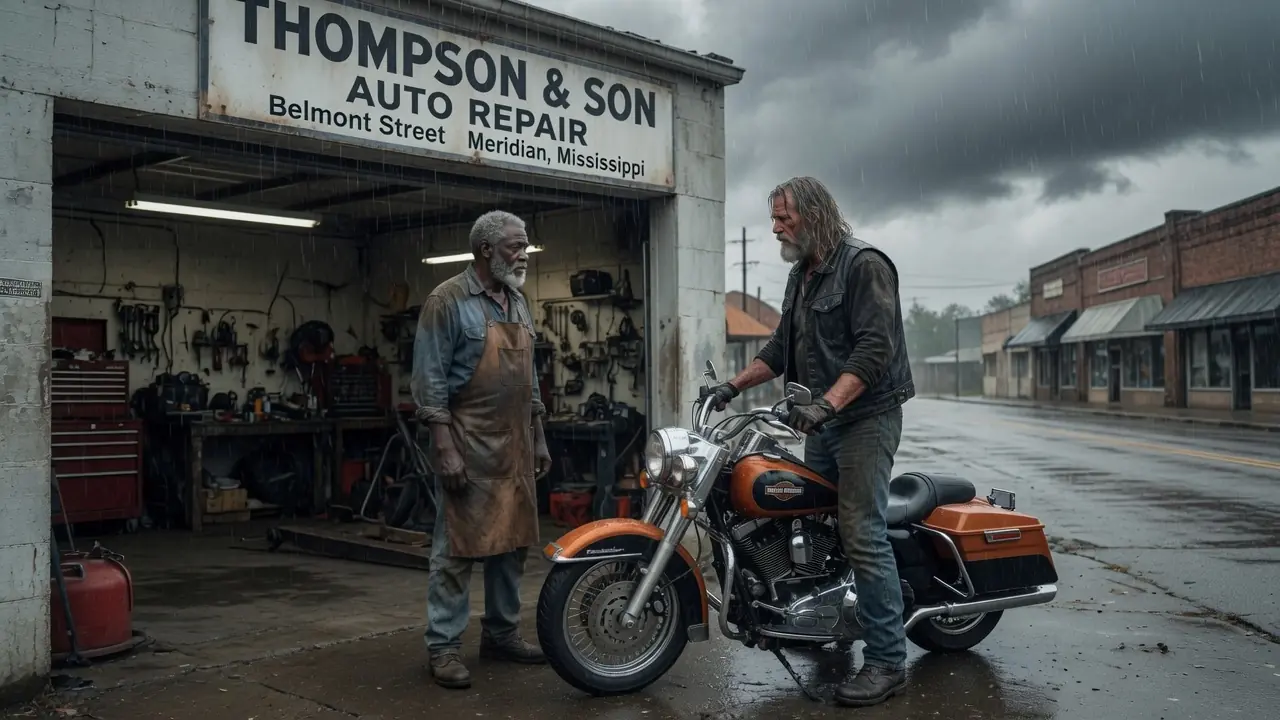
Earl ignored both equally and kept working. Luther remembered the smell before anything else, castor oil and coffee grounds. The way the concrete floor stayed cool even in July, how it numbed his bare feet while he crouched beside the lift. The sound of his father humming gospel while adjusting a timing chain. Never the words, just the melody.
Like the song was too sacred to say out loud. Earl taught him everything, not just engines. Patience. How to listen to a machine the way you'd listen to a person who couldn't speak for themselves. Where does it hurt? What's it trying to tell you?
An engine doesn't lie. Earl used to say it can't. It just runs or it doesn't. And your job is to figure out why.
The valve lifter came from a 1967 Ford Mustang, candy apple red, owned by a school teacher named Mrs. Haywood. Her husband had died that spring and the car was all she had left of him. Every mechanic in Meridian told her the engine was finished. Earl looked under the hood and said, give me a weekend.
Luther was fourteen. He held the flashlight while Earl worked, his arms aching from holding the beam steady for hours. Sixteen hours over two days. And when that Mustang turned over and purred, Mrs. Haywood cried in the parking lot. She tried to pay double.
Earl charged her half. That valve lifter was the part Earl had replaced, the one that brought the engine back. He cleaned it with a cotton rag, set it on the workbench, and told Luther, keep this so you remember what one good part can do. Luther kept it for fifty-four years.
Earl died on a Tuesday in 1988. Lung cancer. He spent his last morning in the shop, sitting in the folding chair by the bay door, watching the street like he was memorizing it. Luther held his hand and didn't say anything because Earl had taught him that too.
Sometimes the best thing a man can do is just be present and let the silence carry the weight. After Earl passed, Luther ran the shop alone. He married Dorothy in 1991. She kept the books, answered the phone, swept the floor every evening even when Luther told her to stop.
She said sweeping was how she prayed, one stroke at a time, pushing the dirt out and letting the clean in. Dorothy died five years ago. Pancreatic cancer, fast and cruel the way that kind always is. Now Luther lived in the two rooms behind the shop.
A bed, a hot plate, a photograph of Dorothy on the nightstand, her reading glasses still folded beside it. He ate dinner at the workbench most nights under the same fluorescent light his father had installed in 1974. The bulb had been replaced eleven times. The fixture never had.
Some things last because they're built right. Some things last because nobody has the heart to take them down. Luther was both.
Belmont Street used to breathe. Saturday mornings you could hear it from three blocks away. Car horns and soul music leaking from open doors. The barbershop radio playing Marvin Gaye while old men argued about nothing important.
Kids on bikes cutting through the parking lot behind the hardware store. Their laughter bouncing off brick walls. There was a rhythm to it, a pulse. The kind of noise that means a place is alive.
Now the street was quiet in the way hospitals are quiet. Not peaceful, just waiting. The hardware store became a pawn shop, then a dollar store, then nothing. The barbershop closed when Mr. Owens had his stroke.
The bakery lasted longest. The Nwin family held on for nineteen years before the rent tripled and the landlord stopped returning calls. One by one the lights went out and nobody came to turn them back on. Luther watched it happen the way you watch weather.
Slowly, then all at once, and there was nothing you could do about either. His only neighbor left was Edna Walters. Seventy-four years old, five foot two, voice like a church bell someone forgot to polish. She ran the laundromat next door.
Six washers, four dryers, a vending machine that hadn't worked since 2019. She stayed open mostly out of spite. Edna came by every afternoon with opinions and sometimes pie.
Luther, she stood in his bay door, arms crossed, apron dusted with flour. You know that valve thing could fetch you three, maybe five thousand from one of them online collectors. Luther didn't look up from the carburetor he was cleaning. It ain't for sale, Edna.
Neither was my patience, but here I am spending it on you anyway. She sat on the stool by the door. Fifteen days, Luther. That's what's left on that letter. You got a plan?
I got a carburetor that needs cleaning. That ain't a plan. That's a Tuesday. He almost smiled. Almost.
That evening, after Edna left, Luther sat alone in the shop with the lights off. The valve lifter caught the street light through the window. Just a sliver of orange on chrome. He picked it up, turned it in his hands, felt the weight of it, the machined edges his father had touched a thousand times.
Outside, a city inspector had come that morning and stapled a yellow condemnation notice to the empty building across the street. The paper fluttered in the wind like a surrender flag. Luther stared at it for a long time. He knew his shop was next.
The building inspector had walked past his bay door, clipboard in hand, and looked inside the way a doctor looks at an X-ray he already knows is bad. Didn't say a word, just wrote something down and kept walking. Luther set the valve lifter back in its case, closed the glass lid, ran his thumb along the edge of the display where a crack in the wood had been growing for years.
He could fix it. He fixed everything. That was the problem. He kept fixing things in a world that had decided it was cheaper to replace.
He locked the shop door and walked to the back rooms, put the kettle on, sat on the edge of his bed, and listened to the nothing outside.
Then the rain started. Light at first, tapping on the tin roof like fingertips asking to come in. Then harder, then steady. The kind of rain that doesn't stop until it's washed something clean or drowned it.
Luther turned off the kettle and listened. Somewhere out there, an engine coughed. The engine didn't just cough. It choked, sputtered, and dragged itself down Belmont Street like a wounded animal looking for a place to collapse.
Luther was already at the bay door before he made the conscious decision to move. Forty-six years of reflex. A sick engine was a sound he couldn't ignore, the same way a doctor can't ignore a scream.
The headlight appeared first, one beam shaking with every misfire, cutting through the rain like a flashlight in fog. Then the shape behind it. A motorcycle, big, heavy. A Harley-Davidson Road King.
Classic body, maybe early 2000s. Chrome pipes streaked with road grime and rain. The rider hunched forward, wrestling the handlebars like the bike was trying to throw him.
The Harley lurched into Luther's parking lot, backfired once, a sound like a gunshot that echoed off every boarded window on the street, and died. Silence, just rain.
The rider sat on the dead machine for a moment, both boots flat on the asphalt, head bowed. Water ran off his helmet and pooled in the cracks of the pavement. Then he swung his leg over, stood up, and looked around. When he saw Luther standing in the lit bay door, he walked toward him with the heavy steps of a man who'd been arguing with the road for three hundred miles and lost.
He was tall, maybe six foot two, somewhere around sixty, with a gray beard trimmed close and sharp blue eyes that didn't blink in the rain. His leather jacket was cracked at the elbows and darkened with water. No club patches, no logos, just worn leather and road dust turned to mud.
You still open? His voice was low, direct, not rude, just the kind that goes past the body and settles in the bones. Luther looked at the clock on the shop wall. Eleven fourteen. He looked back at the man, rain dripping from his jaw.
Wasn't planning on it, Luther said. But your bike sounds like it is. The man almost laughed. Almost. Luther waved him inside, grabbed a clean shop towel from the stack, the last clean one, and tossed it to the stranger.
Put a chipped mug under the coffee maker and poured. It's old, but it's hot. Old and hot works fine. The man sat on Edna's stool, drying his face while Luther walked out into the rain to roll the Harley into the bay.
He didn't ask for help, and the stranger didn't offer. Some conversations happened without words. Luther planted his boots, leaned his weight into the handlebars, and pushed the dead bike across the wet concrete.
Nine hundred pounds of American steel and stubbornness. His shoulders burned, but he didn't stop. He'd pushed heavier. He set the kickstand and stood back, looked at the bike the way a vet looks at a dog that's been hit by a car.
Not judging, just assessing. Then he crouched beside the engine. Didn't touch anything yet. Just listened to the rain ticking on the cooling metal, the small clicks of a hot engine surrendering its heat.
He put his hand flat on the cylinder head the way his father used to, feeling for what the machine couldn't say out loud. He stood up, walked to the other side, crouched again, pressed his ear close to the valve cover, and tapped it with one knuckle. A hollow, uneven rattle answered back. Irregular metallic. Wrong.
Valve lifter, Luther said without turning around. The stranger set down his coffee mug. You got that from a tap? In forty-six years? Luther wiped his hands on the rag.
Your lifters collapsed. Hydraulic system. The oil's not holding pressure. Could be the lifter. Could be the oil pump feeding it. But from that knock pattern, that stutter at the top of the stroke, it's the lifter.
No question. The stranger stood up and walked over. He looked at the engine, then at Luther. Something shifted in his expression, a quiet recognition, the kind that passes between professionals who don't need to explain themselves.
Name's Garrett, the stranger said. He extended his hand. Luther shook it. Lu. And the bad news is this lifter, this specific one for a Road King this year, ain't something I can order at midnight.
Nobody stocks them local. Haven't for years. How far to the nearest dealer? Two hundred miles east and they'd need three business days minimum.
Garrett looked at his bike, then at the rain hammering the parking lot, then at the dark road that stretched into nothing. Luther looked at the glass case on his workbench. The valve lifter sat there under the fluorescent light. Chrome, clean, patient, like it had been waiting for exactly this moment.
The silence between them filled the shop. Luther knew. He already knew.
Luther stood in front of the workbench and stared at the glass case. The valve lifter sat on its square of blue velvet the same way it had for fifty-four years. Chrome catching light, edges precise. A small thing really.
Six inches of machined steel that most people wouldn't look at twice. But Luther looked at it the way some men look at photographs of the dead. Not at the object, at everything behind it. He reached for the case, then pulled his hand back.
Behind him, Garrett sat on the stool, watching. He didn't say anything, didn't push. He could tell this wasn't a mechanical decision. This was something else entirely.
Luther opened the case. The hinge creaked, a small, tired sound. He lifted the valve lifter out and held it in both hands. It was warm from the shop air.
Or maybe that was just his imagination. Maybe it was always warm because he'd held it so many times. His father's hands had touched this metal, had shaped the way it fit, had wiped it clean and set it down, and said those words that Luther carried in his chest like a second heartbeat.
A man's worth ain't in what he keeps. It's in what he gives when he's got nothing left. He saw Earl's face. Not the face at the end, thin, gray, struggling for air.
The other face, the one from 1967, bent over a candy apple Mustang, grease on his forehead, humming a melody he never named. The face that said, this is what we do. We fix things. That's the whole point.
Luther turned around. Garrett was watching him. Not with curiosity, with understanding. The kind that comes from having lost things too.
This part, Luther said quietly, belonged to my father. It's from a '67 Mustang he saved when nobody else could. He gave it to me the day we finished the job. I was fourteen.
Garrett's eyes moved to the valve lifter, then back to Luther's face. It's the only thing I got left of him that still fits in my hands. The rain hammered the roof. The fluorescent light buzzed.
Somewhere down the street, a gutter overflowed and sent water rushing along the curb like a small river with nowhere to go. Luther walked to the Harley. He crouched beside the engine and began fitting the valve lifter into place.
His hands moved with the precision of a man who had done this ten thousand times, but slower now, deliberately, like a ceremony. Garrett stood up. Luther, let me pay you whatever it's worth.
It ain't worth money. Then let me pay more than money. Luther didn't answer. He tightened the last bolt.
Quarter turn, then an eighth. His wrist knew the torque before his mind did. He stood up, wiped his hands on the rag one more time, and reached for the ignition.
The Harley turned over on the first try. The engine caught, held, and settled into a deep, clean rumble that filled the shop like a voice finding its note. After years of silence, Luther closed his eyes for just a second because the sound was right, and right sounds were getting harder to come by.
Garrett listened to his bike run. He walked around it once, ran his hand along the tank. Then he turned to Luther and extended his hand again, but this time it wasn't a handshake.
He held Luther's hand with both of his. The way you hold something you're afraid might break. What is that part to you? Garrett asked.
Luther looked at the empty glass case on the workbench. The blue velvet square with nothing on it. Everything, he said. Garrett held his gaze for three seconds. Four.
Then he nodded once, slow, heavy, the kind of nod that carries a promise, and walked to his bike. He threw his leg over, settled into the seat, and pulled on his gloves. He looked back one more time from the bay door, rain falling behind him, engine alive beneath him.
Then he rode into the dark. Luther stood in the empty shop. The glass case was open. The velvet was bare.
The rain kept falling. He picked up the rag and folded it, set it on the workbench beside the empty case, turned off the lights, and went to bed in a shop that had never felt so quiet.
Luther opened the shop at seven the next morning like he always did. He unlocked the bay door, turned on the fluorescent lights, which took their usual four seconds to stop flickering and commit. Filled the coffee maker, set out the rag pile, swept the floor even though nobody had walked on it since Garrett left.
Routine was what Luther had instead of hope. It worked the same way. It got him out of bed. It just didn't promise anything afterward.
The glass case sat on the workbench, lid still open from the night before. The blue velvet square was empty. Luther looked at it the way you look at a chair where someone used to sit, not with surprise, with the slow ache of confirmation.
He closed the lid gently. The way you close a book you're not going to read again. Edna showed up at nine, right on schedule, carrying a foil-wrapped plate and a face that meant she already knew something was wrong.
You look like a man who lost a bet with God, she said, setting the plate on the counter. Cornbread, still warm. Luther told her what happened. The biker, the rain, the valve lifter, all of it.
Edna listened without interrupting, which was unusual for Edna and therefore alarming. When he finished, she stared at him for a long time. Then she shook her head.
Luther Earl Thompson, you gave away the one thing in this shop worth real money to a man you met for forty-five minutes in a rainstorm. It was the right thing to do. The right thing to do was sell it three months ago and pay your taxes.
That wouldn't have been right. That would have been practical. Right and practical ain't enemies, Luther. They can ride in the same car.
He broke off a piece of cornbread and didn't answer.
The rest of the day moved the way all his days moved now. Slow, empty, shaped by absence. A man called about getting his truck's brakes checked, then never showed. Luther reorganized the socket wrench drawer for the third time that month.
He replaced a washer in the shop sink that had been dripping for weeks. Small repairs, the kind that keep your hands busy while your mind goes somewhere you don't want it to go. At four, the mail came.
Luther sorted through it at the workbench. Electric bill, coupon mailer for a restaurant that closed last year. And one more envelope from the city of Meridian.
He opened it standing up like bad news is easier to take on your feet. Final notice. Fifteen days, now fourteen. No extensions, no payment plans, no exceptions.
He folded the letter and put it in the same chest pocket where the other one lived. Two letters now, pressing against his heartbeat like a countdown he couldn't stop.
That night, Luther didn't eat. He sat at the workbench with the lights off, his hand resting on the spot where the glass case used to be. He'd moved it to the shelf.
Couldn't stand seeing it empty in the center of the bench, right where the light hit. The shop was so quiet he could hear the walls settling. The slow tick of metal contracting as the temperature dropped.
His own breathing, steady, stubborn, going on for reasons it couldn't explain. He pressed his palm flat on the workbench, felt the scratches under his skin. Earl's scratches. Dorothy's scratches. His own.
Forty-six years of hands on this wood and maybe fourteen days left to touch it.
Three days passed, like three copies of the same sentence. Luther opened the shop, cleaned things that were already clean, waited for customers who didn't come, closed the shop, went to bed, repeated. The only variation was which meal he skipped and how late he stayed up staring at the ceiling.
On the fourth morning, something changed. Edna was hanging laundry in the narrow alley between their buildings when she saw a navy blue pickup truck pull up across the street. Two men got out, one with a clipboard, one with a tape measure.
They walked the length of Luther's building, measuring the frontage, checking the foundation, writing things down. They didn't come inside, didn't knock, just measured and left. Edna crossed the alley and told Luther.
Probably the city, he said, not looking up from the brake drum. He was sanding, preparing for demolition. They didn't look like City. City wears polo shirts with logos.
These men wore boots. Luther shrugged. He'd stopped investing energy in things he couldn't control. The shop would be taken or it wouldn't.
The measuring men were just another symptom of a diagnosis he'd already accepted. That afternoon, the shop phone rang. Luther almost didn't answer it.
The last three calls had been robocalls about extended car warranties, which felt like the universe making a joke at his expense. He picked up on the fifth ring. Thompson and Son Auto Repair, Luther speaking.
A woman's voice, professional but warm. She asked about his shop hours, his square footage, whether he had a bay with a hydraulic lift, whether his parking lot could hold twenty vehicles.
Luther answered each question, confused. Nobody had asked about his shop's capacity in years. May I ask what this is about? Just gathering information, sir. Thank you for your time.
She hung up. Luther set the phone down and looked at it like it had spoken a foreign language. That evening, Edna came by with half a sweet potato pie and fresh intelligence.
Talk to Mrs. Greer at the corner store, she said, cutting Luther a slice he hadn't asked for. She said someone came in yesterday asking about you. Wanted to know how long you'd been here, what kind of man you are, whether the neighborhood respects you.
What'd she tell them? She told them, you're the most stubborn man on Belmont Street, and that's saying something because I'm on Belmont Street too. Luther almost smiled again, the second time in a week.
At this rate, by Christmas, he might actually manage one. He didn't know what to make of any of it. The truck, the phone call, the questions.
In Luther's experience, when strangers asked about you, it usually meant trouble arriving in business casual. He'd been forgotten for so long that being remembered felt suspicious.
That night, the night before everything, Luther couldn't sleep. He sat on the folding chair outside the bay door, the same chair Earl used to sit in, and watched the street. It was one in the morning.
The street lights cast orange circles on the wet asphalt. Nothing moved except a stray cat crossing the intersection with the confidence of something that owned the night. Two o'clock came and went. Three.
Luther's eyelids grew heavy, but he couldn't make himself go inside. Something in the air felt different. Electric, the way a field smells before a storm that hasn't arrived yet.
At four fifteen, he heard it. A low vibration so faint it was more feeling than sound. Coming from the east, where the highway fed into town.
It could have been a truck on the interstate. Could have been distant thunder rolling along the ridge. But it was getting louder and it wasn't stopping.
The sound grew the way a tide comes in. Not all at once, but with each wave louder than the last, each pulse pushing further up the shore. Luther stood up from Earl's chair, his knees cracked, his back protested, but his ears, his ears were sharp.
Forty-six years of listening to engines had trained them to sort sounds the way a jeweler sorts stones. And what he heard coming down that highway was not one engine. It was dozens.
The vibration climbed through the pavement first. Luther felt it in the soles of his boots, then in his kneecaps, then in the fillings of his teeth. It was deep, guttural, the kind of sound that doesn't ask permission to exist.
He walked to the edge of the parking lot and looked east. The sky was bruised with early light, purple and gray, not yet committed to morning. And there, where the highway crested the hill before dropping into Belmont Street, a line of headlights appeared.
One, then two, then a dozen, then too many to count. They spilled over the ridge like a river breaking a dam. Golden beams cutting through the mist in parallel lines.
The sound hit Belmont Street like a wall. Eighty-seven motorcycles, Harley-Davidsons, Indians, custom builds, touring bikes loaded with saddlebags and bedrolls. They came in formation, two wide, stretched back a quarter mile.
Their engines fed into a single rolling thunder that shook the glass in every window on the block. Lights came on, curtains moved, doors opened. The people of Belmont Street, the few who remained, stepped onto their porches and stoops and stared at the parade of chrome and leather flooding their forgotten road.
And at the front, riding alone ten yards ahead of the pack, Garrett Shaw. On the Road King that Luther had saved four nights ago, the engine running clean, the valve lifter holding strong, he pulled into Luther's parking lot and killed the engine.
Behind him, one by one, eighty-six bikes fanned out across the street, filling every inch of curb, every empty parking space, every patch of asphalt that hadn't felt a tire in months. The engines cut off in a staggered wave, a rolling silence that was somehow louder than the noise that preceded it.
Garrett swung off his bike and removed his helmet. His gray beard caught the first light. He looked at Luther, who stood in the bay door in a white undershirt and work pants, barefoot, mouth open, unable to form a single word.
Told you I'd find a way to pay, Garrett said. Luther shook his head. Not in disagreement, in disbelief. Behind Garrett, doors of three box trucks swung open.
The contents spilled out onto the pavement in organized chaos. Lumber, paint cans, sheets of drywall, rolls of electrical wire, a brand new hydraulic lift still in its factory crating, tool chests, welding equipment, LED light fixtures, a commercial air compressor, and a folded canvas sign that hadn't been unrolled yet.
Men and women climbed off their bikes and started organizing. They moved with purpose, not the chaotic energy of volunteers, but the disciplined coordination of people who had done this before, because they had.
Garrett walked Luther to the edge of the lot and gestured at the convoy. Luther, this is the Iron Covenant Motorcycle Club. Two thousand two hundred members across the southeast, engineers, carpenters, electricians, welders, painters, plumbers.
Every one of them here today is a volunteer and every one of them knows what you did for me. Luther's jaw worked, but no sound came out. I need to tell you something, Garrett continued.
Before I retired, I spent thirty-one years as a senior engineer at Harley-Davidson powertrain division. I've worked on more engines than I can count. I've seen mechanics from Milwaukee to Miami.
And in thirty-one years, I never, not once, met a man who could diagnose a collapsed hydraulic lifter from a single knuckle tap in the rain. He paused. Let that settle.
But that's not why I'm here. I'm here because that man then gave away the last thing his father ever gave him to fix a stranger's bike and wouldn't take a dollar for it. Edna appeared at Luther's elbow.
She was in her bathrobe, hair in rollers, holding a spatula like she'd been interrupted mid-pancake. Her mouth was open wide enough to catch the morning. Lord have mercy, she whispered.
Luther turned to her. His eyes were wet. He tried to speak and couldn't. He tried again.
Edna, he managed. I think those men are here to fix my shop. Luther, she said, grabbing his arm. I think those men are here to fix your street.
The canvas sign unrolled across the front of the building. Fresh paint, bold letters. Thompson and Son Auto Repair, established 1962. And beneath it in smaller script, where every engine gets a second chance.
Luther read it twice. Then he sat down on the folding chair, Earl's chair, and put his face in his hands. His shoulders shook. Not from cold, not from age, from the weight of being seen after years of being invisible.
Garrett put a hand on his shoulder and didn't say a word. The sun broke the horizon and Belmont Street woke up.
They started before Luther could say yes. Not because they didn't respect him, because the work couldn't wait. And every member of Iron Covenant understood something Luther hadn't learned yet. That saying yes to help is harder than giving it, and sometimes you just have to let people love you.
By seven a.m., the shop was stripped to its bones. The old drywall came down in sheets, revealing the original cinder block Earl had laid in 1962. One of the carpenters ran her hand along the blocks and whistled.
This foundation is solid. Your daddy knew what he was doing. Luther nodded, but couldn't speak. He'd been trying to talk for two hours and kept failing.
Every time he opened his mouth, another piece of his shop wall came down and another piece of the wall inside him came with it. Garrett stayed close. He didn't hover, just orbited.
Made sure Luther had coffee, a chair when his knees gave out, and answers when the questions finally came. How did you find all this? Luther asked, standing in the parking lot while a welder reinforced the bay door frame above him.
Orange sparks raining down and dying on the wet concrete. Garrett leaned against his Road King. Sent a message to the club the morning after you fixed my bike.
Told them what happened. Within six hours, we had eighty volunteers and three trucks. Within twelve, a structural engineer and a licensed electrician.
Within twenty-four, your tax debt covered. Luther's head turned sharply. What? Fourteen thousand two hundred.
Collection took about two hours. A retired judge in Knoxville sent a thousand with a note that said, for the man who gives his last part. Check's already at the city clerk's office.
Your lien is clear. Luther's legs went unsteady. He sat down on the curb. Garrett sat beside him.
You can't. I can't accept. Luther. You gave me something money couldn't buy. You think I'm going to let money stop me from giving back?
Luther looked at his hands, scarred, cracked, stained with decades of oil no soap could remove. Hands that had fixed ten thousand engines and never once asked what was in it for them. Okay, he said quietly.
The hardest word he'd ever spoken.
The rebuild took three days. Day one was demolition and framing. They gutted the interior, reinforced walls, ran new electrical. The old wiring, original 1962, cloth-wrapped, crumbling, came out in brittle bundles.
The electrician held up a section and shook his head. Sir, this was six months from burning your building down while you slept in the back. Day two was mechanical.
The new hydraulic lift went in before noon. A two-post design rated for twelve thousand pounds. New airlines in clean copper rows along the ceiling.
New compressor, tool racks bolted to the walls, labeled by function. Luther watched them install the diagnostic station, a laptop interface for modern engine codes, and felt a strange vertigo, like his father's shop was shaking hands with the future, and he was standing in the middle trying to belong to both.
But they kept the workbench. Luther had asked for one thing. Don't touch Earl's bench. The carpenters built around it like a river around a boulder, sanded lightly, sealed with polyurethane, anchored to the new floor.
Every gouge, every oil stain, every ring from a coffee cup set down thirty years ago, locked under resin like fossils in amber. Day three was finish work. Warm gray paint, new LED panels bright as midday, and one more thing Luther didn't expect.
Edna's laundromat. A crew of eight had been working next door without telling her. New washers, new dryers, a patched roof, a fresh sign.
Edna's Laundry. Est. 1983. Edna stood in her doorway in her flower-dusted apron, hand over her mouth, tears running through the creases of her face, unable to locate a single opinion for the first time in seventy-four years.
On the third afternoon, while the last coat dried and the bikers packed their tools, something happened that mattered more than all the construction combined. A kid showed up. Devon Price, nineteen years old, lean and quiet, wearing basketball shorts and a hoodie two sizes too big.
He'd been watching from across the street all three days, hands in pockets, not speaking to anyone. On day three, he crossed. He walked up to Luther, who stood at Earl's sealed workbench, running his fingers over the old scratches smooth beneath the resin.
Excuse me, sir. Luther turned. Can you teach me? Three words. That's all it took to restart a legacy.
Luther looked at Devon, saw something he recognized. Not the clothes or the posture or the age. The eyes. The quiet hunger of a young man who wanted to be useful and didn't know where to start.
The same eyes Earl must have seen when Luther was twelve, holding a flashlight with aching arms, watching his father bring a stranger's car back to life. Come back tomorrow, Luther said. Six a.m. Bring a clean rag.
Devon nodded and walked away. Luther watched him disappear around the corner. Then he smiled. Not almost, not halfway, all the way.
A full unguarded smile that broke through the dry skin of his face like water through packed earth. The first real smile in longer than he could remember.
The grand reopening of Thompson and Son Auto Repair didn't have a ribbon cutting or a speech or a mayor shaking hands for the cameras. It had Luther standing in the center of his new shop at six in the morning, holding a cup of coffee, looking around like a man who'd woken up in someone else's dream and was afraid to move in case it disappeared.
Everything was different and everything was the same. The walls were clean. The floor was level. The hydraulic lift hummed when he tested it.
A sound so smooth it almost felt wrong after decades of the old jack groaning like it was doing Luther a personal favor. The tool racks gleamed. The LED panels made every corner bright and honest.
And in the center of it all, like an altar in a cathedral, Earl's workbench, scarred, sealed, unbroken. Luther set his coffee on it. The mug made a soft sound on the resin.
He wondered if Earl could hear it wherever he was. He decided yes. Devon showed up at five fifty-eight, two minutes early. Clean rag in his back pocket.
Where do I start? He asked. Luther handed him a broom. Same place everybody starts. You sweep.
Devon looked at the spotless floor. It's already clean. Then you'll finish fast and we can move on to engines.
Devon swept. Luther watched. And somewhere in that silence, the sound of bristles on concrete, the hum of the compressor, the tick of the clock, Luther felt something shift.
Not in the shop, in himself. The same feeling Earl must have had in 1962 when he hung that first sign and waited for the world to notice. The world noticed faster this time.
Garrett had made good on his biggest promise. Iron Covenant designated Belmont Street as an official waypoint on their annual Southeast Rally, a three-state, five-day ride that drew hundreds of bikers every spring and fall. The first scheduled stop was Thompson and Son.
Luther's shop would service, tune, and repair bikes for the convoy. Guaranteed business, steady income, a reason to exist that didn't depend on a neighborhood that had forgotten how. Word spread beyond the club.
A feature in a regional motorcycle magazine, a local news segment. Luther declined the interview, so Edna did it for him. And she was magnificent.
That man fixed this street by fixing one engine at a time, she told the camera. The rest of us just watched. The effect rippled outward.
A young couple leased the old bakery space and opened a coffee shop. A barber, grandson of Mr. Owens, the one who'd had the stroke, came back and reopened the shop with new chairs and the same radio.
A nonprofit arts collective moved into the building across the street, the one with the yellow condemnation notice that Luther used to stare at. They peeled the notice off and painted a mural over the plywood, a pair of hands holding an engine part surrounded by gears and flowers.
Luther didn't take credit. He didn't even acknowledge the mural when Edna pointed it out. He just looked at it for a long time, then went back inside and tightened a spark plug.
But the thing that changed Luther most wasn't the shop or the street or the business. It was Devon. The kid showed up every morning at six.
He swept. He organized. He handed Luther tools before Luther asked for them. Not because he knew which tool came next, but because he watched Luther's eyes and learned to read the sequence.
Within a month, Devon could change oil, rotate tires, and replace brake pads without supervision. Within two, he was diagnosing basic engine sounds. Not with Luther's ear, not yet, but with Luther's method.
Hand on the hood. Listen before you touch. Ask the machine what hurts. Luther taught him the way Earl had taught Luther.
Not with manuals, not with lectures, with presence, with patience, with the quiet repetition of a man who believes that knowledge is a living thing and it dies if you don't pass it on. One evening after Devon left, Luther placed the valve lifter back in the glass case on Earl's workbench.
Garrett had returned it. He'd sourced an identical replacement for his Road King from a collector in Nashville and driven back to Meridian specifically to give Luther his father's part back. Luther had held it in both hands and said nothing for a full minute.
Then he set it in the case, closed the lid, and whispered, welcome home. The chrome caught the new LED light. Brighter now, but the same.
Six months later, Belmont Street didn't look like the same place. It wasn't. And it was. The bones were the same.
The buildings, the sidewalks, the intersection where kids used to ride their bikes. But the skin was new. Fresh paint on storefronts.
A chalkboard sign outside the coffee shop listing the daily special. Music drifting from the barbershop on Saturday mornings. Same station, different generation.
Luther stood in the bay door of Thompson and Son at sunset. The same way he had six months ago. The same way Earl had stood there before him.
Same posture, same rag in his hands, but the street in front of him was alive. Devon was inside finishing an oil change on a Honda Civic. He'd gotten fast, careful too.
Luther never had to tell him twice. The kid had a feel for machines, an instinct that couldn't be taught, only awakened. Luther saw it the first week and said nothing because naming a gift too early is a good way to make someone nervous about it.
Edna's laundromat hummed next door. She'd added a bulletin board by the door where neighbors posted flyers for yard sales, church dinners, and guitar lessons. It was the busiest wall on the street.
Once a month, the rumble came back. A Saturday morning, usually early, when the light was gold and the street was still waking up. The sound rolled in from the east like a wave.
Thirty, forty bikes, a smaller group from Iron Covenant making their regular run. They'd park along Belmont, fill Luther's shop with handshakes and engine talk, eat at the coffee shop, get their haircut at the barbershop.
Then they'd ride out in the afternoon, single file, engines synchronized, and Belmont Street would vibrate with the echo for ten minutes after they disappeared. Luther never got tired of it.
On one of those Saturdays, Garrett pulled up alone, not with the club, just him on the Road King, engine running clean. He parked in front of the shop and walked in like a man coming home.
They sat on the folding chairs outside the bay door. Two old men, two cups of coffee, watching the street do what streets are supposed to do. Exist, breathe, hold people together.
You know, Garrett said, sipping his coffee. I've been thinking about what your father said about a man's worth. Luther looked at him.
He was right. But I think he left out one thing. What's that? A man's worth is also in who shows up when he's got nothing left.
You had nothing, Luther. And you still gave. That's not generosity. That's faith.
Luther didn't respond. He just looked at the street. The mural across the way, hands holding a valve lifter, gears, and flowers, glowed in the late sun.
Devon walked out, wiping his hands and nodded at Garrett. Edna waved from her doorway. The valve lifter sat in its glass case on Earl's workbench, chrome catching the sunset through the bay door.
Still bright, still clean, back where it belonged. Luther took a sip of his coffee and set the mug down on the arm of the chair. The same chair his father sat in the morning he died.
The same chair Luther sat in the night the rumble came. Some things last because they're built right. Some things last because someone was brave enough to let them go and trust they'd come back.
Luther was both.