Officers Framed a Woman During a Traffic Stop — Then a Sealed Folder Reached the Judge
The flashing blue lights appeared in Maya Thompson’s rearview mirror at exactly 8:17 p.m.
At first, she assumed the patrol car was heading somewhere else.
The four-lane avenue through downtown Atlanta was busy even after sunset. Restaurants remained open, office workers were still heading home, and traffic moved steadily beneath the glow of streetlights and illuminated skyscrapers.
Maya checked the mirror again.
The police vehicle remained directly behind her.
Then came the siren.
One short burst.
A command to pull over.
Maya exhaled slowly.
After thirteen years working in intelligence and federal compliance, she had learned one lesson more valuable than almost anything else.
Stay calm.
Observe everything.
React to nothing.
She guided her black Lexus toward the curb and shifted into park.
The dashboard clock read 8:18.
Before lowering the window, she placed both hands where they could be seen on the steering wheel.
A patrol officer approached from the driver’s side.
He was in his early thirties, tall and broad through the shoulders. His badge identified him as Officer Nathan Cole.
Another officer moved toward the passenger side.
Older.
Heavier.
Sergeant Dennis Harland.
Maya noticed the second man kept one hand near his holster even though she had made no sudden movement.
Officer Cole tapped the window.
Maya lowered it halfway.
“Good evening, officer.”
“License and registration.”
“May I ask why I was stopped?”
Cole stared at her.
“License and registration first.”
Maya reached slowly toward her purse.
“I’m retrieving my wallet.”
“I can see that.”
She handed him her driver’s license and insurance card.
Cole glanced at the name.
“Maya Thompson.”
“Yes.”
“This your vehicle?”
“Yes.”
“Registered to you?”
“Yes.”
Sergeant Harland shined a flashlight through the passenger window.
His beam moved across the leather seats, center console, handbag, and sealed cardboard box resting on the back seat.
Maya looked toward Officer Cole.
“Why was I stopped?”
He examined her license again.
“You match the description of a suspect connected to a narcotics investigation.”
Maya’s expression did not change.
“What description?”
“Woman driving a dark luxury sedan.”
“That describes a significant number of people in Atlanta.”
Cole’s eyes hardened.
“Are you arguing with me?”
“No.”
Her voice remained even.
“I’m asking what specific behavior caused the stop.”
Sergeant Harland opened the passenger door.
Maya turned her head.
“I did not consent to that.”
Harland leaned inside.
“We smell marijuana.”
Maya almost smiled.
The car had been professionally detailed that afternoon.
She did not smoke.
Nobody who regularly rode with her smoked.
There was no marijuana odor.
She looked toward Cole.
“I do not smell anything.”
“That doesn’t mean we don’t.”
“Am I being detained?”
“Yes.”
“For what suspected offense?”
Harland answered from the passenger side.
“Step out of the vehicle.”
Maya’s hands remained on the wheel.
“I will comply.”
She unfastened her seat belt carefully.
Cole opened the driver’s door before she could.
Maya stepped onto the sidewalk.
People passing nearby glanced toward the patrol car.
One man slowed with a phone in his hand.
Sergeant Harland pointed toward the rear of the vehicle.
“Stand there.”
Maya walked to the trunk.
Cole positioned himself several feet away.
“Do you have anything illegal in the car?”
“No.”
“Weapons?”
“No.”
“No.”
“Large amounts of cash?”
“No.”
Harland looked toward the back seat.
“What’s in the box?”
“Files.”
“What kind?”
“Work documents.”
“Open it.”
“I do not consent to a search.”
Harland smiled.
“You don’t need to.”
“If your basis is the alleged odor, please state that clearly for the record.”
The smile disappeared.
“What record?”
Maya looked toward his body camera.
“That one.”
Harland glanced down briefly.
The small camera light was dark.
So was Cole’s.
Neither body camera was recording.
Maya filed that detail away.
Cole spoke.
“You seem very familiar with police procedure.”
“I’m familiar with procedure generally.”
“What do you do?”
“Consulting.”
“For who?”
“Various clients.”
“That vague answer supposed to impress us?”
“No.”
Maya looked toward the sidewalk.
The man with the phone had stopped twenty feet away and was clearly recording.
Harland noticed him.
“Keep moving.”
The man did not.
“I’m on a public sidewalk.”
Harland pointed.
“Interfere and you’ll be arrested.”
Maya watched the exchange.
Another useful detail.
Cole returned to the driver’s seat and searched the center console.
Harland opened the back door.
He removed the cardboard box, cut through the sealed tape with a pocketknife, and began examining the files.
Maya said nothing.
The documents were copies.
Nothing sensitive.
She watched Harland’s left hand.
That was the hand holding the flashlight.
His right disappeared briefly behind the open door.
Then reappeared.
The movement lasted less than two seconds.
Small.
Practiced.
Maya shifted her gaze toward the nearby glass storefront.
The passenger side of the Lexus was reflected clearly in the dark window.
Harland could not see the reflection from where he stood.
Maya could.
His right hand had gone into the lower pocket of his jacket.
Then toward the interior of the car.
She saw a small pale object between his fingers.
Not clearly enough to identify.
Clearly enough to remember.
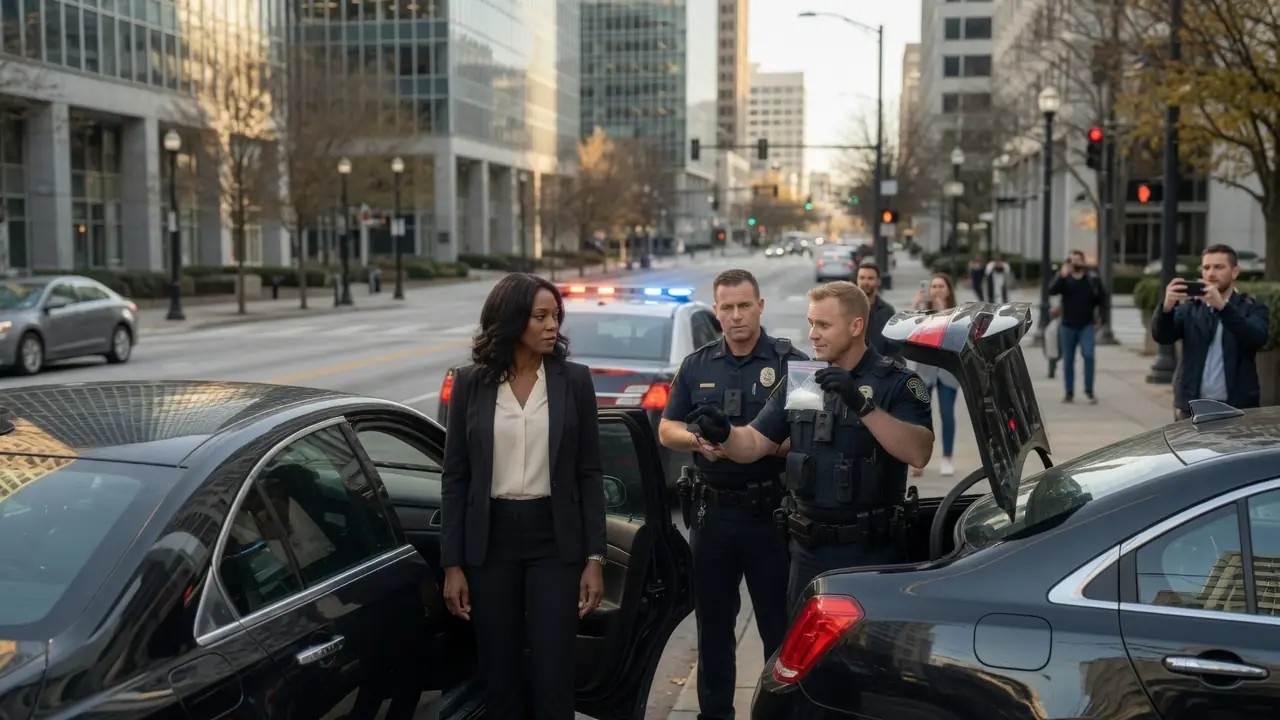
Harland searched the trunk next.
Maya’s luggage compartment contained a folded umbrella, roadside emergency kit, reusable grocery bags, and a clean wool coat.
Cole joined him.
The two men blocked most of the view.
Harland leaned deeper into the trunk.
Then stood.
“What’s this?”
He held up a small transparent plastic bag containing white powder.
The man recording from the sidewalk moved closer.
Maya looked at the bag.
Then at Harland.
“I’ve never seen that before.”
Cole laughed.
“That’s what everybody says.”
“Where exactly did you find it?”
“Inside the lining.”
“Which side?”
Harland’s expression tightened.
“Passenger side.”
Maya nodded.
“Thank you.”
Cole looked confused.
“For what?”
“For answering.”
Harland stepped toward her.
“Turn around.”
Maya did.
He pulled her hands behind her back and applied handcuffs.
They were too tight.
Maya noticed.
Did not complain.
Cole leaned closer.
“You don’t seem surprised.”
“I am observing.”
“Observing what?”
“Everything.”
For the first time, uncertainty touched his face.
Only briefly.
Then Harland took possession of her phone, purse, and car keys.
Maya looked toward the bystander.
Their eyes met.
She did not ask him to record.
She did not need to.
The phone remained raised.
As Cole guided her toward the patrol car, Maya spoke once.
“My vehicle contains a manufacturer-installed security system.”
Harland stopped.
“What kind?”
Maya looked toward him.
“The kind that records certain events.”
That was not entirely true.
It was also not entirely false.
Her Lexus stored limited exterior camera data when the alarm or collision sensors activated. The system did not normally record routine searches.
But Harland did not know that.
His eyes moved toward the car.
Maya saw the fear.
Then it vanished beneath anger.
“Get in.”
She entered the rear seat.
The door closed.
Through the window, she watched Harland and Cole speak beside the trunk.
Harland pointed toward the vehicle.
Cole shook his head.
Then they looked toward the man recording.
Within minutes, a tow truck arrived.
Maya was taken to the Fulton County detention center and booked for possession of a controlled substance with intent to distribute.
The bag allegedly contained forty-two grams of cocaine.
Enough to make the accusation serious.
Enough to justify seizure of the vehicle.
Enough, perhaps, to destroy a person who lacked resources, witnesses, or knowledge.
At the intake desk, Maya answered only basic identifying questions.
The booking officer asked whether she wanted to contact an attorney.
“Not yet.”
“You understand the charge?”
“Yes.”
“You understand you may remain silent?”
“Yes.”
“You sure you don’t want a lawyer?”
Maya looked toward the camera mounted above the counter.
“I’m sure.”
The officer shook his head.
“Your choice.”
Maya was placed alone in a holding cell.
She sat on the narrow bench with her hands folded in her lap.
To anyone watching, she appeared strangely calm.
Inside, her mind was moving quickly.
Officer Nathan Cole.
Sergeant Dennis Harland.
Dark body cameras.
Unlawful entry into the passenger side before consent or probable cause had been established.
Claimed marijuana odor.
Planted bag.
An independent witness recording.
Reflected movement in storefront glass.
Incorrect answer about where the bag was found.
The vehicle’s actual ownership records.
The sealed box of documents.
The time.
The street.
The nearby businesses.
Traffic cameras.
ATM cameras.
Private security systems.
Every city block held more eyes than corrupt officers usually remembered.
Maya did not need to argue on the street.
The street had already recorded the argument for her.
At 11:43 p.m., a detention supervisor approached the cell.
“Ms. Thompson.”
Maya stood.
“You have a visitor.”
“Who?”
“Attorney.”
“I did not request one.”
“He requested you.”
She was taken to a private interview room.
A man in a dark charcoal suit waited behind the glass.
His name was Julian Mercer.
He was fifty-two, silver-haired, and carried himself with the controlled urgency of someone accustomed to entering rooms where people had already made dangerous mistakes.
Maya sat across from him and picked up the telephone.
“You came quickly.”
Julian’s expression remained stern.
“You were supposed to call immediately.”
“I wanted them comfortable.”
“They charged you with trafficking.”
“Possession with intent.”
“This is not the moment to correct me.”
“It is always the moment to be precise.”
Julian closed his eyes briefly.
“You saw the plant?”
“Yes.”
“Clearly?”
“In reflection.”
“Witness?”
“One civilian recording.”
“Body cameras?”
“Off.”
“Dash camera?”
“Unknown.”
“Vehicle?”
“Impounded.”
Julian leaned closer to the glass.
“Did they open the box?”
“Yes.”
“What was inside?”
“Duplicated audit reports.”
His expression sharpened.
“Which reports?”
“The Atlanta police civil asset forfeiture review.”
Julian went silent.
The box contained copies of documents Maya had been preparing for a closed meeting the following morning.
Her consulting work was not vague.
It was confidential.
She served as the lead external investigator for the Georgia Public Integrity Commission, a state-authorized body reviewing corruption, procurement fraud, evidence handling, and abuse of civil asset forfeiture across several law-enforcement agencies.
For eleven months, Maya’s team had examined unexplained traffic stops involving luxury vehicles, cash seizures, and narcotics discoveries across downtown Atlanta.
The pattern was troubling.
Drivers were stopped using vague suspect descriptions.
Officers claimed to smell marijuana.
Vehicles were searched.
Drugs were discovered in nearly identical packaging.
Cash, cars, and property were seized.
Some drivers accepted plea agreements to avoid longer sentences.
Others could not afford prolonged legal battles.
Several cases involved Sergeant Dennis Harland.
Three involved Officer Nathan Cole.
Maya had not been traveling randomly that evening.
She was driving to a secure meeting with the commission’s chief counsel.
The documents in the box were designed to look important but contained no protected witness names.
Her real evidence had never been in the car.
Julian knew that.
He also knew Maya had been under surveillance for two weeks.
“You think they targeted you?” he asked.
“I think they saw the vehicle.”
“You don’t believe they recognized you?”
“Not initially.”
“And after opening the box?”
“They may have.”
Julian looked toward the door.
“We need you released now.”
“No.”
His eyes narrowed.
“Maya.”
“Let them testify first.”
“You want the bail hearing?”
“I want them committed to a story.”
“You already have the arrest report.”
“Reports can be amended.”
“Testimony is harder to retreat from.”
Julian understood.
He did not like it.
“You are playing with your freedom.”
“I’m protecting the investigation.”
“If the judge sets high bail—”
“He won’t.”
“You cannot know that.”
Maya looked at him.
“Bring the folder.”
Julian leaned back.
“The sealed one?”
“Yes.”
“That will expose the operation.”
“You don’t know how far this reaches.”
“No.”
Maya’s voice softened.
“That is why they need to believe they won.”
Julian studied her.
“You always do this.”
“Do what?”
“Become calmest when everyone else should be terrified.”
“Fear is information.”
“So is common sense.”
Maya nearly smiled.
“Tomorrow morning. No public filing before the officers testify.”
Julian nodded reluctantly.
“I’ll coordinate with Judge Langford’s clerk.”
“No advance details to the local prosecutor.”
“You think the district attorney’s office is compromised?”
“I think someone has dismissed seven nearly identical complaints without investigation.”
“That is not proof.”
“No.”
Maya looked toward the detention-room camera.
“It is a reason to be careful.”
The following morning, Maya entered Courtroom 4B wearing the same cream blouse and dark trousers from the traffic stop.
Her hair remained neatly tied back.
She wore no jewelry.
Her wrists showed faint red marks from the handcuffs.
The courtroom was crowded with routine arraignments.
Families waited on hard wooden benches.
Public defenders moved between clients.
Deputies called names.
Officer Cole sat near the prosecutor’s table.
Sergeant Harland stood beside him.
Both men appeared relaxed.
Their report described Maya as evasive, nervous, and argumentative.
It claimed she repeatedly attempted to interfere with the search.
It stated the cocaine had been found beneath the trunk lining after Harland observed a bulge in the carpet.
It also said the officers’ body cameras failed to activate because of a department-wide software update.
Maya read the report once.
Then placed it down.
The assistant prosecutor, Rebecca Sloan, approached.
“Ms. Thompson, do you have counsel?”
“Not appearing yet.”
“You understand this is a serious felony.”
“Yes.”
“We may be willing to discuss reduced charges if you cooperate.”
Maya looked toward the officers.
“Cooperate with what?”
“Information about the source of the narcotics.”
“I have none.”
Sloan lowered her voice.
“The amount supports distribution.”
“Only if the evidence is valid.”
The prosecutor’s expression tightened.
“You should be careful about accusing officers of misconduct without proof.”
“I have not accused anyone.”
“You implied it.”
Maya folded her hands.
“Then perhaps we should listen to their testimony.”
Judge Samuel Langford entered at 10:05.
He was sixty-one, gray-haired, and known for impatience with theatrics from either side.
He reviewed several cases before reaching Maya’s.
“State versus Maya Elaine Thompson.”
Maya stood.
Officer Cole moved to the witness stand for the probable-cause presentation.
The prosecutor guided him through the stop.
“Why did you initiate contact?”
“We received a radio alert regarding a woman in a dark luxury sedan possibly connected to drug activity.”
“Did the defendant match?”
“Yes.”
“What happened when you approached?”
“She was defensive immediately.”
Maya remained silent.
“Did she consent to a search?”
“No, but Sergeant Harland and I detected the odor of marijuana.”
“Did you find marijuana?”
“No.”
“Did you find anything else?”
Cole looked toward Maya.
“Forty-two grams of cocaine concealed in the trunk.”
“Was the defendant placed under arrest?”
“Yes.”
“Did she make any statements?”
“She said she had never seen it.”
The prosecutor nodded.
“No further questions.”
Judge Langford looked toward Maya.
“Do you wish to question the officer?”
“No, Your Honor.”
The judge studied her.
“You have the right.”
“I understand.”
Sergeant Harland testified next.
He repeated the account with confidence.
When asked where the narcotics were located, he said beneath the trunk lining near the driver’s side wheel well.
Maya’s eyes lifted.
On the street, he had said passenger side.
A contradiction.
Small.
Useful.
The prosecutor continued.
“Did Ms. Thompson display nervous behavior?”
“Yes.”
“How?”
“She kept watching our hands. Looking around. Asking procedural questions.”
“Did that raise your suspicion?”
“Absolutely.”
Maya almost laughed.
Observation had become nervousness.
Knowledge had become suspicion.
Silence had become guilt.
When Harland finished, Judge Langford looked toward Maya again.
“Questions?”
“No, Your Honor.”
The prosecutor requested bail set at two hundred and fifty thousand dollars, citing the amount of narcotics, access to an expensive vehicle, and possible flight risk.
Maya remained standing.
Judge Langford removed his glasses.
“Ms. Thompson, do you have anything to say before I rule?”
“No, Your Honor.”
The courtroom murmured.
Even the judge appeared surprised.
“You understand that silence may limit the information available to me.”
“I understand.”
He looked toward the prosecutor.
Then toward the officers.
“I’m prepared to set—”
The courtroom doors opened.
A man in a dark suit entered carrying a sealed black folder.
Julian Mercer walked directly toward the clerk.
A deputy moved to stop him.
Julian displayed identification and spoke quietly.
The deputy’s expression changed.
He allowed him through.
The clerk accepted the folder and carried it to Judge Langford.
The judge looked toward Julian.
“Who are you?”
“Julian Mercer, chief counsel for the Georgia Public Integrity Commission.”
The courtroom became silent.
Officer Cole looked toward Sergeant Harland.
Harland’s confidence disappeared first.
Judge Langford examined the red seal across the folder.
“This filing is marked restricted.”
“Yes, Your Honor.”
“Does the state have notice?”
“No.”
Assistant Prosecutor Sloan stood.
“Your Honor, I object to any ex parte material affecting bail.”
Julian remained calm.
“The folder contains a judicially authorized disclosure order, authenticated surveillance preservation requests, and identification documents concerning Ms. Thompson’s protected assignment.”
Judge Langford looked toward Maya.
Then toward the officers.
He broke the seal.
The first page contained Maya’s commission credentials.
The second identified her as lead investigator in an active corruption inquiry involving falsified traffic stops, planted narcotics, and unlawful asset seizures.
The third page listed names.
Dennis Harland.
Nathan Cole.
Judge Langford stopped reading.
His eyes moved slowly toward the officers.
Harland’s face had gone pale.
Cole looked toward the exit.
The judge continued.
Inside the folder were still photographs taken from a state surveillance vehicle positioned across the avenue the previous night.
Maya had not been alone during the traffic stop.
For the previous week, the commission had maintained distant surveillance due to threats against one cooperating witness.
The camera had captured Sergeant Harland reaching into his jacket pocket before entering Maya’s passenger compartment.
Another photograph showed a small plastic package in his hand.
A third showed the same package disappearing behind the open trunk lid.
The folder also contained an affidavit from the civilian witness who recorded the encounter.
His video had been uploaded automatically to secure cloud storage before officers could seize it.
Judge Langford read the summary twice.
Then closed the folder.
“Sergeant Harland.”
The man remained seated.
The judge’s voice hardened.
“Stand.”
Harland rose slowly.
“Officer Cole. You as well.”
Cole stood.
Judge Langford turned toward the deputy.
“Secure both officers’ service weapons.”
The courtroom erupted in whispers.
Assistant Prosecutor Sloan looked stunned.
“Your Honor, on what basis?”
The judge glanced toward her.
“Counsel, I strongly advise you to read the room before objecting further.”
Two court deputies approached the officers.
Harland stepped back.
“This is a misunderstanding.”
Judge Langford’s expression became cold.
“You testified under oath that the narcotics were found beneath the driver’s side trunk lining.”
“Yes.”
“Your arrest report states passenger side.”
Harland looked toward Cole.
The judge continued.
“Video evidence appears to show you entering the vehicle with a plastic package in your hand.”
“That is not what happened.”
“Then you will have an opportunity to explain it to investigators.”
Cole spoke quickly.
“I didn’t know what he was doing.”
Harland turned toward him.
“Shut up.”
The words echoed through the courtroom.
Cole stopped.
Judge Langford looked toward Julian.
“Does the commission request immediate preservation orders?”
“Yes, Your Honor. For both officers’ personal devices, department lockers, patrol vehicles, body-camera systems, internal communications, and all evidence records connected to twenty-six identified stops.”
“Granted.”
Assistant Prosecutor Sloan stood motionless.
The judge turned toward her.
“Who assigned you this case?”
“Deputy District Attorney Martin Keene.”
Julian opened a second document.
“Your Honor, the commission also requests preservation of Mr. Keene’s communications with Sergeant Harland.”
Sloan looked toward the officers.
Her face changed.
Judge Langford granted that request too.
Then he looked at Maya.
“Ms. Thompson.”
“Yes, Your Honor.”
“Did you know this material would arrive?”
“Yes.”
“You allowed the officers to testify first.”
“Yes.”
“Why?”
“Because reports can be revised before contradictions are exposed.”
The judge studied her.
“You remained in custody overnight to preserve their confidence?”
“Yes.”
Several people in the courtroom turned toward her.
Maya did not look proud.
She looked tired.
Judge Langford leaned back.
“Charges against Ms. Thompson are dismissed without prejudice to any future proceeding based on lawful evidence.”
Julian rose.
“We request dismissal with prejudice as to the alleged narcotics.”
The judge looked at the sealed photographs.
“Granted.”
He turned toward the court reporter.
“The transcript from today’s officer testimony is to be preserved and transmitted to the attorney general’s office.”
Harland’s hands tightened.
“This is political.”
Maya looked at him for the first time since the hearing began.
“No.”
Her voice carried clearly.
“This is documented.”
Court deputies removed both officers.
Cole began speaking before they reached the door.
“I never touched the bag. Harland told me there was an informant tip. He said the car was clean.”
Harland shouted at him to stop.
The doors closed behind them.
Maya sat.
For the first time since the traffic stop, her hands trembled slightly.
Julian moved beside her.
“You all right?”
“Yes.”
“That answer has become unreliable.”
She looked toward the marks on her wrists.
“I’m angry.”
“Good.”
“Why?”
“Because calm is useful.”
Julian gathered his papers.
“But anger reminds you that what happened was not merely evidence.”
The investigation widened within hours.
State agents raided the downtown precinct.
They recovered packets of cocaine from an unlogged locker accessible to Harland.
Each packet used identical plastic bags and nearly identical weights.
Evidence records revealed that substances supposedly seized during fourteen traffic stops had never been tested until weeks after arrests.
In three cases, lab barcodes had been altered.
Officer Cole cooperated quickly.
He claimed Harland recruited him six months earlier.
At first, Cole believed they were targeting known traffickers who escaped prosecution through technicalities.
Harland told him the planted drugs were merely a way to create leverage.
Then cash began disappearing.
Vehicles were seized.
Drivers were pressured into signing property waivers.
Cole received envelopes containing what Harland called “informant reimbursement.”
He knew the money was wrong.
He continued accepting it.
The scheme involved more than two officers.
Deputy District Attorney Martin Keene dismissed complaints against Harland and protected cases from serious review. In exchange, Harland directed seized cash toward private intermediaries who funded Keene’s political campaign.
A tow-yard owner sold impounded vehicles before legal deadlines expired.
An evidence technician replaced planted narcotics with laboratory samples to prevent contamination from revealing their origin.
A patrol supervisor altered body-camera logs to mark deliberate deactivations as technical failures.
The sealed folder had not merely changed Maya’s case.
It opened a structure built to consume people one stop at a time.
Some victims had already served prison sentences.
One was still incarcerated.
A nurse named Camille Brooks had lost custody of her daughter after officers claimed to find cocaine in her car. She accepted a plea agreement because her public defender warned that trial could result in fifteen years.
A restaurant owner lost his delivery van, business savings, and lease deposit during a stop Harland described as suspicious because the man carried twelve thousand dollars in cash.
An elderly widower surrendered his car after officers found pills that were later destroyed before testing.
Each case had seemed isolated.
Together, they formed a machine.
Maya’s team reviewed every arrest.
Convictions were vacated.
Property was returned where possible.
Compensation claims began.
The city resisted admitting liability.
Its attorneys called the misconduct the work of “a limited number of rogue employees.”
Maya rejected the phrase.
At a public hearing, she placed a stack of complaints on the table.
“Rogue behavior is hidden,” she said.
“These complaints were filed.”
She lifted another stack.
“Supervisors read them.”
Then another.
“Prosecutors defended them.”
She looked toward the city council.
“The system did not fail to notice. It repeatedly decided that the people reporting harm were less credible than the officers causing it.”
The hearing was broadcast statewide.
Maya’s calm became a source of public fascination.
News anchors replayed footage of her standing quietly beside the Lexus.
Commentators praised her discipline.
Some called her fearless.
She disliked that word.
She had been afraid.
Afraid Harland might become violent.
Afraid the witness’s recording would disappear.
Afraid the commission had underestimated the network.
Afraid the drugs would be accepted as more believable than her entire life.
Calm did not mean fear was absent.
It meant fear had not been given control of her decisions.
Three weeks after the arrest, the civilian witness visited the commission office.
His name was Daniel Ruiz.
He was twenty-two and worked evenings at the restaurant across from the traffic stop.
Maya met him in a conference room.
“You kept recording after they threatened you,” she said.
Daniel shrugged nervously.
“I almost left.”
“Why didn’t you?”
“My brother got stopped last year.”
His eyes lowered.
“They found drugs in his car.”
Maya became still.
“What was his name?”
“Luis Ruiz.”
She knew the case.
Luis had accepted a five-year plea agreement.
Sergeant Harland conducted the search.
Daniel continued.
“My brother said they put it there. Nobody believed him.”
“Did you?”
“At first.”
He looked ashamed.
“Then the lawyer said everyone says that.”
Maya understood how easily repetition could become false wisdom.
“What made you record me?”
“The officer looked at your car before he looked at you.”
Daniel swallowed.
“And when he opened the passenger door, he turned his body so the camera couldn’t see his hand.”
“You noticed.”
“My brother told me that’s what happened to him.”
The recording helped overturn Luis’s conviction.
He was released after eleven months in prison.
Daniel waited outside the facility with their mother.
Maya stood at a distance.
When Luis emerged, he looked thinner and older than the photograph in his case file.
His mother reached him first.
Daniel followed.
Nobody cheered.
Freedom returned after injustice was not the same as receiving life untouched.
Months later, Harland went to trial on charges including evidence tampering, civil-rights violations, conspiracy, perjury, false imprisonment, and drug distribution.
Officer Cole pleaded guilty and testified for the prosecution.
He described the first time Harland asked him to participate.
A young woman had been driving a new Mercedes.
“She looked like she could afford a lawyer,” the prosecutor said.
Cole shook his head.
“Harland said expensive cars made better seizures.”
“Did race influence selection?”
Cole hesitated.
“Yes.”
“How?”
“He said Black drivers in luxury vehicles attracted fewer sympathetic jurors.”
The courtroom became silent.
Maya sat behind the prosecution table.
She had expected ugliness.
Its plainness still shocked her.
Harland’s attorney argued that the commission had manufactured the case to justify its budget.
He claimed Maya intentionally provoked the traffic stop.
During cross-examination, he asked why she refused to identify herself as a state investigator.
“Because my profession was not relevant to whether officers could plant evidence,” she answered.
“You could have prevented your arrest.”
“I could have revealed an investigation and allowed corrupt officers to destroy evidence.”
“You wanted to be arrested?”
“No.”
“Yet you allowed it.”
“I complied with unlawful actions because resistance would have increased physical danger.”
The attorney paced.
“You expect this jury to believe you remained perfectly calm while being framed?”
Maya looked toward the jurors.
“No.”
She turned back to him.
“I expect them to believe I remained outwardly calm.”
“What is the difference?”
“I was terrified.”
The answer altered the room.
The attorney had expected certainty.
Maya gave him truth.
“My hands shook after the hearing,” she continued. “I did not sleep properly for weeks. I still check mirrors when a patrol car follows me.”
She looked toward Harland.
“Courage is not evidence that harm did not occur.”
Harland was convicted on all major counts.
The judge sentenced him to twenty-eight years in federal prison.
Cole received seven years because of his cooperation.
Martin Keene received twelve.
Other participants received sentences ranging from probation to fifteen years.
No punishment restored the time victims lost.
Still, records mattered.
Public truth mattered.
Names cleared mattered.
The Atlanta Police Department introduced new controls.
Body-camera deactivation triggered automatic supervisory review.
Searches based on claimed odor required contemporaneous documentation.
Evidence discovery had to be photographed before removal whenever safely possible.
Civil asset seizures required review by an independent unit outside the arresting precinct.
Complaints alleging planted evidence could no longer be closed solely on the accused officer’s statement.
Maya supported the reforms.
She also warned that rules alone would not create integrity.
“Every corrupted system contains written policies against corruption,” she told a training class.
“The question is what happens when following policy becomes inconvenient to someone with power.”
A young recruit raised his hand.
“What should officers do when they suspect a colleague?”
“Document.”
“What if the colleague is senior?”
“Document.”
“What if reporting ends your career?”
Maya looked toward him.
“Then decide whether the career you are protecting still deserves you.”
A year after the traffic stop, Maya returned to the same avenue.
The restaurant remained open.
The glass storefront still reflected passing cars.
She parked near the curb and stood beside the place where Harland had placed her in handcuffs.
Daniel Ruiz approached carrying two cups of coffee.
“You sure this is where you wanted to meet?”
“No.”
He handed her one.
“Then why here?”
Maya looked toward the reflected street.
“Because I kept avoiding it.”
Traffic moved around them.
A patrol car passed.
Her shoulders tightened automatically.
Daniel noticed but said nothing.
Maya watched the vehicle disappear.
“I used to think staying calm meant I controlled the moment.”
“Didn’t you?”
“No.”
She looked toward him.
“I controlled myself. That’s different.”
Daniel nodded.
“My brother still won’t drive.”
“How is he?”
“Working with my uncle.”
“Counseling?”
“He says he doesn’t need it.”
“He might.”
“I know.”
They stood quietly.
Across the road, a woman loaded groceries into a dark sedan.
A police vehicle slowed.
Then continued.
Daniel asked, “Do you think what happened changed anything?”
“Yes.”
“Enough?”
“No.”
Maya took a drink of coffee.
“Enough is not how change usually arrives.”
“How does it arrive?”
“Specific cases. Specific policies. Specific people refusing to look away.”
Daniel looked toward the storefront window where he had first recorded.
“Like me?”
“Like you.”
He smiled faintly.
For Maya, the sealed folder became the most famous part of the story.
People remembered the courtroom doors opening.
The judge breaking the seal.
The officers losing confidence.
The dramatic reversal.
But the folder had not created the truth.
It contained truth already gathered through months of quiet work.
Complaints people had dismissed.
Patterns nobody wanted to see.
Victims who had repeated the same account until repetition was mistaken for excuse.
The folder mattered because someone finally carried those voices into a room where power had to listen.
Years later, Maya became director of the Public Integrity Commission.
She kept no photographs from the traffic stop in her office.
No newspaper clippings.
No framed copy of the dismissed charge.
Instead, one small transparent evidence bag rested inside a sealed display case.
It was empty.
Beneath it was a plaque containing a single sentence.
EVIDENCE MUST REVEAL THE TRUTH, NOT CREATE IT.
New investigators often asked whether it was the bag planted in Maya’s car.
It was not.
The real bag remained secured in a federal evidence vault.
The empty one represented every case in which accusation had been treated as proof merely because a uniform delivered it.
Maya told investigators never to become impressed by authority.
“Authority is a responsibility,” she said. “Not a substitute for verification.”
On the fifth anniversary of her arrest, she received a letter from a young woman in another state.
The woman had been stopped with her six-year-old daughter in the car.
An officer claimed to find pills beneath the passenger seat.
Remembering Maya’s case, she asked officers to preserve body-camera footage and requested the vehicle’s manufacturer data immediately.
Video later showed an officer entering the car with an object in his hand.
The charges were dismissed.
The woman wrote:
I stayed calm because I remembered you.
Maya read the sentence twice.
Then she wrote back.
You stayed calm because you were strong enough to think while someone tried to frighten you.
But please remember this:
You would still have deserved justice if you had cried.
You would still have deserved justice if you had panicked.
Calm should never be the price of being believed.
That was the lesson Maya carried longest.
People praised her because she did not shout.
Did not resist.
Did not appear afraid.
Yet innocent people were allowed to be frightened.
They were allowed to cry.
They were allowed to misunderstand procedures, ask imperfect questions, and call for lawyers immediately.
Justice could not belong only to those trained well enough to survive injustice gracefully.
The officers believed Maya Thompson was merely another woman in an expensive car.
Someone they could frighten into silence.
Someone whose denial would sound like every denial before it.
They planted the drugs.
Wrote the report.
Told their story under oath.
And believed the uniform would make it true.
Maya let them finish.
Then the courtroom door opened.
A sealed folder reached the judge.
And for the first time, the officers learned what it felt like when evidence stopped serving them and began speaking for everyone they had tried to silence.