“Turn it off.” “No. We got complaints.” “It’s low volume. I have a permit. I’m not breaking the law.”
“Don’t argue with me. Stand up. ID, right now.” “Your order isn’t lawful without a crime. Look at my credentials.”
“Don’t reach. Hands up. Turn around. Do it.” Officer Derek Miller had been patrolling the streets of Metro City for just six years when he made the decision that would implode his life, humiliate his department, and cost the taxpayers $4.8 million.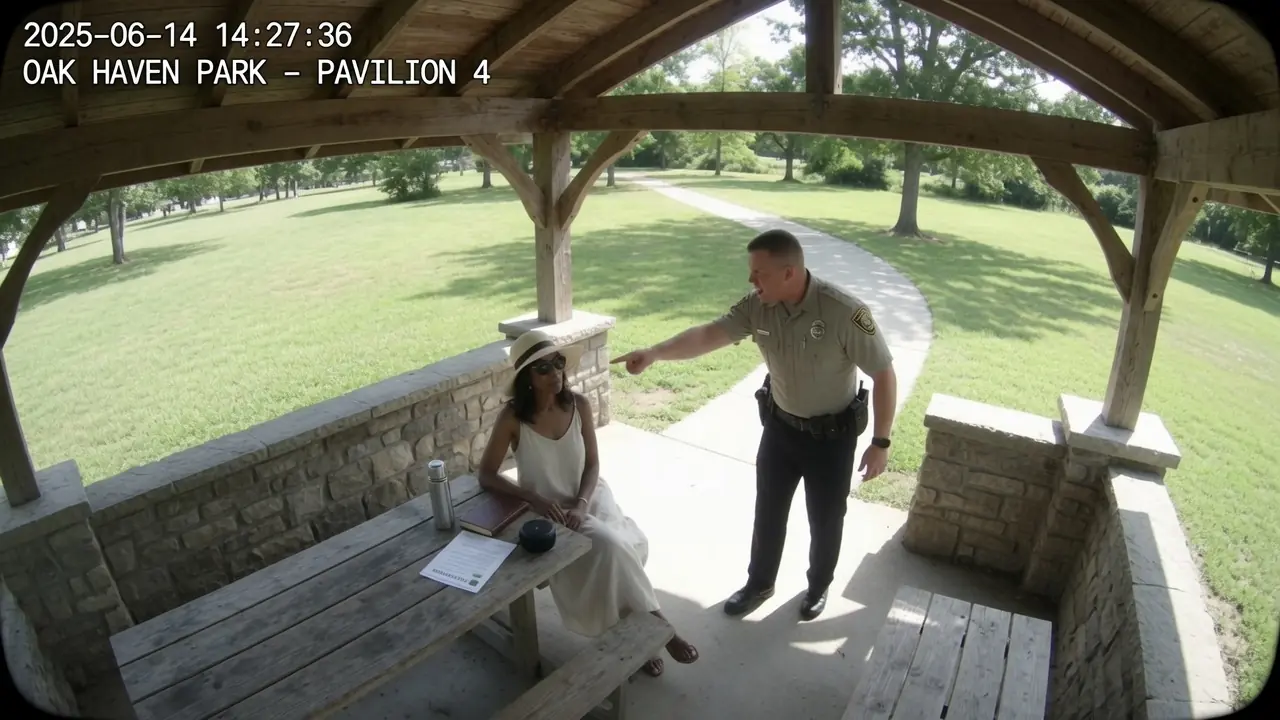
He was 32 years old, young enough to still have ambition, but old enough to have developed a dangerous sense of entitlement. He walked with a swagger that suggested he was the law rather than a servant of it. He believed his badge granted him immunity from consequences, and that his instincts were sharper than the Constitution. But on a bright sunny Saturday afternoon in Oak Haven Park, those instincts would fail him spectacularly. He was about to go toe-to-toe with a woman who didn't just know the law, she wrote the indictments that put career criminals behind bars.
Oak Haven Park is the crown jewel of the city's north side. It's a sprawling expanse of manicured green lawns, ancient oak trees, and limestone pavilions that host family reunions and birthday parties every weekend. It's the kind of place where the grass is always cut to a perfect two inches and the air smells like charcoal grills and blooming magnolia. It was 2:00 p.m. on a Saturday in May. The sky was a piercing blue without a cloud in sight.
The park was alive with activity families throwing Frisbees joggers on the perimeter trail and couples pushing strollers. It was the picture of suburban tranquility. Sitting at the Pavilion 4, a secluded stone structure near the duck pond was Elena Ross. To the casual observer, she was just a woman in her early 50s enjoying the weather. She wore a linen sundress, a wide-brimmed sun hat, and oversized sunglasses.
She was reading a hardcover biography, sipping iced tea from a thermos, and listening to soft jazz playing from a small high-end Bluetooth speaker sitting on the picnic table. The volume was low, barely drifting past the edge of the pavilion's concrete slab. It was Miles Davis kind of blue music for thinking, for relaxing, for decompressing. Elena Ross needed the decompression. She had spent the last 2two weeks in a high-security federal courtroom dismantling a multi-state racketeering syndicate.
She hadn't seen the inside of a park or the sun on a Saturday in months. At 5three years old, Elena was a formidable presence, even when relaxing. She moved with the deliberate grace of someone who never wasted energy. She had reserved the pavilion through the city's parks department weeks ago, specifically requesting this spot for its distance from the playgrounds. She wanted silence.
She wanted peace. She wanted to listen to her jazz and read her book without answering a single email or objection. But peace is a fragile thing when bias walks into the frame. While most people in the park saw a woman enjoying her afternoon, one man saw something else entirely. He didn't see a neighbor.
She had spent 15 years prosecuting organized crime, dismantling cartels, and putting away domestic terrorists. She was known as the Iron Lady of the Federal Courthouse, a woman who could cross-examine a hostile witness with such surgical precision that they would thank her for destroying them by the time she was done. She knew the penal code better than she knew her own family history. She knew the Fourth Amendment like the back of her hand. She had written training manuals for federal agents on proper search and seizure protocols.
She was the last person on earth you wanted to bluff. But Brad Sterling didn't know any of that. Brad was 39 years old, a man who had peaked in high school and spent the last two decades trying to reclaim that feeling of importance. He lived in one of the condos bordering the park and had appointed himself the unofficial guardian of Oak Haven's character. He was the type of man who measured the grass height of his neighbors’ lawns and reported expired registration tags on parked cars.
He walked the park trails daily, not for exercise, but for surveillance. He was looking for problems, and when he couldn't find them, he invented them. That Saturday, Brad was on his patrol when he heard the faint notes of a trumpet. He stopped his head cocked like a hunting dog. He followed the sound to pavilion 4.
He saw Elena. He saw a woman alone claiming a large pavilion that could have been used by local families. He saw the speaker. In Brad's mind, the volume wasn't low. It was deafening.
The music wasn't jazz. It was urban noise. The woman wasn't reading. She was loitering. Brad stood on the path about 50 feet away watching her.
He checked his watch. She had been there for an hour. He decided that was long enough. He pulled out his phone, his thumb hovering over the camera app before switching to the dialer. He didn't approach her.
He didn't ask her to turn it down, mostly because he knew it wasn't actually loud, and he knew she would likely politely decline. Brad wanted a scene. He wanted authority. He wanted to see her removed. He dialed the non-emergency line, but his voice carried the frantic energy of a man under siege.
“Yes, this is Brad Sterling. I’m at Oak Haven Park. There is a woman here blasting music, absolutely blasting it. It’s vibrating the windows of the nearby condos.” This was a lie.
The nearest condo was 300 yards away. “She’s screaming at people who walk by. I think she’s intoxicated or on drugs. It’s creating a very hostile environment for the children.” The dispatcher, familiar with Brad's number, but bound by protocol, asked the standard questions.
“Is she armed? Is she violent?” "She's aggressive," Brad said, lowering his voice to a conspiratorial whisper. “She looks like she could be armed. She’s staring me down right now.
I don’t feel safe. You need to send someone before this gets out of hand. It’s gang-related music.” The call was logged. A disturbance suspicious person ticket was printed and Officer Derek Miller patrolling three streets away in his cruiser saw it pop up on his computer terminal.
Officer Derek Miller read the dispatch notes. Subject playing loud music, shouting at passersby possible intoxication complainant feels threatened. Miller felt a surge of adrenaline. This was what he liked, a tangible problem, a bad actor ruining a nice day. Miller had a reputation in the precinct and not the good kind.
His file was thick with counseling memos, the department's polite way of saying he had a temper. He had four formal complaints in the last two years. One for using profane language with a grandmother during a traffic stop, two for escalating verbal disputes into shoving matches, and one for an unlawful search of a vehicle that got thrown out of court. His sergeant had told him just last week. “Miller, you need to learn to talk to people.
You’re a hammer, and you think everything is a nail. Dial it back.” But Miller didn't believe in dialing it back. He believed in establishing control. In his mind, the streets were chaotic and he was the iron fist that brought order.
When he saw the call was at Oak Haven Park, his bias kicked into overdrive. “Oak Haven,” he thought. That's a nice area. If someone is causing trouble there, they don't belong there. He didn't consider that the caller might be exaggerating.
He didn't consider that gang music was a racially coded dog whistle from a biased civilian. He accepted the narrative immediately. There is a dangerous person in the park and it is my job to neutralize the threat. Miller pulled his cruiser onto the grass, bypassing the parking lot entirely to drive right up to the pavilion path. He wanted to make an entrance.
He wanted to shock the subject into submission. He put the car in park, leaving the lights flashing, and stepped out. He adjusted his belt, checked his body cam was on. He loved the camera. He thought it showed how tough he was, and marched toward Pavilion 4.
The first thing he noticed was the quiet. There was no shouting. There was no window-rattling bass. There was just the wind in the trees and the very faint melancholic sound of a saxophone. But Miller was already committed to the narrative.
If it wasn't loud now, she must have turned it down when she saw the cop car. That was proof of guilt. He saw Elena Ross. She hadn't moved. She hadn't even looked up from her book when he slammed his car door.
This infuriated him. To Derek Miller, a lack of immediate attention was a sign of disrespect. A suspect should be nervous. A suspect should be looking for an exit. Elena Ross was turning a page.
Miller stomped onto the concrete slab of the pavilion, his shadow falling across her book. “Turn it off,” he barked. No greeting. No. “Good afternoon.” Just a command.
Elena paused. She placed a bookmark in her book and slowly looked up. She lowered her sunglasses, revealing eyes that had stared down cartel bosses and serial killers. She looked at Miller's name plate, then at his face. She didn't reach for the speaker.
"Excuse me," she said. Her voice was calm, educated, and icy. The music," Miller said, stepping closer, invading her personal space. “Turn it off now. We got complaints.
You're disturbing the peace." Elena Ross looked at the small Bose speaker. Then she looked back at Officer Miller. "Officer Miller," she said, reading his tag again. "This is a public park.
The city ordinance for noise in public spaces, specifically Section 14B, allows for amplified sound as long as it does not exceed 60 decibels at a distance of 50 feet. As you can hear, or perhaps fail to hear, this music is barely audible at 10 feet. I am not disturbing the peace." Miller blinked. He wasn't expecting a citation of the municipal code.
He was expecting an apology or an argument he could shout down. Intelligence in a suspect always made him defensive. It made him feel small, and Miller hated feeling small. I don’t care about the decibels, Miller snapped. I have a complainant who says you're screaming at people and acting aggressive, and right now arguing with police is exactly the kind of attitude that gets you in trouble.
So, I'm telling you again, turn the music off or I'm seizing the equipment. Elena closed her book. She stood up. She was 5'7, but she carried herself with the posture of someone much taller. “Officer, the complainant lied to you.
I have been sitting here reading for 2 hours. I haven't spoken to a soul. I have a permit for this pavilion. She gestured to a printed paper taped to the table, which grants me exclusive use of this space until 5:00 p.m. If you would like to see my identification and the permit, I am happy to provide them, but I will not be turning off my music because I am not violating any laws.” Miller's face turned a shade of red that matched the stripes on the flag patch on his shoulder.
This was it, the challenge. She was saying no. You think you're a lawyer or something?" Miller sneered. "I am a lawyer, actually," Elena said.
"And I know that you are currently detaining me without reasonable suspicion of a crime. A false noise complaint does not give you the authority to harass a citizen complying with the law." Miller took a step back and put his hand on his radio. “Okay, you want to play it that way? You’re refusing a lawful order.”
“An unlawful order is not a lawful order just because a police officer says it,” Elena corrected him. And you haven't identified what crime I'm committing. “Disorderly conduct,” Miller said, grasping for the catch all charge officers used when their feelings were hurt. Creating a public nuisance and now failure to obey. Failure to obey an order that has no legal standing is not a crime, Officer Miller.
Elena reached for her purse. “I am going to show you my credentials. I suggest you look at them very carefully before you take another step. “Don’t reach for anything!” Miller shouted, his hand dropping to his holster.
The sudden escalation was jarring. Families in the distance stopped playing, heads turned. “Put the bag down. Hands where I can see them.” Elena froze.
She knew the statistics. She knew that a movement toward a purse could be interpreted as a reach for a weapon, and she knew that officers like Miller were looking for an excuse. She slowly moved her hands away from the purse and held them out, palms open. "I am a federal prosecutor," Elena said, her voice projecting clearly now so that the witnesses gathering on the jogging path could hear. "My credentials are in that bag.
I am identifying myself as a deputy chief of the United States Attorney's Office. “You are making a mistake that will end your career.” Miller laughed, a short, nervous, arrogant bark of a laugh. “Yeah, right. And I’m the police commissioner.
You're a federal prosecutor sitting in a park listening to gang music. I don't buy it. You’re probably carrying a fake badge you bought online.” The bias was so thick it was suffocating. To Miller, a woman in a park didn't look like a federal prosecutor.
She looked like a problem. He couldn't reconcile the reality in front of him with the prejudices in his head. "Turn around," Miller commanded. "You're under arrest." "For what?"
Elena demanded. “Disorderly conduct, resisting arrest, and failure to identify.” Miller lied. She hadn't failed to identify. He had refused to look at her ID.
“I am not resisting,” Elena said loudly. I am complying under duress. I am informing you that you are violating my Fourth Amendment rights. You have no probable cause. You are arresting me based on a fraudulent 911 call and your own racial bias.
“Turn around.” Miller grabbed her arm. He didn't wait for her to turn. He spun her. He was rough, far rougher than necessary.
He wrenched her right arm behind her back, twisting the shoulder joint. Elena winced, but did not scream. She wouldn't give him the satisfaction of seeing her in pain. Brad Sterling, the caller, had walked closer. He was standing near the path phone out recording.
He looked smug. He thought he had won. He thought he was watching justice. He had no idea he was documenting his own demise. "That's right, officer!"
Brad shouted. “Take her in. She’s been threatening everyone.” Elena looked directly at Brad's camera. “My name is Elena Ross.
I am a U.S. attorney. This man filed a false police report. This officer is arresting me without cause.” Miller shoved her forward, pushing her chest against the stone pillar of the pavilion. “Shut up.
You have the right to remain silent, so use it.” “I know my rights better than you do, officer,” Elena said calmly against the stone. And I know you are required to verify credentials when they are offered. You are willfully ignoring exculpatory evidence. Miller slapped the handcuffs on her wrists.
He ratcheted them tight. Click, click, click. Too tight. He wanted them to hurt. The walk to the patrol car was a parade of shame, but not for Elena.
It was shameful for the city. Bystanders had their phones out. A young mother with a stroller yelled out. “She wasn’t doing anything. We’ve been here for an hour.
She was just reading.” Miller ignored the crowd. “Back up! Police business!” He shouted at the witnesses.
He shoved Elena into the back of the cruiser. The hard plastic seat was uncomfortable, the handcuffs digging into her lower back. Miller got into the front seat, slamming the door, the air conditioning was blasting. “You really stepped in it now,” Miller said, looking at her in the rearview mirror. Impersonating a federal officer.
“That’s a felony. I’m going to book you for that, too.” Elena sat perfectly straight. She stared into the mirror, locking eyes with him. “Officer Miller, I want you to remember this moment.
I want you to remember the feeling of power you have right now because it is the last time you will ever feel it. Miller scoffed and put the car in drive. “We’ll see what the sergeant says about your fake badge.” The drive to the 12th precinct took 15 minutes. Elena spent the time memorizing the ride, the speed he drove, the fact that he didn't seat belt her in the way he braked aggressively to toss her around the back seat.
She was building her case file in her head. She cataloged the charges false arrest, assault, battery deprivation of rights under color of law, 18 U.S.C. Section 242. Miller was humming to himself. He felt good.
He had cleaned up the park. He had taken down a defiant suspect. He was already thinking about how he would write the report to make her sound dangerous. Subject was belligerent blading his body and reaching for a waistband. The standard creative writing of bad policing.
They pulled into the precinct sallyport. Miller hauled her out of the car. He marched her through the back intake door past the holding cells and up to the booking desk. The desk sergeant was Thomas Reynolds. Sergeant Reynolds was 58 years old, a man with 35 years on the job.
He was tired. He was two years from retirement. He looked up from his paperwork as Miller strutted in with his prize. Reynolds looked at Miller. Then he looked at the woman in handcuffs.
Reynolds froze. His pen dropped from his hand. He didn't just recognize her face. He recognized her presence. He had testified in her court 3 months ago regarding a RICO case.
He knew exactly who she was. "Miller," Reynolds said, his voice trembling slightly. “Why is the deputy chief of the Criminal Division in handcuffs?” Miller stopped, his smile faltered. "The who is Elena Ross," Reynolds said, standing up slowly.
"She is the U.S. attorney for the Southern District. She is the highest ranking federal prosecutor in this city. “Miller, what did you do?” Miller looked at Elena. She looked back.
Her expression one of absolute terrifying calm. I tried to tell him, "Sergeant. He told me my badge was fake and refused to look at it.” Reynolds came around the desk. He didn't walk.
He ran. “Unlock her now. Right now.” “Sarge, she was playing loud music. She refused to identify herself.”
Miller stammered the color draining from his face. “Unlock her!” Reynolds roared a sound that echoed through the booking area. Miller fumbled for his keys. His hands were shaking.
The realization hit him like a physical blow. The confidence evaporated, replaced by a sick, cold dread in his gut. He unlocked the cuffs. Elena rubbed her wrists. There were deep red indentations where the metal had bitten into her skin.
She looked at Reynolds. “Sergeant Reynolds, good to see you again. I wish the circumstances were different.” "Ms. Ross, I I don't know what to say," Reynolds said. “I’m so sorry.
Are you injured?” "My shoulder is strained. My wrists are bruised," Elena said. But my civil rights are the primary casualty today. Captain Harris, the precinct commander, burst out of his office.
He had heard the shouting. “What is going on out here?” “Miller arrested Elena Ross,” Reynolds said, pointing at the junior officer, who was now backing away toward the wall for noise violation. Captain Harris looked at Elena. He looked at Miller.
He looked at the handcuffs on the counter. Officer Miller, Harris said, his voice dropping to a whisper that was scarier than a shout. “Give me your badge and your gun. Place them on the counter.” Captain, I didn't know.
Miller pleaded. You didn't verify. Elena interjected. You assumed. You saw a woman in a park and decided she was a criminal.
You escalated a non-existent noise complaint into a false arrest. You ignored my identification. You used excessive force. badge and gun. Now, Harris repeated. Miller unbuckled his holster with trembling fingers.
He placed the Glock 17 on the mat. He unpinned his badge, the badge he loved so much, and laid it next to the gun. "You are relieved of duty pending an internal investigation," Harris said. “Get out of my station.” Miller walked out the front door, stripping the Velcro patches off his uniform as he went.
He was a civilian now, and he was about to learn that the legal system he had abused was very, very efficient when it turned its gaze on one of its own. The fallout was swift nuclear and absolute. The video recorded by Brad Sterling, the one he thought would vindicate him, was subpoenaed. Ironically, Brad had uploaded it to a neighborhood watch group before the arrest was even over. By Monday morning, it had been ripped and shared across the globe.
The title, Officer Arrests U.S. attorney for listening to jazz, was trending number one on every platform. The video clearly showed the quiet park the reasonable volume of the music and Miller's unhinged aggression. It showed Elena's calm, professional demeanor. The lawsuit was filed on Tuesday. Elena Ross v. the City of Metro, Derek Miller, and Brad Sterling.
The city didn't even try to fight it. The evidence was insurmountable. The Department of Justice threatened a pattern or practice investigation into the entire police department if they contested the claim. The city attorneys looked at the video, looked at Elena Ross, who would be representing herself along with a team of civil rights experts, and cut the check. $4.8 million. It was one of the largest settlements for a wrongful arrest in the state's history.
Derek Miller was fired five days after the incident. But it didn't end there. Elena Ross pressed criminal charges. Miller was indicted for deprivation of rights under color of law and assault. He pleaded guilty to avoid a federal prison sentence that would have put him away for ten years.
He received three years of probation and is permanently barred from holding any position in law enforcement or security anywhere in the United States. He now works in a warehouse packing boxes, a job where he has no authority over anyone. Brad Sterling, the caller, faced his own reckoning. He was sued for defamation and filing a false police report. While he avoided jail time, the civil judgment against him for malicious prosecution bankrupted him.
He lost his condo overlooking the park. He had to move back in with his parents at age 40. His name is now synonymous with the weaponization of 911. Elena Ross donated a significant portion of her settlement to the Legal Aid Society, establishing a fund specifically for victims of racial profiling who cannot afford top-tier legal representation. She returned to work two weeks later.
She still goes to Oak Haven Park on Saturdays. She still sits at Pavilion 4. She still listens to Miles Davis. But now when police cars drive by, they slow down, wave respectfully, and keep moving.