“Go back where you belong. You are not fooling anybody with that college sweater.”
Officer Bradley Thompson’s words sliced through the Chicago afternoon like a blade.
The woman in the Northwestern hoodie stood frozen as his spit landed on her shoe with a sickening splat.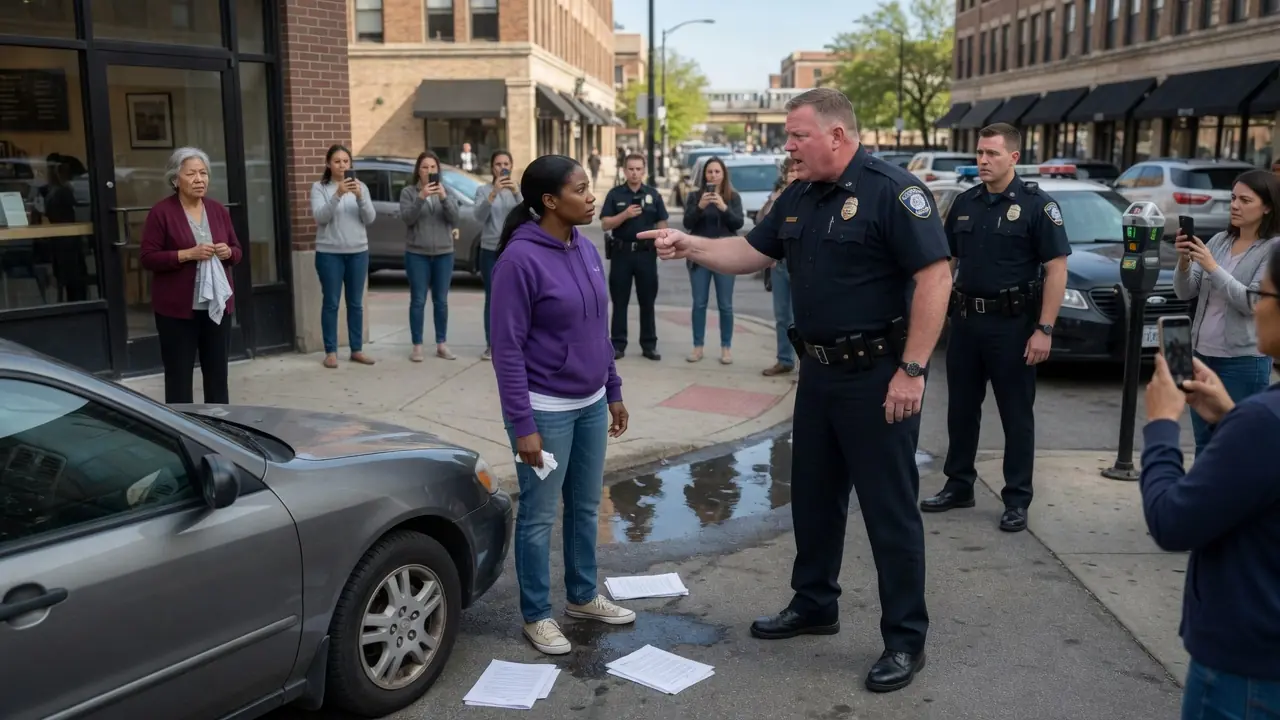
The busy street corner erupted in gasps.
Phones rose instantly, recording every second.
Thompson’s police badge gleamed as he leaned closer, his breath reeking of stale coffee.
“You people always think you are above the law, don’t you?” he said, his thick fingers jabbing toward her face. “Probably stole that car, too.”
The woman slowly pulled out a tissue and wiped the saliva from her canvas sneaker.
Her hands remained steady.
Her eyes never left his face.
“What?” Thompson sneered. “Going to cry about it? File another useless complaint?”
Have you ever witnessed someone destroy their entire life in ten seconds?
Have you ever seen karma arrive faster than a speeding bullet?
Six hours earlier, Jasmine Williams had awakened in her Lincoln Park townhouse to the soft buzz of her phone.
The morning light filtered through sheer curtains, casting golden streaks across the framed commendations on her dresser.
Twenty years of service.
Dozens of awards.
All deliberately tucked away in her bedroom drawer today.
She wanted to be invisible.
Just another citizen enjoying her day off.
Her daughter Maya’s text glowed on the screen.
Good luck at Northwestern today, Mom. Proud of you.
Jasmine smiled, running her fingers over the civilian clothes laid out on the chair.
Faded jeans.
A comfortable Northwestern hoodie she had bought from the campus store.
Canvas sneakers instead of polished boots.
Today, Captain Jasmine Williams did not exist.
Today, she was just Ms. Williams, guest speaker.
The drive to Northwestern took her through Chicago’s divided landscape.
From her tree-lined street in Lincoln Park, past the gleaming high-rises, into neighborhoods where prosperity and poverty lived side by side.
She noticed the increased police presence.
Three patrol cars in four blocks.
Officers standing on corners, hands on their belts, eyes scanning.
The law school auditorium was packed with eager faces.
Professor Carter introduced her simply.
“Please welcome Ms. Williams, our special guest on community policing.”
No mention of her rank.
No mention of her two decades fighting corruption from inside the system.
She had requested it that way.
“Who here has had a negative encounter with police?” Jasmine asked the students.
Nearly every hand rose.
hands.
Brown hands.
Even white hands.
The room’s energy shifted and became heavier.
“Today, we are going to talk about your rights,” she said, clicking to her first slide. “Because knowing them might save your life.”
For ninety minutes, she walked them through constitutional protections, de-escalation techniques, and the proper channels for filing complaints.
Students scribbled notes furiously.
Some recorded on their phones.
One young woman wearing a hijab raised her hand.
“What if the officer does not care about our rights?”
Jasmine paused, choosing her words carefully.
“Document everything,” she said. “Record if you can. And never, ever lose your composure. Your dignity is your power.”
After the lecture, Jasmine stopped at Grounded Cafe on Clark Street.
The familiar smell of Ethiopian coffee beans and fresh pastries wrapped around her like a warm embrace.
Mrs. Carter, no relation to the professor, looked up from behind the counter, her weathered face breaking into a smile.
“Jasmine. Day off, finally?”
Jasmine laughed and ordered her usual dark roast.
“How’s business?”
Mrs. Carter’s smile faded.
“That officer Thompson was here again yesterday. Gave three tickets to customers just for double parking while picking up orders. All customers, you understand?”
Jasmine’s jaw tightened.
She knew Thompson by reputation.
Badge number 5847.
The precinct’s worst-kept secret.
Thirty-one complaints filed against him over five years, all mysteriously dismissed.
His father-in-law ran the police union, a detail that explained his untouchable status.
“They call him the Intimidator,” Mrs. Carter whispered, glancing at the door. “He seems to enjoy it, especially around here, where Lincoln Park meets the real world.”
The area was a borderland.
Young white professionals jogged past elderly residents who had lived there for generations.
And in between, officers like Thompson played king.
“Someone needs to stop him,” Mrs. Carter said, wiping down the counter with aggressive strokes.
Jasmine sipped her coffee slowly.
“Someone will.”
At 11:45, she walked back to her Honda Accord, deliberately chosen for its invisibility.
No vanity plates.
No police parking stickers.
Nothing to indicate she was anything more than another professional trying to navigate the city.
The parking meter showed fifteen minutes remaining.
She had been careful, as always, to overpay.
But as she approached, she saw the patrol car.
It was parked at an angle, deliberately blocking her in.
Officer Bradley Thompson leaned against her car, writing in his ticket book.
His bulk cast a shadow across her windshield.
His uniform was crisp, almost militaristic in its precision, the kind of officer who confused fear with respect.
Jasmine took a breath, feeling her phone in her pocket.
She thought about the student’s question.
What if the officer does not care about our rights?
She was about to find out.
The coffee in her stomach turned cold as Thompson looked up, his pale blue eyes narrowing at her approach.
His hand moved instinctively to his belt, fingers drumming against his equipment.
The street suddenly felt smaller.
The beautiful afternoon dimmed.
And somewhere in the universe, karma checked its watch and began counting down.
“This your vehicle?”
Thompson’s voice carried the weight of assumed guilt, each word deliberately slow, like he was talking to a child.
Jasmine kept her hands visible, moving with the practiced caution every person learns from childhood.
The afternoon sun beat down on the asphalt, making heat waves shimmer between them.
“Yes, officer. Is there a problem?”
“Meter’s expired.”
He did not look up from his ticket book, his pen scratching against paper with aggressive strokes.
“Officer, there are still fifteen minutes.”
She pointed at the digital display showing 0:15 in bright green numbers.
“You calling me a liar?”
His head snapped up, pale blue eyes flashing with something darker than annoyance.
A vein pulsed at his temple.
The question hung in the air like a loaded gun.
Jasmine recognized the trap immediately.
Say yes, and she was aggressive.
Say no, and she admitted to a violation that did not exist.
The street noise seemed to fade, leaving only the sound of her steady breathing.
“I am simply pointing out what the meter shows,” she said evenly, keeping her voice neutral and factual.
Thompson slammed his ticket book shut.
The sound cracked like a whip, making several pedestrians jump.
“You have a smart mouth. Typical.”
The word landed exactly as intended.
Jasmine felt her pulse quicken, but kept her face neutral.
Her hands remained loose at her sides.
Non-threatening.
Around them, the lunch crowd began to notice the confrontation.
A young couple slowed their walk, pretending to window shop while watching.
A delivery driver leaned against his truck, phone already recording.
“May I document the meter?” Jasmine asked, reaching slowly for her phone and announcing her movement.
“Put the phone down now.”
Thompson’s hand moved to his weapon, fingers wrapping around the grip.
She froze completely.
In broad daylight, on a busy Chicago street, his hand rested on his gun because she wanted to photograph a parking meter.
The absurdity might have been funny if it had not been potentially lethal.
The metal of his badge caught the sun, temporarily blinding her.
“I am putting it away,” she said, sliding the phone back into her pocket with glacial slowness. “No sudden movements.”
Mrs. Carter emerged from the cafe, a dish towel still in her weathered hands.
The elderly woman’s face showed a mixture of fear and determination.
“Officer, she has been parked there legally. I saw her pay the meter myself.”
“Mind your business, Grandma, or you are next.”
Thompson did not even turn to look at her.
He dismissed her with a wave.
Mrs. Carter’s face flushed, but she held her ground, her small frame straightening with dignity.
“I have owned this business for thirty years. This is my street, too. I know my rights.”
“Your street?” Thompson laughed, a harsh bark without humor. “We will see about that after I am done here.”
He looked back at Jasmine.
“License and registration. Now.”
Jasmine moved deliberately to her pocket, narrating each action.
“I am reaching for my wallet, officer.”
“I did not ask for a play-by-play. Just do it. And hurry up. I do not have all day.”
She handed over her civilian driver’s license, the one that listed her as simply Jasmine Williams with no rank or indication of her real job.
Thompson studied it like he was decoding enemy intelligence.
He turned it over multiple times, holding it up to the light.
“Jasmine Williams,” he read slowly, overemphasizing each syllable mockingly. “Fancy name for a fancy girl. Lincoln Park address.”
He whistled low and long.
“How did someone like you afford that? Must be a doctor or lawyer, right?”
He paused, his lips curling into a sneer.
“Or maybe somebody is taking care of you.”
“I work for the city,” Jasmine said simply, ignoring the insult.
“Sanitation? Picking up trash?”
His smile was all teeth.
Predatory.
“No, wait. Let me guess. Diversity hire at some nonprofit. They love filling quotas with your type. Probably cannot even spell your job title.”
A crowd was definitely forming now.
A semicircle of concerned faces.
She counted at least twelve phones recording, their small red lights like electronic witnesses.
Good.
Let them see this.
Let them see everything.
“Officer Thompson,” she said, reading his nameplate deliberately, making sure nearby phones could hear. “Badge number 5847. What exactly is the violation you are citing me for?”
His face reddened like a thermometer rising.
“Expired meter. Failure to comply. And now you are getting an attitude. That is three violations right there.”
“The meter shows fifteen minutes, now fourteen minutes, remaining. Multiple witnesses can confirm this. You have not given me any lawful orders to comply with. And asking questions is not an attitude. It is my constitutional right.”
“Oh, you are one of those.”
He stepped closer, close enough that she could smell stale coffee and cigarettes on his breath.
“Probably got a law degree from YouTube University. Let me educate you about the real world.”
He moved even closer, using his six-foot-three height advantage to loom over her five-foot-six frame.
The smell of his cologne mixed with sweat invaded her space, making her stomach turn.
“Step out of the vehicle.”
“On what grounds, officer?”
“I smell marijuana. Strong smell. You been smoking?”
The accusation was so predictable, so textbook, she almost sighed.
“I do not smoke, officer. Never have. I am actually allergic.”
“I said get out. Do not make me tell you again.”
His shout made a baby in a nearby stroller start crying.
The mother, a young white woman wearing a Yale sweatshirt, looked terrified but kept recording, her hand shaking slightly.
Jasmine noticed Officer Mitchell pulling up in another patrol car, probably responding to Thompson’s earlier backup call.
Mitchell was younger, maybe mid-twenties, with nervous eyes that darted between Thompson and the growing crowd like a trapped animal.
Jasmine exited her car with deliberate slowness, keeping her hands visible at all times.
Thompson immediately crowded her against the vehicle, his chest inches from her face, his badge pressing into her shoulder.
“Hands on the car. Spread your legs wider.”
She complied, feeling the hot metal of her Honda burning her palms.
Thompson’s search was deliberately rough and invasive.
He pulled her pockets inside out, scattering her belongings on the filthy ground.
Tissues.
Keys.
Wallet.
Chapstick.
They landed in the gutter.
A few dollar bills caught the wind, floating away like autumn leaves.
“Bend down and pick those up,” he ordered, stepping on one of the bills with his boot.
She bent slowly, gathering her belongings while he stood over her, his shadow falling across her like a dark cloud.
Someone in the crowd whispered, “This is wrong.”
Another voice said, “Keep recording everything.”
“Pop the trunk,” Thompson commanded when she finally stood.
“I do not consent to a vehicle search, officer.”
“I do not need your consent. Probable cause trumps everything.”
“What probable cause exactly?”
“Your attitude. Your failure to comply. The overwhelming marijuana smell. Pick one.”
“That you completely fabricated.”
Mitchell shifted uncomfortably, his hand fidgeting with his radio.
“Brad, maybe we should just—”
“Shut up, rookie. Watch and learn how this works.”
Thompson yanked her keys from her hand roughly, scratching her palm with his fingernails.
The trunk contained her gym bag, an emergency roadside kit, and a box of materials from her Northwestern lecture.
Thompson zeroed in on the papers like a bloodhound, pulling them out roughly.
Pages flew everywhere.
Her carefully prepared presentation on constitutional rights.
Statistics on police misconduct.
Case studies of wrongful arrests.
Testimonials from victims.
“Community Policing and Constitutional Rights,” he read mockingly, his voice dripping with disdain. “Are you some kind of activist? One of those police-hating troublemakers? Figures.”
“I teach at the university,” Jasmine said calmly, watching her work scatter.
“Sure you do, and I am the police commissioner.”
He deliberately threw the papers into the wind.
“Oops. Look at that mess.”
They scattered like white birds.
Some landed in puddles.
Others caught on car windshields.
One stuck to a passing woman’s shoe.
Hours of work destroyed in seconds.
A young man in a Northwestern Law shirt stepped forward, his jaw set with determination.
“Officer, this is blatant harassment. I am calling a—”
“You want to join her?” Thompson snapped. “Obstruction of justice is a felony, son. I will arrest you right now.”
The student held his ground admirably.
“Recording police is a First Amendment right. Riley v. California, 2014. ACLU v. Alvarez, 2012.”
Thompson’s face went from red to purple, the vein at his temple throbbing visibly.
“Another YouTube lawyer. Everyone back up right now, or you are all going downtown. That is an order.”
The crowd stepped back but kept recording.
Jasmine saw Mrs. Carter on her phone, speaking quietly but urgently in Mandarin to someone.
Thompson turned back to Jasmine, his eyes wild with anger.
“You are coming with me right now.”
“On what charge exactly?”
“Obstruction. Resisting. Disorderly conduct. Disturbing the peace. Take your pick. I have all day.”
Mitchell was now staring at Jasmine’s face with growing recognition, his eyes widening with each passing second.
“I have not resisted anything. I have complied with every—”
Thompson’s grip on her arm tightened, his fingers digging deep enough to leave marks.
“Stop resisting.”
“I am not resisting. Everyone here can see—”
“Stop resisting.”
He yanked harder, pulling her off balance.
Her shoulder hit the car’s side mirror with a painful thud.
Mitchell stepped forward, his young face pale with worry.
“Brad, she is clearly not resisting. Maybe we should call a supervisor.”
“I said shut up.”
Thompson’s face was inches from Mitchell’s now.
“You have been on the job for five minutes. I have been doing this for twenty years. When I want advice from a millennial snowflake, I will ask for it.”
Mitchell’s expression shifted.
He was staring at Jasmine’s face with unmistakable recognition now.
His eyes widened further.
The color completely drained from his cheeks.
His hand moved to his radio, then stopped.
“Brad,” he whispered urgently, pulling Thompson’s sleeve. “Brad, I really think we need to stop. I recognize—”
“What part of shut up do you not understand?”
Thompson shoved Mitchell back with one hand.
“One more word, and I am writing you up for insubordination.”
Thompson pulled out his handcuffs, the metal catching the harsh sunlight.
They clinked against each other like wind chimes of doom.
“Turn around. Hands behind your back.”
“Officer Thompson,” Jasmine said calmly, though her heart was racing. “You are making a mistake. A serious mistake.”
“The only mistake was you thinking you could mouth off to me.”
He grabbed her wrist and twisted it behind her back.
“Your type always thinks you are special. Always playing the victim.”
The crowd had grown to at least thirty people now.
An elderly white man in a business suit was on the phone with what sounded like a news station.
Two teenage girls were livestreaming on Instagram.
A construction worker had climbed onto a concrete barrier for a better angle.
“This is police brutality,” someone shouted.
“Shut up, or you are next!” Thompson shouted back, spittle flying from his mouth.
He forced Jasmine’s other arm back, the position straining her shoulders.
She felt the cold metal of the first cuff click around her wrist.
The sound seemed to echo in the sudden quiet that had fallen over the street.
That was when Thompson noticed something in her back pocket.
A leather fold, barely visible.
He pulled it out roughly.
“What is this? Another fake ID?”
He started to open it.
Mitchell lunged forward.
“Brad, no. Do not open—”
But it was too late.
The fold fell open in Thompson’s hands.
The gold badge caught the sunlight like a mirror, temporarily blinding him.
The words were etched deep and clear.
Captain
Chicago Police Department
Internal Affairs Division
Thompson’s hands began to shake.
The badge slipped from his fingers and clattered on the asphalt.
His face went from purple to white in the span of two heartbeats.
His mouth opened, but no sound came out.
“Brad,” Mitchell said quietly. “I tried to tell you. That is Captain Williams. She runs IA.”
But Thompson was not listening.
His rage, humiliation, and fear crystallized into one moment of pure, stupid impulse.
Before anyone could react, before his brain could stop his body, he spat.
The glob of saliva flew through the air in what seemed like slow motion.
It landed with a wet splat on Jasmine’s shoe, some of it splattering onto her jeans.
The crowd gasped collectively.
Someone screamed, “Oh my God, he just spit on her.”
“You think your badge means something?” Thompson’s voice cracked with hysteria. “You probably slept your way to that rank. Diversity hire. Quota.”
He was spiraling now, completely out of control.
“That is what is wrong with this department. People like you pretending to be real cops. You do not deserve that badge. You do not deserve to be in my presence.”
Mitchell grabbed Thompson’s arm.
“Brad, stop. You are done. Stop talking.”
Thompson shoved him away violently.
Mitchell stumbled backward, nearly falling into traffic.
A passing car honked, swerving to avoid him.
“You set me up!” Thompson screamed at Jasmine, spit flying from his mouth again. “This was entrapment. You came here to trap me. I do not care who you are. On this street, I am the law.”
He reached for his radio, his hands shaking so badly he could barely press the button.
“This is Officer Thompson. I need all available units at Clark and Fullerton. Officer under attack. Send everyone.”
“Brad, what are you doing?” Mitchell looked horrified. “She is not attacking you.”
“She is reaching for a weapon,” Thompson shouted into the radio.
Jasmine had not moved at all.
Her hands were still cuffed behind her back.
The crowd erupted in anger.
“She is in handcuffs.”
“He is lying.”
“We are recording everything.”
Mrs. Carter pushed through the crowd, her small frame radiating fury.
“You are lying. She has not moved. We all see you.”
Thompson spun toward her.
“You are under arrest, too. Obstruction.”
“Brad, no.”
Mitchell physically blocked him.
“You cannot arrest witnesses.”
“They are not witnesses. They are accomplices.”
Thompson’s eyes were wild now, darting everywhere.
“This is a setup. They are all in on it.”
He turned back to Jasmine, pulling his pepper spray from his belt.
“You are resisting arrest.”
“I am standing still in handcuffs,” Jasmine said calmly, though every muscle in her body was tense.
“Stop resisting.”
He raised the pepper spray toward her face.
That was when the crowd surged forward.
The construction worker jumped down from his perch.
The law student stepped between Thompson and Jasmine.
Mrs. Carter grabbed Thompson’s arm with surprising strength.
“You spray her, we are all witnesses to assault,” Mrs. Carter shouted. “Captain or not, she is a human being.”
Thompson was surrounded now.
Not by threats.
By phones.
Every angle.
Every moment.
Captured.
His breathing was ragged and panicked.
The pepper spray shook in his hand.
“Everyone back up. That is an order.”
But his voice had lost all authority.
It was the whine of a cornered animal.
Sirens wailed in the distance, growing closer.
Multiple sirens.
Thompson’s false call had worked too well.
In sixty seconds, this street would be flooded with police, and every one of them would see their Internal Affairs captain in handcuffs with spit on her shoe.
Mitchell used the distraction to move behind Thompson.
In one smooth motion, he grabbed the pepper spray and tossed it away.
“Brad, when the supervisors get here and see what you have done to a captain—”
“She is not a real captain,” Thompson said, almost crying now, his voice breaking. “She cannot be. Look at her. She is just a—”
He raised his hand as if to strike Jasmine.
The crowd screamed.
Mitchell grabbed his arm.
And in that moment, three patrol cars screeched to a halt, their doors flying open.
Lieutenant Rodriguez stepped out of the first car.
He took one look at the scene.
Jasmine in handcuffs.
Spit on her shoe.
Thompson’s raised hand.
The crowd of recording witnesses.
His face went white.
“Thompson,” he said quietly, his voice carrying the weight of absolute authority. “Step away from Captain Williams right now.”
Thompson turned, his face a mask of desperate hope.
“Lieutenant, thank God. This woman is impersonating—”
“That is Captain Williams, you idiot.”
Rodriguez’s voice was ice.
“She is my boss. She is your boss. And you just assaulted her.”
The words hit Thompson like physical blows.
His legs gave out.
He fell to his knees on the asphalt, his uniform pants tearing.
The sound that came from his throat was barely human.
Around them, the phones kept recording.
The witnesses kept watching.
And on Jasmine’s shoe, the spit continued to glisten in the afternoon sun, evidence of the moment Officer Bradley Thompson destroyed his own life in the most spectacular way possible.
The street fell silent except for the sound of Thompson’s ragged breathing on his knees.
Jasmine stood perfectly still, her voice cutting through the tension like a blade.
“Lieutenant Rodriguez, uncuff me.”
Rodriguez rushed forward, his hands fumbling with the keys.
“Captain Williams, I am so sorry. I had no idea.”
“You could not have known.”
The cuffs clicked open.
Jasmine rubbed her wrists, red marks already forming.
“I was on my day off.”
She reached into her jacket’s inner pocket with deliberate slowness, pulling out her full credentials.
The leather case opened to reveal not just her badge, but her department ID, her Internal Affairs designation, and her security clearance level.
She held it high so every camera could capture it.
“For the record,” she announced clearly, “I am Captain Jasmine Williams, badge number 3847, Internal Affairs Division, Chicago Police Department. I have served this city for twenty years.”
Thompson made a choking sound from the ground.
His entire body was shaking now, like a man in shock.
Jasmine turned to the crowd.
“How many of you recorded this incident?”
At least twenty hands rose.
The construction worker called out, “I got everything from when he grabbed you, Captain.”
The law student added, “I started recording when he threw your papers, ma’am. I have the spitting on video.”
Mrs. Carter stepped forward.
“I have it from the very beginning. From when he blocked your car illegally.”
“Good,” Jasmine said.
Her voice was calm but commanding.
“Please do not stop recording. This is now an official Internal Affairs investigation.”
She looked down at Thompson, who was still on his knees, his face the color of old paper.
“Officer Thompson, stand up.”
He struggled to his feet, his legs barely supporting him.
His uniform was soaked with sweat. A dark stain spread across the front of his pants where he had lost control of himself.
“Badge and gun on the hood of my vehicle. Now.”
Thompson’s hands shook so violently he could barely unclip his badge.
It clattered onto the hood.
His service weapon followed, the metal scraping against the car’s paint.
“Mitchell,” Jasmine commanded, “secure those items as evidence.”
“Yes, Captain.”
Mitchell moved quickly, pulling evidence bags from his patrol car.
His face showed a mixture of relief and vindication.
Jasmine pulled out her phone and hit speed dial.
The call connected immediately to dispatch on speaker so everyone could hear.
“This is Captain Williams, IA. I need the chief on the line. Priority one.”
“Connecting you now, Captain.”
Three seconds later, Chief Harrison’s voice boomed through the speaker.
“Jasmine, what is happening?”
“Chief, I am at Clark and Fullerton. Officer Bradley Thompson, badge 5847, has just committed multiple serious offenses, including assault on a police officer, false imprisonment, civil rights violations, and filing a false report.”
“Thompson?”
The chief’s voice hardened.
“The one with thirty-one complaints?”
“Thirty-two now, sir. And this one is on video from multiple angles.”
“Is he in custody?”
“About to be.”
Jasmine looked at Rodriguez.
“Lieutenant, arrest him.”
Rodriguez did not hesitate.
“Bradley Thompson, you are under arrest for assault, official misconduct, false imprisonment, and violation of civil rights under color of law.”
As Rodriguez read the Miranda rights, Thompson found his voice.
“Captain Williams, please. I did not know who you were.”
“So assaulting a citizen would have been acceptable?” Jasmine’s voice was sharp. “Spitting on a civilian would have been fine?”
“I did not mean—my father-in-law is union president. He will—”
“Your father-in-law is the reason you have gotten away with this for so long.”
Jasmine turned to the crowd.
“How many of you have had encounters with Officer Thompson before?”
Seven hands rose immediately.
An elderly man called out, “He gave me a jaywalking ticket for crossing with the light.”
A young Latina woman added, “He searched my car for forty minutes because he said I looked suspicious in my own neighborhood.”
Jasmine documented each person’s name and contact information.
Then she looked at her shoe, where Thompson’s spit was starting to dry in the sun.
“Rodriguez, photograph this.”
She pointed to her shoe.
“Evidence of assault.”
Rodriguez pulled out his phone, taking multiple shots from different angles.
The crowd was still recording everything.
Jasmine then addressed Thompson directly.
“You asked if I thought my badge meant something. It does. It means I took an oath to protect and serve all citizens of Chicago, not just the ones who look like me.”
She stepped closer to him.
“It means I have spent twenty years fighting cops like you from the inside. Cops who think the badge is a license to humiliate and terrorize.”
Thompson was crying now, actual tears streaming down his face.
“I have a family. Kids. Please.”
“You should have thought about them before you spat on me,” Jasmine said coldly. “Before you terrorized this neighborhood. Before you violated every oath you took.”
She turned to Mitchell.
“Officer Mitchell, you tried to stop him. That took courage.”
“I recognized you from the department newsletter, Captain,” Mitchell said. “Your photo was in last month’s issue about the community policing initiative. I tried to warn him three times, ma’am. He would not listen.”
Jasmine nodded.
“That is going in my report.”
She looked back at Thompson.
“You had multiple chances to stop. Your partner tried to warn you, but your hatred was stronger than your sense.”
The crowd began to applaud.
Someone shouted, “Finally, justice.”
Thompson’s legs gave out again.
This time, Rodriguez had to hold him up.
“One more thing,” Jasmine announced. “Effective immediately, all thirty-two complaints against Officer Thompson will be reopened and investigated.”
The street erupted in cheers.
The transport van arrived within minutes, its bulk pulling up to the curb like a hearse.
Thompson had to be practically carried to it, his legs refusing to work properly.
The crowd parted to create a corridor of shame.
“Wait,” Jasmine commanded. “Before you take him, I want his statement here on record with all these witnesses.”
Rodriguez positioned Thompson against the van.
The officer’s face was streaked with tears and sweat, his pristine uniform now wrinkled and stained.
“Officer Thompson,” Jasmine began formally, “do you deny spitting on me?”
“I… I was upset. You tricked me.”
“Yes or no? Did you spit on me?”
Thompson’s shoulders sagged.
“Yes.”
“Did you falsely report an officer under attack when I was standing cuffed and motionless?”
His voice was barely a whisper.
“Yes.”
“Louder. These people deserve to hear you.”
“Yes.”
The word came out as a sob.
“Did you search my vehicle without probable cause?”
“I thought—”
“Without legitimate probable cause.”
“Yes.”
Mrs. Carter pushed forward.
“Ask him about all the others. All the people he has done this to.”
Jasmine held up a hand.
“Ma’am, anyone who has been victimized by Officer Thompson can file a complaint directly with me today.”
She pulled business cards from her jacket and handed them to the crowd.
“My direct line is on here. No more complaints getting lost or dismissed without investigation.”
A young woman took a card with shaking hands.
“He searched me on the street last month,” she said. “Said my dress was too short for this neighborhood.”
“Come to my office tomorrow,” Jasmine said gently. “Bring any witnesses or evidence you have.”
Thompson suddenly lunged forward, desperation in his eyes.
“My father-in-law. He is the union president. He will—”
“Your father-in-law is already under investigation,” Jasmine cut him off. “Did you think we did not know about the dismissed complaints? The cover-ups? IA has been building a case for months.”
The revelation hit Thompson like a physical blow.
“You have been watching me.”
“We have been watching a pattern of corruption. You just gave us the smoking gun.”
She gestured to the recording crowd.
“Or should I say twenty smoking guns.”
Rodriguez’s radio crackled.
“Lieutenant, Channel Seven News is two minutes out. Channel Five right behind them.”
“The media,” Thompson said, his voice cracking. “No. Please. My kids will see.”
“Your kids will see who their father really is,” Jasmine said coldly. “Maybe they will learn what not to become.”
Mitchell stepped forward.
“Captain Williams, I need to make a statement. Thompson has done this before. Multiple times. I have dashcam footage he thought he deleted.”
Thompson spun toward him.
“You little rat. You betraying—”
“Finish that threat,” Rodriguez warned, “and I will add witness intimidation to your charges.”
Thompson fell silent, but his eyes burned with rage at Mitchell.
“Officer Mitchell,” Jasmine said formally, “report to IA tomorrow morning with all evidence. Until then, you are assigned to desk duty for your protection.”
“Protection?” Mitchell looked confused.
“Thompson has friends on the force. Friends who will not appreciate your honesty.”
She turned to the crowd.
“That goes for all of you. If anyone threatens or harasses you about today, call me immediately.”
The news vans screeched to a halt.
Reporters jumped out with cameras already rolling.
The perfectly coiffed Channel Seven reporter, Diana Carter, rushed over with her microphone.
“Captain Williams, we are hearing reports of a police officer assaulting a superior.”
Jasmine held up her hand.
“I will make one brief statement.”
The cameras focused on her.
The crowd fell silent.
“Today, Officer Bradley Thompson violated his oath, his badge, and the public trust. He assaulted me, thinking I was just another citizen he could humiliate without consequences.”
She paused, letting the words sink in.
“He was wrong.”
She looked directly into the cameras.
“To the people of Chicago, no officer is above the law. Not when they wear the uniform, and not when they hide behind union connections. If you have been victimized by police misconduct, speak up. Record everything. We are listening.”
Thompson was loaded into the van, his career and freedom disappearing with the closing doors.
As it pulled away, someone in the crowd started clapping.
Then another.
Soon the entire street was applauding.
But Jasmine did not smile.
She looked at the wet spot still visible on her shoe and said quietly, “This is just the beginning.”
Rodriguez’s radio crackled again.
“Captain Williams, the chief wants you at headquarters. Says to bring all witnesses willing to give statements.”
“Tell him I am bringing an army,” Jasmine replied.
She turned to the crowd.
“Who is coming with me to make sure this sticks?”
Every single hand shot up.
Three days later, the federal courthouse was surrounded by news vans from CNN, MSNBC, and Fox News.
Officer Bradley Thompson’s case had exploded from local scandal to national symbol of police corruption.
The FBI had taken over, and their investigation uncovered a cesspool of misconduct.
Agent Sarah Coleman, leading the federal probe, stood before a packed press conference with a stack of files that told the story of Thompson’s reign of terror.
“In five years,” she announced, “Officer Thompson conducted over three hundred suspicious stops. Ninety-two percent were people of color. None resulted in legitimate arrests.”
The numbers kept coming.
Thompson had cost the city 1.8 million dollars in settled lawsuits that were sealed by his father-in-law’s influence.
Forty-seven victims had come forward in just seventy-two hours since the video went viral.
LeBron James had tweeted the video with one word:
Enough.
It had been shared millions of times.
Celebrities, athletes, and politicians demanded justice.
The president himself commented that no American should fear those sworn to protect them.
Inside courtroom 302, Thompson sat at the defendant’s table, unrecognizable from the swaggering bully of three days earlier.
His expensive lawyer, paid for by the police union, was sweating through his suit.
The prosecutor, Assistant U.S. Attorney Marcus Johnson, was a man who had grown up on Chicago’s South Side.
He had waited his entire career for a case like this.
“Your Honor,” Johnson began, “we have eight separate videos of the assault. We have Officer Mitchell’s dashcam footage showing three other incidents of Mr. Thompson planting evidence.”
The courtroom gasped.
This was new information.
Johnson continued.
“We have financial records showing Thompson stole over fifty thousand dollars from the evidence locker over two years. Money seized from citizens who were never charged with crimes.”
Thompson’s lawyer objected weakly, but Judge Patricia Kim, a Korean American woman with a reputation for zero tolerance of corruption, overruled him immediately.
“I will hear from the victims,” she declared.
One by one, they testified.
Maria Santos, the young woman who had been searched on the street, broke down crying as she described the humiliation.
James Washington, a seventy-two-year-old veteran, showed pictures of bruises from when Thompson threw him against a wall for walking too slowly.
Then came the most damaging testimony.
Officer Mitchell took the stand, his hands steady despite the threats he had received.
“I have recordings,” he said quietly, pulling out a flash drive. “Thompson bragged about teaching people their place, about how his father-in-law would always protect him.”
The audio played through the courtroom speakers.
Thompson’s voice came through clear and arrogant.
“These people need to learn. A little fear keeps them in line. Besides, who is going to believe them over a cop?”
Thompson’s father-in-law, Union President Carl Morrison, was in the gallery.
His face was purple with rage, but also fear.
The FBI had served him with a subpoena that morning.
Captain Williams took the stand last.
She sat straight-backed, her uniform immaculate, her voice carrying absolute authority.
“Officer Thompson did not just assault me,” she testified. “He assaulted the badge itself. Every good cop who serves with honor. Every citizen who trusts us to protect them.”
She looked directly at Thompson.
“You asked me if I thought my badge meant something. Today, you have your answer.”
The jury deliberated for exactly three hours and seventeen minutes.
When they returned, the foreman, an elderly white man who had initially seemed sympathetic to Thompson, stood with the verdict.
“Guilty on all counts.”
The courtroom erupted.
Thompson collapsed in his chair, sobbing.
His wife, sitting in the back row with their two teenage children, walked out without looking back.
Two weeks later, at sentencing, Judge Kim did not hold back.
“Mr. Thompson, you betrayed your oath, terrorized citizens, and corrupted the sacred trust of law enforcement.”
She looked at him over her glasses.
“I sentence you to eight years in federal prison for civil rights violations, consecutive with five years in state prison for assault and theft. Total: thirteen years.”
Thompson wailed.
His lawyer tried to argue for minimum security, but Judge Kim cut him off.
“Maximum security, general population. Mr. Thompson needs to experience what it is like to be powerless among those who abuse their strength.”
The ripple effects were immediate.
Thompson’s father-in-law was arrested the next day on corruption charges.
Twelve other officers were suspended pending investigation.
The entire Internal Affairs system was overhauled.
The mayor announced sweeping reforms: mandatory body cameras that could not be turned off, civilian oversight with actual power, and quarterly bias training.
They called them the Thompson Protocols, safeguards to prevent another predator from hiding behind a badge.
Captain Williams was promoted to deputy chief, specifically tasked with reforming department culture.
Her first act was creating a smartphone app where citizens could file complaints directly, bypassing the traditional channels that had protected Thompson for so long.
Six months later, police complaints in Chicago dropped by sixty percent.
The Thompson case became required study at the police academy, a cautionary tale of how power corrupts when unchecked.
In federal prison, Thompson was assigned to kitchen duty, keeping his head down, terrified of the inmates who recognized him as the cop from the viral video.
He wrote letter after letter to Jasmine, begging forgiveness.
She never responded.
Mitchell received a commendation for courage and became a training officer, teaching new recruits that loyalty to justice mattered more than loyalty to corrupt cops.
Mrs. Carter’s coffee shop became a symbol of community resistance.
She framed the news articles about Thompson’s conviction on her wall, right next to a photo of Captain Williams.
The Department of Justice launched a nationwide review of police complaint systems, finding similar patterns of protection for abusive officers in dozens of cities.
The Williams Act was introduced in Congress, making it a federal crime to dismiss legitimate complaints without investigation.
And somewhere in Chicago, on a street corner where injustice had once rained, citizens walked freely, knowing that sometimes, just sometimes, the system actually works.
One year later, that same Chicago street corner looked different.
Not physically.
The buildings were the same.
The parking meters were still digital.
Mrs. Carter’s coffee shop still brewed its Ethiopian dark roast.
But the energy had transformed completely.
Officer David Park, a young Korean American cop, helped an elderly woman with her groceries, loading them into her car with genuine care.
She thanked him without fear in her eyes.
That was the difference.
Captain, now Deputy Chief, Jasmine Williams stood at the Northwestern Law School podium again.
This time, she received a standing ovation before she even spoke.
The auditorium was packed beyond capacity, with overflow crowds watching on screens in adjacent rooms.
“One year ago,” she began, her voice carrying the weight of everything that had happened, “I was just another woman facing harassment. The badge in my pocket saved me. But what about those without badges?”
The audience was silent, hanging on every word.
“Bradley Thompson is serving one of thirteen years. His father-in-law is serving seven for corruption. Twelve officers were fired. But that is not justice. That is just the beginning.”
She clicked to a slide showing statistics.
“Since the Thompson incident, civilian complaints dropped sixty percent. Not because people stopped reporting, but because officers started behaving. Fear is a powerful teacher. Unfortunately, for some, it is more powerful than honor.”
A student raised her hand.
“Deputy Chief, what would have happened if you were not a captain?”
Jasmine paused, considering.
“I would probably be another sealed settlement. Another dismissed complaint. Another woman told she was overreacting to legitimate abuse.”
She let that sink in before continuing.
“That is why every one of you matters. Your cameras are weapons against injustice. Your voices are shields for the vulnerable. You do not need a badge to demand accountability.”
The presentation ended with the video from that day.
Thompson spitting.
The crowd recording.
His complete breakdown when her badge appeared.
The audience watched in horrified fascination.
“This man terrorized a community for five years,” Jasmine said as the video ended. “It took thirty seconds of accountability to destroy him. Thirty seconds. That is how fragile tyranny really is when exposed to light.”
Later, at Mrs. Carter’s coffee shop, the elderly woman polished the framed photo of Jasmine on her wall of heroes.
Next to it hung the news headline:
Corrupt Cop Gets 13 Years.
“You know,” Mrs. Carter told a customer, “that day changed everything. Not just for us, but for the whole country. Sometimes justice needs a push. Sometimes it needs a shove.”
She smiled.
“And sometimes, it needs someone to spit on the wrong person.”
Officer Mitchell, now Sergeant Mitchell, stopped by for his regular coffee.
The threats had stopped after Thompson’s conviction.
He had testified in twelve more cases, helping convict eight other corrupt officers.
“Any regrets about speaking up?” Mrs. Carter asked him.
“Only that I did not do it sooner,” Mitchell replied. “Every day I stayed silent, more people suffered. That is on me.”
Meanwhile, in Marian Federal Penitentiary, Thompson sat in his cell reading the latest letter from his ex-wife.
Divorce finalized.
Kids changed their last names.
House sold.
Pension revoked.
Everything he had built on a foundation of fear and hatred had crumbled to dust.
His cellmate, doing life for murder, laughed at the newspaper article about another corrupt cop arrested using the Williams Protocol, the new system requiring all complaints to be investigated by outside agencies.
“You really thought you were untouchable, did you not?” the cellmate asked.
Thompson did not answer.
He could not, because the truth was too painful.
He had believed it.
Right up until that badge appeared, he had believed his skin and blue uniform made him untouchable.
Back at the Northwestern auditorium, Jasmine concluded her speech with a challenge.
“Each of you will witness injustice. It is not a matter of if, but when. The question is, what will you do? Will you record? Will you speak up? Will you stand between the oppressor and the oppressed?”
She paused, scanning the young faces before her.
“Evil thrives in silence, but dies in sunlight. Be that sunlight.”
The moderator asked for final thoughts.
“Bradley Thompson thought my badge was what gave me power that day,” Jasmine said. “He was wrong. The witnesses gave me power. The recordings gave me power. The community standing together gave me power.”
She looked across the auditorium.
“The badge only gave me the authority to arrest him. The justice came from ordinary people refusing to be silent.”
She looked directly into the main camera broadcasting to the overflow rooms.
“So I leave you with this question. When you see someone abuse their power, whether they wear a badge, a suit, or a crown, will you be the one who records? Will you be the one who speaks? Will you be the one who stands?”
The room stayed silent.
“Because somewhere right now, another Thompson is terrorizing another community, and he is counting on your silence.”
She closed her folder.
“Do not give it to him.”