At exactly 5:30 on a Tuesday afternoon, Lieutenant Grant Keller watched an unfamiliar Black man walk through the front doors of the Westbridge Police Department.
Shift change had just begun.
Uniformed officers moved through the lobby carrying equipment bags and half-finished cups of coffee. Radios crackled with traffic stops. Dispatchers called out vehicle descriptions from behind reinforced glass. Someone near the vending machines laughed at a joke loud enough to echo against the tiled walls.
The visitor entered alone.
He wore a charcoal jacket over a light-blue shirt, dark trousers, and polished shoes. A temporary visitor badge had been clipped neatly to his lapel by the city employee stationed at the entrance.
He did not appear lost.
He moved with the calm confidence of someone who knew where he was going.
That was the first thing Keller disliked about him.
The second was that the man did not lower his eyes when Keller stepped into his path.
“Where do you think you’re going?”
The visitor stopped.
“I have a meeting with the command staff.”
Keller looked him over.
No uniform.
No briefcase.
No visible law-enforcement identification.
Just a Black man standing inside what Keller frequently called “his station.”
“What command staff?”
“The meeting was arranged through the mayor’s office.”
Keller laughed.
Several officers nearby turned toward them.
“The mayor sent you?”
“I said the mayor’s office arranged the meeting.”
“What’s your name?”
“Adrian Carter.”
“And what exactly does Adrian Carter want with my command staff?”
“That is something I will discuss with the watch commander.”
The answer was polite.
Keller heard defiance.
He stepped closer until only a few inches separated them.
“You don’t walk into a police station and start making demands.”
“I haven’t made one.”
“You refused to explain your business.”
“I explained enough to verify the appointment.”
The visitor’s voice remained steady.
That steadiness angered Keller more than shouting would have.
He reached for the temporary badge and ripped it from Adrian’s jacket.
The plastic clip snapped.
Keller looked at the name printed across it.
ADRIAN CARTER — CITY AUTHORIZED VISITOR
He threw the badge onto the floor.
“Anybody can get one of these from the receptionist.”
Adrian glanced down at it.
“I signed in. She called upstairs before issuing it.”
Keller placed one hand against Adrian’s chest.
“Identification.”
Adrian slowly reached inside his jacket.
Every movement was deliberate.
His elbow stayed close to his body. His free hand remained visible. He moved as someone who had spent years understanding how quickly an ordinary gesture could be described as threatening.
He removed his wallet and opened it.
Keller snatched the driver’s license.
Adrian Carter.
Forty-three years old.
An address on the east side of Westbridge.
The photograph showed the same composed face standing before him.
Something shifted behind Keller’s eyes when he read the surname.
The reaction lasted less than a second.
Then it disappeared.
Sergeant Melissa Crane emerged from a side office carrying transfer files.
She had served in the department for nineteen years and knew Keller’s moods better than most people knew weather patterns.
She saw the discarded badge.
She saw Keller holding Adrian’s license.
She saw the crowd beginning to form.
“What’s the problem?” she asked.
“This man claims he has an appointment with command.”
Crane looked toward Adrian.
“Who are you meeting?”
“The watch commander, followed by the outgoing executive staff.”
“There’s nothing on the public schedule.”
“It was not placed on the public schedule.”
Keller smiled.
“Convenient.”
Adrian held out one hand.
“My license.”
Keller did not return it.
Instead, he moved closer and wrapped his fingers around Adrian’s throat.
The lobby changed.
Conversations stopped.
A young patrol officer near dispatch stood halfway out of his chair.
Keller drove Adrian backward.
The visitor’s shoulders struck the plaster wall hard enough to crack it.
His head snapped back.
Pain flashed across his face, but he did not cry out.
Keller tightened his grip.
“Men like you think you can walk in anywhere and act important.”
Adrian’s eyes watered from the pressure against his windpipe.
“I came here peacefully.”
“You came here with a story.”
“I came for tomorrow morning’s ceremony.”
The words made Keller hesitate.
Only slightly.
“What ceremony?”
“Eight o’clock.”
Keller pressed harder.
“You’re lying.”
Adrian forced the words out carefully.
“The mayor will attend. So will the city council and your full command staff.”
Crane moved beside Keller.
She did not tell him to release Adrian.
Instead, she positioned herself between the visitor and the front doors.
The movement was practiced.
Smooth.
A quiet way of making the lobby smaller.
“We should verify his story in the back,” Crane said.
Adrian looked at her.
“You can verify it here.”
“We need privacy.”
“No. You want privacy.”
Across the lobby, probationary Officer Noah Reed sat at the dispatch desk.
He had been with the department for seven months.
Long enough to understand the unwritten rules.
Not long enough to accept them.
He had seen Keller stop Black teenagers near the station without cause. He had watched Crane convert complaints into disorderly-conduct warnings. He had heard older officers joke that some neighborhoods required “a different kind of policing.”
Noah had remained silent because he was new.
Because his probation could be extended.
Because his wife was pregnant and the department health insurance had begun only six weeks earlier.
Now he watched Keller’s hand around Adrian’s throat.
His fingers moved toward the phone inside his pocket.
The recording application was already open.
Adrian looked directly at Keller.
“This feels familiar.”
Keller’s grip tightened.
“What does?”
“My brother.”
The lieutenant went still.
“What did you say?”
Adrian’s expression changed.
Not fear.
Grief.
“Nothing.”
Keller dragged him away from the wall.
“You’re coming with us.”
Adrian did not resist.
His hands remained visible as Keller and Crane escorted him through the rear hallway.
Noah waited three seconds.
Then he followed at a distance.
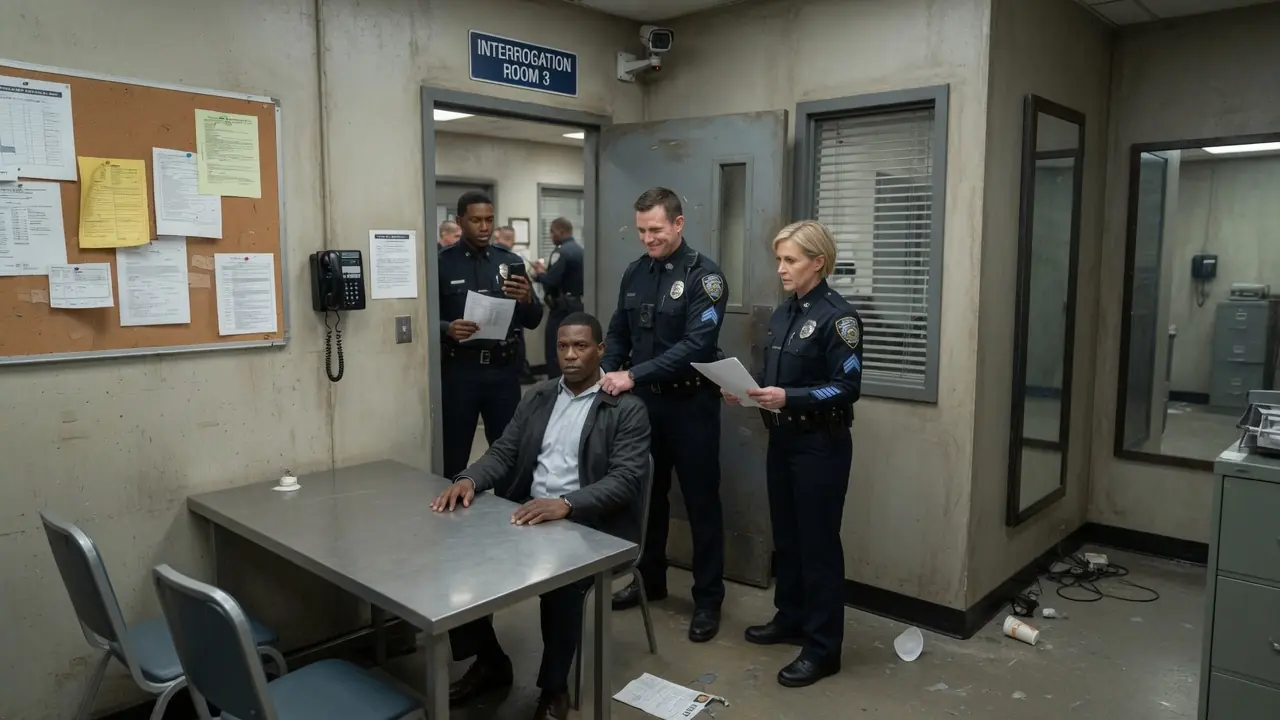
Interrogation Room Three was eight feet wide and ten feet long.
A metal table occupied the center. Three steel chairs had been bolted to the concrete floor. A camera hung in the upper corner, but its red recording light remained dark.
Keller pushed Adrian into the room.
“Sit.”
Adrian sat.
Crane closed the door behind them.
Keller remained standing.
He positioned himself behind Adrian, where the visitor could not see his hands without turning.
“Let’s begin again,” Keller said. “Why are you really here?”
“I told you.”
“No. You offered a story about the mayor and some imaginary ceremony.”
Adrian folded his hands on the table.
“I need to speak with Captain Russell.”
“You’re speaking with me.”
“You are not the watch commander.”
Keller slammed both hands onto the table.
The sound struck the room like a gunshot.
“You’re inside my station.”
Adrian did not flinch.
Keller leaned closer.
“You answer my questions.”
“I have answered every lawful question.”
Crane laughed softly beside the door.
“Lawful?”
Adrian looked toward her.
“You entered a public building during business hours,” she said. “You refused to explain your purpose. You became argumentative when Lieutenant Keller asked for identification.”
“That is not what happened.”
“That is what will appear in the report.”
Adrian studied her.
“How many times have you written that sentence?”
Crane’s smile faded.
Keller walked around the table.
“Community activist?”
“No.”
“Attorney?”
“No.”
“One of those consultants who teaches officers how to apologize for doing their jobs?”
“I did not say that either.”
“Then what are you?”
Adrian met his eyes.
“Someone who understands exactly what you’re doing.”
The room became quiet.
Keller had conducted hundreds of interrogations.
He understood fear.
Fear filled silence with explanations.
It made people speak too quickly, contradict themselves, and offer apologies for actions they had not committed.
Adrian showed none of it.
His breathing remained measured.
His hands stayed folded.
He looked like a man observing an event rather than being trapped inside it.
“Search him,” Keller said.
Crane approached.
“You have no legal basis,” Adrian replied.
“I believe you may be armed.”
“You saw me pass through the entrance screening.”
Crane removed his phone from the inner pocket of his jacket.
“Unlock it.”
“No.”
Keller grabbed Adrian by the collar and pulled him halfway out of the chair.
“You want to discuss rights?”
Adrian held the table edge to keep his balance.
“I want you to follow them.”
Keller shoved him back down.
“You’re suspicious.”
“Because I asked for the watch commander?”
“Because you’re here.”
Adrian looked at him for a long moment.
“That answer will matter later.”
Keller moved behind him again and dug both thumbs into the pressure points above his shoulders.
Pain traveled down Adrian’s arms.
His expression tightened, but his voice remained calm.
“Tomorrow morning,” he said, “the mayor, council president, state representatives, and this department’s command staff will be in the municipal ceremony hall.”
Keller’s hands paused.
“For what?”
Adrian did not answer.
Crane looked toward the door.
“There’s no ceremony on the station calendar.”
“It is on the executive calendar.”
“You expect us to believe you have access to that?”
“I expect you to check.”
Keller opened the door.
“Reed!”
Noah appeared several seconds later.
He had positioned his phone inside the breast pocket of his uniform. The camera faced forward through a narrow opening.
“Yes, Lieutenant?”
“Find tomorrow’s executive schedule. See whether there’s anything at eight involving the mayor.”
Noah looked toward Adrian.
He saw the damage to the visitor’s collar.
The redness around his throat.
“Yes, sir.”
He left.
Keller closed the door.
“You mentioned your brother.”
Adrian remained silent.
“What happened to him?”
“I am choosing not to answer.”
Keller circled the table.
“That isn’t an option.”
“It is.”
Keller seized the front of Adrian’s shirt.
This time he twisted the fabric and pulled upward.
Adrian’s hands rose instinctively to prevent himself from falling.
Crane raised her voice.
“He’s resisting.”
Adrian stared at her.
“I’m trying to breathe.”
“He’s resisting,” she repeated, louder.
The statement was not meant for anyone in the room.
It was meant for whoever might be standing in the hallway.
It was meant for the report.
Keller’s face flushed.
He pulled Adrian forward and slammed his head against the metal table.
The impact was sharp and sickening.
Adrian fell backward into the chair.
Blood appeared above his right eyebrow and moved slowly down his cheek.
For several seconds, nobody spoke.
Keller stepped away, breathing heavily.
“You shouldn’t have resisted.”
Adrian touched the wound.
His fingers came away red.
He stared at the blood.
Then he raised his eyes.
“This is what you did three years ago.”
Keller froze.
“What?”
“In this room.”
Adrian’s voice had changed.
It remained quiet, but grief now rested beneath every word.
“My brother’s name was Marcus Carter.”
The color left Keller’s face.
Crane’s arms dropped to her sides.
Before either could answer, the door opened.
Noah stood there holding a printed page.
His eyes widened when he saw the blood.
“Lieutenant, there is a ceremony.”
Keller stared at him.
“What?”
“Tomorrow at eight. Municipal Hall.”
Noah lifted the paper.
“Swearing-in ceremony for the city’s new chief of police. Mayor Ellis, the council, and state officials are listed as confirmed attendees.”
Keller snatched the page.
His eyes moved rapidly across it.
EXECUTIVE APPOINTMENT CEREMONY
8:00 A.M.
NEW CHIEF OF POLICE
The name of the appointee had been intentionally removed from the department copy.
Keller crumpled the paper.
“Get out.”
“Sir, Mr. Carter is injured.”
“I said get out.”
Noah looked at Adrian.
Their eyes met briefly.
Then he stepped into the hallway.
Crane locked the door.
Keller paced.
“This changes nothing.”
Adrian pressed a handkerchief against his forehead.
“It changes what you know.”
“You trespassed.”
“I signed in.”
“You threatened officers.”
“No.”
“You resisted detention.”
“You attacked me.”
Crane removed a preprinted incident form from a cabinet.
She began completing it.
Subject displayed aggressive behavior.
Subject refused lawful commands.
Subject initiated physical resistance.
Adrian watched her write.
“You already had that form ready.”
Crane did not look up.
“We use standard language.”
“You use standard lies.”
Keller crouched beside him.
“Let me explain what happens now.”
His voice became almost gentle.
“You assaulted an officer. Sergeant Crane witnessed it. Officer Reed will confirm the timeline. We book you, transfer you to the county facility, and let a judge sort it out.”
“I did not assault anyone.”
“You do now.”
Keller stood.
“Book him.”
Crane reached for the handcuffs on her belt.
Adrian lowered the handkerchief.
“Your career ends tomorrow morning.”
Keller turned.
“When I take the oath.”
Crane stopped.
The room became completely still.
Keller stared at Adrian.
“What oath?”
“The oath of office.”
Adrian stood slowly.
Blood marked his shirt collar.
“My name is Adrian Carter.”
He looked directly at Keller.
“Tomorrow morning, I become chief of this department.”
Keller’s mouth opened.
No sound emerged.
Crane shook her head.
“He’s bluffing.”
Keller was no longer certain.
The ceremony was real.
The mayor was attending.
The command staff had been ordered to appear.
The appointee’s name had been concealed from most personnel.
Adrian spoke with the confidence of someone who knew more than any outsider should.
“Who are you?” Keller whispered.
“Former Marine officer. Twelve years with the Federal Bureau of Investigation, including six in crisis negotiation and institutional-corruption cases.”
Adrian touched the cut above his eyebrow.
“And Marcus Carter’s older brother.”
Keller backed toward the wall.
“That death was investigated.”
“It was concealed.”
“He suffered a medical emergency.”
“He called emergency services because he was experiencing a panic attack.”
Adrian’s voice remained controlled.
“He asked for help. Patrol officers brought him here alive and cooperative.”
Crane’s face tightened.
“You were not there.”
“No.”
Adrian looked toward her.
“But the radio transcripts were.”
He turned back to Keller.
“So were the photographs removed from the evidence file. The original medical report. The statements from the first responding officers. The blood pattern preserved beneath this table.”
Keller’s breathing became shallow.
“You came here to set us up.”
“I came for a scheduled meeting.”
“You wanted me to attack you.”
“I gave you my name, identification, and reason for entering.”
Adrian’s gaze did not move.
“You chose everything that followed.”
Crane put down her pen.
“We need Deputy Chief Mercer.”
“He cannot protect you.”
“You don’t know that.”
“He accepted three hundred twenty thousand dollars from Calvin Rourke’s trafficking network over four years.”
The silence became heavier.
Keller stared at him.
“How do you know that?”
“Federal investigators traced the payments.”
Crane moved toward the door.
Adrian continued.
“They also traced fifty-two altered evidence entries bearing your signature.”
Her hand stopped.
“Fourteen civil-rights complaints disappeared after you reviewed them.”
Crane’s face went pale.
“Internal Affairs cleared those.”
“Deputy Chief Mercer supervised Internal Affairs.”
Keller slid into a chair.
For the first time, he looked small.
“You said federal investigators.”
“Eighteen months.”
Adrian looked toward the locked door.
“Tonight was not supposed to be part of the investigation.”
“Then why hide your identity?”
“The mayor wanted the department observed without preparation.”
Keller laughed once.
The sound broke in his throat.
“A test.”
“A final assessment.”
“And you agreed?”
“I insisted.”
Adrian’s expression hardened.
“Because my brother died in this room. Because forty-three families described the same pattern. Because every complaint claimed unknown Black men were treated like suspects before speaking.”
Crane reached for her radio.
“Deputy Chief Mercer to Interview Three. Immediate.”
The response came a moment later.
“On my way.”
Deputy Chief Harold Mercer entered two minutes later.
At fifty-seven, he wore a tailored uniform, custom boots, and an expensive watch that did not fit comfortably within a public employee’s salary.
He stopped when he saw Adrian’s injury.
“What happened?”
Keller answered too quickly.
“He became aggressive during identification.”
Mercer looked toward Crane.
She nodded.
Adrian remained standing beside the table.
“Mr. Carter,” Mercer said carefully, “you appear to need medical attention.”
“After I speak with counsel.”
“Of course.”
Mercer pulled out a chair.
“First, perhaps we can resolve the misunderstanding.”
“There was no misunderstanding.”
“Lieutenant Keller believed you posed a security concern.”
“He called me a criminal before asking my name.”
Mercer’s expression did not change.
“Sergeant Crane?”
“The subject was argumentative and resisted lawful detention.”
Adrian nodded toward the camera in the corner.
“Then turn it on and repeat that.”
Nobody moved.
Mercer leaned back.
“You claim to be tomorrow’s appointee.”
“I am tomorrow’s appointee.”
“That information was confidential.”
“Correct.”
“How did you obtain it?”
“The city council confirmed me two weeks ago.”
Mercer’s fingers moved toward his watch.
A nervous habit.
Adrian noticed.
“Six weeks ago, Mayor Ellis offered me the position. The Department of Justice supported the appointment due to the ongoing federal investigation into this station.”
Mercer’s face remained controlled.
Only his right hand betrayed him.
“Those are serious allegations.”
“Your shell companies are serious too.”
Keller looked toward Mercer.
“What shell companies?”
Mercer ignored him.
Adrian continued.
“Three hundred twenty thousand dollars paid through businesses owned by Calvin Rourke. Payments matched dates when narcotics evidence disappeared from this building.”
Crane moved away from Mercer.
“You told us those audits were closed.”
Mercer stood.
“This conversation is over.”
“No,” Adrian said. “It is beginning.”
Mercer moved toward the door.
“We are transferring Mr. Carter to county custody.”
“On what charge?”
“Assaulting an officer.”
Keller looked relieved.
Mercer understood the system better than he did.
A transfer would create distance.
Paperwork could be altered.
The ceremony might proceed without Adrian.
Confusion could be introduced before the mayor confirmed anything publicly.
Mercer opened the door.
“Process him before ten.”
Adrian looked at him.
“That is what you did to Marcus.”
Mercer stopped.
“You held him overnight without proper booking. By morning, he was dead.”
“Your brother’s case was closed.”
“The falsified version was.”
“The medical examiner ruled cardiac arrest.”
“The original autopsy documented seventeen blunt-force injuries, fractured ribs, a broken orbital bone, and a ruptured spleen.”
Crane’s face collapsed.
Keller whispered, “You said that report was destroyed.”
Mercer looked at him sharply.
The admission hung between them.
Adrian heard it.
So did Noah, who stood outside the door with his phone still recording.
A fire alarm suddenly screamed through the station.
Red lights began flashing.
Officers shouted in the hallway.
Mercer stepped outside.
“What happened?”
“Alarm in the southeast wing!” someone called.
Mercer pointed toward Keller.
“Check it.”
Keller hurried away.
Crane remained inside with Adrian.
The door closed.
For several seconds, they listened to the alarm.
Then Adrian spoke.
“Officer Reed pulled it.”
Crane turned toward him.
“What?”
“He needed the hallway cleared.”
“You’re lying.”
“Dispatch Supervisor Teresa Bell is copying the radio archives.”
Crane’s hand moved toward her weapon.
Adrian remained still.
“FBI Special Agent Laura Pierce is in the parking lot with two Department of Justice attorneys and Mayor Ellis.”
Crane’s fingers froze.
“Check the exterior cameras.”
She removed her phone.
The security application opened.
Three black SUVs stood near the front entrance.
Federal agents in blue windbreakers waited beside them.
Crane backed against the wall.
“No.”
“Officer Reed uploaded seventeen minutes of video to multiple secure servers.”
“This can’t be happening.”
“It has been happening for eighteen months.”
The alarm stopped.
The sudden silence felt worse.
Crane slid down the wall until she sat on the floor.
Her weapon remained holstered.
“Marcus was afraid,” she whispered.
Adrian did not answer.
“He kept saying he couldn’t breathe.”
Her eyes filled.
“Keller told him to stop talking. Marcus cried and asked us to call a doctor.”
Adrian’s jaw tightened.
“I know.”
“I told Keller to stop.”
“But you did not stop him.”
Crane covered her face.
“He said we would both lose everything. Mercer said he would handle the report.”
“You altered the evidence.”
“I had a daughter in college. A mortgage. Nineteen years toward my pension.”
Adrian’s voice became quieter.
“My brother had a life too.”
The door opened.
Noah stood there with Agent Laura Pierce and two federal officers.
“Mr. Carter,” Pierce said, “we need to get you medical attention.”
“After everyone is secured.”
Keller returned from the false alarm.
He stopped when he saw the agents.
His face emptied.
Deputy Chief Mercer appeared behind him.
Mayor Jonathan Ellis entered from the opposite hallway.
The mayor looked at Adrian’s swollen face and bloodstained collar.
Then he looked at the officers surrounding him.
“Lieutenant Keller,” Agent Pierce said, displaying her credentials, “step away from Mr. Carter.”
“He is under arrest.”
“No,” she replied. “He was unlawfully detained.”
Mercer attempted to speak.
Mayor Ellis raised one hand.
“Harold, you are relieved of command.”
“Mayor—”
“Do not reach for your radio.”
Federal agents entered the hallway.
Pierce faced Keller and Crane.
“Hands visible.”
Noah removed his phone from his uniform pocket.
“I have the full recording.”
Keller looked at him.
“You recorded me?”
“I documented a crime.”
“You’re probationary.”
“I’m still sworn.”
The officers were escorted into Conference Room A.
Adrian sat at the head of the table while a paramedic cleaned the wound above his eye.
Mayor Ellis sat beside him.
Federal investigators arranged laptops, files, and evidence boxes across the table.
Keller, Crane, and Mercer occupied the opposite end with attorneys hurriedly contacted by the police union.
Noah connected his phone to the presentation screen.
Mayor Ellis stood.
“Before the evidence is reviewed, the identity of Mr. Adrian Carter will be formally confirmed.”
He looked around the room.
“Mr. Carter was appointed chief of police six weeks ago and confirmed by the city council fourteen days ago. His swearing-in ceremony is scheduled for tomorrow at eight in the morning.”
Keller closed his eyes.
“The department was not informed of his identity because the city needed an unannounced assessment of how this station treated members of the public.”
Mercer’s attorney spoke.
“This was entrapment.”
“No,” Mayor Ellis replied. “Mr. Carter entered peacefully, identified himself, and requested a scheduled meeting.”
He turned toward Noah.
“Play the recording.”
The screen showed the station lobby at 5:30.
Adrian entered.
Keller moved toward him.
The audio captured the lieutenant’s first insult clearly.
Then came the badge being ripped away.
The hand around Adrian’s throat.
The impact against the wall.
The racial language.
The request for the watch commander.
Crane positioning herself near the exit.
The hallway.
Interrogation Room Three.
The slam against the metal table.
Blood appeared on-screen.
Nobody spoke.
Agent Pierce paused the image on Keller’s face after Adrian mentioned Marcus.
“The reaction demonstrates prior knowledge.”
She opened another file.
“Marcus Carter died in this station three years ago after calling emergency services during a mental-health crisis.”
Dispatch Supervisor Teresa Bell entered carrying a box of archived records.
She read the original emergency transcript.
Marcus begging for help.
Saying he was afraid.
Promising he did not want to hurt anyone.
The first responding officers had described him as frightened but cooperative.
Keller and Crane arrived fourteen minutes later.
The mental-health team was dismissed.
Official radio communication stopped.
The federal attorney displayed the original autopsy photographs.
Keller looked away.
Seventeen impact injuries.
Broken ribs.
A fractured facial bone.
Internal bleeding.
Not cardiac arrest.
Not a simple medical emergency.
A beating.
Then came the evidence logs.
Crane’s signature appeared beside every altered entry.
Photographs removed.
Witness statements lost.
Medical documents replaced.
Mercer’s financial records followed.
Payments from shell companies connected to a convicted trafficker.
Each payment aligned with compromised narcotics cases, missing evidence, or dismissed complaints.
Keller began crying.
“I didn’t mean to kill Marcus.”
His attorney seized his arm.
“Do not speak.”
Keller pulled away.
“He would not stop talking. He kept saying he was scared.”
Adrian looked across the table.
“My brother called you for help.”
“I only wanted him quiet.”
“You beat him until he could never speak again.”
Crane stared at the floor.
Mercer attempted one final defense.
“This is politically motivated.”
Adrian stood.
The room became silent.
“No,” he said. “This is accountability.”
Federal agents moved behind the three officers.
Agent Pierce read the charges.
Civil-rights violations.
Assault under color of authority.
False imprisonment.
Evidence tampering.
Conspiracy.
Bribery.
Obstruction.
Accessory charges connected to Marcus Carter’s death.
Keller did not resist when the handcuffs closed around his wrists.
His face had turned completely white.
Adrian walked toward him.
“You asked who I was.”
Keller looked up.
“I am Adrian Carter. Former Marine officer. Former FBI crisis negotiator.”
He paused.
“And tomorrow morning, I become the chief of the department you used to terrorize people.”
Keller lowered his eyes.
“This was a test.”
“Yes.”
Adrian’s voice remained steady.
“You failed.”
He glanced toward the bloodstained handkerchief on the table.
“But Marcus never received a test. He asked for help and died.”
The arrested officers were led through the station.
Personnel lined the hallway.
Some looked shocked.
Others looked relieved.
Adrian remained behind.
He returned alone to Interrogation Room Three.
The table had not been cleaned.
A small drop of his blood remained near the edge.
He placed one hand against the cracked wall.
“Marcus,” he whispered, “they know now.”
For several seconds, he could not continue.
“I’m sorry it took so long.”
Teresa Bell stood quietly in the doorway.
“Your brother would be proud.”
Adrian turned.
“He should still be alive.”
“Yes.”
She did not try to soften the truth.
“He should.”
The following morning, Municipal Hall was filled before eight.
The mayor stood at the podium.
City council members occupied the front row. Community leaders, reporters, federal officials, and police employees filled the remaining seats.
Adrian’s mother sat beside an empty chair.
She wore a purple dress and held a photograph of Marcus against her chest.
Adrian entered in full uniform.
A white bandage covered the stitches above his eyebrow.
He had refused makeup.
The injury belonged in the room.
Mayor Ellis spoke first.
“This city cannot build trust by hiding what happened.”
He described Adrian’s unlawful detention and assault.
He confirmed the investigation into Marcus Carter’s death and dozens of related complaints.
Then he called Adrian forward.
Adrian placed one hand on the Bible Marcus had carried as a teenager.
“Do you swear to uphold the Constitution and serve every resident of this city with integrity, fairness, and respect?”
“I do.”
“Do you swear to hold yourself and every officer under your command accountable to the law?”
“I do.”
Mayor Ellis nodded.
“Then by the authority of this office, I appoint you Chief Adrian Carter.”
The audience stood.
Adrian’s mother lifted Marcus’s photograph.
Applause filled the hall.
Adrian waited until it ended.
Then he approached the microphone.
“Three years ago, my brother experienced a panic attack.”
His voice carried clearly.
“He called the police because he believed they would help him.”
The room became silent.
“He was frightened. He was unarmed. He cooperated.”
Adrian looked toward his mother.
“He died inside Interrogation Room Three.”
Several people lowered their heads.
“The official report erased what happened to him. It described a medical emergency. It protected the officers and abandoned the victim.”
Adrian looked toward the department personnel seated together.
“That era ends today.”
He announced mandatory body cameras with automatic evidence upload.
Independent civilian review of serious-force incidents.
Mental-health response teams.
External investigation of complaints against command staff.
Audits of every in-custody injury from the previous five years.
Protection for officers reporting misconduct.
Noah Reed was promoted to detective and assigned to the new integrity unit.
Teresa Bell was placed in charge of reconstructing missing records.
Adrian did not promise instant trust.
He promised visible work.
After the ceremony, he returned to the station.
Officers stopped in the lobby as he entered.
Some saluted.
Some could not meet his eyes.
Adrian walked past the cracked section of plaster where Keller had slammed him.
He ordered it left unrepaired temporarily.
A brass plaque was mounted beside it.
EVERY PERSON WHO ENTERS THIS BUILDING IS SOMEONE’S FAMILY.
Interrogation Room Three was removed from service.
After renovation, it became the Marcus Carter Reflection and Crisis Room—a quiet space where mental-health professionals could speak with frightened people without handcuffs, metal tables, or armed officers crowding the door.
The camera remained active.
Every interaction was recorded.
On Adrian’s first afternoon as chief, Teresa brought him a box of cold cases.
“These families are still waiting,” she said.
Adrian opened the first file.
Samuel Price, age twenty-six.
Died in custody eight months before Marcus.
Same station.
Same officers.
Same explanation.
Adrian picked up the phone and called the number listed for Samuel’s mother.
“Mrs. Price, my name is Adrian Carter. I am the new chief of police.”
He looked at Marcus’s photograph on his office wall.
“I believe there are questions about your son’s death that were never honestly answered.”
He opened the file.
“I would like to begin answering them.”
Outside his office, shift change started again.
Radios crackled.
Officers moved through the lobby.
The same building continued performing the same daily work.
But it was no longer Keller’s house.
It belonged to the public.
And under Adrian Carter’s command, nobody would ever again be required to reveal power, rank, or connections before being treated as human.