The first thing Marcus Ellison noticed was the sound of a body hitting gravel.
He had been halfway through his usual evening walk around Briarwood Park in Atlanta, one hand tucked into the pocket of his faded navy jacket and the other holding a paper cup of coffee that had already gone cold. The winter sun was dropping behind the trees, turning the lake orange at the edges, and most of the after-work crowd had begun thinning out. Marcus almost kept walking because the sound came from behind a row of hedges, but then he heard a weak scrape, followed by silence. He set the coffee on a bench and hurried toward the path.
An older white man lay on his back beside the walkway, one expensive leather shoe twisted sideways and his gray wool coat open across his chest. His face had gone strangely pale, and one hand rested against the gravel as though he had tried to catch himself before collapsing. A silver watch gleamed at his wrist, and a phone had landed several feet away near the grass. Marcus dropped to his knees and touched the man’s shoulder.
“Sir? Can you hear me?”
Nothing.
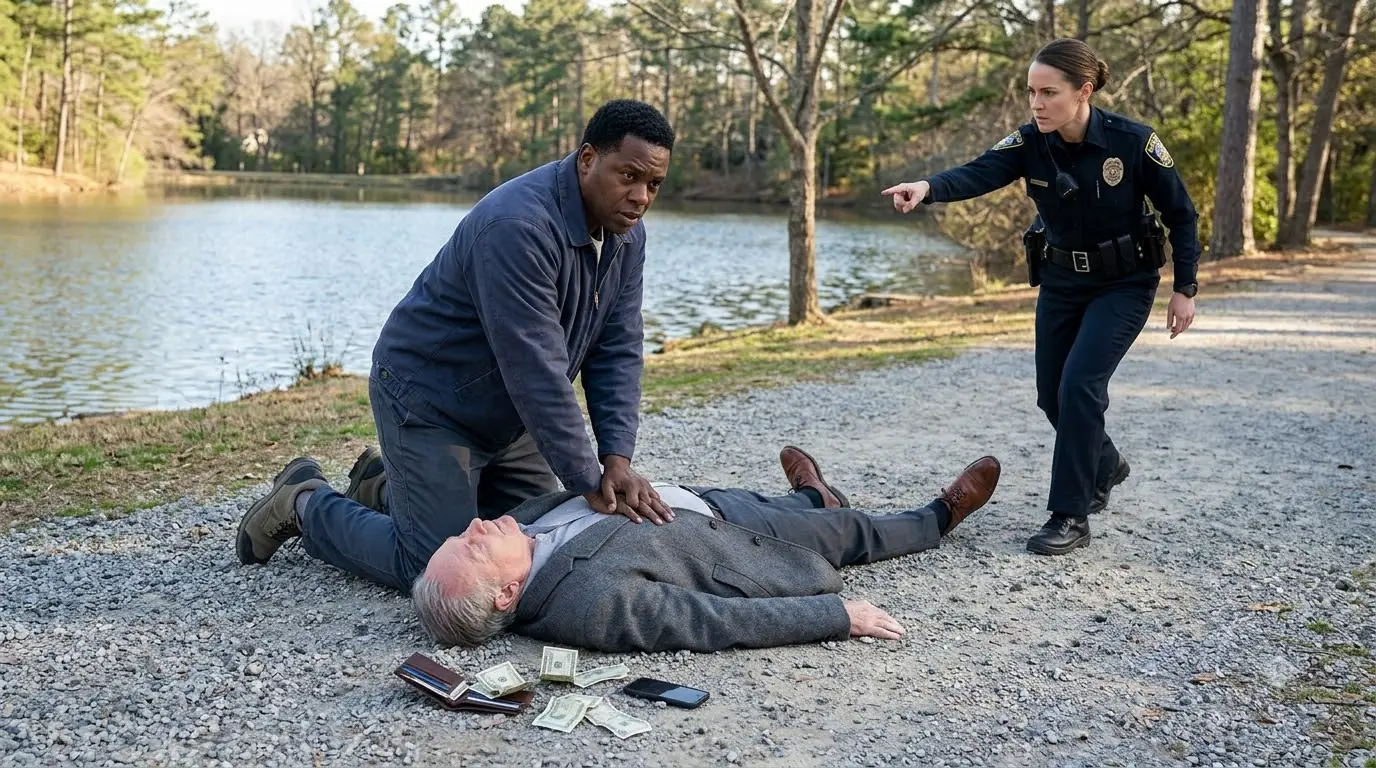
Marcus looked for normal breathing and found only a faint, irregular gasp. His training from the school district came back in sharp pieces: check responsiveness, call emergency services, begin compressions, send someone for an AED if available. He pulled out his phone, put 911 on speaker, and told the dispatcher exactly where they were. Then he positioned his hands in the center of the stranger’s chest and started compressions.
“One, two, three, four…”
The dispatcher counted with him at first, but Marcus already knew the rhythm. He supervised maintenance at West Ridge High School, where every department head renewed CPR certification each year because a gym, cafeteria, shop classroom, and football field could all become emergency rooms without warning. He had practiced on plastic mannequins dozens of times. He had never felt a real person’s chest move beneath his hands.
A woman jogging past stopped several yards away. Marcus shouted for her to run to the park office and ask for the AED mounted near the public restrooms. She took off immediately. Another man pulled out his phone and began recording, not because Marcus asked him to, but because people recorded everything now.
Marcus kept counting.
Thirty compressions. Brief pause. Check. Nothing useful.
He began again.
The fallen man’s wallet had slipped halfway from the inside pocket of his coat. On the next compression it dropped onto the path, opening when it hit the gravel. Credit cards and folded bills scattered beside Marcus’s knee. Marcus did not touch them. He barely noticed.
The first police cruiser arrived before the AED did.
Officer Dana Pike had been turning into the park entrance when dispatch broadcast a medical call involving an unconscious man near the east loop. She parked fast, stepped out, and saw a Black man kneeling over an older white man in an expensive coat. Cash and cards lay scattered on the ground. Marcus was leaning hard over the man’s chest, arms locked, shoulders pumping.
“Get away from him!” she shouted.
Marcus looked up once and kept compressing. “He’s in cardiac arrest. Call EMS. They’re already coming.”
“I said get away from him. Hands where I can see them.”
“They are where you can see them.” Marcus’s voice sharpened despite himself. “I’m doing CPR.”
Officer Pike moved closer, one hand already near her holster. “Stop touching him and step back.”
Marcus stared at her in disbelief. “If I stop, he could die.”
That sentence should have slowed everything down.
Instead, it made Dana more certain he was refusing an order.
She saw the wallet, the scattered cash, the stranger’s luxury watch, and Marcus’s old work jacket. She saw an unconscious man unable to speak for himself. She did not see the first forty seconds before her arrival, the collapse, the gasping breaths, or Marcus calling 911. She did not hear the dispatcher still on Marcus’s phone saying, “Continue compressions until EMS takes over.”
“Last warning,” Dana said. “Back away now.”
Marcus raised one hand long enough to point at the phone on the path. “Listen to dispatch. He doesn’t have a normal pulse.”
Another cruiser pulled up hard near the curb. Officer Brent Lawson came running toward them. At the same moment, the jogger returned carrying the red AED case from the park office.
“I found it!” she shouted.
Marcus reached toward her.
Dana interpreted the movement as sudden resistance.
The Taser cracked before Marcus understood what was happening.
Pain seized every muscle at once. His body jerked sideways, and he hit the gravel shoulder-first. The jogger screamed. The AED case fell from her hands.
“What are you doing?” Marcus gasped.
Lawson rushed in, rolled him onto his stomach, and pulled his arms behind his back. Marcus tried to twist his head toward the unconscious man.