Ma'am, manager wants you out. You're trespassing. Step outside now. I paid for an order. I'm waiting.
You can verify that with your staff. I'm not verifying anything. You've been warned. Leave or you're getting arrested. Officer, you're making a serious mistake.
Turn around. Hands behind your back. Officer Derek Thorne had been with the Metropolitan Police Department for 6 years when he walked into a situation that would not only end his career, but also cost the taxpayers of his city a staggering $6.5 million. At 29 years old, Thorne was known among his peers as an officer who favored action over assessment. He had a thick personnel file dotted with complaints about his demeanor.
Abrasive, condescending, and quick to escalate were terms that appeared with alarming frequency in his performance reviews. Yet he remained on the streets bolstered by a union that fought for every inch of leeway and a department culture that often mistook aggression for effective policing. He believed his judgment was absolute, a dangerous mindset that was about to collide with a force far more powerful than he realized. On a crisp Wednesday afternoon in October, the financial district was alive with the hum of commerce. It was 12:15 p.m., the height of the lunch rush.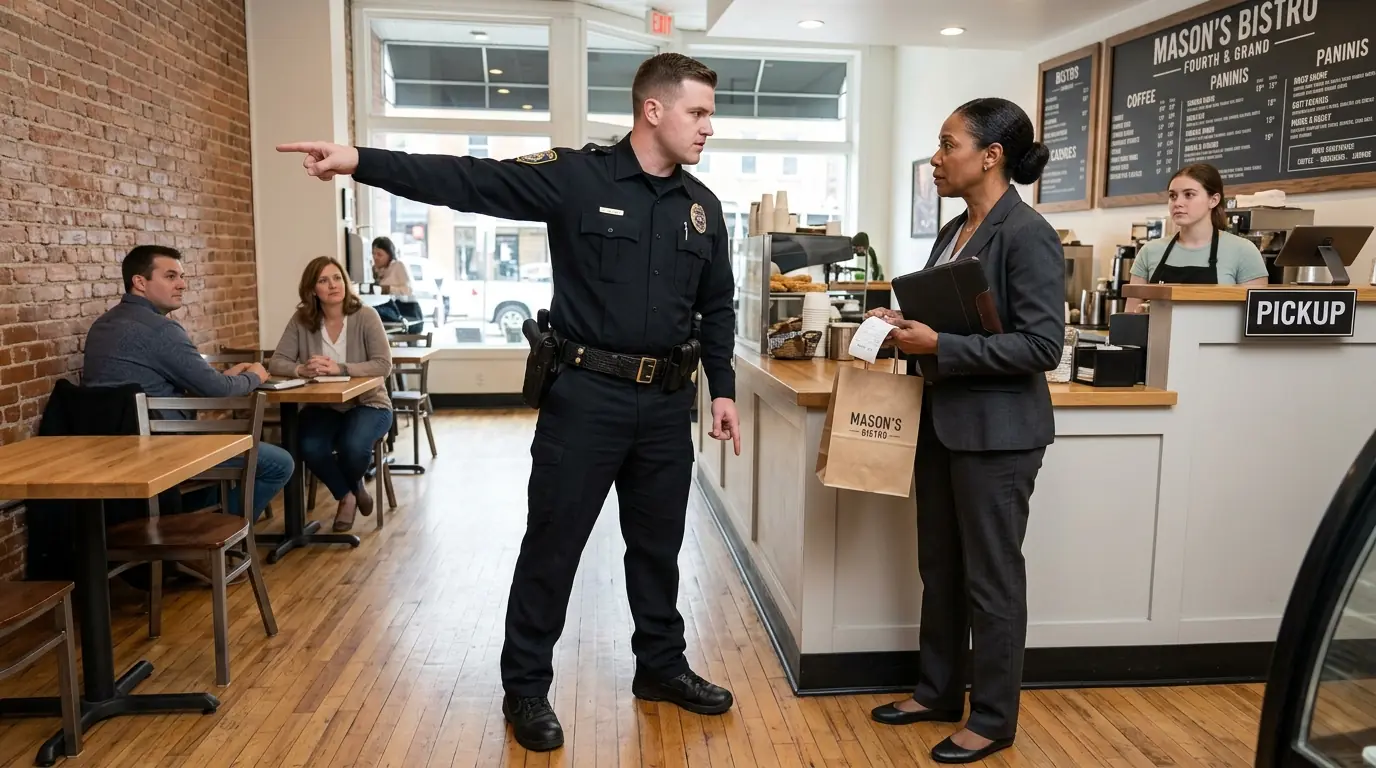
Mason's Beastro, an upscale ery located on the ground floor of a steel and glass high-rise, was packed. The air smelled of roasted garlic and artisal bread. Lawyers, stock brokers, and city officials crowded the tables, their voices creating a cacophony of dealmaking and gossip. Standing near the polished mahogany pickup counter was Evelyn Vance. At 56 years old, Evelyn was a pillar of the legal community.
Though few outside the federal courthouse would recognize her face. As the federal court administrator for the district, she was the highest ranking non-judicial official in the federal court system for the region. She managed a budget of millions, oversaw the operations of the courouses, and reported directly to the chief judge. She was a woman of immense competence and quiet power, known for her sharp intellect, and an even sharper intolerance for incompetence. Today, Evelyn was not presiding over a budget meeting or coordinating security protocols for a high-profile trial.
She was simply picking up lunch. It was a catering order, platters of sandwiches and salads for a judicial conference taking place three blocks away. She had arrived at 11:55 a.m. Precisely when the order was promised, but the kitchen was behind, so she waited. Evelyn was dressed in a charcoal gray wool suit, tailored and expensive.
Her hair was pulled back in an elegant low bun. She held a leather tablet case in one hand and checked her watch with the other. She stood with the posture of a woman who had spent decades commanding respect in rooms full of powerful men. She did not fidget. She did not scroll aimlessly on her phone.
And in a matter of minutes, their inability to see past their own biases would set off a chain reaction that would shake the city's police department to its core. Brad Miller prided himself on the atmosphere of Mason's beastro. At 27 years old, he had been the general manager for only four months, a position he landed through a combination of a hospitality degree and family connections to the ownership group. Brad was fidious, anxious, and deeply concerned with curating the right image for the establishment. He wanted Masons to be the premier spot for the city's elite, a place where the wealthy felt comfortable and the riff raff were kept at bay.
From his vantage point, near the kitchen pass, Brad had been watching the woman by the pickup counter for 10 minutes. He didn't see the tailored suit or the expensive leather case. He didn't see a customer waiting for a delayed order. What Brad saw was a black woman standing still in a hight traffic area, not eating, not drinking, and not moving. In Brad's limited experience, people who stood still without a drink in hand were problems.
They were loiterers. They were solicitors. They were people looking for a handout from his wealthy clientele. He watched as Evelyn checked her watch again. To Brad, this wasn't a sign of a paying customer's impatience.
It was a sign of someone casing the room, timing the staff. He convinced himself she was making the customers at the nearby tables uncomfortable, though no one had looked in her direction. Brad adjusted his tie and whispered to a server, "Has she ordered anything? " The server harried and carrying a tray of iced teas, glanced over. I think she's waiting for a takeout, but I'm not sure. The kitchen is slammed.
She's been there 20 minutes, Brad muttered. She's blocking the flow. Instead of walking 10 ft to ask the woman if she needed assistance or checking the order slip rail to see if a Vance order was pending, Brad Miller made a decision based on instinct, an instinct honed by prejudice rather than professionalism. He retreated to his small office in the back and dialed the police non-emergency line. Mason's Beastro on Fourth and Grand," Brad said when the dispatcher answered his voice tight with manufactured urgency.
"I have an individual here causing a disturbance, refusing to leave. " "Is the individual violent? " the dispatcher asked. "No, not violent yet? " Brad lied, escalating the narrative to ensure a quicker response. "But she's aggressive. She's loitering near the customers and refusing to move. It's bad for business and my staff is intimidated.
I need her removed. Description: Female, black 50s, dark suit. She's just standing there staring at people. The call was logged as a priority 2 disturbance. The nuances of the situation that the aggressive woman was silently reading a PDF on federal sentencing guidelines on her tablet were lost in translation.
Brad Miller hung up the phone, feeling a surge of righteousness. He was protecting his turf. He was maintaining standards. He had no idea that he had just called the police on the woman who signed the paychecks for the court clerks who processed the city's lawsuits. Officer Derek Thorne was only six blocks away when the call came through.
He was already in a foul mood, having spent the morning dealing with a fender bender where both drivers had screamed at him. The dispatch description, female refusing to leave, intimidating staff, gave him a focal point for his frustration. In his mind, the narrative was already written a vagrant or a mental health case disturbing the peace of a taxpaying business. He pulled his cruiser up to the curb in front of Mason's beastro at 12:28 p.m., leaving the lights flashing to announce his presence. He adjusted his belt, checked his body camera to ensure it was recording a policy he resented, but followed and stroed into the restaurant.
The beastro was loud, but the sight of a uniformed officer quieted the front section immediately. Thorne didn't look for the manager. He didn't ask the hostess what was happening. He scanned the room for the description, "Black female 50s. " His eyes locked onto Evelyn Vance. She was the only black woman near the entrance.
She was looking down at her tablet, reviewing a memo regarding courthouse security upgrades. Thorne marched straight toward her, bypassing the counter staff entirely. He stopped 2 ft from her, invading her personal space. Ma'am, we need to talk. Evelyn looked up, startled.
She adjusted her glasses, her expression shifting from concentration to confusion. Excuse me? The manager wants you gone. Thorne stated his voice loud enough to carry over the clatter of silverware. You're trespassing.
You need to leave the premises immediately. Evelyn blinked, processing the aggression. She had faced down federal judges who were having tantrums. She was not easily intimidated. Officer, I believe there is a misunderstanding.
I am waiting for an order. I don't see any food. Thorne snapped, crossing his arms. I see you loitering. The manager says you've been here half an hour bothering customers.
I have not spoken to a single soul. Evelyn said, her voice calm and authoritative, the voice she used when correcting a junior clerk. I ordered catering for a conference. The kitchen is behind schedule. You can ask the staff.
Thorne didn't look at the staff. He looked at Evelyn with a sneer of disbelief. To him, her calm demeanor came off as arrogance. Her suit, which cost more than his monthly salary, registered in his mind as a thrift store find or a disguise. He had decided she was the problem, and he wasn't going to let facts get in the way of his solution.
"I'm not asking the staff anything," Thorne said, stepping closer, his hand resting near his belt. "I'm telling you, you are causing a disturbance. Walk out that door now or I will assist you. The restaurant had gone silent. Diners were watching.
Phones were being raised. Evelyn felt the heat of humiliation rising in her neck, but she tamped it down with the cold steel of her professional training. She squared her shoulders. Officer, she said, "You are making a mistake. The only mistake is you thinking you can stay here after being told to leave. " Thorne retorted.
This is private property. If they say go, you go. Evelyn shifted her tablet to her left hand and reached into her purse with her right. Thorn tensed, dropping his hand to his holster. "Watch your hands," he barked.
"I am reaching for my identification," Evelyn said slowly, narrating her movements as if she were speaking to a slow child. "I am going to show you who I am. " She pulled out a leather wallet distinct from a standard civilian wallet. It bore the gold embossed seal of the United States Federal Courts. She flipped it open. Inside was her gold badge and her photo ID identifying her as the Federal Court Administrator District of Columbia Circuit.
It was a credential that granted her bypass authority at federal checkpoints and commanded respect from law enforcement agencies across the country. She held it up to Thorne's face. I am Evelyn Vance. I am the federal court administrator. I am a senior official with the United States Judiciary.
I am not a vagrant and I am not trespassing. Thorne glanced at the badge. He didn't lean in to read the fine print. He didn't study the hologram. He saw a badge he didn't recognize.
It wasn't NYPD. It wasn't state police. It wasn't FBI. What is this? Thorne scoffed, batting the air near the wallet as if it were a nuisance.
Court administrator. That looks like something you printed off the internet. You can buy those badges at a pawn shop. This is a federal credential, Evelyn said, her voice dropping an octave becoming dangerous. You can verify it with your dispatch.
Call the federal marshall's office. Call the district court. I'm not calling anyone for a fake ID. Thorne said, his ego now fully in the driver's seat. He couldn't back down.
If he backed down now in front of this restaurant full of rich people, he would look weak. He had to be right. You're trying to impersonate an official. That's another charge. I am asking you to verify, Evelyn insisted, her eyes locking onto his.
If you put your hands on me without verification, you will be violating my civil rights and federal law. I'm done debating, Thorne said. I gave you a lawful order. You refused. You produced fraudulent ID.
Turn around. I am not refusing, Evelyn said, turning slightly to address the room, ensuring the cell phone cameras caught her profile. I am waiting for a paid transaction to be completed. I have identified myself as a federal official. Turn around, Thorne shouted, losing his temper.
He grabbed her left arm, spinning her forcefully. Evelyn Vance, a woman who had dined with Supreme Court justices who had drafted policy for the protection of witnesses, stumbled as the young officer wrenched her arm behind her back. She did not fight. She knew that resistance was the officer's excuse for violence. She went limp, allowing him to manipulate her limbs, but her mind was racing, cataloging every second, every touch, every violation.
The sound of the handcuffs ratcheting shut was sickeningly loud in the quiet beastro. Thorne pulled the cuffs tight too tight, pinching the skin of Evelyn's wrists. "You are under arrest for trespassing, disorderly conduct, and criminal impersonation," Thorne announced for the benefit of the audience. "I am complying under duress," Evelyn stated clearly, her face pressed awkwardly toward the counter by Thorne's grip. "My name is Evelyn Vance.
I am a federal court administrator. This officer is arresting me unlawfully. Shut up. Thorne hissed in her ear. He grabbed her by the bicep and began to march her toward the door.
At that exact moment, the kitchen doors swung open. A young server ran out breathless, carrying two large, heavy paper bags filled with sandwiches. Order for Vance. I have the order for Vance. The server stopped dead seeing the customer in handcuffs.
Brad Miller, the manager, emerged from his office at the commotion. He saw the bags. He saw the officer. He saw the woman. She She paid for that.
Miller stammered, his face draining of color. She's being removed, Thorne said, ignoring the food. You called it in. I I thought Miller trailed off. Evelyn stopped walking, forcing Thorne to halt.
She looked at Miller with a gaze that could peel paint. "You called the police on me because I was waiting for my lunch. I paid $400 for that order, Mr. Miller. Let's go. " Thorne yanked her forward.
He didn't care about the food. He didn't care about the manager's sudden hesitation. He had a prisoner. He dragged her out the front door into the bright midday sun past the staring pedestrians. He pushed her into the back of his patrol car.
The hard plastic seat was uncomfortable. Evelyn sat awkwardly, her hands numb behind her back. Thorne slammed the door, shutting out the noise of the city. Inside the car, Evelyn took a deep breath. She did not cry.
She did not panic. She closed her eyes and began to draft the lawsuit in her head. Fourth Amendment violation, false imprisonment, defamation, assault. She memorized the officer's name plate. D.
Thorne. She memorized the time. 12:36 p.m. Thorne got into the driver's seat, energized by the adrenaline of the arrest. He radioed in.
One female in custody, transporting to the fourth precinct. Copy that, dispatch replied. As he pulled away from the curb, Thorne looked in the rear view mirror. "You really thought a fake badge would work? " he taunted. "You people never learn. " Evelyn opened her eyes.
She met his gaze in the mirror. She said nothing. There was nothing left to say to Officer Thorne. He was already a ghost. He just didn't know it yet.
The drive to the fourth precinct took 10 minutes. Thorne hummed along to the radio. Oblivious to the silence in the back seat, he parked in the sallyport, pulled Evelyn out of the car, and walked her into the processing area. The precinct was busy. Phones were ringing.
Officers were typing reports. At the main desk sat Sergeant Thomas Kowalsski. Kowalsski was 58 years old, a veteran of the force who was counting the days to retirement. He was tired, cynical, but fair. He had spent years working the court liaison detail before taking the desk job.
He knew every judge, every prosecutor, and every administrator in the district. Thorne walked Evelyn up to the desk, holding her arm like a trophy. "What do we have, Thorne? " Kowalsski asked without looking up from his paperwork. "Trpassing at Mason's beastro," Thorne said proudly. "Refused to leave.
Impersonating an official. " impersonating. Kowalsski looked up. His eyes landed on Evelyn Vance. The color dropped from Kowalsski's face so fast it looked like he was having a stroke. He stood up his chair, scraping loudly against the floor.
"Miss Vance," Kowalsski whispered. Evelyn looked at him calmly. "Hello, Sergeant Kowalsski. I believe we met at the judicial holiday party last year. " Thorne looked between them, confused. Sarge, you know her?
She flashed a fake badge. Thorne, Kowalsski said, his voice trembling with a mixture of fear and rage. Take those cuffs off now. But she I said take them off. Kowalsski roared a sound that silenced the entire room.
Do you know who this is? This is the federal court administrator. She runs the federal district court. She is the boss of the judges who sign your search warrants. Thorne froze.
The key felt slippery in his hand. He looked at Evelyn, really looked at her for the first time. The suit, the demeanor, the recognition in his sergeant's eyes. The realization hit him like a physical blow to the stomach. I I thought, Thorne stammered.
Unlock them, Evelyn said isoly. Thorne fumbled with the key. The cuffs clicked open. Evelyn rubbed her wrists. There were deep red indentations where the metal had bitten into her skin.
Thorne, give me the fake ID, Kowalsski demanded. Thorne pulled the wallet from his pocket and handed it over. Kowalsski opened it. Federal judiciary active authentic. Jesus Christ, Thorne.
Did you verify this? I thought it was a print out. Thorne mumbled. "You arrested a federal official for waiting for lunch. " Kowalsski said, his voice low and horrified. "You didn't verify.
You didn't listen. " Evelyn stepped back, putting distance between herself and Thorne. "Sergeant, I want the watch commander down here. I want my property returned, and I want this officer's badge number recorded in the official log immediately. " Captain Reynolds, the watch commander, arrived 3 minutes later. He was a tall man with graying hair who had managed to keep his precinct relatively scandal-free for 5 years. That streak ended the moment he walked into the holding area.
Sergeant Kowalsski briefed him in hushed urgent tones. Reynolds listened, his face hardening. He turned to Evelyn. "Mance," Reynolds said, stepping forward with his hands open in a gesture of peace. "I am mortified.
This is a catastrophic error. On behalf of the department, I apologize. Captain, Evelyn said, her voice steady but cold. Apologies are for spilled coffee. This was an unlawful arrest.
I was handcuffed in public. I was paraded past a restaurant full of people. My professional reputation has been damaged. My civil rights have been violated. She pointed a finger at Thorne, who was standing in the corner looking smaller than he ever had in his life.
That officer refused to look at my credentials. He assumed I was a criminal because of how I look. He refused to verify. He used excessive force on a compliant subject. Reynolds turned to Thorne.
Officer Thorne, place your badge and your service weapon on the desk. Captain, I do it now. Thorne unbuckled his belt. The heavy thud of the gun on the counter echoed in the room. He placed his badge next to it.
You are on administrative leave. Effective immediately pending an internal investigation. Reynolds said, "Go home. Do not speak to anyone. " As Thorne walked out of the precinct, stripped of his authority, the world outside was already moving. The videos from the beastro had hit the internet.
A clip titled, "Cop arrests federal court official for waiting for lunch," had 50,000 views in 20 minutes. The comments were a torrent of outrage. Evelyn Vance did not leave quietly. She refused a ride home from the police. She called her own car service.
Before she left, she looked at Captain Reynolds. My attorneys will be in touch by end of business today and tell your chief to prepare for a federal inquiry. She walked out of the precinct head high, rubbing her bruised wrists. She didn't go home. She went straight to the federal courthouse, walked into her office, and began to work.
The wheels of justice usually slowm moved with terrifying speed when the victim was one of the people who kept the wheels greased. The city attorney took one look at the beastro surveillance footage, the body camera footage, and the witness videos and advised the mayor to settle immediately. There was no defense. It was a textbook case of racial profiling and unlawful arrest. The settlement was finalized 6 months later.
The city paid Evelyn Vance $6.5 million. It was one of the largest individual settlements in the department's history. But Evelyn didn't stop at the money. As part of the agreement, she demanded policy changes mandatory training on federal credentials for all officers and a duty to verify clause that required officers to contact dispatch before arresting anyone claiming government status. Derek Thorne was fired.
His certification was revoked by the state board, ensuring he would never work in law enforcement again. At 30 years old, he was unemployed and unhirable in his field. A pariah whose name was synonymous with incompetence and bias. Brad Miller, the manager at Mason's Beastro, fared no better. The corporate ownership of the restaurant chain, fired him 2 days after the incident.
Mason's Beastro, issued a public apology, but the damage was done. The local legal community boycotted the spot and it closed down a year later. On the steps of the federal courthouse, Evelyn Vance held a press conference. The wind whipped her coat as she stood before a bank of microphones. "They paid me because they had to," Evelyn told the crowd.
"They paid me because I had a title. I had a badge. I had the knowledge to fight back. But what about the woman who works in the cafeteria? What about the man who cleans the offices?
If Officer Thorne had done this to them, they would be in jail right now, charged with resisting arrest. She paused, looking directly into the cameras. I was arrested not for what I did, but for who he thought I was. He saw a black woman and assumed criminal.
He didn't see the federal administrator until it was too late. We cannot celebrate this settlement as justice. Justice is when the officer sees the human being first, regardless of the badge in their pocket. The city moved on as cities do.
The news cycle churned, but inside the precinct, the ghost of the incident remained. Officers double-checked IDs. They hesitated before escalating. For a brief moment, the system had been forced to look in the mirror, and it had been terrified by what it saw.