The first thing Officer Daniel Mercer noticed about the black SUV was not a broken light, an expired plate, or a dangerous maneuver. It was the driver. A Black man in his late thirties, broad through the shoulders, driving alone through Coral Ridge, Florida, in a neighborhood where luxury homes sat behind palms and white stone walls. Mercer followed for nearly half a mile before activating his lights. By the time the SUV pulled smoothly into an empty shopping-center parking lot, Mercer had already told dispatch he was stopping a “suspicious vehicle,” though he had not yet articulated what was suspicious about it. The driver lowered his window halfway and placed both hands where they could be seen. Mercer approached slowly, looked inside, and said, “Roll the window all the way down. And put the phone away.”
The driver glanced at the phone mounted near the dashboard. Its camera was recording. “I’m not holding it, Officer.” Mercer ignored the answer. “Open all the windows.” The man looked toward the empty passenger seat and then back at Mercer. “Why?” That single word changed the officer’s face. It was not shouted. It was not disrespectful. It was the kind of question most people asked when an instruction seemed unrelated to the reason they had been stopped. But Mercer heard something else. He heard resistance. “Because I told you to,” he said. “Open them.” The driver exhaled once and lowered the remaining windows. Mercer leaned slightly closer. “Anybody hiding back there?” “No.” “Weapons?” The driver paused. “We can get to that. First, can you tell me why you stopped me?”
Mercer gave a humorless laugh. “You were swerving. You changed lanes without signaling. I watched you.” The driver nodded. “All right. I don’t believe I was swerving, but I understand what you’re saying.” He reached carefully toward the center console. Mercer immediately snapped, “What are you doing?” The man froze. “Getting my registration.” “Then say that before reaching around.” “I thought that was what you were about to ask for.” Mercer stared into the SUV. “You always this difficult?” The man looked at him for a moment before answering. “I’ve answered everything you’ve asked that relates to the stop.” Mercer tilted his head. “You one of those little TikTok lawyers?” The man’s eyes shifted briefly toward the recording phone. “No.”
His name was Adrian Cole. Thirty-nine years old. Six feet two inches tall. Former Army intelligence officer. For the last eleven years, he had worked for the Federal Bureau of Investigation. He had spent five of those years investigating organized crime and another four working public corruption cases. That morning, however, none of those facts were supposed to matter. Adrian was driving back from an interview connected to a federal procurement investigation in another county. He was not in an FBI vehicle, was not wearing a jacket with an agency logo, and had no desire to introduce himself by occupation during an ordinary traffic stop. His credentials were hanging beneath his shirt in a leather case attached to a thin chain around his neck, exactly where he often carried them while working plainclothes. His service pistol was secured on his right side beneath an untucked shirt.
Adrian had been stopped by police before. Sometimes the officer recognized his credentials immediately. Sometimes he identified himself early because the circumstances made it sensible. But nothing about this stop had yet required him to announce his occupation. Mercer had stated two traffic allegations. Adrian intended to provide his paperwork, accept a citation if one was issued, and address any dispute through the normal process. That changed when Mercer stopped asking about driving and started asking about Adrian. “Where are you coming from?” “A meeting.” “What kind?” “Work.” “What do you do?” Adrian looked at him. “Is that relevant to the lane change?” Mercer smiled. “I ask the questions.” Adrian nodded slowly. “Then ask the questions related to why you stopped me.”
Mercer stepped back from the window. “License, registration, insurance.” Adrian provided all three. Mercer examined the license longer than necessary, then looked at the address. “You live almost forty minutes from here.” “Yes.” “So what are you doing in this neighborhood?” “Driving through it.” “That’s your answer?” “That’s what I’m doing.” Mercer gave another short laugh. “You’ve got an attitude problem.” Adrian remained silent. Mercer tapped the license against his palm. “You know what? I love people like you.” “People like me?” “People who think they’re smarter than everybody because they looked up a few laws on the internet.”
Adrian looked directly at him. “Officer, I haven’t quoted a single law.”
That should have ended the exchange.
Instead, Mercer said, “You’re a little weirdo, you know that?”
Adrian’s expression did not change.
The camera continued recording.
Mercer walked back to his patrol car and ran the information. Everything returned clean. Adrian had no outstanding warrants, no suspended license, no stolen-vehicle hit, and no criminal history that gave Mercer any new reason for suspicion. One database entry connected to his federal employment was shielded behind a restricted access field that ordinary municipal traffic queries did not display. Mercer saw only a valid Florida driver’s license, current insurance, and a legally registered SUV. His partner that day, Officer Tyler Grant, was handling another call several miles away. Mercer was therefore alone, and because he was the most senior patrol officer currently working that sector, he had spent years describing himself to younger officers as “the supervisor on the street.”
When Mercer returned, Adrian asked, “Are you issuing a citation?”
Mercer handed nothing back.
“Step out.”
Adrian looked at him.
“For what?”
“There you go again.”
“I’m asking why.”
“And I’m telling you to step out of the vehicle.”
Adrian considered the situation for less than a second. He knew roadside arguments rarely improved by turning lawful orders into physical contests. He unbuckled his seat belt. “I’ll step out.” Mercer raised one hand. “Slowly. Put the phone down.” “The phone is mounted.” “Stop talking over me.” Adrian opened the door carefully. Before standing, he said, “Officer, I want to make you aware that I am carrying a firearm on my right side.”
Mercer’s entire posture changed.
“Gun?”
“Yes.”
“Hands!”
Adrian immediately raised them.
“My hands are visible.”
“Turn around!”
Adrian turned.
Mercer moved behind him and pressed one hand between his shoulder blades. “Spread your feet.”
Adrian complied.
“My firearm is secured on my right side. I also have identification—”
“Shut up.”
Adrian stopped speaking.
Mercer began the pat-down aggressively enough that Adrian had to shift his stance to keep his balance. “Big muscles,” Mercer muttered. “You work out a lot?” Adrian did not answer. Mercer found the pistol beneath the shirt. “There it is.” Adrian said, “I told you it was there.” Mercer removed it and stepped back. “License to carry this?” “It’s lawfully carried.” “That wasn’t my question.” Adrian began again. “My identification is on my chest.”
Mercer laughed.
“On your chest?”
“Yes.”
“So now we’re lying?”
Adrian’s eyes narrowed.
“I’m not lying.”
Mercer moved in front of him, still holding the firearm pointed safely downward. “What are you, some gangbanger?” Adrian said nothing. “Selling drugs around here?” Mercer continued. “Is that what this is? Nice SUV, gun under the shirt, driving around where you don’t live?” Adrian looked at him with a steadiness that only irritated Mercer further. “You have no evidence that I’m selling drugs.” “Maybe I’m trying to find out.” “Then find facts.” Mercer’s jaw tightened. “You think you’re tough?”
Adrian turned his head slightly.
“Officer, retrieve the identification I told you about.”
Mercer looked toward his chest.
“What identification?”
“Under the shirt. On the chain.”
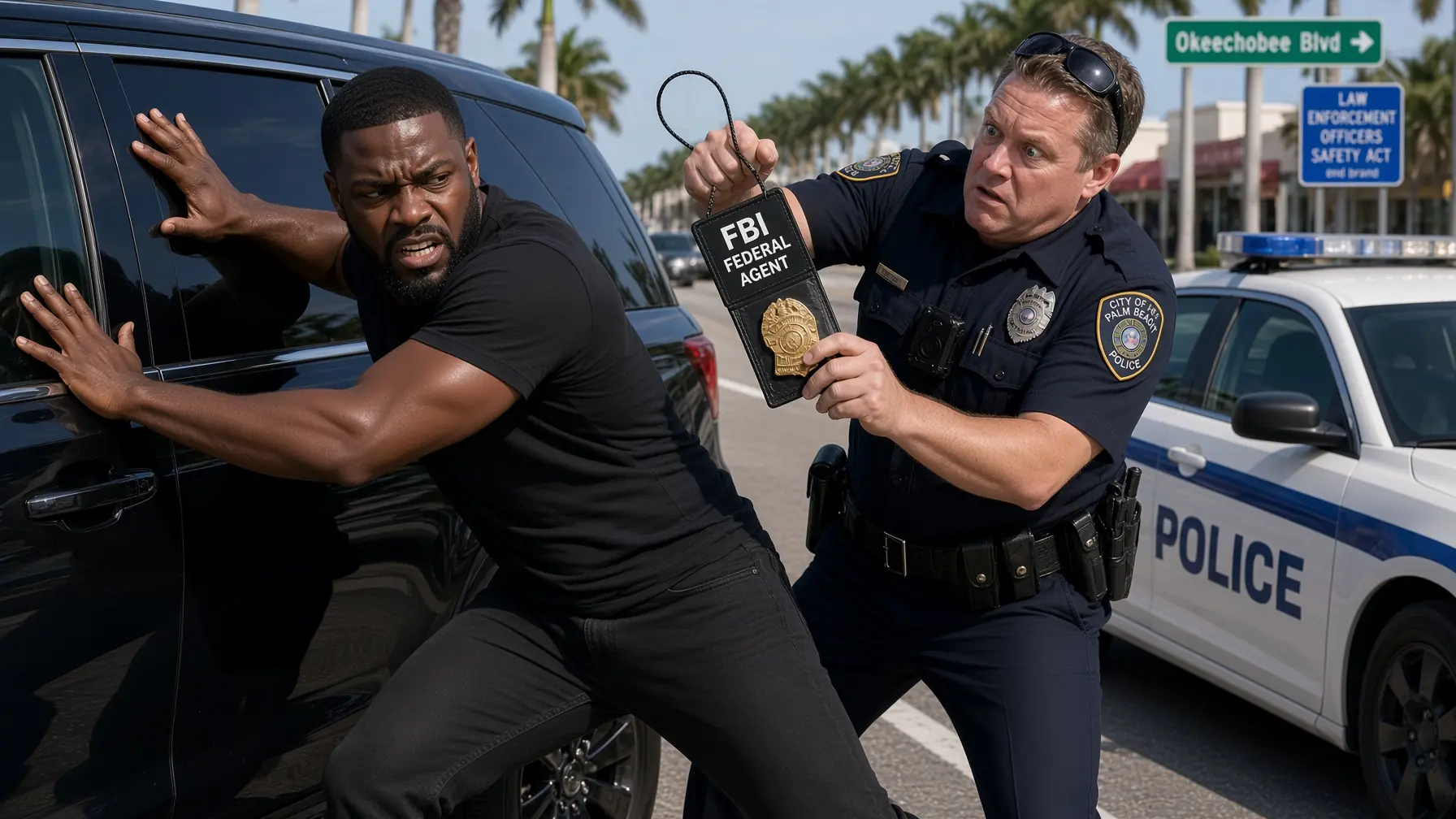
Mercer reached toward Adrian’s collar.
His fingers found leather.
He pulled.
A credential wallet slid into view.
For an instant, Mercer still did not understand what he was looking at. He flipped the case outward. A metallic badge caught the Florida sunlight. Beneath it was an identification card bearing Adrian Cole’s photograph, name, and agency.
FEDERAL BUREAU OF INVESTIGATION.
Mercer stared.
Then he looked at Adrian.
Then back at the credentials.
“What is this?”
“My identification.”
“Is this fake?”
Adrian’s voice remained controlled. “No.”
“People buy fake badges.”
“That one has an identification number. Verify it.”
Mercer looked at him again. “You’re telling me you’re FBI?”
“I’m telling you to verify the credential.”
The officer’s expression changed in stages. Confusion came first. Then disbelief. Then the first appearance of caution since the stop had begun. He turned the leather case over as though inspecting the reverse side might reveal the joke. “Why didn’t you tell me?”
Adrian looked at him.
“You never asked if I was law enforcement.”
“You told me you had a gun.”
“Yes.”
“You could have said, ‘I’m an FBI agent.’”
“I told you there was identification on my chest.”
Mercer stared at him.
Adrian continued. “You called me a liar before you looked.”
For several seconds, the only sound came from traffic beyond the parking lot.
Mercer handed the credentials back but did not immediately return the pistol. “Lean against the vehicle.”
Adrian remained where he was.
“You verified who I am?”
“Not yet.”
“Then verify it.”
Mercer’s defensiveness returned. “You don’t tell me how to conduct a stop.”
“No. But if you’re questioning whether federal credentials are genuine while holding a federal firearm, verification would seem useful.”
Mercer looked toward the recording phone.
The lens was still pointed through the open driver’s door.
Something about that seemed to bother him now.
He reached for his radio.
“Dispatch, I need a credential verification.”
Adrian gave him the identifying information without embellishment. The process took several minutes because municipal dispatch did not simply type “FBI agent” into a public database. A supervisor contacted the appropriate federal duty line through established channels. Mercer stood near his patrol car waiting for the call back, occasionally glancing at Adrian as though he hoped the answer would change. Adrian remained beside the SUV. His hands were no longer spread against the vehicle, but Mercer had not yet told him he was free to move.
Finally, the radio crackled.
“Two-one-six, verification returned. Credential valid. Federal law-enforcement officer.”
Mercer did not respond immediately.
Dispatch repeated him.
“Two-one-six, copy?”