The first thing Officer Derek Walsh noticed was the motorcycle.
It sat alone at the far edge of Morrison Park’s parking lot, black paint dulled by desert dust, chrome pipes streaked with road grime, a faded leather bedroll strapped behind the seat. It was the kind of heavy cruiser that made respectable people tighten their hands around their coffee cups and pretend not to stare. The engine was off, but the machine still looked alive, crouched low against the pavement like something that had been waiting all night for trouble.
The man sitting on the curb beside it looked even worse.
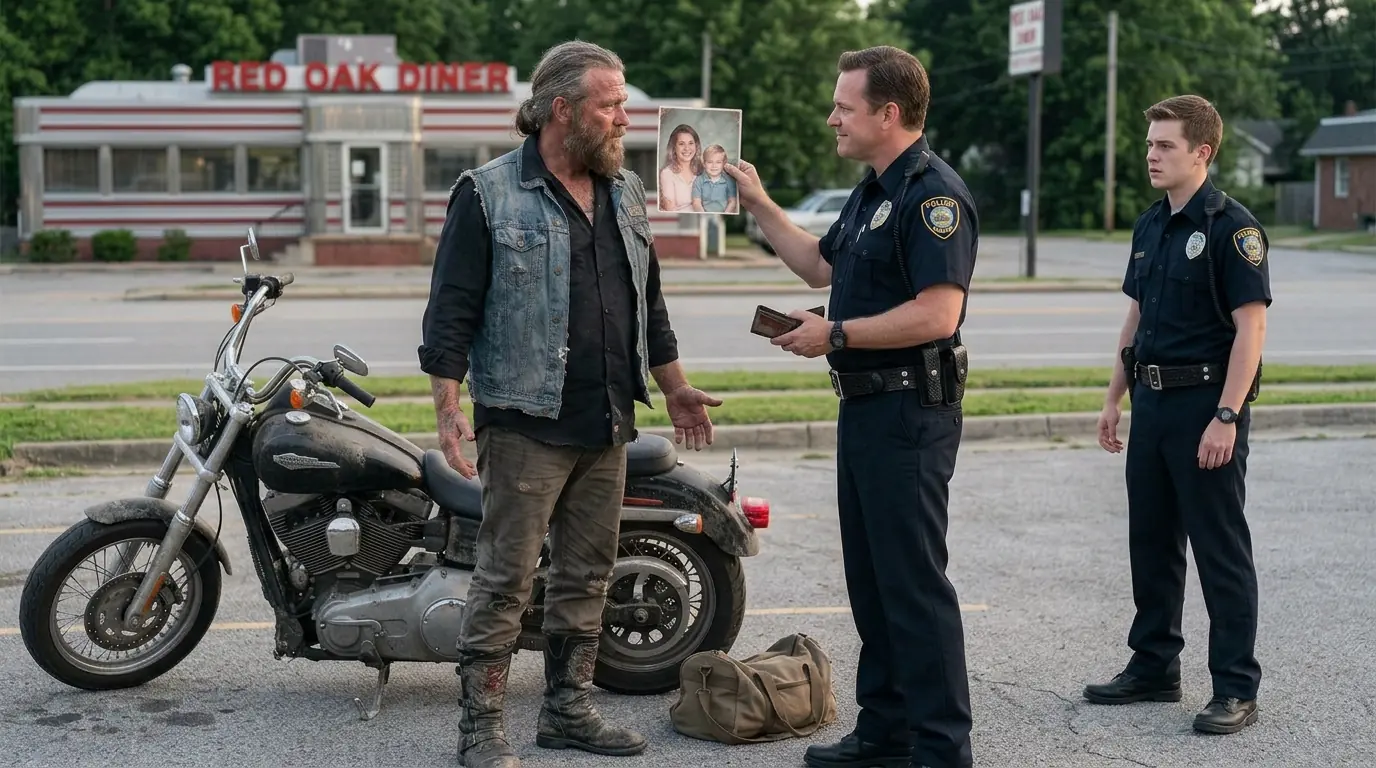
He was broad-shouldered, bearded, and weathered, maybe in his early fifties, with a torn denim vest over a black work shirt and motorcycle boots scarred by thousands of miles. His silver-streaked hair was tied back at the nape of his neck. His knuckles were scraped. A small canvas duffel rested beside him, and a paper coffee cup sat untouched near his boot. To the morning joggers cutting across the park, he looked like every bad story they had ever heard about bikers rolled into one tired body.
To Officer Walsh, he looked useful.
Walsh rolled his patrol car into the lot at 6:41 a.m., slow enough to make the tires hiss against loose gravel. He had been assigned to Morrison Park after three businesses complained about “undesirable types” near the new brunch strip across the street. In Walsh’s mind, undesirable meant poor, loud, tattooed, foreign-looking, homeless, Black, biker, or anyone else whose presence made the new condo owners uncomfortable. He called it keeping order. Everyone else had learned not to call it anything at all.
His partner, Officer Caleb Moore, sat in the passenger seat, younger by nearly fifteen years and still new enough to believe every report had to match what actually happened. Moore looked through the windshield at the biker and shifted in his seat.
“Maybe he’s just resting,” Moore said.
Walsh snorted. “Men like that don’t rest. They wait.”
“For what?”
“For someone too soft to stop them.” Walsh opened his door. “Watch and learn.”
The biker looked up when Walsh approached, but he did not stand. His eyes were gray, steady, and almost unnervingly calm. He held Walsh’s gaze without challenge, without fear, without the restless guilt Walsh expected to see in men who slept near motorcycles and carried their lives in canvas bags.
Walsh stopped three feet from him and planted one hand on his belt.
“You lost, old man?”
The biker’s voice was low and rough, but polite. “No, officer. Just waiting on the diner to open.”
Walsh looked toward the Red Oak Diner across the street. Its neon sign flickered in the early light. Two waitresses moved inside, setting tables. A delivery truck idled near the back entrance.
“Diner opens at seven,” Walsh said. “It’s not seven.”
“I know.”
“So why are you here?”
The biker glanced at the motorcycle. “Because the bike needed a rest before I did.”
Moore had come around the patrol car, standing a few steps behind Walsh. He watched the exchange carefully, his jaw tight.
Walsh smiled in a way that had never comforted anyone. “Funny. You think you’re funny?”
“No, sir.”
“Don’t sir me like you respect the badge. Men like you only respect noise and pain.” Walsh looked down at the vest. There were no club colors on the back, only a faded rectangular patch that had been deliberately cut away, leaving a darker outline in the denim. “Where’s your gang?”
The biker’s expression did not change. “I don’t ride with a gang.”
“Right. You ride with a book club?”
“I ride alone.”
Walsh laughed and turned slightly, making sure Moore could hear him. “They always say that. Lone wolf. Free spirit. Road warrior. Then you search the bags and find pills, stolen jewelry, maybe a gun with the serial number filed off.”
“You got a reason to search my bag?” the biker asked.
Walsh’s smile disappeared. “I don’t need a lecture from a greasy road rat.”
The words reached beyond the parking lot. A woman jogging on the path slowed down. Her name was Sarah Mitchell, and she had seen Walsh act like this before. She had seen him shove a teenager against a vending machine outside the bus stop two weeks earlier. She had seen him empty an old man’s backpack onto wet grass. Each time, she had told herself it was police business. Each time, she had kept jogging.
This morning, for reasons she would later struggle to explain, she stopped.
She took out her phone.
The biker noticed the movement, but Walsh did not.
“Stand up,” Walsh ordered.
The biker placed both hands on his knees and rose slowly. He was taller than he looked sitting down, almost six-foot-two, solid through the chest and shoulders, but carrying the heaviness of someone who had slept badly for too many years. He kept his hands visible.
“Name,” Walsh snapped.
“Jonas Vale.”
“ID.”
“In my wallet.”
“Where’s the wallet?”
“Inside left pocket.”
Walsh stepped close enough to smell road dust, motor oil, and cheap soap on him. “You reach for it and I’ll put you on the pavement.”
“I understand.”
Walsh dug into Jonas’s pocket himself and pulled out a worn leather wallet. He opened it and frowned at the driver’s license. Jonas Vale. Fifty-two years old. Address in Arizona. Motorcycle endorsement. No outstanding flags on the visible side of the card, nothing that made him useful yet.
Walsh flipped the wallet and found a small photograph tucked behind the license. It showed Jonas years younger, standing beside a woman with dark hair and a little boy missing his two front teeth. All three were laughing beside the same black cruiser, back when the paint still shone like midnight.
Walsh held the picture up. “Family?”
Jonas’s eyes sharpened for the first time. “Give that back.”
Walsh looked at the photograph again, then smirked. “Guess they got tired of the biker life.”
Jonas’s jaw moved once. “Give it back.”
Moore took a step forward. “Derek.”
Walsh ignored him. “What happened? Wife smartened up? Kid realize Daddy smelled like exhaust and bad decisions?”
The air changed.
Even Sarah, forty yards away, felt it. Jonas did not move, but something settled over him, something old and cold. His hands stayed open at his sides. His voice remained quiet.
“My wife and son are dead.”
For half a second, even Walsh had the decency to pause. Then the pause curdled into cruelty.
“Well,” Walsh said, sliding the photo back into the wallet. “Maybe they got lucky.”
Moore stared at him. “Derek, come on.”
Jonas closed his eyes. Only for a breath. When he opened them, they were clear again.
“I’m leaving now.”
“No,” Walsh said. “You’re not.”
Jonas looked toward the street, toward the diner, toward the two security cameras mounted under the awning of a bank across the road. His eyes flicked there so briefly no one noticed except Sarah’s phone, which caught the motion. Then he looked back at Walsh.
“Am I being detained?”
Walsh stepped closer and jabbed two fingers into Jonas’s chest. “You’re being whatever I say you’re being.”
The push was not hard enough to knock him down. It was hard enough to make the point. Jonas looked down at the fingers pressed against his shirt.
“Don’t touch me again,” he said.
Walsh’s face lit up. That was what he wanted. Not violence, exactly. Resistance. A word. A movement. Anything he could inflate into a report.
“You threatening an officer?”
“No.”
“Sounded like a threat.”
“It was a boundary.”
Walsh laughed. “A boundary. Listen to this guy. Road trash with therapy words.”
A delivery driver had stopped beside the diner. A retired postal worker walking his terrier paused near the crosswalk. A barista from the coffee shop stood behind the glass door, watching with one hand over her mouth. More eyes. More witnesses. Walsh saw an audience and mistook it for approval.
He grabbed Jonas’s duffel and dumped it onto the pavement.
Clothes. A rolled tarp. Protein bars. A water bottle. A folded map of Utah, Nevada, and Arizona. A small notebook bound with a rubber band. A photograph sealed in plastic. A metal tire gauge. Two clean bandanas.
Walsh kicked through the items. “Where are the drugs?”
“I don’t use drugs.”
“You expect me to believe a biker with no club, no job, and no address in this state is clean?”
“I don’t care what you believe.”
Walsh’s head snapped up. “What did you say?”
“I said I don’t care what you believe. You asked a question. I answered it.”
Moore took another step forward. “Maybe we should just run him and let him go if nothing comes up.”
Walsh turned on him. “You want to do my job for me, rookie?”
“No, I just—”
“Then stand there and learn something.”
Jonas watched Moore lower his eyes. He had seen that look before. A man who knew something was wrong and was trying to decide whether his conscience was worth more than his comfort.
Walsh picked up the notebook.
“That your manifesto?”
Jonas said nothing.
Walsh flipped it open. His eyes skimmed the pages. Dates. Times. Patrol car numbers. Names. Descriptions. Plate numbers. Short sentences written in neat block letters.
Tuesday, 6:32 a.m. Walsh shoved homeless man near fountain. No probable cause.
Wednesday, 6:47 a.m. Walsh searched Latino teenager’s backpack after calling him “cartel junior.” No contraband found.
Thursday, 7:04 a.m. Walsh threatened elderly veteran for sleeping near restroom. Body posture aggressive. Partner did not intervene.
Walsh stopped reading. His hand tightened around the notebook.
“What the hell is this?”