“A guy like you just sits in the park reading?”
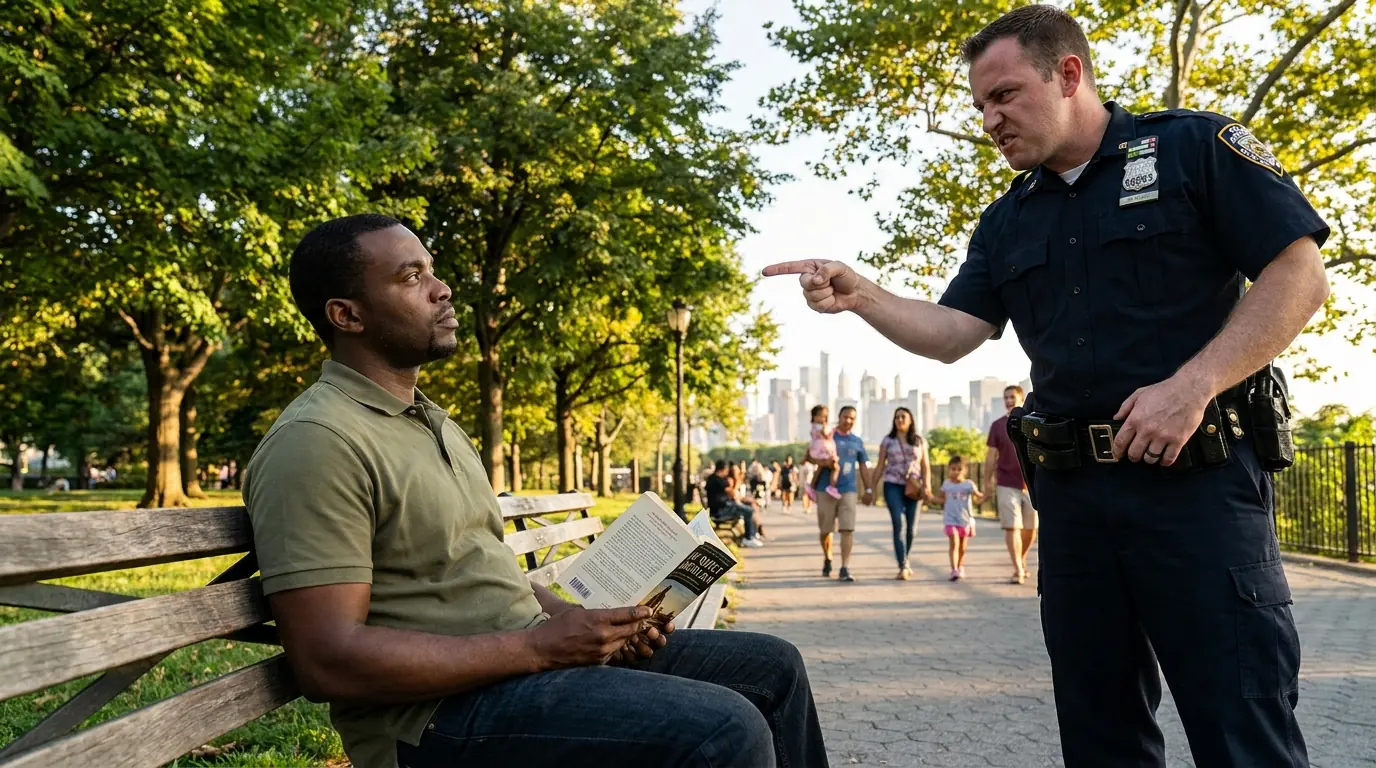
Marcus Davis slowly closed the hardcover book resting across his knee.
He looked up at Officer Brian Harkin.
“What exactly does a guy like me look like?”
For the first time since crossing the grass toward him, Harkin had no immediate answer.
Riverside Park was busy that Friday afternoon.
Children shouted near the playground.
A couple walked two dogs along the river path.
An elderly man scattered crumbs near a cluster of pigeons.
Marcus had been sitting alone beneath an oak tree for almost forty minutes, enjoying the first free afternoon he had managed in weeks.
He was forty-three, Black, six feet tall, athletic without looking imposing, with close-cropped hair and a neatly trimmed beard.
Dark jeans.
Gray pullover.
Running shoes.
Nothing unusual.
Nothing illegal.
The book in his lap was a biography he had been trying to finish for nearly a month.
Harkin had been watching him from across the park for several minutes.
Marcus had noticed.
Men in his profession learned to notice surveillance.
What bothered him was not the observation itself.
It was the expression behind it.
The officer had looked at him before Marcus had done anything.
Then decided there must be something to find.
Harkin shifted his weight.
“We’ve had robberies around here.”
Marcus glanced around.
“Alright.”
“You match the description.”
“What description?”
Harkin’s jaw tightened.
“Taller Black male. Forties. Medium build.”
Marcus waited.
“That’s it?”
“Don’t get smart.”
“I’m asking what part of the description identifies me beyond race, age, and approximate height.”
Harkin stepped closer.
The polite tone disappeared.
“Let me see some ID.”
Marcus kept both hands visible on top of the book.
“Am I being detained?”
“That depends on whether you cooperate.”
“That isn't an answer.”
Harkin’s hand moved toward his duty belt.
Marcus noticed.
So did a woman sitting at the next bench.
She lowered her phone from her ear and began watching.
Harkin said, “Stand up.”
Marcus took a slow breath.
He had worked in federal law enforcement long enough to understand exactly how quickly a routine encounter could turn dangerous once pride entered it.
He also knew that being legally correct did not make a pavement less hard.
So he rose.
Slowly.
Hands visible.
“I am cooperating with your instructions,” Marcus said. “I want that clear.”
Harkin laughed.
“You rehearsed that somewhere?”
“No.”
“You one of those guys who watches legal videos all night?”
Marcus looked at him.
“No.”
“Then stop acting like you know my job.”
Marcus could have ended the mystery in ten seconds.
His federal credentials were inside his wallet.
He could have pulled them out.
SPECIAL AGENT — FEDERAL BUREAU OF INVESTIGATION.
The badge beside them would have changed Harkin’s posture immediately.
Marcus knew it.
That was exactly why he didn’t.
A citizen should not need a federal badge to be treated lawfully.
He reached slowly into his pocket.
“My wallet is coming out.”
“Just do it.”
Marcus removed his ordinary driver’s license and handed it over.
MARCUS ELIJAH DAVIS.
Virginia.
Harkin examined it.
“You don't live here.”
“I work here.”
“Doing what?”
Marcus watched him.
“Am I required to answer that?”
Harkin’s face hardened.
“There you go again.”
He handed the license back.
Then pulled out his handcuffs.
“Turn around.”
Several people were watching now.
Marcus didn’t move immediately.
“For what offense?”
“Suspicious behavior and failure to cooperate with an investigation.”
“I gave you identification.”
“I said turn around.”
“What crime am I suspected of committing?”
Harkin stepped closer until they were only inches apart.
“You want resisting added?”
Marcus looked past him.
A body camera was attached to Harkin’s chest.
Red indicator active.
Good.
Marcus turned around.
Harkin cuffed him.
Too tight.
Marcus felt the metal bite immediately.
He said calmly:
“The cuffs are excessively tight.”
“They’re supposed to be tight.”
“They’re restricting circulation.”
Harkin grabbed his arm.
“You people always have something to complain about.”
Marcus went still.
There it was.
A woman near the walking path audibly said, “Wow.”
Harkin looked toward her.
“Keep moving.”
She didn’t.
Instead, she lifted her phone.
Harkin pulled Marcus toward the patrol car.
Marcus left his book on the bench.
The elderly man with the pigeons picked it up before it could fall.
Marcus glanced back once.
“Could you hold onto that for me?”
The man nodded.
“Absolutely.”
Harkin shoved open the rear door.
“Get in.”
Marcus ducked inside.
As Harkin shut the door, Marcus looked up at him through the glass.
Still calm.
That calm irritated Harkin more than shouting would have.
For twenty-two years, Brian Harkin had told himself he had good instincts.
He knew who belonged in certain places.
Who looked nervous.
Who looked wrong.
Who was trying too hard to look normal.
He called it experience.
Sometimes it was.
Sometimes it was something else.
That afternoon, Marcus’s calmness had become evidence in Harkin’s mind.
If Marcus had looked nervous, Harkin would have called that suspicious.
When Marcus remained calm, Harkin decided that was suspicious too.
There was no way for Marcus to behave correctly because Harkin had reached the conclusion before beginning the investigation.
Driving toward the precinct, Harkin checked the rearview mirror.
Marcus sat upright despite the awkward handcuffs.
“Tell me what you were really doing there.”
Marcus met his eyes through the mirror.
“Reading.”
“You expect me to believe you spend Friday afternoons reading alone in parks?”
Marcus almost smiled.
“Yes.”
“A guy like you?”
Marcus looked at him.
Harkin realized too late what he had said.
Marcus asked quietly:
“What does someone like me do on Friday afternoons?”
Harkin faced forward.
“You know what I mean.”
“No. I don’t.”
Harkin’s hands tightened around the steering wheel.
“Stop trying to make everything about race.”
Marcus looked out the window.
“I haven’t mentioned race once.”
Harkin said nothing after that.
Officer Daniel Jenkins was working the booking desk when Harkin walked Marcus inside.
Jenkins was thirty-one and had been assigned to the precinct for less than a year.
He looked at Marcus.
Then at Harkin.
“What’ve we got?”
“Suspicious person from Riverside.”
Jenkins waited.
“And?”
“Possible robbery suspect.”
Marcus stood beside the desk with his hands still cuffed behind him.
Jenkins typed in the information from the driver’s license.
“Robbery warrant?”
“No.”
“BOLO?”
“General description.”
Jenkins frowned.
“Which case?”
“Riverside commercial break-ins.”
Jenkins typed again.
The actual suspect bulletin came up.
Black male.
Approximately twenty-five to thirty.
Five-foot-eight.
Thin.
Visible neck tattoo.
Last seen wearing a red hooded sweatshirt.
Jenkins looked at Marcus.
Marcus was forty-three.
Six feet tall.
No neck tattoo.
Gray pullover.
Jenkins looked back at Harkin.
“He doesn’t really match this.”
Harkin leaned closer.
“I said I’m questioning him.”
Jenkins lowered his voice.
“Did he run?”
“No.”
“Threaten anybody?”
“No.”
“Anything on him?”
“Not yet.”
Marcus finally spoke.
“Officer Jenkins?”
Jenkins looked at him.
“I requested several times to know the legal basis for my detention.”
Harkin snapped:
“Nobody asked you.”
Jenkins’s eyes shifted toward Harkin’s body camera.
Still active.
He did not respond.
Then he ran Marcus’s full information through the secure database.
Something appeared on the screen.
Jenkins stopped typing.
His posture changed.
Harkin noticed.
“What?”
Jenkins looked at Marcus.
Then back at the screen.
There was only limited information because federal personnel records did not populate like ordinary criminal histories.
But there was enough.
A federal law-enforcement contact flag.
Verification required.
Jenkins reached for the phone.