The patrol car stopped behind Monica Reed just as she dropped the final trash bag into the dumpster.
She heard the tires before she saw the flashing lights.
Red and blue reflections moved across the brick wall of the small office complex, even though the sun was still high enough to make emergency lights unnecessary. Monica lowered the dumpster lid and turned slowly.
The officer was already out of his vehicle.
He walked toward her with one hand resting near his belt, his expression carrying the tense suspicion of a man approaching a crime scene rather than a woman taking out office trash.
“Dispatch, Unit Seven-Nineteen,” he said into the radio clipped to his shoulder. “I’m approaching the suspect now.”
Suspect.
Monica glanced at the two black trash bags inside the dumpster.
Then she looked toward the glass door ten feet away, where gold lettering clearly displayed:
MONICA REED
ATTORNEY AT LAW
The officer stopped several feet from her.
He was tall, broad through the shoulders, and perhaps in his late thirties. His uniform was clean and carefully pressed. A rectangular nameplate above his right pocket read:
OFFICER DARREN COLE
His badge number was 2322.
“Excuse me, ma’am.”
“Yes, Officer?”
“What do you think you’re doing here?”
Monica looked toward the dumpster.
“Taking out my office trash.”
“That’s illegal dumping.”
“No, it isn’t.”
“This is private property. You can’t bring your personal garbage here and throw it into a commercial dumpster.”
Monica kept her voice calm.
“My office is right there.”
Officer Cole followed her gesture toward the door.
“You work here?”
“I rent Suite 104.”
“What kind of work do you do?”
“I’m an attorney.”
Something almost like amusement appeared on his face.
“You’re an attorney?”
“Yes.”
“Here?”
“That’s correct.”
The officer looked at Monica’s clothes.
She wore black trousers, a pale-blue blouse, and comfortable flats. Her blazer remained inside because she had planned to carry the trash outside and return immediately to finish preparing a motion.
Nothing about her appearance was unusual.
But Officer Cole studied her as though the claim itself were unbelievable.
“You have proof of that?”
Monica tilted her head slightly.
“Proof that I’m a lawyer?”
“Proof that you’re authorized to use this dumpster.”
“My office lease includes waste service.”
“I’ll need to see something.”
Monica glanced toward the open office door.
“I can show you my business card. I also have my lease inside.”
“Start with the card.”
She reached carefully into the pocket of her trousers.
The officer’s hand moved closer to his weapon.
Monica stopped.
“I’m reaching for the business card you requested.”
“I know what you’re doing.”
“Then there’s no reason to touch your weapon.”
His jaw tightened.
“Just move slowly.”
Monica removed a white card and held it between two fingers.
Officer Cole took it.
He read aloud.
“Monica Reed. Attorney at Law.”
“Yes.”
“It doesn’t list this address.”
“Turn it over.”
He flipped the card.
The back contained the full office address, telephone number, state bar identification number, and website.
Monica waited.
Officer Cole stared at it longer than necessary.
“The address is small.”
“It’s still there.”
“I don’t see a suite number.”
Monica pointed without stepping closer.
“Second line. Suite 104.”
He looked down again.
The number was clearly printed.
“Anyone can make a business card.”
“That’s true.”
“So this proves nothing.”
“You asked for proof that I work here. My name is on the office door, and the address is on the card.”
“I asked whether you were authorized to use the dumpster.”
“And I answered.”
“No. You made a claim.”
Monica took a slow breath.
She had been an attorney for twelve years.
During that time, she had learned that the words people used often mattered less than the structure of the conversation around them.
Officer Cole was not asking questions because he wanted information.
He was asking them because each answer gave him another opportunity to demand something else.
“Would you like to see the office?” she asked. “The door is open.”
He did not look toward it.
“I need identification.”
“No, you don’t.”
His eyebrows rose.
“Excuse me?”
“You approached me while I was using a dumpster attached to the building where I rent office space. I explained why I’m here and showed you a business card containing the address. There is no crime, no reasonable suspicion, and no legal requirement that I provide identification.”
“Don’t make this difficult.”
“I’m not.”
“You’re being confrontational.”
Monica almost laughed, but she knew that any visible amusement could become another entry in a police report.
“I have not raised my voice. I answered your questions. I offered to show you my office.”
Officer Cole stepped closer.
“I’ve asked you three times for identification.”
“No. You have asked once.”
“Are you calling me a liar?”
“I’m correcting the record.”
His face reddened.
The office complex stood on the edge of Brookhaven, Georgia, in a row of converted brick storefronts occupied by accountants, therapists, real-estate agents, and small law firms.
Monica had leased Suite 104 for nearly four years.
She knew the owners.
She knew the maintenance workers.
She knew which tenant always forgot to lock the side entrance and which accountant left stale doughnuts in the shared break room every Friday.
The dumpster had been in the same place throughout her tenancy.
She had used it hundreds of times.
Never before had anyone treated the act like a crime.
“Ma’am,” Officer Cole said, “I’m attempting to conduct an investigation.”
“An investigation into what?”
“Illegal dumping.”
“Who reported it?”
He did not answer.
“Was there a caller?” Monica asked.
“I don’t have to provide you with that information.”
“Was there a complaint from the property owner?”
“I’ll ask the questions.”
Monica looked toward the patrol car.
The dashboard camera pointed toward them.
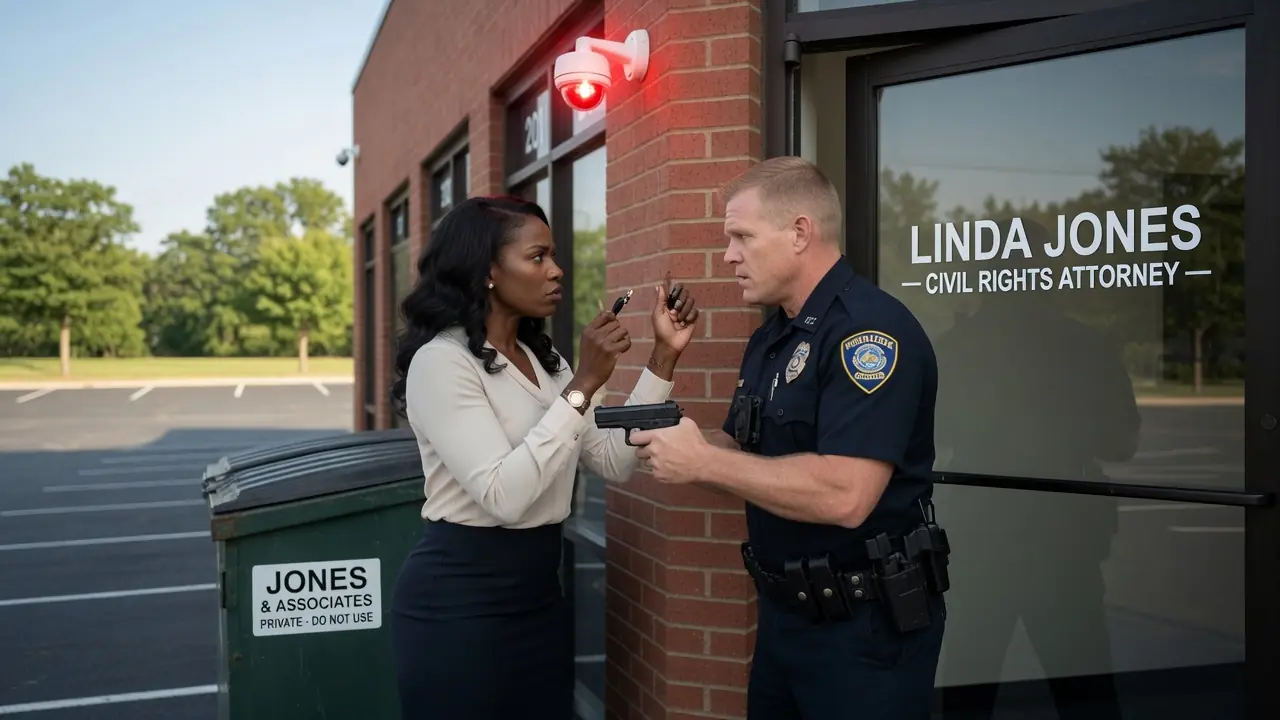
A body camera was clipped to the center of his uniform.
She hoped both were active.
“All right,” she said. “Ask.”
“Where do you live?”
“That is not relevant.”
“It’s relevant because if you live somewhere else, this may be household trash.”
“It came from my office.”
“What is inside the bags?”
“Paper waste, empty food containers, and packaging from office supplies.”
“Confidential documents?”
“No.”
“How do I know that?”
“You don’t need to know.”
Officer Cole stared at her.
“You really expect me to believe you’re a lawyer?”
Monica held his gaze.
“You can verify my bar number.”
“I don’t need legal advice from you.”
“You asked whether I was a lawyer.”
“I’m telling you that this situation looks suspicious.”
“What specifically is suspicious?”
“You.”
The word left his mouth before he appeared to understand what he had said.
The parking lot became very quiet.
Traffic moved on the road beyond the building.
An air-conditioning unit hummed above the rear entrance.
Monica folded her hands in front of her.
“Officer, what about me appears suspicious?”
Cole looked away for a fraction of a second.
“You’re behind a commercial building placing bags into a private dumpster.”
“At four twenty in the afternoon, ten feet from my open office.”
“You keep claiming it’s your office.”
“My name is on the door.”
“That could belong to another Monica Reed.”
“You have my business card.”
“A card does not prove identity.”
“And that is why you want my license.”
“Now you understand.”
Monica considered refusing.
She had every legal right to do so.
But she also understood the reality standing in front of her.
A lawful refusal could become “failure to cooperate.”
A hand reaching toward a pocket could become a “furtive movement.”
An objection could become “aggression.”
She had represented enough clients to know how quickly ordinary conduct could be rewritten once police language entered the report.
“I will show you my license,” she said. “I am not consenting to a search, and I am not agreeing that you have lawful grounds to detain me.”
“Just give me the ID.”
“I said I will show it to you.”
She removed her wallet and held up the license without releasing it.
Officer Cole grabbed it from her hand.
Monica’s expression hardened.
“I did not give you permission to take that.”
“You provided it.”
“I displayed it for verification.”
“Same thing.”
“No. It is not.”
Cole compared the name with the card.
“Monica Elaine Reed.”
“Yes.”
The residential address on the license was six miles away.
He held it beside the business card.
“These addresses don’t match.”
“One is my home. One is my office.”
“That’s convenient.”
“That is how business addresses work.”
“You claim this is your office, but your license lists another location.”
“Driver’s licenses generally list residential addresses.”
“You have an answer for everything.”
“I’m an attorney. Answering questions is part of my occupation.”
The officer turned toward his patrol car.
“I’m running this.”
“You do not have legal grounds.”
“You handed me the ID.”
“I showed it to confirm the business card. You took it.”
“If you are who you claim to be, then you shouldn’t have a problem with me verifying it.”
“That is not how constitutional rights work.”
Cole stopped.
“Are you threatening me?”
“No.”
“You said something about my conduct being unconstitutional.”
“That is legal analysis, not a threat.”
“Maybe you should save the courtroom performance.”
Monica looked at the body camera.
“Officer Cole, badge number 2322, I am requesting the immediate return of my identification.”
“You’ll get it back when I finish.”
“I have not committed a crime.”
“That remains to be determined.”
He walked to his vehicle.
Monica remained where she was.
For several seconds, she considered returning to the office and calling another attorney.
Then she realized Officer Cole still possessed her license. Walking away might be described as fleeing an investigation.
She took out her phone instead.
Cole saw the movement through the patrol-car window.
He stepped out again.
“Put the phone down.”
“I’m documenting the encounter.”
“You are not allowed to interfere.”
“I’m standing still.”
“Stop recording.”
“I have a lawful right to record police activity from a safe distance.”
“You’re part of the investigation.”
“That does not eliminate the right.”
“Put it away before I confiscate it.”
“On what grounds?”
“You’re escalating.”
Monica started recording.
She held the phone at chest height and announced the time, location, officer’s name, and badge number.
Cole approached quickly.
“You need to stop.”
“Do not touch my phone.”
“I said stop recording.”
“You are being recorded by your body camera.”
“That is department property.”
“And this is my property.”
He stopped two feet away.
For the first time, uncertainty appeared in his eyes.
Monica continued speaking into her phone.
“I am standing behind my leased office at 416 Brookhaven Avenue. Officer Darren Cole approached while I was placing office trash into the shared commercial dumpster. I provided my business card and displayed my license. He took the license without consent and is attempting to run it despite the absence of reasonable suspicion.”
Cole pointed toward the phone.
“You are giving a one-sided account.”
“You may state your position.”
“I don’t have to explain myself to you.”
“No. But the recording will reflect that you were invited to.”
He reached toward his radio.
“Dispatch, Seven-Nineteen. Start another unit to my location.”
Monica looked at him.
“For what reason?”
“Officer safety.”
“I have not moved toward you.”
“You’re hostile.”
“I’m speaking calmly.”
“You’re threatening a lawsuit.”
“I said continued harassment could expose the city to legal liability.”
“That sounds like a threat.”
“It is a warning about consequences, the same type you have been giving me.”
Cole spoke into the radio again.
“Possible combative subject. Claims to be an attorney.”
Monica felt anger rise in her chest.
She kept her face still.
“Please describe the conduct you consider combative.”
“Your attitude.”
“Attitude is not a crime.”
“Neither is asking questions.”
“Taking my identification without reasonable suspicion is not merely asking a question.”
Cole walked back to the patrol car.
Monica heard him speaking to someone through the open window.
She could not make out every word, but she heard her name, date of birth, and license number.
He was running the identification.
Her warning had been ignored.
A second patrol car entered the lot four minutes later.
Officer Jason Hale stepped out.
He was older than Cole, perhaps in his early fifties, with a sergeant’s chevrons on his sleeve.
Cole met him near the cars.
The two spoke quietly.
Monica kept recording.
She watched Sergeant Hale glance toward the office door.
Then toward the business card Cole held.
Then toward the dumpster.
Hale approached alone.
“Ms. Reed?”
“Yes.”
“I’m Sergeant Hale.”
“Is your body camera active?”
“Yes.”
“Good.”
He looked toward her phone.
“You’re recording?”
“Yes.”
“That is your right.”
Officer Cole’s expression tightened behind him.
Hale continued.
“I understand there was a concern about unauthorized dumping.”
“There was no reasonable concern. My office is ten feet away, my name is on the door, and Officer Cole has my business card containing this address.”
“Do you have a lease?”
“Inside.”
“Would you be willing to show it?”
“I offered to show Officer Cole my office before he took my license.”
Hale looked over his shoulder.
Cole said, “She was evasive from the start.”
Monica pointed toward the camera on his chest.
“The footage will settle that.”
Sergeant Hale paused.
“Could we see the office?”
Monica unlocked the door even though it had not been locked.
The reception area contained framed legal certificates, photographs, case files, and a wall-mounted copy of her state bar license.
Her name appeared on the directory beside the entrance.
Mail addressed to Monica Reed Law Group rested on the reception desk.
The lease agreement was inside a file drawer.
She handed Sergeant Hale a copy.
He reviewed the first page.
Tenant: Monica Reed.
Suite 104.
Waste disposal included in monthly common-area charges.
Hale closed the document.
“Officer Cole, return her license.”
Cole remained near the doorway.
“I haven’t completed my investigation.”
“The tenant is authorized to use the dumpster.”
“We don’t know whether the bags came from here.”
Monica stared at him.
“Would you like to inspect the coffee cup and printer packaging?”
Hale’s face tightened.
“That won’t be necessary.”
Cole handed back the license.
Monica checked it before placing it in her wallet.
Sergeant Hale spoke carefully.
“It appears this was a misunderstanding.”
“No,” Monica said.
Both officers looked at her.
“A misunderstanding occurs when facts are unclear. The facts became clear within the first minute.”
Hale lowered his voice.
“Ms. Reed—”
“Officer Cole continued after seeing my office door, my business card, my license, and my invitation to enter. He threatened to confiscate my phone for recording. He described me as combative over the radio because I asserted my rights.”
Cole folded his arms.
“I was doing my job.”
Monica looked at him.
“You were trying to find a crime after discovering there wasn’t one.”
“That is your opinion.”
“It is supported by the recording.”
Sergeant Hale stepped between them slightly.
“Everyone needs to lower the temperature.”
“My temperature is fine,” Monica said.
Cole laughed once.
“See? This is what I’m talking about.”
Hale turned sharply.
“Enough.”
The command silenced him.
Sergeant Hale gave Monica the incident number and explained how to submit a complaint.
Cole interrupted.
“She’s being released with a warning.”
Monica looked toward him.
“A warning for what?”
“Be more careful about using private dumpsters.”
“I am a tenant.”
“Then consider it a reminder.”
“No.”
He stared at her.
“No?”
“You are not going to create the impression that I committed an offense and received leniency. I did nothing unlawful.”
“I can document the contact however I see fit.”
“And I will request every record connected to it.”
Cole’s jaw tightened.
Monica continued.
“Your body-camera video. Dispatch audio. Computer searches. GPS location. Any report you file. Any complaint that supposedly brought you here.”
Sergeant Hale looked at Cole.
“Was there a caller?”
Cole did not answer immediately.
Hale repeated the question.
“Who reported the dumping?”
“I observed it while driving past.”
Monica glanced toward the road.
A six-foot privacy fence blocked most of the dumpster from passing traffic.
“From the street?”
Cole’s eyes moved.
“I saw suspicious activity near the rear of the building.”
“You entered from the opposite direction,” Monica said. “I heard your tires on the service lane behind me.”
Hale studied him.
“Why were you in the service lane?”
“Routine patrol.”
“Is that reflected in your call log?”
Cole did not respond.
The silence changed the encounter.
Sergeant Hale looked toward the patrol car.
“Officer Cole, return to your unit.”
“I still have—”
“Now.”
Cole walked away.
Monica watched him go.
Sergeant Hale remained by the office door.
“I apologize.”
“I appreciate that you corrected the situation.”
“That isn’t the same as accepting the apology.”
“No.”
He handed her a card.
“My direct line is on the back.”
“I’ll be filing a formal complaint.”
“I assumed you would.”
“Please preserve all evidence.”
“I’ll notify the watch commander.”
Monica looked toward Cole’s vehicle.
“He came here for a reason.”
“What do you mean?”
“Perhaps he saw me and made an assumption. Perhaps someone complained. Perhaps he has done this before.”
Hale’s expression revealed nothing.
But he did not dismiss the possibility.
The officers left ten minutes later.
Cole pulled away first.
Sergeant Hale remained long enough to photograph the office sign, the dumpster, and the distance between them.
Monica stood in the parking lot after both cars disappeared.
Only then did she notice her hands trembling.
She returned to her office and locked the door.
The motion she had planned to finish remained open on her computer.
She could not read the first sentence.
Instead, she sat behind her desk and reconstructed the encounter from memory.
Time of arrival.
Exact words.
Requests made.
Documents shown.
Threats concerning her phone.
Every detail went into a written statement before memory could soften the edges.
Then she copied the recording to three separate locations.
Monica specialized in employment disputes and civil-rights litigation.
She had represented people whose encounters with authority became battles over whose account sounded more believable.
Without video, an officer’s report often became the official version before the citizen’s voice entered the room.
This time, she had a recording.
The officer also had a body camera.
What she did not yet know was whether the footage would reveal something larger.
The department acknowledged her complaint two days later.
Officer Cole’s report arrived through a public-records request the following week.
It described Monica as “agitated,” “uncooperative,” and “verbally aggressive.”
It stated that she initially failed to provide proof of tenancy.
It claimed she “eventually produced documents after prolonged resistance.”
The report did not mention that her name was displayed on the office door.
It did not mention the business card.
It did not mention her immediate offer to show him the office.
It also stated that the encounter began after “a citizen complaint regarding a suspicious individual using the dumpster.”
There had been no citizen complaint.
Dispatch records confirmed it.
Cole initiated the stop himself.
Monica read the report twice.
Then she telephoned Sergeant Hale.
“He fabricated the reason for the stop.”
Hale was silent for several seconds.
“I’ve seen the dispatch log.”
“Did he explain the discrepancy?”
“That is part of the internal investigation.”
“He described me as aggressive.”
“I saw the footage.”
“And?”
“You were calm.”
“Did he activate his camera before approaching?”
Another pause.
“Yes.”
The body-camera video was released to Monica’s attorney three weeks later.
The footage began while Cole remained inside his patrol car.
His voice could be heard before he opened the door.
“There’s a woman back here dumping stuff,” he said over the radio. “Doesn’t look like she belongs at these offices.”
The dispatcher asked whether a property owner had complained.
“No. I’m checking it out.”
On the video, Monica’s office sign was visible behind her.
Cole walked past it without looking.
The footage captured every word that followed.
Her calm answers.
His repeated interruptions.
His refusal to accept the address on the card.
The moment he said she herself looked suspicious.
His threat to confiscate the phone.
His inaccurate description of a combative subject.
The evidence was not ambiguous.
Internal Affairs expanded the investigation.
Monica discovered that Cole had received six complaints during the previous three years.
A Latino contractor said Cole accused him of stealing tools from his own work vehicle.
An elderly Black man was detained while waiting outside his daughter’s house.
A young woman wearing medical scrubs was questioned for sitting inside her car behind a clinic where she worked.
Each complaint had been closed as a misunderstanding.
None of the complainants had been attorneys.
Most did not have recordings.
Monica contacted them.
She listened to their stories without promising an outcome.
Together, the incidents formed a pattern the department could no longer describe as isolated confusion.
Four months after the encounter, the city announced that Officer Darren Cole had been dismissed.
The department cited dishonesty in an official report, misuse of police authority, repeated biased enforcement, and failure to follow direct supervisory instructions.
Cole appealed.
The body-camera footage remained stronger than his explanations.
The dismissal was upheld.
Monica filed a civil action against the city, not because she wanted a dramatic courtroom victory, but because internal discipline did not address the system that had allowed earlier complaints to disappear.
The case ended in a settlement requiring more than financial compensation.
Officers would receive clearer guidance concerning identification demands.
Supervisors would review stops involving alleged trespass or dumping when the subject claimed to be a tenant or property owner.
Complaints could no longer be closed as misunderstandings without comparing reports against available video.
Body-camera footage had to be preserved automatically after any complaint.
Sergeant Hale testified during the review.
He admitted he had known Cole generated more complaints than other officers.
“I believed he was aggressive,” Hale said. “I did not understand how often that aggression was directed toward people he assumed did not belong.”
Monica asked the question plainly.
“What finally made you understand?”
He looked toward her.
“You knew the law well enough to stop the story from being rewritten.”
“And people who don’t know the law?”
Hale lowered his eyes.
“They needed us to take them seriously before they could prove we were wrong.”
The settlement created an independent civilian review position within the city.
Monica was invited to apply.
She declined.
She had clients, a small firm, and work she had chosen long before Officer Cole entered her parking lot.
But she agreed to serve on the advisory committee that designed the complaint process.
One year after the encounter, Monica stood behind her office again carrying two trash bags.
The same dumpster remained against the brick wall.
The service lane was quiet.
She lifted the lid, placed the bags inside, and closed it.
For a moment, she remembered the patrol lights reflecting across the wall.
The suspicion in Cole’s eyes.
The way he transformed every answer into another reason not to believe her.
Then she looked toward the office door.
Her name remained in gold letters across the glass.
She had always belonged there.
The business card had not created that truth.
The driver’s license had not created it.
The lease had not created it.
And Officer Cole’s disbelief had never been powerful enough to erase it.
Inside, the telephone rang.
Monica returned to her desk and answered.
A young man had been stopped while unloading equipment outside the building where he worked. An officer accused him of theft even after his supervisor confirmed his employment.
The man sounded embarrassed.
More than embarrassed.
Afraid that nobody would believe his version.
Monica opened a new file.
“Start at the beginning,” she said.
“Tell me exactly what happened.”
Outside her window, the afternoon sun moved across the parking lot.
No patrol cars waited behind the building.
No emergency lights reflected against the wall.
Only an ordinary office, an ordinary dumpster, and a woman who had been doing something entirely lawful when another person decided she looked like she did not belong.
That decision had lasted only a few minutes.
Its consequences had reached much farther.
Not because Monica possessed a business card.
Not because she knew how to file a lawsuit.
And not because she had spoken more forcefully than the officer.
The encounter changed because she understood something Officer Cole did not.
Authority did not become lawful simply because it wore a badge.
Suspicion did not become evidence because an officer repeated it.
And a person did not need permission from a stranger to belong in the place she had already earned.