The wind off the Rockies came down into Blackwater with a bite sharp enough to make people lower their heads when they walked. March in Montana Territory was not kind to anyone, least of all a woman with no family, no proper home, and only sixty-three dollars hidden beneath a floorboard. Eliza Hart stood behind the counter of Morrow’s General Store, brushing flour from her sleeves while the front windows rattled in their frames. She had been awake since four that morning, shaping bread, cutting biscuits, and pretending she did not feel the loneliness pressing in around her.
She was twenty-six years old, though the women in town spoke of her as if she had already passed some invisible deadline. She slept in the store’s back storage room, earned three dollars a week, and baked rolls so good that customers rode in from miles away to buy them. Men praised her cooking, then looked too long at her face. Their wives pretended not to notice, then blamed Eliza for being noticed.
That morning, Sarah Pritchard burst into the store with Mary Chen and Constance Wells behind her, all three breathing hard from gossip. Sarah slapped a notice onto the counter as if it were a scandalous telegram from the governor himself. “Rhett Callahan is looking for a wife,” she announced, her eyes shining with cruel delight. Eliza wiped her hands on her apron and looked down at the paper.
The handwriting was precise and bold. It read: “Man of property seeks wife. Must be strong, honest, and willing to work. No drunkards, no gossips, no fragile temperaments. Life will be hard but fair. Compensation, security, respect, share in all holdings. Serious inquiries only. R. Callahan, north boundary.”
Mary laughed first. “Can you imagine? Ordering a wife like he’s ordering fence wire.” Constance wrinkled her nose and said no decent woman would ride within ten miles of Callahan Ranch. Sarah leaned closer and lowered her voice, though everyone in the store could hear. “They say he killed a man once.”
“That was ruled self-defense,” Eliza said quietly. “The man drew first.”
Three sets of eyes turned on her.
Sarah’s smile sharpened. “You defending him now?”
“I’m defending the difference between fact and rumor,” Eliza answered.
The women left with their skirts swishing, carrying the notice and the story back into town. Eliza stood alone behind the counter, thinking of the words that had stayed with her. Work. Security. Partnership. Respect. She had been offered many things in her life, but respect had not been one of them.
By noon, every street in Blackwater knew about Rhett Callahan’s notice. The saloon crowd mocked him, the church women condemned him, and the merchants laughed because laughing was safer than admitting they feared him. People said he was too large, too silent, too strange. They said no woman would live with a man who looked like a mountain and spoke like thunder held behind his teeth.
Eliza had seen Rhett only twice before. Both times, he had come into town for supplies and left without greeting anyone who did not first address him. He stood six and a half feet tall, broad as a barn door, with a heavy beard, guarded eyes, and hands big enough to make ordinary objects look fragile. But she remembered one thing no one else seemed to mention: he had once stepped aside to let a frightened child pass without making her feel stared at.
That night, after closing the store, Eliza went to the storage room and pulled the small wooden box from beneath the loose floorboard. Inside were her savings, a silver locket, a folded deed to Kansas land she had never seen, and a newspaper clipping she never looked at unless fear made her foolish. She did not unfold it that night. She already knew the words.
Woman sought in fraud investigation.
Eliza closed the box and pushed it back under the floor.
Then she sat on the narrow cot with a candle beside her and thought about Rhett Callahan. She thought about the storage room walls, the glances from men, the whispers from women, and the cold knowledge that she had no future in Blackwater. Running from town to town had kept her free, but it had not given her a life. By morning, she had made a decision that felt both reckless and clean.
She borrowed a horse from the livery before dawn and paid double so the owner would not ask questions. The road north was muddy, winding between sagebrush, pine, and patches of lingering snow. As the miles passed, the town disappeared behind her, and the mountains rose ahead like a wall built by God himself. Her heart beat hard enough that she could feel it in her throat.
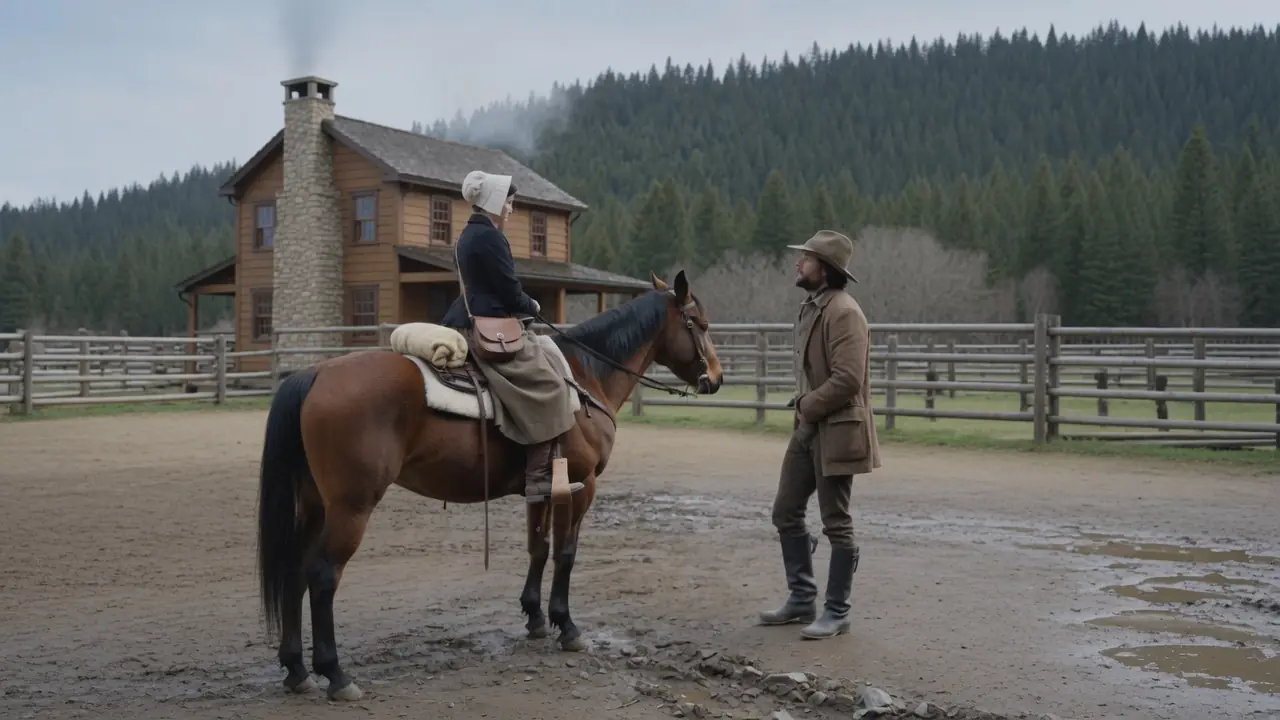
The directions to Callahan Ranch were simple: follow the north road to the fork, take the west trail, ride along the creek until the valley opened. When she reached the ridge, Eliza stopped the horse without meaning to. Below her lay a broad valley of grass, timber, water, and fences, with a large timber house standing at the center like something stubborn enough to survive any winter. Smoke rose from the chimney in a straight gray line.
It was a home.
Eliza rode down slowly, her gloves tight on the reins. In the yard, Rhett Callahan stood beside a horse, shoeing it with the focus of a man who respected pain in animals. He did not notice her immediately. He finished the nail, set the hoof down gently, and spoke one low word that calmed the animal at once. Only then did he turn.
She had forgotten how large he was. Standing on the ground while she sat mounted, he still seemed to fill the yard. His coat was worn, his trousers muddy, and his hat sat low over storm-gray eyes. Yet the first thing she saw was not his size, but his restraint, the careful way he held himself as though he knew people mistook strength for threat.
“Miss Hart,” he said.
His voice was deep, but not unkind.
“Mr. Callahan,” Eliza replied. She forced herself to sit straighter. “I came about your notice.”
A crow called from the pine trees. Somewhere behind the barn, water moved over stones. Rhett studied her in silence, not with suspicion exactly, but with the caution of a man who had learned that people often approached him for the wrong reasons. Eliza refused to look away.
“You read it?” he asked.
“Yes.”
“Understood it?”
“I believe so.”
He wiped his hands on a rag. “Then let me make it plainer. I am not looking for a pretty ornament to sit in a parlor. I am not offering poetry, dancing, or easy living. I need a partner who can work, speak plainly, and stand hard days without turning mean.”
Eliza swallowed. “I am not looking for easy living.”
“What are you looking for?”
She surprised herself by answering honestly. “A place to stop running.”
Something in his face changed, not much, but enough.
“Running from the law?” he asked.
“No.”
He held her gaze for a long moment. “Running from people, then.”
“That is closer.”
Rhett nodded as if the answer made sense to him. “Come inside. I’ll make coffee.”
The house was clean, plain, and built for a large man. The table was heavy, the chairs sturdy, the doorways tall, and the shelves lined with tools, books, and carefully folded blankets. Eliza noticed the order of the place at once. Men who were careless did not live like this.
Rhett poured coffee and set one cup before her. He did not hover, did not flatter, and did not attempt to make himself charming. They sat across from each other while the stove ticked with heat and the wind pushed against the window. For the first time in months, silence did not feel like judgment.
“Why did you post the notice?” Eliza asked.
“Because I am tired of being alone.”
The directness of it made her breath catch.
Rhett looked down into his cup. “I built this ranch over ten years. Land, cattle, timber, contracts, water rights. I have more than one man needs and nobody to share it with. Women in town look at me and see something they fear, so I stopped asking them to see different.”
“Do you blame them?”
He looked up. “Sometimes.”
The honesty of that answer settled between them.
Eliza studied him more closely. “Have you ever hurt anyone who did not deserve it?”
“No.”
“Then perhaps they are fools.”
For the first time, Rhett almost smiled. It was not much, just the faintest break in the guarded line of his mouth, but it made his whole face look younger. “Maybe,” he said. “But fools still make a town.”
He asked about her life then. Not with prying curiosity, but like a man considering whether a bridge could hold weight before crossing it. She told him she had worked in stores, kitchens, bakeries, and boarding houses. She told him she could cook, ride, shoot well enough, keep accounts, and learn livestock if taught. She did not tell him about Kansas.
Not yet.
Rhett listened without interrupting.
When she finished, he said, “If we marry, half of this ranch becomes legally yours. I’ll have the papers filed before any ceremony. You will work for it, same as me, but you will own what you build.”
Eliza stared at him.
No man had ever offered her such a thing. Not protection in exchange for obedience, not shelter in exchange for gratitude, but actual partnership written into law. Her throat tightened, and she looked away before he could see too much. “Why would you trust me with that?”
“If I cannot trust my wife, what is the point of having one?”
It was the least romantic sentence she had ever heard.
It nearly broke her heart.
She asked to see the ranch before giving an answer, and Rhett saddled horses without argument. They rode along fences, past cattle, through timber stands, and up to a ridge overlooking the whole valley. He showed her the creek that never ran dry, the garden plot he admitted he had no talent for, the barn he built with his own hands, and the winter pasture where the cattle could shelter from wind. He described hardship without dressing it up.
“Winters can trap a person here for weeks,” he said. “Cattle die. Roofs break. Men get hurt. Loneliness can turn sharp if you do not know how to sit with it.”
Eliza looked down at the valley. “You are trying to frighten me away.”
“I am trying not to lie.”
That was what decided her more than the ranch itself.
When she returned to Blackwater that evening, Sarah Pritchard waited outside the store like a vulture dressed for church. “You went to see him,” Sarah said. “Everybody knows.” Eliza unlocked the store without answering. Sarah followed her in, her voice full of hunger. “Do you know what people will say if you marry that giant?”
Eliza turned. “I have been in seven towns in three years. People always say something. They decide who I am before I open my mouth, then congratulate themselves for being right.” Her voice stayed low, but Sarah stepped back. “So no, Sarah. I do not care what people say. Not anymore.”
By morning, someone had thrown a rock through the store window.
Morrow found Eliza sweeping glass from the floor. He looked tired, apologetic, and weak in the way decent men sometimes are when cowardice is easier than courage. “Eliza,” he said, “I cannot have trouble here.” She looked at him, broom still in hand. “I did not cause the trouble.”
“No,” he admitted. “But trouble followed you.”
He gave her one week’s pay and a reference she knew she would never use. Eliza packed the wooden box, her clothes, the locket, and her few savings within an hour. Then she went to the telegraph office and sent a message to Callahan Ranch. Answer is yes.
Rhett’s reply came before sunset.
Come tomorrow. Bring everything.
The next afternoon, Rhett waited at the boundary line with a second horse for her belongings. He did not gloat, did not ask if she was sure, and did not pretend the decision was simple. He only looked at the boxes tied behind her saddle and said, “You came.” Eliza lifted her chin. “Did you think I would not?”
“Wasn’t sure.”
“Neither was I,” she admitted.
They rode to the ranch side by side.
The wedding took place the next morning at the land office and then before Judge Morrison. The town gathered to watch as if waiting for a circus accident. The clerk objected to the ownership terms, calling them unusual, and Rhett leaned forward just enough to remind him that unusual was not illegal. Eliza signed her new name with a hand that trembled only slightly.
Eliza Hart became Eliza Callahan.
Sarah Pritchard stood outside the courthouse and laughed as they came down the steps. “Two days of courtship,” she called. “Must be true love.” Rhett ignored her, but Eliza felt every stare. Then Sarah said something that turned her blood cold.
“Did you tell him about Kansas?”
Eliza stopped walking.
Rhett turned slowly toward her.
Sarah smiled like she had found a knife and could not wait to use it. “My cousin writes from Topeka. She remembers a woman matching your description. A bank clerk. Trouble with money.” The crowd leaned in, hungry for the fall. “Maybe your new husband should know what kind of woman he just married.”
Rhett took Eliza’s arm gently. “We are leaving.”
They rode out of town without speaking.
Only when the ranch came into view did Rhett stop. His face was hard, but his eyes were not cruel. “Is it true?” he asked. Eliza’s breath shook. “Part of it.” She told him then, not everything at once, but enough: the bank in Kansas, the supervisor who stole money, the forged records, the accusations, and the running.
“You lied to me,” Rhett said.
“I didn’t lie. I didn’t tell all of it.”
“Same thing.”
She wanted to argue, but he was not wrong.
“If you want to undo this,” she said quietly, “I will leave.”
“Where would you go?”
“I don’t know. Somewhere else. I am good at that.”
Rhett looked at her for a long time, then turned his horse toward the ranch. “Come on. It’s getting cold.”
That night, they did not fight. Somehow, that was worse. Rhett built the fire, made stew, and moved through the house with the stiff control of a man wrestling himself. Eliza sat at the table, feeling like a guest in the home she had been promised only hours earlier.
Finally, Rhett spoke from beside the hearth. “Did you steal that money?”
“No.”
“Would you steal from me?”
“Never.”
“How do I know?”
“You don’t,” she said. “You decide whether to trust me, the same way I decided whether to trust you.”
His jaw tightened, but he did not turn away.
Eliza continued, softer now. “I should have told you before we signed anything. That was wrong. But I have been judged by rumors for years, Rhett. You know what that feels like.”
He looked at her then.
The words had reached him.
“Stay in the guest room,” he said. “I need time.”
She nodded and went upstairs.
For three days, their marriage existed in work and silence. Rhett showed her how to feed the horses, muck stalls, check fence lines, and clean tack. He spoke when teaching and nothing more. Eliza worked until her hands burned, partly because the ranch needed it, partly because work gave shame somewhere to go.
On the fourth day, while they repaired a fence near the creek, Rhett said, “I thought about what you told me.”
Eliza kept her eyes on the wire. “And?”
“I have been hiding here the way you have been hiding by moving. Different method, same wound.” He tightened a post and looked across the valley. “I do not like secrets. But I know what it is to let people turn you into a monster because correcting them costs too much.”
Eliza felt her throat close.
“I want to believe you,” he said. “Not because I’m sure. Because if I cannot choose trust, this marriage is dead before it begins.”
She looked at him. “What do you need from me?”
“The truth. All of it. No more holding pieces back.”
So she told him everything. Richard Vaughn, the bank supervisor who had offered to mentor her. The locked office doors, the comments, the refused advances, the report she made, and the evidence that appeared against her three days later. She told him how people believed Vaughn because he was respected, married, generous in public, and powerful in private.
Rhett’s face darkened as she spoke.
When she finished, he said only, “I believe you.”
“Why?”
“Because that story does not make you look perfect. Liars usually clean themselves up more than that.”
For the first time since the wedding, Eliza laughed.
It was small, but real.
They wrote to a detective agency in Denver. Rhett insisted on hiring help, saying the past would not stop chasing them unless they turned and faced it. Weeks passed while they waited. In those weeks, something fragile and real began growing between them.
Eliza learned the ranch. She learned which cattle were difficult, which horses were gentle, how to mend a loose hinge, and how to read Rhett’s silences. He learned that she sang under her breath when nervous, that she could bake better bread than any woman in the territory, and that fear did not make her weak. It made her careful.
One evening, they sat on the porch after a long day. The sky was pale violet over the pines, and the valley smelled of damp earth and wood smoke. Rhett handed her coffee and sat beside her, not too close, but closer than before. “You’re tougher than people think,” he said.
“So are you.”
“People already think I’m tough.”
“No,” she said. “They think you’re hard. That is not the same thing.”
Rhett looked at her for a long time.
Then he smiled.
The detective’s reply came in late spring. The Kansas case was still active, but new irregularities had appeared at the same bank. Richard Vaughn had continued stealing. More importantly, records suggested the pattern matched what had been blamed on Eliza. The agency needed her testimony to reopen the old case and protect her legally.
Going back terrified her.
Rhett did not pretend otherwise. “If you stay here, I will stand by you,” he said. “If you go back, I will ride with you.” Eliza looked at him across the kitchen table, the letter between them. “You would leave the ranch?”
“For my wife, yes.”
The word wife had changed. It no longer felt like law. It felt like shelter.
They traveled to Kansas by train, and Eliza faced the man who had destroyed her name. Richard Vaughn looked older, smoother, and just as certain of himself. He smiled when he saw her, the way men smile when they believe the world still belongs to them. But this time, Eliza did not run.
She testified.
Her voice shook at first, then steadied. She told the truth about the forged ledgers, the false accounts, the accusations, the ruined life, and the years spent moving from place to place. Vaughn’s attorney tried to make her look frightened, guilty, and unreliable. She answered every question without shrinking.
Rhett waited outside the courtroom door, too large for the narrow bench, his hat in his hands, his eyes fixed on the floor. When Eliza came out, exhausted and pale, he rose at once. She walked straight into his arms before remembering they were in public. He held her anyway.
A month later, Vaughn was charged.
Months after that, he was convicted.
Eliza’s name was cleared in every legal way that mattered, but the deeper freedom came earlier. It came the moment she stopped running. It came when she realized a past can be faced without letting it own the future.
When they returned to Montana, Blackwater watched them differently. Some still whispered, but their whispers had lost confidence. Sarah Pritchard avoided Eliza at first, then eventually offered an apology so stiff it nearly cracked in half. Eliza accepted it because refusing would have kept Sarah too important.
Rhett and Eliza built a life slowly.
Not a fairy tale.
Something better.
They worked the ranch together, expanded the garden, hired two hands, and built a small bakery stall in town where Eliza sold bread, pies, and rolls that made even the church ladies forget their pride. Rhett treated her as he had promised: not as decoration, not as help, but as a partner. When decisions were made, she sat at the table.
When their first child was born, a daughter with Rhett’s storm-gray eyes and Eliza’s stubborn chin, Rhett held the baby like she was made of spun glass. “She’s so small,” he whispered, terrified. Eliza laughed softly from the bed. “So was I once.”
“Hard to imagine,” he said.
“Because I became large in spirit.”
“You did,” he answered. “Large enough to fill a valley.”
Years passed, and the Callahan Ranch became one of the strongest holdings in the territory. People who had once called Rhett a brute brought him cattle contracts. Women who had once pitied Eliza asked her for advice. Men who once feared Rhett learned that he paid fairly, kept his word, and never mistook strength for cruelty.
Eliza sometimes thought of the day she first rode into the ranch yard. She remembered sitting on that borrowed horse, looking down at the giant man everyone feared. She had expected danger, or desperation, or at least disappointment. Instead, she had found a man who was lonely enough to be honest.
Many years later, when their children were grown and the valley had become a legacy rather than a gamble, Eliza found the original notice folded in Rhett’s desk. The paper was worn at the creases, but the words remained clear. Strong. Honest. Willing to work. Life will be hard but fair.
She carried it to the porch where Rhett sat watching the cattle move across the pasture. His beard had gone white, and time had bent his shoulders slightly, though no one would ever call him small. Eliza placed the paper in his lap. “You kept this?”
“I kept everything important.”
She sat beside him. “You know, the town thought no woman would be desperate enough to answer.”
Rhett looked at the notice, then at her. “Were you desperate?”
“Yes.”
He reached for her hand. “So was I.”
They watched the sun lower behind the pines.
Eliza smiled. “Good thing desperation can sometimes look like courage from the right distance.”
“No,” Rhett said. “Yours was courage up close.”
Eliza leaned her head against his shoulder, still amazed by the gentle heart hidden inside the man everyone feared. She had come to his ranch looking for a place to stop running. She had found work, danger, truth, trust, and love. Most of all, she had found a man who saw the pieces of her past and chose not to turn away.
Nobody had wanted the giant cowboy as a husband.
But Eliza had ridden to his ranch anyway.
And in the end, she learned that sometimes the whole town can be wrong about a man, and one brave woman can be right.