Lock the door, Sarah. Turn off the lights and pretend you're not here. No, bring them inside. That's what every single person in Mason Ridge told her that night. 67 motorcycles, Hell's Angel's patches, a blizzard that had shut down the highway for 40 m in every direction, and one man lying face down in the snow, not moving.
Sarah Whitmore stood behind that locked door for 11 seconds. She counted them later. 11 seconds that would change everything she thought she knew about fear, about people, and about what it really means to be brave. The wind came first. It always did in Mason Ridge, Montana.
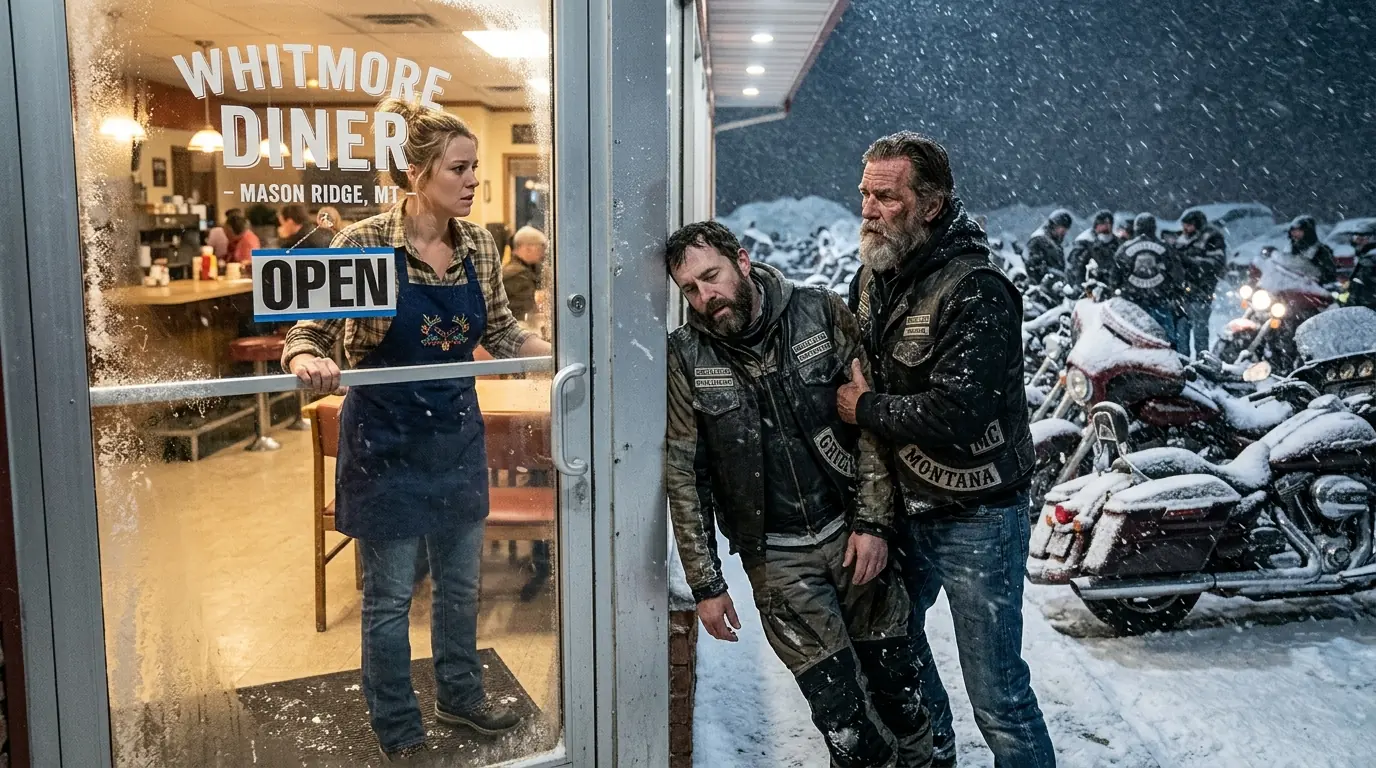
In the deep throat of winter, this particular kind of wind that didn't just blow, it pushed it, pressed, it got personal. It found the gaps in window frames that had survived 30 Montana winters and decided tonight was the night to make itself known through every single one of them. It rattled the hanging coffee mugs above the counter. It made the neon open sign in Sarah Whitmore's window buzz and flicker like it was trying to warn somebody about something. Sarah heard it and paid it no mind.
She had 37 things to worry about before she got to the weather. The grease trap under the flat top grill needed replacing. The replacement cost $412 and she had $219 in the account that wasn't already earmarked for something else. The walk-in cooler had been making a sound for the past week. Not a bad sound exactly, more like a sound that was deciding whether it wanted to become a bad sound.
The women's restroom faucet ran cold even when you turned it all the way to hot. And two customers this week had come out and mentioned it in that particular polite complaint tone that people used when they were thinking about not coming back. And then there was the letter. The letter from First Montana Bank sat on the back counter folded, refolded, and folded again as if the number of creases in it could somehow change what the number inside it said. 30 days.
That was what Gerald Hasting, the bank's regional manager, had written in the kind of formal language that made something devastating sound almost reasonable. 30 days to bring the outstanding balance current or the property would enter foreclosure proceedings. The property, her father's diner. Sarah pressed her palms flat on the counter and breathed. She was 34 years old, and she looked at tonight in the way that women who work 14-hour days and raise a child alone sometimes look their age all at once, like it had been saving up.
Her blonde hair was pulled back because there was no point in it being anything else during a dinner rush. Even a dinner rush as thin as this one. She had her father's hands wide across the palm, short-fingered, the kind of hands that were made for work and knew it. Behind the counter, she moved the way she always moved in this diner efficiently without wasted motion because she had learned from watching her father that a small space demanded small movements and that everything had a place and the place mattered. Dale Whitmore had built this diner with those same hands.
Not built it, built it. He hadn't poured the foundation or frame the walls. But he had built it in every way that mattered. He had found it when it was a failing pie shop with bad lighting and a reputation for cold coffee. And he had turned it into something that people in Mason Ridge and 50 mi in every direction knew by name.
Whitmore. You don't need to describe it beyond that word. People in this county understood what that word meant. It had meant hot food and a fair price and a seat for anyone who walked through the door, no matter what they looked like or how much they had in their wallet or what the rest of the town thought of them at that particular moment in time. Dale Whitmer had been a man with a philosophy about human beings.
And his philosophy was simple. People are more than what you see first. He had said that to Sarah so many times during her childhood that it had become less a lesson and more a piece of furniture, something that was just there, always solid and unmoving in the background of everything she did. She had been running this diner for 4 years now since Dale had his stroke and then 8 months later the second one that finished the first one's work. She had taken over because that there was nobody else and because the alternative was watching something her father loved get sold to strangers and because if she was being honest with herself in a way she rarely allowed herself to be honest anymore because she needed it.
She needed a reason to get up in the morning that was bigger than the debt and the fear and the long awful silence of the house at night after Danny was asleep. Danny, 9 years old, third grade, currently asleep in the small office at the back of the diner in the little cot she had set up there for nights when the storm or the hours made it impractical to drive home. He had his father's dark hair and her father's stubborn jaw in a habit of asking questions at 6:00 in the morning that Sarah was genuinely not intellectually prepared to answer before coffee. His father, Marcus, she let the thought arrive and then she let it leave the way she always did now. Marcus Whitmore had departed Mason Ridge and Sarah's life 18 months ago with the kind of quiet efficiency that still amazed her when she thought about it as if he had been planning the exit long enough to know exactly what to take and exactly what to leave and had made his calculations accordingly.
What he had taken himself their joint savings account and approximately $4,000 of business debt that he had somehow failed to mention existed until it appeared on a bank statement 3 days after he was gone. What he had left Danny the diner of the house with the leaky roof and a silence so complete that it had its own physical weight. She hadn't cried not about Marcus not the way she'd cried about her father. You cried about things you'd lost. You didn't cry about things that had never actually been what you thought they were.
She put the bank letter in the drawer under the register. She started a fresh pot of coffee. Outside the wind made its feelings known again. The first call came in at 7:42. It was Brent Callaway from the gas station two blocks down and he was using the voice he reserved for things he considered himself personally responsible for warning people about.
Sarah, not a greeting, a preamble. Brent, you watching the highway cam? She wasn't. She didn't have a highway cam. She had a kitchen and a half empty dining for a room in a coffee maker that was starting to make a new sound that she was choosing not to investigate until morning.
Tell me what I'm missing, she said. Motorcycles. His voice dropped, which was something Sarah had never heard Brent Callaway's voice do before. Brent Callaway's voice existed at one volume, and that volume was approximately two notches above comfortable. A lot of them coming down off Route 12.
They've been up in the mountains. Must have gotten caught in the front that came through. How many a pause? The counter on the cam says 67. Sarah looked out her front window into the dark and the driven snow and saw nothing but the parking lot in the highway beyond it in the wall of white that the blizzard had built across everything north of town.
"Okay," she said. Sarah, his voice did something else she had never heard it do. It became careful. "I can see the patches on the lead bikes. It's Hell's Angels.
I'm not saying that to start something. I'm saying it so you know what's coming down that road. " She was quiet for a moment. Are they doing anything? " she asked.
"Are they threatening anybody? " "They're on the highway, Sarah. They're not doing anything yet, but they're coming toward town, and the highway is closed north of here, and the motel is already full, and your place is the only commercial establishment with lights on. " So, so they're going to come here, she said. That is what I am calling to tell you.
Brent said, "I would turn the lights off. I'm telling you that as someone who has been in this town for 43 years and has some understanding of Thank you, Brent. She hung up for exactly 3 seconds. She stood behind the counter with her hand still resting on the phone and looked out at the parking lot. Then the phone rang again.
It was Donna Marsh who ran the insurance office next door and had opinions about almost everything that happened within visual distance of her building. Then it was Carl Hendris from the hardware store calling from his house three streets over because Brent had apparently called him first and Carl had called three other people before getting to Sarah. Then it was Pat Nan who was the closest thing Sarah had to a friend in this town calling from her kitchen where she was feeding her kids dinner and sounding genuinely frightened. "Lock the door," Pat said. "I'm serious, Sarah.
Don't be a hero about this. Lock the door and turn the lights off and let them figure out their own situation. " One of them might be hurt, Sarah said. She didn't know why she said it. She hadn't seen anything yet.
You don't know that. I don't know anything yet. That's the point. Sarah, I'll call you back. She put the phone down and looked at the empty diner around her.
Four customers had paid and left in the last 20 minutes. Each of them offering some version of the same advice on their way out the door. Stay safe. Be smart. Keep the door locked.
The subtext of all of it was the same. You're alone here and alone means vulnerable. Invulnerable means you make the smart choice. And the smart choice is the one that keeps you behind glass. Sarah walked to the window and looked out.
They appeared at the edge of her vision like something from a dream. The kind of dream that you wake from uncertain whether it was frightening or magnificent. Headlights, dozens of them, sweeping through the snow, thick dark in a procession that moved slowly, deliberately, like something that had learned patience the hard way. She could hear them now, even through the walls, in the wind, the low collective rumble of engines that had been running for too long and too cold air. She watched them pull into her parking lot.
She watched them park. She watched 67 men and women in leather and denim climb off their bikes in the Montana cold and stand in the snow with the particular stillness of people who are exhausted past the point where exhaustion feels like anything specific. And she watched one of them, a broad shouldered man in a road captain's vest, take three steps away from his bike and go down. Not fall, not stumble, go down. The way someone goes down when the last thing keeping them upright has quietly excused itself and left.
He went down in the snow and he did not get up. Sarah Whitmore had done the Red Cross first aid certification course twice once when she was 22 because her father had insisted and once 3 years ago because she had a 9-year-old in a commercial kitchen and had decided that having done it once at 22 was probably not the same as having done it recently. She knew what cold exposure looked like because she had grown up in Montana and Montana had opinions about what happened to bodies that spent too long in its winters. She knew what it looked like when the dangerous part was already happening. She unlocked the door.
She went outside. The cold hit her like a physical thing. Not a sensation, but a decision the way Montana cold felt when you stepped into it without a coat like the air had looked at you and made a personal choice about you. She crossed the parking lot in her apron and her non-slip shoes, and she went directly to the man in the snow. The people standing around him parted for her.
She registered this distantly that 66 large people in Hell's Angel's patches stepped back to make room for a small blonde woman in a diner apron without anyone saying a word. She filed it away and didn't think about it yet. She went to her knees in the snow beside him. "What's his name? " she said, not looking up, her hands already on him, checking.
Walker, a man's voice, deep. The kind of voice that had been through weather. Ethan Walker. He's our road captain. He We got stuck in the pass for 3 hours before the highway patrol opened the route back down.
He wasn't We didn't know it had gotten that bad. How long was he on the bike in the past? All of it. He refused to be the one to shelter when we couldn't all shelter. She processed this and moved on.
Is he diabetic? Any heart conditions I should know about? Not that I know of. He's healthy. He's He runs.
He takes care of himself. Healthy people die of hypothermia, she said. It came out more blunt than she intended. She looked up for the first time. The man standing over her was somewhere in his late 50s, maybe touching 60, with a face that had been built by experience rather than genetics.
Lines that weren't aged so much as accumulated. Weather, accumulated decisions, accumulated years of being the person other people looked to when things went wrong. He had dark eyes that were right now doing something that she suspected they rarely did. They were afraid. I know, he said.
I know that. My name is Sarah, she said. I own this diner. I'm going to need four of your people to help me get him inside, and I need them to do exactly what I say, and I need you to make sure that happens. I'm Jack, he said.
Jack Reynolds and yeah, anything you need. She looked back down at Ethan Walker. Okay, Ethan, she said quietly. Not to the crowd, not to Jack, just to him, just the two of them there in the snow. I've got you.
You stay with me. He didn't respond. But something in his breathing shifted just slightly, and she chose to believe he heard her. Inside was chaos organized by necessity. Sarah directed the four men who carried Ethan through the door to lay him along the padded bench of the largest booth.
And then she was at the supply closet pulling blankets. She kept four for emergencies, a habit her father had instilled because you always kept things for emergencies. And she was barking instructions over her shoulder in the direction of whoever was listening. I need the thermostat up to 78. Somebody find it.
It's on the wall by the hallway to the bathrooms. I need warm water, not hot warm. And I need it in a basin. There's a basin under the prep counter. Second door from the left.
I got it. A woman's voice. Competent. No hesitation. There's a first aid kit in the office back right corner on the top shelf.
Somebody get it. Going. She worked on Ethan. She removed his outer vest, his jacket, the gloves that had done their job as long as they could and then stopped being able to do it. His skin was the color that told her things had gotten serious.
But his pulse was there slow but there and his breathing was present shallow like someone sleeping too deeply in a place that was too cold. "Talk to me," she said to Jack, who had positioned himself just outside her immediate radius and was watching her the way people watch someone diffusing something. Is he a big drinker? Ethan, no. Any medications?
Not that I know. I can ask. While Jack turned and moved through the crowd with a quiet authority that parted people without requiring any visible effort, Sarah kept working. She checked Ethan's core temperature through feel and proximity in 3 years of Montana winters in the particular kind of knowledge you develop when you pay attention. She got the blankets around him.
She elevated his feet slightly using the folded jackets that someone had appeared beside her with. Without being asked, she noted this person and glanced up and found a woman in her 40s with steady hands in an ex- nurse's calm about her. "You have medical training," Sarah said. "20 years ago," the woman said. Angela, "I'll do whatever you need.