The Norbury Journal came into the house in Bell Street every Sunday folded twice smelling of ink and the printer’s damp. Mrs. Thomasine Pargeter read it aloud after church. She read the corn prices first, because a woman ought to know what her bread costs before she is grateful for it. Then the sales. Then the deaths slowly with her spectacles pushed down.
Last, because she saved it, came the column headed “Marriages in the County.” Mr. Simeon Calcroft of Yarnton to Miss Amity Dunnage, second daughter of the late Mr. Dunnage of this town. She let the paper fall a little. “Amity Dunnage,” she said. “Nineteen and a face like a suet pudding.”
“And yet—” Dorinda laughed into her cup. She was twenty and pretty in the way that costs money to keep. And she laughed at everything her mother said which was one of the reasons her mother liked her. Imogen Kelbury said nothing. She stood at the sideboard where she always stood on a Sunday because there were three chairs in the parlor and three of them were spoken for.
Her hands were folded and there was flour in the creases of her knuckles that no washing ever took out. She was twenty-three years old and she had lived in that house for nine years. Mr. Havard Belsize of the Norbury Bank to Miss Charity Winslow. “Charity Winslow has four hundred pounds a year,” Dorinda said. “Charity Winslow has four hundred pounds a year,” her mother agreed.
“That is generally what is meant when a gentleman writes that he has formed an attachment.” She folded the paper into quarters, always the same way, and laid it down in the same place on the corner of the table nearest the fire that was not lit. Then she turned in her chair and looked at her niece. “Imogen.” “Yes, Aunt.”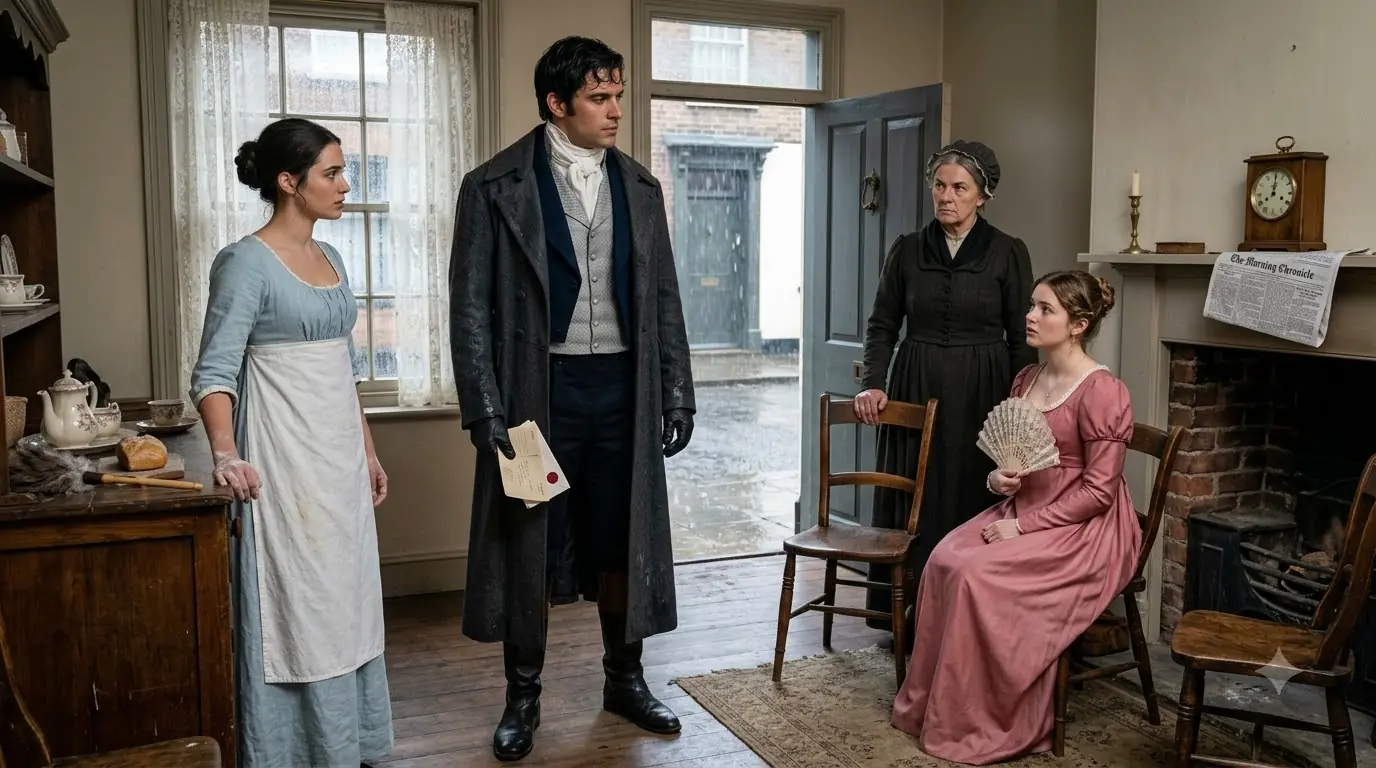
“Nobody is coming for you.” The clock in the hall went on with its business. It had belonged to her uncle Pargeter and it lost four minutes a week and nobody in the house had the money to have it seen to. “I say it because it is a kindness,” her aunt said. “A girl who expects nothing is never disappointed.”
“And a girl who sits at a window waiting is a girl who has stopped being useful.” “Do you understand me?” “Yes, Aunt.” “There is no portion, no father, no house behind you. There is my table which you eat at and my roof which keeps the rain off you, and neither came to you by right.”
She said it without heat, which was the terrible part. She might have been reading the corn prices. “Nobody is coming for you, my dear. Nobody has ever been coming. It is better to know.”
“Yes, Aunt.” “Then take the tray.” Imogen took the tray. She had heard it every Sunday since she was fourteen though not always in those words. In the early years, it had been softer, wrapped in a sigh.
Now it was simply said the way one says that the coal wants fetching. She had learned very early not to argue because arguing gave the sentence something to eat. In the passage, she stopped and set the tray on the shelf, and looked at her hands. Not because she was crying. She had learned long ago that tears in that house were treated as evidence.
She looked at them because they were the only part of her she was sure of. The kitchen at the back of the house in Bell Street was the one warm room. And it was warm because Imogen kept it so. She had lit the oven at four o’clock that morning, as she did every Sunday. And the bricks held the heat until noon, if you fed them right.
There were twelve loaves cooling on the long board under the window, and a thirteenth on the sill. Her grandmother had been Grizel Kelbury, who kept the bakehouse in the corn market for thirty-one years, and died when Imogen was ten. Grizel had baked thirteen for every twelve since she was a girl. The thirteenth was called the baker’s loaf. And in Grizel’s house, it was never sold, and never eaten by the family.
It went on the ledge of the back gate, and it stayed there until somebody took it. “You do not bake because somebody is coming,” her grandmother had said, with her arms in the trough to the elbow. “Any fool can bake for a man who is already at the door. You bake so that there is something ready when he comes. That is the whole of it.”
“The rest is flour.” Imogen carried the thirteenth loaf out through the yard. And before she set it down, she pressed the stamp into the crust. It was a small block of boxwood, worn pale and satiny with handling, cut on the face with an open hand holding three ears of wheat. And under the hand two letters G K. It made a shallow mark no deeper than a thumbnail and it was the only thing in the world that belonged to Imogen Kelbury and to nobody else.
The mark was there so that a family taking the loaf would know it had been given. If a thing is marked nobody has to say the word out loud. “She takes it off the ledge and goes home. She doesn’t have to stand at the door with her hat in her hand and be thanked at. Mark it and let her keep her face.”
She had come to Bell Street in the November she was fourteen in a carrier’s cart with a box that held two gowns and her grandmother’s dough bowl with the tin band round the crack. Her father had died when she was eleven and her mother two years after him of nothing in particular which is what they write down when a woman simply stops. Her aunt had met the cart at the door with her arms folded. “You will not be a burden,” Mrs. Pargeter had said. “I have said as much to Mr. Inchbold and I will say it to you.”
“There is no charity in this house but work which is better because work belongs to the one who does it.” Imogen had believed that last sentence for nine years the way you believe a kind thing said on a cold day. It was much later that she understood her aunt had never once meant it. The bowl went under the kitchen table and the stamp went in her pocket. She kept it there through nine years of aprons, moving it from one pocket to the next as other women move a ring from hand to hand.
Imogen set the loaf on the ledge, stamp upward, and went back in. It was always gone by dusk, and she had never once seen who took it. She had done this every Sunday for nine years in a house where she was told every Sunday that nobody was coming, and she had never thought of the two things together. On Monday, she went to the corn market with the basket. Norbury was a market town of nine thousand souls with a cathedral it was too small to deserve.
The bakehouse in the corner of the corn market had been her grandmother’s. Hester Kettlewell had it now at sixty-one, a widow with a tongue on her that the dean’s wife crossed the square to avoid. “Six,” said the old woman, counting the loaves out of the basket. “Six, and they’re better than mine, and I’d sooner be told I was ugly.” “They are not better than yours.”
“Don’t be civil to me at eight o’clock in the morning. I can’t bear it.” She wiped her hands. “Six loaves, four shillings and sixpence.” She put the money on the board.
Imogen looked at it, then picked it up and carried it home, and gave it to her aunt in the passage as she had done every Monday since she was fifteen. Mrs. Kettlewell knew where it went and had known for eight years. She said what she had said perhaps forty times in perhaps forty different shapes. “You could work here.” “I am not able to.”
“You’re able, you’re not permitted, which is a different animal. She began stacking the loaves. “There’s a bed over the ovens. It’s hot as Egypt in August, and I’ll not pretend otherwise. But it’s a bed with a door and a bolt on the inside.”
“She is my aunt.” “She’s your aunt on Sundays,” said the old woman. “The rest of the week she’s your employer, and she’s forgotten to pay you for nine years, which in my trade we call something shorter.” Imogen put the empty basket over her arm. “Miss Pargeter is to be married in the spring,” she said.
“I don’t know,” said Imogen. And she did not. Which was the plain truth of it. She thought about it though. All the way up Bell Street.
About the gowns that had gone to Bath in the spring. Three of them. And a pelisse lined with squirrel. And gloves at eleven shillings. Then she went in and blacked the grate.
The following Sunday was the fifth of October. And it rained. They came back from the cathedral with their hems heavy. Her aunt read the corn prices. Which were down.
And the deaths. Which included an alderman she disliked. Then, saving it for last, she read the marriages. Captain Osric Flatgate. Late of the Forty-Third.
To Miss Minot. “Miss Minot is thirty-one,” Dorinda said, delighted. “Miss Minot is thirty-one and has a mill,” said her mother. She folded the paper into quarters, laid it on the corner of the table, and turned in her chair. “Imogen?”
“Yes, Aunt.” “Nobody is coming for you.” And somebody knocked at the front door. It was not a loud knock. It was two strokes of the iron, unhurried.
The knock of a man who has all day and expects the door to open. Nobody knocked at the front door in Bell Street on a Sunday. Tradesmen came to the yard, and callers came on Tuesdays, and they were the Winslows, and they came at three o’clock. Mrs. Pargeter’s hand was still on the folded paper. One second.
Two seconds. Three. “Bet,” she called. Her voice had gone up half a tone. “The door.”
The maid went along the passage. They heard the bolt and the rain getting louder, then quieter. Then they heard a man’s voice, low, saying something short. Bet came back into the parlor, walking oddly, as though the floor had been moved an inch while she was out of the room. “Ma’am,” she said, “it’s—Ma’am, it’s the duke of Culverton.”
Dorinda’s cup went down into her saucer with a crack. “It is not,” said her aunt. “He’s given me his card, ma’am.” The card came across on the tray, and her aunt took it and read it twice. Imogen, from the sideboard, could see her aunt’s thumb pressing into the pasteboard hard enough to bend it.
“He’s at the wrong house,” Mrs. Pargeter said. “Tell him—no, no. Show him into the parlor.” “Dorinda, sit up. Sit up straight and take that cup off your lap.”
“Ma’am,” said Bet, and did not move. “He didn’t ask for you, ma’am.” “What?” “He asked whether this was the house of Miss Imogen Kelbury.” Nobody spoke.
The rain went on against the window, and the clock in the hall, four minutes slow, went on being wrong. And Imogen Kelbury stood at the sideboard with her hands folded on her apron. In the ninth year of being told that nobody was coming, and understood, without any warning at all, that somebody had. The Duke of Culverton was a tall man in a wet greatcoat, and he did not take it off because nobody had offered to take it. He stood in the middle of the cold parlor and filled it, though not by design.
The room was ten feet by fourteen feet. The fire was not lit, and a man of twenty-eight, who has been out in the rain, brings weather in with him. His hair was black and needed cutting, and his eyes were a tawny brown, the color of ale held up to a window. They went round the room once, the unlit grate, the three chairs, the folded newspaper, the girl at the sideboard, and came to rest on the lady of the house, who was already curtsying. “Your Grace, you must forgive us.”
“We are quite at sixes and sevens. It is Sunday. We do not—Dorinda, my daughter. Miss Pargeter.” “Ma’am.”
“And if I had known—if there had been any word at all—we should have had a fire, and a great deal more than a fire. But on a Sunday, one does not expect.” “No,” he said, “one does not.” He said it without any edge that could be caught and held up, and her aunt stopped talking anyway. “I am looking for Miss Kelbury,” he said.
“That is my niece.” “Ah.” He turned. Imogen had not moved from the sideboard. She was aware, with a clarity that felt almost like anger, of her apron, and of the flour under her nails.
Her sleeves were rolled to the elbow, because she had come in from the kitchen, and there had been no time. She did not roll them down. Rolling them down would have been an apology, and she had not done anything. “Your Grace,” she said, and curtsied. “Miss Kelbury.”
He inclined his head. “Was your father Reuben Kelbury?” “He was.” “He kept the granary at High Fern?” “He did.”
“Until 1812.” “Yes,” said the duke. “1812.” Something happened to his face then, very small, and gone before it had properly arrived, the way a bird goes off a branch, and leaves the branch moving. “I am settling my father’s affairs,” he said.
“He died in March.” “I was sorry to hear it, Your Grace.” “Were you?” It was not a question, and not quite a doubt. It was a man saying a thing out loud to see how it sounded in a room.
“I was,” Imogen said. “He was good to my mother once. She said so.” The Duke looked at her for perhaps three seconds. “Did she?” he said.
Mrs. Pargeter came forward then with a brightness in her voice that Imogen had heard perhaps four times in nine years. The voice her aunt used at the dean’s and at the Winslows and once at a funeral. “Your Grace, my niece has been under my roof since she was a child—an orphan, quite destitute. Whatever the business is, I am certain I can answer it better than she can. She was a child at the time and remembers nothing.”
“I have kept her books, so to speak, all these years. Every particular.” “That is convenient,” said the duke. There was a pause that went on slightly too long. “Then perhaps you will tell me, ma’am,” he said, “who signed a receipt in this house in June of 1821?”
Imogen, watching, saw her aunt’s hand find the back of the chair. That was all. Her face did not change at all. The hand closed on the wood and stayed there. “A receipt?”
Mrs. Pargeter said. “A receipt?” “Your Grace, I should have to look. There is a great deal of paper in a house. If Your Grace would be so good as to write to me with the particulars—” “I have written to you,” said the duke.
“Twice.” “I never—” “In April and in August.” “My man of business had no answer, so I have come myself.” He put on his hat which he had been holding. “I have business with Miss Kelbury which is Miss Kelbury’s and not, I think, anybody else’s.”
“Ma’am, I will not press you on a Sunday. You will hear from Mr. Gorst.” He turned to Imogen. “Miss Kelbury, do you read and write?” Nine years of standing at a sideboard came up in her throat all at once and she swallowed it because it was not his fault.
“I do, Your Grace.” “Then Mr. Gorst’s letter will go to you,” he said. “By name. Good morning.” And he went out.
The front door shut. The rain took him and the parlor was left with three women in it and no fire. Nobody sat down. Dorinda was the first to speak because Dorinda always was. “Mama, the duke of Culverton was in our parlor.”
“Be quiet.” “But he was in our—” “Be quiet!” Imogen had never heard her aunt shout. Not in nine years. Not when Dorinda broke the sugar bowl.
Not on the day the news came about the Bath lodgings. Mrs. Thomasine Pargeter did not shout. Shouting was for people who could not manage. Dorinda’s mouth shut and she looked at her mother the way a dog looks at a door. Then her aunt turned round perfectly composed again and smiled at her niece.
“Well,” she said, “how very odd.” “Aunt, a gentleman of that rank cannot be expected to keep his own accounts and some clerk has made a muddle. He will have some old business about a granary key or a tally of sacks or heaven knows. Your father was a servant of that family, Imogen, and servants leave loose ends. It is nothing.”
“He said there was a receipt.” “I heard what he said.” “He said he had written to you twice.” “He said,” her aunt repeated, “a great many things for a man who came into a house at eleven o’clock in the morning without being asked.” She crossed to the table and picked up the folded journal and put it down again, which was the only unnecessary movement Imogen had ever seen her make.
“You will not answer that letter,” she said. “He said it would come to me.” “You will bring it to me unopened.” “Aunt—” “Have I ever asked you for anything I had no right to in nine years?” her aunt said. And Imogen stood with her hands in her apron and could not, at that moment, think of a single thing to say.
Later, in the kitchen, she scraped the boards, set the sponge for Monday, did all the small things her hands knew, and her mind went round and round one word, the annuity. That was not the duke’s word. The Duke had said receipt. The word annuity had come out of her aunt at half past eleven o’clock in the passage, very fast, to Dorinda, behind a door that was not quite shut. Nine words and no more.
“If they take the annuity, we are finished.” She stood at the trough with her hands in the flour and did not move for a long time. “We.” There was no we and there had never been a we. There was Bell Street and there was Imogen and the space between them was nine years wide and had been carefully kept.
But there was, somewhere, an annuity and a man had ridden through the rain on a Sunday to ask about it. Imogen Kelbury did not go to bed that night. She sat on the kitchen step with her shawl round her in the last warmth of the bricks. She thought about it the way she thought about a dough that had gone wrong. Not with feeling, but by working backwards to find the hour when it went.
She was not owed anything. She had been told that for nine years, and she had believed it. And belief of that kind gets into the joints. But a duke had come to a door in Bell Street, and dukes do not come about a granary key. At two o’clock in the morning, she got up, lit a candle, went into the front room, and took down the writing box from the shelf.
It was her aunt’s box, walnut with a brass plate, and it was locked, and it had always been locked. Imogen had never once in nine years tried the lid. She tried it now, and it did not open, and she had not expected it to. But she stood there in her nightgown with the candle in her hand and understood something more useful than any key. She had lived nine years in a house with a locked box in it and never once wondered what was inside.
Not out of honor out of training. That was what they had made of her. She put the box back exactly as it had been. Then she went to the kitchen got out the flour paper turned it over and wrote on the clean side. She wrote three drafts of which the first was too apologetic and the second worse.
The third was seven lines and she copied it fair at four o’clock in the morning on a sheet she took from the parlor desk which was she supposed the first thing she had ever stolen. Sir, His Grace the duke of Culverton did me the honor of calling here on Sunday last. He spoke of a receipt signed in this house in June 1821 and of letters written in April and in August of which I have never heard. I am the daughter of Reuben Kelbury late of High Fern. I am of age.
I ask you to send me in a plain account and my own hand whatever it is that has been paid on my account and to whom and when. I am able to read. I would be glad to be answered as though I were your obedient servant Imogen Kelbury. She read it over twice and the last line frightened her more than the rest of it together and she left it in. She walked to the receiving office before the house was up and paid the postage out of her own pocket.
She had five pence in the world earned that summer penny by penny at the back gate and kept in the toe of a stocking. She had never let herself think what it was for. It cost her fourpence to send and she walked home with one penny and no plan and her heart going like a bird in a hand. That was the first decision Imogen Kelbury ever made without asking. The answer came on the Friday and it came to her by name.
Bet brought it into the kitchen because Bet had been told to bring the post to her mistress and for the first time in four years of service did not. “It’s got your name on it, miss.” Bet said and put it on the table and went out quickly like a woman setting down something hot. Imogen wiped her hands and looked at the letter for a while before she touched it. Miss Imogen Kelbury she had never in her life seen her own name written by a stranger and she opened it standing up.
Madam, I have the honor to reply to yours of the sixth at his grace’s express direction and to lay before you the account you ask for plainly as you asked. In April 1812 the late Duke of Culverton settled upon Mrs. Joan Kelbury, widow and her daughter Imogen an annuity of forty pounds payable quarterly at Lady Day Midsummer Michaelmas and Christmas. This was not charged upon the estate but paid by his grace out of his own purse and entered in his own hand. On the widow’s death in 1814, the annuity continued to the daughter. It was directed to be paid to her guardian, Mrs. Thomasine Pargeter of Norbury, for her maintenance and instruction until the said Imogen Kelbury should attain the age of twenty-one years.
There was further set aside a portion of four hundred pounds to be paid to Miss Kelbury herself upon her twenty-first birthday, together with the annuity thereafter into her own hand. The portion was paid in June, 1821, at this office against a receipt signed I. Kelbury. Since that date, the annuity has been paid and receipted quarterly in the same hand, the last at Michaelmas on the second of October. Madam, I am instructed to add one further particular. In the settlement of 1812, there is a memorandum in the late Duke’s own writing, of which I give you the words exactly.
The child is to be taught her letters. She is to be bound to no service. I am, madam, your obedient servant, Cuthbert Gorst. She read it twice, then sat down on the kitchen chair which she was not in the habit of using, and read it a third time. “Forty pounds a year.”
She did her sums the way she did everything out loud and slowly on the deal of the table with a wet fingertip. “Eleven years, four hundred and forty pounds. And four hundred more in June of 1821 on the day she was twenty-one, the day she had spent turning out the back bedroom for Mr. Ewart’s mother who was expected and who did not come. Eight hundred and forty pounds.” She thought of the four shillings and sixpence she had carried up Bell Street every Monday since she was fifteen. She thought of her aunt’s hand closing on the back of the chair and she found that she was not, in fact, angry.
Not yet. What she felt first was a vertigo as though a floor she had stood on all her life had been shown to be a lid. She is to be bound to no service. Imogen Kelbury looked down at her own hands at the flour in the knuckle creases at the shine of an old burn across the back of the left one. That was when it came.
It did not come as fury but as a small, clean, cold sentence arriving from nowhere in her grandmother’s voice. “Somebody has been eating your bread for nine years and telling you that you were the one who was fed.” She put the letter in her bodice. She took off her apron which she never did before four o’clock and hung it on the nail. Then she walked out of the house without saying where she was going which she had not done since she was fourteen.
The market house at Norbury is four centuries old and stands on twenty-two stone pillars with a corn floor above and open air below. Imogen went and stood at the third pillar from the northeast corner. She had not been able to do this for years. She had walked around it, crossed the square at the far side without deciding to and told herself it was because of the crowd. The stone was cold and slightly damp.
There was a great chip out of it at about the height of her shoulder. An old wound pale in the gray where something heavy had struck it long ago. “Miss Kelbury.” She did not jump. She had heard the boots on the cobbles for some seconds without attaching them to anything.
The Duke of Culverton stood four paces off with his hat in his hand. “Your Grace.” “You have had Gorst’s letter?” “An hour ago,” she said and heard how flat her own voice was and did not trouble to soften it. “Good.”
He did not come nearer. She noticed that before anything else and she remembered it ever after. He stood where he was and let her have the pillar. “You come here,” she said. It was not a question.
She had understood it the moment she saw his face which was the face of a man who has arrived somewhere he arrives often. “Yes.” “Why? A gentleman of your rank does not stand about under a market house in October.” The Duke turned his hat over once in his hands.
“Because I was here,” he said. The rain had stopped. “I was seventeen,” he said. “Home from school.” The twenty-fourth of March 1812.
Wheat at one hundred and twenty-six shillings the quarter and the poor of this town living on turnips since Candlemas. He looked up into the timbers. “My father ordered the High Fern granary opened. Flour at half the price under this roof for anybody who came with a sack. It was the right thing.”
“It was the only right thing he ever did that anybody saw.” “I know what he ordered.” Imogen said. “Do you know how many came?” “No.”
“Nor do I.” “Nobody counted, though two thousand some said.” He was quiet a moment. “They began queuing at four o’clock in the morning in the dark. By eight o’clock there were people in the middle of it who could not get out and could not fall down. And at about a quarter past eight o’clock the trestles went over at the north end.”
Imogen put her hand flat on the pillar. “He was under it,” she said. “Yes.” “Three days.” She said.
“He lived three days. I was eleven. They would not let me in the room until the last morning. And by then he was not he was not there to be spoken to.” “I know.”
He was looking at the chip in the stone and not at her. “I know he lived three days. And I know what day he died. I have known it for eleven years and never once said it aloud until this minute.” She looked at him.
“Where were you?” she said. “When the trestles went over?” The Duke of Culverton looked across the square at the upper windows of the Angel. “There,” he said. “At the inn.”
“At the window of the long room on the first floor with my father. He had brought me to see it,” he said. And here for the first time his voice did something. It caught and he took it in hand at once as a man takes a horse’s head. He said, “You will have this to do one day, and you had better see how it is done.”
And when it went over, he shut the window. Imogen did not speak. “He shut the window. He told me to sit down and sent his groom for the surgeon. And then he sat with his back to the glass and did not move for two hours.”
“He did not go down. There were four hundred people in that square, and the duke of Culverton did not go down among them. I was seventeen, and I have hated him for it ever since.” I said so to his face at twenty and at twenty-four, and in March at his own gate six days before he died, when he sent for me. “You did not go,” Imogen said.
“I did not go.” The square was almost empty, and it was a Friday in October, and the light was already thinking about leaving. “In April, I opened his private book,” said the duke. Not the estate books, the little one in the desk that he kept himself and let no clerk touch. “Eleven years of it, quarter days, in his hand, every one.”
He stopped. Kelbury, forty pounds. Kelbury, forty pounds. Kelbury, forty pounds. Forty-four times. Imogen found that she had to hold the pillar.
“He never told anybody,” she said. “He never told me.” He was turning the hat again. He never told his brother. He never told the man who wrote his will.
He hid it the way another man hides a debt. Something went across his face that was not quite bitterness. “I have spent seven months finding out what my father was. A coward who could not be in a room with what he had done. And a man who paid for it every quarter day for eleven years without once letting himself be thanked.”
“I do not know what to do with that, Miss Kelbury. I have not the smallest idea what to do with that.” And there it was. A duke standing in the wet under a market house telling a baker’s granddaughter a thing he had told nobody in the world. Imogen said nothing at all for a long moment.
That was, though she did not know it then, exactly the right thing. And it was the reason for everything that came after. Then she said, “He wrote that I was to be taught my letters.” “Yes.” “And bound to no service.”
She waited until he brought his eyes back to her. “Your Grace, for nine years I have got up at four.” The Duke of Culverton stood very still. “Say the rest,” he said. “There is no rest.”
“And that is all of it.” “I have got up at four, lit an oven, baked thirteen loaves, carried six of them down to the corn market. I have brought back four shillings and sixpence, given it to my aunt in the passage, been told on Sundays that nobody was coming for me.” She heard her own voice, and it was steady, and that surprised her more than anything. “I did not know there was money.”
“I want you to believe that because it will be said otherwise.” “I believe you.” “You cannot know it.” “No,” he said. “I believe you.”
Three words. She had been given a great many in nine years, most of them kind on the outside, and those three sat down in her chest and stayed. Her aunt was waiting in the passage when she came in with the candle already lit, though it was not yet dark. “You were out. Where?”
Imogen hung up her shawl. “At the market house,” she said. Her aunt’s chin came up half an inch. There was no other sign, and there did not need to be. “There was a letter this morning,” she said.
“Bet tells me she gave it to you. I have asked you once already for that letter, unopened. I shall not ask again.” “No,” said Imogen. The word came out perfectly ordinary.
She had expected it to arrive with fire and trumpets. Instead, it stepped out of her mouth in its stockings, stood in the passage, and was simply true. Her aunt looked at her. “I beg your pardon?” “You have asked me for a letter that was directed to me by name,” Imogen said.
“I have read it. I shall keep it.” “You may ask me anything else in the world, and I shall answer you.” “Give me the letter.” “No, Aunt.”
There was a silence in the passage of the house in Bell Street that lasted by the slow clock some eleven or twelve seconds. Nine years. In all that time, Imogen Kelbury had refused her aunt precisely nothing, and she had not known it would be so quiet. “You ungrateful girl,” said her aunt. “Perhaps.”
“Do you know what I have spent on you?” And there it was, laid on the passage floor between them like a glove. Imogen looked at it, and understood that she could pick it up now, this minute, with Bet listening on the kitchen stairs, and Dorinda listening on the landing. It would be the worst possible place and hour to do it. She had been in an oven room since she was nine years old, and she knew what heat does when you open the door too soon.
“No, Aunt,” she said. “I do not know what you have spent on me. I should like very much to know. I think you should like to tell me one day when we are both sitting down.” Mrs. Pargeter’s hand went out and gripped the newel post.
“Get to your work,” she said. “Yes, Aunt.” She lit the oven at four o’clock the next morning, as she always did, and drew thirteen loaves, and put the thirteenth on the ledge of the back gate with her grandmother’s mark in the crust. Then she took the basket down to the corn market. Mrs. Hester Kettlewell was at the peel with her sleeves pinned, and she looked at Imogen’s face for about two seconds.
“Right,” she said. “Shut the door.” Imogen shut the door. It came out badly, in the wrong order, with the sums in the middle of it, and once she had to stop altogether and stand looking at the flour bin. Mrs. Kettlewell did not touch her and did not say, “There, there,” which Imogen was to be grateful for all her life.
At the end of it, she wiped her hands very slowly on her apron. “Eight hundred and forty pounds,” she said. “And the annuity is still running?” “And the annuity is still running.” Mrs. Kettlewell sat down on the flour bin, which she never did.
“Grizel Kelbury took me in when I was fourteen, taught me the trade, and left me this house. And I have known your aunt since she was Thomasine Swath with her hair down her back. I want to say I never suspected. I did suspect. I suspected there was money in that house that had no business being there.”
“And I said nothing because it was not my house and you were not my girl.” She looked up. That was cowardice, and I am too old to call it anything else.” “Now sit down and hear me.” “I would rather stand.”
“Then stand. Nine shillings a week, your keep and the room over the ovens. I want you here at four o’clock and I want you gone by two o’clock. And after two o’clock, I don’t care where you go or who you talk to. In three years, you’ll know the trade better than I do.”
“And I shall be dead or in a chair and we will talk about the lease then. Do you want it?” Imogen opened her mouth. “Before you answer,” said the old woman, “understand what you are taking.” “This town will say you have thrown over your aunt.”
“Half of it will say you did it for a duke. Nobody will say you did it because eight hundred pounds of your own money went into a squirrel-lined pelisse. Nobody ever says that. It is not an interesting thing to say.” “I know it.”
“Then?” “Yes,” said Imogen. “I want it.” She went back for her box that afternoon, alone. There was very little in it.
Two gowns, a prayer book, the letter, a comb, and the dough bowl from under the kitchen table, which her aunt saw her lift and did not stop her lifting. Mrs. Pargeter stood in the kitchen doorway. “If you go out of that door,” she said, “you do not come back into this house.” “No, aunt.” “You will be a servant in a shop.”
“I shall be paid,” said Imogen. She got the box on her hip. At the yard gate, she stopped because the ledge was empty and because she found she could not go without knowing. “Who takes it?” she said. “The loaf.”
“In nine years I have never seen. Do you know?” Something happened in her aunt’s face then, so brief and so unguarded that Imogen thought about it for weeks afterwards. “The Tooke’s children,” said her aunt. “Sheep Street.”
“There are six of them and the father is at the brickworks when he is anywhere.” She said it flatly. “They come at dusk. This eldest girl comes over the wall so as not to be seen at the gate.” “You knew all this time?”
“Of course I knew. I know everything that happens in my house.” “And you never stopped it.” “No,” said her aunt. And then, because that had cost her something, she shut the door.
Norbury talked as the old woman had said it would. Imogen heard it in fragments over the counter that her aunt had been used shamefully by an ungrateful girl and that her aunt had thrown out a niece who had got above herself. She weighed flour and gave change and let it go over her like weather. On the third Tuesday of October, a note came for her at the Bakehouse in a clerk’s hand, and inside it, in a different hand, four words and an initial. Bring the letter.
Come to High Fern. Gorst will send a chaise. C. She had never seen High Fern. It sat in a fold of the down, eight miles north of the town, long and low and gray, and it had not been built to be admired. The park had been let go a little, and there were sheep in it, which she liked.
Mr. Cuthbert Gorst met her at the door, sixty, dry, in black, with the manner of a man who has spent his life being the only person in the room who has read the papers. Miss Kelbury, you are punctual. I am a baker, sir, and we have no other virtue. Something like amusement crossed his face and went away again. His Grace is in the bookroom.
I will say to you first what I shall say to him after. Your letter of the sixth is now in my strongbox, and I am glad of it because it is dated and in your hand and says plainly that you never heard of those payments. He looked at her over his spectacles. That letter may one day be the most valuable thing you own. I would not have you send another like it without telling me.
Am I in some trouble, sir? No, madam, said the lawyer. Somebody is. The bookroom at High Fern was cold and smelled of leather and coal smoke and faintly of apples. There were shelves to the ceiling on three sides, a ladder, and on the fourth side, a window with the whole gray valley in it.
Imogen stopped inside the door. She had not known until that moment that she had wanted a room like this for her whole life and she had never seen one. The Duke was standing at the desk with his back to her. Miss Kelbury. Your Grace.
Come and look at this. It was a small book, not much bigger than a hand, bound in brown calf gone shiny at the corners, and he opened it at a ribbon and turned it round on the desk to face her. Imogen came and looked. The writing was small and upright and desperately regular, the hand of a man who did not enjoy it. Lady Day, 1812, Kelbury, 40.
Midsummer, 1812, Kelbury, 40. Michaelmas, 1812, Kelbury, 40. She turned a page and another. The years went by under her thumb, quarter by quarter, in the same hand, with never a word of comment, never a remark. Every fourth entry the year changed and the letters got very slightly worse as a man’s letters do between fifty-two and sixty-three.
At the entry for Midsummer, 1821, the hand stopped being the same. She saw it at once and anybody would have done. The last eleven entries were in a clerk’s copying hand, neat and dead, and against the June of that year there was a note, portion 400, paid at the office, receipt taken. He wrote the first thirty-eight himself. The Duke laid one finger on the page where the hand changed.
After that, his eyes went. Gorst wrote them and he signed them. Imogen put her finger on the page and did not lift it. He never came, she said, in eleven years, not once. He did not come and look at me.
No. Why? The Duke was quiet. Because he would have had to see your face, he said. They dined at four because the days were shortening.
The dining room at High Fern held a table that seated twenty-four. And the covers had been laid at the two ends. Imogen found herself looking down thirty feet of mahogany at a man she could not have spoken to without raising her voice. She sat for a moment. Then stood up again.
And the footman went rigid. Your Grace, said Imogen. May I move? There was a pause of the kind that has a whole house in it. Move where?
Nearer. I have carried plates for nine years and I would not make work. But I cannot shout at a man across his own table. And I do not want to eat with somebody I can only see the shape of. The Duke looked at her down the length of the mahogany.
Worthen, he said. Move the covers. They were moved to the corner at right angles, which no doubt scandalized the kitchen. They ate their mutton within three ft of one another. And the room, which had been laid out to be impressive, gave up and became a room where two people were having dinner.
The talk was of bread mostly because Imogen was on ground she knew and had the sense to stay there. What the High Fern granary had held in 1812 and what it held now, which was nothing because it had not been used since her father died. Nothing? She said. For eleven years? it is locked.
That is dry standing for one hundred and forty tons of grain doing nothing over a village of nine hundred people. “Yes.” “Your Grace.” said Imogen. “Forgive me. But you are all of you the same.”
“You are so afraid of doing the thing badly that you will not do it at all. And meanwhile there is a roof going to waste in the rain.” The Duke of Culverton put down his knife. For a moment she thought she had gone too far and she found she did not much care. And then she saw what was actually happening at the corner of his mouth.
It was not a smile. It was the almost “You had better repeat that.” he said. “Which part?” “All of you the same.” “Nobody has said all of you to me since my father died.”
“They say Your Grace and they mean the same thing and it is not the same thing at all.” Dorinda came to the bakehouse on the last Friday in October at dusk in a hood which is exactly how twenty-year-old young ladies believe one goes unnoticed. Imogen was banking the ovens. “You have to come back,” Dorinda said. “Sit down.”
I shan’t sit down. You have to come back Imogen. It is all Mama does not sleep. She sits up. There is a man been twice from Mr. Lorimer’s office and she will not see him.
She has sold the sideboard. She has sold Papa’s sideboard and she says it is nothing. And Mr. Hewitt’s mother has written to say that in view of certain reports she stopped. “Certain reports.” said Imogen. “They will break it off.”
Dorinda’s chin went, and she looked, for the first time in her life, like her mother. “They will break it off. I shall be twenty and thrown over, and everybody will know. And it is your doing.” Imogen set the peel against the wall.
“Dorinda,” she said, “do you know where the money came from? For Bath?” “Mama had a legacy.” “From whom?” Dorinda opened her mouth, then shut it.
That was when Imogen understood that her cousin was not a fool, and had not been one for some time, and that being no fool in that house must have been very hard work. “Go home,” she said gently. “Ask her. Not tonight. Ask her when she is sitting down.”
Mr. Gorst came to the bakehouse in the corn market on the fourth of November, and with him came Sir Miles Trumble, who had been on the bench at Norbury for twenty-two years. He was so plainly uncomfortable in a shop that the old woman gave him the good chair out of pure malice. They laid three papers on the scrubbed table. The first was the receipt of June 1821 for four hundred pounds. I. Kelbury.
The second was the receipt of Michaelmas last for ten pounds. I. Kelbury. The third was her own letter of the sixth of October. “Miss Kelbury,” said Sir Miles, “look at the first two, if you please, and tell me plainly, is that your hand?” Imogen looked.
The letters were upright and careful, done slowly by somebody who had thought about how a young woman would write and had got it very nearly right. The K was wrong. It had a foot on it, a little kick to the right. And Imogen had never in her life put a foot on a K because her mother had taught her out of a copybook with no feet in it. No, sir.
You are certain? I am certain. Have you ever signed a receipt in your life, madam? For anything? No, sir. said Imogen.
I have never had anything to sign for. Sir Miles put his hands on his knees and looked at the floor of the bakehouse for a while. Then I must tell you what you are holding, he said. Uttering a forged receipt for money is not a small matter and it is not a family quarrel. In law, it is a felony and the felony is capital.
Mrs. Kettlewell’s hand stopped on the flour scoop. Capital? Imogen said. I do not say it will come to that and it very seldom does now. Juries in this county have a habit of valuing a paper at thirty-nine shillings to save a neck and the bench has a habit of letting them.
He said it steadily. But I will not stand in a shop and tell a young woman a comfortable lie. If this goes to the assizes and is proved the worst is the rope and the likely is transportation for fourteen years and a woman of fifty-four does not come back from that. The oven ticked as it cooled and somebody went past in the square whistling. Sir? said Imogen.
May I ask you a question that is not about the law? You may. How long would it take? twelve to fourteen weeks at the Lent Assizes. And in the meantime, the whole of Norbury would know. The whole of Norbury, said Sir Miles Trumble, knows already, madam, and knows it wrong, which is worse.
When they had gone, the duke came. He had been in the square the whole time. She had seen him from the window, walking the market house out and back. twenty-two pillars and twenty-two pillars, like a man in a cage he had built himself. He came in and stood by the door and did not sit. Gorst has told you.
Sir Miles told me. Then hear this from me and let it be finished. He had his hat in his hands again. It is my father’s money and my house’s paper. Gorst is my servant.
Trumble dined at High Fern last Tuesday. And I could have this laid before the magistrates tomorrow morning without asking you at all. That is the plain truth of what I am able to do. I know it. I am not going to do it.
Imogen looked up. It is your money, said the duke of Culverton. It was set aside for you in 1812. And it has been eaten in front of you for eleven years while you were told you had nothing. They have arranged it, every one of them.
And now here is Gorst with a strong box and Trumble with a warrant, arranging it again, kindly, over your head. He stopped. I will not be another one. What is done with that paper, Miss Kelbury, you will decide. And I shall abide by it, if it takes me a year to like it.
The bakehouse was warm and smelled of yeast and hot brick. “Why?” she said. “Because my father stood at a window and made a decision about four hundred people without going down among them,” said the duke. “I have hated him for it for eleven years and I am not going to stand at a window over you.” Imogen went to Bell Street on the Thursday in the afternoon alone.
Bet opened the door and burst into tears which was mortifying for everybody and then went away down the kitchen stairs. The parlor fire was lit and that frightened Imogen more than anything else in the house because it was the fourth of the month and her aunt had never lit a parlor fire before December in her life. Mrs. Thomasine Pargeter was sitting in the chair by it with her hands in her lap and nothing in them. No work. No paper.
Nothing. The sideboard was gone. There was a paler oblong on the wall where it had stood. And the carpet under it had kept its color. “Aunt?”
“Sit down,” her aunt said. Imogen sat down for the first time in nine years in that parlor. “You have seen Trumble.” “This morning.” said Imogen and put her hands in her lap because there was nothing else in the room to do with them. “Then you know it is the Assizes.”
Mrs. Pargeter’s voice was perfectly level. “You need not soften it. I have known since the Sunday he came to the door. I knew what the word receipt meant before he had finished saying it which is more than my daughter knows And I intend that she shall go on not knowing as long as may be. She has guessed?”
“Yes. Said her aunt. I saw that she had. On Tuesday. She turned her head then.”
“And looked at the fire. And Imogen saw that she had aged perhaps five years in a month. And that the skin of her neck had gone loose over the bone. You asked me a question in the passage. Mrs. Pargeter said.”
“You said I should like to tell you one day. When we were both sitting down. That was clever. I have thought about it every night since. And I have not slept.”
“And I want you to know it was the cleverest thing anybody has ever done to me. I did not mean it to be clever. No. That is why it worked. She smoothed her skirt over her knee once.”
“Your uncle Pargeter died in the March of 1813. And left me 30 pounds a year. A clock and a daughter of 10. She said. 30 pounds. You do not know what that figure is.”
“Because you have never had to know. 30 pounds is one servant. Or coal. And it is not both. And there is nothing left over for a doctor. Do you understand me?”
“There is no year in it. And no next year in it. There is only the week. Aunt. I am not asking for pity.”
“I am telling you an arithmetic. Her hands closed. Then in the November of 1814. My sister died. And there was a girl of fourteen to be fetched from Yarnton.”
“A letter came from a duke’s man of business. To say that forty pounds a year. Came with her. She stopped. I have counted every day for nineteen years,” she said.
“Every day. And that is what nobody sees. My sister never counted a day in her life. She married a granary keeper for love, and she was happy. And she died happy.”
“I sat in this room and counted, and I’ve gone on counting while other women went to bed.” “You could have told me,” said Imogen. “When?” “When I was eighteen.” “When I was twenty-one.”
“And what would you have done at twenty-one?” “I would have gone.” “Yes,” said her aunt. “You would have gone and taken your forty pounds with you. And I should have had thirty pounds a year, and a daughter of eighteen with no gown to be seen in.”
She said it without any shame at all, which was the most terrible part. So, I did not tell you. And each quarter, it became a very slightly older lie. And after enough quarters, a lie stops being a thing you told and becomes a thing about you. And then one is fifty-four.
“And in June of 1821,” said Imogen, “you sat down at that table and wrote my name.” Her aunt looked into the fire. “Yes.” “All of it, Aunt.” “I wrote your name,” said her aunt.
“In this room, at that table, on the ninth of June, at about seven o’clock in the morning, before the house was up. It took me four attempts, and I burned three. It was the easiest thing I have ever done, and I have not had one clean hour since.” “Four hundred pounds,” Imogen said. “Where is it?”
Bath. Gowns. A pelisse lined with squirrel that cost eighteen guineas. And I would spend it again. And there is the whole of it in one sentence.
Her aunt’s mouth twisted. Ninety-one pounds went to a man in London who had the Ewart’s ear. And that is a thing I shall not explain to you. The rest went the way money goes when it is spent to look like money one has always had. There is nothing left, Imogen. There is this house on a lease with four years to run.
And a clock that loses four minutes a week. You told me every Sunday that nobody was coming for me. I did. Why? And her aunt who had not wept at her husband’s funeral put her hand over her eyes.
Because if somebody came for you, she said, somebody would have asked me for the accounts. There it was. Nine years of Sundays. Nine years of a woman folding a newspaper into quarters and telling a girl at a sideboard that she was not wanted by anybody in the world. And doing it not from hatred, not from cruelty, not even from spite.
Doing it from bookkeeping. Imogen found she had to look away for a moment at the pale oblong on the wall where the sideboard had been. That is the worst thing anybody has ever said to me, she said. Yes, said her aunt. I know.
At the door with her hood up, Imogen stopped. What do you want me to do? She said. Mrs. Pargeter did not turn round. I want you to do the thing that is right, she said.
And I should like it very much if the thing that is right did not happen at the Assizes in March where my daughter would have to sit in a gallery and hear it. That is not a plea. That is what I want. You asked me. November went out wet.
Imogen worked. It is a great deal easier to think at four o’clock in the morning with your arms in a trough than at midnight in a bed. By the end of the month she had turned the thing over so many times that the corners had gone smooth. What she kept coming back to was not the four hundred pounds but the granary. Dry standing for one hundred and forty tons of grain. eleven years locked.
A town of nine thousand where the poor bought their bread by the half quarter at the dearest end of Sheep Street. They could not lay out for a whole loaf at once which is the oldest tax on the poor there is. She said so at the bakehouse once. And the old woman looked up. And who’s to run it?
I do not know. Don’t lie in my shop, girl. The Norbury Subscription Assembly was held on the first Thursday in December in the long room over the Corn Exchange by one hundred candles and one bad fiddler. Mrs. Kettlewell had subscribed for eleven years and gone to it twice. You’ll come.
She said. You’ll come. And you’ll wear the gray. And you’ll take my arm at the door. And you will not hurry up those stairs.
They will look at me. They have been looking at you for a month with the door shut said the old woman. Let them do it to your face and get it over. The gray was her mother’s. Imogen had turned the skirt, let out the seams, and put a band of black velvet at the hem.
There was nothing about it that would have made a woman in London look twice, and it fitted her. And it was hers. She wore no ornament except her grandmother’s stamp, which was in her pocket, where it had lived since she was fourteen. They went up the stairs at nine o’clock, and her aunt was already in the room. Of course she was.
She had subscribed in September before any of it. And to stay away now would have been to say the thing out loud. So, she stood at the side with Dorinda beside her in last spring’s bath silk, her back very straight. There was a circle of about four feet of empty floor around her, which nobody in Norbury had put there on purpose, and everybody was maintaining. Imogen saw it and understood it, and felt something she had not expected to feel, which was no satisfaction at all.
Mrs. Flatgate spoke to her at once, kindly, at the tea urn. Mrs. Winslow did not. Mrs. Winslow waited until there were perhaps thirty people within hearing, and then she said, in the voice women use when they intend to be quoted, “Miss Kelbury, how well you look. One does hear that a great deal of good comes of leaving one’s family.” The room did not go quiet because rooms never do.
It only thinned, the way a wood thins when something is moving in it. “Mum,” said Imogen. “Nine years under that roof,” the woman went on, fed, clothed, kept respectable, and now there are lawyers in the corn market and a duke’s shares at a shop door. It is a great deal of trouble to make for a woman who took you in when nobody else would. “Yes, ma’am,” said Imogen.
“It is.” That was not the answer she had prepared for and there was nothing behind it. And into that gap from the other side of the room walked Sir Miles Trumble with his lawyer at his shoulder and a leather case under his arm. Magistrates go to assemblies, too, and he had, God help him, meant it kindly. Miss Kelbury, a word, if I may.
Mr. Gorst has the papers we spoke of and I think it best they are seen by “Sir Miles.” said Imogen. “Madam?” “Not in a corner,” she said. She was aware of her own voice and of how much further it carried than she had ever let it carry in her life. “You were good enough to tell me the truth in a shop when you might have told me a comfortable lie,” she said.
“This town has been telling itself a story about me for five weeks. I will not stand in a corner while it is settled quietly by three men who like me. May I say it here?” Sir Miles Trumble looked at her for a moment. Then he did a thing that Norbury talked about for twenty years.
He stepped back and turned and said to the room at large in his bench voice, “Ladies and gentlemen, Miss Kelbury will be heard.” The fiddler stopped in the middle of a bar. Imogen stood in the middle of the long room over the corn exchange in her mother’s turned gray with a hundred candles going and found that her hands were perfectly steady. “Most of you knew my father,” she said. “Reuben Kelbury kept the granary at High Fern.”
“On the twenty-fourth of March, 1812, the late Duke of Culverton ordered that granary opened and the flour sold at half price under the market house. And my father stood at the north end and served it out. Some of you were in that queue. The trestles went over at a quarter past eight and my father went under them and lived three days. Nobody moved.”
“After he died, the late Duke settled forty pounds a year on my mother and on me. He paid it out of his own pocket for eleven years and told nobody, including his son. He set aside four hundred pounds more to be paid into my own hand at twenty-one. He wrote in the settlement that I was to be taught my letters and bound to no service.” She let that sit.
“I never heard of one penny of it until the tenth of October this year.” Somewhere at the back, a woman said quite clearly, “Oh.” “The money is gone,” said Imogen. “All of it. And the receipts were not signed by me.”
“I have said so to Sir Miles Trumble on oath and I say it here and I shall not take it back.” She turned her head and her aunt stood at the side of the room with her hands at her waist. “That paper is a hanging matter,” Imogen said. Sir Miles told me so in the bakehouse on the fourth of November and I have thought about very little else since. I am asked whether I will go to the Assizes in March.
The whole room was looking at the woman by the wall now, and she was looking at the floor eight feet in front of her. And Dorinda had taken hold of her mother’s sleeve with both hands. “No,” said Imogen. The word went out over a hundred candles. “I will not,” she said.
“Not because I have forgiven anybody. I have not. It will be years, I expect, and it may be never.” She looked around the room and let them have her face. “I will not because the money was my father’s price, and I am not going to spend my father’s price buying a rope.”
“There has been enough of this town’s people carried out from under that market house.” Mrs. Kettlewell, by the tea urn, put her hand over her mouth. “But I am not going to be lied about, either,” said Imogen. “So, hear the rest. Mrs. Pargeter will put her name to a paper before Mr. Gorst tomorrow, setting out what was taken and when.”
“It will be kept in his strongbox. It will not be published or shown to anybody, unless one word is said in this town against my character. And then the crier will read it at the market cross. That is not a threat. That is a receipt.”
“She will know what a receipt is.” Her aunt’s head came up at last. “And she will pay,” said Imogen. Five pounds a year out of 30, for as long as she has it. Not to me.
I will not take a shilling of it. It goes to the parish flour account at the High Fern Granary, in my father’s name, every quarter day. And she will carry it there herself. There was a long, strange silence in the long room over the corn exchange. Then her aunt walked out into the four feet of empty floor that the town had made around her and stopped in front of her niece.
She did not speak. And she never afterwards said a single word about that evening to anybody. Not to her daughter, not to her lawyer, not on her deathbed twenty years later. She curtsied. It was a proper curtsy of the kind a woman of fifty-four makes to somebody above her, done slowly in front of everybody.
It was the most dreadful thing Imogen had ever had to stand still for. Then she took Dorinda’s hand and went down the stairs. Mr. Ewart, who was twenty-six, and who had spent the whole of that speech growing a deeper and deeper red, crossed the room in about four strides and went down after them. The Duke of Culverton had come in at some point during it and was standing by the door and had not moved and did not move now. The fiddler, who had a living to make, started again.
He walked her down the assembly stairs at a quarter to eleven. She had been waiting all evening for him to speak. And by the fourth step, she understood that he was not going to. And by the eighth, she understood why. And it made her throat ache.
“You said nothing?” she said at the bottom. “No.” “Why?” The Duke of Culverton looked out at the wet square and the black shape of the market house. “Because anything I said in that room, you would have had to answer in front of a hundred candles and Mrs. Winslow,” he said.
You have had nine years of being arranged, and I am not going to arrange you on a staircase. Imogen held her cloak at the throat. Then say the thing you would have said. I shall say a different one. He turned.
The door at High Fern is not locked. It has never been locked to you. But I will not send a chaise, and I will not write, and I will not come to the Corn Market again until you come to me. If you never come, you never come. And the granary?
The granary opens in January, said the duke. It opens if you marry a brewer in Bristol. It opens if you never speak to me again as long as I live. It was owed before I ever saw your face. His mouth did the almost.
I should like that to be perfectly clear, because I mean to have it clear for the rest of my life. He put her into the hired chaise himself and shut the door and stood back. He was as good as his word, and he did not write. The High Fern Granary was opened on the seventeenth of January, 1824, with Sir Miles Trumble and the rector there, and eleven years of dust swept out of it by eight men in three days. Flour went at a shilling under Sheep Street, and the board over the door had a name on it that was not the duke’s.
The trade in the Corn Market came up with it. By February, the bakehouse was drawing twice what it had drawn in October, and Mrs. Kettlewell took on three women at the trough and a boy for the barrow. Mrs. Pargeter carried five pounds up to it at Lady Day on foot and gave it in and gave her name to be written down and walked back the eight miles. She did it again at midsummer and she did it for nineteen years. The last Sunday in March came in bright and cold.
Imogen drew thirteen loaves at six put twelve on the board and stood a while with the thirteenth in her two hands. Then she wrapped it in a cloth and took off her apron and told Mrs. Kettlewell she would be back by dark. “Take the cart,” said the old woman without turning round. “I shall walk.” “Course you will.”
It is eight miles from the corn market to High Fern. She did it in two hours and forty minutes and she was not tired at all. She went up the drive between the sheep. She stood at the door for perhaps a minute long enough for a face to appear at a window and vanish again. Then lifted the iron and knocked twice unhurried like somebody who has all day.
He opened it himself. A footman was coming across the hall behind him at a run and the duke of Culverton got there first in his shirt sleeves with ink on his second finger. “Miss Kelbury.” “Your Grace.” Neither of them said anything for a moment and somewhere in the house a clock that kept perfect time struck the half hour.
Imogen unwrapped the cloth and held out the loaf. It was still faintly warm at the center the way a loaf is eight miles and three hours on. There in the crust was the shallow mark of an open hand holding three ears of wheat with two letters under it. “It is the thirteenth,” she said. He looked at it and he did not take it.
“You told me about the thirteenth,” he said. “In November at the corner of your table.” “I did.” The March wind came round the house and took the cloth out of her hand and gave it back. “You have carried it about with you since.”
“You do not bake because somebody is coming. You bake so that there is something ready when he comes.” She found that her hands were shaking now, which they had not done in front of a hundred candles, and she let them shake. “I have not come about the granary. No.”
“I have not come because I am owed anything or because I am afraid or because a woman of twenty-three with nine shillings a week ought to be sensible. I have counted it all up, Your Grace, in my aunt’s fashion. And then I put the paper in the fire.” She lifted her chin. “I have come because I want to.”
“That is the whole of it. The rest is flour.” The Duke of Culverton took the loaf out of her hands and set it down very carefully on the hall table on a marble slab where a hat should have gone. “Victor,” she said. It was the first time she had turned it over in her mouth for five months without once letting it out.
He shut his eyes for a second. “Ask me now,” said Imogen Kelbury. And he asked her in his own doorway in his shirt sleeves with the March wind coming in past both of them. And she said yes before he had finished, which she was teased about for forty years. The Norbury Journal of the fourth of May, 1824, came into the bakehouse in the corn market, folded twice, smelling of ink and the printer’s damp.
Mrs. Hester Kettlewell read it aloud with her sleeves pinned and her spectacles pushed down. The corn prices first, because a woman ought to know what her bread costs. Then the sales, then the deaths, and last, because she had been saving it since Tuesday, the column headed marriages in the county. His Grace, the duke of Culverton, of High Fern in this county, to Imogen, only daughter of the late Mr. Reuben Kelbury of the same place. “Read it again,” said the three women at the trough.
She read it four times, and then she had to go and stand in the yard. They were married at Yarnton, quietly, on a Tuesday, with Mrs. Kettlewell and Dorinda Ewart, and eleven of the duke’s family in the church. And afterwards, at High Fern, on every Sunday of her life, the Duchess of Culverton drew thirteen loaves. Twelve went in, the thirteenth was stamped with an open hand holding three ears of wheat, and set out on the ledge of the gate for whoever should come. Her aunt had been right about one thing. A woman who sits at a window waiting is not living.
But there is a difference between waiting at a window and keeping the bread ready. It took Imogen Kelbury twenty-three years to learn it. And it is the only thing she ever taught her daughters that she taught them twice. Somebody is coming.
He may be eleven years late. He may knock so quietly that you nearly do not hear it over the folding of a newspaper. You cannot make him come. And you must not sit still and wait for him.
And you must never let anybody tell you that the door is not worth opening. You bake the thirteenth loaf. You put it out on the ledge. And you go on with your work with flour in the creases of your knuckles until the morning the iron goes twice unhurried and the whole of your life is standing on the step.