At a high-end restaurant packed with powerful guests, an old woman in a torn coat steps inside clutching a handful of coins. The room falls silent. The staff look away except one waiter. A broke young man with nothing left to lose walks toward her, pulls out a chair, and says, "Welcome." What he doesn't know is that she isn't who she seems and that one small act of kindness will change his life forever.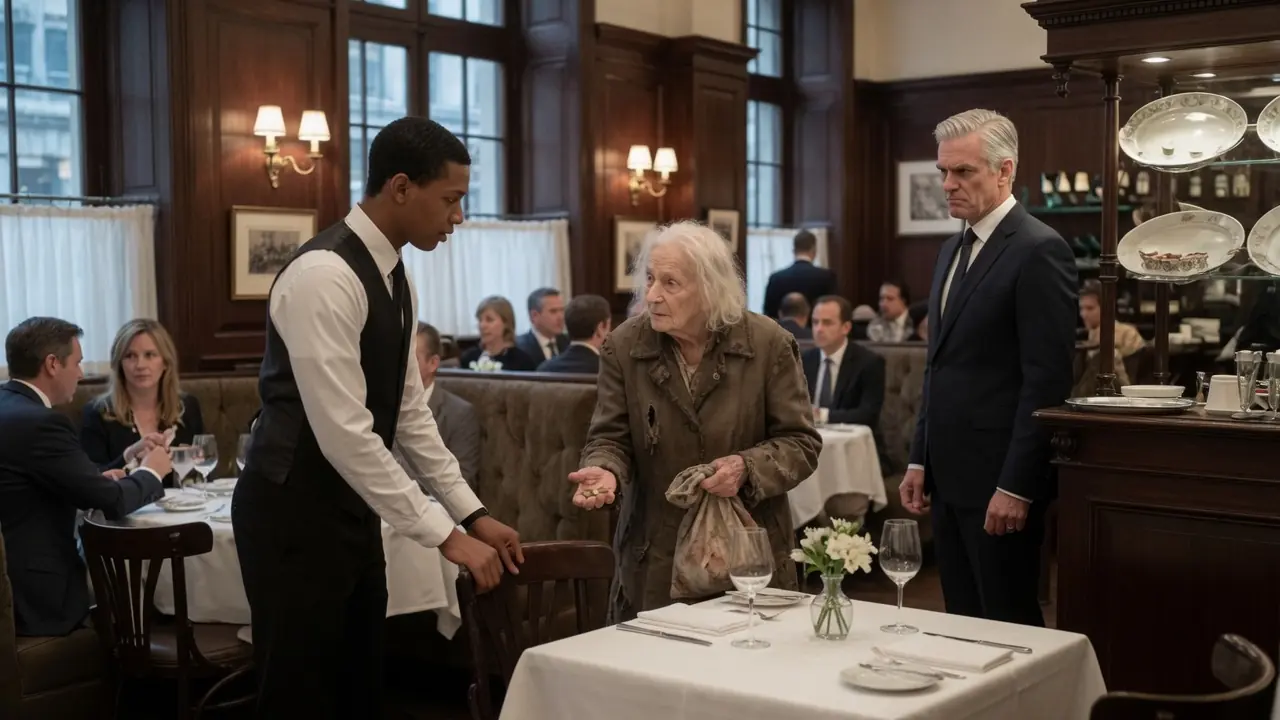
In the heart of Manhattan, where glass towers pierced the clouds and money flowed like water, stood the Grand Pearl. Not a restaurant, but a temple where New York's elite worshipped themselves. It didn't serve food, it served status. Inside, the air hung heavy with truffle oil, aged wine, and the faint scent of imported flowers replaced daily, wilted or not. Crystal chandeliers scattered rainbows across linen-draped tables.
Marble floors veined with gold reflected every careful step. Here, silverware was worth a week of groceries, wine bottles a month's rent, and appearances mattered more than appetite. Through this landscape of calculated excess, moved Elias Grant, a young man of 27 whose dark eyes had learned to see everything while revealing nothing. He wore the standard uniform, crisp white shirt, black vest pressed to knife-edge precision, trousers that never showed a wrinkle.
His shoes were polished to mirror brightness. His posture perfect. His face a mask of professional neutrality that he'd perfected over 3 years of service. Elias had come to the Grand Pearl straight out of college, abandoning his dreams of becoming a social worker when his mother's cancer diagnosis had transformed abstract ideals into concrete necessities. Health insurance, medical bills, experimental treatments that regular insurance wouldn't cover.
The mathematics of survival had been brutally simple. Fine dining paid three times what social work did and his mother needed every penny. So, Elias Grant had learned to smile at people he despised, to serve food that cost more than his weekly salary, to be invisible in plain sight. He'd become very good at it, too good perhaps. Sometimes he caught himself in the mirror and didn't recognize the man staring back.
Someone who'd learned to look away from cruelty, to participate in a system he knew was wrong, to trade his principles for his mother's medication one shift at a time. The restaurant hummed with its evening symphony. At table seven, a hedge fund manager laughed too loudly at his own jokes while his companion, young enough to be his daughter, clearly wasn't feigned fascination. At table 12, a group of lawyers celebrated a victory that had probably ruined lives.
Their voices carried the particular arrogance of people who confused legal with ethical. Near the windows, an elderly socialite examined her reflection in a spoon, adjusting her expression before the photographer she'd hired arrived to document her casual dinner. Presiding over this kingdom of vanity was Richard Blackwood, the restaurant's general manager oversaw everything with meticulous care. At 50, he was a man who had spent his entire adult life serving the wealthy and somewhere along the way he began to mistake their power for his own.
His suits were expensive and his silver hair was always perfectly styled. He moved through the restaurant with quiet authority, noticing every detail, every flaw, as if the place itself were a reflection of him. Richard ran the Grand Pearl with strict control disguised as charm. He believed in hierarchy, in the natural superiority of those who could afford his restaurant over those who could not. To him, the world was divided into two groups, the elite and the help.
He'd already chosen which one he belonged to, no matter what reality suggested. "Grant." Richard's voice cut through the ambient noise like a knife through silk. Table 18's wine needs refreshing, and for God's sake, look pleasant. You're not at a funeral. Elias nodded without meeting his manager's eyes, a skill he'd perfected over 3 years. Direct eye contact with Richard was dangerous, interpreted as either insubordination or incompetence depending on his mood.
Better to keep your head down, do your work, collect your paycheck. That was the bargain Elias had made the price he paid for his mother's chance at survival. He moved through the dining room with practiced efficiency, refilling wine glasses with precise pours, clearing plates the moment guests set down their forks, answering questions with polite brevity that revealed nothing of the person beneath the uniform. His face had become a tool, pleasant and neutral, showing only what the guests wanted to see, competent service delivered by someone who knew their place.
At the service station, Elias crossed paths with Jennifer Thompson, one of the other veteran servers. She was 32, had been working at the Grand Pearl for 5 years, and had the particular weariness of someone who'd seen too much and couldn't afford to care anymore. "Table nine is complaining about their steak again," Jennifer muttered, checking her order pad. "Third time this month. I think he just likes sending food back to feel important."
Tell Chef Antoine to char it slightly more than requested, Elias suggested quietly. Sometimes people don't actually want what they order. They want the power of rejecting it. Jennifer gave him a tired smile. Three years here and you figured out all the tricks. You could run this place. God, I hope not, Elias said with more feeling than he'd intended.
The day I start thinking like Richard Blackwood is the day I need to find a new career. But even as he said it, Elias knew the truth was more complicated. He was already thinking like Richard in small ways, making calculations about which guests deserved his best service based on how much they spent, how they dressed, whether they treated him like a human being or a piece of furniture. The restaurant was changing him, erosion so gradual he barely noticed it happening.
Near the kitchen doors, Elias spotted Thomas Wright, the host, turning away an elderly couple at the entrance. The conversation was brief, but Elias could read the body language from across the room. The man's frayed collar, the woman's scuffed shoes, Thomas's apologetic but firm gesture toward the door. They clearly weren't the type of clientele Richard preferred, and Thomas had learned, as they all had, what kinds of people were welcome at the Grand Pearl and what kinds were not.
The couple left quietly, their dignity bruised but intact, and Elias felt the familiar twist in his stomach that he'd learned to ignore. This happened several times a week. People turned away not because they couldn't pay, but because they didn't look like they could pay, because their clothes weren't expensive enough, their shoes not shiny enough, their entire existence not quite meeting Richard Blackwood's narrow standards of acceptability. Elias had stopped intervening after the first month.
He tried, once, to suggest that they at least let people see a menu before judging them. Richard had taken him aside and explained, with icy politeness, that the Grand Pearl maintained certain standards, that their reputation depended on exclusivity, that Elias was paid to serve, not to make policy decisions. The evening continued its rhythm. Elias delivered a 40-oz Tomahawk steak to table six, $185 of meat that would probably be half eaten and thrown away.
He poured a glass of wine that cost $70, more than he made in tips on a slow night. He smiled at people who didn't see him, served people who didn't thank him, participated in a system that made him feel smaller with every shift. Around 8:30, the kitchen doors swung open with unusual force. Chef Antoine emerged, his white coat spotted with sauce, his face flushed with the particular anger of an artist whose work isn't being appreciated.
The woman at table 14, he announced to no one in particular, his French accent thickening with frustration, she says the Dover sole is too fishy. Too fishy. It is fish. What does she expect it to taste like? Chicken? Richard materialized immediately, his professional smile locked in place. I'll handle it, Chef. Please return to the kitchen.
Elias watched as Richard approached table 14, watched him lean in with conspiratorial concern, watched him offer to replace the meal with something else entirely, on the house, of course. The woman accepted with the air of someone who'd never doubted the world would bend to accommodate her whims. This was how the Grand Pearl operated. The wealthy were always right, their complaints always valid, their satisfaction the only metric that mattered.
Never mind that the Dover sole had been perfect. Elias had smelled it when it passed his station, fresh and delicate. Never mind that the woman had eaten three quarters of it before complaining. Never mind that somewhere in New York, people were going hungry while she wasted expensive fish because it tasted like what it was. Elias felt the anger rising, pushed it down, smiled at his next table.
This was the job. This was the bargain. Principles were a luxury he couldn't afford. By 9:30, his feet ached, his face hurt from maintaining his professional mask, and he had four more hours until closing. He was clearing table 19 when he overheard a conversation that made his hands tighten around the plates he was holding.
Elias glanced toward the entrance and saw her, an elderly woman standing outside the glass doors, her coat threadbare, her posture bent with age. She wasn't harassing anyone. She was just looking at the menu posted outside, her weathered hand pressed against the glass as if drawing warmth from the light spilling out of the restaurant. Something about her expression caught Elias's attention.
It wasn't the glazed desperation of addiction or the aggressive entitlement of someone looking for a handout. It was something else, a kind of wistful longing mixed with calculation, as if she were trying to figure out whether she could afford even the cheapest item on a menu where nothing was cheap. Elias delivered his plates to the kitchen, then found himself walking toward the entrance. He told himself he was just checking to make sure she wasn't blocking the doorway.
That he was simply doing his job, but the truth was more complicated. He saw his own mother in that weathered face, saw the woman who'd worked three jobs to raise him, who'd never asked for help even when she desperately needed it, who taught him that dignity wasn't something wealth could buy or poverty could erase. He pushed open the door, stepping into the October evening. The air was sharp with approaching winter, and the elderly woman turned toward him, startled.
I'm sorry, she said immediately, her voice soft but clear. I wasn't bothering anyone. I was just looking. I know, Elias said gently. I wasn't going to tell you to leave. I just. He hesitated, unsure what he was actually doing. Are you hungry?
The woman's eyes widened slightly, and Elias saw pride warring with need in her expression. I have some money, she said, reaching into her coat pocket. I was trying to figure out if I had enough for soup, just soup, nothing else. Our soup is $22. Elias said and watched her face fall.
She pulled out a small change purse, opened it to reveal a handful of coins and a few crumpled bills, maybe $12 total, carefully saved and counted. I see, she said quietly, closing the purse. I'm sorry to have bothered you. I'll be going. Elias stood there, watching her turn to leave, and felt something crack inside his chest.
This was it, the moment where he could choose to be the person he'd once wanted to be or continue being the person survival had forced him to become. He thought about his mother, about the day she'd been too proud to ask for help, even though she couldn't afford her medication. He thought about all the time strangers had shown her kindness when her own son was too young or too far away to help. He thought about the man he'd been 3 years ago, fresh out of college and determined to make the world better before the Grand Pearl had taught him to look away from suffering.
Wait, Elias said. The woman turned back, hope and caution mixed in her expression. Come inside, Elias continued, his heart pounding. Let me seat you. But I don't have enough. You have enough, Elias said firmly, making a decision that would change everything.
Come inside, please. He held the door open, and after a moment's hesitation, the elderly woman stepped through into the warmth and light of the Grand Pearl. As she crossed the threshold, Elias saw Richard Blackwood's head snap up from across the dining room, saw his manager's expression shift from confusion to recognition to fury, but it was too late to turn back now. Elias had opened the door, literally and figuratively, and whatever came next, whatever price he had to pay for this choice, he would face it.
Because some things, he was discovering, were worth more than survival. Some things were worth risking everything for, even if you didn't know it until the moment arrived, the Grand Pearl had been designed to make certain people feel small, and it was succeeding magnificently with the elderly woman Elias had just ushered inside. She stood in the entrance, her threadbare coat suddenly looking even more worn against the backdrop of crystal and marble, her weathered face pale in the chandelier light. Around the dining room, conversations faltered as heads turned as wealthy patrons registered the presence of someone who clearly didn't belong.
Elias felt every eye on them, felt the weight of judgment settling over the restaurant like fog, but he'd made his choice. He would see it through. This way, please, he said gently, leading her toward a small two-top near the kitchen doors. It wasn't the prestigious window section where the elite held court, but it was a real table at the Grand Pearl, and as Elias pulled out the chair for her, the woman sat down with a dignity that belonged in a palace.
Thank you, young man, she said softly. What's your name? Elias. Elias Grant. Margaret Walsh, she replied, extending her hand. Her grip was surprisingly firm, her palm calloused from years of hard work. You're very kind to do this.
I haven't done anything yet, Elias said, handing her a menu. But even as he spoke, he could see Richard Blackwood cutting through the dining room like a shark through water, his expression promising consequences. Elias had perhaps 30 seconds before his manager arrived. He used them wisely. Mrs. Walsh, our French onion soup is excellent, so is the chicken noodle.
Both will more than fill you up on a cold evening like this. Margaret's eyes scanned the menu, and Elias watched her face as she registered the prices. $22 for soup, 38 for a salad, 65 for the cheapest entree. These weren't just numbers to her. They represented hours of work, careful budgeting, the difference between eating and not eating for days.
The soup sounds perfect. Margaret said, closing the menu with decisive finality. Just the soup. Excellent choice, Elias said, taking the menu back. I'll put that order in right away.
He turned to find Richard blocking his path, jaw clenched, eyes blazing with barely controlled fury. Grant, my office, now. After I place Mrs. Walsh's order, Elias replied, his voice steady despite the fear coursing through him. Now, Richard repeated, his voice dropping to a dangerous whisper, or you can clean out your locker on the way. They both knew what that meant.
This was the ultimatum, the moment of reckoning that Elias had been avoiding for 3 years. Comply or be fired. Stay silent or lose everything. Elias looked back at Margaret, who was sitting quietly at her table, hands folded in her lap, watching this drama unfold with an expression he couldn't quite read. Then he looked at Richard, at the man who taught him to value money over humanity, who trained him to judge people by their bank accounts, rather than their character.
And Elias Grant made the second choice that would define the rest of his life. I'll place her order first, he said quietly. Then we can talk. Richard's face went purple. You're making a mistake.
Probably, Elias agreed, but it's my mistake to make. He walked past Richard to the computer terminal, entered Margaret's order, French onion soup, one piece of bread, and sent it to the kitchen. The cost was $22. Elias had $38 in tips from the evening so far, money he'd been planning to add to his mother's medication fund. He pulled out $40 from his apron pocket and walked to the register, processed the payment under his own name.
Several staff members were watching now, their expressions ranging from shock to admiration to horrified fascination. What are you doing? Jennifer Thompson asked, appearing beside him. Probably ending my career, Elias said, but I couldn't let him throw her out. Elias, your mother. I know, he interrupted gently, but my mother would never forgive me if I let fear turn me into someone who looks away from suffering.
She didn't raise me to be that person. He returned to the dining room where Richard had retreated to his position near the bar, arms crossed, watching with the patience of a predator who knew his prey couldn't escape. Elias approached Margaret's table just as Chef Antoine himself emerged from the kitchen carrying her soup. The chef set it down with a flourish that would have done a Michelin star to establishment proud.
The soup was perfect, a rich golden broth topped with melted Gruyère that stretched as Margaret lifted her spoon. Fresh thyme scattered across the top, the aroma alone worth more than its price tag. Compliments of Chef Antoine, the chef said with a small bow. Anyone who has young Elias standing up to that tyrant Blackwood deserves my best work. Margaret's eyes glistened as she took her first bite.
She closed her eyes, savoring the flavors with the appreciation of someone who understood the difference between merely eating and truly tasting. When she opened her eyes again, there were tears on her cheeks. This is wonderful, she whispered. I haven't had a meal like this in in a very long time. Elias felt his throat tighten.
I'm glad you're enjoying it. Margaret looked up at him and there was something in her expression, something knowing, almost amused, that Elias couldn't decipher. You know you're going to lose your job because of me, don't you? Probably, Elias admitted. And you did it anyway.
Someone once told me that the measure of a person isn't what they do when it's easy. It's what they do when it costs them something. He smiled sadly. I guess I'm about to find out what I measure up to. You're a good man, Elias Grant, Margaret said softly.
This world needs more people like you, even when it doesn't deserve them. Elias excused himself and made his way toward Richard's office, his heart pounding with each step. He'd known this moment was coming from the instant he'd invited Margaret inside. The only surprise was that Richard had let him finish serving her before delivering the inevitable verdict. The office was small and dominated by Richard's desk, which was positioned to ensure that anyone sitting across from him felt diminished.
Elias had been in this room dozens of times for performance reviews, schedule discussions, minor disciplinary actions, but he'd never been here for something like this. Richard sat behind his desk, fingers steepled, expression unreadable. He let the silence stretch for a long moment, a power play Elias recognized from previous encounters. Sit, Richard finally commanded. Elias remained standing.
I'd rather not if it's all the same to you. Richard's eyebrow arched. Growing a spine rather late in the game, aren't we, Grant? Maybe I should have grown one sooner. Do you have any idea what you've done?
Richard's voice was quiet but venomous. Do you comprehend how you've made this establishment look? We have standards, Grant. We have a reputation to maintain. We cannot, absolutely cannot, become known as the kind of place that lets in anyone off the street.
She's not anyone, Elias said quietly. She's a customer, a guest, someone who came here hoping for a meal. With $12? Richard slammed his palm on the desk. $12, Grant? That wouldn't cover an appetizer at this restaurant. And you seated her like she was Mrs. Vanderbilt.
You had Chef Antoine personally deliver her soup. You made a spectacle of the whole thing in front of our actual paying customers. I paid for her meal, Elias pointed out. So technically she was a paying customer. With your tip money.
Richard laughed bitterly. Do you think that makes you noble? Do you think anyone here is impressed by your little gesture? This isn't some diner where you can play the hero, Grant. This is the Grand Pearl. People come here to escape reality, not be confronted with it.
Maybe reality is exactly what this place needs. Elias replied, surprised by the steadiness in his own voice. The words hung in the air like a declaration of war. Richard stood slowly, his face flushing red. You're fired.
Elias had known it was coming, but hearing the words still felt like a physical blow. He thought of his mother, of the bills stacked on their kitchen counter, of the health insurance that would lapse in 30 days. He thought of the medication she needed, the treatments that regular insurance wouldn't cover, the difference between managing her cancer and letting it win. But he also thought about the man he'd wanted to be when he graduated college, before fear and necessity had taught him to compromise his values one shift at a time. He thought about Margaret Walsh, savoring that soup with tears on her cheeks, being treated with dignity in a place designed to exclude people like her.
I understand. Elias said quietly. You understand? Richard repeated mockingly. You understand that you've just thrown away your career for one bowl of soup for a woman you don't even know. You understand that no one else in this city will hire you after I make a few calls.
You understand that your bleeding heart just destroyed your future. Elias met his former manager's eyes steadily. What I understand, Mr. Blackwood, is that I can't work in a place where basic human decency is a fireable offense. So, actually, you've done me a favor. He turned to leave, but Richard's voice stopped him.
When your mother can't afford her medication, Grant, when you're standing in line at a food bank, when reality comes crashing down on your idealistic little head, remember this moment. Remember the choice you made. Elias paused at the door, his hand on the handle. I will remember this moment, he said softly, but not for the reasons you think. He walked out of the office, through the kitchen where staff members pretended not to watch him, and back into the dining room.
Margaret was still at her table, the soup bowl empty, her hands folded in her lap. She looked up as he approached. You're leaving, she said, not a question, a statement. I am, Elias confirmed. Because of me?
Because of me, Elias corrected gently, I made a choice. I'd make it again. Margaret stood slowly, her arthritis evident in every careful movement. She reached out and placed her weathered hand over his. The world needs more people like you, Elias Grant, she said, even when it punishes them for it.
Thank you for saying that, ma'am. She smiled, but there was something in her expression, something knowing, almost secretive, that Elias couldn't interpret. I have a feeling we'll see each other again. I'd like that, Elias said, meaning it. Margaret gathered her worn cloth bag and made her way toward the door, moving with more dignity than half the millionaires in the room.
As she passed, several guests averted their eyes, uncomfortable with acknowledging her existence, but she seemed unbothered, walking through their world as if she had every right to be there. When she reached the entrance, she turned back one last time. Her eyes found Elias across the crowded restaurant, and she gave him a small nod, a gesture of respect, perhaps, or promise. Then she was gone, disappearing into the October night. Elias began gathering his things from his locker, the reality of unemployment settling over him like a cold fog.
He'd have to tell his mother tonight, have to explain why the paychecks would stop, why the insurance would lapse, why everything they'd been working toward was now in jeopardy. But as he changed out of his uniform for the last time, Elias found that the guilt he'd expected wasn't there. Instead, there was something else, something lighter. For the first time in 3 years, he had made a choice based not on fear, but on principle. And whatever the cost, he couldn't bring himself to regret it.
Jennifer Thompson found him in the locker room. Elias, I'm so sorry. What Richard did, it isn't right. It's exactly right, Elias said, surprising them both. For who he is, for what this place represents.
He's consistent. I'll give him that. He values money and status above everything else. He told me that from day one, I just kept hoping it wasn't entirely true. What will you do now?
Elias closed his locker, his uniform folded neatly inside. Find another job. Take care of my mom. Try not to become the kind of person who looks away when someone needs help. He smiled sadly.
The usual impossible things. As he left the Grand Pearl for the last time, walking past the brass fixtures and marble floors and crystal chandeliers that had once seemed so impressive, Elias thought about Margaret Walsh. He wondered where she was, if she'd found shelter, if she was warm. He wondered if she ever thought about the young server who'd bought her soup and lost everything because of it. He wondered if it had been worth it.
The answer came to him slowly, painfully, but with absolute certainty. Yes. Even knowing the cost, even watching his carefully constructed stability crumble, the answer was still yes. Because the alternative, turning away, letting Richard humiliate her, being complicit in that cruelty, would have cost something, too. Something less visible, but more permanent.
His father had once told him that the right thing sometimes costs us something. That's what makes it right. Elias just hadn't realized how much it would cost. As he descended into the subway, heading home to deliver the news that would break his mother's heart, Elias Grant had no way of knowing that his story with Margaret Walsh was far from over. He had no way of knowing that his choice at the Grand Pearl had set into motion events that would reshape everything he thought he understood about justice, dignity, and the invisible threads connecting us all.
But, he would learn. Very soon, he would learn. The subway ride home took 45 minutes, but it felt like hours. Elias sat in the corner of a half-empty car, watching tunnel walls blur past, trying to organize his thoughts into something coherent enough to explain to his mother. How do you tell someone fighting cancer that you've just thrown away the lifeline keeping both of you afloat?
How do you explain that a bowl of soup for a stranger mattered more than financial stability? The Grant apartment was in Flushing, Queens, a modest two-bedroom in a building that had seen better decades. Elias climbed the three flights of stairs slowly, his legs heavy with more than just physical exhaustion. He could hear the television through the thin door. His mother always kept it on in the evenings, some cooking show or nature documentary playing at low volume to fill the silence.
Linda Grant sat in her favorite chair by the window, a blanket across her lap despite the apartment's warmth. At 54, she looked a decade older, the cancer and its treatments having stolen more than just her health. Her black hair, once thick and lustrous, was now thin and streaked with premature gray. But, her eyes, her eyes were still sharp, still capable of seeing through her son's carefully constructed facades. You're home early, she said as Elias entered, her voice carrying that careful neutrality parents use when they sense bad news approaching.
Elias set his keys on the small table by the door. The apartment was clean, but sparse, no unnecessary decorations, no luxuries. Every penny went toward medical bills and treatment. The walls needed painting, the linoleum in the kitchen was cracked, but it was home. Mom, I need to tell you something.
Linda muted the television, her hands moving deliberately. Sit down, Elias. He sat on the old couch that had been with them since he was a child, its springs sagging from years of use. He told her everything. Margaret at the door, Richard's dismissal, the choice he'd made.
As he spoke, Linda's expression never changed, but her hands gripped the arms of her chair tighter. When Elias finished, silence filled the small living room. The refrigerator hummed in the kitchen. Someone in the apartment above walked heavily across the floor. Well, Linda finally said, I guess you inherited your father's stubbornness.
Elias felt his throat tighten. Mom, I'm sorry. I know we can't afford. Stop, Linda interrupted, holding up one hand. I won't have you apologizing for doing the right thing.
Your father wouldn't, and I certainly won't. But the bills. We'll figure it out, Linda said firmly, though Elias could see the fear beneath her brave words. We always do. You think this is the first time we've had to scramble?
Elias, I raised you to be a good man. I didn't raise you to be a coward who looks away when someone needs help. It's not that simple. Isn't it? Linda leaned forward, wincing slightly at the movement.
You saw someone in need. You had the means to help. You helped. The fact that there were consequences doesn't change whether it was right. Elias pressed his palms against his eyes.
I should have thought it through, should have waited, found another way. There wasn't another way, Linda said quietly. If you'd waited, she would have left hungry. If you'd looked for some perfect solution that didn't cost you anything, she still would have left hungry. Sometimes the right thing costs us something.
That's what makes it right. But your treatment is not your responsibility alone, Linda said, her voice gentle but firm. Elias, you're 27 years old. You've put your life on hold for 3 years to take care of me. You've worked at a job that made you miserable, swallowed your pride a thousand times, compromised your values daily, and you did it without complaint because you love me.
I know that. I've always known that. She reached out, taking his hand in hers. But I didn't raise you to sacrifice your soul for my survival. That woman needed help tonight.
You gave it. I'm proud of you for that. Your father would be proud of you. Elias felt tears threatening, pushed them back. What are we going to do?
What we've always done, Linda said. We'll adapt. You'll find another job. We'll adjust the treatment schedule. We'll ask for payment plans.
We'll survive, Elias. We always have. But Elias could hear the fear beneath her brave words, could see the calculations running behind her eyes. They had maybe 2 months of savings. His health insurance would lapse in 30 days.
Her next treatment was in 3 weeks and cost $12,000 without insurance. The mathematics of survival had just become significantly more complicated. Over the following days, Elias learned exactly how vindictive Richard Blackwood could be. He applied to 32 restaurants in the first week, everywhere from high-end establishments to casual dining chains. 32 times, he filled out applications, spoke with managers, explained his experience at the Grand Pearl, and 32 times, something shifted when they called for references.
I'm sorry, the position's been filled. We're not hiring right now. We'll keep your application on file. The rejections began to blur together. Richard had clearly made good on his threat to poison Elias's reputation throughout the industry.
The message was clear. Hiring Elias Grant meant crossing Richard Blackwood, and in the tight-knit world of New York's restaurant scene, that was a risk no one was willing to take. Elias expanded his search beyond restaurants, retail stores, office buildings, anything with a paycheck. But without a college degree that led to specific jobs. Social work positions required licenses he didn't have.
Without skills beyond hospitality, his options were limited, and even when he found possibilities, his resume raised questions. Why had he left the Grand Pearl? Why, after three successful years, would he suddenly be looking for entry-level work elsewhere? He couldn't tell them the truth, that he'd been fired for helping someone, because that story made him sound either naive or like a liability. And he couldn't lie because the gaps in his employment history told their own story.
Two weeks after losing his job, Elias was washing dishes at a 24-hour diner in Brooklyn. The pay was minimum wage, less than half what he'd made at the Grand Pearl. The work was exhausting, 10-hour overnight shifts, his hands perpetually wrinkled from dishwater, his back aching from bending over industrial sinks. But it was work, and Elias had learned not to take that for granted. His mother picked up extra hours doing remote data entry for a medical billing company, work she could do from home between treatments.
It paid poorly and made her exhausted, but she insisted on contributing. Together, they were barely covering rent and utilities. The medical bills stacked up, ignored because there was simply no money to address them. Elias's younger sister, Emma, called from Seattle, where she was finishing her senior year at the University of Washington. She'd gotten a scholarship, thank God, but even with financial she was working two part-time jobs to cover living expenses.
She offered to drop out and come home to help, but Elias refused. One of them was going to finish college and have options. One of them was going to escape the cycle. Three weeks after losing his job at the Grand Pearl, Elias stood in his mother's oncologist's office, listening to Dr. Sarah Morrison explain why they couldn't continue treatment without payment. I'm sorry, Elias, Dr. Morrison said, her expression genuinely pained.
The hospital's billing department has flagged your mother's account. She's $60,000 behind in payments. Until that's addressed, we can't authorize further treatments. She'll die without treatment, Elias said flatly. I know.
Dr. Morrison's voice was gentle, but firm. Which is why I'm telling you this now, so you can figure out payment options. Apply for state assistance, look into charity programs, set up a payment plan. There are options, but I need you to understand that the next treatment is critical. We can't delay it more than 2 weeks without risking significant progression of the cancer.
Elias left the hospital in a daze. 2 weeks to find $60,000 plus the 12,000 for the next treatment. $72,000 total. He might as well have been asked to fly to the moon. That night, he sat at the kitchen table with a calculator and a stack of bills, trying to make mathematics work through sheer force of will.
His dishwashing job brought in about $1,300 a month. His mother's data entry added maybe 800. Rent was 1,500, utilities, food, transportation. The numbers didn't add up. They hadn't added up in weeks.
They were drowning, and Elias had no idea how to save them. His phone buzzed. A text from Emma. Mom told me about the treatment. I'm dropping out.
Coming home next week. Don't argue. Elias stared at the message, feeling something crack inside his chest. This was what his choice had cost. Not just his own career, but his sister's future.
His mother's life. Everything they'd worked for collapsing like a house of cards because he decided to play hero for one evening. He thought about Margaret Walsh, wondered where she was, if she knew what her bowl of soup had cost him. He wondered if she'd even think about him once in the weeks since that night, or if he'd just been another forgettable interaction in her difficult life. He wondered if it had been worth it.
The answer didn't come as easily now, sitting in his dim kitchen with bills he couldn't pay and a future that looked increasingly hopeless. The nobility of his choice seemed hollow in the face of his mother's pain, his sister's sacrifice, the reality of consequences he hadn't fully anticipated. Elias pulled out his laptop and opened a job search website, beginning his nightly ritual of applying to positions he knew he wouldn't get. Retail associate, office assistant, security guard, anything that paid more than washing dishes, anything that might somehow bridge the gap between survival and catastrophe. He was three applications in when his phone rang.
Unknown number, probably another creditor, another medical billing department, another polite voice explaining why his family's desperation wasn't their problem. Elias almost didn't answer, but some instinct, maybe just the desperate hope that comes with having nothing left to lose, made him pick up. Hello? Mr. Grant? Elias Grant? The voice was professional, female, with the crisp efficiency of someone used to conducting important business. Yes, that's me. My name is Patricia Torres.
I'm calling on behalf of Walsh Holdings. Do you have a moment to speak? Elias felt his stomach tighten. Walsh Holdings was one of the largest hospitality companies in the Northeast. They didn't call dishwashers at 11:00 p.m.
I think you might have the wrong number. I'm looking for the Elias Grant who worked at the Grand Pearl until 3 weeks ago. Is that you? Yes, that's me. But I don't understand why Walsh Holdings would be calling me. Mrs. Margaret Walsh would like to meet with you.
Would you be available tomorrow morning, say 9:00 a.m.? The name hit Elias like a physical blow. Margaret Walsh, the woman he'd bought soup for, the woman who'd thanked him and disappeared into the night, the woman he'd thought about dozens of times since, wondering if she was safe, if she'd found shelter. Mrs. Walsh, Elias repeated, his mind racing. The Margaret Walsh who came to the Grand Pearl. The very same.
Would 9:00 a.m. work for you, Mr. Grant? Elias glanced at the bills spread across his kitchen table, at the impossible mathematics of survival. Yes. Yes, I can be there. Where should I meet her?
Patricia gave him an address in Midtown Manhattan, a building Elias recognized as one of the city's more prestigious office towers. He wrote it down on the back of an overdue medical bill with a stubby pencil, his hand shaking slightly. When the call ended, Elias sat there in his kitchen trying to process what had just happened. Margaret Walsh wanted to meet with him. Margaret Walsh, who apparently worked for or with Walsh Holdings.
Margaret Walsh, who had given him a phone number to an office in a building where the rent for one floor probably exceeded his annual salary. None of it made sense. He thought about calling his mother, waking her to share this bizarre development, but it was late. She needed her rest, and he didn't want to give her false hope. This was probably nothing, maybe a job opportunity, maybe just Margaret wanting to thank him properly.
He couldn't afford to read too much into it. But as Elias finally closed his laptop and prepared for bed, he allowed himself a tiny sliver of hope. Maybe, just maybe, the universe was about to throw him a lifeline. Maybe his choice at the Grand Pearl, his decision to help someone who needed it, was about to matter in ways he hadn't imagined. Or maybe it was nothing.
Maybe Margaret just wanted to buy him coffee and express her gratitude, and tomorrow he'd be right back where he started, washing dishes at a diner, watching his mother deteriorate, unable to save anyone including himself. Elias tried not to hope. Hope he'd learned was dangerous when you couldn't afford to be disappointed, but sleep didn't come easily that night, and when it finally did, he dreamed of crystal chandeliers and marble floors and an elderly woman with knowing eyes who promised they would meet again. Elias arrived at the Walsh Holdings building 30 minutes early, wearing his only suit, purchased for college interviews 6 years ago, and now slightly too tight across the shoulders. The lobby was all glass and steel with security guards and expensive uniforms and a directory listing companies he recognized from financial news.
Walsh Holdings occupied floors 28 through 32, the very top of the building. He gave his name to security expecting complications, but the guard simply checked his list and handed Elias a visitor badge. 32nd floor. They're expecting you. The elevator was glass-walled, offering a view of Manhattan unfurling below as Elias ascended.
At 20 stories up, his stomach lurched, not from the height, but from the growing realization that Margaret Walsh was not who he thought she was. Nobody who worked in a building like this counted quarters to pay for soup, which meant that night at the Grand Pearl had been something other than what it appeared. The elevator doors opened onto an understated reception area. No flashy displays of wealth, but everything from the receptionist's desk to the artwork on the walls whispered quality. A young woman looked up as Elias approached, her smile professional but genuine.
Mr. Grant, welcome to Walsh Holdings. Mrs. Walsh is waiting for you in conference room A, just down this hall, second door on the right. Elias walked down the corridor, his cheap shoes silent on expensive carpet, and found the conference room. Through the glass wall, he could see Margaret sitting at a long table. She wore a simple navy dress, her white hair pulled back, and when she saw Elias, she with genuine warmth.
Elias, she said, rising to greet him as he entered. Thank you for coming on such short notice. Please, sit. Elias sat, feeling completely out of his depth. Mrs. Walsh, I don't understand.
What's this about? It's about gratitude, Margaret replied, settling back into her chair. And it's about justice. Can I get you some coffee, tea? I'm fine, thank you.
Elias' mind was racing. The woman he bought soup for was sitting in a conference room that probably cost more per square foot than his entire apartment. Mrs. Walsh, I need to ask. Three weeks ago, were you really in need, or was that night some kind of test? Margaret's smile became somewhat mischievous.
That's a fair question, and you deserve an honest answer. Yes, Elias, it was a test, but not the kind you might think. She leaned forward, her expression growing more serious. 47 years ago, my son, Andrew, was 17 years old. We were desperately poor.
My husband had died two years earlier, and I was working three jobs just to keep us fed and housed. Andrew was brilliant, had scholarship opportunities to good colleges, but we couldn't afford even the small expenses that weren't covered. Books, supplies, transportation. Margaret's voice softened with memory. One night, Andrew collapsed at his part-time job from exhaustion and malnutrition.
He was hospitalized, and we had no insurance. The bills were crushing. I was sitting in the hospital cafeteria counting coins to buy coffee when a young nurse saw me. Her name was Grace Kim. She was maybe 25, working double shifts herself to pay off student loans.
Grace saw me crying over my change purse and did something extraordinary. She bought me coffee and a sandwich from her own money. Then she sat with me for 20 minutes on on break and listened while I told her about Andrew, about our struggles. When she left, she slipped me an envelope with $500 cash, her entire savings, and a note that said, "Pay it forward when you can." Elias felt his breath catch.
That money helped you. That money saved us, Margaret said simply. It paid for Andrew's textbooks that first semester. It bought him a bus pass so he could get to school. It gave us just enough breathing room to survive until Andrew graduated and started earning.
He went to community college, then transferred to a state school, worked his way through, eventually built a successful career in real estate and hospitality. She paused, her eyes glistening. Grace Kim died in a car accident 5 years after she helped us. I never got to thank her properly, never got to tell her that her $500 turned into Walsh Holdings, a company now worth over $3 billion because Andrew never forgot that kindness. Every business decision he's made, every property we've acquired, every restaurant we've opened, it's all been built on the principle Grace taught us that every person deserves dignity, regardless of their circumstances.
Elias's head was spinning. Walsh Holdings, you own Walsh Holdings? Andrew and I built it together, Margaret confirmed. Started with one small inn 40 years ago. Now we own 37 hotels and restaurants across six states.
Some casual, some fine dining, all successful. She smiled, and all committed to the principle that excellence and accessibility aren't enemies, they're partners. But why the test? Elias asked. Why pretend to be homeless?
Because I needed to know, Margaret said quietly. We've been watching the Grand Pearl for 2 years. It's perfectly positioned, beautiful property, but it's been losing money because Richard Blackwood turned it into a shrine to exclusivity. We wanted to buy it, but we needed to understand its culture first. So, I went in as someone with very little money to see how I'd be treated.
Her expression hardened slightly. Richard Blackwood was preparing to have me thrown out before I'd even spoken. He saw someone who looked poor and decided I didn't deserve basic respect. He was ready to humiliate me, to call security, to make an example of me. And then you helped me.
Margaret continued, her voice warming again. You didn't know who I was. You thought I was exactly what I appeared to be, an elderly woman with no money and no options. And you helped me anyway, knowing it would cost you your job. You proved that somewhere in that toxic environment, there was still someone who remembered what hospitality actually means.
Elias sat back, trying to process everything. You've been investigating me. Understanding you. Margaret corrected gently. Understanding the full story.
You lost your job because of me, Elias. You've been blacklisted, struggled to find work, watched your family suffer because you chose kindness over self-preservation. Did you think I would just walk away from that? I didn't do it for a reward. Elias said quietly.
I did it because it was right. I know. That's exactly why we're having this conversation. Margaret slid a folder across the table. Elias Walsh Holdings acquired the Grand Pearl five days ago.
As of this morning, we own it completely. Elias felt his heart stop. You bought the restaurant. We did. And we're making some significant changes, starting with new management.
Margaret paused significantly. We'd like to offer you a position. You want me to come back as a server. Elias asked, trying to process this. No.
Margaret said, and there was something in her tone that made Elias's breath catch. We want you to manage it. The words seemed to hang in the air, defying all logic and reason. What? We're looking for someone to completely overhaul the Grand Pearl's culture, Margaret explained.
Someone who understands that true hospitality isn't about exclusivity or luxury. It's about treating every person who walks through those doors with dignity. You proved you understand that principle. You proved you're willing to sacrifice for it. Mrs. Walsh, I'm 27 years old.
I've never managed anything. I did you'll have support, Margaret interrupted. Advisors, training resources. Andrew has already put together a team to help with the transition. But we need someone with the right values at the helm.
Someone who won't forget what it's like to struggle, who won't start judging people by their bank accounts instead of their humanity. Before Elias could respond, the door opened. A man in his early 40s entered, tall, composed, with Margaret's same penetrating eyes. He wore a suit that cost more than Elias's monthly rent, and he carried himself with the easy authority of someone who'd never doubted his place in the world. Elias Grant, Margaret said.
This is my son, Andrew Walsh. Andrew extended his hand, his grip firm and warm. Mr. Grant, I've heard a lot about you. All good things. Elias shook his hand, still reeling.
Mr. Walsh, I'm honored to meet you. Please call me Andrew. He sat down beside his mother, his expression serious. Elias, I want you to understand something. What my mother did that night at the Grand Pearl, testing the restaurant's character, it's something she's done dozens of times over the years.
At our own properties, at competitors, anywhere she wants to understand how people treat those they perceive as powerless. It's how we've identified our best managers, Margaret added. How we found people who share our values. Grace Kim taught us that kindness compounds, that treating people with dignity isn't just morally right, it's good business. Every person we've hired because they showed compassion in a difficult situation has exceeded our expectations.
Andrew leaned forward. But you're different, Elias. You didn't work for us. You weren't being evaluated by your employer. You were at a restaurant with a toxic culture, working for a manager who'd made it clear that kindness was a liability.
And you helped my mother anyway, knowing, absolutely knowing, it would cost you everything. That's the kind of person we want leading the Grand Pearl. Margaret said, Someone who chooses principles over survival. Someone who can transform that restaurant from a monument to exclusivity into a place where excellence and accessibility coexist. She slid the folder closer to Elias.
This is our offer, the salary, benefits, and operational budget. Take it home, review it, discuss it with your family. But, Elias, I hope you'll say yes. I think you're exactly what that place needs. Elias opened the folder with trembling hands.
The salary listed was $95,000 annually, more than three times what he'd been making at the Grand Pearl. The benefits included full medical coverage for him and his mother, the kind that would actually cover her cancer treatments. There was a signing bonus of $25,000, enough to clear their most urgent medical debt and give them breathing room. This is too much, Elias said, his voice barely audible. It's market rate for a restaurant manager in Manhattan, Andrew corrected, with performance bonuses, profit sharing, and opportunities for advancement within Walsh Holdings if you succeed.
We invest in our people, Elias. That's how we've built everything we have. Elias looked up from the folder, his eyes stinging. Why? Why all this? Margaret's expression softened.
47 years ago, Grace Kim showed me kindness when I desperately needed it. It changed my life, Elias. It gave me hope when I had none. Reminded me that I mattered when the world was telling me I didn't. That Mercers kindness was the foundation on which Andrew and I built everything we have today.
She reached across the table and placed her weathered hand over his. You gave me that same gift 3 weeks ago. You saw an old woman counting quarters and you didn't see a problem to be removed. You saw a person, a human being worthy of dignity and respect. That's so rare, Elias, especially in places like the Grand Pearl, where wealth has replaced humanity as the measure of worth.
I just bought you soup. Elias said, a tear escaping down his cheek. You did more than that. You showed me that there are still good people in this world. People willing to pay a price for their principles.
People who can't be taught to look away from suffering. Margaret squeezed his hand gently. Let me give you the tools to build something better. Let me help you create a place where kindness isn't punished, it's celebrated. Elias sat there overwhelmed, trying to process everything.
The folder in front of him represented not just a job, but salvation. His mother's medications, her treatments, his sister staying in college, a future that had seemed impossible just hours ago. But it also represented something more daunting, responsibility. The chance to prove that kindness wasn't weakness, that dignity didn't depend on dollar signs, that a restaurant could be both excellent and humane. Can I ask you something? Elias said.
Anything. That night at the restaurant, did you know what would happen? Did you plan all this? Margaret considered the question carefully. I didn't know I would buy the Grand Pearl specifically, but I knew I would do something.
When someone sacrifices for me, I don't forget it, and I don't let their sacrifice be in vain. She smiled. Call it my way of paying forward what Grace Kim did for me all those years ago. Elias looked at the folder again, at the numbers that would change his family's life, at the opportunity to transform a place that had broken him into something better. My mother, he said slowly, she's very sick.
She needs treatment immediately. Can I start after? Your mother's medical bills will be paid in full by tomorrow morning. Andrew interrupted gently. Consider it part of the signing bonus.
We take care of our people, Elias. That starts now. Elias felt his composure finally crack. Tears streamed down his face and he didn't try to hide them. I don't know what to say.
Say yes, Margaret said softly. Say you'll take this chance. Say you'll help us prove that Grace Kim was right. That kindness compounds. That treating people with dignity isn't just moral, it's transformative.
Elias wiped his eyes, looked at Margaret and Andrew Walsh, two people who'd built an empire on the foundation of one nurse's $500 act of kindness, and understood something profound. This wasn't charity. This wasn't a handout. This was an investment in the same principle that had saved them. That kindness multiplies.
That dignity matters. That how we treat people when they have nothing reveals everything about who we are. When would I start? Elias asked. Margaret's smile broadened.
Is that a yes? It's a yes. Elias confirmed, feeling something like hope bloom in his chest for the first time in weeks. It's absolutely a yes. Then let's say Monday, Andrew said.
That gives you the weekend to celebrate with your family and prepare for what comes next. And Elias, welcome to Walsh Holdings. Welcome to your second chance. As Elias shook their hands, he thought about that night three weeks ago. The moment when he'd invited Margaret inside.
The moment when Richard had fired him, the moment when his world had collapsed. He thought that was the end of his story at the Grand Pearl. But as he stood in this office overlooking Manhattan, shaking hands with two of the most successful people in the hospitality industry, Elias Grant understood something profound. Sometimes the endings we fear are actually beginnings we haven't recognized yet. And sometimes the cost of kindness is just an investment whose returns we can't immediately see.
Grace Kim had invested $500 in a desperate mother and her son 47 years ago. That investment had grown into a $3 billion company built on human dignity. And now that company was investing in Elias, trusting that his kindness would multiply in ways none of them could predict. The ripples were spreading, and Elias Grant was about to discover just how far they could reach. Monday morning arrived with the kind of crystalline autumn clarity that made Manhattan sparkle with possibility.
Elias stood outside the Grand Pearl at 6:30 a.m., a full 90 minutes before the staff meeting Andrew had arranged. He'd spent the weekend in a blur of celebration and preparation, his mother crying tears of joy when he told her about the medical bills, his sister screaming with relief over video call, his own disbelief that his life had transformed so completely in 72 hours. But now, standing before the restaurant that had broken him, Elias felt the weight of what he was attempting. The Grand Pearl looked different in morning light, less intimidating perhaps, but also more real. Just a building, just a room where people served food to other people.
The mythology Richard Blackwood had built around it seemed suddenly fragile. Andrew Walsh met him at the door, two cups of coffee in hand and a knowing smile on his face. Couldn't sleep? Andrew asked, handing Elias one of the cups. Not much, Elias admitted. Kept thinking about all the ways this could fail.
Good. That means you're taking it seriously. Andrew unlocked the door and they stepped inside. My mother chose you because you have something that can't be taught. A moral compass that points true even under pressure.
Everything else, management skills, operational knowledge, industry expertise, that's all learnable. We'll teach you. They walked through the dining room. Elias's footsteps echoing on the marble floor. How many times had he crossed this space as a server, invisible and voiceless?
Now he was supposed to lead it, reshape it, make it into something better than it had been. The staff will be skeptical, Andrew said, reading his thoughts. Some of them resented you for getting Richard fired. Others will see you as my mother's pet project, unqualified and naive. A few might even try to undermine you.
That's encouraging, Elias said dryly. Andrew laughed. I'm not trying to discourage you. I'm preparing you. Leadership isn't about being liked.
It's about being respected. And respect comes from consistency, integrity, and treating people fairly even when it's difficult. He led Elias to what had been Richard Blackwood's office, now stripped of personal effects and waiting for its new occupant. The desk was the same, the view of the kitchen through the window unchanged, but the feeling was different. No longer a throne room for petty tyranny, just a functional space where decisions would be made.
My mother will be here for the first month, Andrew explained, acting as a consultant while you find your footing. She'll observe, advise, but she won't interfere. This is your restaurant to run, Elias. Your vision to implement. We're just here to make sure you have the resources and support to succeed.
At 8:00 a.m. the staff began arriving. Elias watched from the office window as they filtered in. Their expressions ranging from curious to hostile. He recognized most of them, fellow servers he'd worked alongside, kitchen staff he'd joked with during slow nights, the bartender who'd always made him laugh with her caustic commentary on the guests. Jennifer Thompson, his former colleague, looked nervous.
Thomas Wright, the host who'd survived the purge, looked carefully neutral. And standing near the back, arms crossed and expression thunderous, was Catherine Hayes, the senior server who'd been Richard's favorite, his enforcer among the staff. That's going to be a problem, Elias murmured, nodding toward Catherine. Probably, Andrew agreed, but here's what you need to understand. Some people are invested in the old system because it gave them power.
Catherine could be cruel to guests and staff alike because Richard let her. She had status in his hierarchy. Your new approach threatens that status. So, what do I do? Give her a chance to adapt, but make it clear that the old rules no longer apply.
If she can't accept that, she'll have to go. Andrew checked his watch. It's time. Ready? Elias took a deep breath.
No, but let's do this anyway. The staff meeting was held in the dining room. Everyone gathered around tables that had been pushed together. 21 employees stared at Elias as he stood before them, feeling younger and more inexperienced than ever. But he thought of his mother, of the advice Linda Grant had given him Sunday night.
Tell them the truth. People respect honesty more than perfection. Good morning, Elias began, his voice steadier than he felt. I know most of you. I worked with you, shared shifts with you, celebrated good nights and survived disasters with you.
And I know what you're thinking. Why is Elias Grant, who was fired 3 weeks ago, now standing here as your manager? He let the question hang for a moment. No one answered, but several heads nodded. The honest answer is that I got lucky.
I made a choice that night, a choice to help someone who needed it, and it turned out that someone was in a position to change my life. I'm not going to pretend I earned this through years of experience or special qualifications. I didn't. I'm here because Margaret Walsh believes I have the right values to lead this restaurant in a new direction. Catherine Hayes' laugh was sharp and bitter.
So, we're supposed to follow someone who's been managing restaurants for all of 5 minutes? Someone who got his job because he played hero for a rich lady? Elias met her gaze directly. No, Catherine. You're supposed to follow someone who believes every person who walks through those doors deserves respect.
Someone who thinks our job isn't to guard the gates of exclusivity, but to create experiences that honor human dignity. If you can't accept that philosophy, then no, you probably shouldn't follow me. The room went silent. Catherine's face darkened, but she said nothing more. Here's what's going to change, Elias continued.
We're not turning away anyone who can pay for a meal. I don't care what they're wearing, what they look like, whether they fit some narrow definition of the right kind of customer. If they have the means to pay and they're respectful to our staff, they're welcome here. He paused, looking around the room. That doesn't mean we're lowering our standards.
It means we're raising them. Excellence in service isn't about making rich people feel superior. It's about making every guest feel valued. That's harder. It requires more skill, more empathy, more genuine hospitality.
Jennifer Thompson raised her hand tentatively. What about the regulars? Some of them, they like the exclusivity. They like knowing not everyone could get in here. Then they'll need to adjust, Elias said simply, or they can take their business elsewhere.
We're not in the business of making people feel superior by keeping others out. We're in the business of creating exceptional dining experiences. For the next hour, Elias outlined his vision with Andrew's occasional input. Open seating policies based on availability, not appearance. Staff empowerment to solve guest issues without constant management approval.
A revised menu with a broader price range including options that were excellent but affordable. Community partnership programs with local organizations. This sounds like a completely different restaurant, Thomas Wright observed, though not critically, more with curiosity. It is, Elias confirmed. The Grand Pearl was built on exclusivity and status.
We're rebuilding it on excellence and accessibility. The luxury remains. The quality of food, the caliber of service, the attention to detail. But we're removing the cruelty that was wrapped around that luxury like a vine choking a tree. After the meeting, as the staff dispersed to prepare for the lunch service, Margaret Walsh appeared from where she'd been observing in the background.
She'd said nothing during the meeting, simply watching Elias navigate his first test of leadership. You did well, she said quietly, especially with Catherine. You didn't back down, but you didn't attack either. That's the balance you'll need. She's going to be a problem, Elias said.
Possibly, or possibly she'll rise to the challenge. Margaret smiled. People can surprise you, Elias. Sometimes the ones most resistant to change end up becoming its strongest advocates. Give her time.
The lunch service was Elias's baptism by fire. He'd done every job in this restaurant except management, but now he stood at the expo station coordinating between kitchen and dining room, making split-second decisions about table assignments and timing and a a other details that had once been invisible to him. At 12:15, a family walked in, parents and two young children, none dressed for fine dining. The father wore work boots and had paint on his jeans. The mother carried a diaper bag decorated with cartoon characters.
The kids were energetic and loud, the way children are. Elias saw Catherine's expression from across the room, that look of disdain she'd perfected under Richard's management. She started to move toward Thomas's host stand, clearly intending to redirect the family elsewhere. Catherine, a moment, please. Elias called out.
She approached reluctantly. That family isn't right for this restaurant. Why not? Because they're. Catherine struggled for words that wouldn't sound overtly discriminatory.
They're not our usual clientele. Do they have the means to pay? That's not the point. That's exactly the point. Elias said firmly, but not unkindly.
Catherine, I understand you're used to a different approach, but this is the new approach. We serve everyone who can pay and treats our staff with respect. That family is paying customers. Please seat them and provide the same excellent service you give anyone else. Catherine's jaw clenched.
For a moment, Elias thought she might refuse, might quit on the spot, but then she exhaled sharply and nodded. Fine, but when those kids start screaming and disturbing the other guests, don't say I didn't warn you. As it turned out, the children were remarkably well-behaved. The father had brought them to the Grand Pearl to celebrate his wife's promotion at work. They'd been saving for two months.
When Catherine delivered their meals, Elias watched her face soften slightly at the family's genuine appreciation, their awe at the food, the way they treated her with respect and gratitude. It was a small victory, but Elias would take it. The afternoon brought another test. At 2:15, an elderly veteran shuffled in, his clothes clean but worn, a faded military cap on his head. He moved slowly, a cane supporting his weight, and Elias could see the calculations running behind his eyes, the same look Margaret had worn that first night.
Thomas glanced nervously at Elias, waiting for direction. Elias nodded encouragement. Welcome to the Grand Pearl, Thomas said warmly. Table for one. The veteran hesitated.
How much is I mean, what's the least expensive thing on your menu? Elias stepped forward. Sir, we have a soup and sandwich combination for $18. It's excellent and more than enough food. We also honor military service with a 20% discount. The veteran's face brightened considerably.
That sounds perfect. Thank you. Elias seated him personally at a table by the window, not hidden away, not tucked in a corner, but in plain view. As the man ate his soup slowly, savoring each spoonful, Elias noticed several things happening around the restaurant. Some guests watched curiously, but not with disdain.
A few smiled. One businessman finishing his meal stopped by the veteran's table on his way out. Excuse me, sir, the businessman said. I couldn't help but notice your hat. Were you in Vietnam?
The veteran looked up, surprised. Yes, sir. Marine Corps, 1968 to '70. My father served in Vietnam. Never talked much about it.
The businessman extended his hand. Thank you for your service. It was a small moment, but it represented something profound. Humanity recognizing humanity, kindness breeding kindness. By the end of the first service, Elias was exhausted but cautiously optimistic.
They'd served 68 guests, slightly below average for a Monday lunch, but respectable given the transition. No catastrophes had occurred. The kitchen had kept pace. The staff had adapted, some more gracefully than others. Andrew found him in the office afterward reviewing the day's receipts.
How do you feel? Like I ran a marathon while juggling chainsaws, Elias admitted, but we made it through. You did more than make it through. You set a tone. Andrew sat down across from him. I was watching the staff.
Most of them are cautiously on board. Jennifer's already a believer. She was grinning when Thomas seated that veteran. Thomas is professionally curious. He wants to see if this approach can actually work financially.
Catherine's still resistant, but she didn't quit and I saw her actually smile when that family with the paint stained jeans thanked her. And the guests? Mixed reactions as expected. A few regulars looked uncomfortable, but most people appreciated the warmer atmosphere. And you know what? We had two walk-ins today. People who'd never dared try the Grand Pearl before because it always seemed too intimidating.
Your open door policy is already working. Elias leaned back in his chair allowing himself a moment of satisfaction. One day down. How many until we know if this will actually work? Give it 3 weeks, Andrew said.
21 days to establish new patterns, to see if the staff adapts, to understand how the market responds. My mother's done this before, transformed struggling properties by changing their culture. It works, Elias, but it takes time and consistency. That evening, Elias returned home to Flushing to find his mother waiting with anxious but hopeful expressions. So, Linda demanded before he'd even closed the door.
How did it go? Are you still employed or did you somehow get fired on your first day? Elias laughed, collapsing onto the couch, still employed. It was intense, but good, I think. I didn't completely embarrass myself.
Linda Grant studied her son with pride evident in her eyes. Tell me everything. Elias did, recounting the staff meeting, Catherine's resistance, the family with paint-stained jeans, the elderly veteran. As he spoke, he saw his mother's eyes glisten. You're actually doing it.
She said softly, you're changing that place. Trying to, Elias corrected. Day one is hardly a victory. It's a start, Linda said firmly, and starts matter. Elias, your father used to say that the first step is always the hardest because it's the one where you commit to the journey.
You took that step today. They ordered Chinese takeout, a luxury they hadn't been able to afford in weeks, and celebrated Elias's first day as a manager. But as the evening wore on and the conversation turned to lighter topics, Elias felt the weight of responsibility settling more firmly on his shoulders. He thought about Catherine, still struggling with the new approach, about the regulars who might flee to other restaurants where exclusivity was still the price of admission, about all the ways this experiment could fail, taking Margaret Walsh's faith in and down with it. But he also thought about that elderly veteran by the window, savoring his soup with such appreciation, about the father with paint on his jeans beaming as he celebrated his wife's promotion, 1000's genuine smile as he welcomed who would have never been those brass doors before.
And for the first time, Elias realized that the Grand Pearl had started to feel less like a monument to wealth and more like a living, breathing place, imperfect, fragile, but human. When the dishes from dinner were cleared and his mother had gone to bed, Elias sat by the window with a cup of lukewarm tea looking out over the flickering skyline of Queens. The city pulsed with its endless rhythm, sirens, laughter, distant music, and for once he felt in step with it rather than crushed beneath it. His phone buzzed, a message from Jennifer. We had two walk-ins at closing, a nurse and her kid.
Catherine stayed late to seat them, said she didn't want them to feel out of place, thought you'd want to know. Elias stared at the text for a long time, a slow smile spreading across his face. Maybe change didn't happen in grand gestures, maybe it began with a seat pulled out, a smile offered, a soup served without judgment. He typed a reply, "That's exactly what I wanted to know. Thank you, Jen."
Then he turned off his phone and let himself exhale. The doubts were still there, about money, about whether the new vision would last, but beneath them ran something steady, a purpose. Tomorrow would bring new problems, new resistance, new chances to fail, but it would also bring another chance to keep building the kind of place his father would have been proud of and his mother could finally believe in. Elias closed his eyes hearing her words echo softly in his head, "Starts matter." And for the first time in years, he believed it.