The people of Powder Creek had already decided how Edith Mayburn’s life would end long before she was old enough to make the decision for herself. She would remain in the weather-beaten cabin at the edge of town, baking bread for families who underpaid her, mending shirts for men who laughed at her, and carrying every insult with the quiet endurance people mistook for weakness. She would never marry, they said, because a woman as large as Edith should be grateful whenever a man looked at her twice, and no respectable man would willingly choose a wife whose body provided the town with so much entertainment. By the winter of 1886, Edith had heard some version of that prophecy often enough that there were mornings when she almost believed the cruelty had become simple arithmetic.
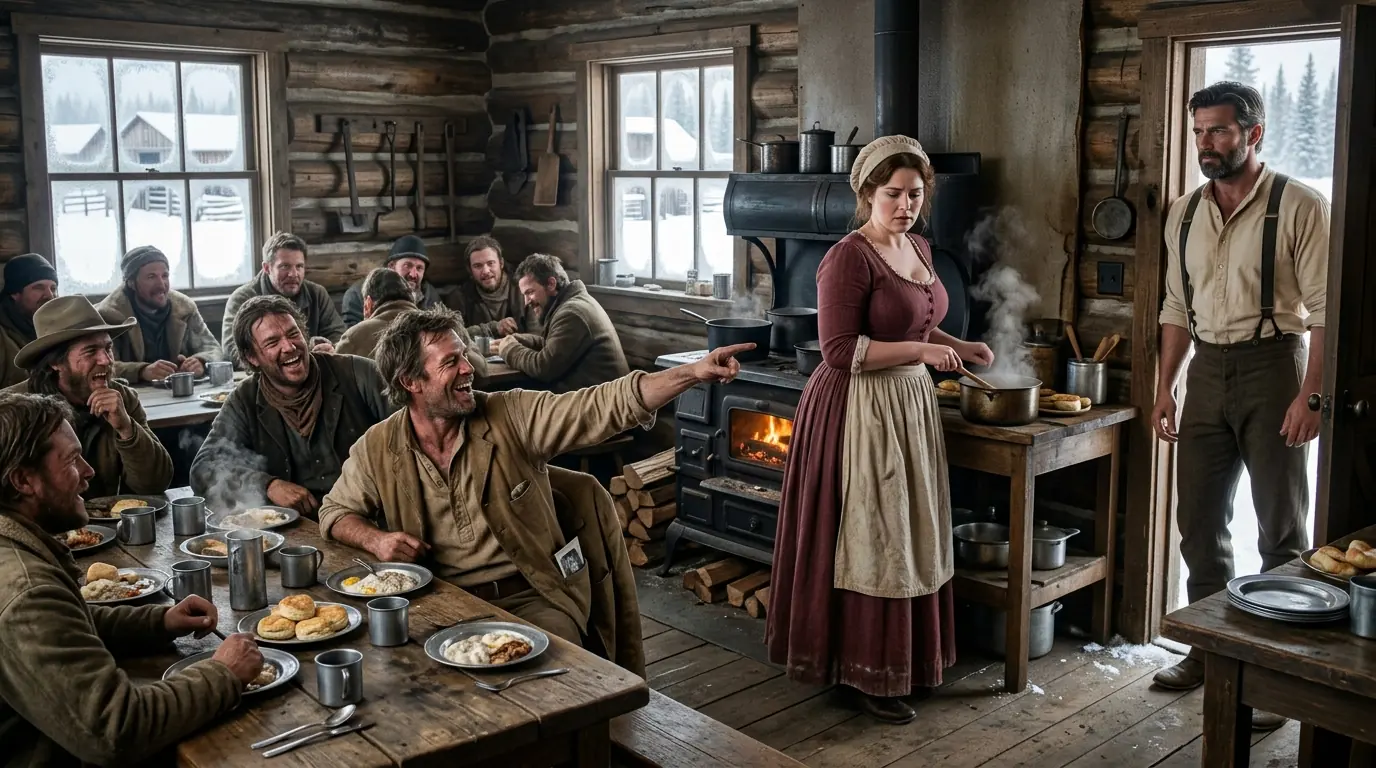
She was thirty-two years old, with thick chestnut hair usually pinned at the back of her neck, gray-green eyes, strong arms from years of lifting flour sacks, and a body that had been broad and heavy since adolescence. She could knead twenty pounds of dough without resting, carry two full water buckets through deep snow, butcher a chicken cleanly, preserve vegetables through winter, mend a torn saddle blanket, and calculate household accounts faster than several merchants who treated her as though numbers should be beyond a woman. None of those abilities protected her from the nickname children had learned from adults and adults pretended had originated with children. Around Powder Creek she remained, in whispers and sometimes openly, the fat girl in the cabin.
The cabin had belonged to her mother’s brother before he died of fever eight years earlier, leaving Edith a roof, six acres of poor soil, and a woodstove whose iron door had to be lifted slightly before it would close. Edith was grateful for all three because gratitude had been drilled into her so thoroughly that she sometimes confused it with the requirement to accept whatever treatment came with survival. She grew beans in summer, kept six hens, traded bread for meat, and repaired clothing by lamplight after the baking was finished. When winter arrived, she survived through the strength of a pantry she planned better than anyone in town realized and the weakness of a society willing to exploit labor as long as the laborer looked unlikely to protest.
The worst customers were often the ones who called themselves charitable. Mrs. Abigail Voss, president of the church benevolence committee, brought torn shirts to Edith twice a month and always explained that the repair should cost less because the Voss family donated generously to the congregation. The butcher, Horace Pike, saved the gristliest beef for Edith because he said a woman “with reserves” did not need the finest cuts, then laughed as if refusing to understand hunger in a large body made him clever. Edith generally paid, accepted the package, and went home because arguing with a butcher did not create better meat when he was the only butcher for forty miles.
She had tried anger when she was younger. At twenty-one, a group of men outside the feed store had joked that any husband who married Edith would need to reinforce his bed, and she had turned on them with such fury that one stepped backward into a horse trough. For three months afterward the story told around town was not that grown men had mocked a young woman’s body, but that Edith Mayburn had become hysterical because someone made a joke. She learned then that humiliation could be transformed into evidence against the humiliated if the person delivering it possessed enough friends.
There had been one man who courted her, or at least pretended to. Vernon Shaw, whose father owned the mercantile before him, walked Edith home from church three times during the spring she turned twenty-four and spoke privately about how lonely life could become for unmarried people. Edith let herself imagine something gentle, until Vernon suggested marriage would make excellent business sense because she could run his boarding rooms, cook for customers, sew for his widowed mother, and “wouldn’t need much in the way of fashionable dresses.” When Edith asked whether he loved her, Vernon looked confused by the relevance of the question.
She declined his proposal. Two weeks later Vernon told three men at the saloon that Edith had begged him to marry her and he had refused because he feared being smothered in his sleep. The joke traveled farther than the truth. By summer, Edith stopped attending socials unless somebody specifically needed her cooking.
The decision reduced opportunities for humiliation but also reduced her world. She went to church early and left before the congregation gathered outside, shopped when stores opened, and accepted mending through a wooden box she hung beside her door so customers could leave garments without conversation. She told herself she preferred solitude. Some days that was true.
The morning Coulter Grady came to her cabin began with wind striking the walls so hard the windowpanes trembled in their frames. Powder Creek had endured eleven days of snow, brief thaw, freezing rain, and then more snow, creating a hard white crust over roads that exhausted horses and snapped wagon wheels. Edith had been awake since before dawn, kneading bread for three households and trying to decide whether she could spare enough flour to make two additional loaves for the widow Jensen without charging her. She was elbow-deep in dough when someone pounded on the door like a man attempting to enter before permission arrived.
Edith froze. Nobody visited at that hour unless someone was sick, dead, or desperate. She wiped flour from her fingers, pulled a wool shawl around her shoulders, and crossed the cabin while the pounding came again.
“Miss Mayburn?” a deep voice called from outside. Edith recognized the name before she recognized the voice.
She opened the door. Coulter Grady stood on the porch with snow across the shoulders of a dark buffalo coat, ice melting from the brim of his hat, and a black gelding tied near the fence behind him. Every person in Powder Creek knew Coulter Grady even if they had never spoken to him, because the Grady spread began ten miles west of town and continued far enough into the foothills that local children believed it reached Montana.
Coulter was thirty-nine, tall without being unusually broad, with a weather-cut face, dark brown hair, and pale blue eyes people routinely described as cold because he did not waste expressions reassuring strangers. He had inherited a failing ranch at twenty-three, survived two cattle crashes, one devastating winter, a stampede that killed his younger brother, and enough financial trouble that bank managers stopped pretending he was merely lucky. By the time Edith knew him, Grady Ranch employed twenty full-time men, controlled valuable grazing ground, and supplied cattle to buyers from Cheyenne to Denver. Coulter rarely attended dances, spoke little at church, and carried a reputation for expecting work to be done correctly the first time.
He looked at Edith’s face. Not her waist, not the flour on her dress, not the body Powder Creek had trained people to evaluate before deciding how seriously to speak. His eyes remained on hers.
“I heard you can cook,” he said. Edith tightened one hand around the doorframe.
“I can.” Coulter nodded once.
“My cook left yesterday morning.” Edith waited.
“He took a bottle of whiskey, forty dollars I’m fairly certain did not belong to him, and a horse I am completely certain did not belong to him.” The corner of Coulter’s mouth moved almost imperceptibly. “I can replace the horse faster than the cook.”
Edith glanced past him toward the storm. “You rode ten miles through that to ask me about breakfast?”
“Eleven and a half.” Coulter stamped snow from one boot. “And I’m asking about more than breakfast.”
He explained that twenty ranch hands were working from before sunrise until after dark because frozen water lines, drifting cattle, injured animals, and collapsing fences had turned ordinary winter work into a constant emergency. Since the cook disappeared, the men had survived on scorched beans, cold biscuits, bacon cooked by whoever arrived first, and coffee strong enough to remove paint. Three men were already ill, tempers were worsening, and Coulter had realized that exhausted workers fed badly became unsafe workers. He needed someone willing to come immediately, live at the ranch until spring if necessary, and take charge of meals without waiting for cowboys to tell her how much salt belonged in stew.
Edith almost smiled. “How much?”
Coulter answered without hesitation. “Twenty-eight dollars a month, room and board, Sundays after noon yours unless weather makes that impossible, and I pay for ingredients separately.” Edith looked at him more carefully because the number was higher than she expected. “That’s more than cooks around here usually get.”
“Most cooks around here are feeding eight people.” He paused. “And most I’ve met can’t bake.”
Edith looked back into the cabin. Her bread dough waited beneath a cloth, six shirts were stacked near the sewing chair, and an entire life of narrow routines sat within one small room. Leaving meant trusting strangers, working among twenty men, and entering a ranch where jokes about her would not disappear simply because the owner had offered a fair wage. Staying meant another winter of selling labor one loaf and one repaired cuff at a time to people who had already decided the dimensions of her future.
Coulter mistook her silence for refusal. “If the answer’s no, say no,” he said. “I’m not here to drag you anywhere.”
Edith looked at him. “You aren’t worried I’ll eat your pantry empty?”
The question came out before she could stop it. Coulter’s face changed, not toward amusement but confusion.
“Why would I be?”
Edith gave a small shrug. “People make calculations.”
“I make calculations too.” His gaze remained steady. “I calculated that twenty men doing winter cattle work need more food than one cook can reasonably steal by appetite.”
A surprised laugh escaped her. Coulter waited.
Edith’s voice softened. “No one marries a fat girl, Mr. Grady, but I can cook.”
He did not laugh. He did not offer the sympathetic protest she hated almost as much as cruelty.
“I’m not looking for a wife, Miss Mayburn,” Coulter said. “I’m looking for someone who can put food on a table and make twenty exhausted men remember there’s still a reason to get up tomorrow.”
Something inside Edith shifted. It was not romance, gratitude, or even trust. It was the unfamiliar experience of being asked whether she could do something instead of being reminded what people believed she could never become.
“When do you need me?” she asked. Coulter looked toward the storm.
“Yesterday.” Edith nodded.
“Then tomorrow morning.”
He raised an eyebrow. “You need help transporting things?”
“One trunk.” She glanced toward the bread dough. “And I have promises to finish before I leave.”
Coulter nodded as though keeping promises was the most ordinary reason in the world to make him wait. “I’ll send a wagon at five.”
After he left, Edith closed the door and leaned against it. Her heart was beating too fast for someone who had merely accepted employment. She looked around the cabin and said aloud, “What have you done?”
The cabin did not answer. Neither did the bread.
She worked until after midnight. She finished every shirt already promised, baked eleven loaves instead of nine, left instructions with Mrs. Jensen about feeding the hens, and packed two dresses, heavy stockings, three aprons, boots, combs, sewing supplies, a Bible, two notebooks, and the small wooden box she rarely opened. At the bottom of that box beneath a folded handkerchief lay a blue enamel brooch shaped like a tiny wildflower.
Edith touched it once. Then she closed the box.
The Grady wagon arrived at 4:58 the next morning. Coulter was not driving it. A young ranch hand with red hair, a crooked grin, and more confidence than judgment introduced himself as Judson Hale, though he said everybody called him Judd unless they were angry.
Judd looked at Edith’s trunk. Then at Edith. His eyebrows rose.
“That all?” he asked. Edith said yes.
He lifted the trunk. “Boss said you might bring half the cabin.”
“Your boss doesn’t know me.” Judd grinned.
“Boss thinks he knows everybody after ten minutes.” Edith climbed into the wagon.
“Does he?” Judd shook his head.
“No, but don’t tell him I said that.”
The ride took almost two hours because drifts buried portions of the road. Judd talked enough for three men, mostly about horses, weather, ranch gossip, and which cowboys had attempted cooking after the previous man disappeared. Edith learned that one had burned oatmeal badly enough to ruin the pot, another tried frying biscuits, and a third served beans partially frozen because he misunderstood what soaking meant. By the time the ranch buildings appeared through morning snow, Edith had concluded starvation might indeed be approaching.
Grady Ranch was larger than she expected. A long bunkhouse stood east of the main house, with barns, corrals, a blacksmith shed, smokehouse, root cellar, calving shed, and several smaller worker cabins spread across the yard. Men moved through the half-light carrying feed, breaking ice, saddling horses, hauling wood, and shouting over wind. Every head turned when Judd stopped the wagon.
Edith climbed down. The first laugh came before her boots touched the ground.
A cowboy leaning beside the bunkhouse looked her up and down and called, “Boss hired us a cook or a winter food supply?” Several men laughed. Judd laughed too.
Another voice answered, “Hope Grady ain’t paying by the pound.” More laughter followed.
Edith stood beside the wagon with one hand on her trunk. The humiliation was familiar enough to feel almost rehearsed.
Coulter crossed the yard from the barn. The laughter faded when the men noticed him.
“Something funny?” he asked. No one answered.
The cowboy who made the first remark, a narrow-faced man named Cal Dobbins, looked away. Coulter waited another second.
“Good,” he said. “Then everybody still has enough breath to work.”
He looked toward Edith. “Kitchen’s this way.”
Edith followed without thanking him for intervening. She had learned that gratitude for basic decency could train people to think decency was a favor. Coulter did not seem to expect any.
The ranch kitchen was a disaster. Sacks stood open near the pantry, mice had chewed one corner of a flour bag, three onions were rotting in a crate, the stove was cold, grease covered part of the worktable, and someone had left dried beans soaking so long the water smelled sour. Edith stared for almost a minute.
Coulter stood beside the door. “Bad?”
“Did your cook leave because he hated you?” Coulter considered.
“Possibly.”
“He hated food more.”
That earned the smallest smile. Coulter removed his coat.
“What do you need?”
Edith looked at him. “Are you asking because you intend to help?”
“I can split wood.”
“Then split wood.”
Coulter nodded and left. No offended pride, no reminder that ranch owners did not take instructions from cooks. Edith rolled up her sleeves.
For the next three hours, she forgot Powder Creek. She threw spoiled food away, scrubbed the worktable with boiling water and lye soap, restarted the stove, sorted potatoes, trimmed onions, rendered bacon, mixed biscuit dough, and put beef scraps into an iron pot with stock, garlic, dried thyme, and black pepper. She found apples in the root cellar, wrinkled but usable, and sliced them into a pan with molasses and oats.
At six, men began drifting toward the bunkhouse expecting whatever disappointment had replaced breakfast. Instead, the first smell reached them before the door opened. Conversations stopped.
Edith carried out the first pan of biscuits. Behind her came crisp potatoes, thick beef gravy, bacon, eggs, apple oat bake, and two enormous pots of coffee made with enough grounds to taste like coffee rather than punishment. By the time all twenty places were set, the room had become suspiciously quiet.
Coulter stood near the doorway. He said nothing.
Cal Dobbins sat first. Judd dropped onto the bench beside him.
One of the older hands, Samuel Boone, looked at the food and asked, “We allowed to eat this?” Edith placed a serving spoon beside him.
“No, I arranged it for decoration.”
Several men laughed, but the laughter was different this time. Samuel took the first biscuit.
The room fell silent within one minute. Forks scraped plates, coffee poured, butter disappeared, and men who had mocked Edith less than three hours earlier stopped looking at her because every bit of attention had shifted to eating. One cowboy closed his eyes after tasting the gravy.
“Merciful Lord,” he whispered. Cal Dobbins said, “Don’t say anything, she’ll know we like it.”
Edith heard him. “I already know.”
Cal looked up. Edith pointed at his empty biscuit plate.
“You ate four.”
The table laughed. Cal actually blushed.
The laughter loosened something in the room. Edith refilled coffee.
Judd had eaten faster than anyone. When he finished, he leaned back, looked toward the kitchen, and saw Edith pin the blue enamel brooch at the top of her apron because the clasp had been snagging on her dress inside the trunk. His expression changed.
He stared. Edith noticed.
“Something wrong?” she asked. Judd did not answer.
He looked at her face. Then at the brooch.
“Miss,” he said slowly, “what did you say your name was?”
“Edith Mayburn.” Judd’s fork slipped from his hand.
Every man near him looked over. Judd stood.
His face had gone pale. He reached inside his coat.
Coulter moved away from the doorway, sensing the change. “Judd?”
The young man ignored him. He pulled a folded leather wallet from an inner pocket.
Inside was a faded photograph.
Judd’s hands shook when he unfolded the protective cloth around it. He walked toward Edith.
“I know who you are,” he said.
The room became completely silent. Edith looked at the photograph before taking it.
Color disappeared from her face. The serving spoon fell from her hand and struck the floor.
The photograph was seventeen years old. Time had faded the edges to brown, but the people remained visible.
A crude timber building stood behind a line of exhausted survivors wrapped in blankets. Snow rose almost to the windows.
At the center was a broad fifteen-year-old girl with tangled dark hair, soot across one cheek, a tin ladle in one hand, and a blue enamel wildflower pinned crookedly near her collar. Beside her stood a thin woman, two injured men, a child with bandaged feet, and nine others staring at the photographer like people who had forgotten photographs existed. Edith knew every face.
Her knees weakened. She gripped the counter.
Judd turned the photograph over. Writing covered the back in faded ink.
He read aloud because his voice had become too unsteady to trust silence. “Black Willow Station, February 1869. Mrs. Nora Mayburn and her daughter Edith kept eleven of us alive after the Red Elk road disappeared under snow.”
Edith closed her eyes. Judd continued.
“My father wrote this.” His voice broke. “Thomas Hale.”
Edith looked at him. The room blurred around his face.
Judd read the final lines. “If I live long enough to have children, tell them the Mayburn girl fed their father when there was almost nothing left, and she never took the full portion for herself.” He swallowed. “If one of my children ever meets her, they owe her better than the world gave us that winter.”
No one moved. Judd looked destroyed.
“My father carried this until he died.” His eyes filled. “My mother gave it to me when I left home.”
Edith stared at the young man who had laughed at her weight before sunrise. His father’s eyes were visible in him now.
Thomas Hale had been twenty-two during the Black Willow winter. Edith remembered cutting frozen leather from his boots while her mother warmed his feet inch by inch because warming them too quickly might do more harm. She remembered him waking delirious and asking for a brother who had died two years earlier.
“You look like him,” Edith whispered. Judd wiped his face with his sleeve.
“I mocked you.”
Edith said nothing.
“My father told me that story a hundred times.” Judd looked around the room as if ashamed to be seen. “He said if it wasn’t for Edith Mayburn, I would never have been born.”
Cal Dobbins stopped looking at his plate. The rest of the men seemed suddenly interested in every cruel word spoken that morning.
Judd turned toward Edith. “I’m sorry.”
She looked at the photograph. The girl in the image looked older than fifteen.
“No,” Edith said quietly. Judd flinched.
She continued, “Not because I refuse the apology.” She placed the photograph on the counter.
“Because you don’t know the story.”
Judd looked confused. “My father—”
“Knew his part.”
Edith removed the blue brooch. Her fingers trembled.
“Your father survived Black Willow.” She looked down. “Not everyone did.”
Coulter stepped closer but said nothing. Edith appreciated the silence.
She had spent seventeen years avoiding this moment. The photograph had crossed into Powder Creek without asking permission.
The name Black Willow meant little to the younger cowboys. Samuel Boone remembered it.
“My father talked about that storm,” he said. “Killed people from Rawlins clear north.”
Edith nodded.
The winter of 1869 had started badly and then turned impossible. Edith’s parents ran Black Willow Station, a lonely stage and freight stop almost eighty miles east of Powder Creek where travelers could change horses, buy meals, repair tack, and sleep if weather made the road dangerous. Her father Amos handled animals and freight, her mother Nora cooked and treated injuries, while Edith and her younger sister Liza did everything their ages allowed.
Edith had been fifteen. Liza was nine.
The storm arrived during an afternoon warm enough to fool travelers into believing spring might come early. By midnight the temperature collapsed, wind turned loose snow into walls, and every road vanished. Three wagons and a stagecoach reached Black Willow before movement became impossible.
Seventeen travelers crowded into a station built comfortably for eight. Two arrived frostbitten.
One had a broken arm. Another was already coughing blood.
Nora Mayburn organized the room as if she had expected disaster. Men capable of work chopped wood in shifts, bedding was moved away from exterior walls, food was inventoried, and a barrel of melted snow began simmering constantly because dehydration killed people even while the world outside seemed made entirely of water. Amos attempted to reach Fort Carlin on the second day after the storm eased for several hours.
He never returned.
His horse came back alone late that evening. The saddle was empty.
Nora knew what it meant before anyone said it. Edith remembered her mother standing with one hand on the horse’s frozen reins while seventeen people watched from inside the doorway.
She did not cry. She said, “We still need wood.”
They found Amos three days later after the storm broke. He had made almost seven miles before the horse went down, then continued on foot.
His body lay near a windbreak of low cedar. The searchers later said he had been facing toward the fort.
Edith never forgot that detail.
Inside Black Willow, food became the next problem. Flour diminished quickly.
Salt pork ran low. One crate of potatoes froze solid because someone stacked it too close to an exterior wall.
Nora reduced portions. Edith learned to turn scraps into soup thick enough to convince exhausted people they had eaten more than they had.
She baked bread with less flour by adding mashed beans. She saved bacon fat.
She roasted bones twice before giving up on them.
She lied about having eaten.
Thomas Hale noticed. He tried to give Edith half his biscuit.
She refused.
“You’re hurt,” she told him. Thomas answered, “You’re fifteen.”
Edith said, “Then I’m younger and need less.” It was terrible nutritional reasoning.
It kept him from arguing.
By the sixth day, Liza developed a fever. She had been coughing since before the storm.
Nora moved her into the smallest room near the stove. Edith slept beside her for two nights while waking every hour to stir food for everyone else.
On the eighth morning, rescue riders arrived. Men cried.
Women laughed. Thomas Hale kissed the floor.
A photographer traveling with the supply party took the picture outside after insisting newspapers would want to know who survived. Edith hated him immediately.
Her father was dead. Her sister was burning with fever inside.
She did not want to stand in snow holding a ladle so strangers could call them brave.
Liza died the following night.
Pneumonia, the doctor said.
Perhaps she would have died even with medicine. Perhaps not.
For seventeen years, Edith had carried a belief that was too irrational to confess and too painful to release. She had fed strangers while her sister weakened.
She knew feeding the others had not caused Liza’s death. Knowledge did not stop guilt from speaking.
The newspapers arrived later. They called Nora Mayburn the Widow of Black Willow and Edith the Frontier Angel with the Ladle.
Edith hated that name too.
People sent letters. Travelers came by when roads reopened.
Some wanted to thank them. Others wanted to stare.
One man asked Edith to stand beside the station door holding the ladle so his children could see the “hero girl.”
Another asked whether she had truly given up meals and then joked that she did not appear to have suffered for it. Edith had been fifteen.
She remembered the laughter.
Nora closed the station that autumn. They moved west.
Within three years, Nora’s health failed.
Edith buried her beside the cabin uncle Silas later left to her.
She told almost nobody about Black Willow.
The legend gradually disappeared beneath newer disasters.
Now, standing in Grady Ranch’s bunkhouse, Edith looked at Thomas Hale’s son. “Your father remembered the food.”
Judd nodded through tears.
“I remember the graves.”
No one knew what to say.
Coulter finally spoke. “Breakfast is getting cold.”
Several men looked at him, surprised. Coulter walked to the fallen serving spoon and picked it up.
“Miss Mayburn has work.” He placed the spoon beside the sink.
“So do all of you.”