Ginsm smoke hanging in the yard like a curtain nobody asked for. Six horses stamping in the dark. A barn door swinging loose on one hinge. Knocking against the frame. Talk like a clock counting down to something.
And in the middle of it all, a woman in a flower dusted apron holding a Spencer carbine like she'd been born with it in her hands. Dutch Ketering. Low almost admiring. You ain't no widow. Widows don't stand like that.
Eliza Marsh, steady, not a tremor in it. I rode dispatches through worse country than this, Mr. Ketering, with better men than you shooting at me. You're not the first fella who figured a woman alone was an easy mark. She didn't blink. She didn't lower the carbine.
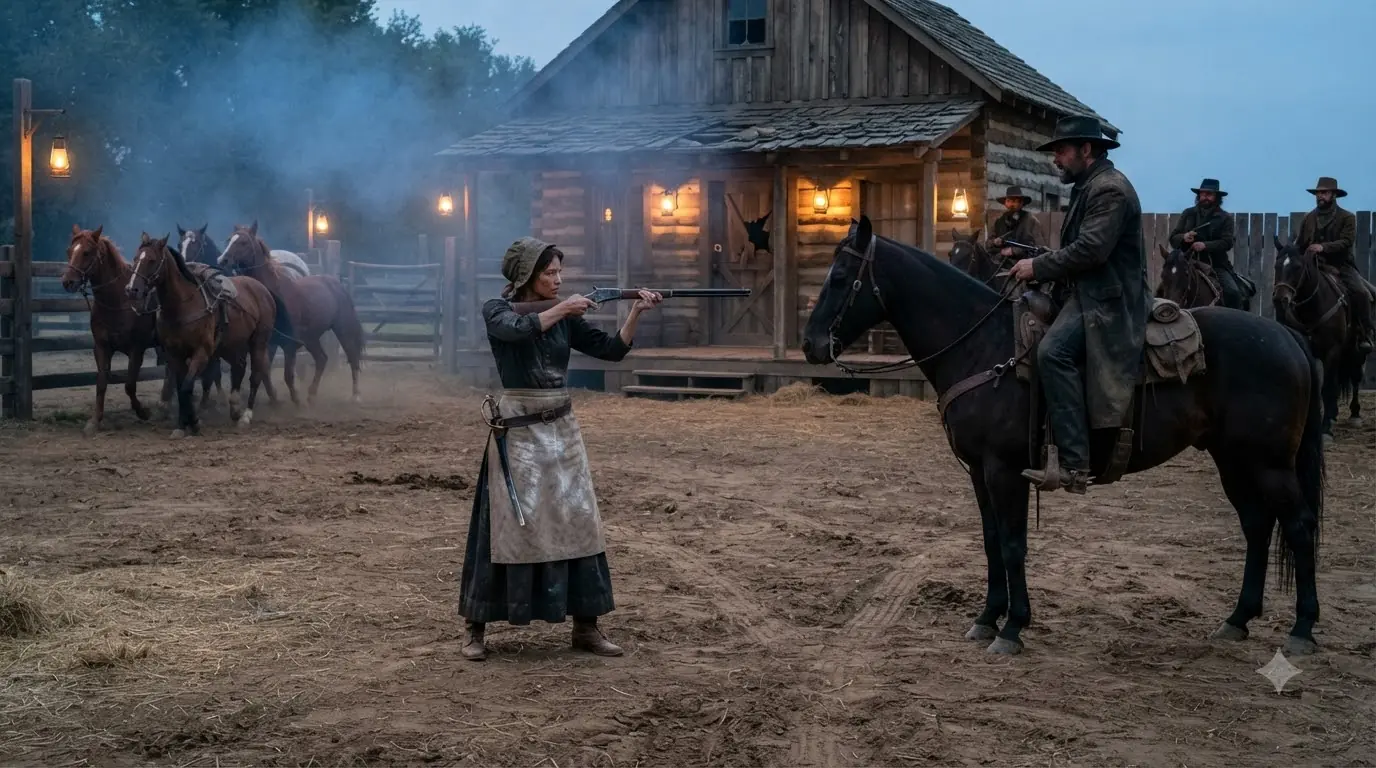
And somewhere behind her, in the dark of the barn, her 10-year-old son was watching his mother become someone he'd never met. How does a war widow who spends her days boiling laundry and mending harness end up standing off six armed men in her own dooryard and winning? What was in that oil cloth bundle she kept locked in the tack room? And why did the men who came to burn her out ride away from Larks Hollow with fewer riders than they came with? Stay with me because before this story is over, you're going to understand exactly why nobody in that valley ever underestimated Eliza Marsh again.
Larchur Hollow wasn't much. A scatter of clabbered buildings pressed into a fold of the foothills where the Sreto range broke the wind. A creek that ran fast in spring and thin by August. And a wagon row that connected it to nothing more important than the next valley over. 40 Families give or take.
A church with a bell nobody had gotten around to hanging yet. A merkantile run by a man who watered his whiskey and his sympathy in equal measure. And on the eastern edge of the valley, with a road narrowed into the pass, sat the marsh way station, 6 acres of pasture, a barn, a corral, and a low adobian timber house that had been built by a man named Daniel Marsh, who was no longer alive to enjoy it. Eliza Marsh had buried her husband two winters back, a fever that came on fast in November and left by December, taking him with it. She hadn't cried in front of anyone.