"Touch my bike again and I'll burn this whole place to the ground." Rex Callahan's voice didn't rise. It didn't need to. The silence that followed was the kind that made grown men forget how to breathe.
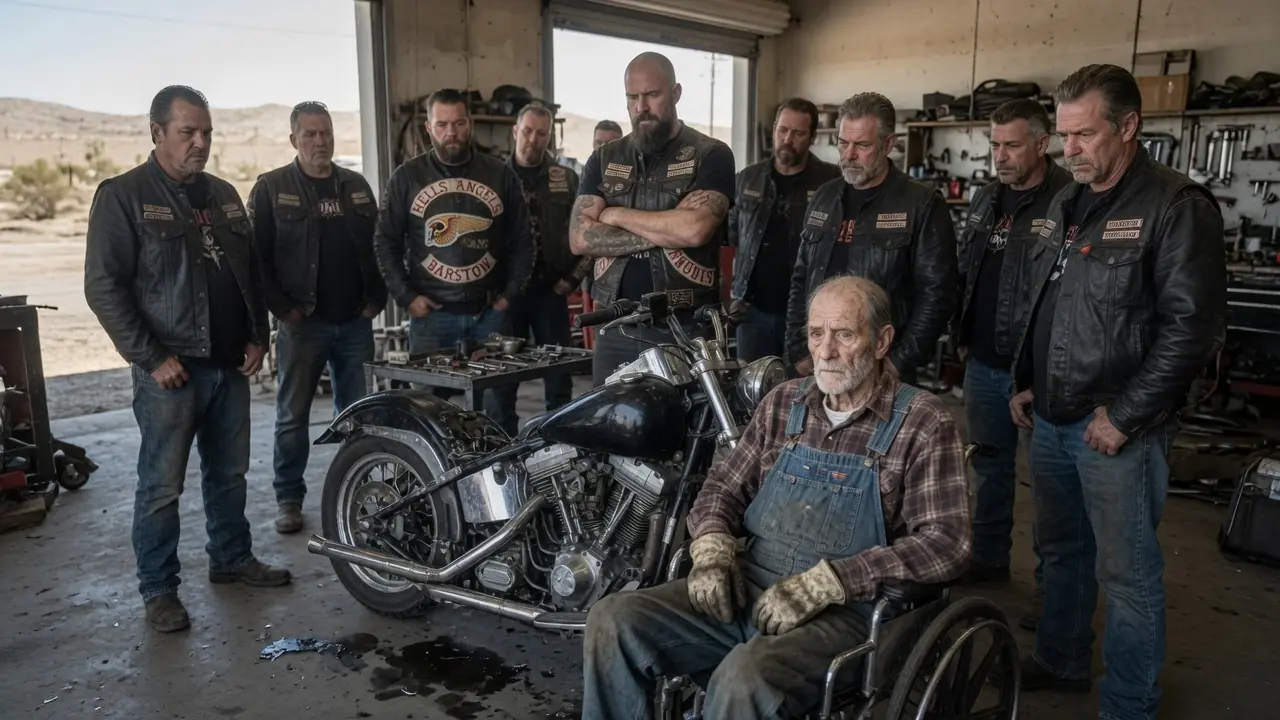
40 bikers stood watching as every mechanic in the shop backed away from the dead Harley, hands up, tools down, eyes on the floor. Nobody could fix it. Nobody even wanted to try anymore.
That's when the old janitor dropped his broom.
The heat on Route 81 was not the kind of heat that made people uncomfortable. It was the kind that made people angry. The kind that crawled under your skin and stayed there, slow cooking everything it touched until even the air felt like something you had to fight to breathe.
By 2:00 in the afternoon, the asphalt outside Mason's Auto and Repair had turned soft enough to leave boot prints and the rusted tin roof over the garage trapped every degree of it inside like a furnace with no exhaust. Nobody chose to stop at Mason's, not anymore.
Five years ago, the shop had a decent enough reputation. Two certified mechanics, a functioning alignment rack, and a sign out front that the highway could actually read. But time and three different ownership changes had stripped most of that away.
Now, the sign was missing two letters, the alignment rack sat in pieces behind the east wall, and the two certified mechanics had both found better work in Tucson. What remained were three young guys, Jake Mercer, Danny Reyes, and a kid everyone just called Suit because of the permanent smudge across his left cheek, and one old man who swept the floors, emptied the oil drums, and slept on a cot in the storage room behind the supply closet.
The old man's name, according to the single piece of paperwork Mason's had on file, was Walter Hayes. He had worked at the shop for 11 months. Nobody knew exactly where he'd come from. He'd shown up on a Tuesday morning, asked the then owner for any kind of work, and the then owner, a man named Craig, who'd had three beers by noon that day, had shrugged and handed him a broom.
Walter Hayes had been sweeping floors ever since. He was somewhere between 60 and 70, though nobody had thought to ask exactly. Silver hair kept short. One cloudy eye that didn't quite track the same direction as the other.
A limp so deep and permanent that it seemed less like an injury and more like something he'd been born carrying. His hands were enormous, rough, calloused, mapped with old scars that had the particular texture of work done over decades rather than days.
But those hands spent their days pushing a broom and carrying trash bags and refilling the paper towel dispensers in the bathroom. Jake Mercer, who at 26 considered himself the senior mechanic and acted accordingly, had a rotating collection of nicknames for Walter.
Old ghost. One eye. Most of the time just the janitor. He said these things loudly and without embarrassment, the way someone says things when they have decided the person they're talking about doesn't quite count as a full audience.
Walter Hayes, for his part, said very little. He swept. He emptied. He refilled. He ate lunch alone on an overturned milk crate beside the east wall slowly without apparent joy or sadness, like a man who had long since made his peace with the particular shape his life had taken.
That Tuesday, the day everything changed, Walter was sweeping the far corner of the garage bay when the sound reached them. He heard it before any of them did. He stopped sweeping just for a second. His head tilted barely almost imperceptibly the way an old dog tilts its head when it catches a sound pitched too high for human ears.
Then he returned to sweeping and nobody noticed he'd stopped. Jake noticed the sound approximately 45 seconds later when it had grown loud enough to be unmistakable. He walked to the garage door and looked out at the highway and what he saw made him take one slow step backward.
"Danny," he said. His voice had lost something. "Danny, get out here." Danny Reyes was 23 and had been working at Mason's for 8 months. He was a better mechanic than Jake, which Jake knew and resented.
And he was also the only one of the three young men who occasionally treated Walter with something approaching basic human decency, not warmth exactly, but the absence of cruelty, which in that garage passed for kindness. Danny walked to the door, looked out, and felt his stomach do something complicated.
The motorcycles were already turning off the highway, not two or three, not a dozen. They came in a formation so long and deliberate that it took nearly a full minute for the last one to clear the highway and pull into Mason's gravel lot.
40 bikes, maybe more. The sound was physical. It moved through the chest and the teeth and the soles of the feet and it did not apologize for any of that. At the front of the formation on a motorcycle that was immediately, obviously, different from all the others rode Rex Callahan.
Jake knew the name. Everyone in that part of Arizona knew the name the way you know the name of a weather event or a geological feature, something large and indifferent that exists whether you acknowledge it or not. Rex Callahan was 44 years old, 6 feet 4 inches tall, and had the particular physical presence that some men develop when they have spent decades in situations where physical presence was the only currency that mattered.
He wore no helmet. His blond hair was longer than you'd expect and his eyes, when they found you, had the quality of someone taking inventory. His motorcycle was extraordinary. Even Jake, who had spent the last year pretending he knew more than he did, could see that.
It was a custom Harley, heavily modified, clearly hand-built in significant ways, the kind of machine that represented not just money but knowledge, taste, and access to someone who had all three. It was painted a deep arterial red that shifted toward black in the shadows, and every surface that could be chromed was chromed, and the chrome was immaculate.
Rex Callahan rode it the way a man rides something he has absolute confidence in, which is why what happened next hit so hard. The Harley crossed the gravel lot, came to the front of the garage bay, and died. Not a gradual loss of power, not a cough and a stumble and a slow fade.
It died with one hard mechanical shudder, like something inside it had simply decided to stop. And in the sudden silence that followed, 40 other engines going quiet in unconscious unison, as if in respect, the sound of Rex Callahan's boots hitting the gravel was the loudest thing for 100 yards in any direction.
He stood over the motorcycle for a moment, not moving. His jaw worked. His right hand, still on the handlebar, tightened and released. Tightened and released. Then he looked up at the garage, and his eyes found Jake Mercer standing in the doorway.
"Fix it," Rex said. It was not a request. It contained no question mark, no conditional, no acknowledgement that anything about the situation was negotiable. It was the utterance of a man who had operated for so long in an environment where his statements became immediate reality that he had essentially lost the grammatical capacity for asking.
Jake Mercer was 26 years old, and he was frightened, and he did what frightened young men who believed they had reputations to protect often do. He covered the fear with performance. "Sure," Jake said, nodding with a confidence he did not feel, wiping his hands on his shop rag. "Bring her in."
Three of Rex's crew wheeled the Harley into the garage bay. The remaining bikers spread out across the lot in the perimeter of the building with a casual practiced efficiency of people accustomed to occupying spaces. A few lit cigarettes, a few didn't. None of them looked like they were in a hurry. None of them looked like they were relaxed, either.
There is a specific form of patience that is really just coiled aggression waiting for permission, and that was the kind of patience that stood in the gravel outside Mason's Auto and Repair that afternoon. Inside the bay, Jake connected the diagnostic scanner to the Harley system and waited. The scanner gave him nothing useful.
The codes it was throwing were either garbled or absent, which meant either the system itself was compromised or this particular machine was old enough in its internal architecture that the diagnostic tools available to a roadside garage in the Arizona desert were simply not equipped to read it.
Jake stood up straight. He looked at the motorcycle. He looked at Danny, who shook his head slightly, the kind of small controlled head shake that communicates, "Don't look at me right now," to people paying attention. Rex Callahan was leaning against the east wall with his arms folded. Watching.
"Well," he said. "Working on it," Jake said. He lifted the fuel tank cover. He checked the connections he knew to check. He looked at things with the expression of a man looking at things, present and engaged technically occupied.
But his hands had slowed in the particular way hands slow when the mind behind them is running out of ideas and knows it. 10 minutes passed. 15. Rex unfolded his arms.
"How long?" he asked. "It's a complicated system," Jake said. "Old ignition architecture. I'm I know what it is," Rex said. His voice was still level. That was the frightening part, the absolute flatness of it, the complete absence of theatrical menace.
"It didn't need to perform. I know it inside and out, which is how I know that nobody in this garage has any idea what's wrong with it." The silence that followed that statement was the kind of silence that has weight. Danny looked at the floor. Suit had found something absorbing to study on the far side of the bay.
Jake's jaw tightened and he turned back to the motorcycle because turning back to the motorcycle was something to do with his body while his mind tried to find a way forward that didn't exist. Rex pushed off the wall. He walked toward the motorcycle slowly and every person in that garage, Jake, Danny, Suit, and the four members of Rex's crew who had come inside tracked him the way small creatures track something larger moving through their environment.
"I want to be very clear about something," Rex said stopping 2 ft from Jake. He wasn't loud. He wasn't touching anything. He was just standing there, which was somehow more effective than either of those things. "This motorcycle is not just a motorcycle. You understand what I'm telling you. It was built by a specific person with specific knowledge, and it runs on principles that most people working today have never even encountered. If I walk out of this garage and that bike is still dead, whatever consequences follow, and there will be consequences, they start here in this building with whoever is standing closest to me right now."
Jake opened his mouth. He closed it again. Rex looked at him for another 3 seconds, then stepped back and leaned against the workbench. "So, I suggest," Rex said, "that whoever you have who is actually capable of fixing it, you go get them right now because the person currently holding those tools," he glanced at Jake's hands, "is not that person."
The words landed like something physical. Jake's face went through several colors. His hands still holding the diagnostic cable tightened around it until his knuckles went pale. "There's nobody else," Jake said. His voice was tighter now. The performance was fraying.
"This is the whole crew. It's me, Danny, and the kid. That's it." Rex said nothing. He simply looked at Jake with the expression of a man recalculating something. And then from the far corner of the garage bay came the slow, dragging sound of a broom being set against a wall.
And then footsteps, uneven. The particular rhythm of a limb that had been carried so long it had become its own kind of signature. Nobody had been paying attention to Walter Hayes. This was normal. Walter Hayes occupied the kind of social position that makes people's eyes slide away automatically the way eyes slide away from things categorized as irrelevant.
But he was walking toward the motorcycle now, and something about the quality of his movement, not its speed, not its ease, because both of those were compromised, but something about its direction, its intent made Danny Reyes look up first, then Suit, then two of Rex's crew, then Rex himself.
Walter Hayes stopped at the edge of the work area three feet from the dead Harley. He did not touch it. He did not speak. He stood there with his weight shifted slightly to his good leg, and he looked at the motorcycle the way a very old doctor looks at an X-ray, not searching exactly, more like confirming something he had already suspected.
Jake turned and saw Walter standing there, and something that was partly disbelief and partly fury moved across his face. "What are you doing?" Jake said. "Walter, why don't you go back to whatever you were doing?" "Ignition spring," Walter said.
His voice was quiet, not performance quiet, not dramatically soft, just the actual unadorned voice of someone saying a thing they know to be true without any particular need for it to be impressive. Jake stared at him. "What?" "The ignition spring," Walter said again.
He hadn't looked away from the motorcycle. It's original to the build. Whoever made this, and I'm guessing it was a long time ago, used a custom wound spring in the ignition assembly, not a stock replacement. Those springs develop a specific kind of fatigue failure. Not a break, more like a loss of tension right at the third coil.
Machine reads it as an electrical fault because that's what the failure pattern looks like from the outside. But it's not electrical, it's mechanical. And it won't show up on any scanner made after about 1987.
The garage was very quiet. Danny Reyes had his head tilted. Something was happening behind his eyes. A recalibration, a reassessment of something he thought he had already assessed. Rex Callahan had not moved. But his eyes, which had been tracking Walter with the careful attention of someone hearing something unexpected, had changed quality slightly. They were sharper now, more focused.
"You can't know that," Jake said. His voice had gone strange, tight, and high in a way that was trying to sound dismissive, and achieving instead something that sounded almost like fear. "You haven't even You haven't touched it. You can't diagnose an engine you haven't touched."
Walter Hayes finally looked away from the motorcycle. He looked at Jake. "I didn't have to touch it," Walter said quietly. "I listened to it." Jake laughed, a short, sharp, genuinely startled sound. "Listen to it, right. You listened to a dead engine."
"It wasn't fully dead," Walter said. "When your boy there tried the ignition four times before giving up, I was in the corner. I heard it. Three of those attempts got a partial engagement. The fourth got nothing. That progression, partial, partial, partial, nothing, that's a specific signature. That's a spring losing its last tension at the third coil. I've heard that sound before."
A pause. Rex Callahan pushed off the workbench. He walked toward Walter Hayes with the measured deliberate pace of a man who has learned not to move quickly when he's thinking because moving quickly interferes with thinking. He stopped in front of Walter. Rex was half a foot taller and looked it.
He looked at the old man with the cloudy eye and the limp and the hands that were enormous and scarred and had spent the last 11 months pushing a broom. "You've heard it before," Rex repeated. "Yes." Walter said. "On what?" "A beat."
"On a motorcycle exactly like this one," Walter said. "A long time ago." Rex studied him for a long moment. The kind of moment that could go several different directions and was as yet undetermined. "Can you fix it?" Rex asked.
And here was the thing, the thing that Danny Reyes would remember later, would describe to people in the years that followed when this story became one of those stories people tell. Walter Hayes didn't answer right away. He didn't jump at it. He didn't perform eagerness or certainty or the particular anxiety of a man trying to prove something.
He looked at the motorcycle for another 3 seconds. Then he said, "Yes." And he walked toward it. Jake Mercer stepped forward. "Hey Hey Walter, you don't you can't just" Rex put his arm out, not aggressively, just extended it horizontally in Jake's path.
Jake stopped. Rex didn't look at Jake. He was watching Walter. "Let him work," Rex said. Walter Hayes crouched beside the motorcycle. The crouch was difficult. His bad leg made it difficult and the effort of it showed in his face and in the particular controlled way he managed his descent.
But once he was down, settled into the crouch with his weight distributed the way he'd learned to distribute it over years of accommodation, his hands came up and touched the motorcycle's ignition assembly and something happened. It was not dramatic. There was no visible transformation, no sudden straightening of the spine, no moment where the camera would have cut to someone else's face registering amazement.
It was subtler than that. His hands, which had the slight tremor of age and possibly of cold or low blood sugar, that tremor simply stopped. It stopped the way a vibrating string stops when the right finger finally finds the right position. His hands were perfectly still.
Danny Reyes saw it. He didn't say anything. He just stood very quietly and watched. Walter began to work. He asked for three things: a set of needle-nose pliers, a small flathead screwdriver, and a lighter. Jake, who had been standing with his arms crossed and his jaw working, looked at Rex, then back at Walter, and with the expression of someone who has decided to be furious about this later, retrieved the items.
What followed was 22 minutes of near total silence. Walter Hayes disassembled part of the ignition assembly with a precision and an economy of motion that was almost architectural in its quality. Each movement building on the last, nothing wasted. Nothing repeated. The sequential logic of it clear even to people watching who didn't understand the mechanics.
The way the logic of a well-written sentence is clear even to someone who doesn't know grammar. He used the lighter to apply heat to a specific point on the spring, a point he located by touch and by some internal measurement that he did not explain and nobody asked him to explain because by that point the garage was operating in a different kind of atmosphere than it had been an hour earlier.
He wound the spring. His fingers worked the metal with a steadiness that seemed to come from somewhere outside normal human steadiness, from muscle memory so deep it existed below consciousness, below deliberation in the part of the body that remembers things the mind has tried to forget.
He reassembled the ignition assembly. He checked two connections with his fingers. He sat back, slightly still crouched, and looked at what he'd done for a moment. Then he looked up at Rex. "Try it," he said.
Rex looked at him for one more second. Then he swung his leg over the motorcycle. He settled his weight. He kicked the starter. The Harley-Davidson erupted. The sound was not just loud, it was violent. The kind of engine note that is so precisely what it should be, so fully realized that it registers as something more than mechanical.
Like hearing a voice after years of silence. Like a room breathing again after something heavy has been lifted out of it. The biker crew outside heard it. Three of them were through the garage door in seconds drawn by the sound of their leader's motorcycle alive and full-throated and absolutely itself.
Rex Callahan sat on the running bike with both hands on the bars and looked straight ahead for a moment that nobody counted but everyone felt. Then he looked down at the old man still crouching beside his motorcycle. Walter Hayes was looking up at him. His face had the same quiet unperformative expression it always had.
The same absence of theater. But there was something else there now. Something that had perhaps always been there and was only visible because the light was different. Rex Callahan reached down and offered his hand. Walter looked at it. He took it.
Rex pulled him upright gently giving the leg in a way that was so unconsciously careful that Danny Reyes would think about it later. Would think that was the moment he understood who Rex Callahan actually was. When something earned his respect.
"You have a name," Rex said. "Walter Hayes," the old man said. Rex looked at him for a long time. "No," Rex said quietly. "That's not your name." Walter Hayes said nothing. "But we'll talk about that later," Rex said.
Jake Mercer's laugh when it came was the laugh of a man trying to reclaim a room that has shifted permanently out from under him. "Oh, come on. It was a lucky guess. The guy's a janitor. He pushes a broom for a living. He got lucky."
Rex's eyes moved to Jake with a particular velocity of a man who does not look around. He looks at things, and when he looks at you, you understand the difference. Jake stopped talking. "Lucky," Rex repeated. The words sat in the air between them like something with mass.
Jake said nothing. "The man," Rex said with a slow, careful enunciation of someone who needs to be perfectly understood, "diagnosed a custom ignition failure in a hand-built 1978 engine by listening to it from across a garage. He fixed it in 22 minutes using a lighter and hand tools without a manual, without a scanner, and without apparently giving a single damn whether any of you believed he could do it."
He looked at Jake for one more second. "You call that lucky," Rex said, "because lucky is the only word you have for things you don't understand." He turned back to Walter. "I'm going to need to know," Rex said, "who you really are."
Walter Hayes reached down and picked up his broom. "I'm the janitor," he said, and he began to sweep. But his hands, Rex noticed, were not trembling anymore, and they would not tremble again for a very long time.
Rex Callahan did not leave. That was the first thing everyone noticed. The engine was running. The problem was solved. There was no practical reason for 40 bikers to remain in the gravel lot of a dying roadside garage in the Arizona heat.
But Rex cut the engine, dismounted, and walked back inside. And when Rex walked back inside, nobody in his crew moved toward the highway. Walter Hayes was sweeping again. Third pass on the same section of floor. Not because it needed a third pass, because sweeping was the thing his hands knew how to do in front of other people.
And right now he needed his hands occupied. Rex pulled a metal stool from beside the workbench and sat on it backwards, arms folded across the top rail, watching the old man sweep with the patient, unhurried attention of someone who has already decided he's not going anywhere and is comfortable with that decision.
Jake Mercer was pretending to organize tools on the pegboard. Danny Reyes was sitting on the floor against the east wall with his knees up, not pretending to do anything. Just watching. Suit had disappeared entirely, which was probably the smartest thing anyone in the building had done all day.
The silence lasted about 4 minutes. Then Rex said, "Where'd you learn to read an ignition by sound?" Walter didn't stop sweeping. "Experience." "That's not an answer." "It's the only one I've got right now."
Rex unfolded his arms and rested his chin on them instead, still watching. "You know what I find interesting? Most men, when they do something impressive, they want credit for it. They want the room to know. They can't help it. It's just how people are wired."
He paused. "You put the bike back together, handed it back and picked up your broom, like it was nothing. Like you've done that a thousand times and the doing of it doesn't require any acknowledgement." Walter stopped sweeping. He didn't turn around. He just stopped.
"Maybe," Rex said quietly, "that's because for you it isn't impressive. It's just what you know, and people only show off things that still feel special to them. Things they haven't been doing long enough for the wonder to wear off."
Another pause. "So, how long have you been doing this, Walter? How long has fixing engines been as ordinary to you as breathing?" Walter turned around then, slowly. "You're going to keep asking until I say something," Walter said.
"Yes," Rex said. "Then I'd rather not say anything." "That's fair," Rex said, "but I've got time." Walter Hayes looked at Rex Callahan for a long moment. Looked at the way the man sat, absolutely still, absolutely committed to the kind of patience that isn't waiting for something because it's already certain that something is coming.
Then Walter leaned the broom against the wall and lowered himself onto the overturned milk crate that was his usual lunch seat. His bad leg extended out in front of him. His enormous hands rested on his knees.
"I was a mechanic," Walter said, "a long time ago." "What kind of mechanic?" "The kind that doesn't work at places like this." Rex's eyes moved briefly, almost imperceptibly, to the garage around them. To the missing letters on the sign visible through the open bay door, to the cracked concrete and the outdated equipment, and the pegboard with tools hanging at odd angles where Jake had pretended to organize them.
Then back to Walter. "Custom builds," Rex said. Walter said nothing, which Rex understood as a yes. Jake Mercer had turned from the pegboard. He'd been listening and he'd been trying not to show he was listening, and he'd failed at both.
"Wait. You're telling me this guy built custom motorcycles? This guy?" He gestured at Walter with a wrench he didn't need to be holding. "He's a janitor. He's been pushing a broom here for almost a year. I've watched him. He can barely walk. He drops things. Last month he knocked over an entire rack of oil cans, and it took him 20 minutes to clean it up because he couldn't"
"Jake." Danny's voice from the wall was quiet but had something in it. Jake looked at Danny. Danny shook his head. A small movement, but definitive. Jake looked at Rex. Rex was looking at Jake with the expression of a man reading something in a language he finds boring but can translate without effort.
Jake put the wrench down. "Finishing your thought?" Rex said pleasantly. "No," Jake said. "Good idea." Rex turned back to Walter. "What happened to the work, I mean? To whatever you were doing before this." Walter's jaw moved, not speaking, just a small internal adjustment, like a door being tested and found locked.
"Life happened," he said finally. "The kind that doesn't ask permission." "It never does," Rex said. The four members of Rex's crew who had stayed inside the bay had settled themselves against various surfaces without anyone directing them to. They weren't performing casual, they were actually calm.
These were men who moved at their leader's pace and their leader's pace right now was slow and total. One of them, a broad man with forearms like bridge cables, who Rex had called Decker when he'd spoken to him in the lot, was looking at Walter with an expression that was hard to name. Not sympathy, exactly. Something more like recognition.
"You said a motorcycle like this one," Decker said suddenly. Everyone looked at him. "Earlier," Decker said, "when you told Rex you could fix it, you said you'd heard that sound before on a motorcycle exactly like this one." He leaned forward slightly. "That's a very specific thing to say because there aren't many motorcycles exactly like Rex's. That bike was a custom build. One of maybe three or four people alive who could have built something like it."
A pause. "So, either you've seen one of the others or you knew the builder." The garage went very quiet. Walter Hayes looked at Decker for a long moment. "Sharp," Walter said quietly. "People always underestimate quiet men," Decker said. "I've noticed that."
Walter looked at the floor, then back up. Something was moving behind his one clear eye, something that had been very still for a very long time and was now, against what seemed like its own preference, beginning to shift. "I knew the builder," Walter said.
Rex sat up straight on the stool, not dramatically, just up, alert. "Who built that one?" Rex said. And here was the moment, the moment Walter Hayes had been navigating around since Rex Callahan had asked him his name and he had said Walter Hayes and Rex had said, "No, that's not your name." Walter had felt that moment approaching the way you feel weather changing, not seeing it yet, but knowing in your chest and your bad leg and some older and more animal part of your awareness that it was coming.
"The builder's name doesn't matter," Walter said carefully. "It matters to me," Rex said. "Why?" Rex stood up from the stool. He didn't move toward Walter. He just stood, which given his size and the quality of his stillness was its own kind of movement. "Because," Rex said, "there are exactly four motorcycles in existence built to that specific internal architecture."
"I have ridden beside men who own two of the others. I have heard stories about the fourth for 15 years. And every single person who ever told me those stories described the builder the same way." He stopped. "They described a ghost."
Walter Hayes did not move. A man who could build engines that other mechanics treated like mythology. A man who disappeared 20 years ago and left behind debts and rumors and three motorcycles that still run better than anything manufactured since. Rex's voice had changed. It was quieter now. Not soft, quieter is different from soft.
It was the voice of a man saying something he has been thinking about for a long time. "They called him the ghost engineer because even when he was alive and working, nobody could fully explain what he did or how he did it. It was like he heard things inside metal that other people couldn't access."
In the corner of the bay, Danny Reyes had stopped breathing in any noticeable way. Walter Hayes looked at Rex Callahan. Rex Callahan looked at Walter Hayes. "The name," Rex said, "was Ethan Blaze." The name sat in the air of the garage like a frequency. Like something that had been vibrating at a pitch too low to hear and had suddenly jumped into audible range.
Jake Mercer opened his mouth. He looked at Walter. He looked at Rex. He looked at Walter again. The wrench he'd put down was suddenly back in his hand, though he had no memory of picking it up, and he set it down again. Walter's expression had not changed, but the quality of his stillness had.
It was the stillness of something very carefully not moving, which is different from the stillness of something at rest. "That name," Walter said, "belongs to a dead man." "Does it?" Rex said. It wasn't a question. "Yes."
"And yet," Rex said, "a dead man just rebuilt my ignition spring with a lighter and bare hands in 22 minutes." Walter said nothing. Rex walked toward him, not fast, not threatening in any external way, just closing the distance with the inevitable patience of a man who is used to distances closing when he decides they should.
He stopped 2 ft from Walter. "I'm not your enemy," Rex said. And the thing about it, the thing that made Danny Reyes's chest tighten and made even Decker shift his weight slightly, was that it was clearly true. Rex Callahan was a lot of things, some of them undoubtedly terrible, but in this moment, in this garage, with his eyes on this old man, he was not a threat.
He was something else. He was a man who had been looking for something for a long, hard time and had just found it in the last place he would have thought to look. "I'm not anything to you," Walter said. "I fixed your bike. That's done. You should go."
"I can't," Rex said. "Why?" Rex reached into the inside pocket of his jacket. He produced a photograph, actual print, not a phone image, old enough that the edges had softened. He held it out to Walter. Walter didn't take it immediately. He looked at it first, and what moved across his face in that half second before he controlled it again was something that had nothing to do with the artificial name, or the broom, or the 11 months of floors and trash bags and oil drum emptying.
It was something that had been buried under all of that, packed down so far, and for so long that even Walter might have half believed it was gone. He took the photograph. It showed a motorcycle, arterial red paint, chrome, and beside it a young man, blond-haired, broad-shouldered, maybe 30 years old, looking at the camera with the particular pride of someone who has just finished making something extraordinary.
Walter's hands, those enormous scarred, steady hands, were not steady right now. "Where did you get this?" Walter said. His voice had changed. It had gone to a place that had no performance in it at all. No protection. Nothing between the sound and whatever was underneath it.
"His name was Marcus Riley," Rex said quietly. "He was 41 years old. He was one of my oldest friends. He died eight months ago, cancer, fast, the kind that doesn't give you time to make your peace. And in his last two weeks, when he was still lucid, the only thing he talked about was that motorcycle."
Rex nodded at the photograph. "He said a man named Ethan Blaze built it for him in 1987. He said it was the greatest piece of mechanical work he had ever witnessed. And he made me promise." Rex paused. "He made me promise that if I ever found Ethan Blaze, I would tell him that the bike ran perfectly until the day Marcus stopped riding it. Every single day. Never failed him once."
Walter Hayes held the photograph. His jaw was very tight. "He's gone," Walter said. The words came out stripped of everything, no tone, no color, just the bare fact of them. "Eight months ago," Rex said. "He was a good man," Walter said. "Marcus Riley was one of the genuinely good ones. And I didn't know. I've been" He stopped. He looked at the photograph again.
Something crossed his face that was not grief exactly, or not only grief, but the particular specific pain of having been absent from the life of someone who mattered. "I didn't know he was sick." "Of course you didn't," Rex said gently. "You weren't Walter Hayes then. You were a ghost."
Jake Mercer was standing very still by the pegboard. His usual restless energy had completely abandoned him. He was looking at the old man on the milk crate, the one-eyed, silver-haired, limping janitor he had called useless for 11 months, and he was having the experience deeply uncomfortable and genuinely unfamiliar of understanding that he had been catastrophically wrong about something.
"So, you're" Jake started. "Don't," Danny said from the wall. His voice was quiet but had iron in it. "Just don't, Jake. Not right now." Jake closed his mouth. Rex crouched down in front of Walter, not looming over him, not standing while the old man sat.
He crouched so their eyes were level, and in that position he looked like a very different version of himself. Less like something large and dangerous. More like someone who had learned somewhere along the way the value of getting down to another person's level.
"I need to ask you something," Rex said. "You're going to ask it regardless," Walter said. "True. So, I'll ask then." "I'll ask straight away. The Las Vegas Underground Championship, you know what that is?" Walter looked at him.
"I've been gone a long time. Not dead." "Then you know it's in six weeks, and you know what winning it means, not the money, the other thing. The recognition. The permanent wipe of old business." Rex held Walter's gaze. "There are men who would stop looking for Ethan Blaze if Ethan Blaze put a winning bike in that competition. Men who have been carrying old debts and old anger for 20 years and would consider them paid if something extraordinary came out of that garage in Las Vegas."
Walter's eyes sharpened. "What men?" "The kind you already know about," Rex said. "The kind you've been hiding from." A long silence. "You've been doing your homework," Walter said. "I've been doing it for six weeks," Rex said, "since Marcus called me the name and made me promise. I wasn't sure I'd find you. And then my bike died in front of a desert garage, and an old man stepped out of a corner and diagnosed it by sound and"
Rex paused. "Well, I've learned not to argue with the universe when it's being this direct." Walter looked at the photograph one more time, then he held it out to Rex. Rex shook his head. "Keep it. I don't need a photograph to remember Marcus Riley," Walter said. "No," Rex agreed, "but maybe you need a reason to stop sweeping floors and start doing the thing you actually are."
He stood back up. "Think about it. That's all I'm asking." He walked toward the bay door. His crew reading some signal invisible to everyone else in the room began moving toward their bikes. At the door, Rex stopped and looked back. "One more thing," he said, "the man who built my bike, Marcus's bike, the other two. If he's still got what he had when he built those, and I'm looking at a man who just proved he does, he's the most gifted motorcycle builder alive. And right now he's sweeping floors in the Arizona desert."
A pause. "I just want to make sure he's heard someone say that out loud." Rex left. The sound of 40 engines starting was enormous and then was gone. And the silence that replaced it was the particular silence that followed something large and irrevocable.
Jake Mercer sat down on the floor. He actually sat down right there on the garage floor, which was not something Jake Mercer did, and he sat there looking at the space where the biker king had been. "Ethan Blaze," he said. He said it the way you say a name you've been mispronouncing your whole life and have only just heard correctly for the first time.
Walter Hayes picked up his broom. Danny Reyes watched him from the wall and said nothing, because Danny was the kind of man who understood that some silences are not empty, but full, full to their absolute capacity with things that have no immediate words and that trying to fill them with sound is not kindness but intrusion.
Walter swept, but his hands, Decker had noticed before he left, were not trembling and the photograph was in his left shirt pocket against his chest where a person keeps things they are not ready to look at again but cannot put down. Walter didn't sleep that night. He lay on the cot in the storage room behind the supply closet and stared at the ceiling and listened to the building settle around him, the creak of the tin roof, the hiss of the refrigerant line in the old AC unit, the particular quality of silence that belongs to a place where machines rest but don't sleep because machines don't sleep, they only wait.
He had spent 11 months learning every sound this building made at night. He knew them the way you know the sounds of a place you've decided is permanent because deciding something is permanent is how you stop listening for the sound of your own name in unfamiliar voices.
The photograph was on the cot beside him. He hadn't looked at it again. He didn't need to. Marcus Riley's face at 30 years old was behind his eyes whether he wanted it there or not. The pride in it, the joy of a man standing beside something extraordinary that another man had made for him.
Walter had built that bike in 11 days. He remembered every hour of it again. He remembered Marcus coming into the shop on day three and standing in the doorway watching and not saying anything. Just watching and finally saying, "It's going to be something, idiot." And Walter saying, "Go home, Marcus. You're distracting me." And Marcus laughing and leaving and coming back the next morning.
Eight months ago, cancer. Fast. Walter turned onto his side and put the photograph face down on the floor. He did not sleep. At 5:40 in the morning he heard the back door of the garage open. This was unusual. Nobody came in the back door before 7:00.
He sat up on the cot and listened, and what he heard was not one set of footsteps, but three moving quickly. Not trying to be quiet about it in the way that people who are trying to be quiet always accidentally are. He had 4 seconds to register this before the storage room door came open.
Jake Mercer was the first one through. Behind him were two men Walter had never seen. Not from Rex's crew, not mechanics, not anyone who belonged in this building at this hour or any other. One was thick through the chest with a shaved head and a scar bisecting his left eyebrow.
The other was younger, lean, with the kind of restless energy that reads as either nervousness or eagerness, and is rarely either usually it's just the look of someone who has made a decision they haven't fully thought through yet.
Jake had something different in his face than Walter had ever seen there before. The usual performance was gone, the posturing, the lazy cruelty, the relentless need to establish himself as the largest presence in whatever room he occupied. What had replaced it was something uglier and more honest, pure motivated greed, and underneath that the particular shame of a man who knows exactly what he's doing and is doing it anyway.
"Where is it?" Jake said. Walter sat on the edge of the cot. His bad leg was in front of him. He had no weapon, no advantage of size, no capacity to run, and he was 63 years old with a shoulder that had been giving him trouble for 6 weeks and one eye that couldn't track distance correctly.
He assessed all of this in approximately 2 seconds and arrived calmly at an accurate picture of his situation. "Where is what?" Walter said. "Don't." Jake's voice was tight. "The money. Whatever he paid you. Whatever Callahan gave you for the bike. And don't tell me he didn't pay you because I saw the way he looked at you when he left, and men like that don't walk away from something without paying for it."
"Rex Callahan didn't give me anything," Walter said. "Jake." The thick man with the scarred eyebrow spoke. He had the voice of someone accustomed to things happening and on his schedule. "We don't have time for this." "He's lying," Jake said. "I know he's lying. He fixed a $40,000 custom motorcycle in 20 minutes. You think Callahan just said thank you and left? That's not how this works."
"I fixed the bike," Walter said. "He told me about an old friend who died. That was the whole transaction." "That is the stupidest story I have ever" "Jake." The thick man again. Harder this time. Jake moved toward Walter. Walter did not move back. He had nowhere to move back to and even if he had, he was not the kind of man who moved back, which was sometimes an asset and sometimes the reason for the particular damage history had inflicted on his body.
"Here's what I know," Jake said. He was close now, close enough that Walter could see the sweat at his temples, could see that Jake's hands were not entirely steady. "I know you're not Walter Hayes. I know you've been hiding here for reasons that are bigger than sweeping my floors. And I know that whatever those reasons are, Callahan knows them, too, which means you're worth something to somebody. So, either you tell me where the money is or my friends here make a more thorough search of this room."
Walter looked at Jake for a long moment. "You have been here 8 seconds," Walter said quietly. "And you've already said three things that contradict each other. Rex Callahan knows who I am, that part is true. But if Rex Callahan paid me and you knew Rex Callahan paid me and your plan is to steal from a man Rex Callahan just publicly demonstrated that he cares about" Walter paused.
"Have you actually thought about what happens when he finds out?" The lean young man by the door shifted his weight. Something in that sentence had landed somewhere uncomfortable for him. Jake's jaw tightened. "Callahan is gone. He's not coming back for a janitor. You're not listening to what I'm telling you," Walter said.
"I'm not trying to threaten you. I'm trying to" "Jake, look at me. Look at me carefully. I'm an old man with one bad eye and a leg that doesn't work right. I'm sitting on a cot in a storage room. I'm not your problem. Whatever you think is here, it isn't. Go home."
Last chance, Jake said. Where's the money? Walter said nothing. What happened next happened fast. The thick man came forward and Walter was off the cot and had his forearm up to take the first impact before the man completed his first step. Because whatever else time and damage had taken from Ethan Blaze, it had not taken the particular instinct that 20 years of working in environments where violence was always a possible weather condition had built into his body.
He took the first hit on the forearm instead of the face. He did not go down from it. He went down from the second one, which caught him across the left shoulder. The shoulder that had been giving him trouble for 6 weeks and the pain was specific and total and he was on the floor and that was that.
They were not there long after that. 10 minutes. 15. They turned the storage room over looking for something that wasn't there and Jake stood in the doorway watching with his arms crossed and his jaw working in the expression of a man who has passed a point he cannot come back from and knows it. And the knowing is making him angrier rather than more careful.
When they left, Walter was on the floor with his back against the cot and his left hand pressed to his shoulder and a cut above his right eye that was bleeding with a determined consistency of head wounds. He stayed there for a while. Not because he couldn't move, but because moving required a decision about direction and direction required knowing what came next and what came next was at this particular moment not clear to him.
His phone was on the cot above him. He reached up and found it. He had three contacts in it. The shop's landline, which was circular, a doctor in Tucson who didn't ask questions about old injuries, and a number Rex Callahan had written on a receipt from the lot and pressed into his hand when he shook it, not making a thing of it, just a piece of paper passed between palms, the way men pass things when they want to make an offer without performing the offer.
Walter looked at Rex's number for a long time. He put the phone face down on his knee. He was still sitting there an hour later when Danny Reyes came in the back door for his shift and found the storage room and stopped in the doorway and went very still.
"Walter," Danny said. "Morning," Walter said. Danny crossed the room in four steps and crouched down and looked at the cut above Walter's eye and the way his left arm was held and the state of the room around him, and Danny Reyes, who was 23 years old and had grown up in a household where men did not ask other men how they were doing directly because directness of that kind was considered a vulnerability, did something that surprised even himself.
"Who did this?" Danny said. "Oh." Not what happened, not are you okay, who did this? Because Danny already knew the answers to the other two questions. "It doesn't matter," Walter said. "It matters to me."
Walter looked at him. "Why?" Danny sat back on his heels. He looked at Walter and then at the floor and then back at Walter and he had the expression of someone sorting through a number of things they want to say and selecting carefully. "Because yesterday I watched you do something I've never seen anyone do," Danny said.
"I've been working on engines since I was 14. My uncle's shop in El Paso every summer, every weekend. I thought I understood what good mechanics look like." He paused. "I've never seen anything like what you did yesterday. And I've been walking past you every day for eight months calling you Walter and not looking at you twice and I"
He stopped. His jaw was tight. "That bothers me that I didn't look." Walter said nothing for a moment. "You were never unkind," Walter said finally. "That's a low bar," Danny said. "It's a higher bar than you'd think," Walter said. "Depending on the room."
Danny stood up. "I'm calling someone." "Don't call the police." "I wasn't going to call the police." Danny already had his phone out. He was looking at it with the focused expression of someone who has made a decision and is moving on it before the decision can be reconsidered.
"I'm calling Callahan." Walter's head came up. "Danny." "He left you a number, didn't he?" A beat. "How did you know that?" Walter said. "Because I watched him shake your hand when he left and I watched the piece of paper." Danny said, "I pay attention. I paid attention yesterday even if I didn't pay it before."
He looked at Walter directly. "And I think you haven't called because you don't want to owe him anything. And I think you're sitting on this floor with a separated shoulder and a head wound because you'd rather take the pain than accept the help." He paused. "Am I wrong?"
Walter looked at the young man standing over him. 23 years old, grease on his forearms, phone in his hand, jaw set. "No," Walter said quietly. "You're not wrong." "Okay," Danny said. "So let me ask you something. You spent 20 years being a ghost because you thought disappearing was protecting yourself. And you ended up here sweeping floors, getting beat up in a storage room alone."
He wasn't being cruel. His voice was even almost gentle. "How's that working?" The silence that followed that question had weight to it. Walter closed his eye, the good one. The cloudy one didn't close all the way. He sat there for a moment with his head back against the cot and the photograph was somewhere on the floor near his hand face down and somewhere outside the building a morning bird was making its single repetitive announcement to the heating air.
He reached into his shirt pocket. He took out Rex Callahan's number. He held it out to Danny. Danny took it, dialed, and waited. Three rings. Then Rex's voice alert, no sleepiness in it, as if he'd been awake already, or had the ability to snap from sleep to full wakefulness without transition.
This is Callahan. This is Danny Reyes. I work at Mason's. Danny's voice was steady. Someone came in last night and hurt Walter. His shoulder's bad, and he's got a head wound. And I think you should know it was Jake Mercer who brought them in. A pause on Rex's end, very short, 2 seconds, maybe 3.
"How bad?" Rex said. "Bad enough," Danny said. "He won't call it bad enough, but it is." "Is he conscious and talking?" "Yes." "Don't move him. I'll be there in 40 minutes." A pause.
"Tell him I said don't move." Danny looked at Walter. "He says don't move." "I heard him," Walter said. Danny ended the call and sat down on the floor beside Walter, which was unnecessary, and also not a thing Danny would normally do, sit on a garage floor beside a man he'd been nodding at for 8 months without real acknowledgement.
But he sat down anyway, and he didn't make it a performance, and Walter didn't comment on it, and they sat there together in the storage room while the morning came through the crack under the door, and the bird outside continued its announcement, and the building made its noises.
"Can I ask you something?" Danny said after a while. "Probably can't stop you," Walter said. "The motorcycle you built for that man, Marcus, how long did it take?" "11 days." Danny was quiet for a moment absorbing this. "And it's still running, 20 years later."
"Rex's bike is still running," Walter said. "20-year-old custom ignition in a desert breakdown, and it needed a spring, not an overhaul. If the machine is built right, it runs." A pause. "Most things, if they're built right, they run." Danny heard the layer beneath that.
He didn't comment on it directly because he was 23 and perceptive enough to understand that some things don't need to be pulled into the light to be acknowledged. Rex Callahan arrived in 37 minutes. Not 40, 37. He came in the back door with Decker behind him and took one look at Walter on the floor and then stood very still for 3 seconds and the quality of that stillness was different from his usual stillness.
His usual stillness was patience. This was something controlled, something being held carefully in check. "Jake Mercer," Rex said. It wasn't a question. "Don't," Walter said. "Don't what?" "Don't do what you're thinking about doing."
Rex looked at him. "You don't know what I'm thinking." "I've known men like you my whole life," Walter said. "I know exactly what you're thinking." Rex crouched down in front of Walter same as the day before. "Eye level."
"He put hands on you." "He made a stupid decision," Walter said. "He's 26. Stupid decisions and 26 go together like engines and heat. You burn the engine down, you've solved nothing." "I wasn't going to burn anything down," Rex said. "Rex."
A pause. "He's a kid," Walter said. "A foolish jealous kid who saw an opportunity and took it for the wrong reasons. The world will handle Jake Mercer. It always handles men like Jake Mercer. You don't need to accelerate the process." Rex studied Walter's face for a long moment.
The shoulder, the cut, the way the old man held himself managing the pain with the practiced economy of someone who has managed pain before and knows the minimum expenditure required. "You're protecting him," Rex said. There was something in his voice that was not quite disbelief but close.
"I'm protecting you," Walter said. "From a decision you can't take back." Rex looked at Walter for a very long time. Then he sat back on his heels and the thing that had been held in check in his jaw, in his hands, in his eyes released incrementally like a spring unwinding.
"Decker," Rex said. "Yeah," Decker said from the door. "Find Jake Mercer. Bring him here. Don't touch him." A pause. "Yet." "Rex," Walter started. "I said don't touch him," Rex said looking at Walter. "That's the accommodation you asked for. I'm giving it to you."
Walter looked at him. Rex looked back steady and immovable as a wall. Decker left. Rex helped Walter to his feet careful as he had been the day before unconsciously accounting for the leg and now the shoulder. He guided him to the workbench where the stool was and sat him down on it and he did this with a matter-of-factness that managed to be neither clinical nor performatively gentle, just present.
Just there doing the necessary thing. Danny had found a first aid kit and was holding it out. Rex took it. While Rex cleaned the cut above Walter's eye with the concentration of a man doing a small thing carefully, Walter sat still and then looked at the middle distance and thought about Marcus Riley standing in a doorway on day three saying, "It's going to be something, isn't it?" And he thought about six weeks in Las Vegas and debts that could disappear and he thought about a motorcycle called the Revenant that didn't exist yet and somewhere underneath all of that thinking, beneath the pain and the grief and the 20 years of accumulated distance from everything he had once been, something was waking up.
Something that had been very still for a very long time and it was angry and it was ready and it remembered everything. Decker brought Jake Mercer back in 20 minutes. Jake came through the back door the way a man comes through a door when he's been given no real choice about it but is trying to look like he chose it anyway.
Chin up, shoulders back, the architecture of defiance over a foundation of pure fear. He saw Walter on the workbench stool, and he saw Rex standing beside Walter, and he saw the cut above Walter's eye, and the way Walter held his left arm, and Jake's chin came down about half an inch, and his shoulders followed.
Rex said nothing. He just looked at Jake. That lasted about 15 seconds, and those 15 seconds were the longest of Jake Mercer's life to that point. "I didn't," Jake started. "Don't," Rex said. Jake closed his mouth.
Rex walked toward him slowly, the way he walked when he was thinking, and what he was thinking right now was visible in the set of his jaw, and the particular quality of his hands open at his sides, which on Rex Callahan was somehow more concerning than fists. He stopped 2 ft from Jake.
He looked at him for another long moment, and then he said very quietly, "Do you know who this man is?" Jake swallowed. "I know what Callahan said he" "Do you know who he is?" Rex repeated, not louder, just slower, each word given its own space. "No," Jake said finally, and it came out honest, which was perhaps the first fully honest thing Jake Mercer had said in that garage in the entire time he'd worked there.
Rex nodded, as if that answer at least was acceptable. Then I'm going to tell you, and you're going to stand there, and you're going to listen to every word because what I'm about to say is the last thing I'm going to say to you before I decide what happens next.
Jake stood there. "This man," Rex said, not looking at Walter, keeping his eyes on Jake, "built machines that people in our world treat like religious artifacts. I have been in rooms with men who have spent 20 years looking for him. Men who would have paid significant money, the kind of money that changes lives or ends them, depending on how it's spent, just for confirmation that Ethan Blaze was still alive."
He paused. "You had him sweeping your floors, and then you sent two men into his room in the middle of the night because you thought he was hiding cash." Jake's face was doing complicated things. "I know," Jake said. His voice had lost all its usual texture.
It was flat and thin, the voice of someone who has had the performance stripped away and hasn't decided yet what to replace it with. "I know what I did." "Good," Rex said. "Then you know that what I want to do right now and what I'm choosing not to do are two very different things. And the only reason they're different" He glanced at Walter briefly.
"is because the man you hurt asked me not to." Jake looked at Walter. Actually looked at him, not the sideways dismissive glance of someone who has categorized a person as furniture. But a direct full look, the kind that requires acknowledging that the person you're looking at is a person.
Walter Hayes looked back at him. "Get out of Arizona," Rex said, turning back to Jake. "Not today, not tomorrow. Today you go home and you think about what kind of man you want to be when you're 40 and looking back at 26. And then you go because I'll be moving through this part of the state for the next 6 weeks and I don't want to hear your name again. Are we clear?"
Jake nodded, a single wordless movement. "Say it out loud," Rex said. "We're clear," Jake said. Rex stepped aside. Jake walked to the back door. He stopped with his hand on the frame and turned back one more time. He looked at Walter.
"I'm sorry," Jake said. The words were rough and uncomfortable in his mouth, the words of someone not practiced at them. But they were real. "That's I know it doesn't fix anything, but I'm sorry." Walter looked at him for a moment. "I know you are," Walter said.
Jake left, the door closed. Danny Reyes, who had been standing against the far wall through all of this, let out a breath he'd been holding for approximately 5 minutes. Rex turned back to Walter. "How's the shoulder?" "It's fine." "It's not fine."
"It's manageable," Walter said, which was closer to the truth and which Rex accepted with a short nod. Rex pulled a stool from the workbench and sat on it and for a moment the two of them were just there, the biker king and the old ghost mechanic in the quiet of the early morning garage while Danny pretended to organize things on the far side of the bay.
"I have a proposal," Rex said. "I know you do," Walter said. "You've been thinking about it." "All night," Walter said. "While my shoulder was reminding me that I'm 63 years old and everything that happens to a 63-year-old body costs more than it used to. And I don't" Walter was quiet for a moment.
He looked at his hands. Those enormous scarred road mapped hands that had been pushing a broom for 11 months and before that had built some of the finest machines anyone in their world had ever ridden. "You said the competition is in 6 weeks," Walter said. "6 weeks from yesterday."
"And you said if a winning bike comes out of Las Vegas, certain people close certain books." "That's what I was told by the people who hold those books," Rex said. "I trust that information." "And the build happens here at Mason's." Rex looked around the garage, the cracked concrete, the outdated equipment, the gaps where better tools used to live.
"You tell me what you need, I'll get it here within 48 hours. Parts, tools, materials, whatever you specify." Walter's jaw moved. He was running something in his head. Not calculations exactly, more like a conversation with himself, a back and forth between the part of him that had been Walter Hayes for 11 months and the part that had been Ethan Blaze for 30 years before that.
"I need Danny," Walter said. Danny looked up from the far side of the bay. "If I'm doing this," Walter said, "I need someone who can learn fast and doesn't make me repeat myself and I need someone I trust." He looked at Danny. "You interested?"
Danny Reyes stood up straight. He looked at Walter and something in his face was the particular expression of a young man who has been handed an opportunity so unexpected and so precisely right that his first instinct is to check that it's real. "Yes," Danny said. No hesitation, no performance, just yes.
"You won't sleep much," Walter said. "I don't sleep much anyway." "It's going to get harder before it gets easier." "I understand." Walter nodded. Then he looked at Rex. "And your crew, I'll need hands for the heavy work. Physical work. Not the mechanical thinking, but the lifting, the grinding, the parts runs. Can you spare people?"
"I'll leave four men," Rex said. "Decker will be one of them. He's the most useful person I know." Decker, still by the door, said nothing. But the slight tilt of his head communicated something like appreciation. "All right," Walter said.
Rex looked at him. "All right meaning yes." "All right meaning yes," Walter said. Rex nodded once. The particular nod of a man who has been working toward a thing and has now watched it arrive. No celebration in it. Just acknowledgement and then the immediate forward movement of someone whose nature is to be already thinking about the next step.
"What are you building?" Rex asked. Walter was quiet for a moment. "Something that hasn't been built yet," he said. And that was the beginning of it. The parts arrived in two waves, the first within 36 hours delivered by three separate vehicles that came from different directions, which told Walter something about how Rex Callahan conducted business.
And how many different supply chains he had access to. The second wave came at the end of day two, and this one included two pieces of equipment that Walter had specified and that took four men to unload. And when they were in place in the garage bay and Walter stood in front of them, something changed in the quality of his stillness.
He stood in front of that equipment the way a musician stands in front of a piano that's finally been tuned correctly after years of a slightly wrong instrument. Not performing the moment, just in it. Danny noticed it. He didn't say anything.
He was learning in those first two days what Walter's silences meant and which ones required response and which ones required only presence. They started on the frame on the morning of day three. Walter talked while he worked. Not constantly and not for the benefit of anyone's comfort.
He talked the way some people think out loud using the words to lay the logic out in the air where he could look at it. The problem with most custom builds, he said his hands moving along the raw frame stock with the assessing touch of someone reading text in a language only he speaks, is that the builder thinks about what the machine should look like. The aesthetics. The chrome, the paint, the silhouette.
They start there and they build backward from the image. He paused, found a point on the frame, pressed his thumb against it. I start with the sound. Danny was beside him watching. "The sound," Danny said. "Every engine has a voice," Walter said.
"Before you build it, you decide what you want it to say. Not how loud, not how fast, what it says. Because a machine that knows what it's saying, that has internal coherence, every part in conversation with every other part, that machine runs differently than one where the builder just put good parts next to each other and hoped."
He looked at Danny. "Most builders hope. I decide." Danny absorbed this. "And what's this one going to say?" Walter's hands moved to another section of the frame. He was quiet for a moment. "It's going to say it's been somewhere hard," Walter said, "and it came back."
Nobody spoke after that for a while. By day five, the shell of the build was taking shape and the three members of Rex's crew who weren't Decker had stopped pretending to do other things and were simply watching when they weren't being directed. They watched the way people watch something they understand is rare, not with the loud appreciation of a crowd, but with the quiet attention of witnesses.
Decker himself proved to be exactly what Rex had said, the most useful person Walter had ever worked beside. He anticipated needs before they were voiced. He moved heavy components with a precision that belied his size. And he asked exactly the right number of questions, which was almost none, only when the answer was necessary for the next action, never for curiosity alone.
On the evening of day five, Walter straightened from the frame and stood with his hand pressed to his left shoulder and Danny saw it and crossed the bay in four steps. "Sit down," Danny said. "I'm fine." "You've been saying that for five days. Sit down."
Walter looked at him, then without further argument, which was itself a sign of how much the shoulder was actually costing him, he sat on the stool. Danny got the anti-inflammatory from the first aid kit that Rex had restocked and handed it over with a bottle of water.
Walter took both without comment. "Can I ask you something?" Danny said, crouching to look at the evening's progress on the frame. "You've been asking me things for five days," Walter said. "Why check now?" "This one's different." Danny was quiet for a moment, still looking at the frame. Then he looked up.
"You said you disappeared because of debts." "Old gang debts, federal attention. Rex mentioned something about that." "But you've been gone 20 years. Most debts don't last 20 years unless there's something attached to them." He paused. "What happened, the real thing? Not the version where it's just debts."
Walter held the water bottle in both hands and looked at it. "I had a son," he said. The garage went very quiet. Even Torres, who had been working on something in the corner, stilled. "His name was Daniel," Walter said. "He was 17. He'd been coming to the shop since he was old enough to hand me tools, since he was 6 7 years old.
He had the gift, better than me, maybe, if he'd had the time to develop it." He paused. The water bottle was perfectly still in his hands. "The people I owed money to, not money I hadn't paid, but work I'd done for people I shouldn't have worked for years earlier, and the weight of that work coming due, they came to my shop one night.
They weren't looking for Daniel. He was just there. He was always just there." Danny's jaw was tight. "He didn't make it," Walter said. Three words, completely level. The levelness of a man who has said something so many times in his own head that the external articulation of it has been worn smooth by repetition, the sharp edges gone, only the shape remaining.
"I'm sorry," Danny said. And he meant it in the full and simple way. After that, Walter said the federal investigation that had been circling for a year closed in fast. "I had nothing left to protect where I was. So, I became Walter Hayes. And Walter Hayes became a man who swept floors and didn't build things and couldn't be found."
He looked up. "I thought if nothing could find me, nothing could hurt me again. Turns out that's not how it works. It just means nothing can reach you, the bad things or the good things." He set the water bottle down. "Marcus Riley used to say," Walter said, "that a man who stops building things starts disappearing. I thought that was a figure of speech."
He looked at the half-finished frame in front of them. "It's not." Danny nodded slowly. He didn't try to make it better or wrap it in something. He just nodded, and that was exactly right. It was Rex who arrived 20 minutes later, coming through the bay door with the particular energy of someone who has news they've been carrying for too long, and Walter read it in the first second.
What? Walter said. Rex looked at Decker briefly. Decker left the bay. Rex sat down on a crate across from Walter. He had a phone in his hand and he placed it face up on the workbench between them. "I've been making inquiries," Rex said. "About the Las Vegas competition, about who's entering, who's sponsoring, what the field looks like."
He paused. "One of the entrants is a man named Carl Voss." Walter's expression didn't change, not a flicker. Which was itself a response because Walter's face was generally expressive in small ways in the complete absence of movement meant the name had hit somewhere deep and produced a lockdown.
"You know that name?" Rex said. "Yes," Walter said. "He's entering a custom build, six-figure budget, professional fabricators, the kind of team that treats a competition like a military operation." Rex kept his eyes on Walter. "He's also the man who held the largest portion of your old debts. And he's also the man who came to my shop," Walter said.
His voice was entirely flat. "20 years ago." The silence in the garage was absolute. Danny looked at Walter, then at Rex, then back at Walter. Rex nodded slowly. "I didn't know that until this morning. My contact confirmed it two hours ago." He paused.
"He doesn't know you're alive, Ethan. As far as Carl Voss is concerned, Ethan Blaze died in the desert 20 years ago and the debts died with him. He's moved on to legitimate money or as legitimate as someone like Voss gets. He's in Las Vegas competing because it's good for his brand."
"And if he sees me," Walter said. "He won't know it's you. Not immediately. You're 63, you've got silver hair, you've got a limp and a cloudy eye and 20 years of different living written on your face. You don't look like the man he knew." Rex paused.
"But if you win, and if you win, people will talk, and the name will come up." "Then it comes up," Walter said. Rex looked at him carefully. "You understand what I'm saying?" "I understand exactly what you're saying," Walter said. "Carl Voss might recognize me. And if he does, we're in the same building and public at a competition where his professional reputation is on the line because I just beat him."
Walter's jaw shifted. "You're asking if I want to pull out." "I'm asking what you want to do," Rex said, "with full information." Walter looked at the frame. He looked at it for a long time. He thought about Daniel who was 17 and had the gift and had been just there the way he was always just there.
He thought about Marcus Riley standing in a doorway saying, "It's going to be something, isn't it?" He thought about 11 months of floors and trash bags and a cot in a storage room and the specific quality of a life spent trying to make himself too small to hit.
"I want to finish the build," Walter said. Rex nodded. "And I want it to be the best thing I've ever made," Walter said. "Not for the competition, not for Voss, for Daniel." His voice on his son's name had a texture it hadn't had before.
"My boy used to sit on a stool in my shop when he was 10 years old watching me work, and he'd say, 'Dad, what makes a great machine great?' And I'd say, 'It's when you can hear the builder's heart in the engine. When the machine is so true that it tells you something about the person who made it.'"
He paused. "I want this build to say something about Daniel. I want every person in that arena who hears that engine to feel something they can't explain, even if they don't know why." Rex was quiet for a long moment. "Then let's finish it," he said.
The next 11 days were something that Danny Reyes would spend years trying to adequately describe to people and never fully succeed at because some experiences resist accurate description the way certain sounds resist notation. You can approximate them, but the approximation is always lesser than the thing.
Walter worked like a man who had been holding something back for 20 years and had finally for specific reasons stopped holding it. He worked through the shoulder pain with a management so practiced it was almost mechanical, taking what the body offered and deploying it precisely, wasting nothing, compensating without complaint.
He worked through nights when everyone else had gone horizontal on whatever surface they'd claimed Decker, on a sleeping bag, Torres on the office couch, Danny on the cot in the storage room, because Walter had stopped sleeping there and started sleeping in a chair by the frame.
He worked like a man with a deadline that wasn't the competition. He taught Danny while he worked, not by stopping and lecturing, by doing and narrating, by letting Danny's hands follow his through operations by the ancient and most effective method of transmission, which is proximity to mastery.
Danny learned things in those 11 days that he would spend the rest of his career understanding the implications of. He learned that an engine is not a collection of tolerances, but a system of relationships. He learned that the difference between a machine that runs and a machine that sings is the builder's willingness to care about the things nobody will ever see.
He learned that Walter Hayes, Ethan Blaze, approached the inside of an engine with the same reverence he'd heard described for great surgeons and great musicians, the total self-forgetful concentration of a person in the presence of something that matters.
On day 14, with the build approaching its final stage, Rex's other crew members, the ones who had come and gone on parts runs and logistics, started returning to the garage and staying. Word had moved through the crew the way word moves through a community that operates on reputation. Something is happening at the Arizona garage.
Something worth seeing. By day 16, there were 12 of Rex's men in and around the building, and none of them had been asked to come. Walter noticed. He said nothing. But he noticed. On the evening of day 17, Danny was helping Walter with the final engine tuning, the detailed intimate work of bringing all the relationships within the machine into their final and correct conversation with each other, when Walter stopped.
He put his tools down. He sat back in his chair, and he put his hands on his knees, and he just looked at what they'd built. The Revenant. It was not pretty in the conventional sense. It was not chrome heavy or aggressively styled in the way that competition bikes often were, the visual excess that compensates for mechanical uncertainty.
It was lean and purposeful, and every line of it was a decision, not a decoration. The paint was a deep complex color that shifted between dark red and near black, depending on the light, and the chrome it did have was placed with the restraint of someone who understands that less chrome correctly placed says more than more chrome scattered for show.
Looking at it, you didn't think about how it looked. You thought about what it was going to sound like when it ran. Walter reached out and put one hand on the frame. Danny sat very still. His name was Daniel Blaze, Walter said quietly.
He was 17 years old, and he was going to be extraordinary. He kept his hand on the frame. I don't know if this is enough. I don't know if anything is ever enough. But it's what I've got, and I built it with everything I had, and I want him to know that.
He paused. Wherever he is, I want him to know his father didn't stop. He just He stopped for a while, but he didn't stop. Danny said nothing, because there was nothing to say that would not be lesser than the silence. Rex appeared in the doorway of the bay.
He'd been there for a while, Walter knew. Without turning, he'd heard the particular rhythm of Rex's footsteps stop at the edge of the light. "It's time," Rex said. Walter took his hand off the frame. He straightened in his chair. He looked at Danny.
"Start it," Walter said. Danny looked at him. "Walter, you built it," Walter said. "I told you in the garage, start it." Danny looked at the motorcycle. He looked at the crowd. He looked back at Walter. "Don't call me Walter right now," Walter said quietly.
Something had shifted in his voice. Something that had been underneath Walter Hayes for 11 months was now on the surface, and its name was Ethan Blaze, and it was not tentative. "Just start the machine." Danny Reyes sat down on the Revenant.
He settled his weight. He kicked the starter. The engine of the Revenant came alive. The sound that filled the garage was not loud in the way that forced engines are loud, that aggressive compensatory roar of machines trying to seem bigger than they are.
This was loud the way a statement of fact is loud because it was completely utterly true. It was a sound with a voice in it. It said exactly what Walter had said it would say. It said it had been somewhere hard and it had come back.
The crowd broke. Not politely, not the controlled appreciative response of people at a formal competition remembering they're at a formal competition. They broke the way people break when something bypasses all their critical apparatus and hits the place underneath the place that responds before the mind can organize a position.
People were on their feet. People who had not been in the main space were coming through doors to find out what that sound was. Harmon was writing, writing fast. The deliberation took 40 minutes. Walter sat beside the Revenant the entire time, one hand on the frame, and nobody disturbed him.
Rex stood nearby and managed the environment and said nothing because Rex understood by now which of Walter's silences were complete. Danny sat on the floor beside the motorcycle and thought about everything he'd learned in 3 weeks and understood he'd carry it for the rest of his life.
Decker brought water, set it down, left. When Harmon came back, he came directly to Walter. Not to Rex, not to a representative. Directly to the old man with the cloudy eye sitting beside the machine.
"I've been running this competition for 22 years," Harmon said. "I want you to know that before I say the rest." Walter looked up at him. "In 22 years," Harmon said, "I have given the top award nine times, twice to the same builder." He paused.
"I've never given it and felt what I feel right now, which is that the scoring is not the point. The point is that something happened in this room today that doesn't happen at competitions. It barely happens anywhere." He looked at the Revenant. "You built something true. That's the word, not excellent, not impressive, true."
He looked back at Walter. "The award is yours, unanimously." Walter said nothing for a moment. "Thank you," he said. "Can I ask you your name?" Harmon said. "Your actual name, not for the record if you don't want it there. Just I want to know who made this."
Walter looked at him. He looked at Rex. He looked at Danny on the floor who was watching him with the expression of a young man who has just witnessed something he will spend decades measuring other things against. He looked at the photograph in his shirt pocket that he could feel against his chest without touching it, Marcus Riley at 30 years old standing beside something extraordinary, proud and alive and eight months from gone.
He looked at the Revenant, which said what he'd told it to say and would say it every time anyone ever started it for as long as it ran, which would be a very long time. "My name is Ethan Blaze," he said. The name came out clean, no hesitation, no performance, just a man saying his own name in his own voice for the first time in 20 years.
Harmon nodded. Something in his expression said the name was not entirely unknown to him and that this explained several things. Carl Voss had left the building. His team was packing quietly. The departure had the quality of a strategic retreat, organized, purposeful, without acknowledgement.
Rex's people confirmed it an hour later. Voss had made two phone calls after the Revenant ran, and whatever had been said in those calls had resulted in the dissolution, at least for now, of old business. The books that Rex had promised could be closed were being closed. The men who had been carrying Ethan Blaze's name in their ledgers for 20 years were retiring the entry.
Rex told Walter this against the east wall while the award ceremony wound down around them. Walter listened. He absorbed it the way he absorbed most significant information quietly, with the stillness of someone who was integrating a fact rather than performing a reaction to it.
"It's done, then," Walter said. "It's done," Rex said. "Marcus would have found that funny," Walter said. "That all it took was one last motorcycle." "He knew what motorcycles meant," Rex said. "That's why he told me the story."
Walter nodded. He was quiet for a moment. "He did a good thing sending you. He was always doing good things for people who didn't deserve them." Rex said nothing. He looked at Walter, and what was in his expression was the particular respect of a man who does not give it easily, and therefore means it completely when he does.
"What happens now?" Danny said. He'd appeared beside them. Hands in his pockets, his 23-year-old face carrying the weight of someone who has just been through something that has permanently changed the grade of their experience. "For you, I mean. What do you do now?"
Walter thought about it. He looked at the award that was now technically his, sitting on the table where the organization had placed it. He looked at the Revenant, which was running quietly. Someone had left it idling, and in the decreased chaos of the post-ceremony arena, it was the loudest thing in the room and also the most right.
"I'm going to build things," Walter said. "That's what I do. That's what I've always been." "Here," Danny said. "Arizona." Walter looked at him. "You have a shop in mind?" Danny blinked. Something moved across his face that was surprised and then immediately something that was not quite hope but moving quickly in that direction.
"I I don't have a shop. I'm 23. I work at Mason's Auto and Repair." "Worked at Mason's Auto and Repair." Walter said. "Past tense because Mason's is not going to survive the next 6 months regardless of what happens here and you know that." Danny opened his mouth, closed it. "Yeah," he said, "I know that."
"So the question is not what you work at," Walter said. "The question is what you build." He held Danny's gaze. "You have the gift. It's not as developed as it will be but it's there. I heard it in the first 3 days the way you anticipated the work, the way your hands learned. That's not teachable if it isn't already present."
He paused. "I'm not going to sweep floors anymore and I'm not going to work alone and I'm not going to hide." He paused again. "So the question I'm asking you is whether you want to be part of what comes next."
Danny Reyes stood very still. "Yes," he said. The same way he'd said it the first time Walter had asked no hesitation, no performance. Just yes, the cleanest answer. Rex watched this exchange and said nothing because Rex understood that some things happen between two people and the most useful thing a third person can do is be absent from it without physically leaving.
Walter left Las Vegas before sunrise. He did not want a ceremony around the leaving. He settled with Rex quietly at 4:00 in the morning in the parking area, a handshake. No words that tried to sum up what the last 3 weeks had been because the right words for that didn't exist and both men knew it.
Rex held the handshake a second longer than necessary and that second was the whole conversation. Decker shook Walter's hand too. His grip was specific and meant something. Torres nodded from a distance and Walter nodded back and that was its own complete thing.
And then Walter Blaze. Ethan Blaze walked out into the last of the Las Vegas dark with grease still on his hands, and the award he'd carried not in his arms, but in his chest for the rest of his life. And Danny was beside him, and behind them the sound of the Revenant idling in the arena drifted through the open loading door and followed them out into the cooling air.
Danny would remember later that Walter didn't look back, not once, not because he was leaving something behind, but because a man who walks away from something he's finished, really finished, built to its last and truest completion, doesn't need to look back at it. He carries it forward.
Every machine he builds after carries the echo of the last one. Every engine he starts from a cold morning carries the voice of every engine he's listened to in the long history of his hands. The world had thrown Ethan Blaze away. It had taken his son and his name and 20 years of what should have been the fullness of his life and had reduced him to a storage room and a broom and the particular invisibility of a man who has decided that being unseen is safer than being known.
And in the end a dead engine on a desert highway had called him back. Not a revival, not a resurrection, something simpler and more permanent than either of those things. Just a man becoming again and fully what he had always been, the greatest mechanic anyone in that world had ever known.
And this time he was not going to disappear.