They Laughed at Her for Filling a Dry Pond With Crawfish — Then Her Farm Took Off
The first truckload of water arrived before sunrise.
By seven o’clock, half the town had heard about it.
By noon, three pickup trucks were parked along the gravel road beside Marie Fontenot’s farm, their drivers leaning against the tailgates as if they had come to watch a building collapse.
Marie ignored them.
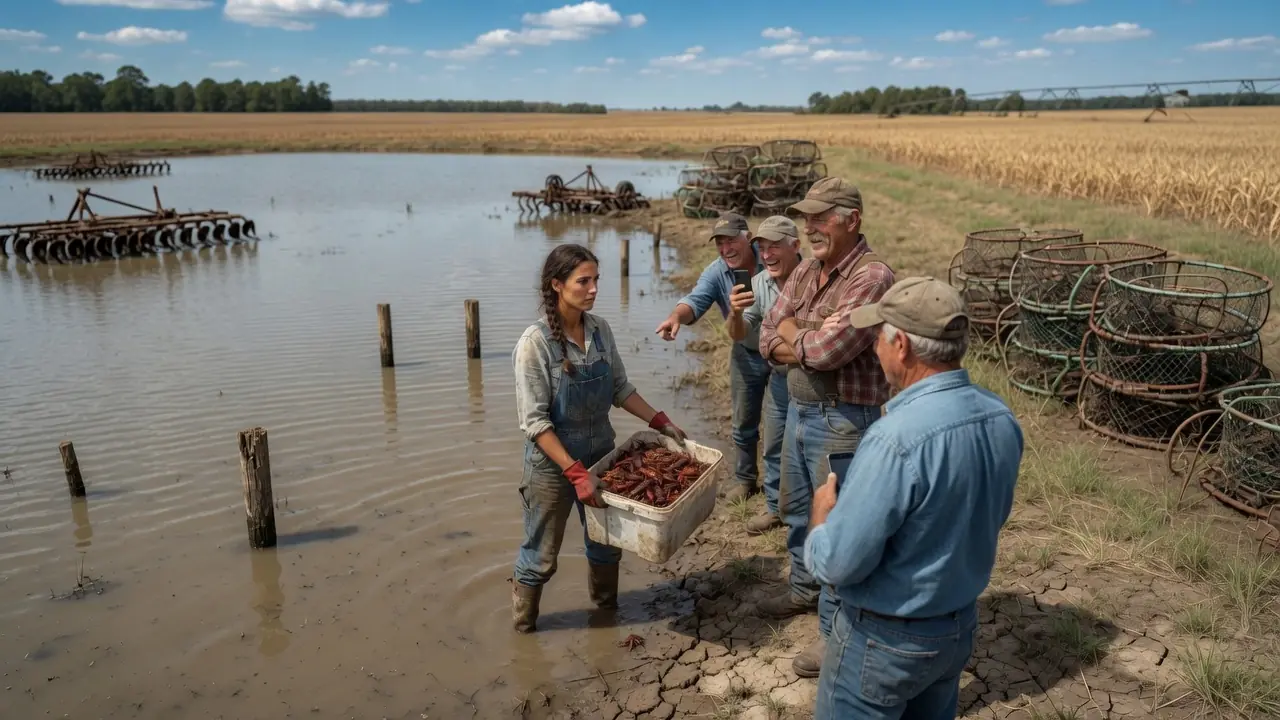
She stood at the edge of the abandoned pond in rubber boots and a faded green cap, guiding a black irrigation hose into the cracked basin. The July sun had already turned the air heavy, and sweat ran beneath the collar of her work shirt.
The pond had not held water in nearly twelve years.
Its bottom was split into hard plates of gray clay. Weeds grew through the deepest cracks. Along the far bank, a rusted pump leaned sideways beneath a stand of young willow trees.
To most people in Saint Landry Parish, the pond was proof of everything wrong with the property.
To Marie, it was the only part that still had a chance.
A horn sounded from the road.
Her nearest neighbor, Dale Broussard, raised a foam cup in greeting.
“You planning to grow fish in dust?”
The men around him laughed.
Marie adjusted the hose.
“Crawfish.”
That made them laugh harder.
Dale climbed down from his truck.
He was fifty-six, broad through the stomach, with a face darkened by decades of sun. His family had farmed rice and soybeans in the parish for three generations. He considered himself generous because he gave advice even when no one requested it.
“Crawfish need water, chère.”
“I noticed.”
“You paid to haul water into a pond that leaks.”
“I repaired the lowest section.”
“With what?”
“Bentonite clay.”
Dale looked toward the pale powder spread along the basin.
“That little bit won’t hold.”
“It doesn’t need to hold forever.”
“What does that mean?”
Marie pushed the hose deeper into the pond.
“It means I’m not explaining my whole plan from the road.”
One of the other men laughed.
“Maybe she’s keeping the bankruptcy strategy secret.”
Marie looked toward him.
“Maybe.”
She returned to work.
The men stayed another twenty minutes, watching the water form a shallow muddy pool across the cracked ground.
When they finally left, Dale called from his window.
“Your grandfather would’ve sold that land.”
Marie did not answer.
That was the one comment that reached her.
The farm had belonged to her grandfather, Louis Fontenot, for forty-seven years.
He had raised rice first.
Then soybeans.
Then cattle for a while.
Every change came after the previous one failed.
By the time Marie was a teenager, the soil had been planted too hard and rested too little. The southern fields flooded unevenly. The northern acres dried faster each year. Fertilizer costs rose while yields fell.
Louis borrowed against the property three times.
He refused to sell.
“This land fed us,” he always said. “You don’t leave family because they get sick.”
Marie loved him.
But even at sixteen, she understood that land was not family.
Land did not love you back.
It responded to what you did.
And sometimes it punished you for what other people had done long before you arrived.
Louis died in February after a brief illness.
Marie inherited fifty acres, a weathered farmhouse, two barns, one failing tractor, and almost one hundred eighty thousand dollars in debt.
She was twenty-three.
Her mother told her to sell.
The bank encouraged her to sell.
Dale Broussard offered to buy the southern thirty acres for half their assessed value.
“You’ll still have the house,” he told her. “And enough money to start somewhere else.”
Marie asked why he wanted land that everyone described as worthless.
Dale smiled.
“Sentimental reasons.”
The truth was simpler.
Dale knew a new drainage project planned by the parish would increase water access along the southern boundary within two years.
He also knew Marie did not yet know.
She found out while reading public meeting records at the library.
That was when she stopped asking neighbors for advice.
Marie had grown up on the farm but left after high school to study agricultural business at Louisiana State University.
She did not finish.
When Louis’s health declined, she returned home during her final year.
People remembered only that she dropped out.
They did not remember the coursework in soil science, farm accounting, wetland systems, and direct-to-consumer marketing.
They saw a young woman with muddy boots.
They did not see the notebooks stacked beside her bed.
The debt schedules.
The rainfall charts.
The soil maps.
Or the business plan she had rewritten eleven times.
Traditional row crops would not save the property.
The farm was too small to compete through volume and too damaged to produce premium yields immediately.
She needed a crop that used the land differently.
Crawfish farming had always existed in south Louisiana, often paired with rice. Flooded fields created habitat. Crawfish fed on decomposing plant material. Farmers trapped them during the cool months and drained the fields before planting again.
But Marie did not have enough money to convert all fifty acres.
She began with the abandoned pond and six surrounding acres.
Her grandfather had once used the pond to hold irrigation water. Years of neglect left the banks broken and the bottom compacted.
Most people saw an empty hole.
Marie saw a test plot.
She borrowed a small excavator from a former classmate’s uncle, repaired the lowest bank, resealed the worst section, and installed a secondhand pump.
She planted sorghum-sudangrass and millet around the basin.
When the plants matured, she cut them and left the material across the pond floor.
It looked messy.
That was deliberate.
Once flooded, the vegetation would decompose and feed the organisms crawfish ate.
The trucked water was expensive.
It was also only the beginning.
Marie planned to use it to saturate and test the repaired pond while waiting for late-summer rains.
If the basin held, she could use the nearby canal legally through a temporary agricultural withdrawal permit.
If it failed, she would lose six thousand dollars.
That was money she did not have.
By evening, the pond held eighteen inches of cloudy water.
Marie marked the level on a wooden stake.
At midnight, she returned with a flashlight.
The water had dropped less than an inch.
By morning, another half inch.
Some loss came from absorption.
Some from evaporation.
The repair was holding.
For the first time in months, Marie allowed herself to smile.
Then the pump failed.
It stopped three days later with a grinding sound and a burst of black smoke.
Marie stood beside it while oily steam rose from the housing.
She had spent nearly all her available cash on the pond preparation and water delivery.
A replacement pump would cost more than seven thousand dollars.
A repair might cost half that.
The local mechanic shook his head.
“This thing was old when your grandfather bought it.”
“Can it be fixed?”
“Anything can be fixed if you spend enough.”
“I don’t have enough.”
“Then no.”
Marie watched him drive away.
That afternoon, Dale appeared.
He walked around the dead pump and kicked one of the tires.
“Bad luck.”
“It’s a machine.”
“That means?”
“It isn’t luck.”
Dale looked toward the pond.
“You could stop before this gets worse.”
“I’m not stopping.”
“The water will be gone in a week.”
“Rain’s coming.”
He looked at the clear sky.
“You betting the farm on weather?”
“No.”
Marie wiped grease onto a rag.
“I’m betting it on people underestimating how much old equipment can be rebuilt.”
She removed the pump housing herself.
For two nights, she worked beneath a hanging shop light in the barn.
She watched repair videos.
Read the original manual.
Called three salvage yards.
The problem was not the engine.
It was the impeller assembly and a cracked seal.
A new manufacturer’s part cost more than she could pay.
A salvage yard in Lafayette had a similar agricultural pump from the same production line.
Marie drove there before dawn.
The replacement impeller did not fit perfectly.
She machined a spacer using equipment in a retired vocational teacher’s workshop.
He charged her forty dollars and a promise of five pounds of crawfish if the pond ever produced.
The pump restarted on the third attempt.
Water surged through the pipe.
Marie laughed so loudly that the mechanic in the neighboring property came outside to see what happened.
By September, rain had filled most of the pond.
Marie purchased her first broodstock from a crawfish farmer near Crowley.
Red swamp crawfish.
Hardy.
Fast-growing.
Well adapted to warm Louisiana wetlands.
The farmer, Mr. Landry, watched her examine the sacks.
“You’ve done this before?”
“No.”
“You read about it?”
“Yes.”
He smiled.
“Reading teaches you what should happen.”
“What teaches the rest?”
“Losing money.”
Marie looked at him.
“Any cheaper teacher?”
“No.”
She released the crawfish along the shallow edges.
They disappeared quickly into the muddy water.
For several days, nothing happened.
Then small burrows began appearing along the bank.
Marie counted them.
Marked areas with flags.
Checked water quality every morning.
She measured dissolved oxygen, temperature, and pH.
When the oxygen dropped too low after a hot week, she ran the pump at night to circulate water.
Dale watched from the road.
“So now you’re giving the pond air?”
“Yes.”
“Crawfish breathe better than some farmers I know.”
“I’m trying to keep them alive.”
“Same thing.”
By October, Marie expanded the project into two low-lying fields.
She could not flood them deeply, but crawfish did not need deep water.
They needed stable water, food, shelter, and timing.
She built low levees.
Repaired gates.
Installed inexpensive standpipes to control depth.
She planted rice in one section, not for maximum grain yield, but as habitat and forage.
People laughed again.
“You’re planting rice for bugs,” Dale said.
“Crustaceans.”
“That supposed to make it sound expensive?”
“It will when I sell them.”
The first cold front arrived in November.
Marie placed forty traps in the pond.
The next morning, she pulled them.
Three were empty.
Most held only small crawfish.
One trap contained two pounds of marketable size.
Not enough to sell.
But enough to prove the cycle had begun.
She returned them to the water.
Mr. Landry visited a week later.
He inspected the banks.
Checked the vegetation.
Lifted one trap.
“You overcrowded this corner.”
“I thought they’d spread.”
“They will. But food’s concentrating here.”
“What should I change?”
He pointed toward the water.
“Move half your traps. Add forage to the eastern side. And stop walking the bank like you’re waiting for bad news.”
Marie looked at him.
“I am waiting for bad news.”
“It comes whether you wait or not.”
He handed her the trap.
“Farmers who stare only at failure miss the crop growing beside it.”
December was dry.
Water levels dropped.
The repaired pump worked overtime.
Fuel costs ate through Marie’s remaining credit.
The bank sent another notice.
She had sixty days to bring the loan current.
Her mother visited the farmhouse and found bills spread across the kitchen table.
“Sell ten acres.”
“No.”
“Marie.”
“I have a harvest coming.”
“You hope you have a harvest.”
Marie looked toward the window.
The pond lay beyond the pecan trees.
“I have inventory.”
“Under muddy water.”
“Yes.”
Her mother sat across from her.
“You are allowed to walk away.”
“I know.”
“Your grandfather didn’t.”
“I’m not Grandpa.”
“Then prove it by knowing when to stop.”
Marie lowered her eyes.
For a moment, the confidence disappeared.
“I don’t know if this will work.”
Her mother reached across the table.
“That is the first honest thing you’ve said in weeks.”
Marie’s eyes filled.
“If I sell now, Dale gets the drainage access when it comes through.”
“Then sell to someone else.”
Her mother leaned back.
“You think he wants to assemble the whole section.”
“Yes.”
“And you’re keeping fifty acres out of the middle.”
“Yes.”
A slow understanding crossed her face.
“This isn’t only about crawfish.”
“No.”
“But the crawfish have to work.”
“They do.”
“How long?”
Marie looked at the payment notice.
“Eight weeks.”
Harvest season began in January.
The first commercial pull produced eighty-three pounds.
Marie expected more.
She sold them to a local seafood buyer at a low early-season price.
The check barely covered fuel.
Dale heard about the number before she returned home.
“Eighty-three pounds?”
He leaned against the counter at the feed store.
“You’re going to need a lot more mudbugs to save that farm.”
Marie purchased bait.
Said nothing.
The second week produced one hundred forty pounds.
The third produced two hundred ten.
Then temperatures dropped sharply.
Crawfish activity slowed.
Marie pulled nearly empty traps for six straight days.
The bank deadline approached.
She slept three hours a night.
Each morning began before four.
Bait traps.
Run the route.
Sort by size.
Clean equipment.
Deliver the catch.
Repair traps.
Record numbers.
Repeat.
Her hands cracked from cold water.
A hook tore through her left palm.
She wrapped it and kept working.
By February, warmer weather returned.
The pond changed overnight.
Trap after trap came up heavy.
Large red crawfish packed the wire baskets.
Marie filled crate after crate.
The six-acre test area produced more than she had projected.
But volume alone would not save her.
Wholesale prices were too low.
So she changed the business.
Instead of selling everything to one buyer, Marie called restaurants in Lafayette, Baton Rouge, and New Orleans.
Most rejected her.
She was too small.
Too new.
Unable to guarantee weekly volume.
Then she called Bayou Table, a farm-to-table restaurant in Lafayette run by chef Antoine Bellerose.
He asked one question.
“How fast after harvest can you deliver?”
“Two hours.”
“Alive?”
“Yes.”
“Size graded?”
“Yes.”
“Bring me fifty pounds tomorrow.”
Marie arrived with sixty.
Antoine opened a crate.
The crawfish were active, clean, and uniformly large.
He selected one.
Turned it in his hand.
“Where are you growing these?”
“Saint Landry Parish.”
“Rice field?”
“Pond and converted low ground.”
“What are they feeding on?”
“Natural forage. Millet, rice stubble, and decomposed vegetation.”
“No formulated feed?”
“Only supplemental bait in traps.”
Antoine looked impressed.
“How much can you supply?”
“Right now? Two hundred pounds a week.”
“You told me fifty.”
“I said right now.”
He smiled.
They agreed on a price nearly forty percent higher than wholesale.
In return, Marie guaranteed freshness, size grading, and direct delivery.
Antoine placed the farm’s name on the menu.
FONTENOT POND CRAWFISH.
Customers began asking about it.
A food writer from Baton Rouge visited the restaurant and published a short article about a twenty-three-year-old farmer reviving depleted land through crawfish aquaculture.
The story brought calls.
A seafood market wanted Saturday deliveries.
A brewery wanted live sacks for weekend boils.
A caterer offered a seasonal contract.
Marie did not accept every order.
She knew overpromising could destroy her faster than low prices.
She built a waiting list.
Raised prices slightly.
Required deposits.
For the first time, she stopped selling only a commodity.
She sold reliability.
Freshness.
A story.
And access to something local buyers could not always get directly.
Dale stopped laughing when refrigerated trucks began entering the property twice a week.
He came to the pond one morning in March.
Marie was lifting traps from a flat-bottomed boat.
Crates filled the platform behind her.
“How much did you pull?”
“Six hundred twenty pounds yesterday.”
“From this?”
“And the south field.”
Dale looked across the water.
The pond everyone had called dead now moved with small ripples beneath the morning light.
“You got lucky with the winter.”
Marie set down a full trap.
“I managed water through the dry season.”
“Still lucky.”
“I repaired the pump.”
“Market could’ve gone the other way.”
“I diversified buyers.”
Dale’s expression tightened.
“You always got an answer.”
“I had to.”
He watched her sort the catch.
“What are you clearing per pound?”
Marie smiled.
“That’s part of the plan I don’t explain from the road.”
By the end of the first season, Marie harvested nearly twenty thousand pounds of crawfish.
It was not enough to make her rich.
It was enough to make the overdue loan payment.
Enough to repair the tractor.
Enough to fund twelve more acres for the following year.
And enough to keep the farm.
The town changed its language.
The cracked pond became the crawfish pond.
The ruined south field became the wetland block.
Marie’s foolish experiment became an innovative rotation system.
People who once warned her to sell began asking when she planned to expand.
Dale made another offer.
This time, it was nearly double the first.
Marie declined without reading the final page.
“You haven’t heard the number,” he said.
“I saw it.”
“That land isn’t worth that much.”
“Then why offer it?”
He folded the contract.
“Development.”
“No.”
“Think about your future.”
“I am.”
“You want to work muddy traps forever?”
Marie looked toward the pond.
“No.”
Dale smiled as if he had found an opening.
She continued.
“I want to own the company that pays other people fairly to work them.”
His smile vanished.
The second season was harder.
Success brought expenses.
More traps.
More fuel.
Labor.
Insurance.
Transport.
A disease scare in a neighboring parish hurt demand.
Heavy rain breached one of Marie’s levees and released crawfish into a drainage ditch.
She lost thousands.
For three days, she worked with sandbags and pumps while people online joked that the famous crawfish girl had finally met reality.
Marie learned quickly that public admiration was as shallow as public ridicule.
Both disappeared when results changed.
She hired two workers.
One was Tommy Ledet, a nineteen-year-old who had dropped out of school to help his mother.
The other was Mrs. Evelyn Broussard, Dale’s older sister, who needed seasonal income after her husband died.
Dale objected.
Evelyn ignored him.
“She pays on Friday,” she said. “You give advice for free, and it’s worth less.”
Marie redesigned the damaged levees.
Added emergency overflow channels.
Installed water-level sensors connected to her phone.
She also began rotating sections more carefully.
Rice grew during part of the year.
Crawfish followed.
Then selected fields rested with cover crops.
The system improved soil structure.
Organic matter increased.
Birds returned.
Frogs appeared along the banks.
The farm did not become untouched wilderness.
It became productive land that worked with water instead of pretending water was the enemy.
Louis had spent decades trying to drain every wet acre.
Marie learned which acres wanted to remain wet.
During the third season, the parish drainage project was completed.
Water access improved along the southern boundary.
Dale expected Marie to expand immediately.
She did not.
Instead, she negotiated a cooperative agreement with four smaller farms.
She provided broodstock, technical guidance, and shared cold-storage access.
They agreed to follow quality standards and sell part of their harvest through Fontenot Aquaculture.
Some people accused her of creating competition for herself.
Marie understood the opposite.
Restaurants wanted larger, stable orders.
She could not supply them alone.
The cooperative made everyone stronger.
Mr. Landry attended the first meeting.
He sat near the back while Marie explained water management, stocking density, harvest timing, and buyer contracts.
Afterward, he approached.
“You sound like you know what you’re doing.”
“Reading helped.”
“What taught the rest?”
Marie smiled.
“Losing money.”
He laughed.
The cooperative’s first major contract came from a regional grocery chain.
The buyer wanted fifty thousand pounds over the season.
Three years earlier, Marie had celebrated eighty-three.
Now she negotiated delivery windows, grading standards, and fuel adjustments.
She refused the buyer’s first price.
The man leaned back.
“There are plenty of farms.”
“Then call them.”
“You’re young.”
“The crawfish don’t know.”
He smiled.
They agreed at her number.
The farm grew beyond crawfish.
Marie restored one barn as a packing facility.
She added a certified kitchen where local workers produced crawfish pies, étouffée base, and frozen tail meat.
She partnered with a nearby high school’s agricultural program.
Students visited to learn water testing, equipment maintenance, bookkeeping, and direct marketing.
The farm hired twelve people year-round and more than thirty during peak harvest.
Tommy completed his equivalency diploma and became operations manager.
Evelyn managed quality control with a level of strictness that frightened buyers and employees equally.
Dale watched all of it from the neighboring road.
He stopped offering advice.
Then a drought struck.
It was the worst in nearly twenty years.
Canals dropped.
Water restrictions tightened.
Several crawfish operations reduced acreage.
Some lost entire ponds.
Marie’s farm survived because she had spent three seasons improving water retention, repairing levees, and creating deeper refuge channels.
But survival was expensive.
She reduced harvest.
Prioritized broodstock.
Suspended several contracts rather than deliver weak product.
The grocery chain threatened penalties.
Marie showed them the force-majeure terms she had insisted on adding.
The buyer called her difficult.
She accepted the description.
During the driest month, Dale came to her office.
He removed his cap.
Marie had never seen him do that indoors.
“My well’s failing.”
She waited.
“I’ve got twenty acres of young rice.”
“I know.”
“If I lose it, I lose the operating loan.”
Marie looked at him.
The man who once offered half value for her land now stood asking for water.
Her southern reservoir had enough capacity to help.
But not without risk.
“How much do you need?”
Dale told her.
Marie calculated silently.
“I can release half that for three days.”
“That won’t be enough.”
“It may keep the roots alive until the parish allocation arrives.”
He looked toward the window.
“You going to charge me?”
“Yes.”
His jaw tightened.
“Market rate?”
“No.”
He looked back.
“Why?”
“Because I’m not giving it away, and I’m not using your emergency to own part of your farm.”
Dale’s face changed.
She slid an agreement across the desk.
“Fuel cost, labor, and replacement volume. Nothing else.”
He read it.
“You could’ve taken ten acres.”
“Yes.”
“Why didn’t you?”
Marie looked toward the old pond.
“Because I remember what it feels like when someone mistakes desperation for opportunity.”
Dale signed.
His rice survived.
He did not become Marie’s closest friend.
Real change was rarely that neat.
But he stopped laughing.
More importantly, he stopped allowing others to laugh in front of him.
Five years after the first water truck arrived, Fontenot Farm hosted its annual spring boil.
Long tables stretched beneath strings of lights.
Workers, restaurant owners, farmers, students, and neighbors filled the yard.
Children ran between the pecan trees.
Steam rose from enormous metal pots.
The abandoned pond reflected the evening sky.
Marie’s mother stood beside her near the barn.
“You could sell now for ten times what Dale first offered.”
“Probably more.”
“Would you?”
Marie looked across the farm.
At Tommy directing deliveries.
At Evelyn arguing with a chef about proper sorting.
At students testing water beside the south field.
“No.”
Her mother smiled.
“Sentimental reasons?”
Marie laughed.
“Business reasons.”
A black truck stopped near the road.
Dale stepped out carrying a sack of onions.
He approached the boil table.
“Where do you want these?”
Evelyn pointed.
“Kitchen.”
He began walking.
Then turned toward Marie.
“Your grandfather would’ve been proud.”
Marie looked at the pond.
“I think he would’ve argued with me for two years first.”
Dale smiled.
“That too.”
The story of Fontenot Farm spread beyond the parish.
Newspapers described Marie as the young woman who turned dead land into a crawfish empire.
She disliked the word empire.
The farm was profitable.
Growing.
Respected.
But it remained vulnerable to weather, fuel, disease, and markets.
There were no magical harvests.
No single season that erased every risk.
The success came from hundreds of ordinary decisions made before sunrise.
Testing water.
Repairing pumps.
Refusing bad contracts.
Saving broodstock.
Listening to experienced farmers without surrendering her own judgment.
Knowing when to expand.
And when not to.
Years later, Marie stood beside the original pond with a group of agricultural students.
One pointed toward the water.
“Is it true people laughed when you filled this?”
“Yes.”
“Did you know it would work?”
“No.”
The students looked surprised.
Marie picked up a trap.
“I knew the land could not survive doing the same thing.”
“That’s different.”
“It’s the most important difference.”
She pulled the trap from the water.
Crawfish crowded inside, red claws moving against the wire.
“People tell the story like I had one brilliant idea and everyone else was wrong.”
She placed the trap on the boat.
“The truth is, they were right about many things.”
The students waited.
“The pond leaked. The pump failed. I was underfunded. The first harvest was too small. I nearly lost the farm.”
“Then why keep going?”
Marie looked toward the fields.
“Because a bad first result does not always mean a bad direction.”
She opened the trap.
“And because I changed the plan whenever the land taught me something.”
The abandoned pond never became beautiful in the polished way magazines preferred.
Its banks remained muddy.
The water stayed dark.
Mosquitoes gathered in summer.
Boots sank near the shallows.
But each season, the pond produced life from land people had dismissed as exhausted.
That was enough.
The neighbors had laughed because Marie filled a dry pond with crawfish.
They believed success belonged to the crops they already understood.
They thought the land had failed because it refused to keep producing the same way.
Marie saw something else.
The farm was not dead.
It was tired of being asked the wrong question.
She stopped asking how to force another crop from cracked ground.
She asked what the water, clay, climate, and market could support together.
The answer had claws.
And by the time everyone else understood it, Fontenot Farm was no longer the property they wanted her to sell.
It was the model they wanted to copy.