When Nola Vero texted me, “I’m staying at my friend’s place for a week,” I stared at the message for almost a full minute before I replied. The old version of me would have asked why, called her immediately, or begged for an explanation like a husband afraid of losing his marriage. But that version of me had already been quietly buried under six months of lies, late nights, locked screens, and smiles she no longer gave to me. So I typed one word back and pressed send: “Alright.”
My name is Asher Trevan, and for most of my adult life, people have paid me to solve problems before they become disasters. I manage logistics for companies that cannot afford mistakes, which means I notice delays, patterns, missing pieces, and lies hidden inside routines. Maybe that is why it bothered me so much that I had missed the slow collapse of my own marriage. Nola had not disappeared overnight; she had simply learned how to leave me while still standing in our kitchen.
We had been married eight years, and from the outside, we looked like the kind of couple people envied. We had the house in Riverside Estates, the black cars in the driveway, the charity dinners, the business friends, and the polished photographs where Nola always leaned into me like we were still in love. She worked public relations for Meridian Corp., the largest development firm in the state, and she knew how to make anything look beautiful from the right angle. What I did not understand then was that she had been applying the same skill to our marriage.
The first change was her phone. It used to sit on the coffee table, on the kitchen counter, on the bed, forgotten and ordinary. Then it became part of her hand, locked, turned face down, carried to the bathroom, and tucked under her pillow at night like it contained state secrets. When I asked about it, she smiled and said work was intense, but her smile never reached her eyes anymore.
The second change was her laughter. Nola had a laugh people remembered, bright, musical, perfectly timed, the kind of laugh that made powerful men feel clever. I had not heard it directed at me in months, not really. Then one evening, I came home early and heard that laugh floating from the kitchen before I even opened the door. She was leaning against the marble counter with her phone pressed to her ear, twirling her hair around her finger while saying, “Owen, stop, I can’t wait for this weekend either.”
Owen Rusk was her boss, a divorced developer with expensive suits, a permanent tan, and the kind of confidence that comes from rarely being told no. I had met him twice, and both times he had shaken my hand as if he was deciding what I was worth. When Nola saw me in the doorway, her face flickered through surprise, guilt, and then irritation, as if I had interrupted something that belonged to her. She ended the call quickly and told me it was a work conversation.
“The penthouse sounded nice,” I said, setting my briefcase on the island.
Her jaw tightened so slightly most people would have missed it. “It’s for a client meeting, Asher,” she said. “Business does not stop because it is the weekend.” I nodded because I knew better than to argue before I had evidence. In my line of work, you do not confront a failing system until you understand exactly where it is breaking.
After that, I stopped being a husband trying to save a feeling and became a man studying a pattern. Nola’s late meetings always lined up with Owen’s travel schedule. Her sudden weekend obligations were always vague, always urgent, and always impossible for me to verify without looking jealous. She bought new dresses I never saw her wear at home, perfume she claimed was for events, and lingerie she left hidden at the back of a drawer she thought I never opened.
The confirmation came from Cleo Martinez, Nola’s best friend and coworker, at a company holiday party. Cleo had too much wine and told me she admired how “modern” Nola and I were about the arrangement. When I asked what arrangement she meant, her face went pale, but alcohol had already loosened the truth. She said Nola had told people I was fine with her spending weekends at Owen’s penthouse for “strategic planning sessions.”
I remember standing near the bar with a glass in my hand, feeling something cold settle in my chest. It was not shock exactly, because part of me had already known. It was the terrible relief of having a name for the thing that had been poisoning my house. Nola was across the room at that moment, laughing beside Owen, touching his arm with careful casualness, and pretending the whole world was too stupid to notice.
“Maya is having a really hard time,” she said, folding a red dress into the suitcase. “Her divorce is getting ugly, and she asked if I could stay with her for a week.”
“A whole week?” I asked.
“She needs support,” Nola replied, without meeting my eyes. “I might be gone through Monday or Tuesday, depending on how she feels.” I looked at the red dress, the expensive heels, the black overnight bag, and the perfume she only wore when she wanted to be remembered. Then I looked at my wife and said, “Of course. Take all the time you need.”
She kissed my cheek before leaving, light and empty, like checking a box. “You’re the best husband a girl could ask for,” she said.
“I try to be,” I answered.
After her car disappeared down the street, I stood in the silent foyer and waited until the sound of her engine was gone completely. Then I picked up my phone and made three calls. The first was to Gavin Pierce, my divorce attorney, who had already drafted everything and only needed the final address for service. The second was to a process server named Rodriguez, who specialized in uncomfortable deliveries. The third was to Jake Morrison, the closest thing I had to a brother, and I told him to meet me at Harbor View Towers the next morning.
Saturday was cold, gray, and perfect for endings. Jake stood beside me outside the building with two coffees and the expression of a man who knew enough not to ask too many questions. “You sure she’s up there?” he asked. I showed him the parking garage photo I had taken an hour earlier, Nola’s car tucked in Owen Rusk’s private section. Jake looked at it, looked at me, and simply said, “Then let’s go.”
The elevator ride to the twentieth floor was silent except for the soft hum of machinery. Rodriguez held the envelope under one arm and kept glancing at me like he was afraid I might explode before we reached the door. I did not feel explosive. I felt clear. There is a strange calm that arrives when heartbreak has finally finished turning into decision.
Owen’s penthouse took up the entire top floor. Smooth jazz played faintly from inside, the kind of music rich men use to make bad choices feel elegant. Rodriguez knocked, and the music stopped almost immediately. A few seconds later, Owen opened the door wearing a silk robe and an expression that died the moment he saw me behind the process server.
“Asher,” he said, his voice cracking around my name.
Rodriguez looked at his clipboard. “Owen Rusk?”
“Yes, but what is this?”
“These papers are for Nola Vero,” Rodriguez said. “I was told she would be here.”
Owen stepped halfway into the doorway, trying to block the view behind him. “You have the wrong address,” he said, but his face had already betrayed him. Then Nola’s voice floated from inside the penthouse, soft and irritated. “Owen, who is it?” I did not raise my voice much, because I did not need to. “It’s your husband,” I called. “And I brought your divorce papers.”
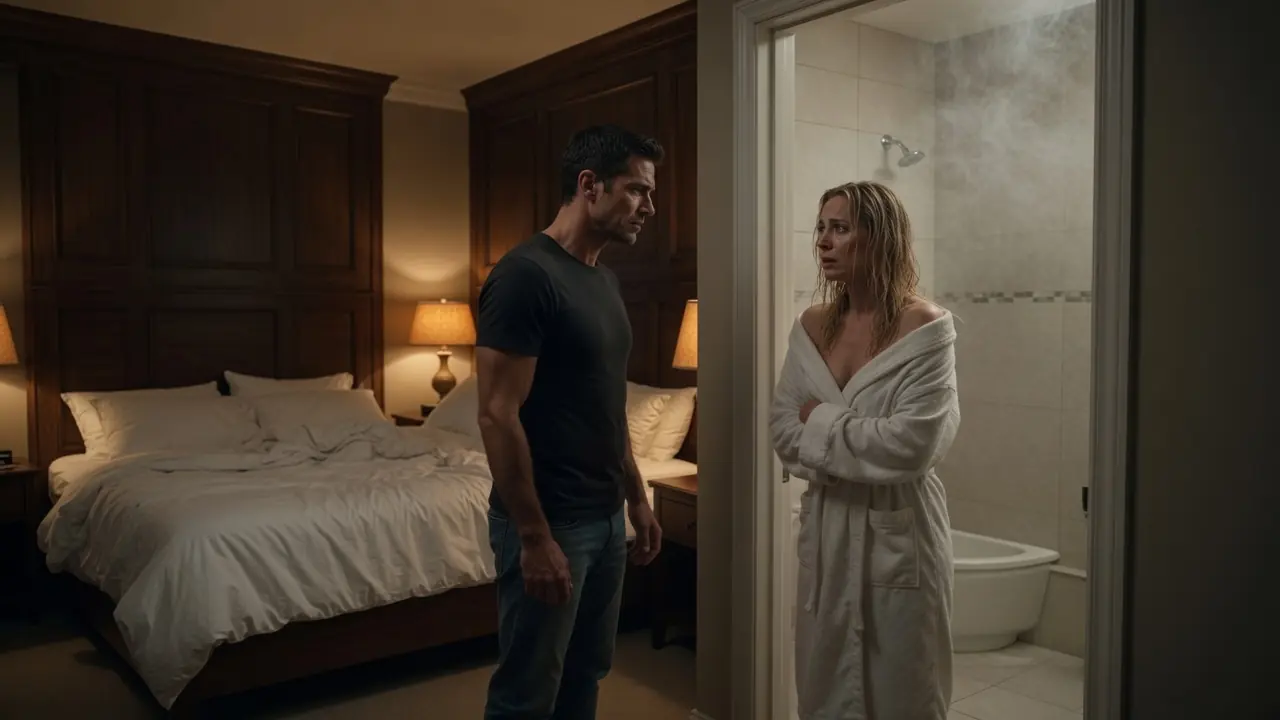
The silence after that was almost beautiful. No music, no footsteps, no pretending, just the sound of two people realizing the door they had hidden behind was open. Then I heard movement, hurried and frantic, and Nola appeared behind Owen wearing one of his white shirts and nothing else visible below it. Her hair was messy, her makeup faded, and her face was a mixture of horror, rage, and disbelief.
“Asher,” she whispered. “What are you doing here?”
“Delivering your mail,” I said.
Rodriguez handed her the envelope with professional boredom. “Nola Vero, you have been served.”
She took it with shaking hands and looked down as if the words might change if she stared hard enough. “You can’t do this,” she said.
“I can,” I replied. “And I did.”
Owen tried to recover his dignity by stepping forward, but the robe ruined most of the effect. “Now look here, Asher,” he began.
“No,” I said, and my voice cut the hallway clean. “You look. Both of you. This is what happens when you mistake silence for stupidity. I knew about the penthouse, the weekends, the red dress, the lies about Maya, and the way you both smiled in my face while you treated my marriage like a joke.”
Nola’s eyes filled with tears, but I knew her tears too well to trust them. She cried when things got ugly, not always when she felt sorry. “Please,” she said. “It wasn’t supposed to happen like this.”
I looked at her standing in another man’s doorway and almost laughed. “That is the first honest thing you’ve said in months. You never cared that it happened. You only cared that I found out.”
Owen’s face reddened. “This is a private matter.”
“You made it public the moment you brought my wife into your office, your events, your hotel rooms, and your bed,” I said. “You just forgot I was the kind of man who documents everything.”
Nola flinched at that word. “Documents?”
I reached into my coat pocket and pulled out a small folded list. “Dates, locations, account activity, phone records, witness statements, photographs, emails, and enough patterns to make your lawyer hate the day you met Owen Rusk.” Her mouth opened, but nothing came out. “You wanted to spend a week at your friend’s place,” I said. “So I made sure you could stay somewhere else permanently.”
Her anger finally broke through the fear. “You’re cruel.”
“No,” I said. “Cruel is lying beside someone at night while planning your next weekend with another man. Cruel is kissing your husband goodbye while your lover waits upstairs. Cruel is making me look like the fool in a marriage I was still trying to respect.”
Jake stood quietly behind me, but I saw his jaw tighten. Rodriguez had already stepped back toward the elevator, satisfied that his part of the job was done. Owen looked from me to Nola, then back to me, trying to calculate how much damage this could do to him. For the first time since I had known him, he looked like a man who was not controlling the room.
“You will find the locks changed by noon,” I said to Nola. “Your personal belongings will be packed and delivered to whatever address your attorney provides. The joint accounts are frozen pending legal division, and the car you drove here will be returned because I am no longer paying for transportation to your affair.”
She stared at me as if I had slapped her without lifting a hand. “You planned all of this.”
“Yes,” I said. “Carefully.”
“You wanted to hurt me.”
“No,” I replied. “I wanted to stop being hurt by you.”
That landed harder than the anger. For one second, something like shame crossed her face, but it vanished quickly under panic. “Asher, please, we can talk about this. We can handle it quietly.”
I looked past her into the penthouse, at the expensive furniture, the half-empty wine glasses, the black heels by the sofa, and the little red dress hanging over the back of a chair. “You had six months to talk,” I said. “You used that time to lie.”
Owen lowered his voice. “Think carefully before you make this ugly. People in this city know me.”
I smiled then, not because I was happy, but because he still did not understand the situation. “That is exactly the point, Owen. People know you. Investors know you. Your board knows you. Your employees know Nola reports to you, and by Monday morning, they will know just how closely you two have been working.”
Nola whispered his name, suddenly more afraid for him than for our marriage. That told me everything I needed to know. Even at the edge of disaster, her first instinct was to protect the man who had helped her destroy us. I felt the last thread of attachment snap so quietly that only I heard it.
I stepped toward the elevator. “Enjoy the rest of your week at Maya’s.”
The doors opened, and Jake followed me inside. Just before they closed, I saw Nola clutching the divorce papers in Owen’s doorway, with Owen standing behind her like a man watching a building collapse from the top floor. The elevator began to descend, and Jake exhaled slowly. “I have seen bar fights less brutal than that.”
“I did not touch either of them,” I said.
“No,” Jake replied. “You did worse. You made them look at themselves.”
By Monday morning, Hartford Heights was already whispering. Nola’s first move was predictable: she tried to control the story before the truth could. She posted careful little messages about betrayal, cruelty, and learning who people really are during hard times. Friends who knew nothing commented with hearts and outrage, telling her she was strong and deserved peace.
I saved every post. I saved every comment. Then I sent everything to Gavin, who responded with a message that read, “She is building our case for us.” That was the problem with people like Nola: they were so skilled at shaping public perception that they forgot facts still existed.
On Tuesday, she came to my office dressed like a woman entering battle. Her navy suit was perfect, her makeup flawless, and her eyes sharp enough to cut through glass. She walked past my assistant without waiting and sat across from my desk as if she still had the right to demand my attention. “We need to talk,” she said.
“I thought that was what lawyers were for.”
“Do not be cute, Asher.”
“I stopped being cute when I found you in your boss’s penthouse.”
Her face tightened, but she kept her voice low. “This does not have to ruin both our lives. We can settle quietly, split things fairly, sign non-disclosure agreements, and move on.”
“By fairly, you mean I stay silent while you keep the reputation you used to lie to everyone.”
“I mean we act like adults,” she snapped.
“No,” I said. “Adults tell the truth before they get caught.”
She leaned forward, and for a moment I saw the woman who had once convinced rooms full of executives to believe impossible things. “Owen is worried about publicity. Meridian is already asking questions. If this gets bigger, people could lose their jobs.”
“That is interesting,” I said. “You were not worried about jobs when you started sleeping with the CEO.”
Her eyes flashed. “You do not get to reduce what happened to one ugly sentence.”
“I can reduce it to four,” I said. “You cheated with Owen.”
She looked away, and that small movement was more honest than anything she had said. “I was unhappy.”
“So was I,” I replied. “I did not crawl into someone else’s bed and call it self-discovery.”
For the first time, her confidence cracked. “You are enjoying this.”
“No,” I said, standing. “I am surviving it. There is a difference, and it says a lot about you that you cannot tell.”
When she left my office, she told me I would regret refusing her offer. I believed she meant it, but I also knew panic had started making her careless. Within days, Meridian opened an internal investigation into her relationship with Owen. I did not need to fabricate anything because the truth had more teeth than any lie I could invent.
Cleo eventually called me, her voice trembling with guilt and fear. She admitted that Nola had told her the affair was serious, that Owen had promised a future, and that Nola believed I would never find out because I was “too focused on work.” Cleo had recorded part of the conversation after Nola asked her to lie and say she had been staying at Maya’s house. When Gavin heard the recording, he called it a gift wrapped in arrogance.
Owen tried to distance himself first. Men like him always do when consequences get expensive. He told the board that Nola had misunderstood their relationship, that she had become emotionally attached during a difficult marriage, and that he had been trying to guide her professionally. Nola heard about it from Cleo and called me screaming, as if I were responsible for Owen betraying her too.
“That is the thing about men who cheat with married women,” I told her. “They are usually not famous for loyalty.”
She went silent, and for the first time, I heard something in her breathing that sounded like fear rather than anger. Owen had sold her a fantasy, and now he was trying to return it before the bill arrived. The man she had risked everything for was already calculating how to save himself. It might have been satisfying if it had not also been pathetic.
The divorce moved quickly after that. Nola’s attorney came in aggressive, accusing me of emotional cruelty and financial control, but Gavin answered with documents, timelines, bank records, travel receipts, witness statements, and evidence of hidden income Nola had never disclosed. Every accusation she made required a door to be opened, and behind every door was another truth she did not want seen. By the second hearing, her side stopped performing outrage and started asking about settlement.
Owen’s problems became worse. Meridian suspended him after investors demanded an explanation for undisclosed relationships with employees. Former staff began talking, old complaints resurfaced, and the image he had polished for years started peeling away in public. He had wanted Nola as proof of his power, but in the end, their affair exposed how carelessly he had used it.
Nola moved into a corporate apartment on the edge of town. The red dress disappeared from her social media, along with the wounded posts and brave captions. She looked smaller when I saw her at mediation, not physically, but in the way people look when they realize the story they told themselves cannot survive contact with reality. She avoided my eyes until the final papers were placed on the table.
“I loved you once,” she said quietly while the lawyers reviewed the documents.
“I know,” I answered.
“I lost myself.”
“No,” I said. “You chose yourself. You just did not like what that choice revealed.”
She cried then, softly and without performance, and I almost felt sorry for her. Almost. But pity is not the same as forgiveness, and sadness is not the same as trust. Some bridges burn so completely that even memory cannot cross them safely.
The house sold in spring. I watched strangers walk through the rooms where I had once tried to build a life with Nola, and I felt less grief than I expected. The bedroom no longer looked like a place where betrayal had begun or ended. It was just a room, walls and windows and floorboards, waiting for people who did not know our ghosts.
On the day I moved out, Jake helped me load the last boxes into a rented truck. He asked where I was going first, and I told him I had rented a small place near the water for a few months. I wanted quiet mornings, honest air, and rooms that did not remember being lied in. Jake nodded like that made perfect sense.
That evening, I stood alone on the porch before locking the front door for the last time. The neighborhood was calm, the lawns trimmed, the windows glowing, all those perfect houses holding imperfect lives inside them. For years, I had believed peace meant keeping the picture steady no matter what was happening behind it. Now I understood that peace begins the moment you stop protecting a lie.
Nola texted me once after the divorce was final. “I hope one day you understand I never meant to hurt you this badly.” I read it twice, not because it moved me, but because it sounded exactly like her. Even in apology, she was measuring the damage by what she had intended, not what she had done.
I typed a reply, then deleted it. There was nothing left to explain. Some people mistake silence for weakness, but sometimes silence is simply the sound of a door closing forever. I put the phone down, poured a cup of coffee, and watched the morning light spread over the water outside my new window.
For the first time in months, no one was lying to me. No phone buzzed with half-truths. No one stood in a doorway clutching a robe and begging me to misunderstand what I had seen with my own eyes. There was only quiet, and for once, quiet did not feel like planning.
It felt like freedom.