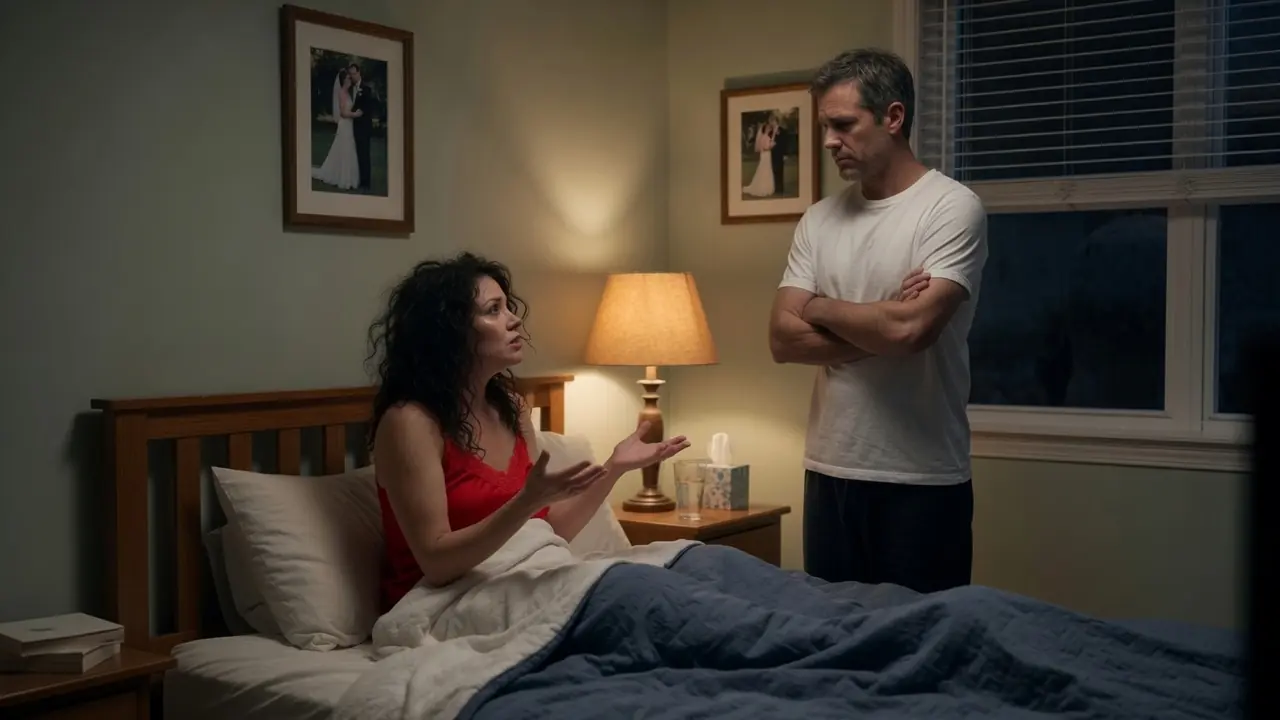
Rachel was sitting upright in bed when she said the words that ended my marriage. The bedside lamp was still on, throwing soft light across the pale green walls, the rumpled white pillows, the dark blue blanket twisted between us like a line neither of us could cross. Her dark curls were messy, her makeup was smudged at the edges, and she had one hand raised like she was arguing a case in front of a judge. I stood beside the bed in a white T-shirt and pajama pants, arms folded, too tired to shout and too awake to pretend I did not already know something was wrong.
It was 3:17 in the morning. I knew the exact time because I had been sitting downstairs watching the doorbell camera on my phone, waiting for her headlights to sweep across the driveway again. She had pulled in quietly, sat in her car for almost five minutes, then walked up to the house carrying her heels in one hand. When she came inside and found me sitting in the living room, she jumped like a person caught doing something she had already rehearsed denying.
“Where were you?” I asked. My voice was calm, but only because anger had burned itself out somewhere between midnight and 2:00 a.m. Rachel rolled her eyes and walked past me toward the stairs without answering. I followed her to the bedroom because something in me knew that if I let the question die that night, I would lose more than an argument.
For four months, her late nights had become part of the house. Client dinners, networking events, emergency meetings, conferences that appeared at the last minute, work calls that somehow stretched until after midnight. She worked in pharmaceutical sales, so at first I tried to be reasonable. I told myself that her job involved dinners, drinks, doctors, clients, long conversations, and people pretending business was more urgent after dark.
But the pattern changed. Three nights a week became four. Weekend errands became overnight stays near conference hotels. Her perfume changed before she left and her stories changed when she came home, always vague, always impatient, always shaped like an answer designed to punish me for asking.
I was not a jealous husband by nature. I had never checked her purse, never followed her, never demanded her passwords, never treated marriage like a prison. I asked normal questions because I thought normal couples still owed each other basic truth. When the person you sleep beside disappears until three in the morning, “Where were you?” is not control. It is the smallest possible request for respect.
Rachel did not see it that way, or at least she pretended not to. That night, as she sat on the bed with the blanket around her waist, she looked at me like I was the problem. “I don’t have to tell you where I’ve been, Nathan,” she said. “I’m a grown woman.”
“You’re right,” I said. Rachel blinked, clearly expecting shouting, not agreement. “You don’t have to tell me anything anymore.” She narrowed her eyes. “What is that supposed to mean?” I looked at her for a long moment and felt something inside me go cold and still.
“It means tomorrow, this house starts respecting the freedom you keep demanding,” I said. She scoffed and looked away, as if my calmness bored her. “Whatever, Nathan. I’m showering.” She climbed out of bed, grabbed clothes from the chair, and went into the bathroom without another word.
I stood in that bedroom after the bathroom door closed, listening to the water run. For seven years, I had been married to Rachel Coleman. We had bought furniture together, planned holidays together, put off having children together because careers came first and timing was never right. But in that moment, I understood that she had not been asking for freedom. She had been daring me to accept how little I mattered.
The next morning, Rachel left for work wearing a clean suit and the expression of someone who believed last night’s argument had already been filed away. She kissed the air near my cheek, not my face, and told me she would be late again because of a client dinner. I said, “No problem. Take your time.” She looked briefly suspicious, then walked out.
After she left, I called a locksmith. Not the neighborhood guy who rekeys apartment doors, but a security specialist who handled commercial locks. I asked for a Grade 1 deadbolt with a restricted keyway, the kind where copies could not be made at a hardware store by someone smiling and pretending they had permission. He came that afternoon, measured the front door, and installed a lock that looked ordinary but felt final.
While he worked, I moved Rachel’s personal belongings into the garage. I did not throw anything away. I did not break anything, cut anything, hide anything, or perform some dramatic revenge scene like people imagine when emotions get ugly. I folded clothes into boxes, wrapped cosmetics in towels, packed her books, framed photos, coffee mugs, shoes, work bags, and jewelry case with the patience of a man preparing evidence instead of revenge.
Then I wrote the note. Grown women find their own place to live. Your belongings are in the garage. You have thirty days to collect everything. I printed it, laminated it, and taped it inside the storm door at eye level.
That night Rachel texted around 10:04 p.m. Client dinner running late. Don’t wait up. I replied, No problem. Take your time. I was already in bed when she came home at 2:47 a.m., but I watched the doorbell camera on my phone.
She tried her key once. Then again. Then harder, like the lock might give up if she made enough noise. I watched confusion turn into irritation, then irritation into anger, and then anger into panic when she saw the note. She rang the bell, knocked, then pounded on the door with the side of her fist.
“Nathan, open the door!” she shouted. I did not move. My phone lit up with her call, then another, then another. Outside, she yelled that it was freezing, though the temperature was in the low fifties, and I wondered how many times she had exaggerated the truth simply because she expected me to accept the emotion over the facts.
After twenty minutes, she called her sister Teresa. Through the camera, I heard broken pieces of the conversation. Changed the locks. Won’t answer. I don’t know why. Can I stay with you? When she finally left, the house went quiet in a way I had not felt in months.
I slept badly, but I slept. By morning, my phone had over a hundred texts, dozens of missed calls, and voicemails that shifted from fury to negotiation to insult to apology and back again. Rachel’s first message called me insane. Her fifth said we needed to talk. By sunrise, she was threatening lawyers. By breakfast, she was asking whether we could just calm down.
At 8:30 a.m., she arrived with Teresa and two men I did not recognize. She tried the key again, which told me more about her than she probably meant it to. When it failed, she rang the doorbell and stood there with her jaw tight, trying to look wronged instead of exposed. I answered through the intercom.
“Your things are in the garage,” I said. “Code is 0909.” Rachel stepped closer to the camera. “Open the door, Nathan. We need to talk.” I looked at her face on the screen and felt nothing that resembled surrender. “No, we don’t. You made it clear you don’t need to explain anything to me, and I’m respecting that boundary.”
Teresa leaned into view, already offended on her sister’s behalf. “Nathan, this is ridiculous. You can’t just kick your wife out over one argument.” I kept my voice even. “I’m not kicking her out. I’m acknowledging that she is a grown woman who does not need to answer to me.” Rachel’s eyes flashed. “This is my house too.”
“The deed says otherwise,” I replied. That part mattered. I had bought the house before the marriage, kept the mortgage payments separate, and never added her name to the deed. At the time, it had felt like paperwork. Later, it felt like the only accidental wisdom I had ever possessed.
They spent two hours moving her belongings from the garage. Rachel made sure to slam boxes into the back of Teresa’s SUV loudly enough for the neighbors to notice. I watched from inside, not hiding, not interfering, just documenting. That was the first morning I understood how useful calm can be when someone else expects chaos.
By noon, her lawyer called me. The woman introduced herself with the polished tone of someone trying to sound powerful before asking questions she already knew might be inconvenient. She claimed I had illegally denied Rachel access to the marital home. I told her the property was purchased before marriage, the deed was in my name, the mortgage was paid from my separate account, and Rachel had removed her belongings with witnesses present.
The lawyer warned me that things would escalate. I told her to file whatever she needed to file. Then I hired my own lawyer, Gregory Miles, a blunt man with silver hair, expensive glasses, and the personality of a locked filing cabinet. When I explained the situation, he did not cheer or scold me. He only asked for documents.
Within days, Rachel filed for divorce and requested exclusive use of the home. Gregory read the motion, removed his glasses, and said, “This is ambitious.” That was his polite way of saying desperate. He told me the house issue would likely fail, but he also told me to prepare for Rachel to rewrite the story. People who lose control often try to win sympathy instead.
That was when I hired a private investigator. Not to chase her, not to punish her, and not because I needed emotional confirmation of what I already suspected. Gregory wanted documentation of her current living situation for the court. If Rachel claimed I made her homeless, we needed to know where she was actually staying.
The investigator’s report arrived nine days later. Rachel was not staying with Teresa. She was living in a downtown penthouse owned by Harrison Garrett, one of her pharmaceutical clients. The photos were painfully clear: Rachel entering the building at night, Rachel on the balcony in the morning with coffee, Rachel’s garment bags being carried upstairs, Rachel kissing a man who was definitely not a client in the way she had described.
Harrison Garrett was married. His wife, Ellen, was out of state caring for her sick mother, which explained the sudden availability of the penthouse. My wife, who had told me she was grown and owed no answers, had been building a second life in another woman’s home. When Gregory saw the report, he leaned back in his chair and said, “That will help the narrative.”
The hearing about the house came quickly. Rachel arrived in court wearing a navy designer suit I had never seen before and the expression of someone who had practiced looking wounded in a mirror. Her lawyer argued that I had locked her out with no warning and created instability. Gregory responded with property documents, the doorbell footage, her text messages, and evidence that she had moved into Harrison Garrett’s residence almost immediately.
The judge asked Rachel where she went the night I changed the lock. She said her sister’s house. Then the judge asked where she was staying now. Rachel hesitated, and that hesitation was the loudest truth in the room.
Gregory stood and presented the investigator’s documentation. Rachel’s lawyer objected. The judge overruled. When the judge asked if she was staying with Harrison Garrett, Rachel said it was temporary. The judge asked again, and finally Rachel said yes.
Her motion was denied. She had suitable housing, no ownership claim to my property, and no immediate legal basis to remove me from a house I had purchased before marriage. Rachel walked past me after the hearing with tears in her eyes, but they were not the kind of tears that ask forgiveness. They were the kind that ask why the consequences have arrived so soon.
After court, she escalated in smaller, meaner ways. She used old saved credit card numbers for streaming services, wine deliveries, meal subscriptions, and random purchases just annoying enough to steal my time. I canceled cards, reported charges, changed passwords, and learned that betrayal does not always arrive as one dramatic blow. Sometimes it becomes a thousand paper cuts.
Then she came to my office. Reception called during a meeting and said my wife was there claiming an emergency. I knew it was not an emergency, but refusing to see her would only give her another scene to describe later. I sent her to my office and arrived five minutes later to find her sitting behind my desk.
That little power move almost made me laugh. Rachel stood when I walked in, then immediately sat again as if she had changed her mind about appearing desperate. “We need to talk,” she said. I closed the office door but stayed standing. “We are talking.”
She said the lock change was cruel. She said I had overreacted. She said she should have communicated better, which was the kind of apology people offer when they want credit for sounding mature without admitting what they did. I asked her one question. “Where were you that night?”
She sighed. “With friends.” I looked at her until she understood I already knew. “Was Harrison Garrett’s wife there?” Her face changed. That moment told me more than the investigator’s photos ever could, because guilt has a way of rearranging the eyes before the mouth catches up.
“You had me followed?” she snapped. “I had your living situation documented for the divorce,” I said. “The rest was your choice.” Rachel called me a name, loud enough that two coworkers heard through the door. Security escorted her out when she refused to leave.
The next part was almost too predictable to feel satisfying. Ellen Garrett returned home early and found Rachel’s things in her closet, bathroom, and home gym. Harrison, who had promised Rachel a future, suddenly remembered he loved his wife and his money. Ellen’s prenup had an infidelity clause, and Harrison had far more to lose than Rachel did.
Within forty-eight hours, Rachel was moved from the penthouse to a hotel, then from the hotel to a corporate apartment, then out of Harrison’s life entirely. He told her it had been a mistake. He told her he needed to save his marriage. He told her the same kind of convenient half-truths she had once brought home to me at three in the morning.
Rachel called me crying after he threw her out. For the first time in months, her voice had no sharp edge. “He said he loved his wife,” she whispered. “He said I complicated everything.” I sat in the quiet house, looking at the new lock on the front door.
“What do you want me to say?” I asked. “I need to come home,” she said. I closed my eyes, not because I was tempted, but because part of me mourned the woman I once thought existed. “No, Rachel. You need to find your own home.”
She apologized then. Really apologized, or at least came close enough that the old version of me might have mistaken it for repair. She said she had been stupid, selfish, confused, lonely, flattered by Harrison’s attention, and addicted to the thrill of feeling chosen by someone powerful. She said she thought she was in love. She said she did not know how badly she had misread him.
But she had not only misread Harrison. She had misread me. She thought I was stable enough to betray and soft enough to keep. She thought I would ask questions forever, accept non-answers forever, and keep the porch light on for a woman who treated marriage like an address she could return to after experimenting with freedom.
The divorce finalized faster than I expected. Rachel had little ground to fight from once the facts became clear. I kept the house, my retirement, my savings, and the peace I had almost forgotten how to recognize. She kept her car, her belongings, some debt, a damaged job situation, and a new life she kept calling a fresh start online.
Her employer moved her to a different department after Ellen Garrett’s lawyers sent letters about inappropriate client relationships. Her salary dropped. Teresa, who had defended her at my doorstep, eventually stopped defending her in private. Rachel texted me sometimes, usually late, usually with some version of I miss us.
I never answered. Not because I enjoyed cruelty, but because silence was the only boundary she had ever respected. The same woman who said she did not have to tell me where she had been now wanted emotional access to the man she had trained herself to dismiss. That door was closed too.
The high-security lock is still on my front door. Sometimes friends ask why I never replaced it with something normal after the divorce ended. I tell them it works fine. I do not tell them that every time I turn that key, I remember the night Rachel stood outside trying hers over and over, shocked that words could become consequences.
The locksmith once told me locks like that were usually installed after a security breach. He asked if I had valuables to protect. I almost said no, because at the time I was thinking of jewelry, cash, electronics, things insurance could name. Instead, I told him the truth without realizing it.
“My peace of mind,” I said.
And that is what I protected. Not a house, not pride, not revenge, not a dramatic little victory over a woman who thought being grown meant never answering for anything. I protected the quiet mornings that came after, the clean nights without waiting, the bed that no longer held lies beside me, and the life that finally belonged to me again.
Rachel was right about one thing. She was a grown woman. She could choose where to go, who to see, what to hide, and what kind of marriage she thought she could return to at the end of the night. But grown people do not get to control the consequences of their choices once they hand them to someone else.
She made her choice at 3:17 in the morning. I made mine the next day. New lock, same house, better life.