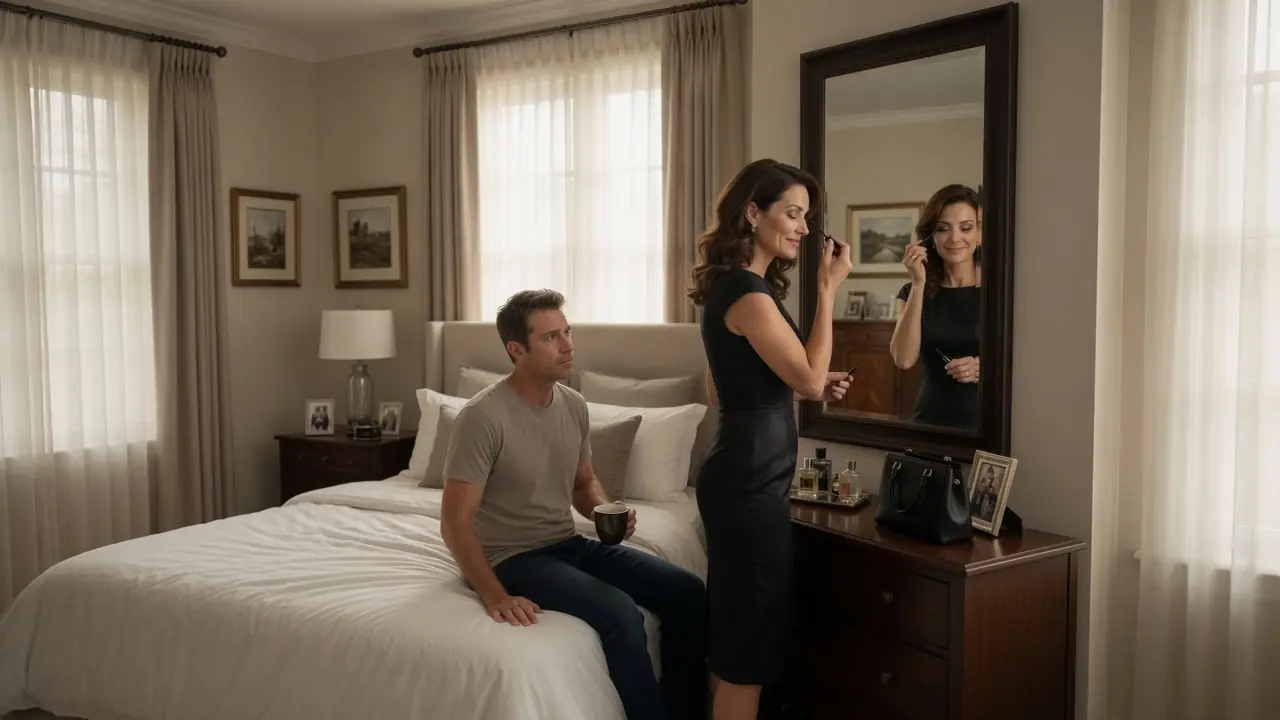
The first thing I noticed was the dress. Allison stood in front of our bedroom mirror in the morning light, slowly applying mascara like she had all the time in the world. It was a black dress, fitted, elegant, and far too careful for an ordinary night out with friends. After twelve years of marriage, I knew the difference between “I want to look nice” and “I need someone to notice me.”
I was sitting on the edge of the bed with a coffee mug in my hand, watching her reflection in the mirror. Her diamond earrings caught the light every time she tilted her head, the same earrings I had bought her for our tenth anniversary. She only wore them for weddings, charity dinners, and moments she wanted to remember. So I asked the question that started everything.
“You look beautiful today,” I said. “Special occasion?”
Her mascara wand stopped halfway to her lashes. It was only for a second, but in marriage, a second can be a confession. Allison smiled into the mirror without looking at me directly. “Just girls’ night with Brianna,” she said, too lightly.
I took a slow sip of coffee. “That dress hasn’t seen a girls’ night since before we remodeled the kitchen.”
She laughed, but the sound came out polished and fake, like one of those smiles people wear in office elevators. “Can a woman not dress up for her friends anymore?”
“She can,” I said. “I just didn’t know wine and gossip required diamond earrings.”
That was when she turned around. Allison was thirty-eight, a senior marketing executive, beautiful in the controlled way successful people learn to be beautiful. Every strand of hair was in place, her makeup was flawless, and her purse was already sitting on the dresser like she could not wait to leave. But her eyes carried something the rest of her had not managed to hide.
“Nick, you’re being paranoid,” she said.
“Maybe.”
“I’ll be home late,” she added, picking up her purse. “Don’t wait up.”
The kiss she placed on my forehead felt automatic, like a receipt printed after a transaction. I listened to her heels move down the stairs, then heard the garage door groan open. A minute later, her silver BMW backed out of the driveway. I watched from the upstairs window until the car turned the corner and vanished.
Across the street, Janice Morrison was already standing on her porch with a watering can in her hand. Janice had lived in the neighborhood for three decades and could spot trouble through closed curtains. By the time I walked outside to get the mail, she was crossing the street with the determination of a detective approaching a crime scene. I already knew she had something to say.
“Morning, Nick,” she said. “Allison looked fancy today.”
“Girls’ night,” I said, sorting through envelopes.
Janice made a face that told me she did not believe that any more than I did. “Funny,” she said. “Because I saw her last Tuesday having lunch downtown with a man in a red Audi. Looked a little cozy for a business meeting.”
My hand stopped on the mail. “Red Audi?”
“Marello’s Italian,” she said. “Nice suit, silver in his hair, very confident type. They were laughing like people who forgot the rest of the restaurant existed.”
I forced a smile because that is what men do when they are trying not to bleed in public. Allison had told me she worked through lunch that day and ate a sandwich at her desk. Marello’s was not a place you accidentally ended up in. It was candles, wine, and reservations.
Back inside, the house felt larger without her. I walked into the bedroom and stared at the mirror where she had stood twenty minutes earlier. Her jewelry box was still open, one empty slot where the anniversary earrings belonged. On the dresser, a faint trace of her perfume lingered in the air.
I told myself not to overreact. People have lunch with clients, coworkers, and old friends. People dress up because they feel like dressing up. But people do not lie about lunch unless the truth has teeth.
By afternoon, I was in my garage office, pretending to finish paperwork for a home inspection report. Instead, I opened our joint credit card account and searched the date Janice had mentioned. Marello’s appeared immediately. Two dinners, one bottle of wine, dessert, and a tip generous enough to impress someone.
Allison hated Italian food. She said garlic stayed with her for days and made her feel sick. The woman who complained when I cooked spaghetti had apparently sat through a long lunch at Marello’s with a man in a red Audi. That was when suspicion stopped being a feeling and became evidence.
At six that evening, I drove to Brianna’s apartment complex. If Allison was really having girls’ night, Brianna’s white Honda would be there, or at least some sign that the story held together. The parking lot was half empty under the yellow apartment lights. Brianna’s car was nowhere in sight.
I sat in my truck for twenty minutes, watching people come and go. Couples walked dogs, a delivery driver dropped off takeout, and a teenager argued with someone over the phone near the mailboxes. None of it had anything to do with me, which made me feel even more pathetic. Twelve years of marriage had brought me to hiding in a parking lot to see whether my wife was lying.
She was.
I drove home numb. Not angry yet, not properly. Anger requires the mind to accept what the heart is still trying to negotiate. I poured bourbon into a glass and sat in the living room, staring at our wedding photo on the mantel.
In the photo, Allison was laughing into the camera, one hand on my chest. I looked proud, amazed, like a man who could not believe he had been chosen. For twelve years, that picture had represented a promise. That night, it looked like evidence from a case I had not known I was building.
She came home a little after midnight. I heard the garage door open, her heels on the kitchen tile, then the soft movement of drawers upstairs. When she finally came down, I was still in the recliner with the bourbon glass in my hand. She stopped at the foot of the stairs.
“How was girls’ night?” I asked.
“Good,” she said quickly. “Really good. We went to that new wine bar on Elm Street.”
I almost smiled. The wine bar on Elm Street had been closed for renovations all week. I knew because I had inspected a property across from it two days earlier and seen the plywood over the entrance. She was not just lying. She was getting lazy.
“Brianna have a good time?” I asked.
“Oh, you know Brianna,” Allison said. “Always full of stories.”
I nodded and looked back at my glass. “Sounds fun.”
She lingered for a second. “Are you okay? You seem quiet.”
“Long day.”
She accepted that because she wanted to. Then she went upstairs, and I sat in the dim living room until the house settled around me. Her purse sat on the kitchen counter, unzipped, tilted open as if it were daring me to look inside.
A better husband might not have looked. A better husband might have respected privacy, waited for honesty, or asked a direct question. But a better wife would not have come home wearing anniversary earrings after lying about where she had been. So I opened the purse.
The hotel key card was tucked behind her wallet. Grand Marquee Hotel, room 412. Under it was a restaurant receipt from the same hotel, dated that night, two dinners, two glasses of wine, one chocolate mousse. Apparently, girls’ night had upgraded to room service.
I took photos of everything and put it all back exactly as I had found it. My hands were steady, which surprised me. Inside, something had turned cold and organized. I was not ready to confront Allison yet, because I did not want an argument. I wanted the truth.
The next morning, after she left for what she called a client breakfast, I called Marty Kowalski. Marty was my work partner, my oldest friend, and the kind of man who owned strange devices because he once suspected his own wife of cheating with a yoga instructor. He had been wrong, but he had kept the tracker. Thirty minutes later, he was under Allison’s BMW with a tiny magnetic GPS device in his hand.
“This will show everywhere she goes,” Marty said, wiping his hands on a rag. “But promise me you won’t do anything stupid.”
“Define stupid.”
“Nick.”
“I just want proof,” I said.
He looked at me for a long moment. “Proof has a way of becoming gasoline.”
That evening, the little blue dot moved from Allison’s office to the Grand Marquee Hotel. She parked in the underground garage at 6:47 p.m. and stayed there for more than three hours. I drove downtown and waited across the street, feeling like every person who passed my truck could see exactly what I had become.
At 9:52, Allison came out of the hotel lobby with him. He was tall, well dressed, silver threaded through dark hair, with the kind of confident walk that made valets hurry. I recognized him from old college photos hidden in Allison’s albums. Kevin Monroe, the ex-boyfriend she once described as “ancient history.”
They stood under the awning, close enough that their coats touched. He tucked a strand of hair behind her ear. She smiled up at him in a way I had not seen directed at me in years. Then he kissed her, and the last fragile excuse I had been holding onto died right there in the street.
I followed his red Audi to an upscale apartment building on the west side of town. Later that night, I searched his name and found the rest easily. Kevin Monroe, real estate developer, husband to Jessica Monroe, father of two, community donor, smiling fraud in expensive suits. His life looked as polished online as mine had looked from the outside.
Two days later, I met Brianna at Murphy’s Tavern. She had already had two drinks when I arrived, which made the truth easier for her and harder for me. I bought her a third and asked about Allison’s long hours. Brianna looked guilty before she answered.
“She’s been seeing Kevin,” she said quietly. “Her ex from college.”
“How long?”
“A few months,” Brianna admitted. “Maybe longer. I told her it was a bad idea, but Allison said she felt alive again.”
Alive. That word hit me harder than I expected. Apparently, I had been the husband who paid the bills, fixed the roof, remembered anniversaries, and built the life. Kevin got to be alive.
That night, while Allison slept beside me, I stared at the ceiling and made a decision. The old Nick might have begged, shouted, demanded counseling, and asked what he had done wrong. The old Nick still believed a marriage could be saved if both people wanted it enough. But Allison had stopped wanting ours long before she put on that black dress.
The next morning, while she showered, I opened her laptop. She had left it on the kitchen table, probably believing I would never invade her privacy. Her messages with Kevin were not hidden well. Dinner reservations, hotel plans, sweet little lies, and promises that made my chest burn.
One message stopped me completely. Kevin had written, “Soon. We just need to be patient.” Allison had replied, “I hate sneaking around, but I want our real life.” Their real life. My marriage, his marriage, two families, and years of trust were just obstacles to their romantic rebranding.
I screenshotted everything and saved copies in three places. Then I brewed coffee and sat at the kitchen table like a man enjoying a normal morning. When Allison came downstairs, she wore a blazer and carried herself like nothing in the world was wrong. I looked at her and saw a stranger with my wife’s face.
“I’ll be late tonight,” she said. “Client dinner.”
“With Kevin Monroe?” I asked before I could stop myself.
She froze with her hand on the door. Slowly, she turned back to me. “What did you say?”
“Nothing,” I said, lifting my coffee. “Have a good day.”
She left without another word, but I saw the fear in her eyes. Good. Let her wonder. Let her feel even a fraction of the uncertainty she had been feeding me for months.
That afternoon, I contacted Jessica Monroe. I wrote a short anonymous message, attached screenshots, hotel receipts, and enough proof to remove any doubt. I expected silence, maybe anger, maybe denial. Instead, an unknown number called me less than an hour later.
“Is this Nick Barlo?” a woman asked.
“Depends who’s asking.”
“Jessica Monroe,” she said. “I think you and I need to talk.”
We met at a coffee shop downtown. Jessica looked like elegance sharpened into a blade. Calm, composed, and furious in a way that did not need volume. She listened while I explained what I knew, then opened her own folder and slid photographs across the table.
Allison and Kevin entering hotel rooms. Allison and Kevin leaving restaurants. Allison and Kevin laughing in a parking garage like two teenagers who thought consequences were for other people. Jessica had hired a private investigator weeks earlier. I had brought proof to a woman who already had a war chest.
“So,” she said, folding her hands around a cup of untouched tea, “do you want revenge or closure?”
“Is there a difference?”
“There can be,” she said. “But not today.”
Her plan was simple and cruel enough to be beautiful. We would not confront them privately. We would let them believe they still controlled the story, then force the truth into public light. Cheaters thrive in secrecy, Jessica said. Take away the shadows and watch them turn on each other.
The first strike was social. Jessica and I drove to a mountain cabin owned by one of her friends and spent a weekend creating the appearance of a cheerful escape. Nothing improper happened, but the photographs suggested comfort, laughter, and the kind of easy companionship that would make two guilty people panic. We posted just enough to be seen.
Allison called me seventeen times that night. Kevin called Jessica even more. Neither of us answered. By Sunday morning, their messages had shifted from confusion to anger to fear.
That evening, Jessica and I went to Murphy’s Tavern and sat by the window where anyone passing could see us. We did not have to wait long. Allison’s BMW arrived first, followed by Kevin’s red Audi. They came in together, which was almost funny, considering they were there to accuse us of being inappropriate.
“What the hell is this?” Allison demanded, stopping beside our table.
I looked up calmly. “Dinner.”
“With her?”
Jessica smiled. “Careful, Allison. You are standing beside my husband while asking that question.”
Kevin stepped forward, face tight with anger. “This is childish.”
“No,” I said. “Childish is lying about girls’ night while using hotel key cards like bookmarks.”
The bar went quiet around us. Murphy’s was not a fancy place, but it was full of people who knew people. That was the point. Allison looked around and realized the walls had ears, eyes, and phones.
“It is not what you think,” she said.
I almost laughed. “You kissed him outside the Grand Marquee, Allison. If I misunderstood, you are welcome to explain the choreography.”
Kevin reached for her arm, but she pulled away. That small movement told me the pressure was already working. Their fantasy required candlelight, wine, secrecy, and the flattering lie that what they had was special. It did not look special under bar lights in front of strangers.
Jessica placed a folder on the table. “We both know enough,” she said. “The hotel receipts, the company expenses, the messages, the photos. So before either of you tries to play victim, remember that we can prove the timeline.”
Allison went pale. Kevin went still.
“Company expenses?” he asked, turning toward her.
Allison’s face betrayed her before she spoke. “That was not your concern.”
Jessica laughed softly. “Oh, it will be. Especially when Hartwell and Associates sees how many romantic dinners were charged as client development.”
Kevin stared at Allison, and I saw the first crack between them. He had known he was cheating. He had not known she might bring financial trouble to his door. Selfish people can excuse passion, but they rarely forgive inconvenience.
The next week unfolded exactly the way Jessica predicted. Allison was placed on administrative leave after Hartwell opened an internal review. Kevin’s largest development client received evidence of his affair, his expense misuse, and his questionable judgment. His reputation, the thing he polished harder than his shoes, began to collapse.
I changed the locks on the house after Allison came home to find her belongings boxed neatly on the porch. She stood in the driveway looking at the boxes as if she could not understand how twelve years could be packed into cardboard. I watched from the porch, holding a beer I barely tasted. For the first time in months, she looked afraid of me, not because I would hurt her, but because I would not save her.
“You can’t just throw me out,” she said.
“I’m not throwing you out,” I replied. “I’m returning you to the life you chose.”
“This is my house too.”
“My name is on the deed. You know that.”
“We are married.”
“And you treated that like a technicality.”
Her eyes filled with tears, and once that would have broken me. But I had seen too much by then. Tears after consequences are not the same as remorse. Sometimes they are only grief for lost comfort.
“I loved you,” she whispered.
“No,” I said. “You loved being safe with me while feeling wanted by him. That is not love, Allison. That is insurance.”
She loaded the boxes into her car one by one. I did not help her. I did not insult her either. I simply watched the woman who had shared my bed and my name drive away with the remains of her chosen life rattling in the trunk.
The final explosion happened at the Riverside Charity Gala. Allison and Kevin had planned to attend together before everything fell apart, hoping to reclaim the narrative as two brave people who had found love at the wrong time. Jessica and I attended too, not as lovers, not really, but as witnesses. She wore emerald green, I wore a black suit, and we sat close enough to the front to be noticed.
Halfway through the evening, Jessica stood during the donor acknowledgments and raised her glass. She did not shout. She did not need to. The room quieted because people like Jessica have a way of making silence obey them.
“My husband Kevin and his companion Allison wanted a public love story,” she said. “So I think everyone deserves the full version.”
The room changed temperature. A projector screen behind the stage lit up with dates, receipts, hotel charges, and images that told a story no one could mistake. Nothing indecent, nothing illegal, just truth arranged so neatly it became undeniable. Allison sat frozen three tables back, mascara already shining in her eyes.
Kevin stood halfway, face red. “Jessica, stop.”
“No,” she said. “You stopped nothing when you had the chance.”
Someone gasped. Someone else whispered Allison’s name. By the time the final slide appeared, Hartwell expense reports beside hotel reservations, the crowd had turned completely. Rich people love scandal even more when it comes with documentation.
Allison fled first. Kevin followed seconds later, but not with her. They left in different directions, which told me everything I needed to know about the strength of their great love. When public shame arrived, they did not hold hands. They looked for separate exits.
Three weeks later, Allison moved out of state. Kevin’s firm forced him out after clients began asking questions he could not answer. Jessica filed for divorce and kept her dignity like a crown. I filed too, and for the first time in years, the paperwork felt less like an ending than a locked door.
I saw Allison once before she left. She came by the house to collect a box I had found in the attic. No black dress this time, no diamond earrings, no polished confidence. Just a woman in jeans and a gray sweater, looking smaller than the memory of her.
“I never meant for it to become this,” she said.
“That is the problem,” I replied. “You thought only your feelings would count, not the damage.”
She nodded as if she understood, but I do not know if she did. People like Allison often think regret is the same as accountability. It is not. Regret looks backward and wishes the cost had been lower; accountability looks forward and accepts the bill.
After she drove away, I stood on the porch until the street went quiet. Janice Morrison watched from across the road, pretending to water flowers that were already soaked. I lifted one hand in a small wave. She waved back, probably disappointed I had not given her more drama for the neighborhood archive.
Inside, the house felt different. Not empty, exactly. Clean. The kind of clean that comes after you stop pretending the dust is not there.
Months later, I received a postcard from San Diego. The front showed a sunset over the Pacific. The back had only Allison’s signature and no message. Maybe she wanted forgiveness, maybe attention, maybe proof that some line between us still existed.
I dropped it in the trash.
Some chapters do not need a final conversation. Some doors do not need to be slammed to stay closed. And some betrayals do not destroy you, not if you let the truth do what truth does best.
It burns away the lie.
And leaves you standing in the light.