Daniel Mercer had stayed late at Langford & Vale because loyalty was still a habit he had not learned to break. The office had emptied hours earlier, leaving only the soft hum of the air vents, the glow of emergency lights, and the distant city shining through the glass walls. He carried a folder of late project files under one arm, the same folder Victor Langford had demanded before morning with that sharp, satisfied tone Daniel had grown to hate. For weeks, Victor had been making his life miserable, criticizing small mistakes, changing deadlines, and turning every meeting into a quiet public embarrassment.
Daniel told himself it was pressure from the merger. That was easier than believing his boss had simply chosen him as a target. At thirty-nine, Daniel had worked too hard and too long to imagine his career could be ruined by one man’s private cruelty. He was an office manager, not an executive, but he knew the systems, the clients, the staff, and the thousand invisible details that kept the company running. Victor knew that too, which made the humiliation feel deliberate.
The top floor was silent when Daniel stepped out of the elevator. Victor’s private executive office sat at the end of the hall, its glass door half open, a line of light cutting across the carpet. Daniel almost knocked, but he heard a soft laugh from inside, a woman’s laugh, familiar enough to stop him before his hand touched the doorframe. His chest tightened, not from suspicion yet, but from the strange fear that comes when a sound knows you before you are ready to know it back.
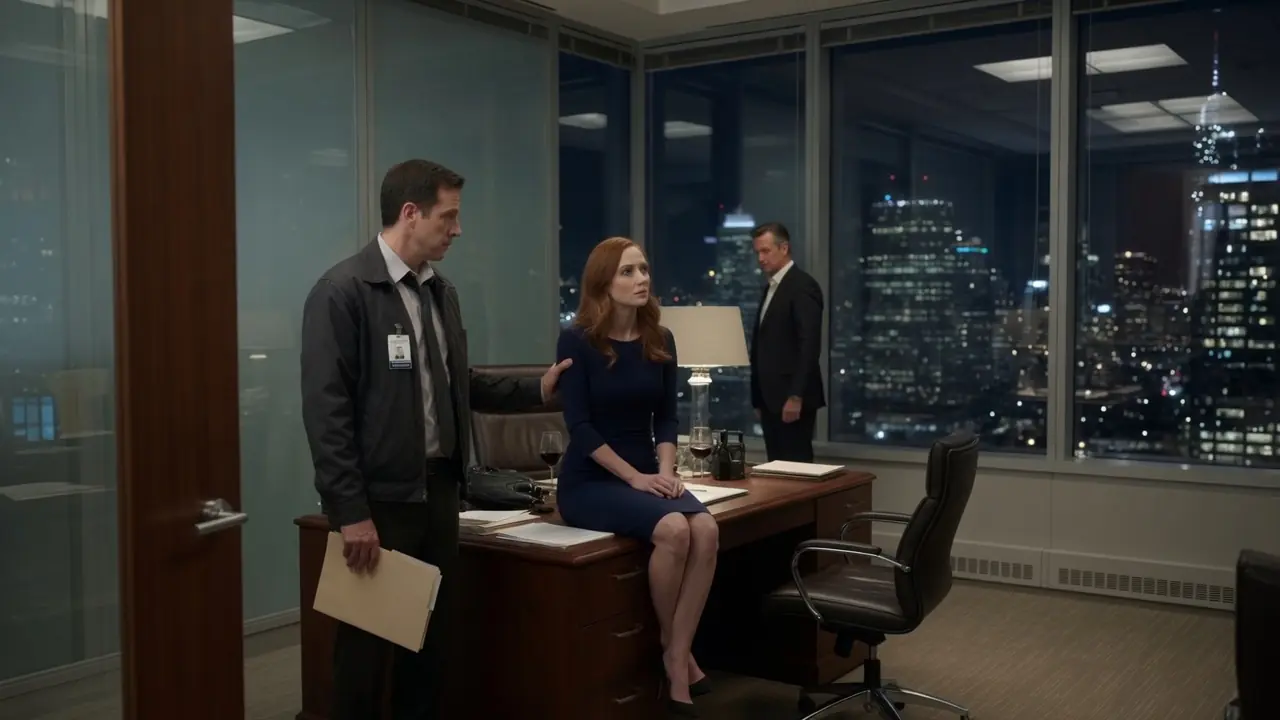
He pushed the door wider. For one frozen second, the whole room held still as if the building itself had stopped breathing. Lauren Mercer, his wife of twelve years, was sitting on the edge of Victor Langford’s polished desk in a fitted navy office dress, her black heels resting against the drawers, her auburn hair falling loose over one shoulder. Victor stood beside her too closely, one hand gently stroking her hair, the other resting near her waist like he had earned the right to touch what Daniel had spent years loving.
The room was full of evidence before anyone spoke. Two half-finished wine glasses sat beside Victor’s laptop. Lauren’s purse lay near the keyboard, exactly where a wife’s purse did not belong at nearly midnight in another man’s office. Scattered contract papers were pushed aside as if work had become a stage prop. Daniel’s employee badge hung from his coat pocket, while the folder in his hand suddenly felt absurd, like he had brought paperwork to the funeral of his own marriage.
Lauren saw him first. Her face drained so fast that all the careful office polish disappeared, leaving panic beneath it. Her hand slipped from Victor’s sleeve, and she tried to slide off the desk, but her movement was clumsy, guilty, too late. Victor did not step away at first. That was what Daniel noticed most.
Victor stood there with a smug possessive confidence, as if the office, the company, the job, and the woman all belonged to him. He was forty-seven, tall, tailored, silver-brown hair slicked back, expensive watch catching the office light. He had the kind of face that made arrogance look like leadership when people were too afraid to question him. In that moment, Daniel understood that every cold remark, every impossible deadline, every meeting where Victor made him feel small, had been part of something much uglier.
Daniel looked at Lauren’s wedding ring. It was still on her finger. The ring caught the light the same way it had on their wedding day, the same way it had when she signed mortgage papers, opened anniversary cards, and rested her hand on his chest in the dark. Now it glittered while she sat on another man’s desk. Daniel felt something inside him detach.
Daniel held the folder tightly, his voice low. “So this is the late meeting you kept choosing over our marriage.”
Lauren’s eyes filled immediately. She stood too quickly, smoothing the front of her dress as if dignity could be pulled back into place with fabric. “Daniel, please… this isn’t how you think it is.” The sentence was so small against what he had seen that it almost sounded childish. He stared at her, wondering how many lies had come before this one, and how many she still expected him to accept.
Victor’s mouth curled slightly. He looked annoyed, not ashamed. “Walk away with some dignity, Mercer. You already lost.” The words landed exactly where Victor intended them to, but something strange happened. Daniel did not collapse under them. He only became stiller.
He looked from Victor to Lauren, then back to Victor. “No, Victor. Tonight I finally see what you both are.” That was the last full sentence he gave either of them in that room. Lauren started crying, Victor started speaking over her, and Daniel placed the project folder on the nearest chair as if finishing the last duty he would ever perform for that man. Then he turned and walked out.
The elevator ride down felt endless. Daniel watched the numbers change above the doors and realized he had not blinked in too long. His hands were shaking now, but quietly, privately, with no one there to witness it. By the time he reached the parking garage, he could barely remember unlocking his car.
He drove home because he did not know where else to go. The apartment still carried Lauren’s presence in every corner: her scarf over a chair, her mug by the sink, the framed photo from Cape Cod on the hallway table. Daniel stood in the living room under the yellow lamp and understood that objects could become cruel when memory stayed inside them. He took the photo down, laid it face down on the table, and sat on the floor until morning.
Lauren came home at dawn. She looked exhausted, mascara faint beneath her eyes, hair tied back now, her voice soft with the rehearsed fear of someone who knew damage had been done but still hoped to control how much. She tried to explain it as confusion, distance, emotional loneliness, and Victor making her feel seen. Daniel listened without interrupting because interruption would have required energy he no longer had.
She told him the affair had been going on for months. The word months moved through him like cold water. It meant every late meeting, every sudden irritation, every phone turned face down, every night she kissed him absently before pretending to sleep. It meant Daniel had been living inside a marriage that had already been abandoned, while Lauren waited for courage or convenience to admit it.
Two days later, she asked for a divorce. Not tearfully, not in a moment of remorse, but with a kind of frightened decisiveness, as if Victor’s world had promised her a cleaner exit. Daniel was too broken to fight. He signed the papers when the time came because resisting felt like arguing with a building after it had already fallen on him.
Work became unbearable after that. Victor did not hide his satisfaction. In meetings, he assigned Daniel impossible tasks, questioned his competence in front of younger staff, and turned every missed detail into proof that Daniel was unstable. The office knew enough to whisper and not enough to help.
Lauren stopped coming by Daniel’s department after the separation became known. Victor, however, found reasons to pass his desk, always polished, always calm, always wearing the expression of a man who believed he had won twice. He had taken Daniel’s wife and was now taking his professional footing piece by piece. Daniel tried to endure it because he needed the job, but humiliation is its own form of exhaustion.
Three weeks after the divorce filing, Daniel was called into HR. The official language was restructuring, performance concerns, and workplace disruption. Victor sat in the meeting with folded hands, letting the HR representative do the talking, but the victory in his eyes was plain. Daniel was offered a small severance and a reminder of confidentiality clauses. He signed because he had learned that some rooms are designed to make refusal look unreasonable.
By the end of the month, Daniel had no wife, no job, and no real sense of who he was without both. He moved into a small apartment on the edge of the city, a place with a radiator that clicked at night and windows that looked onto a brick wall. He ate cereal for dinner, let calls go unanswered, and stopped opening emails unless they looked important. Some mornings he woke up and forgot for three seconds that his life had already changed.
Then grief would return with the precision of an alarm. He would remember Lauren on the desk, Victor’s hand near her waist, the wine glasses, the smugness, the ring. He would remember being told to walk away with dignity by the man who had engineered his collapse. He would remember signing documents that ended his marriage and employment as if his entire adult life were just paperwork being processed by other people.
A month after he lost his job, there was a knock on his apartment door. Daniel almost ignored it. He had become good at ignoring things: calls, bills, memories, his own reflection. But the knock came again, softer this time, and something about it sounded less like demand than hesitation.
When he opened the door, a woman stood in the hallway with rain on her coat and a folder clutched to her chest. She was about forty-three, elegant but tired, with dark blonde hair pinned loosely, pale skin, and eyes that looked like they had already cried but were refusing to do it again. She looked at him for a long moment, as if confirming that pain had led her to the correct address. Then she introduced herself as Claire Langford, Victor’s wife.
Daniel did not invite her in immediately. The name alone made his stomach turn. Claire seemed to understand, because she did not push past him, did not speak quickly, and did not ask him to feel sorry for her. She simply said she had discovered enough about Victor and Lauren to know Daniel was the only person who would understand the shape of what had been done.
That was how two strangers ended up sitting at Daniel’s small kitchen table with coffee neither of them drank. Claire had found messages, hotel charges, office access logs, and a pattern of lies that matched Daniel’s memories so closely it made him sick. She had been married to Victor for eighteen years, long enough to know his charm was most dangerous when he was bored. Daniel told her what he had seen in the office, and Claire listened with her hands folded around the coffee mug like it was the only thing keeping her steady.
At first, the conversation was painful in a practical way. They compared dates, details, and lies. Claire confirmed that Victor had used late executive meetings as cover. Daniel confirmed that Lauren had used overtime and stress as explanations for coming home distant. Together, they assembled the timeline of two marriages being quietly destroyed by two people who believed consequences were for everyone else.
Then something shifted. It was not romance, not yet, not even friendship. It was the relief of being believed without having to perform the wound. Claire did not tell Daniel to move on, forgive, or be the bigger person. Daniel did not tell Claire she should have noticed sooner. They gave each other the rare gift of not making betrayal more complicated with judgment.
The first coffee turned into another meeting at a diner near Daniel’s apartment. The second meeting turned into a long walk through a park where the trees were just beginning to lose their leaves. They talked about the strange embarrassment of being betrayed, how people treated it like a personal failure, as if not being enough explained someone else’s selfishness. Claire had a dry, steady humor that caught Daniel off guard. For the first time in weeks, he laughed without feeling guilty for it.
Claire filed for divorce soon after. Unlike Daniel, she was not financially vulnerable, but that did not make the emotional damage lighter. Victor tried to deny everything, then minimize it, then blame loneliness, then blame her. Claire handled each excuse with terrifying calm. Daniel admired that before he understood he admired more than that.
As the legal processes moved forward, Daniel and Claire became each other’s safest place to speak plainly. They were careful at first, almost formal, both aware of how easy it would be to confuse shared pain with connection. But the connection survived even on days when they did not talk about Victor or Lauren. They discovered ordinary things: Claire loved old bookstores, Daniel hated olives, both preferred rain to heat, and neither of them trusted anyone who described cruelty as honesty.
Daniel found a new job in another city three months later. It paid less than his old one, but the office was healthier, the managers treated people like adults, and no one knew him as the man whose boss stole his wife. Claire encouraged him to take it. A week after he moved, she visited, claiming she wanted to see the neighborhood before deciding whether to relocate after her divorce. Daniel knew that was only half true, but he did not challenge it.
Six months later, they were together. Not because revenge demanded symmetry, not because betrayal had arranged a neat exchange of spouses, but because tenderness had grown in the place where humiliation once lived. Claire understood Daniel’s silences. Daniel understood the way Claire sometimes stared too long at her phone after an unexpected message. They did not heal each other like medicine; they witnessed each other healing.
Lauren emailed Daniel around that time. Her message was long, rambling, and full of regret. She said Victor was not who she thought he was, that the excitement had faded fast, that she missed the steadiness Daniel had brought to her life. She wrote that she had made a mistake and hoped they could talk someday. Daniel read the email once, felt the old wound open just enough to remind him it existed, then closed it without replying.
Claire saw the email because Daniel showed her. She did not get jealous, did not panic, did not ask what he felt. She only sat beside him on the couch and said he owed Lauren nothing. The steadiness in her voice felt like a hand on his shoulder. Daniel realized then that love after betrayal was not louder or more dramatic; it was simply safer.
Two weeks later, the universe offered them a strange scene neither had asked for. Daniel and Claire were having dinner at a small restaurant downtown, the kind with candles on the tables and handwritten specials on a chalkboard. They were laughing over something ordinary when the door opened and Lauren walked in with Victor. For a second, all four of them froze.
Lauren looked different. Her makeup was careful but heavy, her smile too tense, her posture too alert, as if she had learned that standing beside Victor required constant performance. Victor looked worse than Daniel expected. His expensive suit still fit, but his confidence did not; his shoulders seemed lower, his eyes flatter, his charm worn thin from overuse.
Daniel felt Claire’s hand find his under the table. She did not squeeze hard, only enough to remind him that he was not alone and no longer standing in Victor’s office with his world collapsing. Lauren saw their hands. Her eyes moved from Claire to Daniel, and for one brief second regret crossed her face so clearly that even candlelight could not soften it.
Victor noticed too. His jaw tightened, not with heartbreak, but with the irritation of a man seeing proof that the people he hurt had not remained broken for his convenience. Daniel expected to feel rage. Instead, he felt calm, almost surprised by the absence of pain.
He and Claire finished dinner. They did not rush out, but they did not stay to perform victory either. When they passed Victor and Lauren’s table, Daniel did not speak. Claire walked beside him with her head high, her hand still in his. That was all the answer they needed to give.
Outside, the night air was cool. Daniel stopped on the sidewalk and laughed softly, not because the situation was funny, but because his life had become something he could never have predicted. A year earlier, he had walked into an office and thought he had lost everything. Now he was standing beside a woman who had found him through the wreckage and helped him remember that endings could be doors if you survived the hallway.
Claire leaned into him, and he kissed her forehead. There was no bitterness in the gesture, no performance for the people inside, no need to prove anything. The victory was not that Lauren and Victor looked unhappy. The victory was that Daniel no longer needed them to be unhappy in order for him to be free.
In time, Victor and Lauren’s relationship collapsed exactly the way people expected it to. The thrill of secrecy did not survive daylight. Victor lost influence at the company after Claire’s legal team exposed enough misconduct to make the board nervous, and Lauren discovered that being chosen by a man like Victor was not the same as being respected by him. The power that had looked glamorous from the edge of his desk became a cage with expensive furniture.
Daniel did not celebrate their downfall. He had wasted enough of his life orbiting their choices. He built a quieter life with Claire, one made of honest work, weekend trips, shared books, dinners cooked in a kitchen that felt like home, and mornings where no one lied about where they had been. It was not perfect, but perfection no longer interested him. Peace did.
Sometimes, people asked how Daniel and Claire could build love from something so ugly. Daniel never had a simple answer. Pain had introduced them, yes, but pain was not what kept them together. What kept them together was kindness after the pain, respect after the humiliation, and the shared determination never to become the kind of people who used love as a weapon.
Daniel still remembered that office in Boston. He remembered Lauren on Victor’s desk, Victor’s hand in her hair, the wine glasses, the city lights, and the folder trembling in his hand. For a long time, that memory was the worst moment of his life. Later, he came to see it differently.
It was the moment the lie became visible. It was the moment Daniel stopped defending a marriage that had already abandoned him. It was the moment he lost a wife, a job, and a false sense of security, but also the moment the truth began clearing a path toward a better life. He would never thank Victor or Lauren for what they did, but he no longer wished the scene had remained hidden.
Because one month after that collapse, Claire Langford knocked on his door. And from the wreckage of two ruined marriages, something honest began. Not revenge, not replacement, not a neat twist of karma, but real love built by two people who knew exactly how badly betrayal could hurt and chose never to make each other feel that way. Daniel had walked into his boss’s office and watched his old life end under glass walls and city lights. What he did not know then was that somewhere beyond that ending, the right person was already walking toward his door.