Michael Harrison had always believed that betrayal would announce itself loudly if it ever came for him. He imagined a discovered message, a confession during a midnight argument, maybe a stranger’s name falling out of his wife’s mouth at the wrong time. He never imagined it would begin in a hospital hallway, under quiet ceiling lights, with nurses moving softly in the distance and the elevator doors sliding open behind him. But that was where the last hope in his marriage finally died.
He was forty-three years old, a white American marketing firm owner in Chicago, and the kind of man people trusted because he rarely spoke carelessly. His life had been built around discipline, family, and the belief that love was something proven in ordinary ways. He had spent sixteen years married to Elizabeth Harrison, a beautiful woman with long chestnut-brown hair, green eyes, and a voice that could make even a tense room feel softer. Together, they had raised two children, Lily and Josh, and turned a suburban house into the kind of home other people praised at holiday dinners.
Elizabeth had told him she was leaving for a three-day marketing conference in Detroit. She had kissed him quickly in the kitchen, touched his shoulder, and said she would call before bed if the sessions did not run too late. Michael had believed her because believing his wife had once been as natural as breathing. That same night, two officers came to his door and told him Elizabeth was not in Detroit at all.
She was at Northwestern Memorial Hospital in Chicago. The details came slowly, carefully, and with the awkward sympathy of people who knew they were handing a man the pieces of his life in the wrong order. She had been found at a local hotel with a man named Thomas Blackwood, a senior manager from her company. Michael listened without interrupting, but something inside him went very still.
At the hospital, a detective explained that Elizabeth and Thomas had been seen together at the same hotel more than once. Several months, the detective said. Tuesday and Thursday evenings, mostly. Those were the nights Elizabeth had called late client meetings, after-work strategy sessions, and emergency project reviews.
Michael did not cry in front of the detective. He did not curse, throw anything, or ask questions he knew nobody could answer in a way that would save him. He only nodded, signed what needed signing, and asked whether Elizabeth was stable. When the doctor said she would recover, relief came first, and then the relief betrayed him by making room for rage.
He spent that first night at a twenty-four-hour diner across from the hospital. The coffee tasted burnt, but he kept drinking it because the bitterness gave his mouth something to do besides tremble. In the reflection of the window, he saw a man who looked older than he had that morning. He told himself three things before sunrise: he would not fall apart, he would not lie to the children, and he would not let Elizabeth’s choices take his dignity too.
The next evening, Michael returned to the hospital with a colder mind. He did not arrive as a husband desperate to hold his wife’s hand. He arrived as a man who needed truth. He stepped out of the elevator on the fourth floor, turned toward Elizabeth’s room, and stopped before he had taken three full steps.
Elizabeth was standing in the hallway outside her room. She wore a hospital gown under a soft gray cardigan, her long chestnut-brown hair loose around her shoulders, her face pale and tired but still painfully beautiful. Thomas Blackwood stood close beside her, one hand lightly holding her fingers as if he had been comforting her for some time. Their bodies turned toward each other with the quiet familiarity of people who had already crossed every line.
For one second, none of them moved. Michael stood near the elevator, his hand still lifted as if he had been about to step forward. Elizabeth looked at him with tearful shock, but she did not pull away fast enough. Thomas looked at Michael and tightened his jaw, his nervousness hidden badly behind a polished face.
Michael’s eyes dropped to their joined hands. Then he looked at Elizabeth’s face. Then he looked back at Thomas.
“I came here to see my wife,” Michael said, his voice low and rough. “And he is the one holding your hand.”
Elizabeth slowly pulled her fingers away from Thomas, but the damage had already happened. Not because of the touch itself, but because of the way she had allowed it. Even in a hospital hallway, even after everything had been exposed, she had turned toward the man who helped destroy their family instead of reaching for the husband she had betrayed. Michael felt something inside him settle into a final shape.
“Michael,” Elizabeth whispered. “Please don’t do this here.”
He almost laughed at that. Here. She was worried about the hallway, the nurses, the clean walls, the strangers walking past with clipboards. She had not worried about their home, their children, their vows, or the lies she placed between them one by one for months.
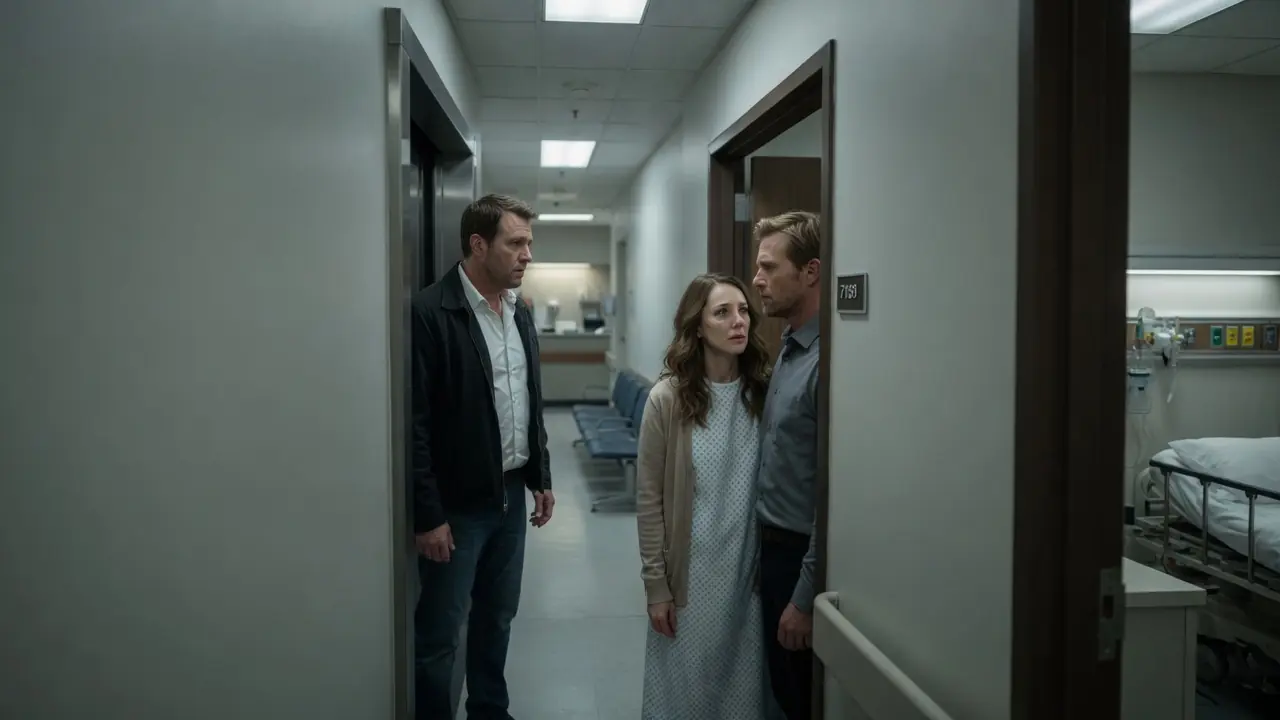
“I’m not doing anything,” he said. “I’m standing here looking at what you chose.”
Thomas shifted beside her. “She asked me to stay.”
Michael turned his eyes on him. “And you did.”
The sentence was simple, but it made Thomas lower his gaze for the first time. Michael saw then that Thomas was not brave. He was not romantic, not noble, not the great love Elizabeth must have imagined in her lonelier moments. He was just a man who had enjoyed another man’s wife until the cost started showing in public.
Elizabeth stepped forward, but Michael raised one hand. “Don’t,” he said. “If you are about to tell me he means nothing, don’t insult me with it.”
Her lips trembled. “I was going to tell you.”
“No,” Michael said. “You were going to keep lying until you couldn’t anymore.”
She closed her eyes, and tears slid down her cheeks. For years, those tears would have undone him. He would have stepped close, lowered his voice, taken her hand, and tried to fix whatever was hurting her. But tonight, looking at Thomas standing close enough to still feel like part of her world, Michael understood that his instinct to protect her had become the thing she counted on.
Elizabeth opened her eyes again, and something in them had changed. The panic faded, replaced by a tired, stubborn resolve. She looked from Thomas to Michael, then back to Michael as if finally choosing which truth she wanted to speak. “I can’t keep pretending,” she said.
Michael did not answer.
“I can’t go back to our house and act like I can be the woman you want me to be,” Elizabeth continued. “I can’t sit at the table with you and the kids and pretend this marriage can be saved. Maybe I should have said it before any of this happened, but I’m saying it now.” She swallowed hard. “I want a divorce.”
The hallway seemed to quiet around them. A nurse walked past at the far end, pushing a cart slowly, but the sound felt distant. Michael looked at his wife, at the woman whose name had been tied to his for sixteen years, and understood that she was not asking for forgiveness. She was asking to make the betrayal official.
Thomas looked uncomfortable, almost surprised by the force of her words. That told Michael something too. Elizabeth might have chosen him in the hallway, but Thomas had not expected to be part of the ending said out loud. He had wanted secret comfort, not public consequence.
Michael nodded once. “You want a divorce.”
Elizabeth’s face tightened. “Yes.”
“And him?” Michael asked, looking at Thomas without turning his head. “Is he part of this new life you’re choosing?”
Elizabeth hesitated. It was only one second, but it was enough. “That’s not what this is about.”
“It is exactly what this is about,” Michael said. “You are standing next to him while ending a marriage with me.”
Thomas finally spoke again. “Michael, I know you hate me, but Elizabeth and I—”
Michael turned fully toward him. “Do not put your name beside hers like you earned that right in front of me.”
Thomas stopped.
Michael looked back at Elizabeth. “You could have told me you were unhappy. You could have asked for counseling. You could have separated before you started lying to our children. You had a hundred clean doors, Elizabeth, and you chose the one that dragged all of us through the dirt.”
Elizabeth wiped at her face with the heel of her hand. “I felt invisible.”
Michael absorbed that quietly. He had heard versions of it before from people trying to explain why loyalty became inconvenient. It was not that the pain was false. It was that she had used it as permission to become cruel.
“You felt invisible,” he said. “So you made me and the kids look foolish in our own home.”
She looked down.
“I helped Josh with his science project while you were at a hotel,” Michael continued. “I told Lily her mother was working hard while you were with him. I defended your late nights. I trusted you in front of our children.”
Elizabeth whispered, “I know.”
“No,” Michael said softly. “You knew then too.”
That sentence broke through the last of her defenses. She covered her mouth and turned slightly away, but Thomas reached toward her shoulder. Michael saw the movement and felt his last remaining hope vanish. She let Thomas touch her again.
Michael stepped back. “Then we are done.”
Elizabeth looked at him quickly. “Michael—”
“No,” he said. “You asked for a divorce. You can have one.”
The firmness in his voice startled her more than anger would have. Maybe she had expected him to beg, to bargain, to remind her of Christmas mornings and family vacations and the life they had built together. Maybe she wanted him to fight hard enough that her choice would feel valuable. But Michael was no longer willing to audition for a place in a marriage she had already emptied.
He turned toward the elevator. Elizabeth called his name once, then again, but he did not stop until he reached the button. When he finally looked back, all three of them were still facing each other from a distance. Elizabeth stood between the door to her hospital room and the man she had chosen, and Michael stood at the edge of the life she had pushed him out of.
“I will tell the kids carefully,” he said. “But I will not lie for you.”
Elizabeth’s face crumpled. “Please don’t make them hate me.”
“I can’t control what they feel,” Michael said. “Neither can you anymore.”
The elevator opened. Michael stepped inside before she could answer. As the doors closed, the last thing he saw was Thomas lowering his eyes and Elizabeth standing very still, as if the divorce she had demanded had arrived faster than she had prepared for.
The drive home felt unreal. Chicago moved past his windshield in streaks of hospital light, traffic signals, and late-night storefronts. He did not turn on music. He let the silence sit beside him because it was more honest than anything Elizabeth had said in months.
At home, his sister Katie was waiting with Lily and Josh asleep upstairs. Katie took one look at him and did not ask whether Elizabeth was all right first. She asked, “What happened to you?”
Michael sat at the kitchen table. “She asked for a divorce.”
Katie closed her eyes. “At the hospital?”
“In the hallway,” he said. “Thomas was there.”
Katie’s face hardened with the protective fury only a sibling could show without needing permission. “Tell me he did not stand there beside her.”
“He did,” Michael said. “And she let him.”
Katie sat across from him, silent for a moment. Then she reached over and placed her hand on his wrist. “What do you need?”
That simple question nearly broke him. Not advice, not blame, not the useless sentence that everything would be okay. Just need. Michael looked toward the stairs where his children slept and took a long breath.
“I need to tell them the truth,” he said. “Not all of it. Not the ugliest parts. But enough that they don’t build their lives on another lie.”
The next morning, Michael made pancakes because routine seemed kinder than silence. Lily came downstairs first, fourteen years old, sharp-eyed, already sensing that adults were keeping something from her. Josh followed, eleven and restless, asking when Mom was coming home. Michael placed the plates on the table and sat down before answering.
“Your mom is recovering,” he said carefully. “Physically, she is going to be okay.”
Relief crossed both their faces, but Lily did not smile. “Then why do you look like that?”
Michael folded his hands. “Because there is something else. Your mom was not where she told us she was. She was with someone from work, and their relationship was not honest.”
Josh stared at him. “You mean she cheated?”
Michael hated the word landing in his son’s mouth. But he had promised himself no more lies. “Yes,” he said quietly.
Lily began crying first. Josh did not cry at all; his face went stiff in a way that frightened Michael more. “Is she coming home?” he asked.
“No,” Michael said. “Your mom told me she wants a divorce.”
That was when Josh stood so quickly his chair scraped the floor. “She chose him?”
Michael reached for him, but Josh stepped back. “She chose him over us?”
“Buddy,” Michael said, keeping his voice steady, “this is not because of you. Not one part of this is because of you or Lily.”
“But she did choose him,” Lily whispered.
Michael could not deny it without lying. “She made choices that hurt this family,” he said. “And now we have to deal with the truth of those choices.”
They cried together at the kitchen table. Michael held both children while the pancakes cooled untouched. For sixteen years, he had measured success by how well he provided for them, protected them, and kept their home steady. That morning, success meant not falling apart while their childhood changed shape in front of him.
By noon, Michael called Samuel Whitaker, an attorney he had used for business contracts. He explained enough for Sam to understand the urgency. Infidelity, hospital, coworker, wife requesting divorce, two children, house, business. Sam listened without interrupting, then told him to document everything and protect the children’s emotional stability first.
Over the next week, Michael moved with careful precision. He separated finances, copied household documents, changed account passwords, and informed the children’s school that the family was going through a serious transition. He scheduled therapy appointments for Lily and Josh before anyone could accuse him of ignoring their pain. He did not post anything, did not call Elizabeth names in public, and did not answer every emotional message she sent.
Elizabeth called constantly. Sometimes she cried. Sometimes she apologized. Sometimes she sounded angry that Michael was moving forward instead of waiting for her to decide whether she had meant what she said in the hallway.
On the fifth day, she left a voicemail that Michael listened to twice. “I said divorce because I was overwhelmed,” she said. “I did not mean to hurt you more.”
Michael deleted it. Not because he hated her. Because he had learned that Elizabeth often regretted consequences more clearly than choices.
Two weeks later, she came to the house to collect clothes. Michael met her on the porch with one suitcase already packed. Her chestnut-brown hair was brushed neatly, her face still tired, and for a moment she looked like the woman who used to stand barefoot in the kitchen making coffee. Then Thomas’s car stopped at the curb.
Michael looked past her. “You brought him here.”
Elizabeth turned quickly. “He just drove me. I can’t drive yet.”
“You could have asked your sister,” Michael said.
She lifted her chin. “Thomas is helping me.”
The word helping landed like an insult. Michael looked at Thomas sitting behind the wheel, then back at Elizabeth. “Of course he is.”
Elizabeth’s eyes flashed. “You don’t have to be cruel.”
“I’m not being cruel,” Michael said. “I’m recognizing the pattern.”
She reached for the suitcase. “The kids won’t answer my messages.”
“They are hurt.”
“You’re turning them against me.”
Michael almost laughed, but the sadness was too heavy for humor. “No, Elizabeth. You did that when you made choices they now have to understand.”
Her expression hardened. “I am still their mother.”
“Yes,” Michael said. “So start acting like that matters more than being defended by the man who helped break their home.”
Elizabeth looked like she wanted to say something sharp, but no words came. She pulled the suitcase toward the steps. Thomas got out of the car and moved as if to help, but Michael’s stare stopped him halfway across the lawn.
“This is still my property,” Michael said. “Stay by the car.”
Thomas froze, then slowly backed away.
Elizabeth whispered, “You’re enjoying this.”
“No,” Michael said. “I enjoyed being married to the woman I thought you were. This is just cleanup.”
That sentence struck her harder than shouting would have. She took the suitcase and left without another word. Michael watched Thomas load it into the car, then watched them drive away, feeling no victory at all.
The divorce filing came quickly after that. Elizabeth responded with anger, then blame, then sudden requests for mediation. She wanted shared custody but also wanted the children to accept Thomas as part of her life. Josh refused to visit if Thomas was present. Lily agreed to see her mother only in public and only if her aunt came along.
Elizabeth called that unfair. Michael called it a boundary.
The first supervised lunch lasted thirty-six minutes. Lily came home quiet, her eyes red but dry. She told Michael that Elizabeth kept apologizing and then kept asking whether Dad had said bad things about her. At the end of lunch, Thomas appeared near the restaurant entrance, pretending he had only stopped by to pick Elizabeth up.
Lily looked at Michael and said, “She still doesn’t understand.”
Michael pulled her into a hug. “Some adults take a long time to understand what children see immediately.”
The legal process became ugly, but Michael refused to become ugly with it. Elizabeth’s attorney painted him as cold, controlling, too logical, too focused on reputation. Michael’s attorney answered with dates, messages, hotel records, and testimony from teachers who had seen him at every school meeting, every concert, every parent conference. Facts did not need to shout.
The most painful part came when the children spoke with the court-appointed guardian. Lily said she loved her mother but did not trust her yet. Josh said he wanted to stay with his father because Dad told the truth even when it hurt. Michael heard that later from Sam and had to sit alone in his car for ten minutes before he could drive home.
Months passed. Elizabeth’s relationship with Thomas began showing cracks almost as soon as secrecy stopped protecting it. The man who had seemed romantic inside hotel rooms looked very different under legal pressure, family judgment, and everyday responsibility. He grew impatient with Elizabeth’s grief, annoyed by custody complications, and uneasy when her career consequences touched his own reputation.
One evening, Elizabeth called Michael crying. “Thomas says this has become too much.”
Michael stood in his kitchen, washing a glass by hand. “I’m sorry you’re hurting.”
“That’s all you have to say?”
“What do you want me to say?”
“I don’t know,” she said. “Maybe that I still have someone.”
Michael looked out the window at the backyard where Josh had left a soccer ball near the fence. “You have children who need consistency. You have a sister who has taken you in. You have a chance to rebuild honestly. But you don’t have me as an emotional safety net anymore.”
She was silent for a long time. “You really stopped loving me.”
“No,” Michael said quietly. “I stopped letting my love for you outrank my respect for myself.”
The divorce was finalized on a gray morning in Cook County. Elizabeth wore a dark coat and kept her eyes on the table while signing. Michael signed after her, his hand steady. It surprised him how ordinary the pen felt considering what it was ending.
Outside the courthouse, Elizabeth approached him alone. Thomas was not there. Michael did not ask why.
“I’m sorry,” she said. “For the affair. For the lies. For saying divorce like it was something I could throw at you in a hallway and take back later.”
Michael studied her face. For the first time in months, she sounded less like a person trying to escape consequences and more like a person beginning to understand them. It did not change the outcome, but it mattered.
“I believe you’re sorry,” he said. “But sorry can’t rebuild what required trust to stand.”
She nodded, tears rising. “What will you tell Lily and Josh?”
“The truth,” Michael said. “That our marriage is over, but we are still their parents. That they are allowed to love you and be angry with you at the same time. That healing does not mean pretending nothing happened.”
Elizabeth covered her mouth and looked away.
Michael walked to his car feeling tired, sad, and strangely free. Not happy. Freedom after betrayal does not feel like celebration at first. It feels like setting down a weight you carried so long your body does not know how to stand without it.
Life after divorce came slowly. Lily began laughing again first, usually at Josh, who had developed a sarcastic sense of humor too sharp for his age. Josh returned to soccer, then asked Michael one night whether loving someone always meant they could hurt you. Michael answered carefully, honestly, and without bitterness.
“Loving someone gives them the power to hurt you,” he said. “But it does not give them the right.”
Josh thought about that for a long time. “Did Mom have the right?”
“No,” Michael said. “And someday, I hope she understands that without anyone having to punish her for it.”
Elizabeth kept trying. Imperfectly, sometimes clumsily, but more honestly than before. She visited when the children agreed, followed their rules, and stopped bringing Thomas anywhere near them. Eventually, Thomas disappeared from the picture entirely, as Michael had expected he would.
One spring evening, almost a year after the hospital hallway, Michael found Lily sitting on the back porch with an old family photo in her lap. Elizabeth stood in it beside him, chestnut hair shining in sunlight, Josh missing two front teeth, Lily holding a melting ice cream cone. “I miss this version of us,” Lily said.
Michael sat beside her. “I do too.”
“Was any of it real?” she asked.
He looked at the photo for a long moment. “Yes,” he said. “The good parts were real. The bad ending does not erase every good beginning.”
Lily leaned her head against his shoulder. “I’m glad you didn’t lie to us.”
Michael closed his eyes for a second. “Me too.”
That night, after the children went to bed, Michael stood alone in the kitchen where his life had once felt complete. The house was quieter now, but not empty. It had changed shape around the truth, and somehow it was still standing. So was he.
He thought about the hospital hallway often, though less painfully as time passed. Elizabeth standing close to Thomas. Her tearful eyes. The words “I want a divorce” falling between them under soft white lights.
At the time, he thought that was the moment everything ended.
Later, he understood it was also the moment he stopped fighting for a lie.
Michael had gone to the hospital hoping to find his wife.
Instead, he found the truth.
And though the truth broke his heart, it also gave him back the one thing betrayal had tried hardest to steal.
His life.