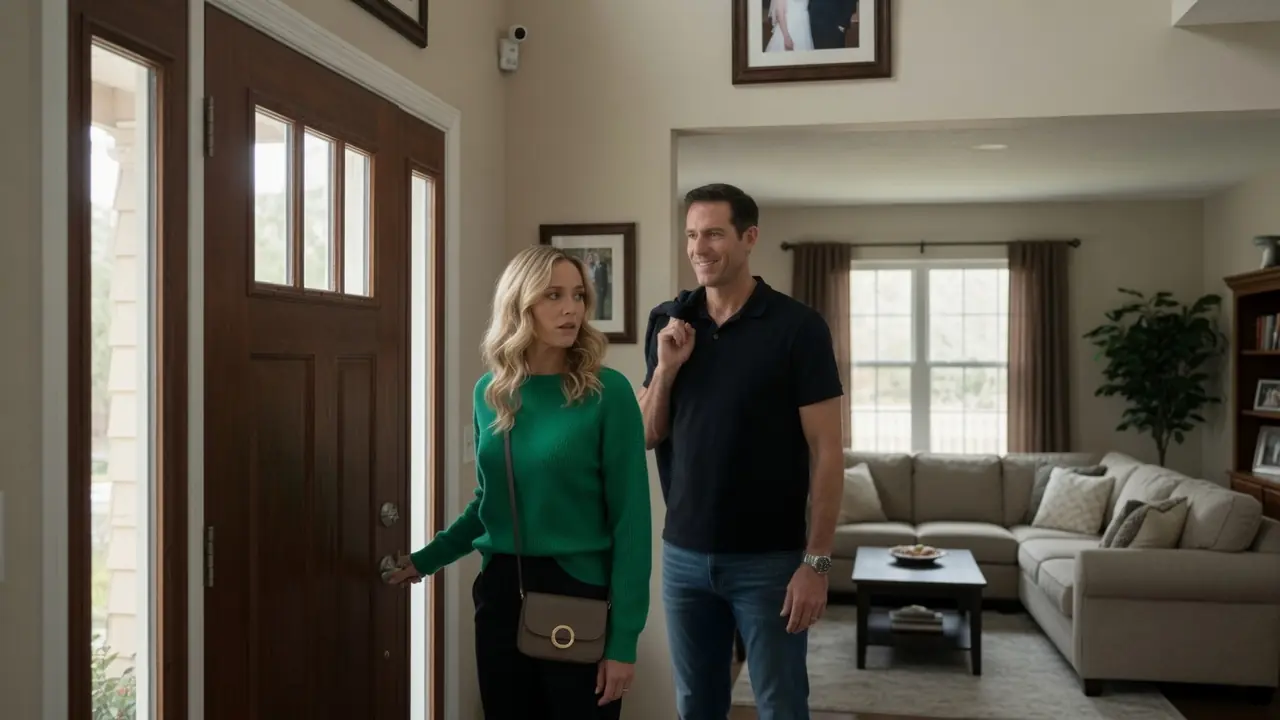
Sarah Carter opened the front door like she had done a hundred ordinary times before, but that morning there was nothing ordinary about the way her fingers tightened around the handle. The house behind her was spotless, almost painfully clean, with beige walls, framed wedding photos, and the faint scent of lemon polish hanging in the air. She wore a loose white blouse, dark jeans, and the small brown crossbody purse Henry had bought her during their anniversary trip to Asheville. For a moment, she looked like the same woman in the photographs on the wall, smiling beside her husband as if loyalty were something permanent.
Brad Miller stood on the porch with a dark jacket slung over his shoulder and a smile that was far too comfortable for a man entering another husband’s home. He was a neighbor from two streets over, the kind of man who waved at mailboxes, borrowed tools he never returned on time, and spoke with the smooth confidence of someone who believed charm could erase consequences. Sarah glanced past him toward the quiet street, then pulled the door wider. “Come in quickly,” she whispered, her voice low and sharp with nerves.
Brad stepped inside without hesitation, and the front door clicked shut behind him. The sound was soft, almost harmless, but it landed in the hallway like a confession. Above them, two wedding portraits hung in matching dark wooden frames, Henry and Sarah smiling beneath spring light, Henry’s arm around her waist, Sarah’s hand resting on his chest. Brad looked at the photos and gave a small laugh, not loud enough to be cruel, but careless enough to be ugly.
Sarah turned toward him quickly. “Don’t,” she said. “Not here.” Brad raised both hands, still smiling, as if he had done nothing wrong. “Relax, Sarah. He won’t be home for hours.” She wanted to believe that so badly that she ignored the uneasy feeling pressing under her ribs.
Henry Carter was supposed to be at work until seven that evening. At forty-two, he had built his life around routine, patience, and quiet responsibility. He managed night inventory at a regional warehouse outside Knoxville, a job that was not glamorous but paid the mortgage and kept the bills from swallowing them whole. He was the kind of husband who remembered oil changes, carried groceries in one trip, and still kissed his wife’s forehead before leaving for a long shift.
That day, a computer system outage shut down the warehouse early. Henry’s supervisor sent everyone home before noon, apologizing for the lost hours, but Henry did not mind. He had been exhausted lately, and the idea of surprising Sarah with lunch felt like a small blessing. On his way home, he stopped at Miller’s Barbecue, her favorite place, and ordered the pulled pork sandwich with extra pickles she always said she should not eat but always finished anyway.
He drove home with the takeout bag warm on the passenger seat and a quiet smile on his face. For the first time in weeks, he felt hopeful. Their marriage had been strained, not broken, at least that was what he kept telling himself. Sarah had seemed distant, distracted, protective of her phone, but Henry had blamed stress, bills, and the long ache that comes when two people love each other but stop speaking honestly.
When he turned onto their street, he noticed Brad’s gray sedan parked half a block away beneath a large oak tree. It was not in front of their house, not in the driveway, not anywhere a guest would normally park. Henry slowed only for a second, then continued forward, his hands steady on the wheel. A strange stillness moved through him, the kind that arrives before the mind is ready to name what the heart already understands.
He pulled into the driveway and turned off the engine. The house looked peaceful from the outside, with trimmed hedges, clean windows, and two rocking chairs on the porch Sarah had insisted made the place feel Southern. Henry picked up the takeout bag and walked toward the front door. Before he reached it, he saw movement through the narrow glass panel beside the door.
Sarah was standing in the entryway, facing Brad. She was too close to him, close enough that Henry did not need to hear a single word to understand the shape of the moment. Brad leaned forward slightly, smiling in that lazy, confident way Henry had seen at neighborhood cookouts. Sarah’s face was tense, but she did not step away.
For one wild second, anger rose in him so fast that it seemed to empty the air from his lungs. He imagined throwing the door open, shouting until the whole street came running, demanding answers from both of them while the barbecue went cold on the porch. But then Sarah turned her head slightly, and Henry saw something worse than passion on her face. He saw familiarity.
This was not a mistake that had happened once. This was not a moment that had slipped out of control. The way Brad stood in that hallway, comfortable beneath Henry’s roof, told Henry everything. This man had been inside before.
Henry stepped back from the door without making a sound. He walked to the side of the house, set the takeout bag carefully beside the trash bin, and stood there with his eyes closed. His chest hurt, but he did not cry. The pain was too fresh for tears, too clean and sharp, like glass that had not yet drawn blood.
He got back into his truck and drove away before either of them knew he had come home. He drove for nearly an hour, past gas stations, pawn shops, churches, and strip malls, with no direction except away. At a red light, he looked at his wedding ring and laughed once, a small broken sound that startled him. Then he stopped laughing and made a decision that changed everything.
Henry would not beg. He would not shout. He would not give Sarah and Brad the satisfaction of turning him into the angry husband they could blame for everything later. If they had built their secret inside his home, then he would answer with silence, patience, and proof.
When Henry returned home that afternoon, Brad’s car was gone. Sarah was in the kitchen wiping down the counter with frantic little circles, even though the counter was already clean. She looked up when he entered, and her smile appeared half a second too late. “You’re home early,” she said, trying to sound casual.
“System went down at work,” Henry replied. His voice came out calm, almost gentle. Sarah nodded too quickly and turned toward the sink, pretending to rinse a glass. Henry watched her shoulders rise and fall. For years, he had believed he knew every version of his wife, but now he was looking at a stranger wearing familiar perfume.
“I thought I’d surprise you with lunch,” he said. Sarah froze for a moment, then glanced toward his empty hands. “Oh,” she said. “Where is it?” Henry looked at her for a long second. “I lost my appetite.”
That night, Sarah acted like nothing had happened. She made pasta, asked about work, complained about a neighbor’s barking dog, and even touched Henry’s arm while passing him a plate. Henry answered when he needed to and smiled when silence would have looked suspicious. Every word between them felt like furniture arranged over a cracked foundation.
After dinner, Sarah went to the bedroom and stayed there with her phone. Henry sat in the living room beneath their wedding portraits and stared at the hallway where he had seen her with Brad. The house was quiet, but not peaceful anymore. It felt like a stage after the actors had left, with all the props still in place and the lie still hanging in the air.
The next morning, Henry called in sick. Sarah left at ten for what she called errands, though she dressed better than errands required. Henry waited until her car disappeared, then walked slowly through the house with a notebook in his hand. He wrote down things he had once ignored: the basement door that was always locked lately, the guest towels washed twice a week, the faint smell of unfamiliar cologne near the hallway.
He did not break anything. He did not search wildly. He moved through each room like a man counting what was already missing. In the bedroom, he found a receipt tucked behind Sarah’s jewelry tray, folded so tightly it might have been hidden by guilt alone.
It was from a small hotel outside town, dated two weeks earlier. One room, one night, paid in cash. Henry stared at it until the numbers blurred, then took a photo and placed it exactly where he had found it. He was learning that betrayal leaves fingerprints everywhere, especially when the betrayer believes the victim is too trusting to look.
Over the next week, Henry became the perfect husband. He brought home groceries without being asked. He listened when Sarah talked. He kissed her cheek before work and asked if she needed anything from town. Sarah relaxed little by little, mistaking his calm for ignorance.
Behind that calm, Henry was building a wall of evidence. He checked bank statements, phone records on their shared plan, calendar patterns, and the security camera footage from the small doorbell camera they had installed the previous winter. He did not need to spy on private moments or chase humiliation. He only needed enough to prove what Sarah would deny.
Brad appeared more often than Henry expected. His car passed their street at strange hours, sometimes circling the block before parking under the oak tree. Once, the doorbell camera caught his shoulder and the edge of his face as Sarah opened the door. Another time, a reflection in the hallway mirror showed him entering while Sarah laughed softly, the wedding photos visible behind them like witnesses.
Henry saved everything in three places. He copied files to a secure drive, emailed documents to himself, and placed printed copies in a folder at work. The more he gathered, the quieter he became. His anger did not disappear, but it changed shape, hardening into something controlled.
On Friday, Henry met with a divorce attorney named Marlene Brooks in a glass-walled office downtown. She was in her late fifties, sharp-eyed, plainspoken, and impossible to impress. Henry laid the folder on her desk without drama. “I need to know what my options are,” he said.
Marlene read in silence. She looked at the hotel receipt, the doorbell images, the phone records, and the financial statements. When she finished, she removed her glasses and studied Henry carefully. “You’re calmer than most people who sit in that chair,” she said.
“I’m not calm,” Henry replied. “I’m just finished being careless.” Marlene nodded, as if that answer made more sense than any tears would have. She explained the process clearly: separation, financial protection, documentation, property division, and what he should not do under any circumstances. “Do not threaten her,” she said. “Do not confront him physically. Do not give them a story where you become the villain.”
Henry listened to every word. That last sentence stayed with him all the way home. Do not give them a story where you become the villain. He realized then that his revenge would not be loud. It would be clean, legal, and impossible to twist.
Two days later, Sarah told Henry she wanted to host a small dinner at the house. She said it might be good for them to reconnect, to invite a few neighbors, make things feel normal again. Henry almost laughed at the word normal, but he only nodded. “Sure,” he said. “Let’s make it special.”
Sarah seemed relieved. She invited Brad and his wife, Lisa, along with two other couples from the neighborhood. Henry watched her type the messages with careful innocence. She did not know that Lisa had already called Henry three days earlier.
Lisa Miller was not stupid. She had noticed the same patterns from the other side: Brad’s sudden errands, his guarded phone, his new attention to clothes, the way he stepped outside to answer calls that lasted only seconds. When Henry contacted her gently, offering proof but not pressure, Lisa went silent for a long time. Then she said, “Send me what you have.”
By the time Sarah planned the dinner, Lisa knew enough to attend for one reason only. She wanted to see Brad lie to her face one last time. Henry and Lisa agreed on boundaries: no screaming, no public cruelty, no children present, no drama beyond the truth itself. The truth would do enough damage on its own.
The dinner took place on a Saturday evening. Sarah set the table with white plates, cloth napkins, and the blue glass candleholders she used whenever she wanted the house to look warmer than it felt. She wore the same white blouse Henry had seen her wearing the day Brad came in. Henry wore a dark button-down shirt and moved through the house helping calmly, as if he were preparing for guests instead of the end of his marriage.
Brad arrived with Lisa at six-thirty. He smiled too broadly when Henry opened the door. “Good to see you, man,” Brad said, clapping him lightly on the shoulder. Henry looked at Brad’s hand, then at his face. “Come in,” he said.
Sarah greeted Lisa with a hug that made Lisa’s jaw tighten. Lisa smiled anyway, controlled and unreadable. The other neighbors arrived soon after, filling the house with ordinary sounds: greetings, laughter, chairs scraping, ice dropping into glasses. To anyone watching from outside, it looked like a normal dinner among friends.
But Henry noticed everything. Sarah avoiding Brad’s eyes too carefully. Brad glancing at her whenever he thought no one was looking. Lisa turning her wedding ring slowly around her finger. The whole room seemed balanced on a thin piece of glass, and Henry was the only one holding the hammer.
For the first hour, they ate and talked. Sarah served roast chicken, green beans, and mashed potatoes with a brightness that almost looked real. Brad told a story about a work client and made everyone laugh. Henry laughed too, softly, at exactly the right moment.
After dinner, Sarah began clearing plates. Henry stood and said, “Leave them for a minute.” The room quieted just slightly. Sarah looked at him with confusion. “Henry, what are you doing?”
“I want to show everyone something,” he said. His voice was calm enough that no one moved. He walked to the living room console and picked up a slim folder and a small remote. The television screen on the wall lit up, showing not a video at first, but a simple photograph of Henry and Sarah on their wedding day.
Sarah’s face softened with surprise, then suspicion. “Henry,” she said, forcing a laugh. “What is this?” Henry looked at the picture for a moment. “This was taken eight years ago,” he said. “I used to think it was the happiest day of my life.”
The room became still. Brad leaned back in his chair, smile fading. Lisa looked straight ahead. Sarah’s hand tightened around the back of a dining chair.
Henry clicked the remote. The wedding photo changed to a doorbell camera image of Brad stepping into Henry’s house. The timestamp glowed in the corner. No one spoke. Sarah’s face drained of color so quickly that she seemed to shrink in place.
Henry clicked again. A second image appeared, then a third: Brad’s car parked beneath the oak tree, Sarah opening the front door, the reflection in the hallway mirror, the hotel receipt. The evidence moved across the screen in clean, silent order. There was no shouting, no insult, no performance. That made it worse.
Brad stood abruptly. “Turn that off,” he said. His voice cracked on the last word. Henry looked at him with cold patience. “Sit down, Brad.”
“You have no right,” Brad snapped. Lisa finally turned toward him. “No,” she said quietly. “He has every right.” Brad looked at his wife, and for the first time that night, he seemed to understand that the trap had not been built for Sarah alone.
Sarah stepped toward Henry, tears already forming. “Please,” she whispered. “Not like this.” Henry looked at her, and the sadness in his eyes was deeper than anger. “You invited him into our home, Sarah. You stood under our wedding photos with him. You don’t get to choose the room where the truth comes out.”
One of the neighbors pushed back from the table, uncomfortable but unable to look away. Another lowered her eyes, embarrassed for everyone. The living room light shone evenly over them all, turning the clean suburban home into a place of judgment. Sarah covered her mouth with one trembling hand.
Henry clicked one final time, and a document appeared on the screen. It was not a photograph. It was a legal filing. Petition for dissolution of marriage.
Sarah stared at it as if the words were written in a language she had never learned. “Henry,” she said, her voice breaking. “You already filed?” He nodded. “This afternoon.”
Brad cursed under his breath and grabbed his jacket. Lisa stood at the same time, but not to follow him blindly. She placed a folder of her own on the table. “Mine is filed Monday,” she told him. “And you can explain to your lawyer why your messages are already printed.”
Brad looked around the room, searching for sympathy and finding none. The same confidence he had brought into Henry’s house collapsed into panic. “This is insane,” he said. “You two planned this?”
Henry answered before Lisa could. “No, Brad. You planned it. We just stopped being the last people to know.” That sentence landed harder than any shout.
Sarah began crying openly now, but Henry did not move to comfort her. Once, he would have crossed the room for the smallest tremble in her voice. Once, he would have forgiven a sharp word, a forgotten promise, a bad day stretched too far. But this was not a bad day. This was a secret life built inside the home he had paid for with years of labor and faith.
The guests left quietly, one couple at a time. No one asked for details. No one tried to defend Sarah. The door closed behind the last neighbor, and the house returned to silence.
Sarah stood in the middle of the living room, mascara streaking her cheeks. Brad was gone, chased out not by fists or threats, but by the full weight of exposure. Lisa had left separately, calm and pale, carrying her folder like a woman carrying proof of her own escape. Henry turned off the television.
“Are you proud of yourself?” Sarah asked suddenly. Her voice was sharp now, desperate for a way to make him cruel. “You embarrassed me in front of everyone.” Henry looked at her for a long moment. “No,” he said. “You embarrassed yourself. I just stopped hiding it for you.”
She flinched as if the words had struck something deeper than pride. “I made a mistake,” she said. Henry shook his head. “A mistake is forgetting an anniversary. A mistake is saying something ugly in an argument. You opened the door for him more than once.”
Sarah looked toward the hallway, toward the wedding pictures. “I was lonely,” she whispered. Henry’s face changed then, not softening exactly, but closing with finality. “So was I,” he said. “But I didn’t bring someone else into our home.”
That was the sentence that ended the conversation. Sarah tried to speak again, but nothing useful came out. Henry walked upstairs, took the suitcase he had already packed from the guest closet, and carried it down. Sarah watched him as if the sight of the suitcase hurt more than the divorce papers.
“You’re leaving tonight?” she asked. “Yes.” “Where will you go?” Henry paused at the front door. “Somewhere that doesn’t ask me to pretend.”
He stayed at a small hotel near the interstate for the next week. The room was plain, with stiff pillows and a humming air conditioner, but it was honest. No wedding photos looked down at him there. No one lied in the hallway.
The first night, Henry sat on the edge of the bed and waited for grief to come cleanly. It did not. It came in pieces: rage while brushing his teeth, shame while turning off the lamp, sadness when he realized he did not need to text Sarah goodnight. Betrayal did not arrive like a storm and then pass. It lingered like smoke in clothes.
Sarah called twenty-three times in two days. Henry did not answer. She sent messages that moved from apology to blame to panic and back again. She said Brad meant nothing. She said Henry had been distant. She said public exposure was cruel. She said she still loved him.
Henry forwarded every message to Marlene Brooks. He stopped reading them after the fourth one. Love, he was learning, could become a word people used when consequence finally arrived. It did not mean the same thing as loyalty.
Brad tried a different approach. He sent Henry one message from an unknown number. You ruined my marriage over something that wasn’t your business. Henry read it twice, then showed it to Lisa and Marlene. Lisa replied to Brad herself with one sentence: You ruined your marriage when you walked into another man’s house.
Within a month, the neighborhood knew enough. People did not say much directly to Henry, but they became gentler with him. Mrs. Alvarez from across the street left a casserole on his hotel front desk with a note that said, You deserved better. A man from two houses down offered to help him move his tools from the garage. Even silence changed shape around him.
Sarah stayed in the house for a while, but she stopped opening the curtains. The same windows that once framed her carefully polished life now made her feel watched. Brad moved out of his home after Lisa changed the locks with her attorney’s approval. The oak tree where he used to park became a neighborhood landmark no one mentioned by name.
The divorce was not quick, but it was clean. Henry had prepared too well for confusion. The evidence did not give him everything, but it protected him from being painted as unstable, cruel, or unreasonable. Sarah’s attorney tried to argue that Henry’s dinner reveal was unnecessary, but Marlene simply placed the timeline on the table and said, “My client chose witnesses because your client chose secrecy.”
In mediation, Sarah looked smaller than Henry remembered. She wore a gray sweater, no necklace, no wedding ring. For a second, he saw the woman from the photographs again, the one who had danced barefoot in their first apartment and cried when they adopted their first rescue dog. Then she looked away, and the memory released him.
“I never thought you would really leave,” Sarah said during a break. Henry stood near the window with a paper cup of bad coffee in his hand. “That was the problem,” he replied. She looked at him then, really looked, and he saw that she finally understood at least part of it. She had mistaken his patience for weakness.
By winter, the house was sold. Henry did not keep the wedding portraits. He placed them in a box with Sarah’s remaining things and left them for her to collect. The new owners painted the entryway a pale green and removed the old frames from the wall. Henry was grateful when he heard that from the realtor, though he did not say why.
He moved into a smaller brick rental on the other side of town. It had hardwood floors, a narrow kitchen, and a porch that caught the morning sun. He bought only what he needed at first: a bed, a table, two chairs, and a coffeemaker. The emptiness felt strange, but not lonely in the same way the marriage had become lonely.
Lisa Miller became an unexpected friend. They did not become lovers, not the way gossip might have wanted. They met sometimes for coffee, speaking honestly about lawyers, shame, anger, and the strange humiliation of being betrayed by people who expected forgiveness as a convenience. There was comfort in being understood without having to explain every wound.
One evening, nearly six months after the dinner, Henry returned to the old neighborhood to pick up a forwarded package from Mrs. Alvarez. He parked beneath the same oak tree where Brad had once hidden his car. The sight no longer made his chest tighten. It only reminded him of how quietly people sometimes destroy what others spent years building.
Mrs. Alvarez hugged him at the door. “You look better,” she said. Henry smiled. “I think I am.” She handed him the package and a small paper bag of cookies. “For the road,” she said, pretending not to be emotional.
As Henry walked back to his truck, he looked once at the house he used to own. The porch chairs were gone. The curtains were different. A child’s bicycle leaned near the garage, bright red against the driveway.
For the first time, Henry felt no claim over the place. It was not his home anymore, and maybe that was a mercy. The betrayal had happened there, but it had not ended him there. He had walked away before the lie could teach him to hate himself.
His phone buzzed as he started the truck. It was a message from Sarah, the first in weeks. I know you may never forgive me, it said. But I am sorry for what I brought into our home.
Henry read the message once. He did not feel the old surge of anger. He did not feel the desperate need to answer either. After a moment, he deleted it.
Some apologies arrive too late to repair anything, but that does not make them meaningless. Henry hoped Sarah meant it, not because he wanted her back, but because truth should change a person if it arrives hard enough. Still, her regret was no longer his responsibility. Her loneliness was no longer his assignment.
He drove home through the quiet streets of Knoxville, past porch lights and closed diners and families settling into their evenings. His new place waited for him with its narrow kitchen and honest silence. There would be no dramatic victory waiting there, no crowd applauding, no perfect ending wrapped in justice. But there would be peace.
That was what Sarah and Brad had never understood. Henry’s silence had not been weakness. It had been the space where he gathered his dignity, counted the cost, and chose a revenge that left his hands clean. They expected him to break in front of them, but instead, he let the truth stand up straight.
By the time he reached his porch, the sky had turned deep blue. Henry carried the package inside, set the cookies on the counter, and turned on a lamp. The room filled with quiet light. For the first time in a long time, the silence did not feel like betrayal.
It felt like freedom.