On Christmas Eve, I sat alone in a freezing house waiting for my 10 daughters to return for dinner. Instead of a doorbell, I received a text from my eldest. “We have no obligation to compensate for your loneliness.” I had devoted my life to raising them. Yet only 2 years after my wife’s death, they chose luxury parties over their aging father.
The pain was sharp, but it awakened me. I realized I had confused sacrifice with enabling. The next morning, I executed a long prepared plan. 76 missed calls followed. Thousands of pleas. I answered none. It was time for them to understand who truly held the power of choice.
I stood in the kitchen doorway, hands resting on the frame. The dining room table stretched before me. 10 white plates arranged in a perfect circle. Each one waited empty and patient under the soft glow of Christmas lights I’d strung up 3 days ago. The turkey sat in the center, golden and gleaming.
Mashed potatoes steamed in the serving bowl. Cranberry sauce caught the light, deep red and glossy. The apple pie cooled on the counter behind me, filling the house with cinnamon and memory. Everything was ready. Everything except the people who were supposed to be here.
The clock on the wall ticked. That was the only sound. No laughter, no footsteps on the porch, no car doors slamming in the driveway. Just the steady mechanical rhythm of time passing second by second in a house that felt too big and too quiet. I’d set the table at 3:00 that afternoon.
10 plates, 10 forks, 10 knives, 10 napkins folded the way Martha taught me. Crisp triangles that looked almost elegant. I’d even put out the good glasses, the crystal ones we only used for special occasions. This was supposed to be special. This was supposed to be the first Christmas in 3 years where all 10 of my daughters came home.
But the driveway stayed empty. The porch stayed dark. And my phone, sitting face up on the counter, stayed silent. I walked to the table and adjusted one of the forks. It didn’t need adjusting. I just needed something to do with my hands.
Something to keep me from checking my phone again. I’d already checked it 17 times in the past hour. No messages, no missed calls, nothing. The wind picked up outside, rattling the windows. Snow had started falling an hour ago, light flurries that danced in the street light glow.
Now it was coming down heavier, thick flakes that stuck to the driveway and the bare branches of the oak tree in the front yard. The weather forecast had called for it. Winter storm moving in. Travel not recommended after 6:00. It was almost 6:00 now.
I turned back to the table. 10 plates. 10 empty chairs. I could picture them all sitting there the way they used to when they were younger. Margaret at the head, bossy even as a child. Elizabeth beside her, always the peacemaker.
Rebecca, quiet and thoughtful. Rachel, the baby, laughing at something one of her sisters said. They’d filled this house once, filled it with noise and chaos and life. Now the house was just mine. Mine and the silence.
It had been 3 years since Martha died. 3 years since that last Christmas when she sat on the couch in a blanket that swallowed her whole. Too weak to help with dinner, but too stubborn to stay in bed. The girls had been here that year, all 10 of them. They’d flown in from across the country, crowded into this house, cooked and laughed and cried and held their mother’s hand.
I remembered the moment she pulled me aside late that night after the girls had gone to bed. She’d asked me to sit with her by the tree. The lights had been the only thing illuminating her face, casting shadows under her eyes. She’d taken my hand. Her fingers were cold, thin, fragile as bird bones.
But her grip was strong. “George,” she’d said, “promise me something.” I’d nodded. I would have promised her anything. “If they forget you after I’m gone,” she’d continued, her eyes locked on mine, “don’t let them take you for granted.”
I’d started to protest. “They won’t forget. They’re our daughters.” She’d smiled at that. A sad, small smile that didn’t reach her eyes. “I hope you’re right. But if I’m not,” she’d squeezed my hand, “you’ll know what to do.”
I hadn’t understood what she meant. Not then. But I was starting to now. The furnace kicked on, or tried to. I heard the familiar hum, the click of the ignition, and then nothing. The hum died. The house stayed cold.
I walked over to the thermostat in the hallway. The little screen blinked red. Error. I pressed the reset button. Waited. Nothing. The temperature reading dropped another degree. 63. 62.
I went down to the basement. The furnace sat in the corner, old and reliable for 30 years until tonight. I checked the pilot light. Out. I tried to relight it. The spark clicked, caught, died. Clicked again, nothing.
Outside, the wind howled louder. I climbed back upstairs. The kitchen felt colder than it had 10 minutes ago. I pulled my cardigan tighter around my chest. The turkey was starting to lose its shine. The mashed potatoes weren’t steaming anymore.
The cranberry sauce sat there perfect and untouched like a prop in a play no one was watching. I walked to the window and looked out at the snow. It was coming down in sheets now, thick and fast, erasing the driveway, the yard, the road beyond. The street lights glowed orange through the white curtain.
My phone buzzed. I spun around, hope flaring in my chest. But it wasn’t a call. Just a weather alert. Winter storm warning in effect until midnight. Avoid travel. Stay indoors.
I set the phone back down. The screen went dark. I thought about calling them. Margaret, Elizabeth, any of them. Just to check in. Just to see if they were coming. But I didn’t. Because I already knew the answer.
If they were coming, they’d be here by now. I’d heard plenty of excuses over the past 3 years. Work, traffic, kids, plans, always something. Always a reason why they couldn’t make it for Sunday dinner or my birthday, or just a phone call that lasted longer than 5 minutes. I told myself it was fine. They were adults. They had lives.
But this was Christmas. This was the one day I’d asked. I walked back to the table. 10 plates. 10 empty chairs. I pulled out the chair at the head of the table and sat down. The wood creaked under my weight.
The house settled around me, groaning in the cold. The clock ticked. The wind howled. The snow fell. And somewhere deep in the back of my mind, I heard Martha’s voice. Soft. Certain. “You’ll know what to do.”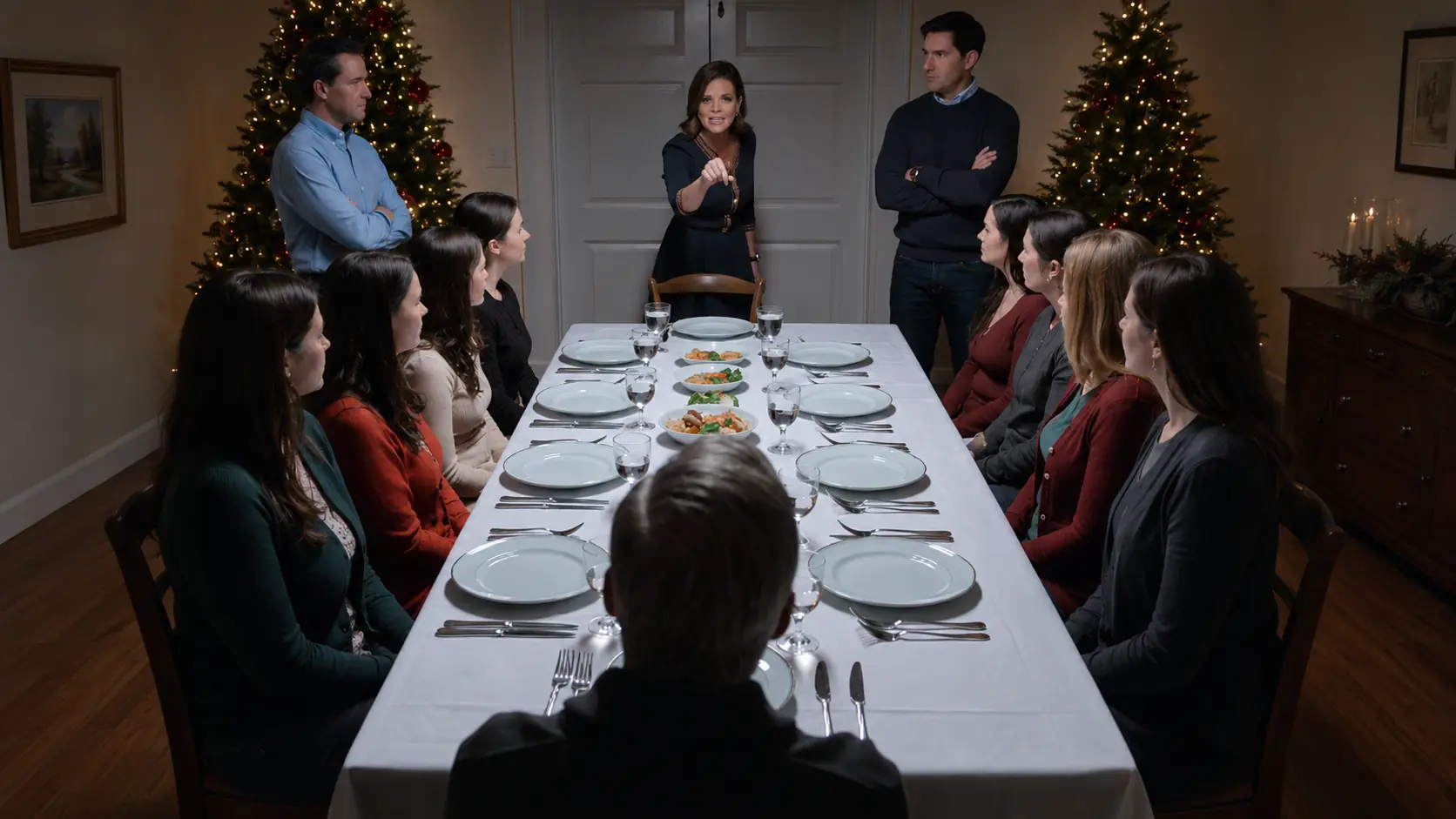
I looked at the 10 plates, the cold food, the silent phone. The house grew colder, and I realized with a clarity that felt almost physical that Martha had been right all along. I sat on the couch with my phone in my lap, watching the screen like it might suddenly come alive. The living room felt smaller than usual, the walls pressing in with every minute that passed.
Outside, the snow kept falling. Inside, the silence stretched. My fingers were numb. Not from the cold, though the house was losing heat fast without the furnace. It was the kind of numbness that comes from holding still too long, from waiting for something you already know isn’t coming.
The phone buzzed. Finally. I picked it up so fast I almost dropped it. Rachel. My youngest. 25, still calling me every Sunday to ask how to cook a roast or fix a leaky faucet. I swiped the message open.
Dad. I’m so sorry. Got stuck at work. Boss needs me to cover tonight. Rain check. It’s okay, sweetheart. Be safe. I set the phone down. Then it lit up again. Elizabeth. 38. The responsible one. David’s parents are hosting. Can’t skip it. Maybe next week.
Next week. As if Christmas happened twice. The phone buzzed again. Jennifer. Steven’s sick. Got to stay home with him. Sorry, Dad. Then Patricia. Kevin’s family emergency. Talk soon. The messages kept coming one after another. Each one a variation of the same excuse.
Catherine. Snowed in at a friend’s place. Roads are bad. I looked out the window. The roads were bad, but not impossible. Not if you really wanted to get somewhere. Amanda. Brian booked a surprise trip. Already at the airport. Nicole. Double shift at the hospital. You understand, right? Stephanie. Kids are sick. Can’t risk spreading it.
The phone rang. Actual ringing this time. I answered before the second ring. Rebecca. Hi, Dad. Her voice was soft, hesitant. Are you coming? She was quiet for a moment. Too long. I can’t. I’m sorry. I really am.
Why? Oh, it’s complicated. Complicated how? Another pause. I could hear her breathing on the other end, could picture her biting her lip the way she used to when she was little and didn’t want to tell me she’d broken something. I just can’t, Dad. I’m sorry.
She hung up before I could say anything else. I set the phone on the coffee table, stared at it. 10 daughters, 10 excuses. Some of them might have even been legitimate, but that didn’t change the fact that I was sitting here alone with a table full of food no one was going to eat.
The clock on the mantel said 9:30. I’d been sitting here for over 2 hours, waiting, hoping, fooling myself into thinking that maybe one of them would surprise me. But no one came. The phone buzzed one more time. I almost didn’t pick it up. I’d had enough.
But something made me look. Margaret. My oldest. 40 years old. The one who used to climb into my lap when she was little and make me promise I’d never let anything bad happen to her. The one who’d called me crying when her first boyfriend broke her heart, when she didn’t get into her top choice college, when she found out she was pregnant with her first kid.
I opened the message. No apology. No explanation. Just a wall of text in all caps like she was shouting at me through the screen. “We don’t owe you company just because you’re lonely, Dad. You need to understand that we have our own lives now. Stop guilt-tripping us.”
I read it once, twice, three times. Each word hit like a fist. Not the kind that leaves bruises you can see. The kind that knocks the air out of you and leaves you gasping. It was like a backdraft. Sudden, overwhelming, breathtaking.
I set the phone down. My hands weren’t shaking. They should have been, but they weren’t. I just sat there staring at the screen until it went dark. Guilt-tripping. That’s what she thought this was. Me sitting here with a table full of food I’d spent all day making waiting for my daughters to show up because I’d asked them to, because I thought just once they might want to be here.
I stood up. My knees cracked. My back ached. 60 years of wear and tear, of carrying people out of houses that were falling apart, of running toward danger when everyone else was running away. And now I was standing in my own house alone because the people I’d spent my whole life protecting couldn’t be bothered to show up for dinner.
Something shifted in my chest. Not anger, not even sadness, just clarity. The kind that cuts through everything else and leaves you seeing things exactly as they are. I walked to the dining room. The 10 plates were still there. The food was cold now.
The turkey had lost its shine. The mashed potatoes had a film on top. The cranberry sauce sat there untouched like a monument to wasted effort. I didn’t clean it up. I didn’t cover it. I just turned around and walked toward the bedroom.
Behind me the house was silent. The Christmas lights blinked on and off casting shadows across the walls. The clock ticked. The wind rattled the windows and somewhere in the back of my mind I heard Martha’s voice again, clear as day. “You’ll know what to do.”
I did. I finally did. The house settled around me as midnight approached. I’d turned off the Christmas lights an hour ago. The blinking had started to feel less festive and more like a reminder of everything that wasn’t happening.
Now the only light came from the lamp on the side table casting long shadows across the living room floor. I walked to the kitchen and opened the cabinet above the refrigerator. The bottle was where I’d left it 3 years ago, tucked in the back behind the whiskey I never drank. Pinot Noir. Martha’s favorite.
We’d bought it together on our last anniversary, back when she could still walk without help, back when we thought we had more time. I carried the bottle to the living room and set it on the coffee table. The cork came out with a soft pop. I poured a glass watching the dark red liquid catch the lamplight.
I lifted the glass. The wine smelled like earth and cherries and something else I couldn’t name. Something that reminded me of autumn evenings on the porch of Martha’s hand in mine, of the life we’d built before everything fell apart. A merry Christmas, Martha. I said to the empty room. You were right.
I drank. The wine was smooth, almost sweet with a bite at the end that made me wince. I wasn’t much of a wine drinker. Never had been. But Martha had loved it, so I’d learned to tolerate it. Her picture sat on the mantel. I’d taken it 5 years ago at Rebecca’s wedding.
Martha was wearing a blue dress that matched her eyes, her smile bright even though I knew she’d been tired that day. I raised the glass to the picture. You knew they wouldn’t come, didn’t you? The photo didn’t answer, but I could hear her voice in my head anyway, clear as if she were sitting right next to me.
The memory hit me without warning. Not the gentle kind that drifts in slowly, the kind that grabs you by the throat and won’t let go. October 2021. St. Mary’s Hospital. Room 314 on the oncology floor. Martha was in the bed by the window propped up on pillows that made her look smaller than she was.
The IV drip hung beside her, clear liquid flowing through a tube into her arm. She’d been there for 3 weeks by then. The treatments weren’t working. The doctors had stopped using words like remission and started using words like comfortable and quality of life. I’d pulled a chair up next to her bed.
She turned her head to look at me and even though her face was drawn and pale, her eyes were sharp, alert. “George,” she’d said. “I’ve been thinking about the girls.” “What about them?” “They love us, but they’ve grown too comfortable. They expect everything, money, time, support, but they never ask how you are. They only call when they need something.”
I’d wanted to argue, but deep down I’d known she was right. “That’s not fair,” I’d said anyway. “They’re busy. They have their own lives.” “They do. And I’m proud of them for that. But after I’m gone, it’ll get worse. You’ll see.” “Don’t talk like that.”
She’d reached out and taken my hand. Her fingers were cold, thin, fragile. “Listen to me. I want you to test them. One Christmas after I’m gone. Don’t send gifts. Don’t send money. Just invite them. See who shows up. And if they don’t,” her grip had tightened, “then you’ll know. And you’ll be free.”
“Free from what?” “From waiting for people who aren’t coming.” I’d sat there holding her hand not knowing what to say. The machines had beeped softly in the background. “Promise me,” she’d said. “I promise.” She’d smiled then. A sad, small smile. “Good. Because I’m going to make sure you follow through.”
“What does that mean?” “You’ll see.” I came back to the present with the taste of wine still on my tongue. The living room was quiet. The clock on the mantel said 11:53. In 7 minutes it would be Christmas.
I stood up and walked down the hallway to the bedroom. The room smelled like dust and old wood and faintly of the lavender sachets Martha used to keep in the dresser drawers. I hadn’t changed much since she died. Her side of the closet still had her clothes hanging in it.
I knelt down in front of the dresser and opened the bottom drawer. Beneath the sweaters I never wore and the extra blankets there was a box, brown cardboard about the size of a shoebox with a label stuck to the top in Martha’s handwriting. Important. Open only when ready.
I’d found it a week after the funeral tucked away in her closet. She told me about it in the hospital in one of those quiet conversations we’d had in the last few weeks. She’d said she was leaving me instructions, a plan, something to help me when the time came. I hadn’t been ready to open it then. I wasn’t sure I was ready now.
But ready or not, the time had come. I lifted the box out of the drawer and carried it to the small desk by the window. I set the box down and stared at it for a moment, running my thumb over the label. Then I opened it.
Inside were papers, legal documents folded and organized with the kind of precision only Martha could manage. There was a letter on top in an envelope with my name written on the front. I recognized the handwriting immediately. Strong, neat, unmistakable.
I opened the envelope and unfolded the letter. The paper crinkled softly. “Dear George,” it began, “If you’re reading this, it means the test has begun. Here’s what you need to do next.” I stopped reading. Not because I didn’t want to know, but because I needed a moment.
Because once I read the rest of this letter, once I followed the instructions Martha had left for me, there would be no going back. Outside the wind howled. The snow kept falling. The house stayed cold.
And somewhere between the last sip of wine and the first line of Martha’s letter, something inside me settled. Not peace, exactly, but something close to it. A kind of acceptance, a kind of understanding. Clarity came like dawn, slow, inevitable, impossible to ignore.
I sat down at the desk and kept reading. Martha’s handwriting was precise even in those last weeks. The instructions were numbered, methodical, each step laid out with the kind of care she’d always brought to things that mattered. The first document in the box was a copy of the property deed, 47 Maple Street, Pinewood Heights.
I’d bought the house 32 years ago, back when Martha was pregnant with Margaret, and we needed more space. The deed had both our names on it then. Now it just had mine. I unfolded the paper and ran my finger down the typed lines. Current estimated value, $485,000.
The number felt abstract, like it belonged to someone else’s life. Next was the bank statement for our joint account. First National Bank. Balance, $25,000. Our emergency fund, the money we’d scraped together over the years for whatever life threw at us.
I set the statement aside and picked up the next paper. Life insurance policy. MetLife. Benefit amount, $600,000. Beneficiary, George Hutchison. The payout had come through in January of 2023, 3 weeks after Martha died. I deposited it straight into savings and tried not to think about what it represented.
Beneath that was a portfolio statement from Vanguard. $180,000 spread across mutual funds and bonds. Conservative investments, the kind that grew slowly but steadily. Below that, another statement. My old 401k from the fire department. $95,000.
I added the numbers in my head. The house, the emergency fund, the insurance payout, the investments, the retirement account. All told, somewhere north of $700,000. More money than I’d ever thought I’d have. More than enough to live on for the rest of my life if I was careful.
But there was more. Another set of papers clipped together with a binder clip that had started to rust at the edges. Monthly allowances. I recognized the heading immediately. Martha had started keeping track about 2 years before she died, when she’d noticed how often the girls were calling to ask for money.
She’d made a spreadsheet. Daughter, amount, date, reason. Margaret, $1,200 a month, sometimes more. Elizabeth, 900. Jennifer, 800. Patricia, a thousand. On and on, all 10 of them. Some months the total hit $10,000.
$10,000 a month going out to my daughters for rent and car payments and credit card bills and emergencies that never quite seemed to end. I stared at the numbers. 40 years of working, of saving, of planning for a future that was supposed to include Martha and me growing old together.
And here it was, leaking out month by month to daughters who’d stopped saying thank you years ago. I set the papers down and reached deeper into the box. My fingers brushed against something smooth and heavy. An envelope sealed with wax. Martha had pressed her initial into it. M for Martha.
I broke the seal carefully. Inside was a document official and dense with legal language. At the top, in bold letters, the Martha Eleanor Hutchison Irrevocable Trust. I read the date first. November 15th, 2022. One month before she died.
One month before that last Christmas, when all 10 girls had come home. The document was six pages long. I read it slowly, my eyes catching on words I half understood. Trust. Irrevocable. Beneficiary. Condition precedent.
The language was formal, precise, unforgiving. Martha had worked with Mr. Daniels on this. I skipped ahead, looking for the section that mattered. Section 3, subsection 1. Conditions precedent. The words were clear, unambiguous.
All 10 daughters were required to be present at a specific time and place. If the condition was met, the trust would be distributed according to schedule. If not, the entire amount would be transferred to the Pinewood Heights Community Foundation. I sat back in the chair. The wood creaked under my weight.
Outside the sky was starting to lighten, the deep black fading to a bruised purple. Martha had planned this. Every word. Every condition. She’d known they wouldn’t come. Or at least she’d suspected. And she’d built this test to prove it.
At the bottom of the page, in smaller print, “This trust has been irrevocable since its creation. No changes, amendments, or revocations may be made by any party after the date of execution.” I read that line three times. Irrevocable. Once the trust was created, it couldn’t be undone.
Not by me. Not by the girls. Not by anyone. Martha had made sure of that. I folded the document and set it aside. My hands were shaking. Not from cold, though the house was freezing now, from something else, something that felt like anger and grief and relief all mixed together.
I opened my laptop. The screen glowed blue in the dim room. The battery was low, but it had enough for what I needed to do. I opened my email and started typing. To [email protected]. Subject, trust activation. Christmas Eve, 2024.
I kept it simple, professional, the kind of email you send when you’re doing something that can’t be undone. Dear Mr. Daniels, I am writing to inform you that the conditions outlined in the Martha Eleanor Hutchison Irrevocable Trust have now been tested. As you are aware, the test date was set for December 24th, 2024.
None of my 10 daughters attended Christmas dinner tonight. I have documentation via text messages, calls, and timestamps. Per the terms of the trust, I am requesting that you proceed with the next steps as outlined in section 4.2 of the trust agreement. I will be available for a meeting at your earliest convenience.
Sincerely, George Hutchison. I read it over once, twice, then I hit send. The email disappeared from my screen. Sent. Delivered. Irreversible. I closed the laptop and looked out the window. The snow had stopped. The sky was lighter now, the first hint of dawn creeping over the roofline of the house across the street.
I pulled out a blank sheet of paper and a pen. My handwriting wasn’t as neat as Martha’s, but it was clear enough. Authorization to freeze joint accounts. Date, December 25th, 2024. Account holder, George Hutchison. Reason, pending legal review. I signed my name at the bottom.
The ink was still wet when I folded the paper and slipped it into an envelope. By sunrise, everything would change. The test was over. The reckoning had begun. The drive into town took longer than usual. The streets were slick with snow that had frozen overnight, and the plows hadn’t made it through all the neighborhoods yet.
I took my time, kept both hands on the wheel, and tried not to think about what I was about to do. Downtown Pinewood Heights was quiet. Most of the shops were closed for the holiday, their windows dark except for the Christmas displays that nobody was around to see.
I found a parking spot on Main Street, pulled in, and sat there for a moment with the engine running. The building was easy to spot. Three stories of red brick with a brass plaque beside the door that read, “Daniels and Associates, established 1987.” I’d been here before years ago when Martha and I had drawn up our wills. The place hadn’t changed much.
I turned off the engine and stepped out into the cold. The wind cut through my jacket sharp and bitter. I pulled the collar up and walked to the door. Inside, the air was warmer, but not by much. The reception area was small, just a desk and a few chairs with framed law degrees on the walls.
A woman sat behind the desk, older than me by a few years, with reading glasses on a chain around her neck. She looked up when I came in and smiled. “Mr. Hutchison?” “That’s me.” “He’s expecting you. Second door on the left.”
I nodded and walked past her. The hallway was narrow, lined with filing cabinets and framed photographs of Pinewood Heights from decades ago. The floorboards creaked under my feet. The second door was open. I stopped in the doorway and saw him sitting behind a heavy wooden desk surrounded by stacks of paper and legal books.
He glanced up, saw me, and stood. “George.” He was older than I remembered. 68, maybe 69 by now. His hair had gone completely white and he’d grown a beard that was more salt than pepper. But his eyes were the same. Sharp, focused. “Mr. Daniels.” “Come in. Sit down.”
I stepped inside and closed the door behind me. The office smelled like old paper and coffee. I took the chair across from his desk. The leather was cracked, but comfortable. He sat back down and folded his hands on top of a Manila folder. “I got your email. I figured let’s talk.”
He opened the folder. I recognized the papers inside immediately. The trust document, copies of everything I’d gone through the night before. “I’ve been Martha’s lawyer for 22 years,” he said. His voice was steady, calm, the kind of voice you trusted whether you wanted to or not. “She came to me in November of 2022, a month before she passed. She was very clear about what she wanted.”
“Did she really think they wouldn’t come?” He looked at me for a long moment. “She hoped they would, but she prepared for the worst. And she was right, wasn’t she?” I didn’t answer. I didn’t need to. He pulled out a sheet of paper and slid it across the desk. “Let’s review the facts. December 24th, 2024 was the test date. All 10 daughters were required to be physically present at your home by 6:00 in the evening.”
“You have documentation proving none of them attended.” “I do.” “Text messages, calls, timestamps, all of it.” He nodded. “Then per section 3.1 of the trust, the primary condition has failed.” I leaned back in the chair. “What happens next?”
He pulled out another paper. “I’ll send a formal notice to all 10 daughters informing them that the joint accounts are frozen effective immediately. This includes checking accounts, credit cards linked to your name, and monthly allowances.” “How long will the freeze last?” “Until you decide otherwise, or until the trust is fully executed.”
“And they can’t contest it?” “Not without proof of fraud, which they don’t have. Everything Martha did was legal, documented, witnessed by three people, notarized twice, and accompanied by a psychological evaluation confirming she was of sound mind.” He looked at me over the top of his reading glasses. “They can try, but they’ll lose.”
I let that sink in. “What about the house?” “The house is yours. Your name is on the deed. You can sell it, keep it, do whatever you want with it.” “And my pension, my savings?” “Yours, separate from the joint accounts. They have no claim to any of it.”
I nodded. The weight I’d been carrying since last night felt a little lighter. He pulled out three documents and set them in a row across the desk. “I need you to sign these.” I leaned forward. The first was titled Authorization to Freeze Accounts. Effective date, December 26th, 2024 noon.
The second was a notice to be sent to all 10 daughters, short and formal. “Your accounts have been temporarily frozen pending legal review. Contact the account holder for details.” The third was a timeline. Phase one, freeze accounts. Phase two, family meeting. Phase three, trust execution.
I picked up the pen he’d set out and signed all three. My handwriting looked shaky compared to the printed text, but it was legible. He collected the papers and slipped them back into the folder. “George, I have to warn you. When those accounts freeze, your phone is going to explode. They’ll call. They’ll threaten. They’ll beg. Are you ready for that?”
I thought about the 10 empty plates, the cold food, the years of waiting for people who never showed up. “I’ve been ready for 3 years.” He nodded. “Then let’s begin.” I stood. He stood. We shook hands across the desk. His grip was firm, solid, the kind of handshake that sealed something permanent.
“One more thing,” he said. “The freeze takes effect at noon. That gives you about 2 hours.” “2 hours for what?” “To prepare. Once that first card declines, they’ll know. And they’ll come looking for answers.” I nodded. “I’ll be ready.”
I walked out of his office past the receptionist who smiled and wished me a good day, out into the cold. The wind had picked up. The sky was gray, heavy with the promise of more snow. I got in my car and sat there for a moment staring at the dashboard. By noon, the first card would decline. By evening, they’d all know. And by the time the sun set, everything I’d built with Martha would be either proven or destroyed.
I started the engine and pulled out onto Main Street. There was no turning back now. When I got home, the house was exactly as I’d left it. The dining room table still held 10 empty plates. The food was long gone, scraped into the trash that morning, but the plates remained. I hadn’t been able to bring myself to put them away. Not yet.
I walked past them and into the small office off the hallway. The desk was cluttered with bills and old magazines. I cleared a space and pulled open the bottom drawer. Inside was a box of stationery Martha had bought years ago. Cream-colored linen paper, the expensive kind she used for thank you notes and condolence letters. Heavy, formal, the kind of paper that demanded to be taken seriously.
I took out 10 sheets and set them on the desk. Found a pen. Black ink, the kind that didn’t smudge. For 32 years, I’d run toward danger, toward houses that were falling apart, toward people who needed saving. This was different. This wasn’t running toward anything. This was walking away, and somehow that felt harder.
I picked up the pen and stared at the blank page. The first letter took me almost an hour. Not because I didn’t know what to say, because I knew too much. “Margaret, I remember the day you graduated from law school. You called me first. You said, ‘Dad, I did it. Thank you for believing in me.’ I still believe in you, but I can’t keep being your ATM. You’re 40 years old, married to a man with a good job, and yet every month you ask for just a little extra. Last month, it was $2,400. I’m not angry, I’m tired. The joint account is frozen. Your credit card linked to my name is frozen. From now on, if you want my time, you’ll have to give me yours first. I’m not asking you to choose between your life and mine. I’m asking you to remember I’m still here. Love, Dad.”
I folded the letter and slipped it into an envelope. Wrote Margaret’s name on the front. Set it aside. The second letter was easier, or maybe just different. “Rebecca, you were the only one who hesitated last night. I heard it in your voice when you called. You didn’t want to say no. You just did. I don’t know if that makes it better or worse. I’m not asking for an apology. I’m asking for honesty. If you knew why, didn’t you say something? The account is frozen, not as punishment, as a boundary. If you want to talk, really talk, you know where I am. Love, Dad.”
I folded it, wrote her name, moved on. The rest came faster. Not because they mattered less, because the pattern was the same. A memory, a truth, a boundary. Rachel, you were 5 years old when your mother taught you to ride a bike. You fell 17 times. Every time you got back up. I don’t know when you stopped trying. Last night, you said you were stuck at work. But your online photos say you were at a resort. The account is frozen. Not because I don’t love you. Because I do.
Elizabeth. Your wedding day. You asked me to walk you down the aisle twice because you wanted to get it perfect. But you can’t skip my Christmas dinner and still expect me to fund yours. Catherine. The summer you spent on my porch reading books and watching the sunset. You said you loved the quiet. I thought that meant something.
Jennifer. The night you called me crying because Steven lost his job. I sent you $3,000 the next day. No questions asked. I haven’t heard from you since. Patricia. You used to bring the grandkids over every Sunday. Then you got busy. I understand busy. But busy isn’t an excuse for 3 years.
Amanda. You told me Brian booked a surprise trip. But the tickets were bought 2 weeks ago. I saw the confirmation email. I still check your mother’s old address sometimes. Nicole. I know nursing is hard. I know the hours are long. But you found time to go to Catherine’s birthday party last month. You couldn’t find time for Christmas.
Stephanie. Your kids are sick. I believe you. But they were healthy enough for photos at the park yesterday. I’m not asking you to choose. I’m asking you to stop pretending you don’t have a choice. I folded each letter. Wrote each name. Lined them up on the desk like soldiers waiting for orders. 10 letters. 10 daughters. 10 ways of saying the same thing. I love you. But I’m done waiting.
The clock on the wall said it was almost 6. The light outside was fading. I picked up the letters and walked back to the dining room. The 10 plates were still there. I set one envelope in front of each plate. Margaret at the head of the table where she always used to sit. Rachel at the far end. The others spread between them. Each name facing the chair it belonged to.
I could have mailed them. Could have sent them certified. But I didn’t. I wanted them to find the letters here. In this house. At this table. The table where they should have been sitting two nights ago. I wanted them to see the empty plates. The cold chairs. The silence they’d left behind. I wanted them to understand what their absence looked like.
I stood there for a moment. Looking at the 10 envelopes arranged in a perfect circle. The Christmas lights blinked on and off reflecting off the white paper. Then I turned and walked upstairs. Behind me the letters waited. And somewhere out there so did my daughters.