I felt the weight of the room settle on my shoulders long before anyone stopped talking. The waiter placed the black leather check holder right in front of me, and every conversation around the long table seemed to evaporate into the chandelier's glow. Crystal glasses hung frozen in midair. Silverware halted, and for a moment, not even the background music dared to breathe.
Then Mara leaned toward me. Her perfume sweet, but her tone razor sharp. "Cash or card, Linda?" The question sliced through the silence, and my name felt like it had been pinned to the table for everyone to examine.
I sat there in the middle of a restaurant so expensive I could barely pronounce half the menu. Surrounded by people who pretended I belonged among them, Evan, my son, couldn't even look at me. His gaze stayed fixed on his untouched steak, like the lines of fat marbling it were suddenly fascinating enough to keep him from facing what was happening.
I am Linda Hail, 65 years old, and I've spent my entire life sewing dresses for women who never learned my name. But nothing prepared me for the humiliation wrapped neatly inside a single question. Cash or card.
If they expected me to break, they were about to learn they underestimated the wrong woman.
The morning it all began was cold enough to make the air sting. I remember waking to the thin hum of the heater, the little portable one Evan bought me months earlier, the one that sometimes flickered like it was deciding whether my comfort was worth the electricity it borrowed. I pulled the blanket tighter around my shoulders and stared at the ceiling.
A sheet of unfinished plywood nailed in place above my bed. It was the kind of ceiling meant for storing tools or holiday decorations, not for a woman to wake under every day.
A soft knock broke the silence. It wasn't the knock of someone visiting. It was the careful, hesitant knock of someone who wasn't sure he should be there. When I opened the door, Evan stood on the step with his hands shoved into the pockets of his jacket, his shoulders hunched as if he were trying to fold himself down to a size that fit the moment.
Eight months ago, seeing my son at the door would have warmed me. Now, all it did was remind me how far I'd fallen inside my own life.
"Hey, Mom," he said, forcing a smile that looked practiced in the rearview mirror. "Can we talk?" He didn't wait for an invitation. He stepped past me and into the tiny room, ducking slightly to avoid hitting his head on the low beam overhead.
His eyes drifted around the cramped space, the narrow cot, the stack of folded clothes at the foot of it, the single chair beside the small window that faced the fence. He didn't comment on any of it. He never did. And I never asked why. Some truths didn't need to be spoken to be understood.
"I didn't wake you, did I?" he asked, even though he clearly had. "No," I said, tightening my blanket. "I've been up." He nodded, only half believing me.
Then he took a breath. One of those deep, bracing breaths men take when they're about to say something they know won't land gently. "Mara's mom is having a birthday dinner this weekend," he began. "A big one. Kind of a family event. Mara wants you to come."
I stared at him, trying to read the hidden parts of his expression. Mara had barely spoken to me in months. She breathed in and out of the main house like she was allergic to the air around me. If she wanted me at anything, it wasn't out of affection.
"Why?" I asked quietly. He shrugged, eyes darting toward the wall. "She just thinks it'd be nice if everyone was together." The word together felt like a loose thread in a sweater. Pull it and the whole thing comes undone.
I looked around the tiny room, the room I'd been moved into temporarily. The room no one ever mentioned anymore. My throat tightened. "Evan," I said softly. "Is there something going on?" His jaw flexed. "Mom, please just say you'll come."
I wanted to ask more. I wanted to shake him to make him meet my eyes and tell me the truth behind the tightness in his voice, but I didn't. Mothers often choose the path that hurts less in the moment, even if it costs more later.
"All right," I said. "I'll go." Relief washed over his face too quickly, like someone exhaling after holding their breath for too long. He kissed my cheek and left without another word, the door clicking behind him with a finality that echoed.
When I was alone again, the room felt smaller than ever. I sat on the cot and pulled out the small metal box I kept beneath it. Inside were pieces of my life, photographs from years when laughter lived easily in our house. Scraps of fabric from dresses I'd sewn for customers who paid me in smiles and gratitude. Notes Evan had written as a child in crooked handwriting.
Things I couldn't bring myself to throw away even when Mara suggested I declutter. At the bottom was a folded dress, blue, simple. I had sewn it for myself a decade earlier, back when my hands were steadier and my heart lighter. I held it in my lap, smoothing the fabric with my thumb. It felt like touching a version of myself I didn't quite recognize anymore.
I spent the rest of the morning cleaning the room, even though it didn't need cleaning. I straightened the blanket, wiped the small counter where I kept my kettle, rearranged the books on the single shelf, all the rituals of someone trying to make sense of a space they never expected to occupy.
As the day faded into evening, I stood by the narrow window and watched the lights turn on in the main house. Warm yellow glows moved from room to room. My old rooms, the ones I had decorated, painted, filled with the smell of fresh bread on Sundays. I could see shadows pass in front of the curtains. Laughter drifted faintly through the fence boards. Laughter I was never close enough to join.
A gust of cold air seeped under the door, and I felt it like a reminder. Someday wasn't coming. The remodel wasn't ending. The house wasn't mine anymore. And yet, for reasons I couldn't explain, I still ironed the blue dress on Saturday morning. I still fixed my hair, still polished my shoes, still waited near the window for Evan's car to pull up.
Hope didn't fade quickly. Not in mothers. We carry it long after it's gone cold. When he finally honked from the driveway, I took a deep breath, smoothed my dress, and stepped outside. Something tightened inside my chest. A soft tug that felt like warning or instinct or both. I didn't know it yet, but that night would change everything.
When Evan pulled up to the curb outside the restaurant, the sky had already dipped into that deep blue that comes just before night fully settles. Street lights glowed like tiny moons along the sidewalk, and every window of Le Bell Lumiere shimmered with warm light. It was the kind of place where people went to celebrate promotions, anniversaries, engagements, moments worth remembering. I had never imagined myself walking into it as someone's burden.
Evan stepped out of the car quickly and hurried around to open my door, but the gesture felt more like obligation than care. I thanked him anyway. Habit. Some instincts survive long after they've stopped being earned.
As we approached the entrance, a pair of diners in expensive coats brushed past us, laughing in a way money often allowed people to laugh. Their perfume lingered in the air like something delicate and unreachable. Evan gave the doorman our reservation name, Mara's family name, not ours, and the man offered a polite nod before leading us inside.
The restaurant was breathtaking. Chandeliers scattered light across white tablecloths. Waiters flowed between tables with the quiet precision of dancers. Silver gleamed everywhere. The smell of butter and herbs drifted through the air, mingling with the faint sweetness of wine. I felt smaller with each step. Like the room itself was gently reminding me I didn't belong.
The hostess guided us through the dining room, past tables where people sipped champagne and leaned in to whisper about vacation homes or stock options. Their conversations floated around me like a foreign language. Then I saw the table, long, elegant, dressed in white linen, the one Mara's family had claimed at the far end of the room.
Mara stood to greet us, her smile wide and polished, the kind practiced in mirrors for events like this. She wore a champagne colored dress that matched her mother's, both silky and expensive looking. It was impossible not to notice the contrast between their glow and the simplicity of my blue dress.
"Linda," she said brightly, leaning in for a hug that barely grazed my shoulders. "We're so glad you made it." Her tone suggested the opposite. She directed Evan to sit beside her, then pointed me toward the farthest chair on the end. So far down the table, I could have been part of a different party altogether.
I took my seat quietly, smoothing my dress beneath me. The table filled quickly with noise, laughter bouncing between Mara's sisters, wine glasses chiming, cutlery clinking. Diane, Mara's mother, sat at the head of the table, observing it all with the calm presence of someone accustomed to hosting. She caught my eye for a moment and offered a small, polite smile. It was the only smile that didn't feel manufactured.
Menus were passed out, thick and heavy, the kind printed on paper you wouldn't dare fold. The dishes were described in French, followed by prices that made my hands tense around the edges of the page. I tried to hide the way my breath caught when I saw the cost of the entree, a single steak that cost more than my monthly allowance.
When the waiter came to take orders, Mara began, choosing a dish so elaborate the waiter nodded with admiration. Her sisters followed suit, selecting delicacies I couldn't even pronounce. Evan ordered without glancing at prices, slipping easily into the world he had married into.
When the waiter turned to me, I hesitated. Just the chicken soup, please. Mara leaned forward with a laugh so bright it hurt my ears. "Linda, you don't have to be modest. Tonight's special. Get something you'll enjoy." I forced a smile. "The soup is fine." The waiter nodded and moved on.
I could feel the stares, the quiet judgment, the curiosity about why I didn't order something grand. They didn't know, of course. They had no idea about the room behind the house, the hot plate, the two hundred dollar envelope handed to me every month like charity.
Dinner arrived in beautiful steaming plates. My soup was simple, delicate, aromatic. Theirs came in towers of lobster, steaks glistening with butter, arrangements of truffle and gold fleck garnishes. Their wine came in bottles so old the labels looked like parchment.
I sipped quietly, listening to talk of European trips, new cars, kitchen remodels, the kind of remodel that replaced countertops rather than an elderly woman's dignity. Each word pulled me further from the table, like I was shrinking into invisibility. No one asked me how I'd been. No one asked where I'd been living. They didn't care. I was background, silent, expected, decorative in the saddest way possible.
But amid the noise, Diane kept glancing toward me, not with pity, but with attention, like she sensed something beneath my stillness. At one point, she leaned slightly toward me across the distance separating us. "Linda," she said warmly, "How was your week?" It was the gentlest question I had heard in months. I swallowed. "It was fine." She nodded thoughtfully. "Good. I'm glad you're here."
I wanted to believe her. I really did. But even as she spoke, even as dessert menus appeared and laughter grew louder, a sharp unease curled in my gut, a warning, a whisper in the back of my mind telling me I wasn't invited here to be included. I was invited here to be exposed.
The night didn't tell me that directly, but the way everyone fell quiet when the waiter returned with the check, that told me everything. The room seemed to hush itself the moment the waiter set down the black leather check holder. It was subtle at first, a soft dip in conversation, a pause in the movement of hands and forks, but soon it spread like a ripple across the long table.
The waiter stepped back with a small bow, his expression carefully neutral, as if he sensed what was coming. The folder sat near Diane's place at the head of the table, positioned exactly where tradition would dictate, for a heartbeat. Everything felt almost normal.
Diane reached for it with a calm grace, the kind that matched her neatly styled hair and the pearl earrings she wore like second nature. She opened it without hesitation. Then something shifted in her expression. It wasn't shock and it wasn't annoyance. It was something quieter, something calculating.
Her gaze lingered on the total for a breath too long and then with a movement so smooth it felt rehearsed. She slid the check down the long table toward me. It stopped right in front of my plate.
At first, the gesture didn't register. My mind tried to make sense of it, tried to convince itself that Diane wanted me to look at it for some other reason. Maybe she needed a light. Maybe she wanted me to read something for her. But then I heard a soft snicker.
One of Mara's nephews, phone in hand, glanced at me like I had been cast in a role he wasn't sure I could pull off. Mara leaned forward, resting her elbows on the table. Her voice dropped into a tone sweet enough to rot every tooth in the room. "Cash or card, Linda?"
The words echoed in my ears, bouncing around inside me like they had nowhere else to go. I stared at the folder, at the simple black cover hiding whatever number lay inside. My throat tightened.
Evan didn't move. He didn't speak. He didn't even breathe. He just sat there, eyes fixed on his hands, as though looking at me would force him to admit something he wasn't ready to face.
I reached for the folder, my fingers trembling. When I opened it, the candle light reflected off the page, illuminating numbers I couldn't fully process at first. $8,043. I closed the folder carefully, as though the number might change if I handled it gently enough.
"I can't pay this," I said quietly. Mara's eyebrows lifted with a performance worthy display of surprise. "Why not? You live with us. You don't have bills."
"You I live in a utility room," I said, cutting her off. "Behind the house, 10 ft by 10 ft. There isn't even space to turn around without bumping into something." The table went still.
"I get $200 a month," I continued. "And I use it to buy groceries, soap, enough to get by, if that." Someone dropped a spoon. Someone else cleared their throat. The air seemed to thicken.
Evan finally lifted his head. His expression was a mixture of panic and shame, the kind that made it clear he wasn't expecting me to say any of this out loud. "Mom," he whispered urgently. "Please don't do this here."
I looked at him. My son, the boy I had sewn Halloween costumes for. The man I had once imagined growing into someone noble. "Where should I do it, Evan? In the room where you keep the paint cans? The one where you put me while you and your wife redid the house that used to be mine."
"Linda," Mara said sharply. "That's enough." "No," a voice cut in. It wasn't mine. It was Diane's. Her chair scraped back as she rose, and suddenly the entire table felt smaller, as though we were all being pulled into her orbit.
She turned slowly toward her daughter, her face unreadable. "Mara," she said, her voice soft but threaded with steel. "Is this true?" Mara opened her mouth, closed it, then forced out a brittle laugh. "Mom, she's exaggerating. We gave her a place to live."
"A place to live?" I repeated. "You mean the storage room?" Diane's eyes narrowed at her daughter. "Answer me." Mara's voice cracked. "Mom, it's not a big deal."
"It is a big deal," Diane said. "It's a very big deal." The silence that followed was suffocating. Even the waiters paused, unsure whether they should continue gliding through the room or retreat.
Diane turned to me then, her expression softer, but laced with a deep and unmistakable sorrow. "Linda," she said quietly, "would you come outside with me, please?" I swallowed hard, unsure whether to stand, unsure whether this was another part of the humiliation or the first breath of something else entirely.
But when she held out her hand, it didn't feel like judgment. It felt like rescue. I rose from my seat, the room shifting around me as I did. Gasps, whispers, a few angry mutters from Mara. I didn't look back at the table. I didn't look at Evan. I didn't look at the bill.
I followed Diane out of the restaurant and into the cool night air. And for the first time in 8 months, I felt the wind on my face and realized something inside me had finally cracked open. Not a break, but the beginning of a way out.
Diane didn't say anything until we were a few blocks from the restaurant. The hum of the car was the only sound between us, soft and steady, as if the engine understood silence better than either of us did. Street lights slid across the windshield in gentle streaks, and I watched them blur together like a row of distant moons. The quiet wasn't uncomfortable. It felt like a space she was giving me to breathe.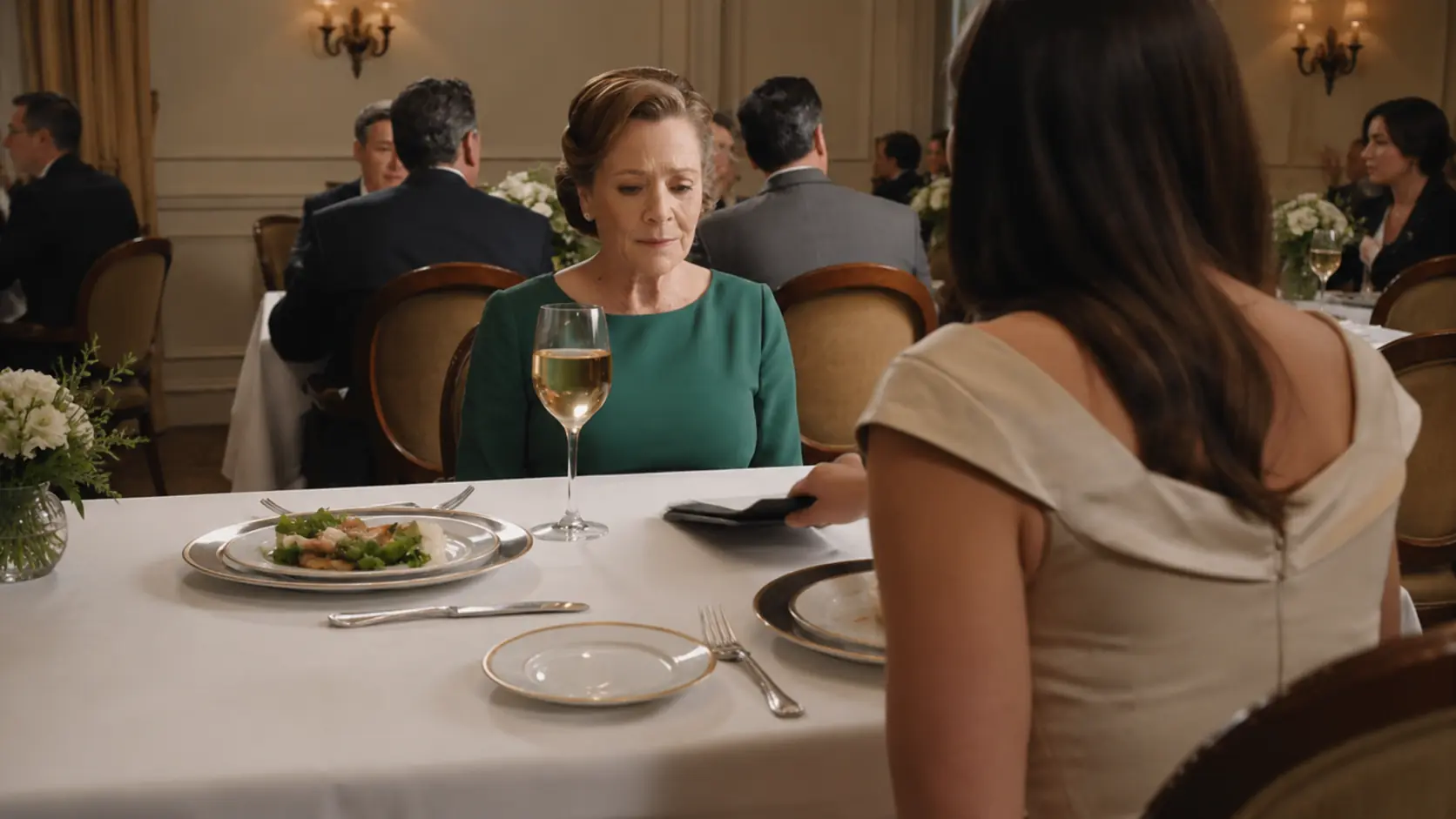
Finally, Diane exhaled. "Linda, I didn't slide that bill to you for the reason you think." I turned toward her. "Then why did you?" Her fingers tightened around the steering wheel. "Because I needed to see how my daughter reacted and how your son reacted and how you reacted." She shook her head softly. "I saw enough to know something's terribly wrong."
The lump in my throat rose, sharp and unexpected. No one had looked at me with that kind of clarity in months. When we arrived at her home, she guided me inside. And for the first time in a long while, I stepped into a space that felt warm. Real warmth, the kind built from soft lamps, lived-in chairs, and a table waiting for conversation.
She motioned for me to sit and moments later set a cup of tea in front of me, wrapping her hands around mine as if anchoring me back to myself. "Tell me everything," she said. So I did.
I told her about the notary, the rushed paperwork, the remodel that never ended, the utility room where I slept beside boxes and tools. I told her about the envelope of $200 a month, about the nights when laughter floated from the main house like I was a stranger renting space on the property I had spent 40 years paying off. I told her about the shrinking, the silence, the shame.
When I finished, she looked as though she'd aged a decade in a few minutes. "You can't go back there," she said firmly. "And you won't face this alone."
The days that followed moved faster than I expected. Lawyers, documents, questions, hearings, and then finally the judge's verdict. The house returned to me. The transfer nullified. Evan and Mara ordered to leave within 72 hours.
When I stepped back into the house 3 days later, it was empty. Not just cleared out, stripped. No furniture, no curtains, no dishes. Even the rug I bought when Evan was 10 was gone. But the walls remained, the floors, the familiar creak in the hallway, the bones of the home I had built.
Diane helped me carry in a few pieces, a mattress, a thrift store chair, a lamp. She hugged me before leaving, whispering, "You're safe now."
Later that evening, as I stood in the quiet of the living room, I heard footsteps on the porch. When I opened the door, Evan was standing there, hands deep in his jacket pockets, his face pale and tired, like sleep had abandoned him.
"Mom," he said, voice trembling. "Can I talk to you?" I stepped outside but didn't invite him in. He swallowed hard. "Mara left. She said I ruined her life. That I should have controlled you. Controlled the situation." His voice cracked. "She's gone and I don't blame her. I messed everything up."
He took a shaky breath. "I'm sorry. I'm so sorry for what I did. I don't know how I let it happen." I looked at him, the boy I raised, the man he became, and the pieces of him scattered between. His eyes held regret, fear, and something deeper, something like recognition.
"I loved you every day," I said quietly. "Even when you forgot how to love me back, but love doesn't erase what happened." His chin quivered. "Do you think you'll ever forgive me?"
The wind moved between us, carrying the faint scent of the lemon tree at the side of the house. I realized then that forgiveness wasn't something I could offer just because he was finally asking.
"Some wounds don't heal," I said softly. "They reshape you." He closed his eyes, tears slipping out despite himself. He nodded once, slow, resigned, then turned and walked down the sidewalk, shrinking with every step until he disappeared into the dimming light.
I watched him go, my chest aching in a way that felt both familiar and new. Then I stepped back inside my house, the house that was mine again, and closed the door gently, letting the quiet settle around me like a beginning I didn't yet know how to name.