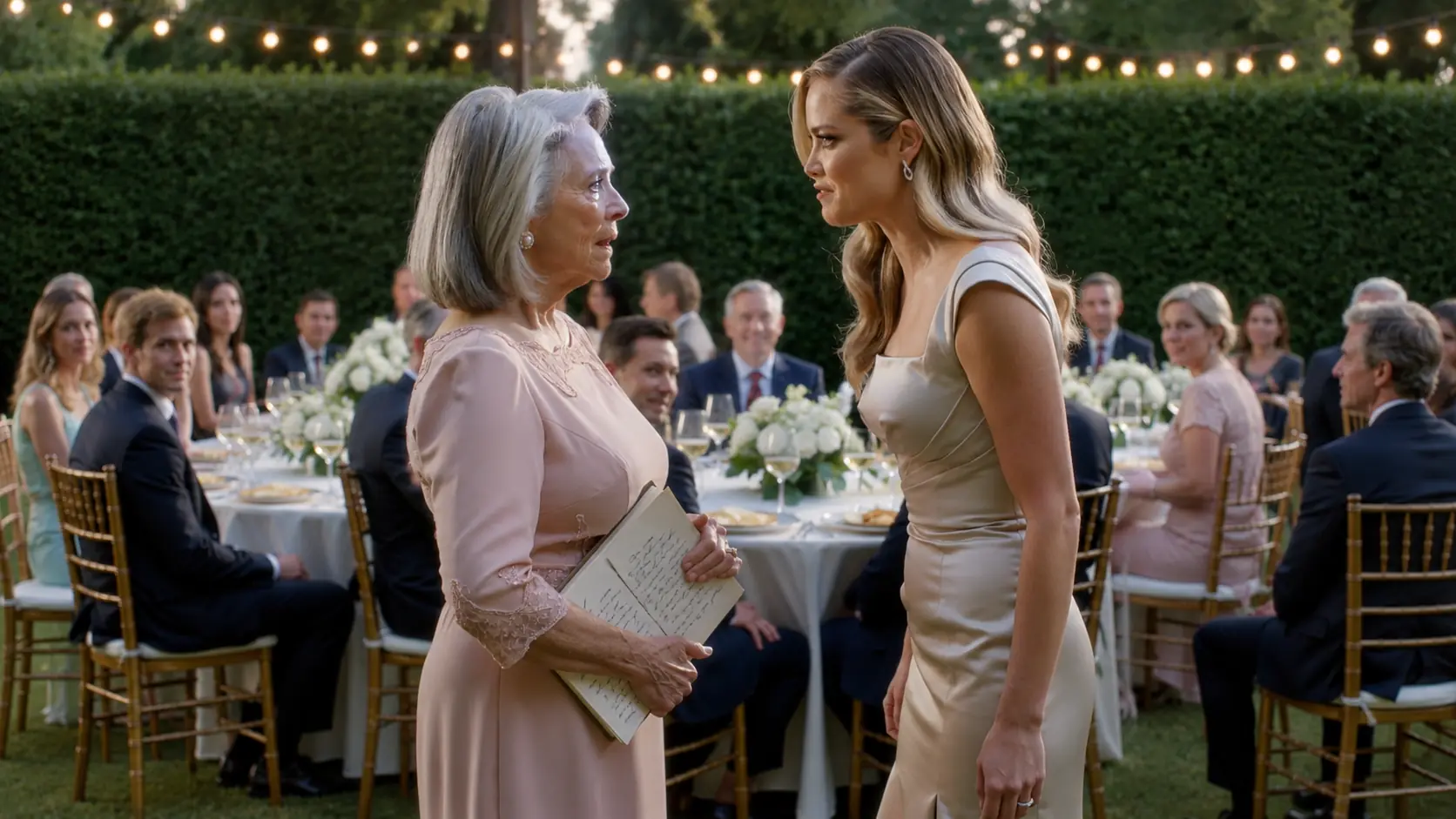
The pre-wedding party for my son was held in a fancy restaurant in downtown Charleston. I stood quietly in a corner, watching my son smile, my heart full of pride. Then the bride-to-be walked over, her smile as bright as the lights, but her eyes cold as ice. She leaned in and whispered, “After tomorrow, you won’t be part of this family anymore.”
I went numb. Laughter still filled the room, glasses clinked, and no one knew that in that moment, my world collapsed. She curled her lips, her voice low and mocking. “You’ve done your job. You raised him. Now let me take over.”
All my life as a single mother, I thought I had survived the worst nights already. Yet I had never felt so humiliated. I just smiled, the kind of smile you wear when you know a storm is coming. Then I slipped out under the bright lights, and no one knew that from that second on, I started moving.
My name is Eleanor Shaw. I am 66, a retired nurse, living alone in a small house on the outskirts of Charleston. For 30 years, I lived for my only son, Nathan Shaw. When my husband, David, left for another woman, Nathan was only six.
That night, Nathan held my hand and asked, “Where’s Dad going, Mom?” I hugged him and lied, “Dad’s on a work trip. He’ll be back.” But David never came back. From then on, I became both mother and father.
By day, I worked in the ER, where people fought for every breath. By night, I picked up extra shifts at a nursing home. Some nights, after clocking out, I sat in the car with my hands still shaking from exhaustion, then remembered I still had to stop for milk for Nathan. I got used to the smell of disinfectant, cold sandwiches for lunch, and being so tired that I forgot my own birthday.
But my son never felt unloved. Nathan studied hard, behaved well, and had a kind heart. He helped poorer classmates and stood up for kids who were bullied. Once, he said, “I’m going to be a lawyer so I can protect people who can’t protect themselves, like you always protect me.”
I cried that day, not from exhaustion, but from pride. When Nathan grew up, I thought I had weathered everything. Then he brought home Isabella Green, and I wanted to believe she was a good woman. She was young, beautiful, confident, and polished, the kind of woman I hoped would make my son happy.
From the first meeting, I felt something was wrong. She looked around my small, tidy house as if she were appraising it. When I served dinner, she took one careful bite and said, “You cook this yourself? That’s great. Nathan says you like hands-on work.” It sounded polite, but it was not a compliment.
After that, every time we met, she wore a mask. Sweet in front of Nathan, chilly when we were alone. She never asked about my life or the years I spent raising him. She only spoke about herself, her projects, cocktail parties, luxury trips, and people who mattered.
For two years, I was slowly pushed out. When they got engaged, Isabella said she would handle everything to keep it modern. I was invited to one dress fitting just to sit in the hallway. She smiled and said, “Don’t worry. You just show up on the day and look elegant.”
I nodded and swallowed my tears. I still tried to believe she would change. I even spent a month making a wedding gift, a scrapbook of Nathan’s life, from his first steps to college graduation to the day he wore his law school regalia. I thought when Isabella saw it, she would understand who Nathan really was and how deeply I loved him.
But at the rehearsal party, everything turned. The restaurant hummed with jazz and the scent of wine. People toasted, laughed, and took pictures while I stood in a corner holding the gift. Nathan was talking with coworkers, and Isabella glowed in the center of her friends like a queen.
I walked up softly and said, “Isabella, I have something for you, too.” She turned with the perfect smile still on her face. But when she saw the scrapbook in my hands, her eyes dimmed. I said, “I made this for Nathan. A memory book for you two to look through together.”
She did not take it. Instead, she tilted her head, leaned in, and whispered, “After tomorrow, you won’t be part of this family anymore.” Then she smiled like she had said something charming. “You’ve done your job. You raised him. Now let me take over.”
I stood frozen, still clutching the scrapbook. Around us, people laughed and took photos, not realizing that in that bright room, a mother was being stripped of her place on her own son’s happy night. I left without remembering whether I said goodbye. I drove home in silence as Charleston streets glowed around me.
At home, I set the scrapbook on the table and opened to the first photo. Nathan at four, gap-toothed and grinning, holding a toy fish. The tears fell before I could stop them. I had done everything to give him a good life, and now the woman I hoped would become my daughter-in-law was breaking my heart.
I sat up all night thinking of overnight shifts, late tuition payments, and sprinting home just to hug him before he fell asleep. All that effort had been reduced to one word: excess. When dawn came, I wiped my tears and whispered, “No. She doesn’t get to rewrite this story. Not while I’m alive.”
That morning should have been the day I sat in the front row at my son’s wedding. The Charleston sky was clear, and sunlight slipped through the curtains onto the table where the invitation still lay open. The teal dress I had chosen hung in the corner, crisp and perfect. Nathan once said that color looked beautiful on me, like sunrise.
But it no longer felt like sunrise. It looked lonely in a room full of memories. The phone started ringing, first one call, then another. Friends, relatives, old coworkers, all asking where I was. I turned the ringer off and looked at the invitation again.
Nathan and Isabella. With love and gratitude to our families. After what she had whispered, those words had become bitter irony. I told myself, “No one can force me to sit through my own erasure.”
Around 9:00 a.m., my sister Margaret knocked hard on the door. She wore a pale blue dress, her hair curled, her heels still dusty from the road. “Eleanor, what are you doing? The whole church is asking where you are.” I said calmly, “I’m not going.”
Margaret stared at me. “Today is Nathan’s wedding. Your son.” I lifted my head and said, “She told me last night that after today, I’m no longer part of the family. So I’m honoring her words.” Margaret sank into a chair and told me people would call me bitter, but I had already been labeled excess.
At 10:00, Nathan left a voicemail. His voice trembled. “Mom, I’m on my way to the church. Where are you? Please don’t hide. It’s my day. You can’t be missing.” I pressed the phone to my chest and cried. I wanted to run to him, but I remembered Isabella’s cold stare and whispered, “Not today. He needs to see the truth.”
Near noon, Margaret called again. Her voice shook. “Eleanor, are you sitting down?” My heart pounded. “What happened?” She took a breath. “The wedding is off.”
I stood so fast that the teacup fell and shattered. “What do you mean, off?” Margaret said the church was in chaos. Then, a few moments later, her voice broke. “Nathan found out she was cheating.”
The room went silent around me. Margaret told me that Nathan’s best man, Mark, had shown him photos of Isabella with her boss two weeks before the wedding. The pictures were clear. Isabella tried to deny it, then blamed me. She said I had always hated her and wanted to ruin the wedding.
But Nathan cut her off. “That’s enough. My mother didn’t ruin anything. You did.” Then he walked to the altar and told the guests there would be no wedding. When Isabella screamed that he would regret it, he answered, “I’m not destroying anything. I’m done lying to myself.”
The news spread quickly. By afternoon, Charleston was full of rumors. Online headlines painted me as the jealous mother who had ruined her son’s wedding. Isabella posted a tearful photo of herself in her gown, making herself look like a victim. Comments called me controlling, bitter, and cruel.
The next morning, Nathan came to my house and asked me not to respond publicly. “They’ll get bored and move on,” he said. But silence no longer felt like protection. It felt like erasure. Two days later, a yellow envelope arrived at my door.
It was a legal notice from Isabella Green and her parents, accusing me of emotional distress and interfering with the marriage. I took it to my friend Linda Cole, a retired attorney. She read it, laughed dryly, and said, “Eleanor, this is a scare tactic.” Then she told me why they were desperate.
The Green family was broke. Isabella’s father, Richard Green, had failed in several real estate projects and owed the bank millions. They needed Nathan’s future income and clean reputation to stabilize their finances. The wedding had not been love. It had been a rescue plan.
Linda later found the evidence. A draft prenuptial agreement showed that 70% of Nathan’s income for the first five years would go into a joint account accessible by Isabella’s father. My hands shook as I read it. They did not want a son-in-law. They wanted a bank.
Three days later, Richard Green invited me to a reconciliation dinner at the Charleston Grand Plaza Hotel. Nathan warned me not to go, but I wore the teal dress I had once planned to wear to his wedding and carried Linda’s file in my bag. At the private dining room, Isabella smirked and said she thought I had come to apologize. I sat down and placed the agreement on the table.
I read Clause 12 aloud. Richard’s face drained of color. Isabella tried to laugh it off, but her mouth twitched. I looked at her and said, “In my world, marriage is love, not a business contract. You weren’t marrying into my family. You were marrying a bank.”
Richard slammed his hand on the table. Isabella threatened to sue. I stood and said, “Watch me.” Then Nathan appeared at the doorway. He had heard enough. He looked at Isabella and said, “You said you loved me, but you only loved my bank account.”
Two days later, Linda connected me with an investigative reporter. A week after that, the story broke across Charleston. Green Capital Group was exposed for financial fraud, and the failed marriage plan became public. The same people who had called me bitter began saying I had saved my son.
I did not feel joy watching the Greens fall. Richard was investigated, Marion hid from cameras, and Isabella disappeared from public life. Some victories do not make you happy. They simply let you breathe.
Nathan came to see me that evening. He looked tired, but lighter. “I’m proud of you,” he said. “You didn’t stay silent.” I smiled through tears. “I only did what a mother is supposed to do. Protect her child.”
Two months later, life began to settle. Nathan left his old firm and joined a smaller practice where he could help people again. I returned to volunteering at Harborview Nursing Home, helping residents write letters and tell their stories. Many of them had been pushed aside by their own families, labeled burdens, forgotten, or made invisible.
Their stories healed something in me. I began writing my own in a brown leather journal. I called it The Day I Was Erased. Not because I wanted to relive the pain, but because I wanted to remember that being pushed aside does not mean you disappear.
One evening, I sat on the porch as the wind off the Ashley River cooled the air. I thought about Isabella’s words. “After tomorrow, you won’t be part of this family anymore.” That sentence had once stabbed through my heart. Now I understood that no one else had the right to define my place.
I turned to the final page of my journal and wrote one line: “When people try to erase you from the picture, become the color they can’t cover.”
I read it again and smiled. For years, I believed silence was virtue and endurance was peace. Now I know silence is not noble when it lets others crush your dignity. No one has the right to erase you from your own story.
My family did not end that day. It changed. Nathan found himself again, and I found the voice I had buried under years of sacrifice. I am still his mother, still Eleanor Shaw, and still standing.