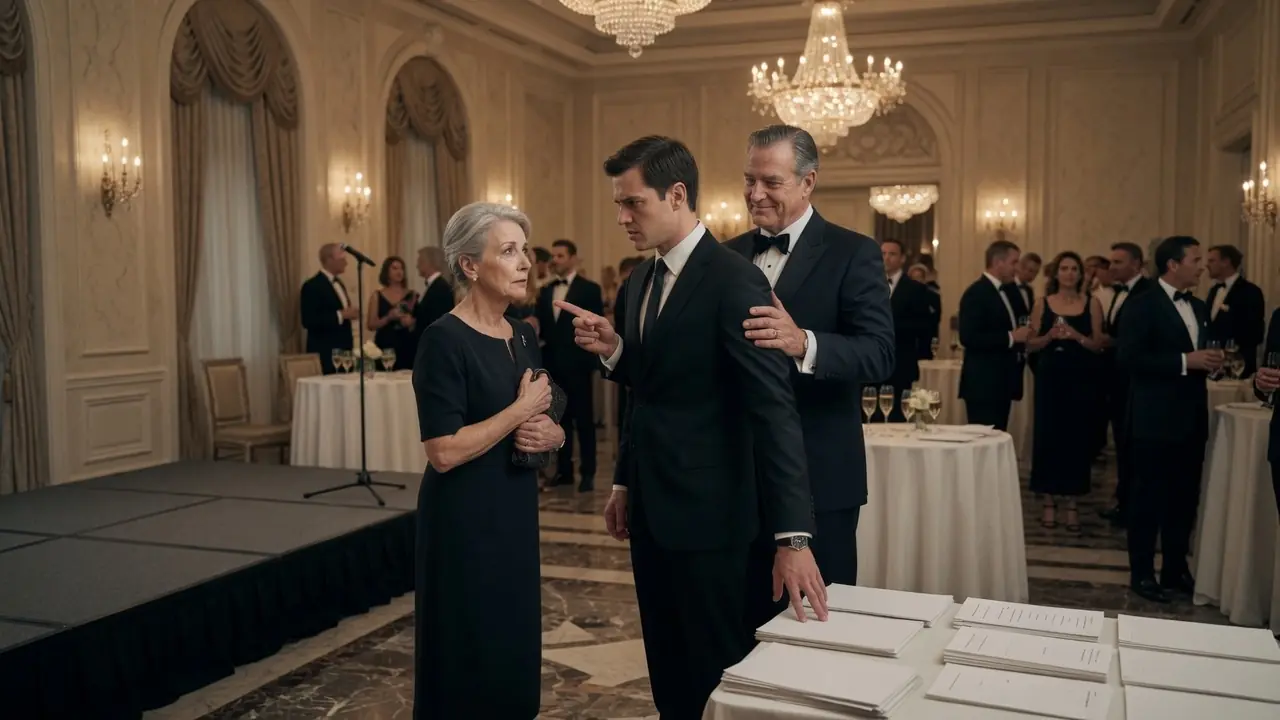
Brenda Matthews stood beneath the crystal chandeliers of the Columbus Grand Hotel and watched her son point at her like she was something that had wandered into the wrong room. Ethan’s finger cut through the air between them, sharp and public, while guests in black suits and silk dresses turned their heads to listen. Richard Whitmore, Ethan’s wealthy father-in-law, stood beside him with one hand resting on Ethan’s shoulder, smiling as if he had been waiting years to see this moment. “Stop embarrassing me, Mom,” Ethan said, his voice hard enough to freeze the room. “You don’t belong in places like this.”
Brenda did not move at first, because pain sometimes makes the body forget what it is supposed to do. She was sixty-eight years old, wearing a modest navy dress and a small pair of pearl earrings she had owned for twenty years, and she suddenly felt every hour she had ever worked pressing against her chest. Around her, champagne glasses glittered, servers paused near the wall, and wealthy strangers watched as if her humiliation were part of the evening’s entertainment. Richard gave a soft little laugh, then looked toward Ethan like a proud teacher watching a student pass his final test.
“You see?” Richard said smoothly, loud enough for the nearest guests to hear. “Success requires difficult choices.” Ethan’s jaw tightened, but he did not step away from the man’s hand. “Richard gave me a future,” he said, still looking at Brenda as if she were the problem. “All you ever gave me was struggle, guilt, and stories about sacrifice.” Brenda felt those words land in the same place where she had once held his feverish body as a child, the same place where every old Mother’s Day card still lived like proof that he had not always been this man.
She wanted to remind him of the winter she wore the same coat for ten years so he could have new shoes. She wanted to tell him about the grocery store aisles where she counted pennies with a calculator, removing food from her cart so he could keep the cereal he liked. She wanted to ask whether he remembered falling asleep at the kitchen table while she helped him study after working two shifts. But when she opened her mouth, nothing came out, because the little boy who once called her the strongest person he knew was now standing in front of rich people, ashamed of the woman who raised him.
Brenda Matthews had never expected her life to be grand. When her husband Thomas died, Ethan was only ten years old, and her world narrowed overnight to bills, work schedules, school lunches, and grief she could only feel after her son fell asleep. She worked as a receptionist in the morning, waited tables at night, and did bookkeeping on weekends whenever anyone offered. There were nights she came home so tired that she leaned against the kitchen sink before taking off her shoes, but she always stood straight before Ethan saw her. She wanted him to believe their life was hard, not hopeless.
Ethan had once been worth every sacrifice. He washed dishes without being asked, mowed lawns for neighbors to help with small expenses, and left handmade cards on Brenda’s pillow every Mother’s Day. In one card, written when he was twelve, he had said, “Mom, you’re the strongest person I know.” Brenda kept it in her nightstand drawer, folded carefully beside Thomas’s old watch and a photograph from Ethan’s graduation. Whenever life felt too heavy, she would read that card and remember why she had kept going.
The first change came slowly during Ethan’s junior year of college. His calls grew shorter, and new words entered his conversations: networking, influence, image, opportunity, status. Then came Olivia Whitmore, beautiful, polished, intelligent Olivia, who arrived one evening at Brenda’s small house carrying a homemade apple pie and a nervous smile. Brenda liked her immediately and told Ethan afterward, “She’s a keeper.” She had no idea that loving Olivia would eventually lead Ethan into the orbit of Richard Whitmore.
Richard Whitmore was everything Brenda was not: rich, powerful, confident, and surrounded by people who measured value by proximity to money. The first dinner with Olivia’s parents took place at a country club with marble floors and chandeliers that made Brenda feel as though she should whisper. Richard shook her hand without warmth and called her “Brenda” in a tone that made her name sound small. His wife Margaret was polite, but polished in a way that felt rehearsed, every compliment smooth enough to hide an insult.
Ethan was fascinated by Richard from the beginning. Brenda saw it in the way her son leaned forward when Richard spoke about investments, political connections, real estate, and private business networks. Richard had the dangerous talent of making money sound like morality, as if being wealthy meant being wiser, better, and more deserving. Ethan listened as if a door had opened in front of him. Brenda watched quietly, trying not to feel the first cold edge of losing him.
Over the next year, Richard became a constant presence in Ethan’s life. Golf outings, business dinners, networking events, private meetings, and whispered advice all began replacing the easy phone calls Ethan once shared with his mother. When Brenda invited him to their old diner for lunch, he spent most of the meal checking his phone and smiling at messages from Richard’s circle. She asked him if he was happy, and he laughed like the question embarrassed him. “Mom, people grow,” he said, and the wall between them rose another inch.
Then Brenda discovered an old photograph in a family album. Thomas stood beside two men at a business event nearly thirty years earlier, his smile warm and confident in a way she had almost forgotten. One of the men was unmistakably Richard Whitmore, younger and leaner, but with the same sharp eyes. Brenda sat at her kitchen table staring at the picture for nearly an hour. Richard had pretended not to know Thomas, yet there they were, side by side, looking like more than acquaintances.
The photograph became a question she could not put down. Why had Thomas never mentioned Richard? Why had Richard’s expression changed whenever Thomas’s name came up? Why did a man as confident as Richard seem suddenly guarded around Brenda once he realized she was asking old questions? She did not yet know the answer, but instinct told her the past was not buried as deeply as Richard believed.
At a private dinner at the Whitmore estate, Brenda heard the words that first broke her heart. She had stepped into a hallway searching for a restroom when she heard Ethan and Richard speaking inside the study. Richard told Ethan that success required knowing which obligations no longer served a purpose. Ethan answered quietly, “My mother means well.” Then Richard laughed, and Ethan added, “Honestly, sometimes she embarrasses me around people like this.”
Brenda stood outside that door with tears burning behind her eyes, but she refused to let them fall in Richard Whitmore’s house. Her son had not shouted at her, had not insulted her directly, but the betrayal still cut deep because he had spoken the truth of his changed heart when he thought she could not hear. He was embarrassed by the woman who had built his life with tired hands and late-night wages. That night, she drove home in silence, walked into her living room, and looked at Thomas’s photograph.
“Your son chose them,” she whispered to the empty room. The words sounded terrible out loud, but saying them made denial impossible. The next morning, after barely sleeping, she opened an old address book and found the name Daniel Coleman, the attorney who had once worked with Thomas. Her hands trembled as she dialed. When Daniel answered, Brenda said only, “I think it’s finally time.”
Daniel’s office sat in an older brick building downtown, the kind of place where wood floors creaked and every locked cabinet seemed to hold a secret. He was in his seventies now, with white hair, sharp eyes, and a tired kindness that made Brenda feel both safe and afraid. When she showed him the photograph, he did not look surprised. Instead, he closed his office door and said, “I wondered when this would find its way back to you.”
Daniel opened a file that had been locked away for more than two decades. Inside were contracts, letters, ownership records, corporate documents, and one sealed note written in Thomas’s unmistakable handwriting. Brenda learned that Thomas had helped found a company Richard later claimed as the foundation of his empire. Thomas had sold some interests before he became ill, but not all of them. Through private legal structures, a major ownership position had remained protected, and after Thomas died, those rights had passed to Brenda.
The room seemed to tilt as Daniel explained it. Brenda had spent decades believing she was only a widow who struggled because tragedy had left her with too little. Now she was learning that Thomas had left behind something far larger than she had ever imagined, something Richard had every reason to hide. Then Daniel handed her the note Thomas had written before his death. One sentence had been underlined in black ink: If anything happens to me, do not trust Richard Whitmore.
For weeks, Brenda told no one. Daniel investigated quietly, contacted old associates, retrieved records, and found Victor Reynolds, one of Thomas’s former business partners. Victor confirmed what the documents suggested: Richard had built his empire partly on structures Thomas helped create, then benefited from confusion and illness when Thomas became too weak to fight. There were letters showing disputes, records showing preserved ownership rights, and witnesses who had kept quiet because Richard’s power had once seemed permanent. But power, Victor told Brenda, only lasts while people remain afraid.
Richard soon realized something was happening. Ethan arrived at Brenda’s house one afternoon carrying a document in a leather folder, looking tired, tense, and angry. He placed the paper on her kitchen table and told her it was only a legal acknowledgment. Brenda read enough to understand what it really was: a waiver preventing her from pursuing claims connected to Thomas’s old business interests. Richard had sent her own son to ask her to sign away the truth.
“Who benefits if I sign this?” Brenda asked. Ethan did not answer. Instead, he told her she was making things harder than they needed to be. He said Richard had given him opportunities Thomas never could. The sentence stunned Brenda into standing, her chair scraping the floor behind her. “Your father gave you his name,” she said quietly. “He gave you values, a family, and a life he worked himself sick trying to protect.”
Ethan’s face hardened, as if tenderness might make him lose the future Richard had promised. Brenda pushed the document back across the table and gave him one last chance. “If Richard built everything honestly, he has nothing to fear from the truth.” For a moment, uncertainty flickered in Ethan’s eyes. Then he placed the paper back into his folder and said, “I have already chosen.”
Three weeks later, Richard Whitmore hosted a grand family celebration in the ballroom of the Columbus Grand Hotel. Officially, the event was meant to announce an expansion of one of his companies. Unofficially, everyone knew Richard intended to present Ethan as the future face of the Whitmore legacy. The room was filled with investors, executives, donors, local press, and people who had spent years applauding Richard’s version of success. It was meant to be Ethan’s coronation.
That was the night Ethan pointed at Brenda and humiliated her in front of everyone. Richard had guided the confrontation carefully, letting Ethan do the cruel part while he stood beside him smiling. Ethan slapped the unsigned waiver onto a side table and told Brenda to stop digging through old business matters before she destroyed his future. “Richard has done more for me than anyone else,” Ethan said. “Anyone else,” Brenda repeated softly, and the words made several guests look away.
Then the ballroom doors opened. Daniel Coleman walked in with a leather briefcase in one hand and a calm expression that made Richard’s face lose color. His gray hair caught the chandelier light as he crossed the floor, every step measured, every eye turning toward him. Richard’s smile vanished completely. For the first time since Brenda had met him, he looked frightened.
“Before this celebration continues,” Daniel said, “several matters require clarification.” The room fell silent. Richard tried to interrupt, but Daniel spoke over him with the authority of a man who had brought paper strong enough to quiet power. “My name is Daniel Coleman,” he said. “I represent the estate interests of Thomas Matthews, and I represent Brenda Matthews.”
Every head turned toward Brenda. She remained still, hands folded in front of her, though her heart was beating hard enough to hurt. Daniel opened his briefcase and removed the first folder. He explained that Richard Whitmore had never been the sole controlling founder of the company he claimed as the root of his empire. A murmur moved through the ballroom like wind before a storm.
Then Daniel delivered the sentence that changed everything. “The largest surviving ownership interest belongs to Brenda Matthews.” Absolute silence followed. Ethan stared at his mother as if he had never truly seen her before. Richard’s jaw tightened, and Olivia, standing near the stage, looked from her father to Brenda in stunned confusion.
Richard recovered enough to call the claim ridiculous. Daniel calmly produced ownership agreements, witnessed documents, recorded filings, and correspondence showing that Thomas’s interests had been preserved through private estate structures. Every document landed like another stone in the foundation Richard had tried to hide. The investors began whispering. Reporters lowered their champagne glasses and began taking notes.
Daniel then read portions of Thomas’s letters, including the disputes with Richard over control, unauthorized decisions, and withheld information. Richard’s face reddened, but he could not stop the documents from speaking. Finally, Daniel unfolded the letter containing Thomas’s warning. His voice was steady when he read, “If anything happens to me, do not trust Richard Whitmore.”
Gasps spread across the room. Olivia turned toward her father with tears in her eyes and asked, “Dad, is this true?” Richard hesitated, and that hesitation damaged him more than any denial could have. “It is complicated,” he said. The answer sounded small in a room where he had always made himself look enormous.
When Daniel finished, he stepped back and nodded once to Brenda. She stood slowly. She had spent most of her life working quietly, living quietly, and loving quietly, but silence had protected the wrong people for too long. “My husband never cared about being the richest man in the room,” she said. “He cared about integrity.”
The room listened. Brenda looked at Ethan, and the pain in his face nearly broke her, but she continued. “For years, I stayed silent because I thought silence protected my family. Now I understand silence can also protect wrongdoing.” She turned toward Richard. “I did not pursue this for revenge. I pursued it because the truth matters.”
Richard could not meet her eyes. Ethan sank slowly into his chair, as if the weight of his own choices had finally reached him. Brenda sat again, not triumphant, not joyful, but steady. The son who had called her a burden had just learned that the future he sold his loyalty for may have belonged, in part, to the mother he shamed.
The days after the ballroom revelation were chaotic. Business publications reported the ownership dispute, board members demanded reviews, investors asked questions, and Richard’s influence began collapsing faster than anyone expected. Former associates came forward with records and statements they had once been too afraid to share. Daniel told Brenda the ownership documents had been verified. For Brenda, the money mattered less than the confirmation that Thomas had not imagined the danger.
Ethan did not come to apologize immediately. First came a note under her front door: Mom, please let me explain. Brenda placed it in a drawer and went about her day, because pain does not heal faster simply because the person who caused it becomes sorry. Two days later, Ethan came in person, alone, without Olivia, without Richard, without the expensive suit. He looked younger than he had in years.
They sat at Brenda’s kitchen table, the same table where she had helped him with homework and birthday candles. For a long time, he stared at his hands. “I’ve been an idiot,” he said finally. Brenda said nothing, because the first honest sentence deserved room to breathe. Ethan admitted that Richard made him feel powerful, important, and chosen in ways he had craved after growing up without his father. Then he admitted the hardest truth: “Sometimes I was embarrassed by where I came from.”
Brenda closed her eyes for a moment, because hearing the truth still hurt even when it came with remorse. “Longer than you realize,” she said when Ethan asked how long he had been hurting her. Tears filled his eyes. He apologized without excuses, without blaming pressure, ambition, Olivia, or Richard. That mattered, though it did not undo the damage.
When Ethan asked if she could forgive him, Brenda answered carefully. “I forgave you because I needed peace,” she said. His face softened with relief until she added, “But forgiveness and trust are not the same thing.” The words hurt him, and she hated that, but false comfort would have been another lie. Trust had been built over a lifetime and broken in public; it would need time, action, and humility to return.
In the months that followed, Richard Whitmore’s empire continued to shrink. Board seats disappeared, partnerships dissolved, and his reputation never fully recovered. Olivia began separating herself from her father’s influence, slowly and painfully, and Brenda found more compassion for her than she expected. Ethan changed too, not through speeches but through consistent choices. He volunteered, helped community programs, mentored young people, and stopped chasing rooms where character had to be traded for applause.
Brenda eventually used much of the recovered wealth to create a foundation in Thomas’s name and hers. Its mission was to support older women facing abandonment, financial hardship, and family isolation. She remembered every widow, single mother, and forgotten grandmother she had met over the years, women who gave everything and were later treated as burdens. The foundation became her answer to Richard’s world. Money would not be used to measure people; it would be used to restore dignity.
At the foundation’s launch event, Ethan arrived quietly and stood near the back. He did not try to draw attention, did not ask about inheritance, and did not perform repentance for an audience. After the speeches, he walked to Brenda and said, “I spent so long trying to become successful that I forgot who taught me what success means.” Brenda placed a hand on his shoulder. “Then remember now,” she said.
Years later, Brenda would still think about the night in the ballroom. She would remember Ethan’s pointed finger, Richard’s satisfied smile, Daniel’s briefcase, and the way truth walked into a room where money thought it ruled. The greatest inheritance Thomas left was not ownership, wealth, or business rights. It was character, preserved quietly until the day it was needed most.
Brenda did not get back the years of sacrifice. She did not get back the version of Ethan who had never been ashamed of her. But she gained peace, dignity, and eventually a son who understood what he had almost lost. And when people asked whether she regretted exposing the truth in front of everyone, Brenda always gave the same answer. “No, because the truth took longer, but it traveled farther.”