She had trimmed the carrots, seasoned the potatoes, polished the dining table, and taken out the good linen napkins she still kept folded in the drawer Frank had built for her thirty years earlier. The house smelled like butter, rosemary, and the kind of love nobody noticed until it stopped appearing. Caleb had always loved roast beef when he was a boy, and even at forty-two, he still took the thickest slice without asking. Beatrice had smiled when she placed his plate in front of him, because some habits of motherhood remained even after they stopped being returned.
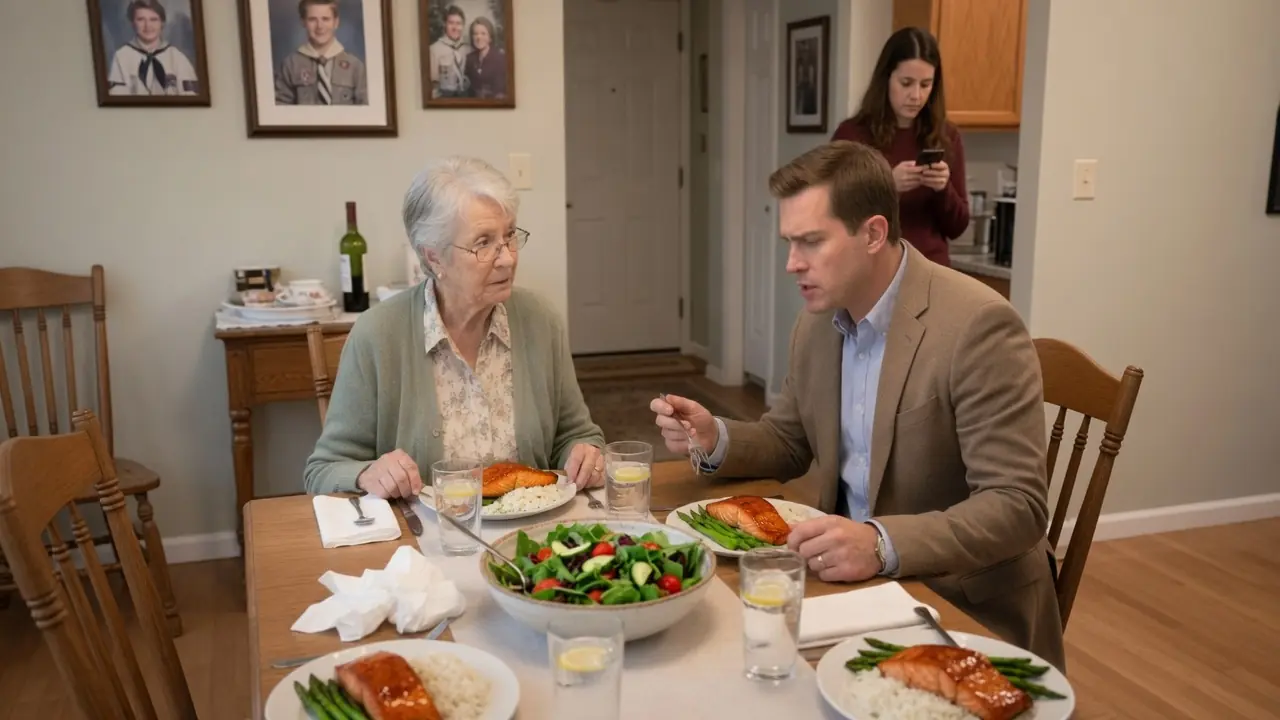
The dining room was quiet except for the scrape of forks and Kimberly’s phone tapping against her manicured nails. Caleb sat across from Beatrice in a dark sweater over a white shirt, his wedding ring flashing each time he lifted his fork. Kimberly stood near the hallway for half the meal, answering messages and pretending to be too busy to sit down properly. Beatrice sat at the head of the table in her navy cardigan and pale blouse, trying to ignore the cold draft slipping under the guest room door.
She had not meant to complain.
She had only said, softly, that the guest room window seemed to be letting in more air lately. Then she added that Saturday evenings had become difficult since Frank passed, because the house felt too large when it was quiet. It was not a demand. It was not a performance. It was a mother offering the smallest piece of loneliness to the only child she had left.
Caleb did not even look up from his plate.
“Mom, we’re fed up,” he said, cutting into his meat as if the conversation were no more important than a tough corner of roast. “Honestly, we are exhausted by your constant need for attention. Every week it’s the draft, the quiet house, your loneliness, your aches, your errands.” He finally looked at her, but there was no tenderness in his face. “Can’t you just be quiet and live like other seniors?”
The words landed in the room and stayed there.
Kimberly gave a small nod without putting down her phone. “You’re not helpless, Beatrice,” she said, her voice sharp and bored. “You’re just needy and dramatic. Other women your age join clubs, sit on the porch, maybe garden a little. They don’t expect their adult children to be an emotional support team.”
Beatrice felt her hands go still beside her plate.
She looked down at the roast she had cooked for them, the potatoes she had roasted slowly, the carrots she had glazed because Kimberly once said plain carrots were depressing. She thought of every tuition check, every sleepless fever night, every school project she had helped Caleb finish after he forgot until the last minute. She thought of Frank, gone three years now, and the way he used to place one hand over hers when Caleb spoke too carelessly. Frank was not there to do that anymore.
“I see,” Beatrice said.
Her voice sounded strange to her own ears, flat and calm in a way that did not match the sharp heat rising in her chest. Caleb seemed relieved, as if her quietness proved his point. He leaned back and lifted his glass. “Good. Glad we’re finally on the same page.”
“We have stress too, Mom,” he continued. “Between my mortgage, the car payments, Kimberly’s career, and everything else, we can’t keep managing your feelings. You’re sixty-five, not six. You need to stop acting like every small inconvenience is a crisis.”
Beatrice picked up her half-finished plate.
At the sink, she scraped the rest of her roast into the trash.
Not because she was angry at the food. Because suddenly, she could not swallow another bite of something she had made with love for people who had just called that love a burden. Her reflection in the kitchen window looked older than it had that morning, but also clearer. Caleb wanted a quiet senior. Beatrice decided he was going to get exactly what he had asked for.
“Noted,” she said.
The word was quiet, but it changed everything.
Caleb did not understand it at the time. Kimberly certainly did not. They left that night with leftovers wrapped in foil, still accepting the comfort of her kitchen even after mocking the woman who created it. Beatrice stood in the doorway and watched their car pull away. When the tail lights disappeared, she closed the door, locked it, and stood in the silence Caleb had demanded.
The next morning, she did not send her usual “Did you get home safe?” text.
She did not call Caleb to ask whether the roast reheated well. She did not remind Kimberly that the dry cleaner closed early on Tuesday. She did not check whether they needed anything from the grocery store, whether the dog’s medicine had been refilled, or whether Caleb remembered his dentist appointment. Beatrice made coffee, sat at the kitchen table, and let the house remain quiet.
Three days later, Kimberly called.
Beatrice watched the name flash on her phone and let it ring twice before answering. Kimberly’s voice arrived with that sweet, brittle tone she used when she wanted something. “Hey, Beatrice, quick favor. Caleb and I are going to that lakeside retreat this weekend. Could you swing by and watch the dogs, maybe take in the mail, and water the plants?”
In the past, Beatrice would have rearranged her entire weekend.
She would have canceled her own plans, prepared a casserole for them to return to, checked the house twice, and felt grateful to be useful. This time, she looked at the hallway mirror and saw a woman who had spent forty years teaching children with complex needs. A woman with a master’s degree, a career, a mind still sharp enough to manage rooms full of children everyone else had given up on. A woman who had been reduced by her own family to free labor and emotional inconvenience.
“No,” Beatrice said pleasantly. “That doesn’t work for me.”
There was silence on the other end.
“What?” Kimberly said at last. “Why not? What are you doing?”
“I have plans.”
“What plans?” Kimberly demanded, the sweetness already gone. “It’s not like you have a job.”
Caleb shouted something in the background, muffled but angry. Then his voice came closer. “Mom, don’t be difficult. You’re always home. Just do this for us.”
“No,” Beatrice said again, and this time she smiled. “The answer is still no. Enjoy your trip.”
She hung up before they could argue.
For a long moment, she stood there with the phone in her hand, waiting for guilt to flood in. It did not. What came instead was a strange, clean space inside her chest, as if a window had been opened in a room that had been sealed too long. Caleb had not hated her needs. He had hated that her needs had started interfering with his convenience.
A week later, Beatrice drove across town to the industrial district.
The community center sat between two warehouses, its paint peeling, its sign faded, and its parking lot cracked with weeds. Inside, the hallway rang with the sound of overstimulated children, exhausted staff, and fluorescent lights that hummed too loudly. A young director named Sarah sat behind a desk buried in paperwork, looking as if she had not slept properly in years. When Beatrice introduced herself, Sarah looked up politely, already bracing for one more problem she could not afford to solve.
“My name is Beatrice Hatcher,” she said. “I spent forty years as a lead educator for children with developmental and sensory needs. I developed three sensory integration curriculums that were used across four districts.” She placed her worn leather folder on Sarah’s desk. “I retired to care for my husband. He is gone now. I do not want a paycheck. I want a classroom.”
Sarah stared at her.
“We can’t afford someone with your experience,” she said slowly. “Our funding was just cut.”
“I didn’t ask for money,” Beatrice replied. For the first time in months, her old professional voice returned, calm and steady. “I asked for purpose.”
That afternoon, Sarah introduced her to Leo.
Leo was six years old, nonverbal, and overwhelmed by nearly everything. He spent most days pressed into the corner of a padded room, rocking hard enough that aides hovered nearby in fear. Other programs had sent him away. Beatrice sat several feet from him on the floor, not too close, not too eager. She hummed a low, steady tone she had used decades before with children whose nervous systems could not survive the ordinary noise of the world.
Leo stopped rocking.
It was small. Almost nothing. But Beatrice felt the moment like light touching an old wound. She was not a needy mother in that room. She was not dramatic, burdensome, or too much. She was exactly what someone needed.
Her life changed quietly after that.
She still waved at the postman in the morning. She still watered her roses and bought milk on Thursdays. But in the afternoons, she became Miss Bea, the woman children trusted when the room became too loud, when language failed, when their bodies carried storms no one else could read. Parents cried in her arms. Staff members followed her notes like scripture. Children who had been called impossible began taking one small step at a time toward peace.
At home, Beatrice became what Caleb had requested.
Quiet.
No more Sunday roasts. No more midweek check-in texts. No more offers to help with car insurance when Caleb overspent. No more extra groceries dropped off because Kimberly had complained about prices. No more leaving the side door unlocked in case they needed something.
When Caleb and Kimberly decided to move from their starter home into a luxury apartment downtown, Caleb came to her kitchen expecting drama. He announced the move with the tone of a man waiting to be begged not to leave. Beatrice sat with her crossword puzzle and listened. “I’ll help you pack if you bring boxes here,” she said calmly.
Caleb looked startled.
“You’re not upset?”
“Should I be?”
He opened his mouth, then closed it. Beatrice saw panic flicker across his face. The free laundry, the free meals, the emergency money, the open door, all of it was disappearing. He had called her emotional to silence her, but now that she was silent, he found the silence unbearable.
They moved on a Saturday.
Beatrice did not attend the housewarming. Instead, she called a locksmith and changed every lock on her house. She did not do it out of revenge. She did it because a quiet senior deserved privacy.
Six months passed.
At the center, Beatrice became indispensable. She built sensory stations from donated furniture, trained exhausted teachers, rewrote classroom routines, and helped parents understand that their children were not broken. They were tuned to a different frequency. Leo began looking at her hands when she signed simple words. Then one day, he touched a picture card and pushed it toward her.
Bird.
Beatrice went home that night and cried in her car for ten minutes before going inside.
By the third month, word spread beyond the center. A journalist came first, then a local education board member, then a man in a charcoal suit from a private educational firm in Chicago. He watched Beatrice through a glass observation window for nearly an hour while she guided a group of overwhelmed children through a light-and-sound regulation sequence she had designed in the 1990s. Afterward, he met her in the break room and slid a folder across the table.
“We’re opening a private academy for neurodivergent children,” he said. “High-net-worth families. We need someone with your exact background as senior consultant.”
Beatrice opened the folder.
The salary was $350,000 a year, plus travel allowance and a signing bonus. She read the number twice. For Caleb and Kimberly, it would have solved half the financial problems they had created for themselves. For most people, it would have been impossible to refuse.
“It’s generous,” Beatrice said.
“We can increase the signing bonus if needed.”
She thought of Caleb telling her to be quiet.
She thought of Kimberly saying she was needy and dramatic. She thought of Leo touching the bird card with one trembling finger. Then she closed the folder and slid it back.
“No, thank you,” she said.
The man blinked. “Mrs. Hatcher, this is a major opportunity.”
“I already have one,” Beatrice replied. “These children have nowhere else to go. The children at your academy will have every resource money can buy. My experience belongs here.”
He tried to persuade her for twenty minutes.
Beatrice listened politely, then stood. “Money is a noise I’ve learned to ignore,” she said. “I’m quite happy with my silence.”
She told no one.
Not Caleb. Not Kimberly. Not the neighbors. She simply returned to the classroom, sat on the floor beside Leo, and helped him touch another card. Blue. Then ball. Then help.
The newspaper article came out on a Sunday.
The headline read: “The Silent Miracle: How One Retired Teacher Is Transforming Life for Our City’s Forgotten Children.” There was a photograph of Beatrice sitting on the floor beside Leo, who was looking directly into the camera with a small, peaceful smile. The reporter had done her research. She wrote about Beatrice’s forty-year career, her master’s degree, her volunteer work, and the private academy offer she had declined.
The article quoted Beatrice only once.
“I found a place where people actually want to hear what I have to say.”
Beatrice read that line with a cup of coffee in her hand.
She did not feel triumphant exactly. Triumph was too loud a word for what settled over her. It was justice, but not the courtroom kind. It was the deep, quiet justice of being seen by the world after being dismissed by the people who should have seen her first.
Her phone began ringing at ten.
First Caleb sent three links to the article. Then Kimberly sent, “Wow, we had no idea.” Beatrice did not answer. She went outside and pruned her roses. She was busy living like a quiet senior.
That evening, the doorbell rang again and again.
When Beatrice opened the door, Caleb and Kimberly stood on the porch with the newspaper in Caleb’s hand. They did not look proud. They looked frightened and angry, like people who had thrown away something valuable and only realized its worth after someone else picked it up.
“Mom, what is this?” Caleb demanded, pushing into the foyer. “Three hundred and fifty thousand dollars? You turned down $350,000?”
“Good evening, Caleb,” Beatrice said. She closed the door calmly. “Please don’t shout. The neighbors are quiet people, and I’m trying to fit in.”
“Don’t give me that,” he snapped. “We are drowning. The apartment lease is killing us, Kimberly’s car needs repairs, and I’m working eighty hours a week. You’re sitting on a skill set that could save this family, and you’re giving it away for free.”
Kimberly’s eyes shone with frustrated greed. “If you were lonely, why didn’t you come to us? Why didn’t you tell us you had this kind of opportunity? We could have planned together. We could have moved into a bigger house together.”
Beatrice looked at them.
Really looked.
They did not see the teacher. They did not see the woman who helped a child speak without fear. They did not see the years of study, instinct, patience, and mastery. They saw money with gray hair.
“Why would I tell you?” she asked.
Her voice was so quiet they both stopped speaking.
“Six months ago, at that table, you told me my needs were exhausting. You told me to be quiet. You told me to live like a senior with nothing left to offer.”
“I was stressed,” Caleb said quickly. “People say things when they’re stressed.”
“No,” Beatrice said. “People say what they believe when they think there will be no consequences. You believed I had no value beyond what I could do for you. You wanted the cook, the dog-sitter, the laundress, the emergency wallet, and the quiet old woman who never asked for anything back.”
Caleb’s face tightened.
“That’s not fair.”
“It is extremely fair,” Beatrice replied. “You did not want my voice. You did not want my wisdom. You did not want my needs. So I gave all of those things to people who value them.”
Kimberly folded her arms. “This is different. That salary is family money.”
Beatrice turned toward her slowly.
“No,” she said. “That salary is my value. And I chose where to invest it.”
Caleb looked down at the newspaper, then back at her. For a second, his face softened into something almost like shame. Then his eyes returned to the number printed in the article, and Beatrice saw the shame lose to need. “We’re your family,” he said. “Doesn’t that count for anything?”
“It counted for forty years,” Beatrice said. “I paid for your college. I helped with your first car. I gave you the down payment for your first home. I cooked, cleaned, babysat, encouraged, rescued, and forgave.” She straightened her shoulders. “I have done my job as a mother. I am not your servant, and I am certainly not your retirement plan.”
“So you’re going to watch us fail?” Kimberly asked coldly.
“You are not failing,” Beatrice said. “You are meeting the life you chose. You chose an apartment you could not afford. You chose to treat your only living parent like an inconvenience. Now you get to choose how adults repair their own mistakes.”
Caleb’s eyes filled, but Beatrice did not rush to comfort him.
That was the hardest part. Not the confrontation. Not Kimberly’s coldness. The hardest part was looking at her son in pain and not immediately sacrificing herself to make the pain stop. Motherhood had trained her to run toward his distress. Wisdom finally taught her that not every distress was hers to carry.
“I’m not taking the job,” she said. “I signed a two-year volunteer contract with the center. They need me, and for the first time in a very long time, I am exactly where I want to be.”
“Mom,” Caleb whispered.
“I am not lonely anymore,” Beatrice said. “I am busy. Just like you wanted.”
They left in silence.
This time, it was not the silence of Beatrice being wounded. It was the silence of two people realizing there was nothing left to take. She locked the door behind them, walked back to the kitchen, and stood for a moment beside the dining table where Caleb had delivered the sentence that changed her life.
The house did not feel too large anymore.
It felt exactly the right size.
A year later, Caleb and Kimberly lived in a smaller apartment across town. They called less often, and when they did, their words were careful. Beatrice did not punish them, but she no longer performed closeness for people who had mistaken access for love. Sometimes Caleb apologized, and sometimes she believed he meant it. She accepted the apology without giving back the old version of herself.
She still worked at the center.
Leo spoke his first full sentence in spring. He pointed out the window and said, “Miss Bea, look at the bird.” Beatrice cried then, openly, in front of Sarah and three aides and a room full of children who understood big feelings better than most adults did. No one told her she was too much.
People often imagine justice as a door slamming, a fortune lost, a dramatic punishment.
Beatrice learned that real justice could be quieter. It could be a woman reclaiming her mornings. It could be a locked door, a classroom floor, a child’s first word, a salary refused because purpose mattered more than rescue. It could be the moment a mother stopped begging her son to see her and walked toward people who already did.
When someone tells you your needs are too loud, Beatrice learned, they may simply be admitting they are too small to hold them.
So she stopped shrinking.
She took all the wisdom, warmth, skill, and stubborn love Caleb had called exhausting, and she carried it into a place that was starving for it. There were a thousand children waiting for someone like her. There were parents who cried with relief when she spoke. There were staff members who wrote down her words because they knew they mattered.
Caleb had wanted a quiet senior.
Instead, he got a mother who finally became quiet enough to hear herself.
And once Beatrice heard herself clearly, she never let anyone silence her again.