At my son’s housewarming gala in his brand-new four-million-dollar mansion, he grabbed the quilt my dying wife had sewn by hand and threw it into the fireplace. “That ratty old blanket does not belong in this house,” he said. My eight-year-old grandson stood there watching his grandmother’s last gift burn. I said nothing. I walked to the fireplace, reached into the flames, and pulled it out with my bare hands.
Two days later, the seamstress I brought it to unraveled a hidden pocket in the lining. Her hands started trembling. “Sir,” she whispered, “do you have any idea what is sewn inside this quilt?” That was the moment I realized my wife had left behind more than memories. She had left behind a secret powerful enough to expose everything my son had become.
My son’s voice had sliced through the laughter of sixty guests like a blade through silk. I stood in the center of his ridiculous living room, all imported marble and recessed lighting, holding a folded quilt that suddenly felt heavier than anything I had ever carried. My name is Walter Brannigan. I am seventy-one years old, a retired carpenter from Fort Worth, Texas. For forty-three years, I spent my life building things with my hands: houses, furniture, cabinets, and a life.
Standing in my son’s palace of glass and ego, I had never felt more useless. James had outdone himself with that housewarming party. The mansion sat on six acres outside Dallas, a sprawling monument to a surgeon’s salary and a surgeon’s pride. Crystal chandeliers hung overhead, catering staff in black vests carried champagne on silver trays, and guests wandered around in clothes that probably cost more than my truck.
I wore my good flannel shirt, the one Dorothy ironed the night before she went to the hospital for the last time. It smelled like cedar and memories. James spotted me from across the room, and his smile was the kind doctors practice in mirrors. “Dad,” he said. “What is that?”
“Your mother’s quilt,” I answered. “For Noah. She wanted him to have it.” His jaw clenched. I could see the calculation behind his eyes, the same look he got before telling a patient bad news he did not actually care about. “This really is not the place, Dad,” he said.
“Grandpa!” Noah’s voice broke through everything. My eight-year-old grandson came running across the hardwood floor, all skinny legs, Dorothy’s brown eyes, and a grin that could mend broken things. “Is that Grandma’s blanket? The one with the stars?” I knelt so we were eye to eye.
“She made it for you, buddy,” I told him. “Every single stitch.” Noah reached for it, but Claire appeared first. My daughter-in-law was thirty-six, blonde, and the kind of beautiful that looked expensive to maintain. She put her hand on Noah’s shoulder like a leash.
“Noah, sweetie, that is very old,” she said. “We have Egyptian cotton sheets upstairs, much nicer.” Noah frowned. “But Grandma made it for me. She promised.” James moved closer, and I smelled bourbon.
Expensive bourbon, yes, but bourbon at three in the afternoon is still bourbon at three in the afternoon. “Dad,” he said, his voice dropping but carrying enough edge that the nearest guests went quiet. “Mom is gone. It has been two years. You cannot keep showing up with her things like she is still here. It is not healthy for you or for Noah.”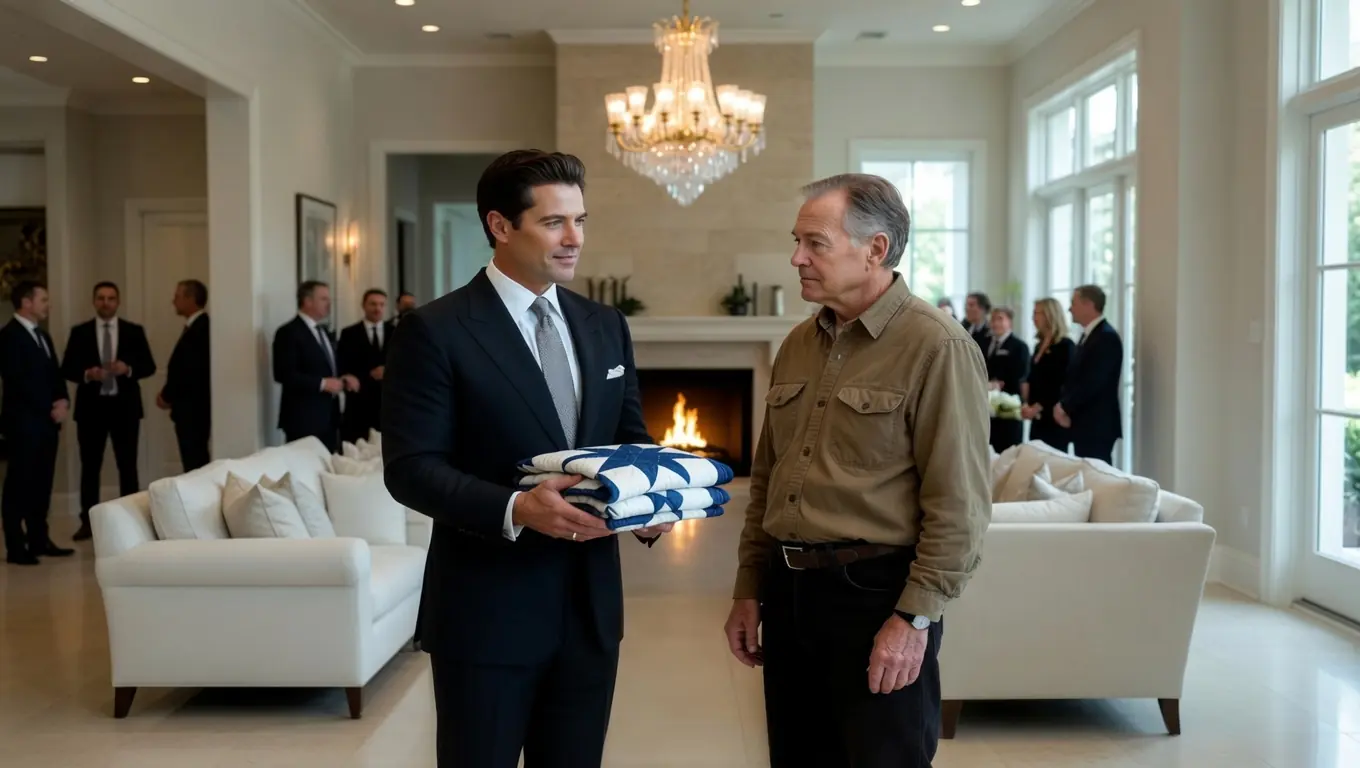
“Dorothy wanted him to have this quilt,” I said. “And I want my son to have the best of everything,” James replied. Then he grabbed the quilt from my hands. “Not homemade junk from a woman who spent her last years sewing instead of accepting reality.” He walked three steps to the massive stone fireplace, where a decorative fire crackled behind a glass screen.
It was not a child’s tantrum. It was a wound. “Daddy, no! Grandma made that! She promised me! She promised!” James turned back to his guests with his surgeon’s smile firmly in place.
“Kids get attached to the strangest things,” he said. “More champagne, anyone?” Nervous laughter moved through the room. A few guests looked away. Most pretended nothing had happened.
I did not shout. Dorothy always said anger wasted loud is anger wasted twice. Instead, I walked to the fireplace, opened the glass screen, reached in, and pulled the quilt out with my bare hands. The edges of the fire bit into my palms. The pain was sharp and honest, nothing like the dull ache my son had just put in my chest.
I smothered the flames against the marble floor. The quilt was damaged. One corner was blackened, and a few patches were singed, but most of it survived. Dorothy had used thick batting and dense quilter’s cotton. It did not burn easily.
She had built things to last, just like I taught her. I looked at my son, forty-four years old, the boy I had taught to throw a football, the man whose college I helped pay for, the doctor I had driven to medical school interviews. Somewhere between his first scalpel and his first Mercedes, I lost him. “Your mother left Noah more than a blanket, son,” I said. “You just tried to burn your boy’s inheritance.”
His eyes narrowed. “What are you talking about?” I did not answer. I wrapped the damaged quilt carefully, tucked it under my arm, and knelt beside Noah. He was crying into Claire’s dress, but Claire was not comforting him. She was checking her phone.
“Do not worry, buddy,” I said. “Grandpa has the blanket safe. Just like Grandma wanted.” Then I walked out. Behind me, I heard James laughing at something. The sound followed me to my truck like a stray dog I could not shake.
The drive back to Fort Worth took forty-five minutes on I-35, but it felt like forty-five years. The quilt sat on the passenger seat, smelling like smoke and heartbreak. My hands throbbed where the fire had kissed them. Second-degree burns on three fingers. I did not care.
My house on Elm Street was nothing special. Three bedrooms, a workshop out back, and a kitchen Dorothy had painted yellow because she said yellow kitchens made food taste better. She was right about most things. I set the quilt on our kitchen table and ran cold water over my hands. While the sting faded, a memory hit me like a freight train.
Two years earlier, Dorothy had lain in the hospital bed we had set up in the living room. Stage four pancreatic cancer had taken everything except her stubbornness. Her voice was barely a whisper, but her eyes were fierce. “Walter, I need you to give this quilt to Noah. Not to James. To Noah directly. Promise me.”
“I promise, Dot,” I said. “But why not just let James give it to him?” She grabbed my wrist with surprising strength. “Because James has forgotten what matters. And if he has forgotten, he will throw away anything that reminds him of who he used to be.”
“This quilt is Noah’s protection, Walter,” she whispered. “There is more in it than stitches. You will understand when the time comes. Just promise me. Keep it safe and give it to Noah.” She died four days later at 5:17 in the morning, holding my hand while rain fell on the roof she had loved for thirty-eight years.
Now I understood the first part of her warning. James had thrown the quilt into a fire. But the second part still puzzled me. More in it than stitches. Protection. What had Dorothy hidden?
I spread the quilt across the table. It was a blue and white star pattern, her specialty. She had been a master quilter and had won ribbons at the state fair three years running. But this quilt was different from her usual work. It was heavier.
The batting felt uneven in places, thicker in certain squares than others. The binding along one edge had a peculiar double fold I had never seen her use before. “Dorothy,” I said to the empty kitchen, to her photograph on the wall, to the ghost of lavender that still lingered in every room. “What did you sew inside?” Saturday morning, I drove to Maggie Chen’s shop on West Magnolia.
Maggie had been Dorothy’s quilting partner for twenty years. If anyone could decode what my wife had hidden, it was her. The bell chimed as I entered. Bolts of fabric lined the walls like a library of color. Maggie looked up from her cutting table, scissors paused mid-snip.
When she saw the quilt in my arms, her face changed. “Oh, Walter,” she said. She set down her scissors. “Dorothy told me this day might come. Sit down.” She spread the quilt across her worktable and examined it with the same focused intensity a surgeon might use, which felt ironic given what we were dealing with.
For several minutes, Maggie ran her fingers along every seam, pressing, feeling, measuring. Then she stopped at the center star, the largest one. “This batting is wrong,” she said. She pulled out a seam ripper. “Standard quilting cotton is about a quarter inch thick. This section is over an inch. Dorothy did not make mistakes.”
She carefully opened the stitching along one edge of the center star. Then she reached inside and pulled out a clear plastic sleeve. My heart stopped. Inside the sleeve were documents, thick official-looking papers with seals and signatures. Maggie’s hand went to her mouth.
The first document was a property deed. Travis County, State of Texas, two hundred and twelve acres along the Colorado River, twelve miles southeast of Austin, registered in trust for Noah James Brannigan. Dorothy’s signature was at the bottom, dated March 2019. The second document was another deed, one hundred and forty acres adjoining the first parcel. Same trust. Same signature.
The third was a letter from a real estate attorney confirming the trust structure and appraised value as of 2021. Three hundred and fifty-two acres. Maggie whispered, “Do you know what land along the Colorado River is worth now? With the tech boom and all the California money pouring into Austin?” I shook my head. My hands were shaking too hard to hold the papers.
Maggie was already on her phone, pulling up comparable sales. She went pale. “Walter, comparable acreage in that corridor sold last year for ninety-two thousand dollars an acre. Three hundred and fifty-two acres at that price.” She did the math twice. Over thirty-two million dollars. The room tilted.
I grabbed the edge of the table. “How? Dorothy was a nurse. We lived on two modest incomes our whole lives. How could she possibly afford three hundred and fifty-two acres?” Maggie found more documents deeper in the quilt, hidden in three other star squares, each one containing records that told a story I never knew.
Starting in 1986, two years after James was born, Dorothy had begun buying small parcels of undeveloped ranchland outside Austin. Five acres here, ten acres there, never more than she could afford from her nursing salary. She had found a rancher named Hector Medina who was selling off sections piece by piece as he aged. Dorothy bought whenever she had savings, quietly and patiently, over thirty-five years. Hector gave her favorable prices because she had been his wife’s hospice nurse.
The land sat empty for decades. Brush, wildflowers, and limestone. Nobody wanted it. Then the tech industry exploded into Austin like a supernova, and suddenly every acre within thirty miles of downtown was worth a fortune. Dorothy never told me.
Thirty-five years of purchases had been hidden in a quilter’s patience. Maggie found one more thing in the final star square: a letter in Dorothy’s handwriting on her good stationery. “My dearest Noah, this land is yours, not your father’s, not your mother’s, yours. I bought it piece by piece over your daddy’s whole lifetime, using money I saved from nursing shifts and overtime hours and skipping luxuries I did not need. I did not tell anyone because I wanted the land to grow in peace, just like I wanted you to grow in peace.”
“If your father treasures this quilt, it means he remembers what I taught him about love, hard work, and family. If he throws it away, then he values pride more than love, and you will need this land to build a life he cannot control. Grandma loves you to the moon and the stars I sewed for you. Forever, Grandma Dorothy.” I read it four times. Each word cut deeper than the last.
Dorothy had known. She had watched James become someone she did not recognize, cold, arrogant, obsessed with status. She had built a safety net for Noah with thirty-five years of nickels and dimes that turned into millions. “Your wife,” Maggie said softly, “was the smartest woman I ever knew. James has no idea. He tried to burn thirty-two million dollars because the blanket did not match his decor.”
Maggie carefully replaced everything and resealed the quilt. “What are you going to do?” she asked. I picked up the quilt, feeling the weight of Dorothy’s love, planning, and sacrifice in every stitch. “I am going to protect my grandson,” I said. “And I am going to make sure James understands exactly what he tried to destroy.”
Monday morning, I sat in the office of Rebecca Torres, an attorney Maggie had recommended from her network. Rebecca specialized in estate law and child advocacy. Her office was on the tenth floor in downtown Fort Worth, with a view of the Trinity River. She read through everything twice before speaking. “These deeds are legitimate and bulletproof,” she said.
“Dorothy registered everything through a licensed trust attorney in Austin. The trust is irrevocable. Noah is the sole beneficiary, and you are named as trustee. James has zero legal claim to this property.” She tapped the most recent appraisal with her pen. “But here is where it gets complicated. Your son is in financial trouble.”
“Serious trouble,” she continued. “I did some research after you called yesterday.” She pulled a file from her desk. “James Brannigan, chief of orthopedic surgery at Dallas Metropolitan, salary of eight hundred thousand dollars a year, but his spending outpaces his income by a factor of three. That mansion cost four-point-two million. The cars, the country club, Claire’s shopping, he is leveraged to the ceiling.”
She listed a second mortgage, maxed credit lines, and a malpractice suit that could cost him his license. “A malpractice suit?” I asked. “A patient named Gloria Fernandez,” Rebecca said. “Routine knee replacement went wrong. James was allegedly impaired during surgery. The hospital settled quietly, but the patient’s family is pursuing a separate civil case.”
“If they win, James could lose everything,” she said. “And if the medical board investigates the impairment claim, he could lose his license entirely.” My throat tightened. “Impaired? You mean he was drinking?” Rebecca’s expression was careful. “The complaint alleges he appeared under the influence.”
“Walter,” she said, “if James discovers the land exists, he will come after it. Men in his financial position do not hear thirty-two million dollars without trying to grab it. His first move will be to come after you.” “Come after me how?” I asked. She pulled out a document. “Conservatorship.”
“If James can convince a court you are mentally unfit to serve as trustee, he can petition to have himself appointed in your place,” she explained. “Then he controls the trust. He controls the land. He controls Noah’s future.” The blood drained from my face. “He would try to put me in a home?”
“It is disturbingly common in inheritance disputes,” Rebecca said. “He will hire a psychiatrist to say you are confused. He will use the incident at the housewarming, reaching into a fire with bare hands, as evidence of erratic behavior. He will paint you as a danger to yourself.” I looked at my bandaged hands. James had already laid the groundwork without knowing it.
“We need to move fast,” Rebecca said. “Independent medical evaluation proving your competency. Witnesses to your daily function. And we need evidence of James’s unfitness as a parent, because our best defense is a strong offense.” She slid a business card across the desk. “Carlos Vega, private investigator, former Texas Ranger. If James has skeletons, Carlos will dig them up.”
“Walter,” she added, “men like your son do not lose gracefully. When he finds out about the land, it is going to get ugly.” “How ugly?” I asked. She looked at me for a long second. “Whatever he did to that quilt will look gentle by comparison.”
Tuesday night, Carlos Vega called from his car outside James’s mansion. “I have been on him for forty-eight hours,” he said. “It is bad, Walter.” The file Carlos assembled over the next three days made me sick. James had been moving money to accounts in the Bahamas for four months, two-point-one million dollars transferred in small increments to avoid reporting thresholds.
He had booked one-way flights to Grand Cayman for three passengers: himself, Noah, and a woman named Kristen Mercer, a pharmaceutical representative he had been seeing for seven months. “She is twenty-nine,” Carlos said flatly. “She works for the same drug company whose painkillers James has been overprescribing. The affair started at a medical conference in Scottsdale. He is planning to leave Claire, take Noah, and disappear to the Caribbean.”
“The flight leaves in eleven days,” Carlos said. “He is taking my grandson out of the country with a woman who sees the kid as luggage,” I whispered. Carlos pulled up text messages he had obtained through legal discovery channels. James had written, “Tickets confirmed. New life starts the twelfth.” Kristen had asked, “What about your kid? Can he stay with your wife?”
James answered, “Noah comes with me. Claire is useless without my money. But the kid has a trust fund worth millions. Dorothy left something. I do not know the details yet, but I need to control it.” Kristen replied, “Millions? Then definitely bring him. We will figure out the rest in Cayman.” I stared at the screen until the words blurred. My son was not taking Noah because he loved him. He was taking Noah because Noah was worth thirty-two million dollars.
“There is more,” Carlos said quietly. He had obtained Noah’s school records through child welfare protocols. The counselor’s notes stretched back fourteen months. Noah Brannigan, age eight, exhibited persistent anxiety regarding academic performance, described fear of his father’s reactions to grades below an A level, and frequently asked the teacher if his work was good enough. Significant distress was noted.
Six months earlier, Noah had arrived at school visibly upset. When asked, he said, “Daddy told me I am not trying hard enough.” He stated his father called him lazy and said lazy boys did not deserve nice things. Noah asked if he could stay at school over the weekend. Three months earlier, Noah flinched when a door slammed during class.
The teacher noted that Noah became very still and quiet when adult men raised their voices. The pattern was consistent with exposure to verbal aggression in the home. I could not breathe. Fourteen months of suffering, documented in clinical language, somehow made it worse. My grandson had been drowning, and I had been too afraid to call it what it was.
Carlos showed me security camera footage from the mansion’s lobby, obtained through the building’s management company. Noah and James stood in the hallway after school. Noah held a painting he had made in art class. “Look, Daddy, I painted our family. That is you and me and Mommy and Grandpa.” James barely glanced at it.
“Why is everyone the same size?” James said. “I told you about proportions.” Noah answered softly, “My teacher said it was really creative.” James snapped, “Your teacher hands out participation trophies.” Then he crumpled the painting and dropped it on the floor.
“When you can paint something worth looking at, show me,” James said. “Go do your homework.” Noah stood in the hallway staring at the crumpled painting. He picked it up, smoothed it flat, and folded it carefully into his backpack. Then he walked away with his shoulders curled inward, making himself as small as possible.
Carlos stopped the video. My hands were shaking. “That is emotional abuse, Walter,” he said. “Documented, repeated, escalating. Combined with the financial fraud and the flight plans, we have more than enough.” My phone rang.
“James,” Carlos said. “Do not answer.” I picked up anyway. I needed to hear my son’s voice. I needed to understand what he had become. “Hey, Dad,” James said, sounding relaxed.
“Listen, about the housewarming,” he said. “I overreacted with the blanket thing. Claire thinks I should apologize, but I need you to understand something. You cannot keep bringing Mom’s old stuff around Noah. It confuses him. Makes him emotional.”
“Noah loved his grandmother,” I said. “She is gone, Dad,” James replied, his voice hardening beneath the false warmth. “You are seventy-one. You are living alone. Frankly, Claire and I are worried about you. Reaching into a fire, that is not rational behavior.”
There it was, the conservatorship threat, exactly as Rebecca predicted. “I am fine, James.” “Are you, though?” he asked. “Because from where I am standing, a seventy-one-year-old man who shoves his hands into a fireplace needs professional evaluation. We have been looking into care facilities. Nice ones. You would be comfortable.”
“I do not need a facility,” I said. His mask dropped completely. “Then stay out of my business and stop filling Noah’s head with stories about his dead grandmother. I do not need a senile old man undermining my authority with my own son. Throw away the blanket, Dad. It is burned anyway. And do not come around without calling first. Better yet, do not come around at all.”
“James, tell me something.” “What?” “When your mother was dying, stage four, Dr. Hendrix said there was an experimental treatment in Houston. Immunotherapy. Sixty thousand dollars for a shot at eight more months. She begged you to help pay for it. She said she wanted to see Noah start third grade.”
Silence filled the line. “You told her no,” I said. “You said sixty thousand dollars for eight months was not a sound investment. Those were your exact words. Not a sound investment. Your mother’s life.” James’s voice turned to ice. “She was dying anyway, Dad.”
“The treatment had a twenty percent success rate,” he said. “I am a doctor. I understood the math better than she did. It would have been throwing money away.” My hand tightened around the phone. “You let her die to save sixty thousand dollars, and you spent four-point-two million on a house.” “This conversation is over,” James said. “Remember what I said. Stay away from my family or I will have you evaluated, and we both know what happens then.”
The line went dead. Rebecca had been listening on speaker and recording everything. Carlos was writing notes furiously. “We got it all,” Rebecca said. “Threats, conservatorship language, and the admission about Dorothy’s treatment. He just handed us his character on a silver platter.” The next nine days were war.
Rebecca filed emergency motions while Carlos tracked James’s every move. The evidence piled up like bricks in a wall. Dr. Harold Beck, the psychiatrist James hired to declare me incompetent, had been disciplined in two states for falsified evaluations. James had paid him thirty-five thousand dollars, seven times his normal fee. James’s business partner at his surgical practice testified that James had offered him a percentage of future earnings in exchange for signing a statement about my erratic behavior at the housewarming.
Witness tampering. Claire called me Wednesday morning, her voice a cocktail of panic and greed. “Walter, I know about the land. James found something in Dorothy’s papers. I do not know details, but there is property worth millions. Whatever you are planning, I want in.”
I met her at a diner in Arlington. She came overdressed and under-sincere. “James is leaving me,” she said. “He is taking Noah and some woman to the Caymans. I know about the flights. I know about the accounts.”
She leaned forward. “I have proof. Photos, texts, hotel receipts. I will give you everything. I will testify against him. But I want custody of Noah and half of whatever Dorothy left.” Half of Noah’s inheritance. Sixteen million dollars.
“What would you do with Noah?” I asked carefully. Claire blinked. “Well, I would enroll him somewhere excellent. There are boarding schools in Connecticut, Switzerland. He would get an incredible education. And I would have the resources to rebuild my life.”
“You would send him to boarding school?” I asked. “He is eight years old.” “He would thrive,” she said. “Children adapt.” She waved her hand like she was discussing furniture placement. “I am being realistic, Walter. I never wanted to be a hands-on mother. That is what nannies are for. But I can provide Noah with opportunities, with the right funding.”
The recording captured every word. Two days before the hearing, James filed an emergency motion to expedite. The judge granted it, and three days compressed into twenty-four hours. Then came the bombshell. Carlos called at midnight. “James changed the flights. Tomorrow night, 9:45 p.m. to Grand Cayman. Not eleven days from now. Three passengers. He knows the walls are closing in. He is running.”
Rebecca had the emergency custody petition ready by sunrise. The hearing happened at ten in the morning in a Dallas family courtroom with wood-paneled walls and Judge Patricia Okonkwo presiding. She was a woman in her sixties, known for being brilliant and brutal when children were at stake. James sat with his attorney, looking confident and concerned in equal measure. The loving son worried about his confused father.
His attorney went first. He called it a straightforward case: Robert Sullivan, elderly, living alone, exhibiting signs of cognitive decline and erratic behavior witnessed by dozens of guests. A man who reached into a burning fireplace with his bare hands. His son simply wanted to ensure proper care. Then they brought Dr. Beck to the stand.
Dr. Beck delivered his rehearsed testimony about my supposed dementia with practiced sincerity. Rebecca stood for cross-examination. “Dr. Beck, your standard consultation fee is five thousand dollars. How much did James Brannigan pay you?” Beck hesitated. “That is a private matter between physician and client.”
“Your Honor,” Rebecca said, “I submit bank records showing a thirty-five-thousand-dollar wire transfer from James Brannigan to Dr. Beck, seven times his usual fee. I also submit disciplinary records from medical boards in Oklahoma and Louisiana documenting sanctions for falsified psychiatric evaluations in conservatorship cases.” The courtroom shifted. Judge Okonkwo’s eyes hardened. Then James took the stand, projecting wounded sincerity.
“I love my father,” he said. “Watching him decline has been heartbreaking. All I want is to make sure he is safe.” Rebecca approached with a thick folder. “Mr. Brannigan, you claim your father had a confused episode at a hardware store on Camp Bowie Boulevard on March third. Can you describe it?”
“He could not remember what he came to buy,” James said. “He got disoriented. Staff had to help him find the exit.” Rebecca pulled out phone records. “Your father’s location data shows he was at his workshop on Elm Street all day on March third. Security cameras at the hardware store show no record of him entering the premises. This incident was fabricated, was it not?”
James’s composure cracked. “I might be mistaken about the date.” Rebecca continued. “You are also mistaken about the incident at your bank, since bank surveillance shows a perfectly routine transaction. Mr. Brannigan, are you currently under investigation by the Texas Medical Board for performing surgery while impaired?” His attorney objected. Rebecca said it went to credibility.
“The petitioner is facing career-ending investigations while carrying over three million dollars in debt,” she said. “This conservatorship would give him control of his father’s assets and his son’s trust, which contains property worth over thirty-two million dollars.” The courtroom erupted. Judge Okonkwo called for order. “Continue, Ms. Torres.”
Rebecca played the phone recording. James’s own voice filled the courtroom. “She was dying anyway. The treatment had a twenty percent success rate. It would have been throwing money away.” Then came the security footage of James crumpling Noah’s painting. “When you can paint something worth looking at, show me. Go do your homework.”
Then came the school counselor’s notes, fourteen months of an eight-year-old boy’s fear documented in heartbreaking detail. Then came Claire’s recording from the diner. “I never wanted to be a hands-on mother. That is what nannies are for. We would send him to boarding school.” Then came the flight records: one-way tickets to Grand Cayman departing that night.
Judge Okonkwo stared at James for a long moment. Then she spoke. “This petition is not only without merit, it is a calculated, cynical attempt by a father to seize control of his own child’s inheritance through the legal abuse of his elderly parent. Petition denied with prejudice. I am referring this matter to the district attorney for investigation of elder abuse, witness tampering, perjury, and fraud.”
“Furthermore,” she continued, “based on the evidence of emotional abuse, parental unfitness, and imminent flight risk, I am granting emergency temporary custody of Noah Brannigan to his grandfather, Walter Brannigan, effective immediately. The respondent’s passport is to be surrendered to the court. Neither parent is to have unsupervised contact with the child pending full investigation.” The gavel came down. Outside the courthouse, the Texas sun was blinding after hours of fluorescent courtroom light.
James was led away in handcuffs, his surgeon’s hands cuffed behind his back. He looked at me once, and the hatred in his eyes was a living thing. Noah was brought to me by a CPS worker an hour later. He had his backpack and a stuffed dinosaur he had kept since he was three. When he saw me, he ran.
“Grandpa, are we going home? To your house?” I knelt down, holding his small face in both my hands. “We are going home, buddy. To the yellow kitchen, the workshop, and Grandma’s quilt, for as long as you need. Forever if you want.” He hugged me so tight I felt his heartbeat against mine.
“Can we play Grandma’s quilt game?” he asked. “Where I find all the star patterns?” “Every single night,” I said. That first evening, I spread Dorothy’s quilt across Noah’s bed in the room I had been preparing for weeks. Fresh paint, bookshelves, and a nightlight shaped like a star because Dorothy loved stars.
Noah traced the quilt’s pattern with his finger, finding every star and counting every stitch the way Dorothy had taught him. “Grandpa, is Grandma watching us right now?” “I think she is, buddy,” I said. “I think she never stopped.” He curled up under the quilt and was asleep in minutes.
It was the first time in months that he fell asleep without crying, the school counselor would tell me later. I sat beside his bed listening to the old house settle around us. Dorothy’s photograph watched from the hallway. The workshop stood out back, where I would teach Noah to build things with his hands. The yellow kitchen waited for us, where we would burn toast together the next morning.
Three months passed. Noah started sleeping through the night after the first two weeks. The nightmares faded. His teacher called to say he had started laughing in class again, raising his hand, showing other kids his drawings without asking permission first. Small victories, the kind that matter most.
James wrote from county jail. His letter was careful, measured, nothing like the man who had burned his mother’s quilt. “Dad, I have had time to think, more time than I have allowed myself in thirty years. I destroyed everything Mom built, everything you taught me. I chose money over family so many times I forgot there was another option.”
“I am getting help in here,” he wrote. “Therapy, anger management. I do not expect you to believe me yet. I do not expect Noah to forgive me. I just needed you to know that I finally understand what I became, and I am sorry I was not the son Mom raised.” I read it several times, searching for manipulation and finding what might have been genuine remorse.
Trust would take years to rebuild, if it could be rebuilt at all. But for Noah’s sake, I left that door open, a crack of light in a dark room. We donated one million dollars from the trust to the Fort Worth Children’s Hospital in Dorothy’s name. Noah signed the papers in his careful, crooked handwriting. Another million went to scholarships for children of incarcerated parents, breaking cycles and offering the second chances Dorothy always believed in.
Saturday afternoon, Noah and I sat in the workshop. I was teaching him to use a hand plane on a piece of red oak. His small hands gripped the tool with fierce concentration. “Grandpa,” he asked, “why did Daddy throw the blanket in the fire?” I set down my tools and gave him my full attention.
“Your father forgot what was important,” I said. “He thought expensive things were better than handmade things. He forgot that the most valuable things in life, love, family, and time, cannot be bought at any price.” Noah was quiet. Then he looked up with Dorothy’s eyes. “Is Daddy sad now?”
“I think so,” I said. “I think he is starting to understand what he lost.” Noah nodded. “Good. Not in a mean way. But maybe if he is sad enough, he will remember how to be nice again.” “Maybe so, buddy,” I said.
That night, after dinner, homework, and three chapters of a book about a boy who built a tree house, I tucked Noah into bed under Dorothy’s quilt. He pulled it up to his chin and smiled. “Grandpa, this blanket is the best thing I own. Better than anything in Daddy’s big house. You know why?” My throat tightened. “Why?”
“Because Grandma made it with love,” he said. “And you cannot buy love at any store.” “That is exactly right,” I whispered. He closed his eyes. “Grandpa, you will be here tomorrow, right? And the day after?” “Every single day, buddy. That is a promise.”
He was asleep before I reached the door. I stood there watching him breathe under a quilt full of stars and secrets and thirty-five years of a woman’s quiet love. “Dorothy,” I whispered to the yellow kitchen, to the workshop, to every corner of the house she had filled with warmth, “our grandson is safe. He is healing. He knows he is loved exactly as he is. He does not have to be perfect. He just has to be Noah.”
I kept my promise. Every morning, when that boy wakes up under Dorothy’s quilt, he is learning what she spent her whole life teaching. Love is patient. Family is everything. The most valuable things are not the ones that cost the most, but the ones someone made with their own two hands and their whole heart.
James had everything. He had a loving mother who worked overtime shifts for thirty-five years to build his child a future. He had a father who taught him to work with his hands. He had a son who only wanted to show him a painting. And he threw it all away for marble countertops, champagne, and the approval of people who would not visit him in jail.
I have lived seventy-one years on this earth. I have built houses, raised a family, and buried the woman I loved. I can tell you this with certainty: people are given to us to love, not to impress. Dorothy understood that. She spent every spare dollar not on herself, but on land that would grow in value for a grandson she might never see grow up.
Even when cancer was stealing her body, she was still planning, still protecting, still loving. She did not measure wealth by houses, titles, or cars in the driveway. She measured it by the love we leave behind. By that measure, Dorothy Brannigan was the richest woman who ever lived. Every morning, Noah wakes up safe under a quilt full of stars, and that is the only legacy I will ever need.