When the doctor told me I had only five days left to live, my son gripped my hand tightly and said, “Finally, just five more days. Everything and all your assets will belong to me.” I froze when I heard what he said, but I pretended as if I had not heard a thing. After he left, I called my lawyer because in that very moment, I understood I did not have much time left. But it was still enough to rewrite the ending for everyone who thought they had already won.
The first thing I remember is the beeping. Not like the gentle alarm clock from my penthouse apartment. This was different, relentless and clinical, a constant reminder that I was not in my bedroom anymore. I was trapped in a room with walls the color of institutional grief and machines that seemed to have more life in them than I did.
I forced my eyes open. The fluorescent lights above burned like a thousand angry suns, and for a moment, I could not remember how I had gotten there. Then it came back in fragments: the weakness in my legs, the yellowing of my skin in the mirror, and the way my best Armani suits no longer fit. I had blamed it on age and stress, the cost of running a tech empire that had made me a very rich man at sixty-four.
My hands felt like lead weights. I tried to lift my arm, and it took everything I had just to move it an inch. The IV line tugged at my inner elbow, and the sting told me something serious was happening. Real serious.
“Charles.” A voice cut through the fog. It was Dr. Michael Thornton, a sharp man with a good reputation, the kind of doctor who did not waste words. His face looked ashen now, like he was delivering something he would rather not say.
He pulled a chair close to my bed, and that was when I knew. Doctors do not sit when they have good news. “Your liver is in critical condition,” he said carefully. “Advanced cirrhosis. I am going to be direct with you, Charles. We have run every test. The damage is too extensive.”
He paused, and in that pause, a year of my life seemed to drain away. “You have roughly five days, maybe a week, but I would prepare for five.” Five days. The words landed like a sledgehammer, and I waited for panic, fear, or grief to arrive. Instead, what came was something colder, a kind of clarity that only appears when you realize the clock is actually ticking and you can hear it.
Thornton continued explaining comfort care and pain management, but I was no longer listening. My eyes had moved past the doctor and landed on the figure standing in the corner of the room. My son Vincent was thirty-five, impeccably dressed in a charcoal suit that probably cost more than some people’s cars. He worked in administration at one of my tech companies, a position I had given him more out of obligation than merit.
It was something else entirely, something my gut recognized before my mind could name it. Our eyes locked for just a fraction of a second, and I saw the mask slip. A flicker passed across his face, quick and ugly. Then it vanished, and he stepped forward with the performance of a worried son.
“Dad, we will get through this,” he said softly. “The best doctors, the best care, whatever it takes.” The words were right, and the tone was right. Everything about it sounded exactly like what a concerned son should say.
I tried to shake his hand. My grip was weak and pathetic. His was firm and confident. He held on a beat longer than necessary, and I wondered if he could feel my pulse racing.
“Thank you, Vincent,” I said. I meant it, though not in the way he probably thought. After he left, after Thornton left, and after the nurses adjusted my IV and checked my vitals, I lay in the quiet hum of the ICU room and started remembering. I remembered the tea.
Natalie had been bringing it for months. She was my son’s wife, though the distinction had started to blur in my mind lately. She would appear with little cups and that polished smile of hers. “For your energy,” she would say. “It’s herbal. Very good for you.”
I drank it day after day without thinking twice. Why would I question it? She was family. But now, lying in that bed with five days to live, I began to wonder when the weakness had really started and when Natalie had started bringing me tea.
My mind was suddenly sharp, clearer than it had been in years. Vincent’s smile, Natalie’s tea, and my failing liver no longer felt like coincidence. The machines beeped on, the fluorescent lights hummed, and I lay there alone in the dark heart of the night. I made myself a promise: whatever was happening, I would find out, and I would make sure it mattered.
The clock on the wall said 11:47 p.m. when I heard the soft click of the door closing. I had not been sleeping. My mind had been looping through questions, memories, and fragments of conversations I had filed away without thinking. The IV drip had been changed twice since Vincent left that afternoon.
Vincent stepped into the room like he owned it. In his mind, maybe he did. He wore a fresh black shirt, expensive and sharp, and his face had lost that careful mask of concern. Now he looked hungry.
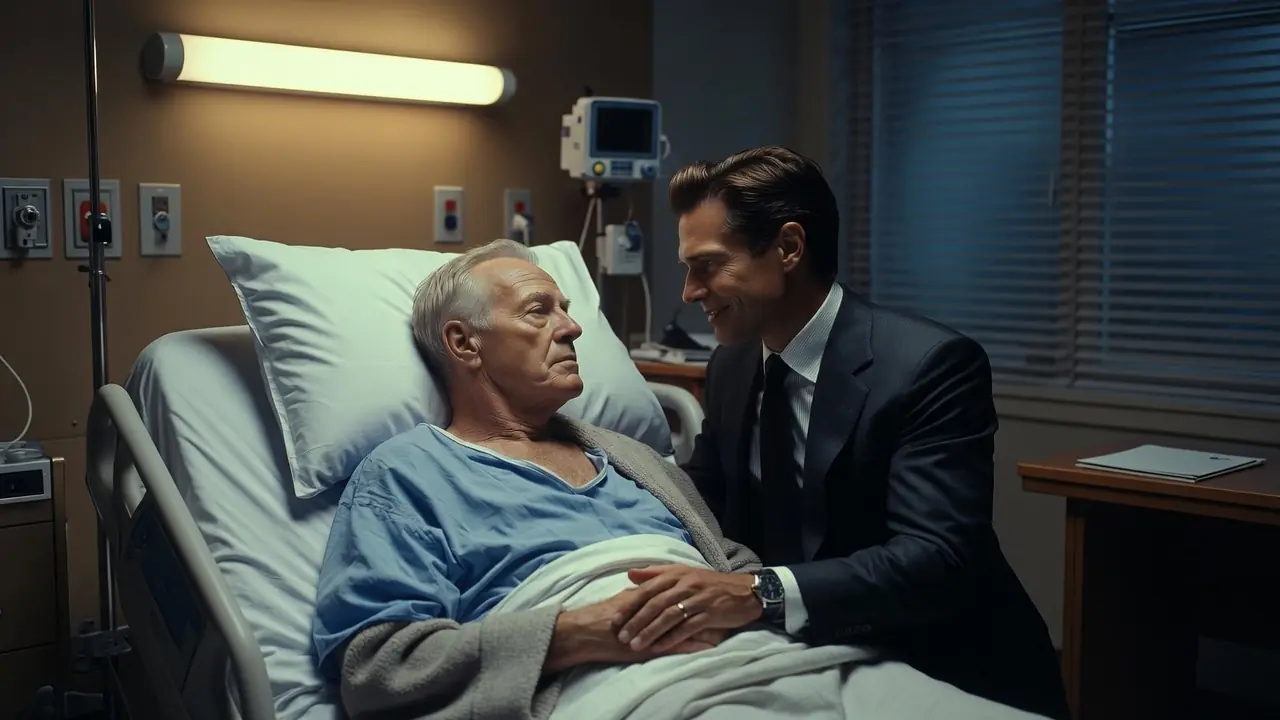
He locked the door behind him. That simple action told me everything. “I can’t sleep either, Dad,” he said, almost playful. He pulled the visitor’s chair right next to my bed, close enough that I could smell his cologne.
I did not answer. I listened and watched. I was a man who suddenly understood the rules of the game had changed, though I did not yet know all the pieces on the board. Vincent smiled, and this time he let the smile stay.
“Five days,” he said softly. “Isn’t that something? Just five days, and the house, the company, all of it, everything you built, comes to me.” He leaned back, utterly relaxed and certain. “I have to say, I’m impressed by how quickly you are going. I honestly thought it would take longer.”
The room seemed to tilt. “What are you talking about, Vincent?” He laughed, actually laughed. It was a sound like breaking glass. “Come on, Dad. Don’t insult my intelligence. I know you’re smart. You have that look right now, the one where you are connecting dots.”
He leaned forward slightly. “So let me connect the last one for you. The tea. Three months. Every single day, Natalie has been bringing you that herbal blend, and every single day you have been drinking it like a trusting father.”
My mouth went dry. Not from fear, though fear was there, but from the terrible clarity of having my worst suspicion confirmed by the person who orchestrated it. “You,” I started, but the words would not finish. Poisoned me. Tried to kill me. Even those words seemed too small.
“Me and Natalie,” Vincent continued, as if he were discussing a clever business plan. “She is smarter than people give her credit for. Very creative in the kitchen. Very attentive to your needs.” He stood and paced the small room like this was not a confession but a victory lap.
“Three months of that specialty blend,” he said. “The doctors cannot even tell where it came from. They just see a liver failing and a body betraying you.” I wanted to move, to lunge at him, to grab him. But my body was a prison, and Vincent knew it.
“You have maybe five days left, Dad. A week if you are lucky. When you are gone, when the will is read, the will that says everything goes to me, Natalie and I are going to disappear.” He stopped near the window and looked at the Denver skyline. “Maybe Bora Bora. I have always wanted to see the water there. Seventy-five million dollars is a lot of water to look at.”
“People will know,” I said. My voice sounded thin, but dangerous. Vincent turned back with a nearly sympathetic expression. “The doctors will list it as advanced cirrhosis. Technically, it will be. Just accelerated.”
He told me no one would believe a dying man screaming about poison. He said even if I could prove it, I would be dead. There was no hesitation in him, no awareness that he was talking about killing his own father. He moved toward the door and unlocked it casually.
“Enjoy your last few days, Dad,” he said. “Natalie will probably visit tomorrow with soup or something. She is thoughtful that way.” Then he smiled again. “And do not bother calling anyone. What would you say? That your son is a killer? Good luck with that.”
Then he was gone. My heart pounded so hard I thought the machines might alarm. My hands shook, and every muscle screamed at me to act. Vincent was right about one thing: no one would believe me yet.
But he had made one mistake. In his arrogance, he had told me everything because he thought I was helpless. He thought I was already dying. He was wrong about one of those things.
I did not sleep that night. The darkness became my confessional, and my own mind became the priest. Hour after hour, I let the memories come, not in order, but in fragments. The tea. Natalie’s little cups. Vincent’s careful questions. The weakness that had arrived gradually enough to hide itself.
Two weeks earlier, I had done something on impulse. One of the few smart things I had managed in the last three months. I went to a walk-in clinic and asked for a blood test without telling anyone. I listed vague symptoms, paid cash, and had the results sent to a P.O. box I had opened years ago for business correspondence I did not want traced through the house.
I had no idea what I was looking for then. Just a feeling. Now, lying in that ICU room, I understood that blood test was my insurance policy. Somewhere between the hospital and that P.O. box in downtown Denver, there was evidence.
The morning light was cruel. It washed across my face at 6:47 a.m., and I had not slept a minute. Jennifer Cole, the first nurse of the day shift, came in to check my vitals. She was holding an envelope.
“You got mail,” she said. “From some lab in Boulder. Medical stuff, right?” She set it on the rolling table beside my bed and continued her routine. My hand moved toward it almost involuntarily.
The envelope was standard, white, unremarkable. The return label said Boulder Medical Labs. My hands shook as I opened it. The letter was clinical and precise, but my eyes jumped immediately to the important words: elevated levels, palliative-grade compound, unusual concentration, chronic exposure.
The compound was levorphanol, a legitimate palliative care medication used primarily for pain management in terminal patients. In therapeutic doses, it was safe. But the concentration in my blood was four times higher than a standard therapeutic dose. The report stated that the pattern suggested chronic exposure over several months, not a single overdose or accidental ingestion.
Several months. The mechanism was described in detached medical language that somehow made it worse. In sustained elevated doses, the compound accumulated in fatty tissue, metabolized through the liver, and progressively compromised hepatic function until complete organ failure. Until my liver stopped working. Until I died.
I folded the letter carefully and slid it into my shirt beneath the hospital gown. It crinkled against my ribs. I had proof now. Not just a confession, but science.
When the next nurse came to collect my lunch tray, I stopped her. “I need to make a phone call.” She brought me a cordless hospital phone, and I dialed Henry Morrison from memory. Henry had been my lawyer for twenty years, a man I trusted with contracts worth hundreds of millions.
His assistant answered, and within seconds Henry was on the line. “Charles, what happened?” “I am in Denver Memorial,” I said. “I need you here within two hours. This is life or death, and I am not being metaphorical.”
There was a brief pause. “I am on my way. What do I need to know?” “Everything,” I said, “but not over the phone.” Then I added, carefully, “My son is trying to kill me. Or has been. I have medical evidence, and I have a confession, but I do not have much time.”
Henry arrived in ninety minutes. He walked into my hospital room like a man on a mission, wearing a charcoal suit and carrying the authority Vincent had only pretended to possess. He pulled the visitor chair close to my bed and asked me to show him the lab letter. He read every line carefully. When he finished, his mouth tightened.
“Levorphanol,” he said. “That is not something you accidentally ingest.” “No,” I said. “It is not.” He looked directly at me. “Tell me everything. Start from the beginning and do not leave anything out.”
So I told him about the tea, about Natalie’s visits, about Vincent’s questions, about the symptoms I had dismissed, and about Vincent’s midnight confession. Henry listened without interrupting. When I finished, he sat back slightly. “They made mistakes,” he said. “The first was telling you. The second was assuming you could not do anything about it.”
Then Henry opened his briefcase and pulled out my current will. It was seven years old and painfully simple. Everything went to Vincent. In the event of Vincent’s death, everything went to Natalie.
“Seventy-five million dollars,” I said quietly. “More, actually, if we include the properties and tech company equity,” Henry replied. “Vincent tried to poison you for the majority of that sum. If he succeeds, he inherits every penny.” “Then we change it,” I said. “Immediately.”
Henry nodded, but he warned me that it had to be done carefully. The moment Vincent realized the will had changed, he would panic. A panicked man who had already tried to kill me once could become unpredictable. The new will needed witnesses, a notary, a capacity evaluation, and video proof that I was lucid.
“Who gets the money?” Henry asked. I had been thinking about it since I understood what Vincent and Natalie had done. Legacy, wealth, purpose, and what my life had truly built toward. “The Denver Children’s Hospital Foundation,” I said. “All of it.”
Henry’s pen moved across the legal pad. “That is a hell of a legacy,” he said quietly. “Let’s make sure they get it,” I replied. By evening, my hospital room had become a legal office.
A notary named Victoria Miller arrived, professional and precise. Dr. Thornton came in to conduct a capacity evaluation, asking the date, the current president, details about my family, and the nature of the legal decision I was making. “I am changing my will,” I told him. “I am leaving my entire estate to the Denver Children’s Hospital Foundation instead of my son. I understand the implications, and I am making this decision freely.”
Thornton signed the form confirming that I was mentally competent. Nurse Jennifer Cole and my housekeeper Martha Williams served as witnesses. A camera recorded the entire process. My signature was shaky, but it was unmistakably mine.
I signed the new will. Jennifer and Martha signed as witnesses. Victoria notarized the document with her official seal. Henry secured the original and returned to tell me it would be nearly impossible to challenge.
The next morning, Henry came back with news. He had spoken with prosecutor Richard Hastings, a man known for his sharp intellect and total lack of patience for people who believed they were above the law. Hastings opened a file immediately. He assigned Marcus Coleman, a former major-crimes detective turned private investigator, to begin the groundwork.
Marcus pulled three months of hospital security footage. He traced every visit from Vincent and Natalie, every cup, every jar, every suspicious movement near the pharmaceutical wing. Soon he found the link: a pharmacy technician named Victoria Cross. She had access to the restricted storage area and had been caught on camera removing labels from vials and replacing them with fake labels reading herbal tea extract.
The final photo showed Vincent meeting her in a parking garage. She handed him a small padded envelope, and he handed her what looked like a thick roll of cash. “They were not even creative,” Marcus said later. “Classic handoff.”
Marcus found Victoria Cross before Vincent knew the walls were closing in. He showed her the footage, the meetings, the labels, and the evidence. She broke quickly. She admitted Vincent had blackmailed her after discovering she had taken expired medication from a disposal bin to help her sick sister.
Victoria told them Vincent had demanded concentrated formulations of the compound and had threatened to destroy her life if she refused. She gave them names, dates, logs, and formulas. She revealed that a senior pharmacist named Margaret Foster had helped prepare the vials. Natalie was the final step, mixing the compound into tea and masking the bitterness with honey and herbs.
By day four, the evidence was overwhelming. Henry sent Vincent a formal letter stating that my new will had been signed, witnessed, notarized, and supported by a medical evaluation confirming my capacity. The entire estate, approximately seventy-five million dollars, was now going to the Denver Children’s Hospital Foundation. The old will was revoked.
Vincent’s reaction was immediate. According to the investigators, he turned gray, called Natalie, and panicked. He had committed a terrible crime for a prize that no longer existed. Natalie told him they had to get to the hospital and make me change it back.
They never got the chance. Vincent stormed into Henry’s office, shouting that the will was fraud and coercion. Henry calmly told him the signing had been recorded, the medical evaluation was valid, and the evidence around the tea was already in the hands of the authorities. Then Detective David Brooks entered and arrested him.
Natalie was arrested at home. Officers found the herbal tea bags behind expensive pantry items and a leather-bound journal in a kitchen drawer. In it, she had recorded every dose, every date, and my physical reactions. One entry noted tingling in my hands and an increased dose.
Margaret Foster was arrested at the hospital pharmacy. Investigators found unlabeled vials and encrypted messages between her and Vincent. The triangle was complete: Vincent, the architect; Natalie, the administrator; and Margaret, the supplier. Victoria Cross became the key witness.
On day five, interrogations began. Vincent eventually confessed that he had wanted the capital, the company, and the inheritance. He claimed he did not think of it as murder, only acceleration. Hastings called it what it was: attempted first-degree murder and conspiracy.
Natalie tried to play the terrified wife, but her own journal destroyed her. The messages proved she was not a victim but a partner. Margaret admitted she had been paid ten thousand dollars and knew the concentrations would damage a human liver. Victoria testified to every vial, label, meeting, and threat.
By July 2025, I walked into Denver High Court no longer as a dying shadow, but as a man who had survived. My recovery was called a miracle, but I knew it was the result of finally being free from the tea that had been destroying me. Prosecutor Hastings built the case brick by brick. He showed the lab results, the video of the new will, the recovered messages, the tea bags, the pharmacy logs, and Victoria’s testimony.
The jury was out for only two hours. Vincent was found guilty of attempted first-degree murder and conspiracy and sentenced to twenty-five years in state prison without early parole. Natalie received twenty years for her role. Margaret received eight years, with a possible reduction for cooperation.
Victoria Cross was spared the primary charges because her cooperation had helped save my life. She received two years of mandatory community service and a permanent ban from the medical field. As the bailiffs led them away in handcuffs, I closed my eyes. Justice had not erased the betrayal, but it had answered it.
The following week, the Denver Children’s Hospital Foundation received formal notice that seventy-five million dollars was being transferred. It was the largest private donation in the state’s history. By August 2025, I stood beneath the Colorado sun at the ribbon-cutting ceremony for the Charles Hayes Pediatric Wing. Behind me rose an eight-story structure of glass and steel, filled with clinics, research labs, and wards designed for children fighting the hardest battles of their lives.
As I looked at my name etched in silver letters, I did not see a monument to wealth. I saw a lighthouse. I saw children entering a place that might save them. Vincent had tried to bury me to take my money, but instead he had dug the foundation for a place that would save thousands of lives after I was gone.
I walked away from the podium with my heart lighter than it had been since I was a young man building a company in a garage. I had survived a dark conspiracy, but I had not won with violence or anger. I had won with the law, the truth, and a decision that turned a poisoner’s greed into a child’s hope. I lived to witness my own legacy, and I finally understood that true family is not who inherits your wealth, but who deserves your trust.