“Dad, we need your house.”
That was what my son Trevor said in the middle of Sunday dinner. Not congratulations, not a question, not even a careful lead-in. Just that sentence, dropped across my dining room table like a decision that had already been made without me. I set my fork down slowly and looked at him, waiting for the part that would make it sound less like an order.
Only then did he add, almost as an afterthought, “Stephanie’s pregnant.”
The order of those two statements told me everything I needed to know before I even responded. I am Frank Morrison, sixty-two years old, and I have spent my life dealing with problems that looked simple on the surface but were never simple underneath. I worked hard for decades, built a home with my wife Susan, raised my son as best I could, and learned that people reveal themselves most clearly when they want something. What I saw at that table did not add up.
I smiled first because that is what you do when someone announces a baby. My fingers tightened slightly around my coffee mug, but my voice stayed even. “Congratulations,” I said. Stephanie reached for Trevor’s arm, but she did not look like a woman bursting with joy. She looked careful, like she was watching my face more than celebrating the news.
There was no rush of excitement. No details spilling out, no nervous laughter about names, no mention of doctor appointments, no glow in their eyes. There was just waiting. Then Trevor leaned forward and said, “Our place isn’t big enough. We’ve been thinking about it, and we need something bigger.”
The way he said “we’ve been thinking” made it clear that this conversation had already happened. It just had not happened with me. I let the silence stretch one second longer than they expected. Then I asked, “And why is that my problem?”
The room went quiet immediately. Trevor looked down at his plate. Stephanie inhaled, then straightened slightly, like she was stepping into a role she had rehearsed. “We’re just trying to plan ahead,” she said. “For the baby, for stability.”
I did not lean back. I stayed exactly where I was, one hand on the table, watching them the way I used to watch people explain things they hoped I would not question. “What exactly are you asking?” I said. Another pause followed, and it was not confusion. It was calculation.
Trevor cleared his throat but did not answer right away. Stephanie glanced at him, then back at me, measuring how direct she could afford to be. That was when I understood this was not an announcement. It was a negotiation they believed they had already won.
They did not answer my question directly. Instead, they adjusted their approach. Stephanie leaned forward slightly, folding her hands as if we were discussing something reasonable and ordinary. “It’s just that your house has space,” she said. “More than you really use now.”
Trevor kept his eyes on the table. He did not correct her, did not soften what she said, and did not step in to make it sound less cold. I watched that more closely than anything else. Sometimes what a person refuses to say tells you more than what comes out of their mouth.
“This place is quiet,” Stephanie continued. “Stable. It would make things easier for us, especially with a baby coming.”
Easier. I repeated the word silently, letting it settle. “So this is about convenience,” I said.
Trevor shifted in his seat. Stephanie’s expression tightened, then smoothed again. “It’s about family,” she replied. “Helping each other when it matters.”
I nodded once. “Yes. Helping. Not replacing responsibility.”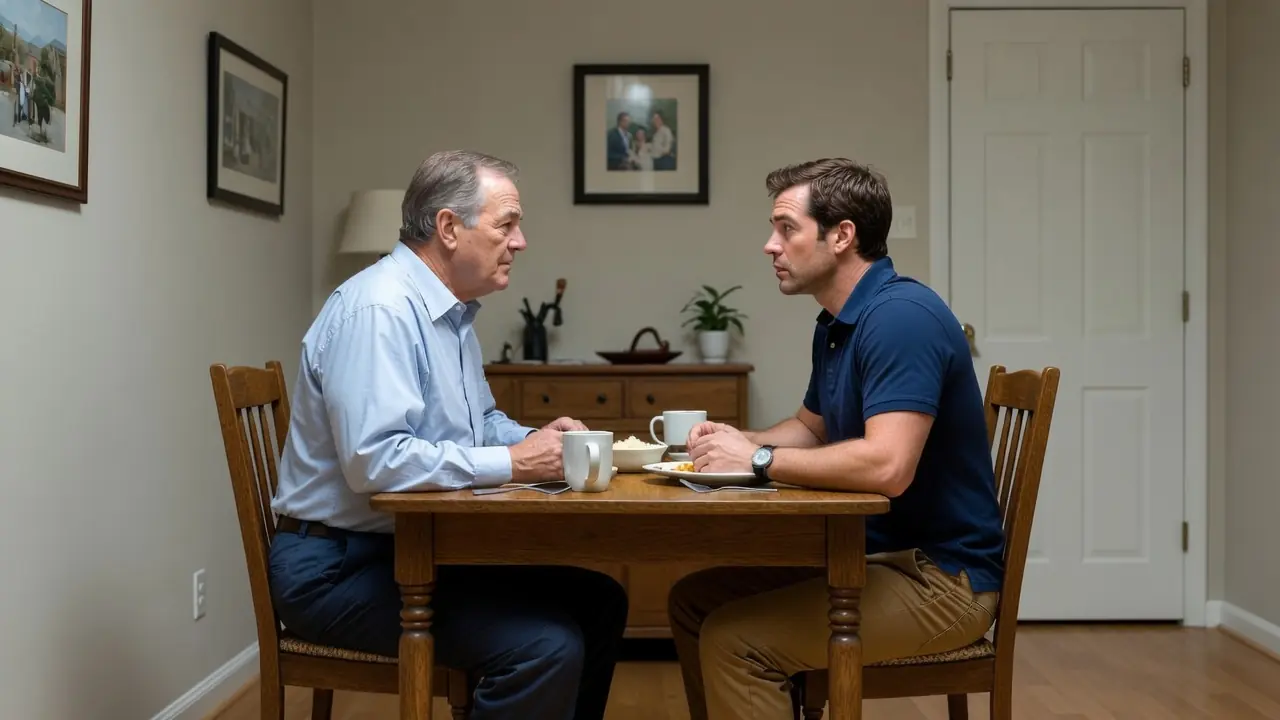
That was when Trevor finally looked up. “Dad, we’re not trying to take anything from you. We just thought maybe there’s a way to make this work for everyone.”
For everyone. The phrasing was careful, too careful. I could hear the space where the real sentence should have been. I did not raise my voice.
“That is your child,” I said. “Your responsibility.”
The words landed clean between us. Trevor opened his mouth, then closed it again. Stephanie leaned back slightly, reassessing me. She was not hurt, not offended in the way someone might be if they had come with honest joy and been met with suspicion.
“I will help you build something,” I said. “I won’t hand it to you.”
Another pause followed, heavier this time. They were not asking directly, and that bothered me more than if they had simply said what they wanted. They were trying to move the conversation somewhere I had not agreed to go. The more I listened, the clearer it became that what they wanted was not advice, not support, and not guidance.
They wanted permission.
I kept my voice steady. “If you’re not ready to stand on your own, why have a child?”
Trevor flinched slightly. Stephanie did not. She just watched me with a composed expression, like she was recalculating rather than responding. That difference did not escape me.
“It’s not like that,” Trevor said. “We just want to be prepared.”
“Prepared?” I repeated. “By shifting the weight somewhere else?”
“No,” he said quickly. “That’s not what I mean.”
But he did not finish the thought. I looked from him to Stephanie and back again. “I didn’t force you to have a baby,” I said. “That was your choice. So now you find your way.”
Trevor leaned back, exhaling slowly. “You’re making this sound like we did something wrong.”
“No,” I said. “I’m saying you made a decision, and decisions come with responsibility.”
Stephanie tilted her head, studying me. There was no softness in her, no excitement, no nervous joy. No mention of due dates, appointments, morning sickness, or names. Just strategy wrapped in family language.
That was when the thought settled clearly. This did not feel like joy. It felt like leverage.
After they left that night, I sat alone at my kitchen table, the same table where Susan and I had made plans for thirty-five years before cancer took her. I replayed everything. The timing of the announcement. The way Stephanie had watched me instead of sharing the news. The way Trevor followed her lead instead of speaking first.
Most of all, I replayed the order of the words.
“We need your house.”
Then, “Stephanie’s pregnant.”
It had not been excitement. It had been positioning. And I had lived long enough to know the difference.
Three days later, I called my neighbor Jim, who was retired from the phone company. I asked him about home security systems and told him I was thinking about upgrading. There was nothing suspicious about a sixty-two-year-old widower wanting better security. Within a week, I had cameras covering my driveway, front door, and backyard.
They were small cameras, the kind you do not notice unless you know where to look. I did not install them because I was afraid of Trevor. I installed them because something about the conversation told me I needed records. When people start treating your property like their future, you protect it before they decide to help themselves.
Then I started making calls. Not to Trevor, but to people who might know things. I contacted Rick, an old friend who worked at the credit union where Trevor had his accounts. I did not ask him to break any rules. I simply mentioned that Trevor had been asking for financial help and that I wanted to understand the situation before making any decisions.
Rick’s face told me more than his words. “Frank,” he said, “I can’t give you specifics, but if your son is asking for money, there’s probably a good reason.”
“How good a reason?” I asked.
“The kind that keeps people awake at night.”
That was when I knew I was dealing with something real. The following week, I started watching their social media. Stephanie posted everything online, restaurants, shopping trips, furniture, weekend getaways, anything that made her life look better than it was. I began taking screenshots and making notes of dates and locations.
For two people supposedly saving money for a baby, they were spending heavily on things that had nothing to do with a child. A brand-new sectional sofa. A weekend trip to Napa Valley with restaurant photos and wine tastings. Designer handbags posted across two months. Either money was coming from somewhere I did not know about, or they were spending money they did not have.
Two weeks after our confrontation, I invited them over again for Sunday lunch. This time I was ready. I set up a small digital recorder in the dining room, the kind people use for business meetings. It was my house and my conversation, and I wanted a record of what was said.
They came in looking relaxed, as if they believed the hard part was over. We sat down, and I asked, “How’s Stephanie feeling? Morning sickness starting yet?”
Trevor looked at Stephanie. Stephanie looked at Trevor for just a second too long. Neither of them knew who should answer first.
“Oh, you know,” Stephanie finally said. “Just tired mostly.”
“When’s the due date?” I asked.
Another pause.
“We’re still early,” Trevor said quickly. “Haven’t really calculated all that yet.”
I nodded as if that made sense. “Well, when was the last period? That’s how they calculate it, right?”
Stephanie’s face went blank for half a second before she recovered. “I don’t really track that stuff,” she said.
I am not an expert on women’s health, but I was married for thirty-five years. Susan and I tried for children when we were young, and while it did not happen for us, I learned plenty during those years. Any woman who is actually pregnant knows the answer to that question, or at least understands why it matters. It is one of the first things a doctor asks.
That was when I became certain, but certainty was not enough. I needed proof. So I stood up and said, “You know what? This calls for a celebration. Let me bring out the good wine.”
I went to the kitchen and came back with a bottle of Cabernet I had been saving. I poured three glasses and handed them around. “To new beginnings,” I said.
Trevor took a sip immediately. I watched Stephanie over the rim of my glass. She brought the wine to her lips, hesitated for just a moment, then took a small sip. Maybe she was being cautious. Maybe she forgot the role she was supposed to be playing.
Either way, I had enough to start asking harder questions.
“Trevor,” I said, “I’ve been thinking about what you said last week, about needing help with a house situation.”
His face lit up. “Yeah?”
“Before I make any decisions, I’d like to understand your current financial picture. Income, expenses, debt situation. If you’re going to be responsible for a mortgage and a baby, I need to know you can handle it.”
The light in his face dimmed. “What do you mean?”
“What’s your monthly take-home after taxes?”
Trevor looked at Stephanie again. She gave him a small nod. “About forty-two hundred,” he said.
“And monthly expenses?”
The pause was longer this time. “We haven’t really calculated everything exactly. Rough estimate, maybe forty-five hundred.”
I set my wine glass down carefully. “So you’re spending more than you make.”
“It’s not that simple,” Stephanie jumped in. “There are irregular expenses. Seasonal things.”
“Like what?”
She started listing things quickly. Car maintenance, holiday gifts, clothing, entertainment, eating out. The sort of expenses that sound reasonable when said fast but become frightening when written down. I listened to the whole list, then asked the question I really wanted answered.
“What about debt? Credit cards, loans, anything like that?”
The silence stretched until it became uncomfortable.
“Some,” Trevor finally admitted.
“How much is some?”
“It’s manageable.”
I used the calm voice I had learned over decades. “How much?”
He looked down at his hands. “Maybe twelve thousand.”
“On how many cards?”
“Three.”
I nodded slowly. “And the mortgage? Current?”
Another long pause.
“Mostly.”
“What does mostly mean?”
“We might be a little behind.”
“How little?”
“Two months.”
Two months behind on the mortgage, twelve thousand dollars in credit card debt, spending more than they earned, and now they wanted to take over a bigger house under the cover of a baby story. I kept my face neutral, but inside, everything was clicking into place. This was worse than I thought.
“I see,” I said. “And the baby is due when exactly?”
Stephanie opened her mouth, then closed it. Trevor looked at her, then back at me. “We’re still really early,” he said again.
“Early like first trimester? Second month? Give me something to work with.”
They looked at each other like they were silently deciding which lie was safest. That was when I knew I had them.
“You know what?” I said, standing up. “I think I need to see some documentation before we go any further.”
“Documentation?” Stephanie asked.
“Doctor’s confirmation of the pregnancy,” I said. “Bank statements showing your actual financial situation, recent pay stubs, credit card statements, and a written plan for how you’ll handle your existing debt while taking on new responsibilities.”
The color drained from Trevor’s face. “Dad, we’re family. You don’t need to treat this like a business transaction.”
“Trevor, this is my house,” I said. “The house your mother and I worked thirty-five years to pay off. If you’re asking me to make decisions about it, then yes, I absolutely need to treat this like a business transaction.”
I went to the kitchen and came back with a notepad. I wrote down what I wanted. Proof of pregnancy. Three pay stubs. Six months of bank statements. Credit card balances. A written repayment and budget plan.
Stephanie stood up. “This is ridiculous. We’re trying to plan for your grandchild.”
“Then you should have no problem providing proof that you can actually take care of that grandchild.”
Trevor stood too. “We should go.”
“Yes,” I said. “You should. Come back when you have the paperwork.”
After they left, I sat in the living room and thought about what I had learned. The financial trouble was bad enough, but it was the method that bothered me most. The coordination. The careful timing. The use of emotion to bypass logic.
This was not desperation. This was strategy.
Over the next three weeks, I did more research. Real research, the kind I used to do when solving engineering problems. I hired a private investigator named Paul, who did background checks for local businesses. I told him I was considering a family loan and wanted to understand the full picture before making a decision.
What Paul found confirmed my worst suspicions. Trevor’s actual salary was eight thousand dollars less per year than he had told me. They had been late on rent five of the last seven months. There were two judgments against them, one from a credit card company and another from a furniture store.
The picture was getting clearer, and it was not pretty. But I still needed the truth about the pregnancy. So I observed Stephanie’s routine for a few days, not to invade her life, but to see whether the story matched reality. What I saw did not help her case.
One morning she went to a coffee shop and ordered a large coffee with extra shots, then went to a nail salon. The next day she went to a gym and did a full workout, including ab exercises and a kickboxing class. Maybe there was an explanation, but combined with everything else, it only made the pregnancy story look weaker. Four weeks after the first dinner, I was ready to end it.
I called Trevor and asked him to come over alone. I told him we needed a man-to-man conversation. He showed up the next afternoon looking nervous but hopeful. We sat in my living room, the same room where I had helped him with homework when he was a teenager.
“Trevor,” I said, “I want to ask you something, and I want a straight answer.”
He nodded.
“Is Stephanie actually pregnant?”
The silence that followed told me everything before he spoke. He did not say no immediately. He did not act shocked by the question. He just sat there, looking like a man trying to calculate how much trouble he was in.
Finally, he exhaled and shook his head. “No.”
“How long have you been planning this?”
“It wasn’t supposed to be like this,” he said quickly. “We just thought if you believed we needed help, you might…”
“You might what?”
“Let us move in,” he said. “Just temporarily. Until we got back on our feet.”
I leaned back in my chair and processed the full scope of what they had tried to do. “So you lied about having a grandchild to manipulate me into giving you my house.”
He winced. “We weren’t going to keep lying.”
“No?”
“We were going to tell you eventually.”
“After I moved out?” I asked. “After you changed the locks?”
“It’s not like that.”
“What is it like, Trevor?”
He rubbed his face with both hands. “We’re drowning, Dad. The credit cards are maxed out. We’re behind on everything. Stephanie lost her job three months ago, and I’m barely making enough to cover the basics.”
“So you decided to make it my problem.”
“We just needed a break. A chance to reset without losing everything.”
I stood and walked to the window, looking out at the yard Susan and I had planted together over the years. “Trevor, do you know what this house represents?”
“Dad, I…”
“This house represents thirty-five years of getting up every morning and going to work, even when I didn’t want to. Even when your mother was sick and I wanted to stay home with her. Even when money was tight and we had to choose between fixing the roof and taking a vacation.”
I turned back to face him. “This house is what we built by doing the right thing even when it was hard.”
“I know that.”
“Do you? Because what you just tried to do tells me you don’t understand it at all.”
Trevor looked down at his hands. “What are we supposed to do now?”
“Now you do what every adult has to do,” I said. “You figure it out.”
“How?”
“The same way everyone responsible does. You cut expenses. You increase income. You pay your debts. You live within your means.”
“It’s not that simple anymore.”
“It is exactly that simple,” I said. “It’s just not easy.”
I sat back down across from him. “Trevor, I love you. You’re my son, and nothing will ever change that. But I will not enable you to avoid the consequences of your choices.”
“So you won’t help us at all?”
“I’ll help you learn to help yourself. I’ll help you create a budget. I’ll help you find a smaller apartment if you need it. I’ll even lend money for absolute necessities with clear terms. But I will not hand you a solution that teaches you nothing.”
Trevor sat there for a long time. Finally, he looked up. “What about Stephanie?”
“What about her?”
“She’s not going to be happy about this.”
“That’s between you and her,” I said. “But if your wife’s happiness depends on lying to your family and manipulating your way into someone else’s house, you should think hard about what that says about your marriage.”
He left that day with a quiet “I’ll call you later” and a hug that felt heavier than usual. He did not call later. Not that day, not that week. But Stephanie did.
Two weeks later, she called on a Tuesday morning around ten. Her voice was sharper, less careful. “Frank, we need to talk.”
“About what, Stephanie?”
“About what you’re doing to your son.”
“What am I doing to my son?”
“You’re abandoning him when he needs you most.”
I almost laughed. “Is that what he told you?”
“He told me you refused to help us.”
“I offered to help him in every way that would actually help him. What I refused to do was enable him.”
“That’s not your decision to make.”
“It is exactly my decision to make,” I said. “It’s my house.”
There was a pause, then her voice turned colder. “You know, Trevor always said you were selfish. I guess he was right.”
“Stephanie, let me ask you something. In all the time you’ve been married to my son, how many times have you encouraged him to live within his means?”
Silence.
“How many times have you suggested cutting expenses instead of increasing debt?”
More silence.
“How many times have you told him he should work harder or find better employment instead of looking for handouts?”
She said nothing.
“That’s what I thought.”
“You don’t understand what it’s like for our generation.”
“I understand every generation faces challenges,” I said. “What I do not understand is expecting other people to solve problems you created for yourself.”
She hung up on me.
Six weeks later, Trevor called. His voice sounded different. Tired, yes, but clearer somehow.
“Dad, can we talk?”
“Of course.”
“Stephanie left.”
I did not say anything right away. I just waited.
“She moved back in with her mother,” he said. “She said this wasn’t what she signed up for.”
“I’m sorry you’re hurting,” I said.
“Are you sorry she left?”
I thought about that. “No,” I said. “I’m not sorry that someone willing to lie to your family to get what she wanted is no longer directing your life.”
He was quiet for a while. Then he told me he had found a small apartment he could actually afford. He had been looking at his budget like I suggested and realized they had been spending about eight hundred dollars more than he made every month for nearly two years. He sounded ashamed, but shame can be useful when it finally turns into honesty. For the first time in a long time, he was talking like a man facing reality.
Then he asked, “Were you ever really going to help us? If we had been honest from the beginning?”
I thought before answering. “Trevor, if you had come to me and said, ‘Dad, we are in financial trouble, we made poor decisions, and we need help getting back on track,’ I would have moved heaven and earth to help you. But not the way you did it. That was not asking for help. That was trying to transfer your problems to me without taking responsibility.”
Another long pause followed. Then he said, “I think I’m starting to understand that.”
“Good,” I said. “That’s the first step.”
“What’s the second?”
“Making a plan and sticking to it,” I said. “Even when it is hard. Even when it takes longer than you want. Even when other people are doing things you cannot afford to do.”
We talked for another hour that day. Really talked, not as a father lecturing a son, but as two men discussing a problem that needed solving. Eight months later, Trevor called with an update. His second job was exhausting, but he had paid off one credit card completely.
He still had a long way to go, but he could see the light. When his car needed eight hundred dollars in repairs, he almost called a payday loan place. Then he remembered what I had said about solving problems instead of shifting them. He worked extra shifts, sold some furniture, and covered the repair without borrowing.
“It sucked,” he told me. “But I did it.”
“That,” I said, “is the kind of progress that matters.”
He comes over for dinner sometimes now. Just him. Stephanie and he are divorced, and that chapter is done. After dinner, we sit on the back deck, drink beer, and watch the sun drop behind the trees Susan loved.
Last month, Trevor said, “Dad, I need to tell you something.”
“What’s that?”
“When all this was happening, when we asked for the house, I knew it was wrong,” he said. “I knew we were lying to you, but I was so scared of losing everything that I convinced myself it was okay because we were family.”
I nodded and let him finish.
“I understand now why you said no,” he said. “And I respect you for it.”
That meant more to me than an apology. It meant the lesson had gone deeper than the argument. He told me that if he ever had kids someday, he would teach them what I had tried to teach him.
“That nobody owes you anything just because you want it,” he said. “That if you want something, you earn it. And that family helps each other get stronger, not weaker.”
We sat there in comfortable silence for a while, watching the last light fade from the sky. Trevor is doing better now, really better. He is saving money for the first time in his adult life and talking about going back to school part-time for HVAC training. He is not fixed overnight, but he is standing.
And me? I am still in the house Susan and I built together. I protect what we created, not because it is just walls and rooms, but because it represents a life of choices, sacrifices, and discipline. When my time comes, it will go to someone who understands what it means. Someone who knows the difference between earning something and being handed something.
The best gift you can give someone you love is not always what they ask for. Sometimes it is the boundary that forces them to become stronger. Sometimes love is not opening the door to your house. Sometimes love is refusing to let someone use that door to escape responsibility.
Real love is not giving someone what they want.
It is giving them what they need to become who they are supposed to be.