After an argument, my son left me at a bus stop with no money. A blind gentleman whispered, “Pretend you’re my wife. My driver is coming. Your son will regret leaving you.”
The afternoon sun beat down mercilessly as I watched Daniel’s car disappear around the corner. The screech of tires on asphalt was a final punctuation to our argument. At 67, I never imagined I’d be standing abandoned at a bus stop, my own son driving away in anger.
“I’m not a child, Daniel,” I had told him, my voice trembling despite my efforts to remain calm. “I don’t need you arranging my life as if I’m incompetent.” His response had been predictably dismissive. “Mom, you’re being unreasonable. That senior living facility is perfect. They have activities, medical staff, everything you need.”
“Everything except my independence,” I’d countered. That’s when he’d pulled over abruptly. “Fine, if you’re so independent, find your own way home. Maybe that will make you realize you need help.”
Only after his car disappeared did I discover my predicament. My purse, containing my wallet and bus pass, sat on my kitchen counter where I’d left it in our rush to leave. My cell phone, which I’d grabbed at the last minute, showed just 3% battery remaining.
I felt a flush of humiliation rise to my cheeks as I stood at the bus stop. A woman of my age with no way to get home. Five years a widow, thirty years a teacher of literature, and now reduced to this, stranded by my only child who couldn’t understand that living in that antiseptic prison of a retirement community would kill me faster than any physical ailment.
The bus stop bench offered little comfort to my arthritic hip as I contemplated my options. I could walk, but my apartment was at least four miles away. I could ask a stranger to borrow a phone, but I’d need to swallow considerable pride. And who would I call? The few friends my age who still drove wouldn’t see a message for hours, and calling Daniel was out of the question.
Lost in these thoughts, I hardly noticed when someone sat beside me until a cultured male voice spoke quietly. “Pardon me, but I couldn’t help overhearing your predicament.”
I turned to find an elegant man in his early 70s sitting next to me. Dark sunglasses covered his eyes and a white cane rested against the bench beside him. He was impeccably dressed in what my late husband would have called old money attire. A perfectly tailored light gray suit that managed to look comfortable despite the summer heat.
“I’m fine, really,” I said automatically, embarrassment coloring my voice. A slight smile crossed his face. “I may be blind, but my hearing is excellent. Your son left you here without ensuring you had transportation home. That strikes me as inconsiderate.”
There was something about his direct assessment that bypassed my defenses. “That’s one word for it,” I admitted. “Another might be cruel.” He angled his face toward me, his expression serious. “Pretend you’re my wife,” he said in a lower voice. “My driver is coming. Your son will regret leaving you like this.”
I blinked, taken aback by the unexpected offer. “I couldn’t possibly.” “I’m Robert Wilson,” he continued smoothly, extending his hand with surprising accuracy toward mine. “And you are?”
“Martha Collins,” I replied automatically, taking his hand. His grip was warm and firm. “Well, Martha Collins, I’m offering you a dignified solution to an undignified situation. No strings attached.”
He tilted his head slightly. “Unless you’re uncomfortable accepting help from a blind old man.” Something in his self-deprecating tone made me smile despite everything. “Being blind doesn’t make you incapable, Mr. Wilson. Just as being older doesn’t make me incapable. Despite what my son believes.”
He laughed then, a genuine sound that crinkled the corners of his eyes above his dark glasses. “Touché, Mrs. Collins. Then we understand each other.”
Before I could respond, a sleek black car pulled up to the curb. The driver, a distinguished-looking man about my age, stepped out and approached us. “Right on time, James,” Robert said, gathering his cane. “We’ll be giving Mrs. Collins a ride home today.”
If James found this unusual, he didn’t show it. “Of course, sir,” he responded with a slight nod in my direction. “Ma’am.” As James helped Robert to the car with practiced efficiency, I hesitated. I’d spent my life being cautious and sensible. Getting into cars with strangers, even elegant blind gentlemen with chauffeurs, wasn’t something Martha Collins did.
And yet, as my phone finally died with a sad little beep in my pocket, I found myself making a decision that felt like stepping off a cliff. “Thank you,” I said, allowing James to open the rear door for me.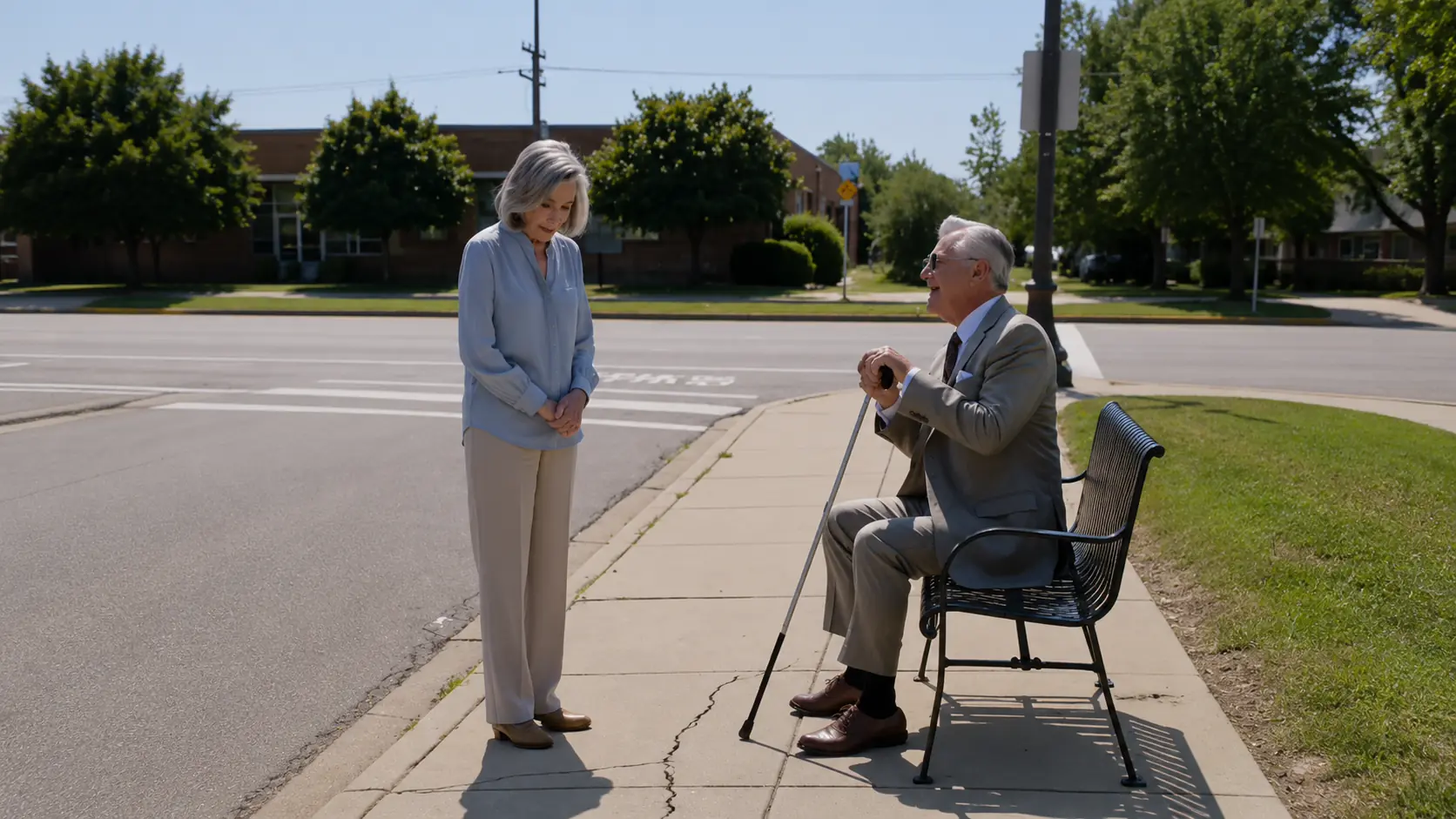
The interior of the car was cool and smelled of leather and subtle cologne. “Where do we have the pleasure of taking you, Mrs. Collins?” Robert asked as James started the engine. I gave my address in the modest eastside neighborhood where I’d moved after selling our family home following Frank’s death.
Actually, Robert said after a moment’s consideration, “I hope you’ll allow me to offer you tea first. My home is nearby, and after such an eventful afternoon, you might appreciate a moment to collect yourself before returning home.”
The proper response would have been to decline politely. Instead, I found myself considering what awaited me at my apartment. Empty rooms and the lingering echo of Daniel’s frustrated voice. The weight of the day’s humiliation pressed down on me. “Tea would be lovely,” I heard myself say as we drove through increasingly upscale neighborhoods.
I studied Robert Wilson more carefully. His silver hair was expertly cut, his hands manicured but strong. The blindness seemed to have done little to diminish his confident bearing. There was something almost theatrical in the precision of his movements, the way he turned his head when I spoke, how his expressions matched my tone perfectly.
“If you’re wondering if you’ve made a terrible mistake accepting a ride from a stranger,” he said suddenly, as if reading my thoughts, “I assure you, James has an impeccable driving record, and I’m far too old and respectable to be dangerous.” I found myself chuckling. “I was actually thinking, you seem remarkably well adjusted for someone who can’t see.”
“Ah,” he replied with a small smile. “Well, one adapts or one becomes bitter. I chose the former.”
When the car finally pulled through an ornate gate and up a curved driveway, I couldn’t suppress a gasp. Robert Wilson’s home was nothing short of a mansion. A stunning colonial revival with perfectly manicured grounds stretching in every direction. “Welcome to my humble abode,” Robert said with a hint of irony in his voice. “I hope you like Earl Grey.”
The grandeur of Robert Wilson’s home left me momentarily speechless as James helped us from the car. The mansion stood three stories tall. Its symmetrical facade featured elegant columns and expansive windows that caught the late afternoon sun. Flower gardens bloomed in carefully orchestrated color patterns. And somewhere in the distance I heard the gentle splash of a fountain.
Your silence suggests either you’re admiring the view or reconsidering the wisdom of having tea with a stranger, Robert commented as we approached the front entrance. “It’s a bit overwhelming,” I admitted. “You didn’t mention you lived in a palace.”
His lips quirked upward. “Hardly a palace, though I suppose it is rather large for one person and a small staff. The family has owned it for generations, and I find comfort in familiar surroundings, especially since losing my sight.”
As James opened the massive front door, I noticed something curious. Despite Robert’s apparent blindness, there were no obvious accommodations for a visually impaired person. No textured pathways, no specially marked doorways. Everything was simply beautiful, designed for sighted appreciation.
“The house doesn’t seem particularly adapted for,” I hesitated, “for a blind man.” Robert finished for me. “I prefer aesthetic beauty over practicality. I’ve memorized every inch of this place. Fifteen years without sight teaches one to map spaces quite efficiently.”
We entered a foyer with soaring ceilings and a grand staircase that curved upward like something from a classic film. A crystal chandelier hung overhead casting rainbow prisms across marble floors. “We’ll take tea in the garden room,” Robert told James. “And perhaps some of those lemon biscuits Mrs. Chen made yesterday.”
“Very good, sir,” James replied before disappearing down a hallway. Robert offered his arm with surprising accuracy. “Shall we? The garden room offers a pleasant view of the east grounds, or so I’m told.”
I hesitated before taking his arm, struck again by how confident he seemed for someone who couldn’t see. As we walked through the house, I noticed subtle details, the way he occasionally trailed his fingers along certain surfaces, how he counted steps under his breath between rooms.
The garden room proved to be a sunlit conservatory with floor-to-ceiling windows overlooking immaculately landscaped grounds. Comfortable wicker furniture with plush cushions created several seating areas among large potted plants. The effect was both grand and intimate. Wealth displayed without ostentation.
“Please make yourself comfortable,” Robert said, gesturing to a seating arrangement near the windows. He settled himself in an adjacent chair with practiced ease, placing his cane carefully beside him.
“Have you lived here long?” I asked, trying to reconcile this palatial home with the man before me. “All my life, with a few intervals away for education and business,” he replied. “Though I’ve closed off portions of it since losing my sight, no point maintaining rooms I’ll never see again.”
There was a wistfulness in his tone that touched me unexpectedly. “I downsized after my husband died,” I offered. “Our family home felt too empty with just me rattling around in it.”
“Frank, wasn’t it? Your husband’s name?” I blinked in surprise. “Yes, but I don’t remember mentioning —” “You were wearing a wedding band, but referred to yourself as Mrs. Collins, not Miss. And you mentioned your son, so I made an educated guess,” Robert explained smoothly. “Was it a long marriage?”
“Forty-two years,” I replied. “High school sweethearts, if you can believe such a cliché. He was an engineer. Heart attack took him five years ago.” “My condolences. A significant loss.”
James returned with a tea service that would have impressed the queen. Delicate china, silver serving pieces, and an array of small sandwiches and biscuits arranged on tiered plates. “Will there be anything else, sir?” James asked after setting everything before us. “No, thank you, James. We’ll manage.”
Robert waited until James had left before speaking again. “Now then, Martha Collins, former teacher of literature I would guess from your speech patterns. Widow, mother to at least one controlling son — tell me why he left you stranded today.”
My hand froze midway to the teacup. “How did you —” “Teachers have a particular way of expressing themselves — precise vocabulary, complete sentences, even in casual conversation. You mentioned being older but not incapable, suggesting retirement. The rest I heard at the bus stop.” His smile was gentle. “I may be blind, but I’m far from unobservant.”
As he poured tea with surprising dexterity, I found myself telling Robert about Daniel’s increasingly insistent campaign to move me into assisted living, how he’d arranged today’s tour without consulting me, presenting it as a fait accompli. The argument that had escalated in the car afterward, culminating in my impulsive demand to be let out.
“You were asserting your independence,” Robert nodded, “and he responded by attempting to prove your dependence.” “Exactly.” The validation from this stranger was unexpectedly powerful. Daniel doesn’t see the irony. He claims I can’t manage on my own, then abandons me without transportation to teach me a lesson about needing help.
Children often struggle to see their parents as autonomous beings, Robert observed, sipping his tea. “My daughter Sophia went through a similar phase after my sight deteriorated. She wanted to manage everything, my medical care, my business interests, my daily routine. It took time for her to understand that blindness hadn’t diminished my competence.”
The tea was perfectly brewed, the sandwiches delicate and flavorful. As we continued talking, I found myself relaxing in a way I hadn’t for months. Robert was an attentive listener and a thoughtful conversationalist, drawing connections between my experiences teaching adolescents and his navigating the business world.
“I founded a technology company specializing in security systems,” he explained when I asked about his career. “Ironic that I now can’t see the very screens our software protects.” Something about that statement struck me as odd. But before I could analyze it further, the door opened and a striking woman in her early 40s entered.
“Dad, James mentioned you had a guest.” She stopped short upon seeing me, surprise evident in her expression. “Sophia, perfect timing,” Robert said, turning his head in her direction. “This is Martha Collins. Martha, my daughter Sophia Wilson.”
Sophia recovered quickly, extending a perfectly manicured hand. “How lovely to meet you. Dad rarely entertains these days.” Her tone was friendly but evaluative. Her gaze taking in my simple dress and practical shoes with subtle assessment. I recognized the protective calculation in her eyes.
“Your father rescued me from a rather awkward situation,” I explained briefly, recounting my abandonment at the bus stop. Something in Sophia’s face softened. “That sounds exactly like something dad would do.” She glanced at her father with a mixture of exasperation and fondness. “Always collecting strays.”
“Martha is hardly a stray,” Robert countered. “She’s a retired literature teacher with a son who needs remedial education in respecting his mother’s autonomy.” Sophia laughed. A genuine sound that transformed her professional demeanor. “Well, then you’re in good hands. Dad has strong opinions about autonomy.”
She checked her watch. “I can’t stay. Board meeting in 30 minutes. Will you be at the foundation dinner tomorrow night?” “Wouldn’t miss it,” Robert replied.
After Sophia departed with a quick kiss to her father’s cheek, Robert tilted his head slightly. “My daughter,” he said with mock conspiracy, “thinks I need constant supervision. The blindness makes her nervous even after all these years.”
I studied him carefully. Something about his demeanor was nagging at me. “She seems lovely. Protective, but that’s natural indeed.” Robert set down his teacup with precision. “Now, shall we arrange to get you home before your son sends out a search party?”