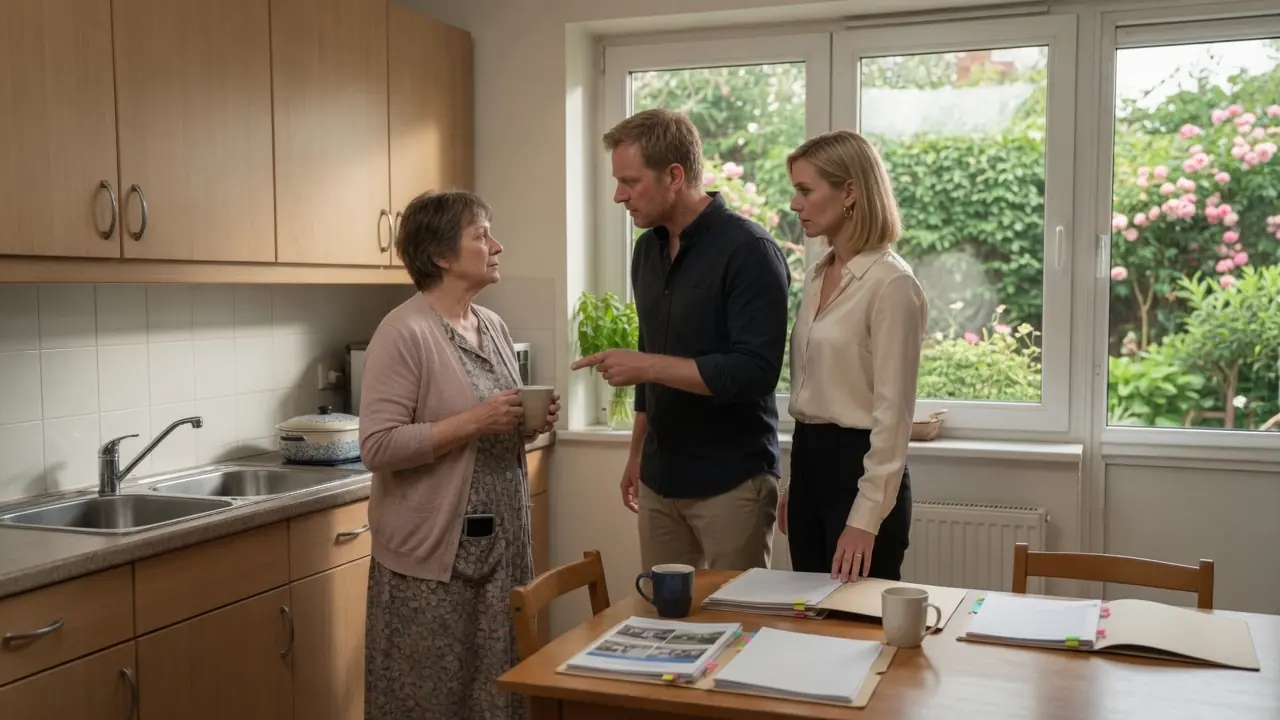
Rowan Quinn pointed one sharp finger at his mother across the kitchen table and laughed like her life had always been a joke he was finally tired of hearing. “You had nothing, Mom,” he said, his voice rising until it filled every clean corner of the villa kitchen. “Now you’re acting like a little house makes you somebody.” Lena stood behind him with her arms crossed and her smile tucked neatly into the corner of her mouth, letting him do the ugly work while she watched the old woman in front of them grow silent.
Milena Quinn held her coffee mug with both hands because it gave her fingers something steady to do. She was sixty-three, small, tired in the bones, and dressed in a floral house dress with a pale cardigan buttoned at the front. The kitchen behind her was modest but spotless, with basil on the windowsill, old wooden cabinets, two white mugs on the table, and a garden visible through the back door. It was not a mansion, but every tile, every curtain, every quiet morning inside it belonged to her.
On the table between them lay Rowan’s folders. One held glossy nursing home brochures with smiling elderly people posed under bright lights. The other held legal papers marked with colored tabs where Lena had placed neat little stickers beside every line they wanted Milena to sign. Property transfer, power of attorney, assisted living arrangement, financial authorization, all dressed up as concern.
Rowan’s finger stayed raised toward Milena’s face. “You’re too old to manage a place like this,” he said, his tone hard and impatient. “You forget things, you live alone, and sooner or later you’ll embarrass us.” Milena looked at that finger, then at Lena’s hand resting near the documents, and something inside her became still in a way that had nothing to do with fear.
This was not the first time Rowan had made her feel small. Years earlier, when she lived in a rented room and worked early shifts as a caregiver, he had laughed at the food she brought to his house. She had woken before dawn to make enchiladas, the way he once loved them as a boy, and carried the dish across town wrapped carefully in foil. He had pushed it aside and said it tasted like “rent food,” as if poverty had a flavor and his mother had brought it into his clean kitchen.
Lena had been there that day too, sipping something green from a glass straw. “We’re eating clean this week,” she had said, not bothering to pretend kindness. Milena had folded the foil back over the dish and nodded because some humiliations are too deep to answer while they are happening. She remembered walking out into the cold with the casserole pressed to her chest, whispering one word to herself before she reached the bus stop.
Enough.
The next morning, she called the caregiving agency and asked for steady work. Not occasional shifts, not emergency coverage, not the sort of assignments where someone thanked her only after she was too tired to stand straight. She needed something reliable, something that would give shape to her days and weight to her savings. That was how she met Thomas Redmond.
Thomas was a retired academic with mild tremors, mismatched socks, and a way of looking at people as if they had arrived with a history worth hearing. On her first morning, he opened the door in a cardigan with one button wrong and asked if she wanted tea before work. Milena almost forgot how to answer. Nobody had offered her tea before asking her to scrub, lift, cook, wash, or clean in years.
She worked for him five days a week. She cooked light meals, folded laundry, cleaned bathrooms, organized books, helped him move safely through the house, and ran errands when his hands shook too badly for small tasks. He thanked her every day. That alone was enough to make her return the next morning with her hair combed neatly and her lunch packed in brown paper.
At night, Milena saved every dollar she could. Tips went into a tin can hidden beneath a loose floorboard under her rented bed. Weekend earnings from tamales and sweet bread at the flea market went into the same tin. She wrote dates on folded bills in pencil, not because the bank required it, but because she wanted proof that every small sacrifice was moving somewhere.
Years passed slowly, then quickly. She stopped buying anything unnecessary, learned to mend old shoes, carried sandwiches instead of buying lunch, and walked when the bus fare felt too heavy for the week. Thomas saw more than she said. Once, while she was cleaning his kitchen, he told her, “Milena, you work like a person who is building a door nobody else can see.”
She smiled at the sink. “I suppose I am.” He did not ask what she was escaping from. That was part of his kindness. He had a way of leaving doors open without pushing anyone through them.
When Thomas died in his fourth year with her, the house felt finished, not merely empty. Milena grieved him more than some relatives grieve blood, because respect can build family where blood has failed. She attended his funeral in her best dark dress and stood near the back, not wanting to intrude. Thomas’s son, Darius Redmond, shook her hand afterward and thanked her for giving his father dignity to the end.
Weeks later, the lawyer called. Thomas had left Milena a gift, not an extravagant fortune, but enough to combine with her tin can savings and buy something small. For the first time in decades, she sat across from a real estate agent without feeling foolish. When the agent showed her the villa, Milena knew before entering that she wanted it.
The villa needed work. A cracked tile near the entrance, a tired fence, an old gas range, and wild ivy creeping along the back gate made it imperfect. But the roof was sound, the plumbing held, and the garden, though neglected, seemed ready to forgive whoever would kneel in the soil long enough. The day Milena received the keys, she did not smile. She breathed.
She moved in quietly on a Wednesday and told no one. For the first week, she unpacked slowly, placing each plate in the cabinet as if she were introducing it to a home. She washed the windows, trimmed the basil, cleaned the old stove, and hung simple curtains that let in clear morning light. The silence inside the villa did not feel lonely; it felt like a room finally listening.
Rowan found out three months later. He came through the back gate without calling, sunglasses pushed into his hair and Lena behind him in heels that clicked against the garden path. Milena was kneeling by the basil, gloves damp with soil, when she heard the metal scrape of the latch. She turned and saw her son walk toward her with the smile he used when he wanted something.
“Mom,” Rowan said, stretching the word like affection. “We were just in the neighborhood.” Milena glanced toward the curb where their SUV ticked with heat. Lena’s eyes had already started moving across the garden, the windows, the roofline, the entry door, measuring everything. “I didn’t know you were coming,” Milena said.
They entered without invitation. Rowan went straight to the fridge, opened it, and held up an off-brand yogurt with a laugh. “You still buy this stuff? You never change.” Lena touched the countertop with two fingers, scanning the kitchen like a woman judging a property she had already half claimed. “These appliances would all have to go,” she murmured.
Milena stood near the doorway with her garden gloves still on. Rowan opened cabinets, peered into the hallway, and looked around with the careless authority of someone who had forgotten whose threshold he had crossed. Lena stepped into the second bedroom and tapped the doorframe softly. “She could sleep here,” she said to Rowan, almost under her breath. “Like a maid, but family.”
The words were casual. That made them worse. Milena did not answer, because she understood now that some people reveal more when they believe you are too quiet to matter. She watched them walk through her home and let the shape of their intentions become clear. By the time they left, she knew they would return with papers.
They came the next Sunday wearing softer colors and sweeter faces. Lena carried two folders tucked under her arm, and Rowan held a store-bought pie still cold from the shelf. Milena opened the door and offered coffee. They sat at her kitchen table as though politeness could cover the greed that had already stepped inside.
Rowan began carefully. “We’ve been thinking, Mom.” Lena nodded beside him, placing one hand over his as if they were presenting compassion instead of a plan. “We want you safe,” Rowan continued. “You’ve done enough struggling. It’s time to let us take care of you.” Milena poured coffee into their mugs and kept hers in her hand.
Lena opened the first folder. Inside were brochures for assisted living facilities, all smiling residents, clean hallways, and pastel rooms. Rowan opened the second folder, revealing legal documents marked with yellow and blue sticky tabs. He explained that they could transfer the villa into a trust, manage taxes, handle maintenance, and make medical decisions if something happened.
Lena leaned forward with polished tenderness. “We’d be your power of attorney, only for practical things.” She slid a pen across the table. Milena looked at the pen, then at Rowan’s face. He was trying to look loving, but his eyes were too eager.
Milena did not sign. Instead, she smiled faintly and said she needed time to think. Rowan relaxed, believing delay was the first crack in resistance. Lena patted Milena’s hand and told her not to worry, they would help her understand. When they left, Milena locked the door and stood very still in the kitchen until the sound of their SUV faded away.
The next afternoon, Darius Redmond arrived. He was Thomas’s son, now an attorney, polished but kind in a way that reminded Milena of his father. He did not walk through her home measuring appliances or rooms. He sat at the table like a guest and folded his hands. “Mrs. Quinn,” he said gently, “I think you need to know why I came.”
Rowan had contacted his office, asking about guardianship. Specifically, he wanted to know how to have a parent declared mentally incapacitated in order to assume control over her assets. Darius told her Rowan described her as confused, forgetful, unstable, and unable to handle financial matters. Milena listened without gasping.
“So he isn’t trying to help me,” she said quietly. “He’s trying to erase me.” Darius nodded. “If he succeeded, you could lose control over your home, your money, and your personal decisions.” The room did not spin. It sharpened.
Milena looked down at her hands. Those hands had cooked for Rowan, folded his childhood shirts, counted rent money, scrubbed floors for strangers, and signed the papers that bought this villa. They had trembled from exhaustion, but not from incompetence. She lifted her eyes to Darius. “I want to fight.”
“I was hoping you would say that,” he replied. They made a plan. A certified geriatric evaluation to establish her competence, an updated will, protective legal filings, documentation, and audio recording inside her own home where legally permitted. Darius explained everything calmly, and Milena listened like a student who intended to pass with honors.
When Rowan and Lena returned two weeks later, they brought the children. That was the part that hurt. Their daughter handed Milena a crayon drawing of a flower, and their younger son gave her a clay dish wrapped in too much tape. Milena kissed both children on the forehead and placed the gifts on the sideboard, understanding they were innocent tools in someone else’s pressure campaign.
The recorder Darius had given her was already running in her apron pocket. Coffee brewed. The kitchen was clean. The folder from Darius waited in the drawer beside the refrigerator.
Lena started softly. “We’ve been thinking more about what’s best for you.” Rowan nodded and leaned forward. “You forgot to turn off the stove last week, remember?” Milena kept her face still. There had been no stove incident, no neighbor knocking, no smoke, no danger. Lena added that she had noticed a bruise on Milena’s arm and suspected a fall.
There had been no bruise. No fall. Only a story being built in front of witnesses too young to understand it.
Rowan placed the legal folder on the table and turned it toward her. “Everything is ready,” he said. “Transfer documents, power of attorney, assisted living arrangements. You just need to sign.” Lena pushed the pen closer. “You’ll still have gardening programs there. It will be good for you.”
Milena stirred her coffee slowly. “Tell me again why I need to sign.” Rowan’s face tightened. He had expected obedience, not questions. “Because you can’t handle this place,” he said. “You never handled anything well, Mom. You had nothing until some old man took pity on you.”
Milena felt the words strike, but they did not knock her down. Rowan pointed at her then, his finger cutting the air over the table. “You think owning a villa makes you respectable? You’re still the woman who brought cheap food in a foil tray and expected applause.” Lena lowered her eyes, not out of shame, but to hide her satisfaction.
The children went silent. Milena hated that they heard it, but perhaps one day they would remember the truth of the room. Rowan kept going, louder now. “Sign the papers before you embarrass us again. Lena needs a real home, and you need somewhere managed.”
That was the moment Milena reached into the drawer and removed Darius’s envelope. She laid it beside Rowan’s folder with a quiet motion. “I’ve been thinking too,” she said.
Rowan frowned. Lena’s smile flickered. Milena unfolded the first document and placed it in front of them. “This is my medical evaluation. Certified specialist. Full mental competence. No cognitive impairment. Dated last week.” Rowan’s mouth opened, then closed.
She placed the second paper down. “This is a letter from Darius Redmond, confirming that you contacted his office about guardianship and described me as incapacitated without cause.” Lena’s face drained of color. Rowan reached toward the documents, but Milena pulled them back. “These are copies.”
Then she took the recorder from her apron pocket and pressed play. Their voices filled the kitchen. Lena’s casual comment about Milena sleeping like a maid. Rowan’s chuckle. The false stove story. The invented fall. The demand to sign.
Lena stood so quickly her chair scraped the floor. “You had no right.” Milena looked at her calmly. “You had no right to come into my house planning to take my life from me.” Rowan’s face twisted with anger and panic. “Mom, you’re confused. This is exactly what I mean.”
“No,” Milena said. “I am clearer than I have ever been.” She turned toward the front door. Darius had arranged for a security guard from a local firm to wait outside during the visit. The guard stepped in quietly, steady and professional.
Milena gathered the papers into Darius’s envelope. “You are no longer welcome on this property.” Rowan stared at her. For the first time, she did not see superiority in his eyes. She saw fear.
“You would throw out your own son?” he asked. Milena looked at him for a long moment, seeing the baby he had been, the boy who once loved her food, the man pointing at her now as if she were furniture to be moved. “No,” she said. “I am protecting myself from the man my son chose to become.”
The guard escorted them out. The children looked confused and frightened, and Milena’s heart tightened as they passed her. She did not blame them. She only hoped one day they would know that their grandmother’s door had not closed because she lacked love. It closed because love could not be allowed to become a weapon in Rowan’s hands.
After the SUV left, Milena sat alone in the kitchen. The recorder rested on the table. Darius’s envelope lay beside her mug. The villa was quiet, but not empty.
Over the next months, Milena worked with Darius to strengthen every protection. Her will was rewritten, her property documents secured, her medical power of attorney assigned to someone trustworthy, and trespass instructions were filed formally. The villa would never pass into Rowan’s hands. When Milena was gone, it would become a shelter for older women needing safety, locked gates, and rooms nobody’s son could steal with a pen.
The garden recovered beautifully that spring. Basil thickened on the windowsill, dahlias bloomed late but bright, and wild ivy was trimmed back from the gate. Milena began inviting other women for tea, neighbors who had heard pieces of the story and came with careful questions. How do I protect my account? What if my daughter says the house should be hers? Can my son force me into a facility?
Milena did not pretend to be a lawyer. She simply told them where she had begun. Get the papers. Get the evaluation. Get the passwords changed. Get someone honest in the room. Most importantly, do not apologize for protecting what you built.
One letter came months later with no return address. Inside was a crayon drawing of a flower and a note from Rowan’s daughter. “Hi Grandma. I’m sorry about everything. I hope I can visit one day when I’m older, when I can come alone.” Milena read it twice, then placed it in a small box with recipes, loose buttons, and the things her heart was not ready to explain.
She did not hear from Rowan again. Part of her grieved that. Another part of her understood that silence from a person who wants to use you can be mercy. She watered the basil that afternoon and thought about the day Rowan laughed at her for having nothing.
He had been wrong then, and he was wrong now. Milena had always had hands that worked, eyes that noticed, a spine that bent but never broke, and the slow patience to build a life from scraps. The villa did not make her somebody. It simply gave the woman she had always been a door, a garden, and a lock she controlled.
That evening, she sat in her kitchen with tea and watched the light settle over the cabinets. No folders on the table. No pointed fingers. No son telling her she was too old, too simple, too useless, or too poor to matter.
Only the quiet. Only the house. Only Milena Quinn, no longer waiting for anyone to decide what she deserved.