My name is Claudette Jones, and for more than twenty years, my only son knew me through a story written by other people.
To Damian, I was not his mother. I was not the woman who held him through fevers, patched his little jeans, sang to him when storms shook the windows, and worked odd jobs when his father’s business started falling apart. To him, I was the woman his father’s family called disgraceful, broken, and unworthy.
They gave me a name and fed it to him until it became the only name he knew.
The wretched woman.
For years, I carried that name like a chain around my throat. I heard it in the silence on Mother’s Day, in the empty mailbox, in the birthdays that passed without a card, and in the quiet nights when I wondered whether Damian still remembered my face. I wondered if he remembered my laugh, my hands, or the sound of me calling him baby when he was still small enough to fit against my chest.
But Damian had been raised on bitterness. He had been raised by Howard Jones, the man who once promised to love me, then stood silent while his family destroyed me. He had been raised by people who needed him to hate me because if he ever questioned the story, their whole world would crack open.
So he grew up believing I had abandoned him.
He grew up believing I had chosen shame over motherhood.
He grew up believing I was nothing.
What he did not know was that the woman he thought broken, forgotten, and buried had not stayed buried. I had risen from the ashes they left me in. Quietly, slowly, painfully, I had rebuilt my life until the woman they mocked no longer existed.
The call came on a quiet afternoon.
I was sitting in my study, surrounded by ledgers, contracts, property deeds, and the kind of documents that spoke of an empire built in silence. Outside my window, the city skyline glimmered in the afternoon light. On my desk lay three closing packets for properties in Charlotte, Chicago, and Houston.
My phone rang. The number was unfamiliar.
For a second, I almost let it go to voicemail. Then something tightened in my chest. Maybe it was instinct. Maybe it was blood. Maybe some part of me knew that the past had finally found my number.
I answered.
“Claudette,” the voice said.
Not Mother. Not Mom. Not even Mrs. Jones.
Claudette.
The name came through the line like a hand pressing against an old scar. I went still. The voice was deeper now, older, sharpened by adulthood, but I knew it immediately. A mother knows.
“It’s Damian,” he said.
The room disappeared around me.
Now he was calling me as if silence had not stretched between us like a grave.
“I’m getting married,” he said.
My heart clenched.
I wanted to hear warmth. I wanted to hear hesitation. I wanted to hear even one small crack in his voice, one human opening, one sign that somewhere behind the contempt was the boy who had once cried for me from a doorway.
There was nothing.
“Of course,” he continued, “you’ll want to be there.”
The words should have been an invitation. They were not. They were bait.
I waited.
Then the sneer came through the phone. “I’ll finally get to show everyone what I’ve told them about you. The wretched woman. You’ll sit there in your rags, and they’ll see you for what you really are.”
For a moment, I said nothing.
If I had still been the woman they dragged away in handcuffs, those words would have broken me. They would have sent me back into shame, back into hiding, back into every dark corner where I once believed I deserved nothing better than silence.
But that Claudette had died a long time ago.
The woman holding the phone now had survived prison, poverty, loneliness, public humiliation, and a son trained to despise her.
I pressed the phone tighter against my ear. Then I laughed.
Not loudly. Not cruelly. Just softly, steadily, with more steel than sorrow.
“I’ll be there,” I said.
Then I hung up.
In that instant, I understood what Damian had done. He had not invited me to his wedding out of love. He had invited me as entertainment. He wanted to parade me before his guests, his bride, his father, and everyone who had ever believed the lies. He wanted me to appear poor, ashamed, and small.
He thought he had given me a punishment.
He had given me a stage.
I sat back in my chair and looked at my reflection in the darkened glass of the window. I did not see the frightened young mother they had accused. I did not see the prisoner counting days on a concrete wall. I did not see the woman cleaning motel bathrooms while strangers avoided her eyes.
I saw a woman sharpened by fire.
Damian thought he would bury me one final time.
Instead, he had summoned the ghost of a past he could never kill.
To understand why that word, wretched, carried so much poison, you have to understand how it began.
I was not born into power. I was not born into money. I came from the wrong side of town, from a place where every dollar had a purpose before it reached your hand. When I married Howard Jones, I believed love might be enough to carry us beyond class, family pride, and all the little judgments people pretend not to make.
Howard came from a respectable family with a small trucking business and a great deal of pride. They were not rich, not truly, but they acted as though old furniture and a family name made them nobility. His mother never liked me. At our wedding, I heard her whisper, “She doesn’t belong in this family.”
I ignored it because I was young and hopeful.
When Damian was born, I poured everything I had into motherhood. I stayed awake through his fevers, rocked him when he cried, and took jobs wherever I could when Howard’s hours were cut. I made casseroles stretch for three nights. I clipped coupons, patched clothes, and smiled through exhaustion because Damian deserved a mother who was present.
But Howard’s family never saw my sacrifice. They saw me as a burden, a woman who had married above herself and needed to be put back in place.
The breaking point came when Howard’s business collapsed. He had borrowed money under shady terms, cut corners with bookkeeping, and trusted people he should never have trusted. When the authorities came knocking, his family moved fast.
They needed someone to blame.
They chose me.
I was accused of signing papers I had never touched and taking money I had never seen. Howard knew the truth. He knew every corner that had been cut. He knew the ledgers, the loans, and the lies were not mine.
But he stayed silent.
He watched his wife become the scapegoat because saving himself mattered more than saving me.
I will never forget the day they led me away in handcuffs. Damian was only a little boy. He stood in the doorway, gripping the frame, crying so hard his face turned red.
“Mommy!” he screamed.
I screamed his name until my voice broke.
Howard’s mother pulled him back, covering his ears as if I were poison. In that moment, I stopped being Damian’s mother in their eyes. I became the story they needed him to believe.
The courtroom was a formality. Their connections, Howard’s silence, and the weight of accusation sealed my fate. When the judge’s gavel fell, everything I loved was stripped from me.
My freedom.
My reputation.
My marriage.
My son.
Prison was a cage, but the greater prison was knowing Damian was being raised to hate me. I wrote letters. I wrote so many letters that my fingers cramped and the paper blurred from tears. I told him stories about when he was little. I told him I loved him. I told him I had not abandoned him.
Most of those letters never reached him.
Mother’s Day was the worst. The first year, I waited for mail. I asked three times. Nothing came. The second year, I waited again. Nothing. By the third year, I stopped asking.
I learned to keep my face still while other women cried over cards from their children.
I had no cards.
No visits.
No calls.
No son.
But rage is a strange kind of fuel. It can destroy you, or it can keep you alive long enough to become someone new. Mine kept me alive.
When I walked out of prison, no one was waiting. Not Howard. Not Damian. Not a friend. Not a cousin. The state gave me a bus ticket and forty dollars. That was the price of freedom.
I rented a bed in a halfway house and started over with nothing but shame following me like a second shadow. Every application asked the same question. Have you ever been convicted of a felony? I checked yes and watched smiles disappear.
So I took what I could. I scrubbed toilets in motels. I flipped burgers. I cleaned offices after hours. I pushed a mop across marble floors while executives laughed about vacations I could not afford to imagine.
At night, I went to the library. I read books on finance, real estate, business, and hospitality. I copied notes by hand and memorized words I barely understood. Knowledge became the only currency no one could take from me.
Then one night, while cleaning an office breakroom, I overheard two assistants talking about renting their apartments to travelers on a new platform.
One of them said, “I made enough in one weekend to cover half my rent.”
I froze with a cleaning rag in my hand.
Half a rent check in one weekend.
That night, I went to the library and looked it up. I had a tiny one-room apartment then, plain and drafty, but I cleaned it until it shone. I borrowed a camera, took pictures, rearranged furniture, and listed it for less than anyone else.
My first guests were a couple passing through town. They paid, slept in the bed I made with trembling hands, and left a glowing review.
That weekend changed everything.
I stopped seeing my apartment as a place I survived in. I saw it as an asset. I reinvested every dollar. I moved to a two-bedroom apartment, lived in the smaller room, and rented the larger one. Then I rented a small house and listed that. Then another.
I learned photography, hospitality, cleaning schedules, market cycles, zoning laws, contractor management, guest relations, and negotiation. I worked until my body ached, but every payout felt like a door opening.
One property became two.
Two became four.
Four became a portfolio.
I built quietly, using LLCs, trusted partners, and careful paperwork. Banks underestimated me. Investors dismissed me. Competitors ignored me.
That was fine.
Their doubt became my cover.
By the time I turned fifty-five, I owned rental properties in multiple cities. By sixty, I could have walked into any dealership and bought the most expensive car there in cash. But I did not flaunt anything.
I lived modestly on the surface because I was not preparing for applause.
I was preparing for revelation.
Damian haunted me through it all. I knew where he lived. I knew where he went to college. I knew where he worked. I knew when he became engaged to Vanessa King. I had people quietly keep me informed, though I never approached him.
Sometimes, I drove past his neighborhood and looked at the lights in his windows. I never knocked. I never called. I sat in my car and wondered whether he hated me, missed me, or thought of me at all.
My Aunt Louisa, the only person who never stopped believing in me, once told me, “Child, you built all this, and you are still chained to a boy who won’t even say your name.”
I wanted to argue.
But she was right.
Success had freed my body. It had not freed my heart.
Then Damian called.
He wanted me at his wedding.
He wanted to show the world the wretched woman.
So I prepared.
The first call I made was to my head of security. I told him I needed two of his best men, discreet, polished, and unshakable. He did not ask why. He knew me well enough to know I did nothing without a reason.
Next came the car.
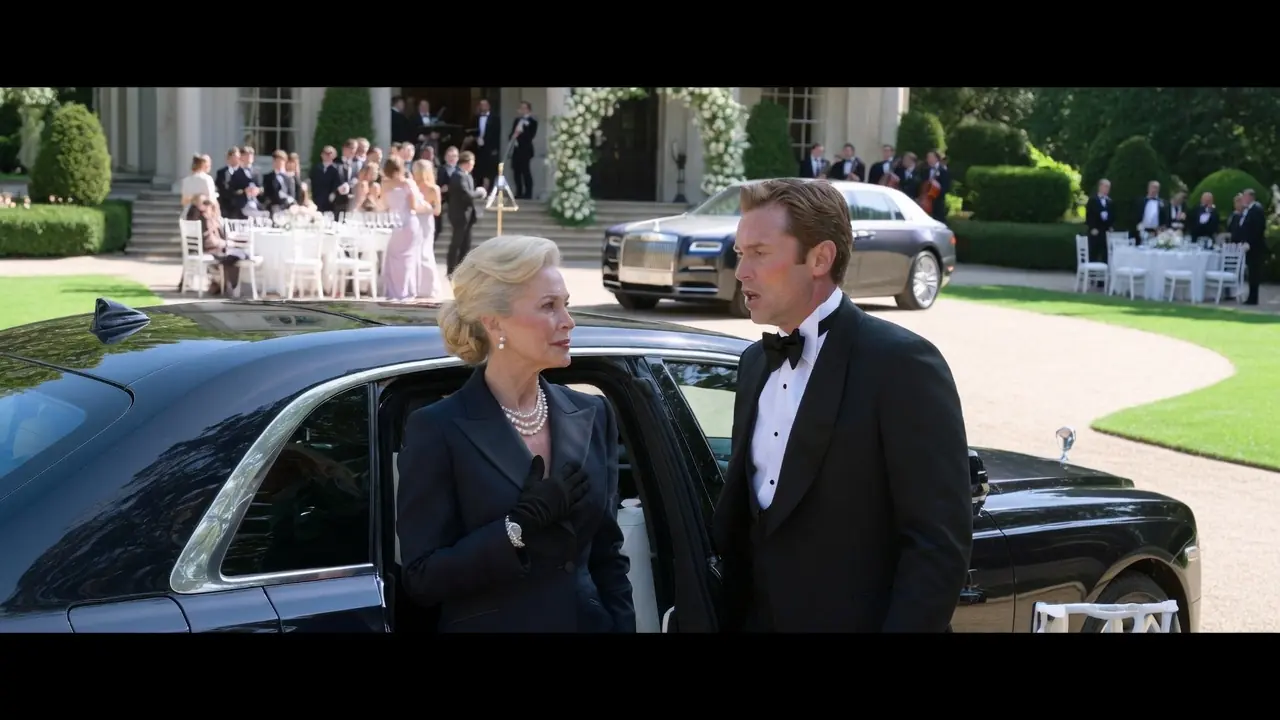
A silver Rolls-Royce Ghost.
It was not about showing off. It was about symbolism. I was the ghost of Damian’s past, returning in a form he could not ignore.
Then came the outfit. A private tailor came to my home and measured not just my body, but my posture. I chose a deep navy suit, sharp enough to speak before I opened my mouth. Pearl necklace. Pearl earrings. Polished black heels. A diamond watch. Nothing excessive. Nothing desperate.
Every detail said one thing.
I am not the woman you thought you buried.
On the morning of the wedding, the sky was clear and still. The Rolls-Royce moved down the long driveway to the King family estate like a secret finally ready to be spoken. Ahead, guests stood near champagne tables, silk dresses and pressed suits glittering beneath the afternoon light.
The car drew attention before it stopped. Heads turned. Whispers moved across the lawn.
Who had arrived in that car?
Which dignitary?
Which investor?
Which family friend?
They were not expecting me.
The driver opened the door. One bodyguard stepped out first, tall and silent in a black suit. The second followed. Then I stepped onto the stone driveway.
The air changed.
I held my chin high. My navy suit fit perfectly. My pearls rested at my throat. My heels clicked against the stone with calm, measured rhythm.
I saw Howard first. He had grown older, heavier, but arrogance still sat on him like an old coat. When recognition hit him, his face flushed red and then drained pale.
Then I saw Damian.
He turned toward me, and the smirk he had carried all morning vanished. His hand gripped the back of a white wedding chair. His knees seemed to weaken. For a moment, I thought he might truly collapse.
He had expected rags.
He had expected shame.
He had expected the woman from the story his father gave him.
Instead, he saw me.
I walked forward slowly. Guests fell silent. The music faltered. Whispers died before they could become words.
Damian stared like a man watching the ground open beneath his feet.
I stopped before the bride. Vanessa King stood in white, beautiful and uncertain, her eyes moving between Damian’s ruined face and my calm one.
I extended my hand.
“Congratulations,” I said. “I’m Claudette Jones, Damian’s mother.”
The silence that followed was louder than the string quartet.
Vanessa blinked. “I didn’t know you’d be here.”
“I was invited,” I said, and looked at Damian.
He opened his mouth. No words came.
That was when I knew the stage was mine.
At the reception, the whispers followed me. People glanced, leaned, murmured. They knew there was a story. They could feel it in Damian’s trembling hands and Howard’s frozen smile.
Then Howard’s sister, already bold from wine, raised her glass and said loudly, “We’re so proud of Damian for inviting his mother. It takes grace to forgive the past.”
There it was.
The old knife, dressed up as politeness.
I placed my napkin on the table and stood.
“A toast,” I said.
The room quieted.
“To my son Damian and his beautiful bride, Vanessa. May your marriage be blessed.” I paused long enough for the courtesy to settle. “But before you drink, let me tell you something true.”
Every eye turned toward me.
“I have been called the wretched woman,” I said. “I have been painted as a mother who abandoned her child, a woman who chose disgrace over love. For years, I carried that name in silence. But tonight, let me be clear. I did not abandon my son. I was taken from him.”
Gasps broke across the room.
Vanessa turned toward Damian, searching his face. Howard stared at his plate.
“I was led away in handcuffs while my son cried for me in the doorway,” I continued. “And those who should have told the truth stood silent instead. Lies were told. My name was buried. But what they did not bury was my spirit.”
The room became still.
“I walked through prison. I walked through poverty. I scrubbed floors. I studied under library lights. I rebuilt my life brick by brick, not in shame, but in dignity. I did not crawl back. I rose.”
Damian’s jaw tightened. His face was red now.
“I stand here tonight not to beg for forgiveness and not to seek approval,” I said. “I stand here because the truth cannot stay buried forever.”
I lifted my glass.
“May your marriage be built on truth, not lies. Because lies, no matter how polished, always crack under the weight of time.”
I drank slowly.
No one applauded.
No one spoke.
Then Damian exploded.
He shot up from his chair, pointing at me with a trembling hand. “You think this is your stage? You think you can walk in here and ruin my day?”
I did not move.
“You ruined everything,” he shouted. “You left me. You abandoned me. And now you come here acting like you’re better than us.”
Howard grabbed his arm. Damian shook him off.
“Don’t touch me,” he snapped. “This is her fault.”
The more he shouted, the smaller he looked. Every guest saw it. His anger did not expose me. It exposed him.
I took one calm sip from my glass.
“Sit down, Damian,” I said softly. “You are only proving what I already knew.”
That hit him harder than yelling ever could.
He looked around the room then, finally seeing the faces. Not admiration. Not pity for him. Judgment.
He had not disgraced me.
He had disgraced himself.
I did not stay for cake. I did not stay for dancing. Before I left, I asked for one private moment with him.
We met in a small side room off the hall. He stood stiff and furious, his fists clenched. For a flicker, I saw the boy he had been, the child crying in the doorway. Then I saw the man he had chosen to become.
“I don’t hate you, Damian,” I said. “But I don’t love you anymore. Not the way I once did. That bond died the day you chose their lies over the truth.”
His face shifted.
“You can call me wretched,” I continued. “You can spit my name to anyone who will listen. But you cannot erase what I survived. I carried chains. I carried shame. And still I rose. Whatever you carry now is yours.”
He opened his mouth, but I lifted one hand.
“No more.”
Then I turned and walked out.
My bodyguards fell into step beside me. Outside, the Rolls-Royce waited beneath the afternoon light. I stepped into it without looking back.
When I think of that day now, I do not remember joy. I do not remember revenge in the way people imagine it. I remember clarity.
They called me wretched. They erased my name. They taught my son to despise me. But scars tell stories, and mine tells one of survival.
Every property I bought, every deal I closed, every key that turned in a new lock was proof that I had not been destroyed.
I did not arrive at Damian’s wedding to beg.
I did not arrive to reconcile.
I arrived to show the truth.
The woman they buried in shame had returned in dignity.
The mother they erased had built an empire.
The wretched woman was wretched no more.
And that was enough.