My son-in-law grabbed my wrist and twisted it. Not hard enough to break anything, just hard enough to remind me who he thought was in charge. I did not say a word. I pulled my arm back, walked to my bedroom, and started packing.
The next morning, my daughter threw a brunch for her friends and stood on the back patio with a mimosa raised high, laughing. “Finally, this house feels like ours,” she said. She had no idea the envelope was already in the mail. She never saw the man sitting in the car across the street, watching.
I pulled into the driveway at half past seven that evening, still carrying the smell of sawdust and machine oil from the shop. Forty-one years in finish carpentry leaves marks on you that soap cannot fully reach. I had spent the day at my old colleague Ray’s workshop, helping him mill crown molding for a restoration project downtown. It was the kind of detailed work that slowed my hands and quieted my mind.
I was tired in the good way, the kind of tired that earns sleep. The house was lit up when I came through the side gate, every room blazing. I could hear music from the backyard, loud and heavy with too much bass. My daughter’s car sat in the driveway beside her husband’s truck, which was parked at an angle with one wheel up on the grass I had seeded the spring before.
I went in through the kitchen door the way I always had. The kitchen smelled wrong, like burned sugar with something chemical underneath it. Three pots sat unwashed in the sink. A half-empty bottle of wine stood open on the counter beside my wooden cutting board, the one I had made from a walnut slab thirty years earlier, now stained with red rings.
I set my keys on the hook by the door and walked into the living room. My daughter, Cassandra, was curled on the sofa with her phone. Her husband, Derek, sat in my reading chair, not the couch, not the armchair by the window, but my chair. It was the chair I had owned since before Cassandra was born, reupholstered twice and worn soft at the armrests in the exact shape of my forearms.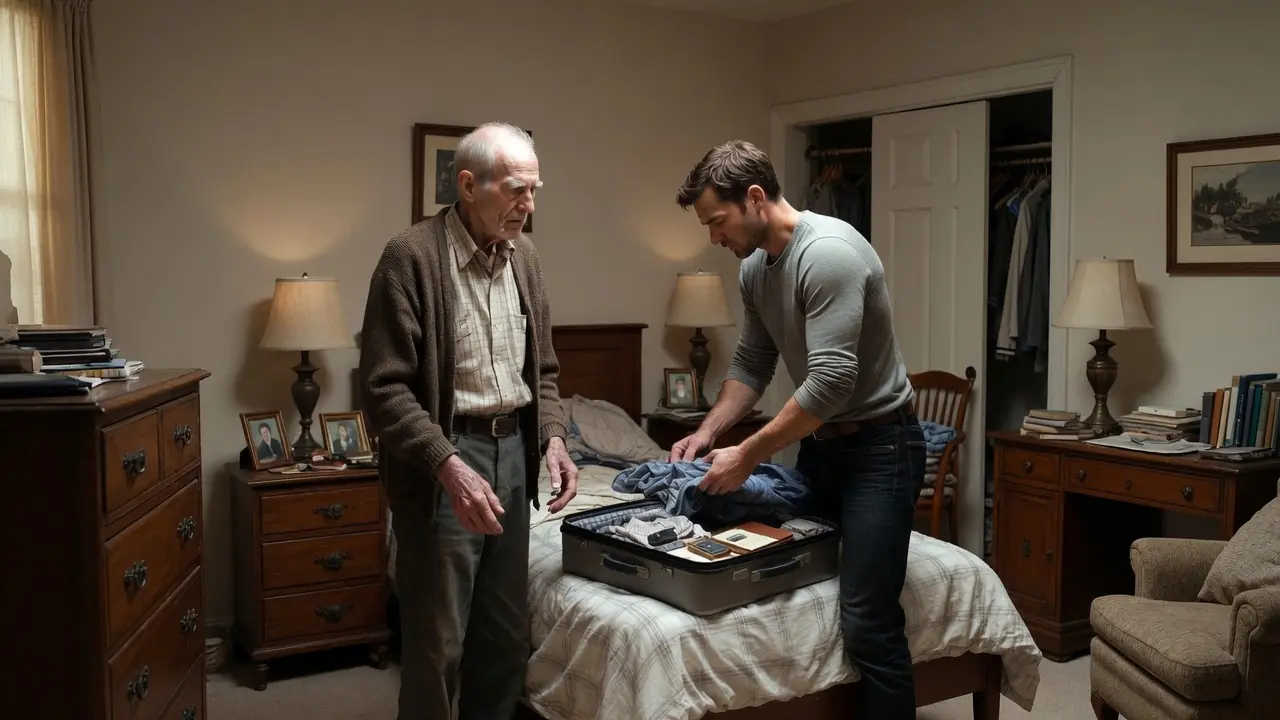
He was watching television with the volume turned far past comfortable. Neither of them looked up when I came in. I walked to the television and lowered the volume two notches. Derek looked up then and asked, “What’s the issue?”
“That is too loud for this time of evening,” I said. “My neighbor Earl is seventy-eight.” Derek looked at me the way a man looks at a slow driver in the left lane, patient on the surface, hostile underneath. Then he picked up the remote and turned the volume back up one notch, just enough to make a point.
Cassandra did not look up from her phone. I went to my bedroom, washed my hands, changed my shirt, and stood at the window for a moment. I looked out at the backyard, at the garden beds I had built along the fence and the raised planters where I grew tomatoes and peppers every summer. Someone had left a folding table in the middle of the lawn, unfolded, with one leg bent.
I went back to the kitchen and started making dinner. Pasta, simple, because it was what I had. Cassandra appeared in the doorway while the water was heating. “We already ate,” she said.
“There is enough here if you want some,” I replied. She hesitated in the doorway the way she had been doing lately, not quite present and not quite gone. There was something careful in her eyes when she looked at me now, a kind of measuring. It had started about six months after she and Derek moved in.
Temporary became permanent the way a guest becomes furniture. Derek’s business never recovered. He did occasional subcontracting jobs, cash work he did not discuss in detail. Cassandra worked part-time as a dental receptionist, and neither of them paid rent because I had never asked for it, an error in judgment I had been quietly cataloging for some time.
After dinner, I went to my study to read. I had converted the smallest bedroom into a workspace, with bookshelves along two walls, a drafting table where I still drew furniture plans by hand, and a lamp I had built from reclaimed oak. My father’s tools hung on a pegboard above the table: chisels, planes, and marking gauges, each one oiled and sharp. That room was the center of my life in the house.
The door was open the way I always left it. I sat down, opened my book, and got through four pages before I heard Derek’s voice down the hall. He was speaking louder than necessary, the way he always did on the phone. I heard the word “equity,” then the phrase “not in his name alone.”
I stopped reading. I sat with the book open in my lap and listened until the call ended. Footsteps passed my door without stopping. I set the book down and thought about what I had heard.
The next morning was Saturday. I came downstairs before either of them woke, made coffee, and sat at the kitchen table. I opened the county assessor’s website on my phone and checked my property record. My name was on the deed, with no liens and no co-owners.
I already knew that, but I looked anyway. Then I opened my email and found three messages from a financial services company I did not recognize. The subject lines referred to a home equity inquiry with my name and address. I had not initiated any home equity inquiry.
My jaw tightened. I forwarded the emails to my personal address, then deleted them from the shared family account I had foolishly given Cassandra access to two years earlier when she was helping with household bills. I changed the password. At breakfast, I said nothing.
Derek came down around nine, poured coffee without speaking, and stood at the counter scrolling on his phone. Cassandra followed twenty minutes later. We sat at the same table and said ordinary things about the weather and whether the market up the street had good peaches. I watched Derek’s hands on his coffee mug, strong hands like a working man’s hands, but he used them differently.
He used them to take hold of things that were not his. That afternoon, I drove to the public library on Maple and sat at a research terminal for three hours. I had spent my working life building things from raw materials, reading grain, stress, and joint tolerance. I understood structures, and a man’s financial history is a structure like any other.
It has load-bearing points, weak joints, and places where the material has been stressed past tolerance. I started with Derek’s business, Hartwell Construction LLC, registered four years earlier. The public filings showed it had not been struggling. It had been dissolved eighteen months earlier.
He had not told Cassandra, or if he had, she had not told me. I printed the dissolution filing, then searched his name alongside financial records. I found a civil judgment from three years earlier over a contractor dispute for forty-two hundred dollars. Then I found another, larger one.
A lender in another county had filed suit over an unpaid business line of credit. The amount was listed as sixty-eight thousand dollars. The case had been settled out of court, but the filing remained public. I wrote the case number in my notebook.
Then I searched his name with previous addresses and found a community newspaper archive from a smaller county two hours east. Derek Raymond Hartwell was listed in a Chapter 7 bankruptcy filing from six years earlier, before his relationship with my daughter. I sat back and looked at the screen. My daughter had married a man whose financial history read like a map of other people’s losses.
That man was now living in my house and trying to initiate an inquiry against my home equity without my knowledge or consent. I drove home the long way with the evening air coming through the window. I was not a man given to reaction. I had learned that early in the trade.
A carpenter who reacts to split grain by forcing the cut loses the piece. You stop, assess, and find a different approach. Whatever you build has to last. I decided I would build something that lasted.
Ray was at his workbench when I came by Sunday morning. He had known me for thirty years, longer than my marriage had lasted and longer than Cassandra had been old enough to make her own choices. He was the kind of friend who did not require explanation before offering a spare room. I told him what I had found, not everything, but enough.
He set down his plane and looked at me. “You think she knows?” he asked. I told him I did not know what she knew, but I knew what I had heard on Derek’s phone call. Ray wiped his hands on a shop rag and asked how long I needed.
“As long as it takes to do this right,” I said. He nodded and said the room was mine. I went home that afternoon and packed the things that mattered. I moved my father’s tools to Ray’s garage myself, three careful trips, each tool wrapped in moving blankets.
I could not move the drafting table alone, but I took everything on it: the plans, notebooks, photographs, the deed to the house, my insurance documents, and the will I had updated four months earlier with an attorney named Susan Greer. She was quiet, precise, and not the type to lose paperwork. I packed a bag of clothes and took the walnut cutting board. Then I left before Cassandra came home from her Saturday shift.
I did not leave a note. I left the key on the kitchen counter where they would see it and know I had gone willingly. I wanted them to feel relief. I wanted them to get comfortable.
The thing about a house is that it teaches patience. You wait for wood to dry before you joint it. You wait for glue to cure before you load the joint. You do not rush the process because the process is the work.
I sat in Ray’s guest room that first night and thought about timelines. Derek’s equity inquiry was the clearest thread. Someone had used my address and my name to contact a lender. If he had gotten far enough to have a conversation, there might be documentation.
Monday morning, I called Susan Greer. She listened without interrupting, one of the things I valued about her. Then she asked three questions. Was my name the only name on the deed? Yes.
Had I signed any documents in the past six months authorizing anyone to act on my behalf regarding the property? No. Did I have the email correspondence? Yes, forwarded to myself with timestamps.
“That is potentially fraud,” she said. “An inquiry without authorization. Do you want to pursue it now or hold it?” I told her I wanted to hold it and understand the full picture first. She told me to come see her Thursday and bring everything.
I spent the week at Ray’s table. He left a desk lamp on for me in the evenings and did not ask how things were going. That is the virtue of a man who works with his hands. He understands that some jobs require silence.
I built my case the way I would build a piece of furniture. Start with what you know to be true: the deed, the dissolution of Derek’s LLC, the bankruptcy, the civil judgments, and the unauthorized equity inquiry. Then add what you can verify. I called the financial services company that had sent the emails, identified myself as the property owner, and asked what information had been submitted.
The representative hesitated. I told her my name was on the deed, I had not authorized the contact, and asked whether she would prefer I involve the state consumer protection office before or after we had this conversation. She told me a preliminary inquiry had been submitted online using my name, address, and a partial Social Security number. No credit pull had been completed because the partial number did not match the full record.
He had tried and been stopped by a single incomplete digit. I thanked her and asked for written confirmation, which she agreed to send. When it arrived, I printed it and added it to the folder. Thursday with Susan Greer lasted ninety minutes.
She read everything twice. When she looked up, her expression was precise and unhurried. She said the equity inquiry alone might not be enough for a criminal charge, but it documented intent. Combined with the concealed LLC dissolution and financial history, it showed a pattern.
She asked what outcome I wanted. I told her I wanted my house back, I wanted them out, and I wanted Derek to understand that what he attempted had been documented by more than one party. Susan said eviction was straightforward because I had sole ownership and there was no lease agreement. A thirty-day notice was required under state law, and she could file it that week.
She recommended holding the fraud documentation until after they vacated. If they contested the eviction or things escalated, we would use it. If they left quietly, I would still have it on record. I told her to file the notice.
The next morning, I drove to the house while Derek’s truck was gone. Cassandra’s car was there. I used my key and went inside. The house felt occupied in the way a place feels when someone else’s habits have settled into it.
They had rearranged the living room. My sofa was pushed against the far wall, a glass-topped coffee table sat in the center, and my reading chair had been moved into the corner near the window. It was partially blocked by a fern, sidelined like even the furniture had been demoted. I went room by room and photographed everything that had been changed.
In the kitchen, three cabinet doors had been removed to create an open-shelf look Cassandra had once mentioned in passing. In the back bedroom, someone had painted the wall behind the bed deep charcoal without asking. In the bathroom, the vanity mirror I had hung myself had been replaced by one too large for the space. I photographed everything quietly and methodically.
Then I left through the side gate and drove back to Ray’s. The certified eviction notice arrived two days later. I knew because Cassandra called within the hour. “Dad, what is this?” she asked.
“It is a legal notice to vacate,” I said. “You have thirty days.” She was quiet, then her voice shifted into the tone she had used as a teenager when she thought rules did not apply to her. “You cannot do this to us. We live here.”
“You live there without a lease, without paying rent, in a house that belongs to me,” I said. She told me that did not mean I could throw them out. I told her it did, actually, and that she could confirm it with a lawyer. She hung up.
Derek called forty minutes later. His voice was flatter and harder than Cassandra’s. He said we needed to have a real conversation. I told him I agreed, and that he should have it with my attorney because her number was on the notice.
He said I was making it into something it did not need to be. I told him he had made it into something the first time he submitted my name to a lender without my knowledge. There was silence. Then he said he did not know what I was talking about.
“Written confirmation from the lender disagrees,” I said. “I have it in my files.” The call ended. That evening, Ray brought sandwiches to the workshop, and we ate without talking for a while.
Outside, his neighbor’s children played in the street the way children do in summer when the days are long. Ray finally asked whether I thought Cassandra knew what Derek was doing. I turned it over in my mind. Cassandra was not stupid, but she had a talent for looking away from things she did not want to see.
Whether she knew the specifics or simply knew the direction Derek was heading and chose not to ask questions, I could not say. Either way, she had let it happen. Either way, the house I had built a life in over forty years had been put at risk because my daughter had brought a man into it and stood aside while he tested its foundations. I told Ray I did not know, but it did not change what I had to do.
The next two weeks ran on two tracks, one visible and one hidden. The visible track was the eviction proceeding. Derek and Cassandra retained an attorney named Fielding, who argued that two years of residence without a formal lease created an implied tenancy and that the notice was retaliatory after a minor family dispute. Susan read his letter to me in a tone that made clear she had heard that argument before.
The hidden track was a man named Thomas Whitfield. I found him in Derek’s bankruptcy filing, listed as the owner of Ridgeline Custom Builds, a company owed forty-one thousand dollars. Public records showed that Thomas had once sued Derek for fraud and breach of contract. The suit alleged Derek had invoiced for materials never delivered, signed contracts for work never completed, and used Thomas’s equipment and supplier relationships to pocket payments.
The suit had been dismissed when Derek filed for bankruptcy, but dismissal was not the same as resolution. The facts had never been properly judged. I wrote Thomas Whitfield a handwritten letter because some communications deserve that weight. I introduced myself, explained my situation, and told him Derek was now living in my home and had attempted to use my information for a lender inquiry.
I told him I was not asking for money or anything illegal. I was simply extending the courtesy I would have wanted someone to extend to me. The man who had wronged him had not changed direction. I included my phone number.
He called four days later. His voice sounded like a man who had spent years on job sites: straightforward, worn, and without excess. He said he had thought about Derek more times than he could count. The forty-one thousand dollars had set his company back three years and his marriage back even further.
He asked what I planned to do. I told him about the eviction proceeding and the fraud documentation I was holding. I said I expected the legal channels to be enough. Then he told me there was something I should know.
Before the bankruptcy and court case, Thomas had heard from another contractor that Derek had done the same thing to a homeowner. An older woman in her seventies had hired him to build a sunroom. He took a twelve-thousand-dollar deposit, did about two thousand dollars worth of framing, then stopped working and stopped returning calls. She had filed a complaint with the state contractor licensing board.
I found the complaint that afternoon. Her name was Ruth Ann Pelletier, age seventy-three. The complaint described exactly what Thomas had said: twelve thousand dollars taken, work abandoned, repeated calls ignored. The board suspended Derek’s license for sixty days and assessed fines that were only partially paid.
Sixty days for twelve thousand dollars taken from a seventy-three-year-old woman. I sat with that for a while. Then I called Susan again. She listened to the new information without interruption.
When I finished, she said the Pelletier complaint changed the character of what we had. There was now a pattern across multiple victims, businesses, and an individual homeowner. The unauthorized equity inquiry in my case could be part of that same pattern. She recommended contacting the State Attorney General’s Consumer Fraud Division, but timing it carefully.
We agreed to wait until after the eviction hearing. Once they were out and the civil matter was resolved, we would file the criminal referral. That way, no one could argue it was filed to influence the eviction. I also told Susan I wanted to contact Ruth Ann Pelletier.
I found Ruth Ann’s number through a public directory and called on a Tuesday evening. She answered cautiously, the way older people answer calls from numbers they do not recognize. I introduced myself, told her I was not selling anything, and explained that we had a person in common. She listened while I spoke.
When I finished, she was quiet long enough that I thought the call had dropped. Then she said, “I knew he would do it again.” Her voice was not angry. It was quieter and more certain than anger, the voice of a woman who had been right about something she wished she had been wrong about.
She told me she had spent six months trying to get the board to do more than suspend his license. Her family told her to move on, that the money was gone and the stress was not worth it. She had mostly moved on, but she had kept the files. When I asked if she would speak with the Attorney General’s office if the time came, she said, “Give me the number and I will call them myself.”
Cassandra came to Ray’s house two weeks into the process. She did not call first. I heard the knock from the workshop, where I was helping Ray with a chair joint. She stood on the porch looking thinner than I remembered, though not much time had passed.
Something in her face had changed since the notice arrived. The careful quality I had noticed before was gone, replaced by something unguarded and tired. She asked if she could come in. We sat at Ray’s kitchen table while he found reasons to be in the workshop.
She started to say several things and stopped. Then she asked if there was anything she could do to change my mind. I looked at my daughter and remembered holding her the day she was born. I remembered driving her to school for twelve years and to college for four.
I remembered walking her down the aisle at a wedding I had doubts about but kept silent on because she was happy. I asked, “Cassie, do you know what Derek tried to do with this house?” She looked at the table, her hands flat against the wood. She said she knew he had made some inquiries.
“Inquiries?” I said. “He submitted my name, address, and a partial Social Security number to a lender without my consent. If that digit had matched, I could have had a second mortgage on my property before I knew what was happening.” She was quiet.
I asked if she had known. After a longer silence, she said she knew he was looking into options, but she did not know he was using my information without telling me. I believed part of that. I was not sure which part.
I told her it did not change the legal situation. The house was mine, the eviction notice was valid, and the hearing was in ten days. She asked where they were supposed to go. I told her that was a question for her husband, since he had lived in my house for two years without contributing to its costs.
She made a sound that was not quite a laugh and admitted he had not been saving. I thought about the sixty-eight thousand dollars owed to a lender, the forty-one thousand owed to Thomas Whitfield, and the twelve thousand taken from Ruth Ann Pelletier. “He does not save,” I said. “He takes. There is a difference.”
She looked at me directly for the first time in months. I could see that she already knew what I meant. She had known it for some time and had worked hard not to finish the thought. I told her I would not tell her what to do about her marriage, but she needed to understand that Derek’s behavior was not a rough patch.
He had a history she did not know. I told her about the dissolved LLC, the bankruptcy, the civil judgment, Thomas Whitfield, and Ruth Ann Pelletier. She sat very still while I spoke. When I finished, her face showed both embarrassment and anger.
She said Derek had told her the LLC dissolved because of a bad contract and that the bankruptcy was old and handled. Then she quietly admitted she should have looked it up herself. I told her yes, she should have, but that lesson was for later. For now, there was a hearing in ten days and a referral to the Attorney General’s office I intended to file whether she stayed with him or not.
She repeated the words “hearing in ten days” as if the ground had shifted beneath her. She left an hour later without asking me to change my mind again. The eviction hearing was held in circuit court on a Thursday morning. I wore the same suit I wore to funerals and serious occasions.
Susan met me outside the courtroom at a quarter to nine with a briefcase in hand. She was reading the opposing counsel’s latest filing on her phone and said, without looking up, “We are going to be fine.” Derek and Cassandra sat at the respondent’s table with their attorney. Derek wore a jacket slightly too large in the shoulders and did not look at me.
Cassandra did look. I gave her a small nod. She looked away. The judge, Helen Caster, was a woman in her late fifties with the air of someone who had heard every variation of this argument and had no patience for wasted time.
Fielding argued that two years of residence established domestic arrangements and that there had been no prior indication occupancy was conditional. He also claimed the eviction was retaliation after a personal disagreement. Susan presented the ownership documentation, the chain of title, the absence of any written or recorded lease, and the properly served thirty-day notice. She also presented photographs of unauthorized property modifications.
Those included removed cabinet doors, unapproved paint work in a bedroom, and a statement from a building inspector confirming that two modifications would have required permits. Judge Caster asked whether the respondents had paid rent at any point during their two-year occupancy. Fielding conferred with his clients, then said they had not paid rent but had contributed to household expenses. The judge looked at the exhibits, Susan, and me.
She ruled that sole ownership was documented and undisputed. No lease had been executed, no rent had been paid, and lawful notice had been provided. The claimed implied tenancy did not overcome the absence of a formal agreement and my clear position as sole title holder. She ordered the eviction effective in twenty-one days.
Fielding immediately filed a motion to extend the timeline because of hardship. Judge Caster allowed an additional fourteen days, making it thirty-five days total. I could live with that. From the courthouse parking lot, I called Thomas Whitfield and told him the outcome.
He said Ruth Ann Pelletier had already called the investigator independently and given a statement about her own case. The investigator had confirmed there were other complaints in the system from other counties. At least two had already been connected, possibly more. I sat with that for a moment.
That was the mathematics of a man like Derek. The number of people whose losses had funded the life he was building on top of mine. I drove back to Ray’s and told him the hearing outcome over coffee. He asked when I would get my house back.
“Thirty-five days,” I said. Then he asked about Cassandra. I watched the light come through the workshop window and fall across the wood shavings. Some joints can be repaired, and some have to be cut away and started fresh with new material. You do not know which until you clean the break.
The thirty-five days passed slowly at first, then quickly toward the end. Cassandra and Derek left three days before the deadline. I knew because Ray’s neighbor, who lived two streets over from my house, mentioned seeing a moving truck. I thanked him and did not drive past.
A week after they left, I received a text from an unfamiliar number. It was Cassandra, explaining that she had gotten a new phone, which I understood to mean she had also gotten a new arrangement. Her message said, “We left it clean. I am sorry, Dad.”
I held the phone for a long time before answering. Then I typed, “I know you are. When you are ready to talk, call me.” She did not call that week, and I did not expect her to.
The day I returned to my house, I brought Ray with me. Not because I needed help, but because some things are better witnessed. The house was clean. They had left it better than they found it in some ways, with dishes washed and surfaces wiped.
But the changes were still there. The cabinet doors were missing, apparently taken or discarded. The charcoal wall remained in the back bedroom. Different furniture had left imprints on the carpet.
I stood in the doorway of what had been my study and looked at the bare walls where my pegboard had hung. Ray stood beside me and said, “It is still your house.” I told him I knew. That is the thing about a house. It waits.
We started with deep cleaning. We opened the windows and let air move through. I measured the study wall for the pegboard while Ray held the tape. That afternoon, I reinstalled it and hung my father’s tools back where they belonged.
The chisels, planes, and marking gauges returned to their places. The room smelled of oil and old wood. My room. My tools. My house.
Three weeks after I returned, Susan filed the referral to the State Attorney General’s Consumer Fraud Division. The package included the equity inquiry documentation, Derek’s financial history, Thomas Whitfield’s written account, and Ruth Ann Pelletier’s licensing board complaint. It also included a timeline I had built by hand on drafting paper. Forty months of conduct, documented from public records and firsthand accounts.
Susan told me the investigator had confirmed receipt and would review it alongside existing complaints from other counties. I asked about the likely timeline, and she said investigations like this took months, sometimes more. I told her I had patience. What I did not say was that I had made peace with the fact that the outcome was no longer mine to control.
I had built the structure and placed it where it needed to go. What the law did from there was the law’s work, not mine. What was mine was the house. I stood on my back porch two weeks into October, coffee in hand, looking at the garden beds along the fence.
The tomatoes were finished. I had pulled the plants, turned the soil, added compost, and covered the beds with straw for winter. In spring, I would plant again. The folding table Derek’s friends had left in the lawn had been repaired in the shop and stored in the garage.
Ray came over for dinner that Thursday, as he had started doing once a week. I made a meal that took time, a braise cooked low and slow for hours. We ate at the kitchen table under the light I had rewired six years earlier. He asked about Cassandra.
She had called the previous Sunday. It was a short call, careful on both sides, the kind of conversation two people have when they are testing weight before stepping forward. She told me she had left Derek and was staying with a friend. She had spoken with a lawyer about the financial situation, what she was responsible for, and what debts were in his name.
She said she was trying to understand what the last two years had actually been. I told her she could take whatever time she needed. She said she should have listened to me. I told her maybe, but she had needed to see it herself.
Then she said she wanted to understand what Derek had been doing with my house. She wanted to understand all of it. I told her I would tell her everything when she was ready to hear it. Not to punish her, not to prove a point, but because she deserved the whole picture of the man she had trusted.
Understanding it was the only way to make sure it never happened again. We would talk soon. Not yet, but soon. I told Ray this over dinner, and he listened the way he always did, without excess commentary.
“You are a patient man, Harlan,” he said. I thought about forty years in finish carpentry. I thought about reading grain before making a cut and waiting for the right conditions before joining two pieces of wood you wanted to hold permanently. “I am a carpenter,” I said. “We learn to work with what the material gives us.”
He raised his glass, and I raised mine. Outside, the October dark settled around the house I had built my life in. The house still had my name on the deed. It had waited for me while I worked.
I had not won cleanly. I had lost months of peace, a measure of trust in my daughter, and a version of the future I once imagined that included her and her husband differently. But I had not been erased. I had not been quietly borrowed against or sold out from under myself.
I had stood my ground and done it properly. Document by document, step by step. In the way of a man who understands that work worth doing is always slower than you want it to be and stronger because of that. Justice, I had come to understand, is not a moment.
It is a structure you build carefully and leave standing long after the noise is over.