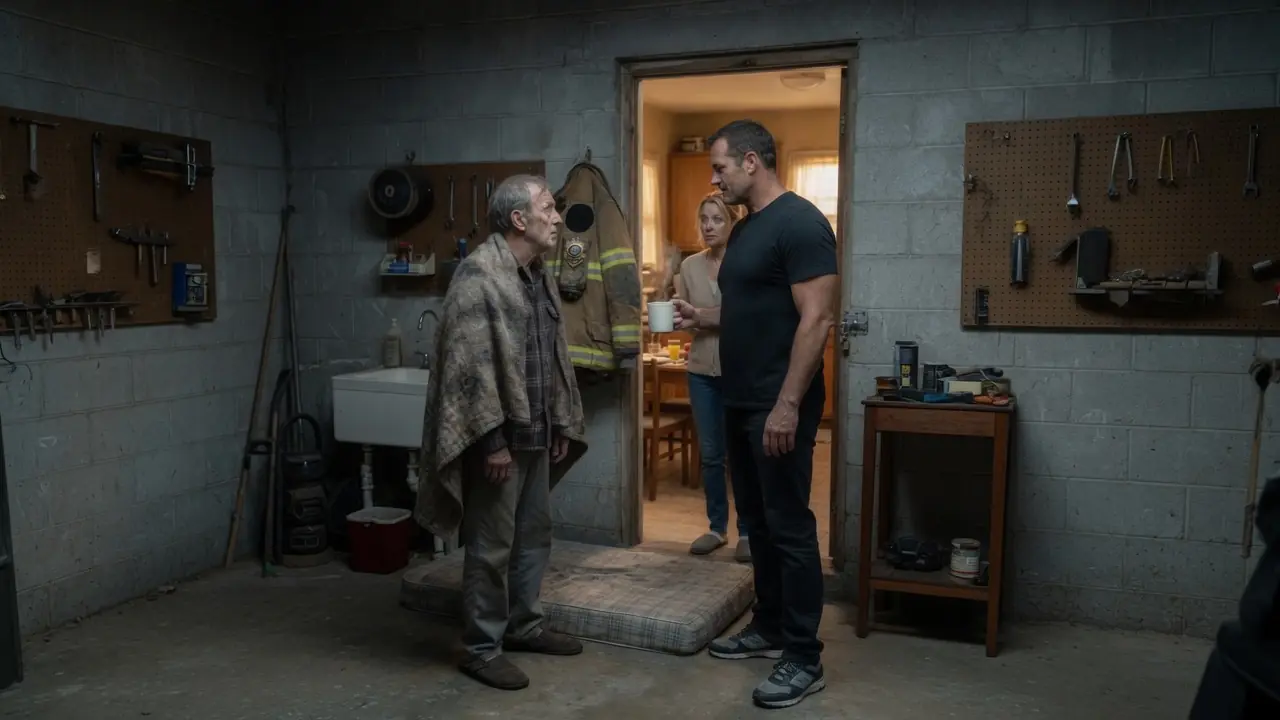
Ambrose Russell woke on the thin mattress in his own garage with the taste of rust in his mouth and the smell of motor oil in the air. The August morning had already turned heavy, but the concrete under his back still held the cold from the night before. A single blanket lay twisted around his legs, too scratchy to comfort him and too thin to hide what had become of his life. Forty years as a Philadelphia firefighter, seventeen commendations, one house paid off with honest work, and now he was sleeping beside a utility sink like a stray dog someone had not yet decided to chase away.
Through the small garage window, he could see the kitchen that used to be his. Wesley Matthews sat at Ambrose’s dining table in a clean black T-shirt, drinking fresh coffee from Ambrose’s favorite mug and eating eggs off Ambrose’s plates. Gertrude, Ambrose’s daughter, sat beside him with her blonde hair tied back and her eyes fixed on her cup, pretending not to know her father was awake outside. Ambrose watched her for a long moment, remembering the little girl who used to run into his arms after school, and the memory hurt more than the ache in his shoulder.
His stomach growled, a low hollow sound that embarrassed him even though no one else could hear it. He had eaten only crackers the day before, handed to him through the garage door like a favor. Wesley had said food was earned, not requested, and Gertrude had stood behind him silently while he said it. Ambrose had spent his career carrying people out of burning buildings, yet the people living in his own house had learned to step over him without seeing him.
He pushed himself upright, pulled the blanket around his shoulders, and walked slowly toward the kitchen door. His slippers scraped across the concrete, each step making him feel older than sixty-eight. He knocked once, not because it was not his door, but because Wesley had made rules and punishments around every ordinary thing. Before Ambrose could knock again, the door opened and Wesley filled the frame.
Wesley was broad, tall, and comfortable in a house he had not earned. He held a mug of coffee in one hand, the steam curling upward between them like a cruel little luxury. His gray eyes dropped to Ambrose’s blanket, slippers, and tired face, and a smile tugged at the corner of his mouth. It was not amusement; it was ownership pretending to be amusement.
“I just need coffee,” Ambrose said quietly. His voice sounded rough, and he hated that Wesley could hear weakness in it. Wesley lifted the mug toward him, then pulled it back before Ambrose could even think about reaching for it. He laughed once, soft and mean. “Garage residents don’t get kitchen privileges, old man.”
Ambrose looked past him toward the table. “This is still my house, Wesley.” Gertrude moved slightly in her chair, but she did not look up. Wesley leaned one shoulder against the doorframe, making his body into a wall. “Not anymore. Your pension pays the bills, but I make the rules.”
The words landed in the garage like another lock sliding into place. Ambrose’s pension was seven thousand dollars a month, money earned from smoke, heat, long shifts, and lungs that still tightened when the weather changed. Wesley had called it “family management” when he first offered to help with finances, smiling across the kitchen table while Gertrude told Ambrose it would make life easier. Ambrose had signed the papers because family was supposed to mean trust, not a trap written in legal language.
Now that pension bought Wesley’s dinners, Wesley’s clothes, Wesley’s new gadgets, and Wesley’s confidence. Ambrose had seen the delivery boxes through the garage window. He had watched Wesley carry in a large television, expensive groceries, and bottles from a liquor store Ambrose never visited anymore. Every purchase had been made with money that should have kept an old firefighter safe in his own home.
Gertrude finally rose from her chair and came closer, standing half-hidden behind Wesley near the warm kitchen. Her face was pale, anxious, and ashamed, but shame without action had become another kind of cruelty. Ambrose looked at her with a father’s final hope. He did not ask for much, only one sentence, one objection, one proof that the child he raised had not completely disappeared.
“Wesley,” she whispered, barely enough to disturb the air. “Please don’t talk to him like that.” Wesley turned his head slowly and gave her a look so hard she shrank back. Then he faced Ambrose again, smiling wider because even her protest had proven his control. “See? Even your daughter knows better than to challenge me.”
Ambrose’s hands trembled around the blanket, but he did not raise his voice. He had learned in burning houses that panic wastes air. Wesley wanted begging, shouting, or tears because those things would prove Ambrose was exactly as helpless as Wesley needed him to be. So Ambrose swallowed the hunger and the humiliation and stood still.
Wesley stepped closer, lowering his voice but sharpening every word. “You should be grateful I let you stay here at all. A nursing home would take that pension faster than I do, and they would not let you wander around asking for coffee.” He looked toward the old firefighter uniform hanging from a nail on the garage wall. “Maybe you were something once, but now you’re just an old man with a check.”
Ambrose turned his head slightly toward the uniform. The dark blue fabric had faded, but the badge still caught the weak garage light. That uniform had been soaked in water, smoke, sweat, and the kind of fear men never confessed until years later. It had belonged to someone people called brave, someone children waved at from sidewalks and grown men trusted when roofs gave way.
Wesley followed his gaze and laughed. “Don’t look at that badge like it still means anything. It won’t save you. Your son won’t save you either.” Gertrude flinched at the mention of Daniel, but she still said nothing. Wesley noticed and enjoyed it, because silence had become his favorite proof of victory.
Daniel Russell lived two hours away and had not been to the house in months. Wesley had taken Ambrose’s smartphone first, claiming he needed to pay the bill, then let the old flip phone run out of credit. Gertrude told Daniel their father was resting, busy, stubborn, not feeling social. Ambrose imagined his son hearing those words and believing them because the truth was too ugly to fit inside a normal family.
Three months earlier, Daniel would have found Ambrose in the living room, drinking coffee from the good mug and reading the morning paper. Six weeks earlier, he would have found him in the spare bedroom, after Wesley had “temporarily” moved him out of the primary room to make space. Two weeks earlier, he would have found him exactly where he was now, on a garage mattress, eating whatever Wesley allowed and asking permission to enter the house he owned. The trap had not snapped shut all at once; it had tightened one humiliation at a time.
Wesley lifted the mug again and drank slowly in front of him. “You want breakfast?” he asked. Ambrose did not answer. Wesley leaned closer. “Then act right. Stop asking about money, stop looking at Gertrude like she owes you something, and stop pretending this house still belongs to you.”
“It does belong to me,” Ambrose said. It came out quietly, but the sentence had steel in it. Wesley’s expression changed just enough to reveal irritation beneath the smugness. He pushed the door open wider, not inviting Ambrose in, only showing him the bright kitchen beyond reach. Plates, eggs, toast, coffee, sunlight, his daughter, his table, his life.
Then Wesley stepped back and shut the door in his face. The lock clicked. Ambrose stood there with his hand half-raised and his mouth closed around every word he did not say. Behind the door, he heard Wesley laugh.
He returned to the mattress and sat slowly, breathing through the tightness in his chest. On the workbench lay an old contractor’s notebook, dusty but usable. Ambrose picked it up and turned to a blank page. He had spent decades writing fire reports, incident times, damage notes, injuries observed, equipment used, response minutes, and names of witnesses. If Wesley wanted to turn his life into an emergency, Ambrose knew how to document an emergency.
He wrote the date, then the words kitchen denied, food denied, pension stolen, Wesley threatened nursing home. The handwriting shook at first, then steadied. He wrote about the papers Wesley had brought to the table in May, calling them limited power of attorney. He wrote about the account transfers, the missing pension payments, the new television, the expensive shoes, the SUV Wesley had been admiring online. Each fact became a small plank under his feet.
By afternoon, the garage grew hot. Ambrose used the rusty utility sink for water, splashing his face and drinking from his cupped hand. He sat beneath his old uniform and studied the house through the window as Wesley moved through the kitchen like a landlord. The anger inside him had changed shape since morning, becoming less like fire and more like a pilot light, small, steady, waiting.
At four-thirty, the sound of a car rolled into the driveway. Not Wesley’s SUV. Not Gertrude’s old sedan. Ambrose knew that engine before he saw it, a familiar rattle from a Honda Accord that Daniel kept promising to fix. His heart lurched so sharply he had to grip the workbench.
Voices sounded from the front of the house. Daniel’s voice came first, warm but confused. Then Gertrude’s voice, too fast, too bright, telling him their father was in the garage working on something. Wesley added something casual, but even through the wall Ambrose could hear the warning in it. A moment later, footsteps approached the garage door.
The door swung open, and light from the house flooded across the concrete. Daniel stood in the frame, tall, broad, and suddenly very still. His eyes moved from Ambrose’s face to the mattress, the blanket, the utility sink, the notebook, and the firefighter uniform hanging like a silent witness behind him. The warmth drained from Daniel’s expression and was replaced by horror.
“Dad?” Daniel’s voice broke. He crossed the garage in three strides and gripped Ambrose by the shoulders with careful hands. “What happened to you? Why are you in the garage?” Ambrose tried to speak, but shame rose faster than words. Daniel looked around again, then back at him. “You have a pension of seven thousand dollars a month. Where is it?”
Before Ambrose could answer, Wesley appeared in the doorway. He came with his chest lifted and his chin high, the way a man enters a room when he believes he has already won every argument inside it. Gertrude stood behind him, pale and trembling. Wesley pointed at Ambrose with an ugly little smile.
“That pension is mine now,” Wesley said. “I control everything. He signed the papers.” Daniel turned slowly, and the look on his face made even Wesley pause. It was not loud anger. It was something colder and far more dangerous.
“Say that again,” Daniel said. Wesley smirked. “He signed power of attorney. I manage the money, the bills, the house rules, everything.” He stepped into the garage and gestured toward the mattress. “This is where he stays now. Garage residents follow garage rules.”
Daniel’s hand moved to his wrist. He wore a stainless steel Omega watch Ambrose remembered from Christmas two years earlier. Daniel unclasped it slowly and placed it on the dusty workbench between them. The small click sounded enormous in the garage. Wesley stared at the watch despite himself.
“This watch is worth about eight thousand dollars,” Daniel said. “Take it. Walk out of this house right now, and maybe you leave with one smart decision.” Wesley blinked, confused by greed and suspicion arriving at the same time. He picked up the watch, turned it in his hand, then set it back down with a laugh. “Why would I take eight thousand when I have seven thousand coming in every month?”
Daniel did not look surprised. He looked as if Wesley had stepped exactly where Daniel wanted him to step. “So you admit you’re taking his pension.” Wesley spread his hands. “It’s legal. He signed. The money is mine, the house will be mine, and if he causes trouble, I’ll have him declared incompetent.” Gertrude made a small sound behind him, but Wesley waved her off. “Your brother needs to understand how things work here.”
Daniel’s phone was already in his hand, angled low near his side. Ambrose saw it then, the screen glowing, the red recording line active. Daniel’s voice remained calm. “And you forced him into the garage?” Wesley laughed again, louder now, drunk on his own confidence. “I made rules. He broke them. If he doesn’t like it, he can find a nursing home.”
The silence afterward was different. Wesley heard it too late. Daniel looked at the phone, saved the recording, and slipped it into his pocket. Then he picked up the watch and put it back on his wrist with slow precision. When he raised his eyes, Wesley’s smile finally weakened.
“You just confessed,” Daniel said. “Financial exploitation, illegal eviction, coercion, and threats against an elderly homeowner.” Wesley’s face tightened. “You think a little recording scares me?” Daniel stepped closer, not shouting, not touching him, just standing with a force that made the garage feel smaller. “It should.”
Wesley tried to laugh again, but the sound failed. Daniel turned to Ambrose and softened immediately. “Dad, get your things. You’re coming with me.” Ambrose looked at Gertrude, waiting one last time for her to speak like a daughter. She covered her mouth with one hand, tears in her eyes, but she still did not move.
That was the moment Ambrose stopped waiting for her. He took the notebook, the old firefighter jacket, and the small plastic bag of clothes near the mattress. Daniel placed one arm around him, not because Ambrose could not walk, but because a son sometimes needs to hold his father upright after the world has tried to bend him too far. They walked past Wesley, past Gertrude, and into the house.
Everything inside looked familiar and stolen at the same time. The living room had a new sofa Ambrose had not chosen. His recliner had been pushed into a corner, and his photographs had been removed from the mantel to make space for decorative candles. Daniel saw it all. His jaw tightened, but he kept walking.
At the front door, Wesley found his voice again. “He can’t just leave. I control his accounts.” Daniel stopped without turning. “By tomorrow morning, you will control nothing.” Then he led Ambrose outside into the evening air.
The car smelled clean, warm, and safe. Ambrose sat in the passenger seat with his hands folded, unable to stop looking down at them. Daniel drove in silence for several blocks before asking how long it had been happening. Ambrose answered in pieces at first, then in full sentences. Three months since the papers, two weeks in the garage, three crackers the day before, pension redirected, phone taken, threats made, Gertrude watching.
Daniel pulled into a hotel parking lot and got them a room with two beds. He ordered dinner, more food than Ambrose could finish, and said nothing when Ambrose’s hands shook around the knife and fork. Only after Ambrose ate half the meal did Daniel take out a legal pad and begin asking questions. Dates, amounts, names, exact phrases, account numbers, document descriptions, visible injuries, witnesses.
For the first time in months, Ambrose felt the shape of order returning. Daniel was not just angry; he was methodical. He explained that power of attorney did not give Wesley ownership, that coercion could void documents, that elder financial exploitation was a serious crime, and that Ambrose’s house was still his house. Then Daniel played the recording.
Wesley’s voice filled the hotel room, arrogant and clear. The pension is mine. The house will be mine. This is where he lives now. House rules. Ambrose closed his eyes as the words played, ashamed to hear his degradation spoken so casually, but Daniel stopped the audio and placed a hand on his father’s shoulder.
“That is evidence,” Daniel said. “Not shame. Evidence.” Ambrose opened his eyes. The distinction mattered more than he expected. Shame belonged to the person being exposed; evidence belonged to the person seeking justice.
The next week became a controlled counterattack. Daniel found Sandra Mitchell, an elder law attorney with a calm voice and a fierce dislike of people who preyed on aging parents. Ambrose met her in a coffee shop near the library, wearing his old firefighter jacket and carrying the notebook. Sandra read the timeline, listened to the recording, and reviewed the first photographs Daniel had taken of the garage.
“You documented this like a first responder,” she said. Ambrose almost smiled. “Old habits.” Sandra nodded. “Good habits. They may save your home.”
A doctor documented his weight loss, stress symptoms, and the marks from Wesley’s rough handling in clinical language strong enough for court. The Johnsons next door gave statements about seeing Ambrose in the garage and hearing arguments through the window. Daniel pulled bank records, delivery receipts, and account transfers. Piece by piece, Wesley’s control stopped looking like family management and started looking exactly like what it was.
When Wesley was served, Ambrose was back in the garage, watching through the window. He saw the envelope arrive, saw Wesley open it, saw confidence drain from his face and panic rise behind it. Gertrude stood beside him as he shouted, waving papers in the air. Ambrose did not smile much, but he did allow himself one quiet breath of satisfaction.
The emergency order came two days later. Wesley’s access to Ambrose’s accounts was frozen. Ambrose was legally restored to full access to his own home. When he walked from the garage to the front door with the printed order in his hand, Wesley tried to block him one last time. Ambrose held up the paper.
“Court order,” he said. “Move.” Wesley stared at him, hatred replacing the old smugness. “You’re making a mistake, old man.” Ambrose met his eyes without fear. “No. The mistake was trusting you.”
At the hearing, the judge listened to the recording and reviewed every photograph. The garage mattress appeared on the courtroom screen. The bank statements showed the missing pension payments. The doctor’s report described deprivation and stress, while Sandra explained the coerced power of attorney with clean, devastating precision.
Wesley’s lawyer tried to call it a family dispute. The judge stopped him cold. A family dispute did not explain a retired homeowner being forced into his own garage while another man spent his pension. A family dispute did not explain threats of a nursing home, blocked access to food, or a son-in-law admitting the money was his now. Wesley stood pale and silent as the words he once used for power returned as evidence against him.
The power of attorney was voided. Restitution was ordered. Wesley and Gertrude were given forty-eight hours to leave Ambrose’s house, and a protection order barred them from contacting him. The judge also referred the matter for criminal review. When the gavel fell, Ambrose felt as if someone had opened a window in a room full of smoke.
Gertrude tried to speak to him in the hallway, crying and saying she had been afraid. Ambrose looked at her with the grief only a parent can carry. “I was afraid too,” he said. “I was hungry, weak, and sleeping in a garage. You were my daughter, and you looked away.” She sobbed harder, but Daniel stepped between them and reminded her of the no-contact order.
Two days later, Wesley and Gertrude drove away in a rented truck. Ambrose stood in the driveway with Daniel beside him, watching the vehicle disappear around the corner. He expected triumph, but what came first was exhaustion. Winning back a stolen life still meant touching every place where the theft had happened.
The locksmith arrived that morning. Every lock changed. The bank closed the compromised accounts and opened new ones. Security cameras went up at the front door, back door, and garage. Daniel helped move Ambrose’s firefighter uniform from the garage wall back to the house, hanging it in the hallway where the badge could catch proper light again.
That night, Ambrose sat in his own chair with a mug of coffee in his hands. The house was quiet, but this quiet did not feel like abandonment. It felt like peace learning how to return. Daniel sat across from him, tired but watchful, as if still afraid his father might vanish back into that garage if no one paid attention.
“You came at the right time,” Ambrose said. Daniel shook his head. “I should have come sooner.” Ambrose looked toward the hallway where the firefighter jacket hung. “We all should have seen things sooner. But fires spread fastest when people pretend they smell nothing.”
A month later, the first letter came from Gertrude. She wrote that she had cooperated with prosecutors, that Wesley was facing charges, and that she did not expect forgiveness. Ambrose read it twice, folded it carefully, and placed it in his desk drawer. Not answered, not destroyed, simply held for some future day when his heart might know what to do with it.
For now, he reclaimed the ordinary. Coffee in his own mug. Breakfast at his own table. Mail opened by his own hands. His pension arriving in an account only he controlled. The garage door stayed closed most days, but sometimes Ambrose opened it and stood there for a few minutes, looking at the empty concrete where the mattress had been.
It did not break him to look. That surprised him. Instead, it reminded him that he had survived not because Wesley underestimated him, but because Wesley forgot who he was. Ambrose Russell had spent forty years walking through smoke toward people who needed saving. When the fire finally came for him, he learned he could still find an exit.
And when his son walked through that garage door, Wesley’s cruel game ended not with shouting, but with truth, evidence, and the quiet return of a man’s dignity. Ambrose had lost months to hunger, fear, and humiliation, but he had not lost himself. The house was his. The pension was his. The badge, the memories, the strength, and the final word were his too.