During dinner, my son-in-law, drunk on whiskey, threw a glass at me because I refused to pour him another drink.
“Servants must obey!” he shouted, as if I were not his father-in-law, but a servant in my own home. And the next morning, when he woke up, he saw something that made him scream in horror. My response was cold, deliberate, and inevitable.
The whiskey bottle was nearly empty when Leroy started talking about servants. I had been watching him pour since he came home thirty minutes earlier, each glass fuller than the last. His tie hung loose around his neck, and his jacket was thrown over the back of his chair. The dining room felt smaller with his frustration filling it.
“My boss wouldn’t know a good deal if it smacked him right in the mouth,” he said, his words beginning to blur at the edges. He snapped his fingers, the sound sharp in the quiet room. “Three months of work gone, just like that.” Georgiana reached across the table and placed her hand on his forearm.
“Maybe he’ll reconsider tomorrow, honey,” she said gently. “You know how Mr. Hendricks can be.” I sat at the head of my own table, the oak solid beneath my palms. I had finished eating twenty minutes ago, and the evening light was fading through the windows.
Eight months they had been living with me. Eight months since Georgiana had called, her voice tight with embarrassment, asking if they could stay temporarily while Leroy changed positions. Temporary had stretched like taffy. I had given them space, meals, patience, and silence.
“Must be comfortable,” Leroy said, turning his attention toward me. His eyes had that unfocused quality I had learned to recognize. “Sitting here all day, no pressure, no deadlines, no boss breathing down your neck.” Georgiana tried to redirect him by mentioning a legal thriller I had finished, but I kept my hands folded on the table.
“I think your husband has something on his mind,” I said. Leroy leaned back, and his chair creaked. “Living like royalty while the rest of us actually work,” he said. “That’s what I’ve got on my mind.”
The words settled between us like stones dropping into still water. Georgiana’s hand tightened around his arm until her knuckles went pale. “I worked for three decades putting criminals behind bars,” I said, my voice measured. “This house, I earned it. Every room, every piece of furniture.”
The family photos on the walls watched us. Georgiana’s wedding day. Her mother and me standing beside her in front of the church. Better times, when smiles came more easily and her future still looked safe.
Leroy poured himself another drink, the whiskey sloshing against the glass. His movements had grown loose and aggressive. He drank half of it in one swallow. Georgiana stood and began gathering plates with trembling hands, trying to move the evening somewhere quieter.
But Leroy was not finished. He leaned forward, elbows on my table, glass dangling from his fingers. “You know what I think?” he said. “I think you’ve forgotten what real work feels like.”
I remained seated. Stillness learned in thirty years of courtrooms can be more powerful than volume. I held his gaze and let the silence stretch. Leroy gestured vaguely toward the window, talking about real people and working people, as if retirement had erased the life I had already lived.
“That’s enough,” I said quietly. Georgiana positioned herself between us, one hand on the table edge, the other still touching her husband’s shoulder. She was trying to be a bridge, but bridges can only take so much weight before they crack. “Dad’s earned his rest,” she said. “You know he has.”
“Is it generosity when you remind us every single day whose house this is?” he asked. “I’ve never said a word about it,” I replied. “You don’t have to,” he said. “It’s in every look, every time you sit there watching us like we’re performing for you.”
The whiskey bottle remained on the sideboard, close enough for him to reach without effort. I had placed it there before dinner, making sure it was accessible. Now it sat untouched while my son-in-law held out his empty glass. “Get me more whiskey, old man.”
Georgiana’s breath caught. “Leroy, you can reach it yourself. It’s right behind you.” But Leroy’s eyes stayed locked on mine. “I asked him to do it,” he said. “Or is serving beneath you, too?”
I stood slowly and deliberately. My chair did not scrape. I did not rush. When I reached my full height, I squared my shoulders and met his glassy stare with the same expression I had used on defendants who thought intimidation was a strategy.
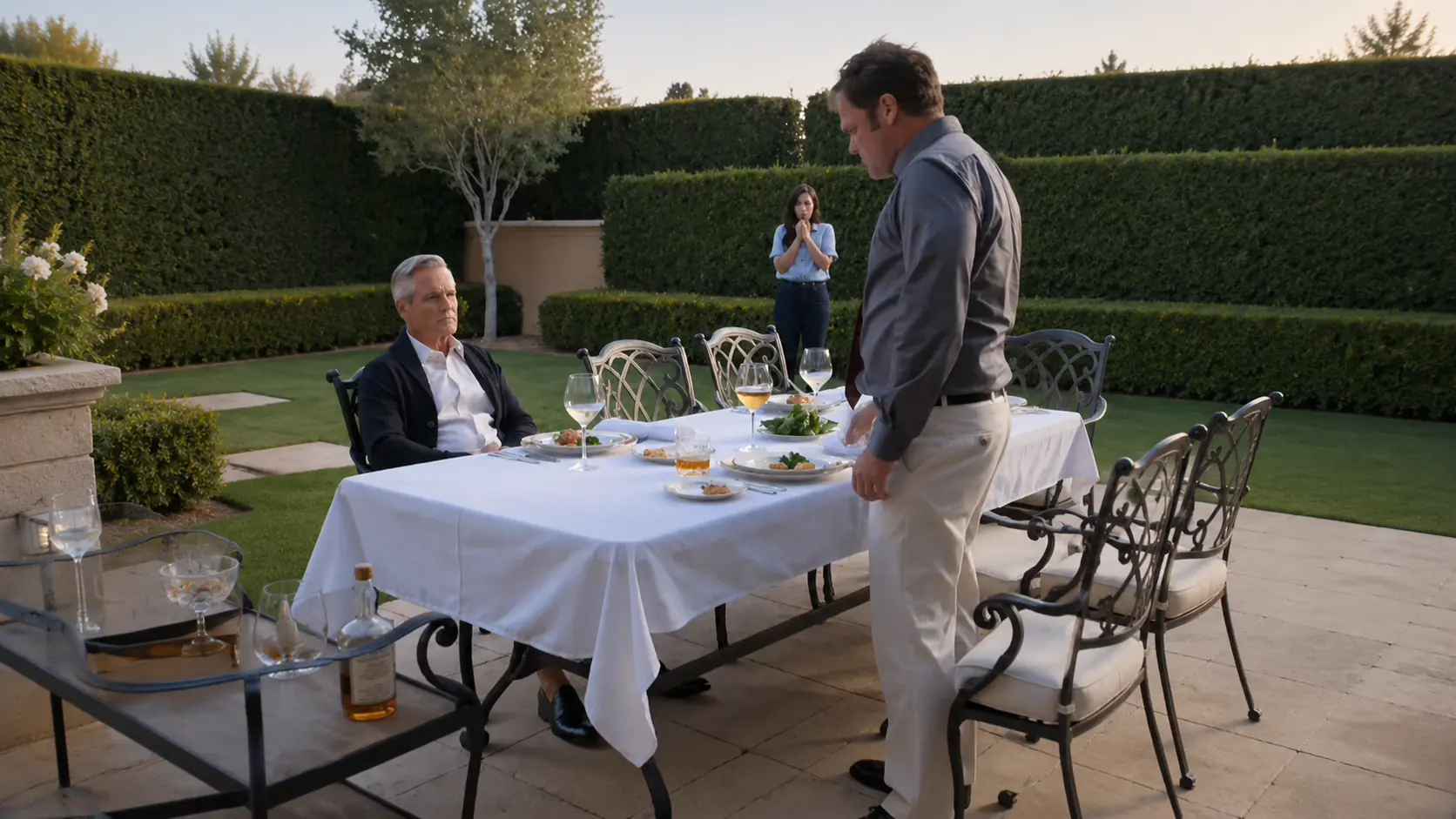
“There are no servants in this house,” I said, each word level and final. “And there is only one person here who decides who does what. That’s me. You are a guest, Leroy. You might want to remember that.”
The air in the room changed. Georgiana froze, her hands still extended toward her husband but no longer touching him. Leroy’s face flushed darker, and his fingers tightened around the glass. He swayed slightly, whether from alcohol or rage, I could not tell.
“A guest,” he repeated, his voice dropping low. I gestured calmly toward the sideboard. “You know where it is.” Something shifted in his expression then, something I recognized from years watching desperate men in courtrooms. Logic was drowning in emotion.
Georgiana stepped forward, hands raised between us. “Please, both of you,” she begged. But I could already see the evening had changed. Eight months of patience had bought me nothing but a drunk man’s contempt in my own home.
Leroy took two steps toward me. I could smell the whiskey on his breath. The glass hung at chest level, ice rattling against crystal. His height advantage meant nothing to me; I had faced men far more dangerous in courtrooms, men with nothing left to lose.
“Pour my drink,” he said, each word separate and deliberate. “Old man, servants obey their masters. That’s how this works.” My voice came out cold. “There are no masters in this house except me. You are a guest. Remember that.”
Georgiana moved between us, her voice climbing toward panic. “Stop. Both of you, please.” But Leroy was not listening to his wife. His arm snapped forward before I could process the motion. The glass left his hand and tumbled through the space between us.
Time seemed to stretch and compress at once. I saw the crystal catch the light, saw the amber liquid trail behind it, saw ice cubes separate in midair. Then it struck my temple and cheekbone. Pain burst across the right side of my face, sharp and bright.
The glass shattered, fragments bouncing off my shoulder and chest. Whiskey sprayed across my neck, cold and stinging where it met the cut. Ice scattered across the hardwood floor. I staggered back one step, my hand rising automatically to my temple.
When I pulled my fingers away, they came back red. Georgiana gasped and turned toward her husband, horror flooding her face. Leroy stood there with his arm still extended, eyes wide like he had surprised himself. His mouth opened, but nothing came out.
“Get him out,” I said. My voice sounded distant, muffled. Warm blood traced a line down the side of my face. “Get him out of my sight.”
Georgiana was crying now. She pushed Leroy backward toward the stairs, using his poor balance to guide him away from me. “I’m sorry, Dad,” she said, her voice breaking. “He didn’t mean it. Please, let me get him upstairs.”
I started to say her name, but she was already moving. “Just let me handle this,” she said without looking at me. They disappeared up the stairs, Leroy’s footsteps heavy and uneven. A door closed above me, and then the house fell silent.
I stood alone in the dining room, hand pressed to my bleeding temple. The dinner plates still sat on the table, abandoned mid-clearing. The whiskey bottle remained on the sideboard, witness to everything. Shattered glass glittered near my feet beneath the chandelier light.
My legs felt unsteady, not from the blow, but from the violation of it. My own home. My own table. After eight months of patience, kindness had bought me a glass to the face.
I walked to the bathroom, my footsteps the only sound in the house. Blood dripped onto my collar, spreading dark across the white fabric. The bathroom light buzzed harshly when I turned it on. The mirror showed me everything.
The cut ran along my temple, deep enough to bleed freely but not enough to require stitches. A bruise was already forming near my cheekbone. But it was my eyes that caught my attention. They looked harder than they had an hour earlier.
They were the eyes of a prosecutor who had just been handed all the evidence he needed. I touched the cut gently and felt pain flare again. I welcomed it. Pain meant clarity, and clarity meant I would not soften in the morning.
Eight months I had given them. Eight months of opening my home, sharing my space, tolerating Leroy’s resentment and Georgiana’s careful attempts to keep peace. I had told myself family came first. But Leroy had looked at my generosity and mistaken it for surrender.
He had looked at my silence and heard permission. He had looked at my age and seen someone to dominate. He had forgotten something important. I had spent thirty years learning how evidence is collected, how cases are built, and how justice reaches people who think they are untouchable.
In the mirror, blood trailed down my temple, and something cold settled inside me. Not rage. Rage was impulsive and sloppy. This was determination.
I cleaned my face carefully and watched the water turn pink in the basin. Upstairs, I heard nothing. Georgiana had chosen to protect her husband before calling the police. In that moment, she had made her choice clear.
Fine. Let her sleep beside him. Let her try to convince herself that whiskey and work stress excused what he had done. Let her remember the look on her father’s face when that glass struck him. I dried my hands and studied my reflection one last time.
The prosecutor in me was already cataloging. Unprovoked assault. Physical evidence. Witness present. Clear escalation pattern.
Leroy had thought he was establishing dominance. What he had actually done was hand me a weapon. Sleep would not come that night. I had planning to do.
Around three in the morning, I sat in my office chair and watched the hours crawl past. The house made its familiar settling sounds, creaks and whispers I had learned over decades. Upstairs, Georgiana and Leroy stayed behind their closed door. I wondered if she was awake too, staring at the ceiling and trying to reconcile what her husband had done.
When dawn finally broke, I returned to the bathroom. The mirror gave me what I needed: evidence. The bruising had spread overnight, and the cut was clearly visible along my hairline. I took out my phone and began documenting everything.
Profile shot. Front view. Close-up of the cut. Each photo was date-stamped and clear.
By 6:30, I stood in the kitchen with my phone pressed to my ear. “I’m reporting an assault that occurred in my home last night,” I said. “The perpetrator is still on the premises. I have visible injuries, and I am ready to provide a full statement.”
The police arrived within thirty minutes. Two officers, one man and one woman, were professional and thorough. I led them through my house like a prosecutor presenting evidence to a jury. I showed them the dining room, the chair Leroy had shoved back, the glass fragments, and the shirt stained with blood and whiskey.
They photographed everything while I gave my statement. Dinner. Leroy’s drinking. The escalating hostility. His demand that I serve him. My refusal. The glass leaving his hand and striking my face.
“Where is Mr. Patterson now?” one officer asked. “Upstairs in the guest bedroom,” I said. They climbed the stairs together while I sat in the living room, hands folded in my lap. The knock on the bedroom door echoed through the quiet morning.
Leroy appeared at the top of the stairs in boxer shorts and an undershirt, squinting against the hallway light. The officers flanked him, unmoved by his confusion. “Wilbur, what did you do?” he snapped. “It was an accident. You’re seriously calling the cops on family?”
I met his eyes but said nothing. Let him see the bruise. Let him see the officers. Let him understand that this was happening.
“Sir, we need you to get dressed,” the male officer said. “You are being placed under arrest for assault.” Georgiana rushed into the hallway, pale and panicked. “Please, can we just talk about this?” But there was nothing left to discuss.
The female officer read Leroy his rights. The handcuffs clicked around his wrists, metal on metal, final and irreversible. Georgiana followed them down the stairs, crying. She grabbed my arm and begged me to call it a mistake.
“He’s my husband,” she said. “Think about what this will do to us.” I looked at her tear-streaked face, and something in my chest tightened. But I had taught her for years that the law applied to everyone. I could not abandon that lesson now.
“He broke the law in my house,” I said. “What would you have me teach you now? That violence has no consequences?” She whispered, “But he’s family.” I answered, “The law does not stop because we are family.”
The officers led Leroy out through the front door and into the morning light. I watched from the living room window as they guided him into the patrol car. The lights were not flashing. There was no emergency now, only routine transport of someone who had committed a crime.
After the car pulled away, the house felt different. Quieter. As if something that had been pressing against the walls had finally released. Georgiana came back inside, passed me without speaking, and climbed to her room.
I returned to the dining room and began gathering the glass fragments into a plastic evidence bag the officers had left behind. Each piece caught the morning light as it fell. My phone sat on the table where I had left it. I picked it up and found the number I needed.
The courthouse opened at eight. I would file for a protective order before lunch. This was only the beginning.
Twenty-six hours after his arrest, Leroy walked out of the Scottsdale jail into morning sunlight. I was not there to see it, but Georgiana told me later in a mechanical, exhausted voice. She had driven to pick him up and watched him emerge through heavy glass doors wearing the same clothes he had been arrested in.
While she drove him away from that building, I sat in a courthouse hallway three miles away. The protective order hearing lasted fifteen minutes. I showed the judge my photographs, medical documentation, and the police report. She barely hesitated before signing the temporary order.
“One hundred yards minimum distance from the petitioner and his residence,” she said. “Valid immediately. Enforceable by law.” I thanked her and left with stamped documents in my hand. Official. Legal. Irreversible.
A court clerk served Leroy the order the moment he left jail. He unfolded the papers and read the bold restrictions. His face went white, Georgiana said, as if someone had opened a drain. “This is my house,” he said. “My home.”
But it was not his home. It was mine. It had always been mine. And now the law agreed.
That afternoon, they hunted for apartments. Georgiana drove while Leroy scrolled through listings on her phone, his rage gradually turning into panic. The cheapest places they found were fourteen hundred dollars a month for studios in neighborhoods they would never have considered before. They settled on a ground-floor unit off Indian School Road.
The leasing agent sensed their desperation. Employment verification would take three days, and Leroy’s credit showed problems. Georgiana co-signed because she still believed she was saving her marriage. That evening, she texted me asking when they could collect his belongings.
“Thursday between two and four,” I wrote back. “I will not be present. Take only what belongs to him. The house locks change Friday.”
On Thursday, I left my house at 1:45 and sat at a Starbucks three miles away. The protective order required distance, and I would not violate my own protection. At 4:15, Georgiana sent one word: “Gone.” I drove home slowly.
The guest bedroom closet was empty. Dresser drawers had been pulled out and abandoned in haste. The bathroom they had used was cleared of toiletries, leaving rings on the counter where bottles had stood. Small things were missing, but nothing worth fighting over.
In the guest bedroom, I stripped the sheets myself. I pulled off the comforter and opened the windows. The mattress looked bare and impersonal again. The house was mine once more.
But I was not finished.
That evening, I searched for private investigators in Scottsdale and found one who specialized in financial investigations. The next morning, I met Robert Chen in a bland office off Scottsdale Road. I slid the police report across his desk. “The man who did this is my son-in-law,” I said. “I want to know everything about his finances, debts, employment status, assets, and vulnerabilities.”
Chen read the report and looked up with understanding. “This is personal.” “It is justice,” I said. He smiled slightly and asked how deep I wanted him to dig. I held his gaze. “All the way down.”
Three weeks later, an email arrived: “Investigation complete. L. Patterson.” I printed the forty-seven pages and spread them across my kitchen table. The first section covered finances. Seven credit cards, all maxed out. Total debt: forty-three thousand dollars.
His minimum payments alone totaled nearly what he now paid in rent. Employment records showed his commissions had dropped sixty percent over the past year. Lost clients. Missed quotas. Reviews declining from “Meets expectations” to “Needs improvement” to “Probationary status.”
Then I reached the bank statements from Georgiana’s retirement account. Three withdrawals over three months. Seven thousand in January. Five thousand in February. Three thousand in March.
Fifteen thousand dollars total, taken while they lived under my roof rent-free and ate food I paid for. He had been draining her future while smiling at my dinner table. But the final section was even worse. Chen had interviewed three of Leroy’s coworkers.
One said Leroy claimed the old man would not last much longer and that he would inherit an eight-hundred-fifty-thousand-dollar house soon. Another said Leroy had called it an investment strategy: move in, wait it out, inherit. The third said Leroy joked that retirement homes were expensive and that his father-in-law would not waste money on one when he had free care at home. I set the papers down carefully.
He had not moved into my house because Georgiana asked. He had moved in because he saw me as an asset to acquire. Not a father-in-law. Not family. A real estate investment with an expiration date.
By noon, I scheduled a notary appointment. By two, I had drafted a new will, using thirty years of legal experience to make it precise and binding. Georgiana would inherit the house, retirement accounts, and remaining assets only if she legally divorced Leroy before my death. Otherwise, the entire estate would go to the Arizona Coalition Against Domestic Violence.
The notary, Patricia Reeves, reviewed the clause carefully. “Your daughter inherits only if divorced?” she asked. “You understand this may cause family conflict.” I told her I understood completely. That was the point.
She chooses him, she chooses poverty. She chooses herself, she has security. Her decision.
I also sent Georgiana a formal certified letter telling her the estate planning documents had been updated and conditional terms now applied. The letter revealed nothing specific. It was a seed of doubt. A question she could not ignore.
The timing was deliberate. She would receive it two days before Leroy’s court hearing. I wanted her questioning everything when he stood before a judge. I wanted doubt growing like a crack in a foundation.
The Maricopa County Superior Court building rose twelve stories in downtown Phoenix. I arrived at nine in a navy courtroom suit, pressed sharp. The gallery held about twenty people. I chose the third row, center, with a perfect view of the defense table.
At 9:15, Leroy entered with his public defender and Georgiana. His suit did not fit, the shoulders too wide and the sleeves too long. When he saw me, his jaw clenched. Georgiana touched his arm and guided him forward.
The plea agreement had already been negotiated. Leroy would plead guilty to simple assault. He would receive eighteen months of supervised probation, a twenty-five-hundred-dollar fine, a certified anger management program, and fifty hours of community service. The judge confirmed that Leroy understood the terms.
When asked whether he understood he was admitting to assaulting his father-in-law in his own home, Leroy hesitated. His public defender whispered urgently. Finally, Leroy said yes. He signed the papers hard enough to tear the corner.
The judge accepted the plea and imposed sentence. Then Leroy opened his mouth. His lawyer tried to stop him, but Leroy shook him off. He began calling the case ridiculous, claiming it was an accident, accusing me of destroying his life over nothing.
The judge cut him off. “The time for statements has passed. You have pled guilty. The case is concluded.” The gavel came down. Leroy stood trembling with rage.
As he reached my row, he stopped and pointed at me. “You’ll regret this, old man,” he said. “This is your fault. You ruined everything.” His voice echoed through the courtroom.
Security officers moved immediately. The judge slammed the gavel twice and ordered Leroy back to the bench. He had just threatened the victim in open court. His probation terms were tightened to include mandatory weekly in-person check-ins, and any further violation would mean immediate incarceration.
Leroy left with his head down. Georgiana followed several steps behind him, not touching him. In the hallway, I caught her eye. Her expression held something I had not seen before: doubt.
Six weeks later, Georgiana called me from an outdoor coffee shop. Leroy had lost his job after a background check flagged his assault conviction. Money was tight. Bills were growing. She asked if I could help them temporarily.
“I will help you,” I said. “One condition. File for divorce and move back home. That is what I am offering. Not money. Not loans. A home for my daughter. Alone.”
She was silent. Then anger rose in her voice. “You want me to leave my husband when he’s struggling?” But halfway through the sentence, she stopped. I could hear the moment realization hit. “You planned this, didn’t you?”
“I pressed charges after he assaulted me in my own home,” I said. “Everything that followed came from his choices, not mine. I will help you. Not him. There is a difference.” She hung up without another word.
For six more weeks, I did not call her. The Arizona heat settled heavily over the city. I stayed home, read on the patio in the mornings, and let silence do its work. Their apartment became a pressure cooker.
Leroy was unemployed and nearly unemployable. Applications disappeared into silence. Interviews ended when background checks returned. Georgiana worked long remote hours, trying to cover bills that multiplied faster than her income.
Then one afternoon, while searching for tax documents, she found a folder labeled Fidelity Retirement. Inside were statements showing the withdrawals Leroy had hidden from her. Fifteen thousand dollars gone. Money taken from her future while they lived rent-free in my house.
She confronted him. He tried to justify it as household money, community property, necessary spending. But she saw the truth. He had hidden it from her because he knew it was wrong.
Then she checked his credit report. Seven maxed-out cards. Forty-three thousand dollars in debt. The retirement money plus the debt equaled fifty-eight thousand dollars of damage. And he had blamed me for everything.
That night, she searched for divorce lawyers in Scottsdale. The next morning, she texted me. “Can we meet? Just us. I need to understand something.” I replied within minutes. “Name the place.”
We met at a coffee shop on Camelback Road. I arrived first and ordered her a latte the way she liked it. She arrived ten minutes late, nervous and pale. The small gesture nearly broke her composure.
“Why did you do this?” she asked. “Press charges? Refuse to help us? Make that divorce demand?” I answered calmly. “I did not do this to you. He assaulted me. I documented it and let the legal system function. I will not give money to a man who steals from my daughter and blames everyone but himself.”
She looked down at her coffee. “You knew about the retirement money,” she said. “That’s why you made that offer.” I told her I was trying to help her see clearly. Sometimes people need to discover truth for themselves.
She asked what it would look like if she came home. I told her the room was ready, the locks were changed, and Leroy could not follow her there. She sat quietly, thinking about the apartment, the debt, the theft, the marriage that had cost her home and peace. Finally, she said she needed time.
Ten days later, my phone rang while I sat on the back patio. “Dad, I’m coming home,” Georgiana said. Her voice carried certainty. “Can I come today?” I answered, “Of course. Whenever you’re ready.”
She had waited until Leroy left for his probation check-in. Then she drove to her divorce attorney’s office and signed the petition. Irreconcilable differences. Unauthorized use of marital funds. Property division requested.
When Leroy returned to the apartment, he found two suitcases by the door. She handed him the divorce petition with a steady hand. He accused me of poisoning her against him. She picked up the papers he threw on the floor and folded them carefully.
“You stole fifteen thousand dollars from my retirement while we lived rent-free,” she said. “You blamed everyone but yourself. You threw a glass at my father’s face. I am not destroying this marriage. You already did.”
Twenty minutes later, my doorbell rang. I opened the door and saw my daughter standing there with tear tracks on her face and two suitcases at her feet. I stepped aside and held the door wide. “Welcome home.”
She walked in like someone who had been holding her breath for months and could finally exhale. I carried her suitcases upstairs to the room I had quietly prepared. Fresh linens, cleared drawers, empty hangers, folded towels. Small preparations that said she was welcome without needing words.
That evening, with a police escort arranged by her attorney, Georgiana collected the rest of her belongings. Leroy stood back, unable to interfere without risking a probation violation. She left the wedding album behind. She took her clothes, books, documents, and a photograph of her mother.
When she returned, she carried the final boxes into her room. Not the guest room anymore. Her room. We stood there in silence, looking at walls that needed repainting and furniture that was dated but safe.
“We should repaint this room,” she said quietly. “Fresh start.” I asked what color. For the first time in months, she smiled. “Something bright,” she said. “Something that looks like hope.”
Three weeks later, the divorce decree arrived. We sat at the kitchen table together while she read the summary aloud. The dissolution of marriage was granted, effective immediately. Leroy retained his personal debts. Her retirement account balance remained hers, minus what he had already taken.
“It’s done,” she said. I opened my own envelope from the county clerk. Leroy’s case had been closed after completing the plea terms: probation, community service, anger management, and victim notification. I placed the letter in a drawer with the police report, protective order, and investigator’s report, then closed it firmly.
That evening, Georgiana and I sat on the back patio with coffee. I had bought a second chair after she moved in. We watched the desert light shift across the yard. The silence between us felt earned.
“Dad, I’m sorry I didn’t believe you at first,” she said. “I’m sorry I chose him over you for so long.” I told her she believed when she was ready. No one can be forced to see a truth before they are prepared for it.
She asked if it was wrong to feel relieved. Not angry, not vindictive, just free. I told her freedom was the point. Everything else had simply been removing obstacles.
The stars appeared one by one over the Scottsdale sky. I thought about the glass, the blood, the photos, the police report, the courtroom, the divorce, and the long road back to peace. I had not destroyed Leroy. I had only refused to enable him.
The consequences came from his own choices.
Georgiana was healing. She worked steadily, went to therapy twice a week, and slept through the night again. Some mornings, I heard her humming while making coffee, and the sound filled the house with something that had been missing.
Leroy had left Arizona three days after the divorce filing. His brother in Nevada had taken him in, starting over at thirty-seven with debt and a criminal record. I did not wish him harm. I simply did not think about him.
My house was quiet again.
Peaceful.
Mine.
But this time, my daughter was there too, safe and building her future instead of financing someone else’s failures.
When the night grew cooler, Georgiana said we should go inside because morning would come early. I stood and offered my hand to help her up. She took it, and we gathered our cups.
Inside, she went upstairs to her blue room with its hopeful walls. I turned off the patio light and locked the door. The house settled around us, quiet and whole. Everything was exactly as it should be.