My Son-in-Law Slammed the Door and Said “Not Her Again” - Then He Asked Me for Money and Regretted It
The humidity in Dallas during late September felt like a wet blanket pressed over my shoulders, heavy enough to steal the breath from my lungs with every step I took. My name is Margaret Miller. I am sixty-eight years old, and my hands, once quick and nimble behind the roar of textile looms in Pennsylvania, are now mapped with deep lines and swollen joints. On that Sunday afternoon, the Texas sun hung white and blinding above the polished streets of Preston Hollow. It reflected off marble steps, white brick, black luxury cars, and lawns trimmed so carefully they looked almost unreal.
I was carrying a heavy ceramic dish wrapped in several layers of kitchen towels to keep the heat inside. In that dish was my signature fried chicken, the kind with a buttermilk crust that used to shatter when Chloe bit into it as a little girl. Beside it was cornbread made from a family recipe that had survived three generations. Chloe used to call that meal her comfort on a plate. Before high-end real estate, designer clothes, and Dallas society swallowed her whole, she would sit on the counter in our small Scranton kitchen and watch me fry each piece with pure adoration.
Back then, we were a team. I was the mother who worked double shifts at the factory so Chloe could have good sneakers, a decent prom dress, and eventually a college education that I had never been able to afford for myself. I had believed every sacrifice was building a better life for her. I had believed a mother’s love was something a child remembered forever. As I walked up the driveway of her six-bedroom colonial mansion, I carried that belief with me like something fragile. I also carried a nervous hope that maybe, just maybe, my daughter would be happy to see me.
The house stood like a monument to success. A gleaming black Tesla sat in the driveway beside a luxury SUV, both vehicles worth more than the house where I had raised Chloe. For one moment, I felt a twinge of pride. I had helped her get here. I had sold my own home to help fund this beautiful place in this expensive neighborhood. But as I approached the heavy dark oak door, that pride slowly twisted into anxiety.
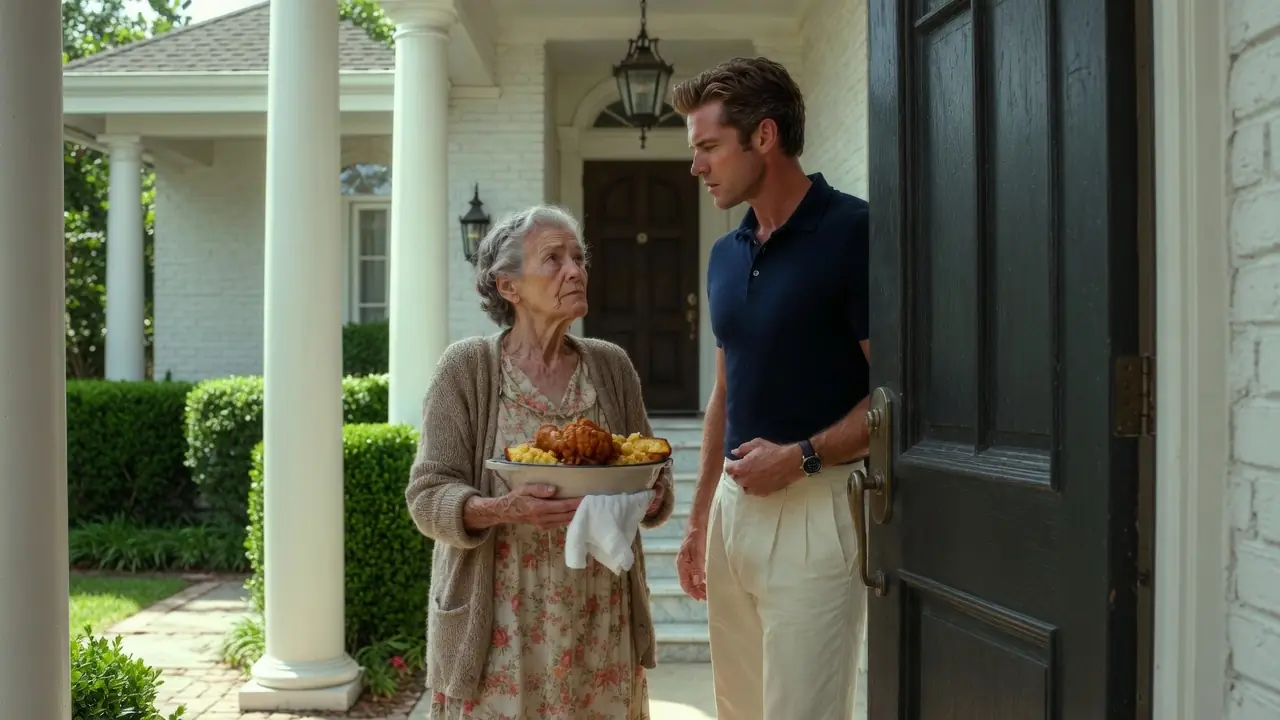
I smoothed my simple floral cotton dress, the one I had bought on sale at a department store, and adjusted the dish in my arms. Then I pressed the doorbell. The chimes echoed through the house, elegant and melodic, almost mocking the simplicity of the woman standing outside. I waited with my heart hammering in my chest. I heard footsteps on hardwood floors, the sharp click of expensive shoes coming closer. Then the door swung open.
It was not Chloe. It was Bradley, my son-in-law. He stood in the doorway wearing a tailored navy polo shirt and cream linen trousers, looking as if he had stepped off a yacht instead of out of a living room. His hair was perfectly gelled, his face clean and polished, and his eyes narrowed the moment they landed on me. He did not say hello. He did not offer to take the heavy dish from my arms. Instead, he let out a loud theatrical sigh that carried more cruelty than a shout.
“Not her again,” Bradley said, loud enough for the quiet street to hear. The words struck me harder than the heat. He looked past me toward the lawn, as if he were embarrassed that the neighbors might see me on his porch. Then he looked back at me with cold annoyance. “Margaret, I told you Sundays are for us to decompress. We have a busy week with new listings, and we don’t need you showing up like some uninvited solicitor.”
“We don’t want your greasy chicken, Margaret,” he snapped. “We’re on a clean eating protocol. Chloe is trying to maintain her image for the gala next week, and the last thing she needs is your heavy, old-fashioned cooking cluttering up our kitchen.” His mouth curled in disgust. “You can’t keep appearing whenever you feel like it. You’re invading our space.”
I looked past him, hoping to see Chloe. For one fleeting second, I did. She stood at the top of the grand staircase, her blonde hair perfectly styled, wearing an outfit that probably cost more than my monthly Social Security check. Our eyes met. I expected her to come down. I expected her to defend me, or at least say my name. Instead, she turned her head away as if she were watching a stranger be refused service at a restaurant.
Bradley did not wait for another word. He stepped back and gripped the handle of the oak door. “This isn’t a soup kitchen, Margaret. Call before you come, though I suggest you wait until we invite you, which won’t be today.” Then he slammed the door. The sound was deafening. It cracked through the porch, through my bones, and through something inside me that had been holding on far too long.
I stood frozen in front of the closed door, still holding the warm dish against my chest. The towels began slipping from my fingers, and the smell of fried chicken, once so comforting, now felt like a cruel joke. I was a mother who had given everything, and I had been turned away like garbage on the sidewalk. For one second, I thought I might knock again. Then I saw my reflection in the glass beside the door, an old woman with damp gray hair, swollen hands, and eyes full of shame, and I knew there was nothing inside that house for me.
I turned around slowly. My legs felt weak, like they belonged to someone else. I walked down the long driveway, past the luxury cars, past the perfectly trimmed hedges, and toward the main road. I did not own a car anymore. I had sold my reliable old sedan the year before to help cover closing costs on the very house whose door had just been slammed in my face. So I walked four long blocks to the nearest bus stop, clutching Chloe’s ruined comfort meal as the Texas sky began to darken.
The storm broke before I reached the bus stop. Rain fell in hard sheets, sudden and punishing, the way Dallas storms often came without mercy. I had no umbrella. I held the ceramic dish tighter against my chest, trying to protect the food even though I knew it was useless. By the time I reached the metal bench, my cotton dress was soaked and clinging to my shivering body. My gray hair was plastered to my forehead, and the towels around the dish were damp and cold.
I sat down at the bus stop and looked at the dish in my lap. The steam was gone. The crust would be soggy now. The cornbread would be heavy and wet. A sob rose in my chest, deep and primal, but I bit it back because even there, alone in the rain, I was still ashamed of making a scene. I thought about the house I had sold in Scranton, the sturdy three-bedroom Craftsman my late husband Henry and I bought in 1984.
It had not been a mansion, but it had been mine. We had marked Chloe’s height on the kitchen doorframe there. We had hosted Thanksgiving dinners there. Henry had planted tomatoes in the little backyard garden, and I had complained about weeds while secretly loving every minute of it. That house had been my safety net, my history, my proof that forty years of factory work had meant something. Then Chloe and Bradley came to me three years ago with tears in their eyes and dreams in their mouths.
They told me Dallas was the future. Bradley talked about the booming real estate market and how they could build a legacy if they only had enough capital to get started. They needed three hundred thousand dollars for the down payment on a home in the right neighborhood. They promised me a guest suite. They promised me I would never have to worry again. They promised I would be the center of their lives, able to rest after decades of working in the factory.
I believed them because I wanted to be near my daughter. I sold the house. I sold the memories. I handed over every penny of the three hundred thousand dollars and kept nothing for myself because I thought Chloe’s love was the only insurance I needed. Instead of the guest suite, I ended up in a small one-bedroom apartment in a neighborhood Bradley called up and coming. In reality, it was noisy, neglected, and four thousand dollars a month, which took nearly every cent of my Social Security and pension.
For three years, I had lived on the margins. I clipped coupons, skipped meals, stretched medication, and made old clothes last longer than they should have. I did it because I wanted to stay near Chloe. I told myself she was busy, that Bradley was stressed, that Dallas society was hard on them. I excused every canceled dinner, every cold phone call, every joke about my Scranton accent, and every moment when I was made to feel like a stain on their polished life.
When the bus finally arrived, its tires splashed through the puddles. I climbed aboard, dripping water onto the floor while the driver glanced at me with pity and annoyance. I found a seat near the back and sat in silence as the engine hummed beneath me. I felt small. I felt invisible. I realized that to Chloe and Bradley, I was no longer a mother or benefactor. I was an obstacle.
When I reached my apartment, I was shivering uncontrollably. The little space felt colder than usual. I placed the ceramic dish on the kitchen counter and unwrapped it slowly. The food was ruined. The chicken crust had turned soggy and gray, and the cornbread had collapsed into a damp, heavy block. I did not even have the energy to put it in the refrigerator.
I scraped the entire meal into the trash. The sound of the chicken hitting the plastic liner felt final. I sat on my old worn sofa, the one piece of furniture I had managed to keep from my old life, and I did not turn on the lights. I listened to the rain hammer against the window. I thought of Chloe on her graduation day, hugging me and saying she could not have done it without me. I thought of her wedding day, when my hands trembled as I fastened the buttons on her dress.
Where had that girl gone? How could she stand at the top of the staircase and watch her husband treat me like a stray dog? The silence in my apartment became unbearable. It was the silence of a woman who had given away her kingdom and was now begging outside the gates. That night, I finally admitted the truth I had avoided for years. They did not love me the way I loved them. They loved the money I had provided, and once the money was gone, I became a burden.
I looked at my hands in the dim light. They were worker’s hands, marked by forty years of textile dust, needle pricks, and the grinding rhythm of factory machines. Those hands had fed Chloe, clothed her, paid for her education, and helped buy the mansion where I was no longer welcome. A cold anger began to stir in my stomach. It was not the hot, wild anger of youth. It was slower than that, deeper than that, the kind of anger that forms when a woman has been pushed too far.
For two days, I stayed in my apartment. I did not call Chloe to apologize for invading her space, though in the past I might have. I did not leave messages. I did not beg. I nursed the cold I had caught in the rain and thought about every humiliation of the past three years. I remembered holidays when I was asked to stay away because important friends were coming over. I remembered Bradley laughing at my accent. I remembered the day I signed away my house and saw triumph, not gratitude, in his eyes.
On Tuesday morning, the phone rang. Chloe’s name appeared on the caller ID. My heart skipped, an old reflex I hated myself for having. I let it ring. Then it rang again. On the fourth call, I picked up and said, “Yes, Chloe. I’m here.”
She began with an apology that did not sound like one. Bradley had been stressed, she said. The real estate market was volatile, she said. Sundays were his time to decompress. She waited for me to reassure her, to tell her it was all right, to forgive them before she had even asked properly. I said nothing. Finally, impatience crept into her voice, and she got to the real reason for the call.
They needed money. Bradley had found an incredible investment opportunity, a block of luxury townhomes in North Dallas. According to Chloe, it was a once-in-a-lifetime chance to scale the business. They were short on liquidity for the initial deposit. They needed fifty thousand dollars by Friday. I felt a cold laugh rise in my throat, but I swallowed it down.
“Fifty thousand dollars, Chloe?” I said. “I don’t have fifty thousand dollars. You know that. I gave you everything I had for the down payment on your house.” She brushed it aside as if I were being difficult. She said I must still have savings bonds from the factory, or retirement money tucked away. She called it a short-term loan, six months, maybe eight, with interest. Then she used the words that finally snapped something clean in my mind: family legacy.
“Chloe,” I said, “I have four hundred dollars in my checking account. My retirement fund was liquidated to cover the closing costs on your mansion. I have nothing left to give.” There was a long pause. Then the sweet little-girl voice vanished. In its place came a cold tone that sounded exactly like Bradley. She said it was disappointing. She said they had counted on me. She said Bradley warned her I might be difficult because I had become selfish lately.
“Selfish?” I whispered. “I sold my home. I moved across the country. I gave you three hundred thousand dollars. I live in a tiny apartment while you live in a palace. How am I the selfish one?” Chloe groaned and said I always brought up the Scranton house. She told me that money had been a gift for her happiness. Then she said if I could not help them now, I should not bother coming over this Sunday or any Sunday. She said they needed to focus on business and did not have time for my drama.
Then she hung up. The dial tone hummed in my ear like a blade. I slowly set the phone down. My hands were no longer trembling. The betrayal was complete. It was not only Bradley’s cruelty or Chloe’s silence. It was their total lack of humanity. They had looked at me and seen a bank account, not a mother.
I walked to the window and looked out at the Dallas skyline, cold towers of glass and steel rising beyond the street. For three years, I had been a ghost in their lives, waiting for scraps of affection that were never coming. But ghosts can be powerful when they stop begging to be seen. I went to my desk and pulled out a manila folder hidden at the bottom of a drawer. Inside were the legal documents from the house transfer, the papers I had signed three years earlier in a blur of love and trust.
This time, I did not read them like a mother. I read them like the woman who had managed a textile floor for twenty years, trained to spot the smallest flaw in a beautiful weave. I knew Bradley was arrogant. Arrogant men miss details when they think they are dealing with someone inferior. I turned to the final page, titled Exhibit C. It was a rider my old family lawyer in Scranton, Arthur Vance, had insisted on including.
At the time, Bradley had rolled his eyes and called it legal clutter. Chloe had urged me to sign quickly so we could get everything done. But Arthur had protected me when I was too blinded by love to protect myself. The property transfer was contingent on a right of habitation and a non-disparagement clause. If I was denied access to the property or subjected to documented emotional or financial abuse by the grantees, the transfer could be rendered null and void. The full value of my initial gift could become a secured lien against the property, payable immediately.
I closed my eyes. “Arthur Vance, you brilliant old man,” I whispered. Then I picked up the phone and dialed a number I had not called in three years. When Arthur answered, his voice sounded older but steady. “Arthur,” I said, “this is Margaret Miller. I’m in Dallas, and I need your help.” As I explained everything, the pain in my chest slowly cooled into clarity.
Arthur arrived in Dallas the next morning. He sat at my small kitchen table with papers spread out in careful stacks. He explained that the three hundred thousand dollars was not a simple gift under the rider he had drafted. It was a conditional advancement tied to my well-being and right to respectful treatment within the family structure. The non-disparagement clause mattered. Bradley calling me a solicitor in public, Chloe barring me from the home I funded, and their demand for more money all created a pattern. But Arthur said we needed proof.
I had to return to the mansion not as a mother searching for love, but as an auditor. On Thursday afternoon, I put on my best beige suit, pinned my hair neatly, and took the bus back to Preston Hollow. I carried the empty ceramic dish as my excuse. I did not ring the bell. I used the spare key I knew the gardener kept hidden near the mudroom. The house was silent, expensive, and cold.
I placed the dish on the granite island and stood still for one breath. Then I moved. I did not go into their bedroom, because even after everything, my decency had limits. Instead, I went into Bradley’s home office, a mahogany-paneled room smelling of cigars and leather. I found the first thread in the trash can: a final demand notice from a luxury car dealership. The overdue amount on the black Tesla was more than fifteen thousand dollars.
Under it were credit card statements with balances that made my head spin. Bradley was not short on liquidity. He was drowning in high-interest debt and trying to outrun it with my money. I took photos with steady hands. Then I heard the garage door open and hurried back to the kitchen. Chloe walked in with mail and a yoga mat, irritation already tightening her face.
“What the hell are you doing here?” she snapped. I lowered my eyes and played the apologetic mother. “I just came to return the dish. I didn’t want to leave it on the porch.” Chloe sighed with bored disdain. She said Bradley was right, that I had become needy and embarrassing. They had a huge gala on Friday night, she said, and they did not need Scranton drama distracting them.
I looked at my daughter and saw fear beneath the polish. She was clinging to the facade because the foundation was already cracking. “The gala sounds wonderful,” I said gently. “I’m sure you’ll be beautiful.” Then I told her I had been thinking about the fifty thousand dollars and might be able to find a way to help. Her entire face changed. The anger disappeared, replaced by hungry relief.
As I walked out through the mudroom, I heard her calling Bradley. “She’s going to do it,” Chloe said, excitement bright in her voice. “The old bird is coming through.” The words should have hurt. Instead, they confirmed everything. I spent the rest of Thursday and Friday morning with Arthur in a hotel room, reviewing the photos, the recorded phone call, and the documents. Then Arthur’s investigator found the real truth.
The luxury townhomes did not exist. Bradley had created a shell company, used images from a project in Atlanta, and was soliciting Dallas investors to pay off his existing debts. It was fraud dressed in linen trousers and polished shoes. Chloe’s name was on promotional materials, lending credibility to lies she either did not understand or chose not to question. That discovery hurt more than I expected. My daughter was not only being used. She was participating.
The gala was scheduled for Friday night at a luxury downtown hotel. Bradley had spent money he did not have on a VIP table to impress people who did not care about him. Chloe had bought a dress that cost more than two thousand dollars. At noon, I called her and said I would meet her at the gala with the confirmation papers. I could hear relief in her voice. For one moment, I felt like a traitor. Then I remembered the rain, the door, and the word solicitor.
I did not wear the cotton floral dress that night. I bought a simple black sheath dress and a single strand of pearls. I had my hair styled in a smooth bun. When I looked in the mirror, I did not see the factory worker from Scranton they were ashamed of. I saw Margaret Miller, a woman of substance, a woman who had earned every line on her face and every dollar she had ever saved. I met Arthur in the hotel lobby at 6:45.
“You look like a woman who knows exactly what she is doing,” he said. “I do,” I replied. “I’m taking back what belongs to me.” We walked into the ballroom, a sea of tuxedos, evening gowns, perfume, champagne, and ambition. I spotted Bradley immediately, laughing near the center of the room with men he wanted to impress. Chloe stood beside him, charming and nervous, holding a glass of champagne like a scepter. They looked successful, but I knew the truth.
I waited before approaching. I watched Bradley receive a nod from a prominent developer, the kind of validation he craved. I watched Chloe whisper to him with hope lighting her face because she thought my money would save them. The old maternal instinct tugged at me one last time. Then I remembered walking to the bus stop in the rain while holding a ruined meal. I remembered the house my Henry and I had built. I walked toward their table with Arthur behind me.
Chloe saw me first. Her eyes widened with excitement and apprehension. Bradley turned, and his face tightened for a split second before he smoothed it into an oily smile. “Margaret, you made it,” he said loudly enough for nearby tables to hear. “We were beginning to think you’d gotten lost. Did you bring the documents we discussed?”
I reached into my evening bag and pulled out a single white envelope. “I did, Bradley. I have everything right here.” Chloe reached for it, her fingers trembling slightly. “Oh, Mom. Thank you. You have no idea what this means to us.” I pulled the envelope back just out of her reach. “I think you should read it first,” I said. “It’s not exactly what you’re expecting.”
Bradley’s smile faltered. “Margaret, what is this? We have people here. This isn’t the time for games.” I handed the envelope to Chloe. “It’s not a game. It’s a reality check.” Chloe opened it, and her brow furrowed. As her eyes moved down the first page, the color drained from her face. Bradley snatched the paper from her and read it, his mouth tightening with each line.
“A lien?” he hissed. “A rescission of the property transfer? Margaret, what the hell is this?” Arthur stepped forward like a calm legal wall. He introduced himself as my attorney and explained that we had filed a formal lien against the Preston Hollow property based on breach of the non-disparagement and habitation rider. He also explained that a full investigation had begun into the shell company Bradley used to solicit investments for a nonexistent North Dallas project.
The neighboring tables began to turn. The ballroom murmurs faded. Bradley’s face turned a furious purple. “You can’t do this,” he snarled. “This is my house. I’m a respected businessman in this city.” Arthur’s voice remained cool. “The house was funded by Margaret’s conditional gift. By excluding her and disparaging her publicly, you made the transfer voidable. As for your business reputation, the authorities will decide that once they review the evidence.”
Chloe looked at me as if I had betrayed her. “Mom, how could you do this to us at our gala? You’re destroying everything.” For the first time in three years, I did not feel the need to apologize. “No, Chloe. I’m not destroying anything. I’m showing everyone there was nothing solid here to begin with. You destroyed it every time you chose Bradley’s greed over your mother’s dignity. You destroyed it when you let him slam that door in my face while it was raining.”
The silence at the table was complete. The developer Bradley had been trying to impress stood and walked away with polite disgust. Other guests whispered, their eyes moving from Bradley’s red face to Chloe’s trembling hands. Bradley looked around and realized his audience had become witnesses. He turned back to me with pure hatred in his eyes. “You’ll regret this, Margaret. You’ll be alone in that pathetic apartment with nothing. We were your only family.”
I looked at him and felt a profound freedom rise in my chest. “No, Bradley. I was alone when I was with you. I was alone waiting for love that never came. In that apartment, I have my dignity. In this ballroom, I have the truth.” Then I turned and walked away with Arthur beside me. I did not look back at the table. I did not look back at the daughter I had lost.
The next day, Bradley’s house of cards began to fall. The North Dallas Townhome Project was flagged as fraudulent. The fifty thousand dollars he had tried to squeeze from me was meant to cover a high-interest bridge loan from private lenders. The district attorney’s office moved to freeze accounts connected to his business. The Tesla, the designer clothes, the catering bills, and the gala expenses were all folded into a wider investigation.
But the mansion mattered most. At two o’clock that afternoon, I returned to Preston Hollow, not with chicken or apologies, but with Arthur, a police escort, and a court-certified order of immediate possession. Bradley opened the door before we could ring. He looked like a ghost of the man I had seen the night before, with rumpled clothes, messy hair, and bloodshot eyes. He looked at the officers, then at me, and defeat settled into his face. “You can’t do this,” he whispered. “You gave us that money.”
“No, Bradley,” Arthur said. “The transfer was conditional. You breached the terms. The court has granted Mrs. Miller an emergency order of rescission. This house is no longer yours. You have two hours to pack your personal belongings and vacate.” I walked past Bradley into the foyer. The marble floor was cool beneath my shoes. Chloe sat on the grand staircase with her head in her hands, still wearing jewelry from the night before. When she looked up, her eyes were red and swollen.
“Mom, please,” she sobbed. “We have nowhere to go.” I looked at my daughter, the girl I had worked double shifts to protect. “Chloe, you stopped thinking about family when you let your husband call me a solicitor on a public street. You stopped thinking about family when you watched him slam the door in my face in the rain. You called me a weight around your neck. Well, the weight is gone now. You are free to swim on your own.”
The next two hours passed in motion and noise. Bradley dragged suitcases down the stairs, argued with officers, called lawyers, and claimed he was being targeted by a vengeful old woman. Facts did not move for him. The car dealership had already sent a tow truck for the Tesla. Credit card companies were filing their claims. The world he built on my money was evaporating around him.
At the front door, Chloe looked at me one last time with fear and resentment in her eyes. “I hope you’re happy, Margaret. You got the house. Are you going to live here all alone in this giant mausoleum?” I shook my head. “No, Chloe. I’m putting it on the market tomorrow. The three hundred thousand dollars will go back into my retirement fund. The surplus will go to a charity that helps women financially abused by family. I’m going back to Scranton, where people know my name and respect my hands.”
I watched them walk down the driveway with their bags. They had no car and no plan. They walked toward the same main road I had walked in the rain only days earlier. For one moment, the old maternal instinct rose in me, asking me to call them back. Then I remembered the factory looms. If you ignore the flaw in the fabric, the whole weave unravels. I was finally letting it unravel so they could learn how to weave something honest.
I spent one final evening alone in the mansion. It was beautiful, but it was not a home. It was a transaction. I thought about Henry, about our Scranton house, about the garden and the kitchen doorframe where Chloe’s height marks had once climbed year after year. My dignity was never tied to marble floors or high ceilings. It was tied to the truth.
I called Arthur and told him to finalize the listing. I told him I wanted to leave Dallas within forty-eight hours. The legal proceedings would continue, and Bradley would likely face the consequences of his schemes. Chloe would have to face her choices too. That was their journey now. I had done my part. I had been the mother who gave, and then I became the woman who took back.
As I walked out of the house for the final time, I paused at the threshold. I looked at the heavy oak door Bradley had slammed in my face. I touched the wood, feeling the grain beneath my fingers. I did not feel hatred. I did not even feel revenge anymore. I felt the quiet, steady touch of justice.
Then I pulled the door shut behind me. The click of the lock sounded like a period at the end of a long, painful sentence. A taxi waited at the curb. The Dallas skyline glittered in the distance, polished and cold as ever. I climbed into the back seat and told the driver to take me to the airport. I was going home, not to a mansion, but to a life that was finally mine.
Revenge is not always about hatred. Sometimes it is about forcing truth into rooms where lies have been too comfortable. Justice is not meant to destroy for pleasure. It is meant to restore dignity. Family is no shield for cruelty, and love does not require a woman to disappear inside someone else’s ambition. The most important forgiveness is the one we grant ourselves for loving too long, trusting too deeply, and believing people who were never worthy of that faith.