The smoke from the charcoal grill drifted sideways across my driveway, carrying the smell of ribs, onions, and sweet barbecue sauce into the open mouth of my garage. It was a clear Saturday afternoon in upstate New York, the kind of day my late wife Eleanor would have loved because the sunlight made the red brick of the house glow and the roses beside the fence look freshly painted. I had set three folding chairs beside the garage, placed paper plates and lemonade on a small plastic table, and parked my old Toyota near the curb so my daughter Maya and her husband Preston could have the driveway. I thought we were having a simple family barbecue.
At seventy-one years old, a man learns not to expect too much. A quiet meal, a few honest words, and maybe one afternoon without being treated like furniture can feel like a holiday. I had spent the morning wiping down the old grill, trimming the hedge near the garage door, and arranging my tools back on their hooks because I still believed a man’s home should greet guests with dignity. My hands were stiff from age, but the garage wall was neat, every wrench hanging in its place, every drill battery charged, every old coffee can of screws labeled by size.
Preston arrived fifteen minutes late in a navy polo shirt, tailored shorts, and loafers so clean they looked like they had never touched real ground. He stepped out of his leased Mercedes with sunglasses pushed into his hair and a smile that never reached his eyes. Maya got out on the passenger side holding a container of store-bought potato salad, her shoulders tense before she even reached the gate. That was how my daughter walked in those days, like every room was a test she expected to fail.
“Smells good, Pops,” Preston said, taking the barbecue tongs from the side table without asking. “Look at you, still useful.”
Maya gave him a quick look. “Preston.”
“What?” he said, grinning. “It’s a compliment.”
I smiled because old men get good at letting small insults pass like flies over a screen door. “Ribs need another ten minutes.”
“I’ll handle it,” Preston said, lifting the grill lid. “Can’t have you overcooking everything and calling it tradition.”
I sat down in the folding chair beside the garage and rested my hands on my knees. The chair creaked under me, not because I was heavy, but because it was old and honest, like most things I owned. Maya stood near the table, smoothing the napkins into a neat stack though the breeze kept disturbing them. Preston poked at the ribs with the confidence of a man who had never cooked anything that did not come with delivery instructions.
He looked around the garage, then made a face. “You still keep all this?”
“All what?” Maya asked.
“This museum,” Preston said, gesturing with the tongs toward my tools, the old radio, the pegboard, the jars of bolts, and the framed black-and-white photograph of me standing in front of my first rental property in 1982. “Every time I come here, I feel like I’m walking into a hardware store that forgot to die.”
I looked down at my glass of lemonade. The ice had already begun to melt.
Maya forced a laugh that died quickly. “Daddy likes things organized.”
“Daddy likes junk,” Preston said. “There’s a difference.”
The words were casual enough that a stranger might have missed the sharp edge in them. But I had been listening to Preston for years. Cruel people rarely begin with shouting. They start with jokes, with little cuts, with comments wrapped in a smile so they can accuse you of being sensitive if you bleed.
I had known men like him in boardrooms, in restaurants, and in military offices where young officers mistook a clean uniform for wisdom. Preston thought he had invented arrogance because he dressed it in expensive cotton. He did not know arrogance had been around long before him, and I had survived men who were far better at it. So I sat still.
Preston turned one rib over too early, making the sauce drip into the coals. A flare rose and licked the edge of the meat. He jerked back, then laughed as if he had meant to do it.
“Careful,” I said. “That fire catches fast.”
“I know how fire works, Luther.”
It was always Luther when he wanted distance, never Dad, never Mr. King, never anything with respect. Maya stiffened slightly at the way he said my name. I saw it, and I saw how quickly she hid it.
Preston leaned toward her, lowering his voice only a little. Then he switched languages.
“Une fois qu’on aura vendu cette vieille maison poussiéreuse, ce vieux fou et toutes ses cochonneries de garage pourront enfin disparaître.”
Once we sell this dusty old house, that old fool and all his garage junk can finally disappear.
He said it in French with the smug confidence of a man closing a private door. His accent was clumsy, his vowels flat, the sentence stiff, but the insult was clear enough. He thought the language made him safe. He thought I was just an old Black man in a short-sleeve shirt, sitting by my own garage with a paper plate in my lap, too simple to hear the knife sliding between his words.
Maya frowned. “What did you say?”
Preston gave her the soft, false smile he used whenever he wanted her to doubt herself. “I said your father’s garage has character.”
“You didn’t say it like that.”
“Because it was French, Maya. Everything sounds sharper in French.”
I lifted my lemonade and took a slow sip. The sweet, cold taste passed over my tongue, and I swallowed as if nothing had happened. But inside my mind, the old filing cabinet opened. I placed the sentence inside, labeled it carefully, and closed the drawer.
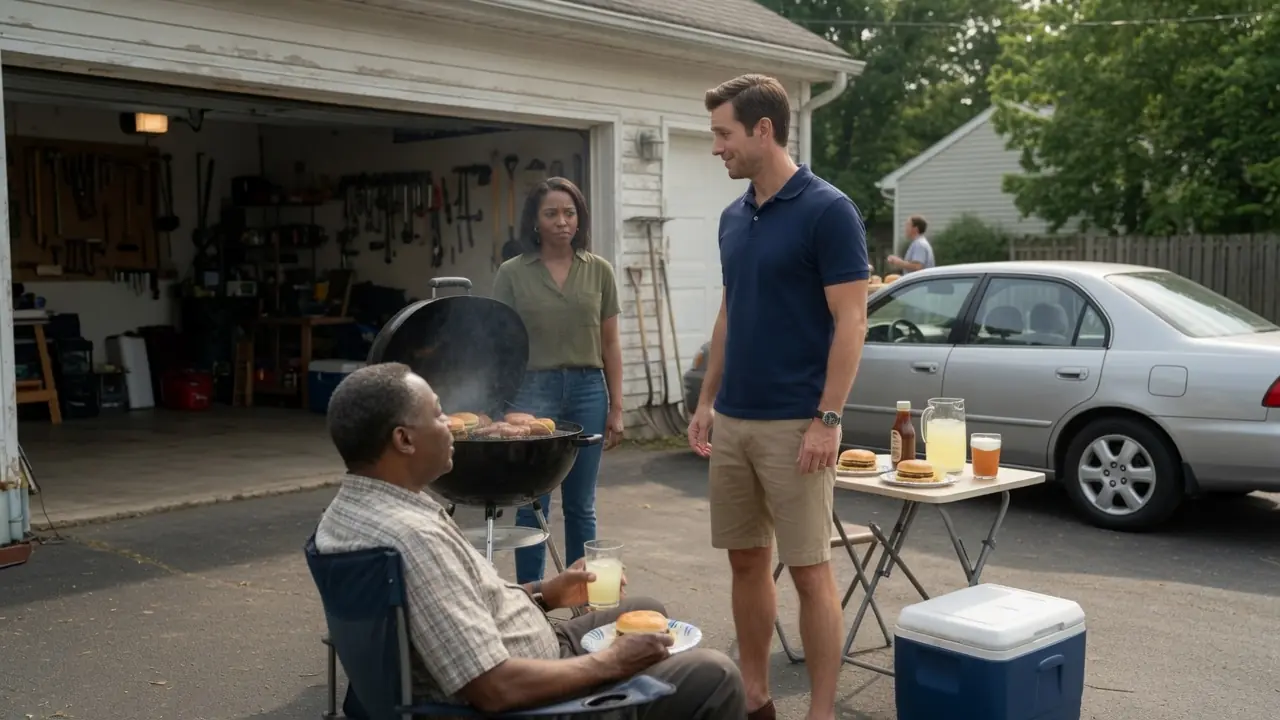
Preston watched me over the grill, waiting for confusion, hurt, or perhaps some little sign that I had sensed the insult but could not prove it. I gave him nothing. I had learned long ago that silence is not surrender. Sometimes silence is bait.
He turned the meat again, then leaned back in the kind of posture men use when they want to look taller than they are. “You know, Luther, this driveway could fit two cars if you cleared out half the junk in that garage.”
“It fits what I need.”
“That’s the problem,” he said. “You only think about what you need. This property could be something. A modern addition, a rental unit, maybe even a tear-down and rebuild if someone with vision handled it.”
Maya set the potato salad down too hard. “Preston, it’s Daddy’s house.”
“For now,” he said before catching himself. Then he smiled. “I mean, eventually families have to plan.”
There it was, finally spoken close enough to English for Maya to hear. My house was not a home to him. It was a waiting asset, a number sleeping under a roof. He did not see the porch where Maya took her first steps, the kitchen where Eleanor taught her to make cornbread, or the garage where I built shelves at midnight after long shifts because my wife wanted the pantry organized before Christmas.
He saw equity. He saw leverage. He saw my age as a locked door whose hinges were beginning to rust.
I reached for my paper plate and set it gently on the table. “Plan for what?”
Preston looked at me, surprised I had entered the conversation. “Nothing for you to worry about.”
“I worry about my home.”
He laughed, not warmly. “That’s the thing, Luther. You worry about little things. Paint, tools, old photographs, dusty records in boxes. Adults worry about money.”
Maya’s face went tight. “Preston.”
“No, sweetheart, he needs to hear this.” Preston turned toward me with the tongs still in his hand, pointing them like a judge’s gavel. “This place is not a home anymore. It is a retirement problem with a garage, and you are the obstacle standing between us and the money.”
The backyard went quiet.
There were no guests to hide behind, no restaurant noise, no clinking glasses, no waiters hovering near white tablecloths. Just my garage, my grill, my daughter, and my son-in-law standing in my driveway with barbecue smoke curling around his polished watch. His words hung in the air like a bad smell.
I looked at Maya.
She had gone pale. Her mouth opened, but no sound came out. She looked at her husband as if she had heard something she had been trying not to know. The fear in her eyes told me this was not the first time he had spoken of my property as if it were already his.
Preston saw her expression and realized he had pushed too far in English. So he retreated into French again, the coward’s curtain.
“Il est vieux, Maya. Vieux, lent, inutile. S’il avait un peu de dignité, il nous laisserait vendre avant de devenir un vrai fardeau.”
He is old, Maya. Old, slow, useless. If he had any dignity, he would let us sell before he becomes a real burden.
Maya did not understand every word, but she understood enough from his face. “Stop it,” she said.
Preston laughed. “Stop what? Telling the truth?”
Then he turned to me, and maybe because I had stayed silent too long, he decided I was safe to kick harder.
“Le vieux ne comprend rien,” he said. “Regarde-le. Il pense probablement que je parle du barbecue.”
The old man understands nothing. Look at him. He probably thinks I’m talking about the barbecue.
I sat back in my chair.
The afternoon seemed to hold its breath. A small breeze moved through the garage and made the chain on the pull light tap softly against the metal shade. Tap. Tap. Tap. It sounded almost like a countdown.
Preston smirked. “You understand me?” he said in English, mocking the idea before it fully reached him. “Do you, Luther? Do you understand anything happening around you?”
I placed my glass of lemonade on the small table. My hand did not shake. Then I looked directly at him.
“Oui, Preston,” I said in French. “Je comprends parfaitement.”
Yes, Preston. I understand perfectly.
His smile disappeared.
Not faded. Not softened. Disappeared.
The tongs slipped a little in his hand, and the metal tips struck the side of the grill with a sharp click. Maya turned toward me so fast her earrings swung against her neck. Her eyes widened, confused first, then stunned.
Preston blinked. “What?”
I did not raise my voice. “J’ai compris chaque mot.”
I understood every word.
His face changed in stages. First disbelief. Then embarrassment. Then fear, quick and naked, before pride rushed in to cover it. He tried to laugh, but the sound came out thin.
“You speak French?”
I leaned forward slowly. “I lived in Paris for fifteen years.”
Maya whispered, “Daddy?”
I kept my eyes on Preston. “I negotiated property deals in French before you learned how to fake an accent from travel videos. I bought buildings in French. I sued contractors in French. I buried friends in French. And today, I listened to my son-in-law call me old, useless, and an obstacle in French.”
Preston swallowed. “I was joking.”
“No,” I said. “You were safe. There is a difference.”
The grill popped behind him. Smoke rose from the ribs, and for once Preston did not turn around to check them. His whole body had gone rigid, like a man standing on a bridge and hearing the crack beneath his feet.
Maya stepped closer to me. “Daddy, why didn’t you say something before?”
“Because your husband talks more when he thinks I am stupid.”
She turned toward Preston, shame and anger mixing in her face. “How long have you been doing this?”
Preston recovered enough to point at me. “Don’t let him twist this. He has been sitting there pretending to be confused, spying on us.”
“In my own yard?” I asked. “Beside my own garage? While you discuss selling my house?”
“It’s not spying when you understand a language someone else is using to hide cruelty,” Maya said, and her voice shook because she was finally hearing herself choose a side.
Preston’s jaw tightened. “Maya, don’t start. You know we need options.”
“Options?” she repeated. “You called my father an obstacle.”
“Because he is!” Preston snapped. “Look around. This house is worth more than he will ever use. He sits here polishing tools and pretending memories pay taxes.”
I smiled then, just a little.
Preston saw it and frowned. He had expected anger. He had expected me to become the stereotype he wanted, loud, wounded, emotional, something he could later describe as unstable. Instead, I was smiling like a man who had just found the last missing receipt.
“Taxes,” I said. “That is an interesting word.”
He went still.
I stood slowly, not because my knees hurt, though they did, but because I wanted him to feel the height of me. I am seventy-one, but I am still six feet two inches tall, and I have spent a life standing through rooms that wanted me seated. Preston took half a step back before he caught himself.
“You came to my barbecue for money,” I said. “Not ribs. Not family. Money.”
“That’s ridiculous.”
“You talked about selling my house. You talked about clearing out my garage. You talked about me disappearing. You used French because you thought the language would hide your character.”
Preston lifted his chin. “You’re making this sound worse than it is.”
“It is worse than it sounds.”
Maya looked at me. “Daddy, what does that mean?”
I reached into the breast pocket of my short-sleeve shirt and removed a folded piece of paper. Preston stared at it as if paper had suddenly become dangerous. I unfolded it carefully and placed it on the plastic barbecue table between the lemonade pitcher and the hamburger buns.
It was not a dramatic document. No gold seal, no fancy envelope, no expensive texture. Just plain white paper with numbers printed in clean rows.
“Maya,” I said, “your husband’s advertising company owes City National Bank one hundred forty-five thousand dollars.”
Her hand went to her throat. “What?”
Preston lunged toward the paper. “Where did you get that?”
I placed one finger on it before he could snatch it away. “Public filings.”
He froze.
“Your apartment was not under renovation,” I continued. “You were evicted. Your office furniture was not an investment. It was purchased on a maxed-out card in Maya’s name. Your Mercedes is three payments behind, and your parents’ summer home has been in foreclosure proceedings for two months.”
Maya looked at Preston like the ground had opened beneath her. “Preston?”
He shook his head hard. “He is lying.”
I turned to my daughter. “Ask him why he wanted me gone before the next bank notice arrived.”
Preston threw the barbecue tongs onto the side table so hard they bounced. “You had no right to dig into my life.”
“You brought your debt into my yard,” I said. “You dragged my daughter into it. You stood beside my garage and called me an obstacle. I decided to find out what I was standing in the way of.”
Maya backed away from Preston. “You told me the business was fine.”
“It is fine,” he said too quickly. “This is temporary.”
“Temporary is a flat tire,” I said. “This is a crash.”
His eyes flashed. “You smug old bastard.”
Maya flinched.
I did not. “Careful.”
“No, I’m done being careful,” Preston shouted. “You sit here in your little garage like some wise old king, judging everyone. You think because you saved some money and own a house, you get to look down on me?”
“I never looked down on you.”
“You never had to. Your whole silence is judgment.”
That was the first honest thing he had said all afternoon.
I looked at my daughter. “Maya, go inside and bring me the brown folder from the kitchen table.”
Preston stepped in front of her. “No.”
Maya stared at him. “Move.”
His face tightened. “Maya, I said no.”
“And I heard you,” she said. “Now move.”
For one beautiful second, I saw the girl I had raised. The girl who climbed trees, argued with teachers when she knew she was right, and once stood between a stray dog and a boy throwing stones. Preston saw her too, and fear passed over his face because men like him do not fear strength until it appears in someone they thought they had weakened.
He moved.
Maya walked into the house. The back door closed behind her, leaving me alone with Preston beside the smoking grill. He turned toward me slowly.
“You’re enjoying this,” he said.
“No.”
“You want to destroy me.”
“I want to protect my daughter.”
“From what? From ambition? From a future? From a man who wants more than rusted tools and old stories?”
I looked toward the garage wall where my tools hung in perfect order. “Those rusted tools built the porch you sat on. They repaired the furnace that kept your wife warm when you were gambling with borrowed money. They fixed the Toyota you laughed at, the same Toyota I used to drive Maya to school when she was seven years old and afraid of thunder.”
He looked away.
“And those old stories,” I said, “bought three rental duplexes, two commercial lots, and a silent partnership in a freight company you once begged to pitch.”
Preston turned back slowly. “What did you say?”
I smiled again, and this time I let him see how little he knew. “You thought the old man was poor because I did not wear money on my wrist.”
His eyes moved to my bare wrist.
“I never needed a watch to know what time it is,” I said. “Right now, it is time for you to listen.”
Maya returned with the brown folder pressed against her chest. Her face was pale, but different now. Not weak. Awake. She handed me the folder, and I opened it on the barbecue table.
Inside were copies of bank filings, lien notices, credit card statements, a business loan agreement with Maya’s signature attached to a guarantee she had never fully understood, and one printed email where Preston referred to my house as “the old man’s asset.”
Maya stared at that line for a long time. “You called my father an asset?”
Preston rubbed both hands over his face. “It was business language.”
“It was my father.”
“He was never going to know!”
The words erupted from him before he could stop them. Then his face went slack as he realized what he had confessed.
I nodded. “There it is.”
Maya looked sick. “Preston.”
He reached for her. “Baby, listen. I was under pressure. I needed a plan. Your father has all this property just sitting here, doing nothing.”
“Doing nothing?” I asked.
“Yes!” he snapped. “Doing nothing. You’re old. You don’t need all of this.”
I closed the folder. “And you do?”
“I can turn it into something.”
“You turned your business into a lawsuit and your marriage into collateral.”
He took a step toward me. “You don’t know anything about running a modern company.”
I held his gaze. “Preston, I own the building your company tried to rent last month.”
The words struck him silent.
Maya looked at me. “What building?”
“King Tower,” I said.
Preston’s mouth opened, then closed. “No.”
“Yes.”
“No, King Tower is owned by a management group.”
“My management group.”
He looked like every bone in his body had briefly forgotten its purpose. I saw him replaying phone calls, emails, applications, fake projections, the meeting he had bragged about for weeks. He had tried to impress investors by promising office space in the tower I owned through a holding company he had never bothered to research.
“You rejected my lease,” he whispered.
“I flagged your application for fraud.”
Maya covered her mouth.
Preston pointed at me, his hand shaking now. “You understood me? You heard everything? Every insult, every plan, every word?”
I looked at the barbecue smoke rising between us. “Yes.”
He stumbled back a step.
“All this time,” I said, “while you thought I was too old and too stupid to understand, I was listening. When you laughed at my Toyota, I listened. When you told Maya I was a resource, I listened. When you called my garage junk, I listened. And when you stood beside my grill today and said I should disappear so you could get to my money, I heard that too.”
Maya’s tears finally fell. “Daddy, I’m sorry.”
I turned to her, and my voice softened only for her. “I know.”
“No, I really am,” she said. “I let him talk down to you. I let him make me afraid to defend you.”
Preston snapped, “Maya, don’t crawl to him now.”
She turned on him. “Do not speak to me.”
The command shocked both of us. Preston stared at her as if she had changed languages too.
She stepped closer, trembling but standing straight. “You made me think my father was in the way. You made me ashamed of this house, this garage, his clothes, his old car. You made me forget that everything stable in my life came from him, not you.”
Preston’s face twisted. “So now I’m the villain?”
“No,” Maya said. “Now I’m finally admitting it.”
I picked up the tongs from the side table and turned the ribs before they burned. It was a strange thing to do in the middle of a family collapse, but good food deserves not to suffer because people behave badly. The sauce hissed against the coals, and the smoke rolled upward.
Preston laughed once, a broken sound. “This is insane. You two are acting like I committed a crime because I talked about money.”
I opened the folder again and pulled out the final sheet. “No. This is why we talk about crime.”
He saw the heading and went pale.
It was the bank guarantee attached to Maya’s name, the one his loan officer had sent to her email after she asked for copies, the one Preston had told her was just routine paperwork. Her signature was there, but I had known my daughter’s handwriting since she was four years old. The slant was wrong. The pressure was wrong. The M in Maya was wrong.
“You forged her signature,” I said.
Maya went very still.
Preston’s eyes darted between us. “That’s not what happened.”
“Then explain.”
“It was a digital authorization.”
“Explain it to the attorney Monday morning.”
“Attorney?” Maya asked.
“My attorney,” I said. “He already has copies.”
Preston stepped back again, and this time there was nowhere for his pride to go. The garage wall was behind him, my neatly hung tools waiting like witnesses. He looked at the old wrenches, the drill press, the labeled drawers, the workbench Eleanor used to call my second church.
For the first time since I had known him, Preston looked small in my garage.
“Luther,” he said, changing his tone. “Let’s not make this ugly.”
I almost laughed. “You made it ugly in French.”
“I was angry.”
“You were honest.”
He looked toward Maya, desperate now. “Baby, tell him we can fix this. Tell him we don’t need lawyers. Tell him families don’t do this.”
Maya wiped her cheeks with the back of her hand. “Families don’t forge signatures.”
His face hardened. “You’re really choosing him over your husband?”
She looked at me, then at the house, then at the garage, and something settled inside her. “I’m choosing the person who never tried to sell me.”
Preston’s mouth opened, but nothing came out.
I picked up the folder and held it against my chest. “You have until sunset to leave my property.”
“What?”
“Your car, your clothes, and anything that belongs only to you. Nothing from the house. Nothing from the garage. Nothing from Maya’s accounts.”
“You can’t throw me out.”
“I can. You are not a tenant. You are not on the deed. You are a guest whose invitation just expired.”
Maya whispered, “Daddy.”
I looked at her. “You can stay, if you choose. But if you stay, you stay as my daughter, not as his shield.”
Preston looked at her, panic flashing through his arrogance. “Maya, get in the car.”
She did not move.
“I said get in the car.”
“No.”
The word was small, but it hit the driveway harder than any shout.
Preston stared at her. “You’ll regret this.”
Maya lifted her chin. “I already regret enough.”
He turned toward me, eyes wet with fury. “You ruined my life.”
I shook my head. “No, Preston. I translated it.”
For a moment, none of us spoke. The grill crackled. A car passed slowly on the street. Somewhere behind the fence, a neighbor’s dog barked once and went quiet, as if even the afternoon knew the important part had already been said.
Preston grabbed his sunglasses from the table and shoved them onto his face though the sun had shifted behind the trees. He walked to the Mercedes with the stiff, furious stride of a man trying to leave like a winner while carrying every proof of defeat on his back. He opened the driver’s door, then stopped and looked at the house one last time. For a second, I saw the calculation return, the old hunger, the belief that some angle still existed.
“Monday,” I said.
He looked at me.
“My attorney will call yours. If you have one.”
His face tightened. Then he got into the car, started the engine, and backed out of my driveway so fast the tires scraped the curb. The Mercedes disappeared down the street, leaving behind the smell of smoke, sauce, and burned pride.
Maya sank into the folding chair beside me.
For a long time, she did not speak. She stared at the garage floor, at the old Toyota, at the tools she had watched me use her entire childhood. Then she looked at me with the expression of someone seeing a familiar room after the lights had finally been turned on.
“You really lived in Paris for fifteen years?” she asked.
I nodded. “Before you were born.”
“And you own King Tower?”
“Yes.”
“Why didn’t you tell me?”
I looked toward the roses near the fence. “Because I wanted to know who loved me before they knew what I owned.”
She lowered her head.
“I failed,” she whispered.
“You got lost,” I said. “There is a difference. Failure is staying lost because pride feels easier than the walk home.”
She cried then, not loudly, not dramatically, but with the exhaustion of a woman whose fear had finally loosened its hands from her throat. I let her cry. I did not rush to fix it. Fathers have to learn that sometimes rescuing a child too quickly only teaches them to keep falling in the same direction.
After a while, she wiped her face and looked at the grill. “The ribs are probably ruined.”
I lifted the lid and checked. “Not ruined. Just close.”
She laughed through tears, and the sound broke something open in me that had been locked for a long time.
We ate on paper plates beside the garage. The ribs were a little smoky, the potato salad was too sweet, and the lemonade had gone watery, but it was the first honest meal I had shared with my daughter in years. She asked me about Paris, about the buildings, about how a man with rough hands and an old Toyota could own things nobody knew about. I told her pieces, not everything, because truth is food, and people who have been starving must eat slowly.
By evening, the driveway was clean. Preston’s tire marks still showed faintly near the curb, but they would fade after the next rain. Maya carried the plates inside while I closed the garage door. Before pulling it down, I stood there for a moment, looking at the tools hanging in their perfect places.
Preston had called them junk. He had called me an obstacle. He had spoken in another language because he thought it made him powerful.
But language is only a locked door to people who do not have the key.
I had the key.
I had always had the key.
That night, after Maya went to bed in her old room for the first time in years, I sat alone beside the garage with a fresh glass of lemonade and watched the last light disappear from the driveway. The house was quiet again, not empty, not defeated, but quiet in the way a battlefield becomes quiet after the smoke clears. I knew lawyers would call. I knew Preston would lie. I knew Monday would bring paperwork, threats, and more of his desperate noise.
But I also knew the game had changed.
He had walked into my yard believing I was too old to understand him.
He left knowing I had understood everything.
And that was the beginning of his end.