My son’s wedding was the most beautiful room I had ever been invisible in. The venue was everything Deshawn had wanted. High ceilings, soft gold lighting, round tables dressed in white linen, a bar that never ran dry. Charlotte’s finest had shown up in their best. Laughter moved through the room in warm easy waves. The band played something smooth and unhurried. Everyone looked like they belonged exactly where they were standing.
I was standing alone near the far window with a glass of water I hadn’t touched. I watched my son work the room the way he had been working rooms since he was twenty-two. Chin up, hand extended, smile arriving just before the words. Deshawn had always known how to make an entrance feel like a gift to whoever received it. I had always known that the gift had conditions.
My name is Verlain Odum. I am fifty-eight years old. I raised that man. And on the evening of his wedding I was the one thing in that room he needed to manage. I felt him before I saw him. The hand at my back, not a guide, a grip. The specific pressure of a man moving something he finds inconvenient without wanting to appear as though he is moving it at all.
I set my glass down on the windowsill and let him steer me. There is someone I want you to meet, he said low and smooth. Nothing in his voice suggested what was coming. He walked me across the room toward a man holding court near the center. Tall, silver at the temples, the kind of stillness around him that only comes from decades of being the most significant person present. Three associates flanked him in a loose half circle.
Reginald Whitfield, my new daughter-in-law’s father, a name that moved markets in three states. Deshawn’s hand stayed at my back until we were close enough that removing it would have looked deliberate. Then he began. Mr. Whitfield, this is my mother. I should warn you. A small laugh rehearsed, landing like a joke told too many times. She is what we call the family failure. Never quite figured out what she wanted to do with herself.
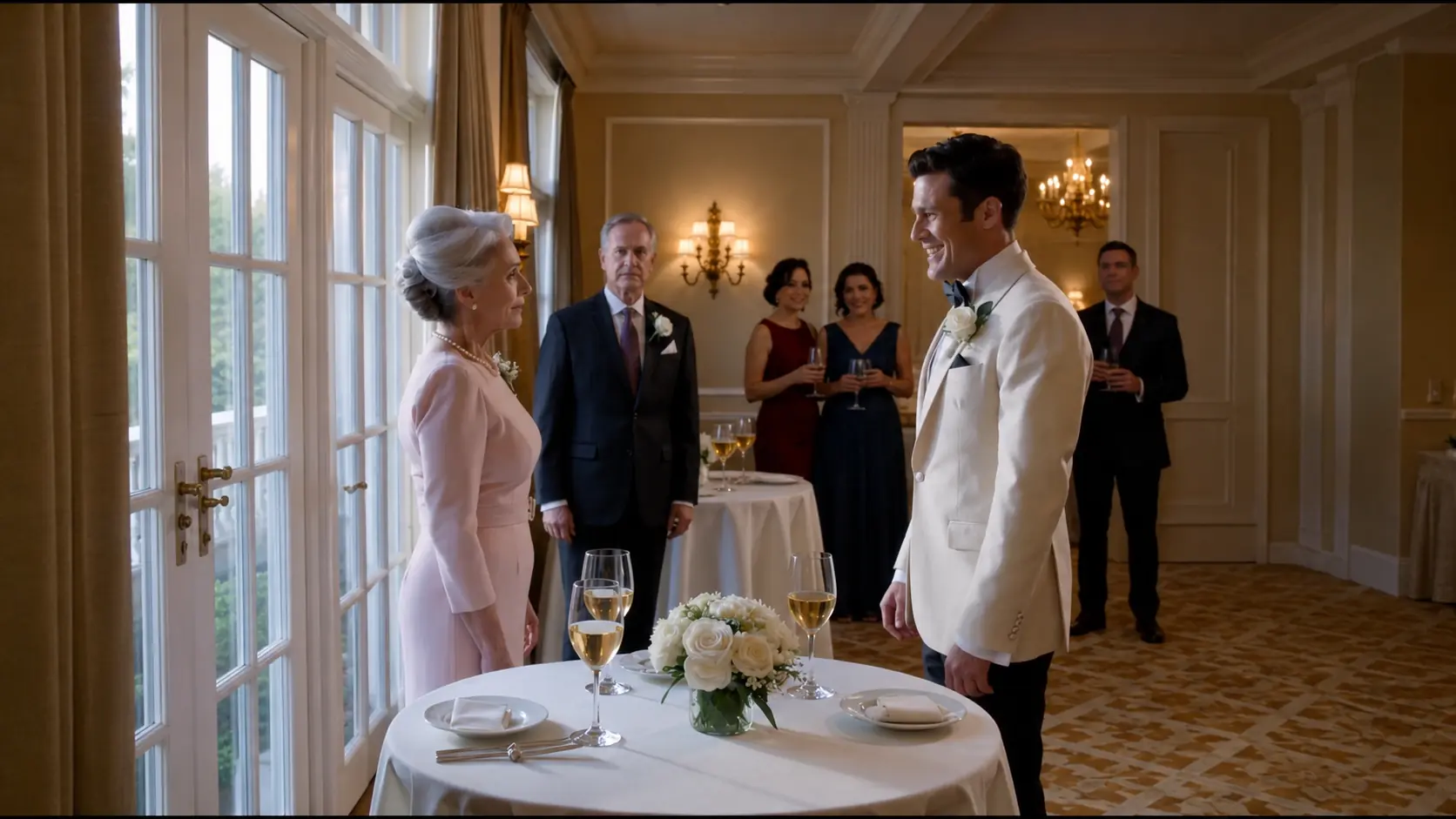
I kept my face still. Courtland materialized at my left shoulder the way he always did. Drawn to Deshawn’s orbit like something without its own gravity. He half turned toward the bar as he spoke, his attention already leaving before his words arrived. We do not brag about her, he said. Casual, unexamined, gone before the sentence finished.
Reginald Whitfield did not laugh. That was the first change in the room. His glass paused halfway to his mouth. Not dramatically, just long enough for his eyes to settle on me properly, now with the specific attention of a man re-checking information he thought he understood. One of the associates beside him glanced between us. The conversation nearest to us softened slightly. More instinct than interruption.
Then Reginald set his glass down. He stepped forward and took my hand in both of his. Not performative warmth, not society politeness. Recognition. Real recognition. When he spoke his voice was low enough that only I could hear the full weight of it. So it is you. A pause. This is unexpected.
Behind me Deshawn gave a short uncertain laugh. The kind people use when they feel a conversation shifting somewhere they can no longer predict. Courtland turned more fully toward the bar, already reaching for the safety of another interaction. Neither of them saw what I saw. Reginald Whitfield was not looking at me like a billionaire discovering hidden royalty. He was looking at me the way experienced people look when a professional name they have heard quietly for years suddenly acquires a face.
There was no spectacle in his reaction. That was what made it matter. He leaned slightly closer, said four words I will not repeat yet. I simply nodded. Deshawn’s face was doing something it had never done in front of me before. Not anger, not embarrassment, something quieter and more unsettling than either. The specific expression of a man who has handed something over confidently and is only now realizing he did not understand what he was holding.
He stood eight feet away with his champagne glass and his wedding smile and watched Reginald Whitfield keep me exactly where I was. I could see him searching for an explanation that fit the world as he had built it. He did not find one. Reginald moved naturally, the way men of his standing always move in rooms without urgency, without performance. He turned slightly to his left and introduced me to the two associates still flanking him. First name only, no title offered, no context given. Just this is Verlain. The way you introduce someone whose name is expected to do its own work.
It did. The first associate, a compact man in a charcoal suit, extended his hand and said I did not realize that was you. Three words carrying the specific weight of someone recalibrating a room they thought they already understood. The second associate, a woman with close-cropped hair and reading glasses pushed up on her forehead, held my hand a half second longer than a standard greeting requires. ODM Capital, she said quietly. Not a question. I smiled and said it was good to meet them both.
Across the room Deshawn had not moved. Courtland found me within minutes. He came close enough that his voice would not carry and tilted his head toward Reginald with the expression he always used when he wanted to appear casual about something that was eating at him. How do you know that man? he asked. I looked at him, let the question sit for exactly one beat. Then I smiled, the same smile I had been giving Courtland for thirty-two years when I could decide a conversation was not worth having, and said we have crossed paths.
He waited for more. I picked up a fresh glass from a passing tray and turned slightly toward the room. That was the end of that. What I noticed next was Amara. She had positioned herself near her father with the practiced ease of someone reading him close enough to observe, far enough not to intrude. She was studying his face the way you study something that is behaving outside its pattern. Reginald Whitfield had attended dinners with senators, closed rooms with developers worth nine figures, and stood in circles that moved serious money. Amara had watched all of it.
She knew exactly how her father looked in those rooms. He had never looked at anyone the way he had just looked at me. I watched her watching him, and I remembered something. Three weeks before this wedding, at a dinner in Deshawn’s home, someone had directed a question toward me about my background. Amara had answered before I finished my first sentence. Smooth, warm, seamless, and steered the table somewhere else entirely. She had not been cruel about it. She had simply decided in that moment that my answer was not necessary.
I had filed it then. I filed this moment now. Same drawer, no urgency. The band shifted into something slower. Conversations resumed their natural shape around us. The room settled back into its version of normal. It was not the same room it had been forty minutes ago. Only two people in it understood that fully.
Reginald caught my eye from across the space. A single glance, unhurried and deliberate, and nodded once. The specific nod of a man confirming something that did not need to be spoken aloud. I nodded back. Deshawn saw it. I know because I saw him see it. The stillness that moved through his body like something cold, finding no exit. He did not know what had just passed between us. He knew it mattered.
Reginald Whitfield did not summon me. He simply began moving toward the quieter end of the room and left just enough space beside him that the invitation was clear without being stated. That was the language of a man who had never needed to ask twice for anything. I followed. We settled near a stretch of wall away from the band, away from the bar, away from the warm cluster of wedding noise.
He turned toward me with the full attention of someone who had been waiting to have this conversation for longer than I had known it was coming. Your attorney is Apprentice Ware, he said, not a question. Has been for twenty-two years. I said he nodded once. The way men nod when a detail confirms something they already suspected. Eight years ago my team was working a Southeast Corridor acquisition. Different asset class, different market position, but the same structural fingerprint as a repositioning that had moved through Charlotte a few years earlier.
My attorney flagged it, said the prior move was cleaner than anything he had seen in that space. He paused briefly. He reached out to Apprentice’s office for background. She said the principal preferred to remain private. My team respected that. A faint shift at the corner of his mouth. I remembered the name anyway. ODM Capital, I said. Odum Capital, he repeated. And then tonight your son introduced you and you said your last name, and he stopped. A short exhale through the nose. Almost a laugh, but quieter than that. That was all it took.
I had said my name the way I always said it, plainly without decoration. I had not known that one word had been sitting in Reginald Whitfield’s professional memory for eight years, waiting for a face. The Charlotte repositioning saved that project, he said. I do not use that word loosely. Half the room thought the corridor had peaked already. You moved before the institutional money caught up. He looked at me directly. That changed the outcome for everyone downstream from it.
It was a calculated decision, I said. The fundamentals supported it. They did, he agreed. But plenty of people see fundamentals and still hesitate. Timing is usually where people fail. There was no performance in the conversation, no showing off, no need to establish credentials either of us already understood. We spoke in the natural shorthand of people who had spent years reading the same landscape from different corners of it. It was the most honest conversation I had been part of in years. No translation, no softening, no careful editing of myself before the words left my mouth. I had forgotten what that felt like.
I became aware of Deshawn before he spoke. He had positioned himself close enough to hear fragments and far enough away to pretend he was not listening. What he was hearing was making no sense to him. I could feel it in the way he kept shifting his weight, recalibrating, trying to find an angle that made this version of his mother fit the one he had carried his entire adult life. It did not fit. It was never going to fit.
He stepped forward finally and touched Reginald’s arm lightly. The social interruption dressed as familiarity. Mr. Whitfield, I hope she is not talking your ear off. A laugh followed it, rehearsed, landing badly. Not cruel enough to challenge directly, just dismissive enough to shrink the moment back into proportions he understood. Reginald turned slowly toward him. The expression on his face was not unkind. That would have been easier for Deshawn to process. It was something more unsettling than unkind. Patient, measured, completely without social cushioning. The look of a man quietly reassessing another man in real time.
For a brief second nobody spoke. Then Reginald said very evenly your mother and I were discussing a project that impacted half this corridor. Nothing aggressive in the sentence. That was what made it land. Deshawn’s smile faltered almost invisibly at the edges. He glanced at me then, quickly, instinctively, like he was checking whether I intended to rescue him from the moment or expose him further inside it. I did neither. Reginald returned his attention to me with calm finality, and Deshawn’s laugh disappeared before it fully finished.