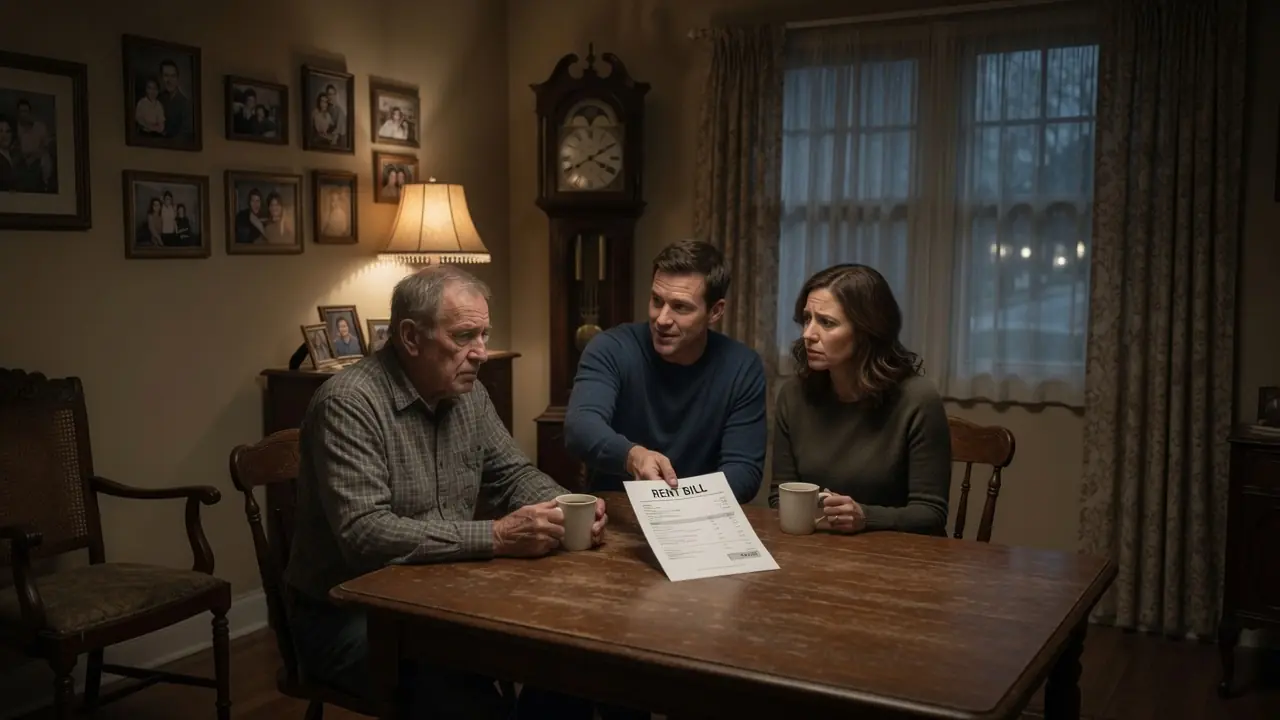
Walter Hayes sat at the left side of the old oak dining table, both hands wrapped around a white coffee mug that had already gone cold. The room looked almost exactly the way it had when his late wife, Margaret, was alive: family photos on the walls, a brass table lamp glowing on the side cabinet, and the grandfather clock ticking in the corner with a sound that had measured forty years of their marriage. Across from him, his son Brian sat with a folded sheet of paper in one hand and a hard smile on his face. Beside Brian, his wife Melissa stared at her coffee, silent and pale, as if she already knew what he was about to do was wrong.
Brian slapped the paper onto the table so loudly that the coffee in Walter’s mug trembled. “There,” Brian said, pushing it across the scratched wood. “Starting next month, you pay eight hundred dollars if you want to keep living here.” Walter looked at the paper but did not touch it. For several seconds, the only sound in the room was the clock ticking behind him.
Walter was seventy-two years old, a retired electrician with thick gray hair, tired blue eyes, and hands that still carried the shape of tools he had used his entire life. He had bought that house in 1983, when Brian was still a baby and Margaret was sewing curtains at the kitchen table because new ones cost too much. He had rewired the place himself, replaced the roof after a storm, built the back deck, paid every mortgage bill, and finally burned the last payment notice in the fireplace the year he turned fifty-two. Now his own son was sitting across from him, acting like a landlord.
“I must have heard you wrong,” Walter said quietly. Brian leaned back and folded his arms, clearly enjoying the moment. “You heard me fine, Dad. You live here, you use heat, water, electricity, food, and space. Everybody contributes.” Melissa’s eyes flicked toward Walter, then back down again. She said nothing.
Walter slowly lifted the paper and read the first line. It said “Monthly Occupancy Contribution Agreement,” as if a fancy title could hide the insult underneath it. His name was typed under “resident,” while Brian’s name was typed under “property manager.” There were dates, penalties, late fees, and even a section about “failure to cooperate.” Walter lowered the page back onto the table and looked at his son.
“This is my house,” he said. Brian rolled his eyes, loud and disrespectful in the way adult children sometimes become when they think age has made their parents weak. “Technically, sure. But I run everything now. Melissa and I moved in to help you after your fall, remember?” Walter’s jaw tightened. He had slipped on ice six months earlier, sprained his hip, and let Brian move in “for a little while” because he thought his son was worried about him.
At first, it had felt like a blessing. Brian and Melissa had arrived with suitcases, groceries, and a promise that they only needed a few months to get back on their feet after Brian’s business failed. Walter gave them the upstairs bedroom, the room that had once belonged to him and Margaret, because Brian said the stairs would be easier for younger legs. Walter moved into the smaller downstairs guest room, telling himself it was practical. The first night, he lay awake listening to his son and daughter-in-law laughing above him in the room where Margaret had died, and tried not to feel replaced.
The bills came next. Brian asked to handle the utilities because Walter “shouldn’t worry about paperwork at his age.” He redirected the internet bill to his own email, then the water bill, then the property tax notices. When Walter asked why his mail was missing, Melissa told him she was only sorting out the junk. When Walter asked for the attic key, Brian said he had misplaced it.
Walter had told himself not to be suspicious. Brian was his only child, the boy Margaret had rocked through fevers, packed lunches for, and defended even when Walter thought he needed discipline. A father does not want to believe his son is measuring him like an obstacle. So Walter kept swallowing small insults, one at a time, until the night the rent bill landed on the table.
Brian tapped the paper with two fingers. “Eight hundred is generous. A room like yours would cost more anywhere else.” Walter stared at him. “A room like mine?” Brian’s smile hardened. “Yes, Dad. The downstairs room. Your room.” Walter felt something in his chest shift, not rage yet, but a cold, clear disbelief. He remembered carrying Brian through that same dining room on his shoulders, pretending to be a horse while Margaret laughed from the kitchen.
“This house was not built for you to charge me admission,” Walter said. Brian leaned forward, raising his voice. “Stop acting like a victim. Melissa and I cook, clean, manage repairs, and keep this place running. You sit around drinking coffee and talking about the way things used to be.” Melissa flinched slightly at the cruelty, but still did not speak. Walter watched her silence and realized it was a choice, not confusion.
“I never asked you to manage my life,” Walter said. Brian slapped his palm against the table. “Because you don’t know what you need anymore. That is exactly the problem.” Walter’s eyes moved to the paper again. For the first time, he noticed the signature line at the bottom, waiting for him like a trap.
Brian pushed a pen toward him. “Sign it tonight. We need things official.” Walter did not pick up the pen. “Why?” he asked. Brian’s mouth tightened. “Because Melissa’s parents are coming next month, and we need to know what money is available.” The answer came too quickly. Walter looked toward Melissa, and this time she could not meet his eyes.
Melissa’s parents had lost their condo after a bad investment, and Walter had heard enough whispered phone calls to know they were desperate. He had also heard Brian tell Melissa that “Dad has savings sitting there doing nothing,” as if Walter’s retirement was a loose jar of coins on a shelf. Walter had never said anything because he wanted to believe they were only worried and tired. Now the rent bill made every whisper sound different.
“So that’s what this is,” Walter said. Brian’s face reddened. “Don’t twist this.” Walter lifted the paper slightly. “You want me to pay rent in my own house so you can bring more people here for me to support.” Brian stood up so fast his chair scraped against the floor. “You are selfish, Dad. You have more space than you need, more money than you spend, and you still act like helping family is some kind of crime.”
Walter looked up at him without moving. “Helping family is not a crime. Turning your father into a tenant is.” Melissa whispered Brian’s name, but he ignored her. He pointed at Walter, his voice rising. “You either sign that paper, or we start discussing assisted living. Because if you can’t cooperate, maybe you shouldn’t be here alone.”
The threat hung in the room like smoke. Walter felt it pass through him and settle somewhere deep. He had lived long enough to know when a conversation ended and a decision began. He folded the paper once, then placed it beside his mug.
“I will think about it,” he said. Brian looked satisfied, believing he had won. “Good. Do that.” Melissa stood quickly and began collecting the coffee cups, though none of them had been finished. Walter stayed seated until Brian and Melissa went upstairs, then reached for the phone on the side cabinet.
The call took three rings. “Oliver Grant,” said the voice on the other end. Walter closed his eyes for one second, grateful his old friend was still the kind of man who answered at night. “Oliver, it’s Walter Hayes,” he said. “I need a lawyer, and I need one before morning.”
Oliver did not joke, did not ask if it could wait, and did not waste time. He had been Walter’s friend for thirty years, ever since they played cards at the same veterans’ hall and argued about baseball every summer. He listened while Walter explained the rent bill, the missing mail, the blocked attic, the changed bills, and the threat of assisted living. When Walter finished, Oliver was silent for a long moment.
“Do not sign anything,” Oliver said finally. “Do not give Brian access to your bank accounts, your deed, or your medical records. Do you have the original deed?” Walter looked toward the hallway, then lowered his voice. “In the old lockbox under my bed.” Oliver exhaled. “Good. Bring it to my office at nine tomorrow morning.”
Walter barely slept that night. At 2:10, he heard soft footsteps outside his door. The handle turned slowly, then stopped because Walter had locked it. No one knocked. After a few seconds, the footsteps moved away, and Walter lay in the dark with one hand gripping the blanket, knowing exactly what someone had been looking for.
Before sunrise, he packed the deed, mortgage release letter, property tax receipts, bank statements, and Margaret’s death certificate into an old leather folder. He slipped the rent bill inside as well, because Oliver had told him every insult looked different when a judge could read it. At seven, Brian knocked on his door and asked if he wanted breakfast. Walter said he was going out.
“Where?” Brian asked, appearing in the hallway in sweatpants and a dark blue sweater. Walter looked at him calmly. “Errands.” Brian frowned at the folder under Walter’s arm. “What kind of errands?” Walter put on his coat. “The kind a grown man handles without asking permission.”
Brian looked angry, but Melissa called him from upstairs, and Walter used the moment to leave. The morning air felt sharp and clean as he stepped onto the porch. For the first time in months, he looked back at the house and did not see a place he was losing. He saw a place he had been too slow to defend.
Oliver’s office sat above a bakery on Maple Street, with narrow stairs and old windows that rattled when trucks passed below. He met Walter at the door, took the folder, and read through everything without interruption. His face darkened when he reached the rent agreement. “He put himself down as property manager,” Oliver said. “That is not arrogance. That is preparation.”
“What do I do?” Walter asked. Oliver removed his glasses. “First, we secure the deed and create certified copies. Second, we revoke any informal authority he has been pretending to have. Third, we draft a notice requiring him and Melissa to leave the property. If he fights, we go to court.”
Walter’s stomach tightened. “Evict my own son.” Oliver leaned forward. “Walter, he is trying to evict you without using the word. He already moved you out of your bedroom. He restricted your access to your belongings. He demanded rent from you for property you own.” Walter looked down at his hands. They looked old to him that morning, but not useless.
They spent two hours preparing documents. Oliver called the county office and confirmed that the house was solely in Walter’s name. He helped Walter change online banking passwords and freeze an old shared emergency card Brian had quietly used for house purchases that were not house purchases at all. He also discovered small transfers from Walter’s account to Brian’s business account, labeled “maintenance reimbursement.” Walter had never approved a single one.
By noon, Walter no longer felt confused. He felt sick, but clear. Brian had not lost his way in one bad moment; he had been walking toward this for months. The rent bill was only the moment he had decided to stop hiding the road.
Oliver insisted they go to court the next morning for an emergency protective order regarding the property and finances. Walter almost resisted because court made everything feel too final. Then he remembered the doorknob turning in the middle of the night. “Set it up,” he said.
That evening, Walter returned home with only one certified copy of the deed in his coat pocket. The originals were locked in Oliver’s office safe. Brian was waiting at the dining table, the rent bill spread in front of him like a business proposal. Melissa sat beside him, looking worse than before.
“You were gone all day,” Brian said. Walter hung his coat carefully. “Yes.” Brian pointed at the paper. “Did you think about it?” Walter walked to the table and sat in his old chair, the left one, the one he had used since Margaret was alive.
“I did,” he said. Brian pushed the pen forward again. “Then sign.” Walter took the pen, looked at it, and placed it sideways across the bill. “No.” Brian stared at him. “No?” Walter folded his hands. “I am not signing a rent agreement for my own home.”
Brian’s face hardened. “Then we have a problem.” Walter nodded. “We do.” Brian leaned forward, his voice rising. “You think you can just sit here while everyone else carries the burden? You are old, Dad. You need help. You need structure. You need someone making decisions before you ruin everything.”
Walter pulled the certified deed copy from his pocket and laid it over the rent bill. The room went silent. Melissa’s eyes widened. Brian looked down at the document, then back at his father.
“My name is on the deed,” Walter said quietly. “Not yours.” Brian scoffed, but the sound was weaker now. “That doesn’t mean you can handle the house.” Walter held his gaze. “It means you cannot charge me rent for it.” Melissa whispered, “Brian, stop.” This time, Walter heard fear in her voice.
Brian stood and slammed his hand on the table. “You went to a lawyer, didn’t you?” Walter did not answer. He did not have to. Brian’s face flushed with anger. “After everything I’ve done for you, you run to some lawyer like I’m a criminal?”
Walter looked at the rent bill, the deed, and the son who had confused entitlement with care. “I ran to a lawyer because my son handed me a bill for the house I built.” Brian’s mouth opened, but no words came. For one small second, Walter saw the shame trying to reach him. Then pride slammed the door shut.
The next morning, Oliver and a county officer arrived at the house. Walter had spent the night at Oliver’s guest room to avoid another confrontation, and now he returned with the law standing beside him. Brian opened the door, saw the officer, and immediately looked past him at Walter. “You’ve got to be kidding me.”
The officer handed Brian the notice. It required Brian and Melissa to vacate within a court-approved timeframe and prohibited them from accessing Walter’s financial accounts, mail, attic, office, or bedroom. Brian read it quickly, his face changing from anger to disbelief. Melissa began crying before he reached the last page.
“You’re throwing us out?” Brian shouted. Walter stood in the hallway, the same hallway where Brian had taken his first steps. “No,” he said. “I am taking my home back.” Brian laughed bitterly. “This is your answer? Court papers? An officer? You couldn’t talk to your own son?”
Walter’s voice stayed calm. “I tried talking when you moved my things. I tried talking when you took my mail. I tried talking when you called yourself property manager. You only heard me when I brought witnesses.” The officer glanced at Brian with a look that said he had seen this kind of family argument too many times. Brian noticed and lowered his voice, but not his anger.
Melissa finally spoke. “Walter, I’m sorry.” Brian turned on her. “Don’t.” She flinched, then looked at Walter anyway. “I knew this was wrong. I should have said something.” Walter felt the words cut more deeply than he expected. Silence had been her way of helping Brian, and now apology was her way of stepping back from the wreckage.
Brian packed like a man being robbed, though every box he filled had been brought into Walter’s house by his own hands. He argued over furniture, over dishes, over a television he claimed he had bought. Oliver had receipts for most of Walter’s property and calmly separated what belonged to whom. Three times, Brian tried to pull Walter aside privately, and three times Walter refused.
“You have changed,” Brian said near the garage door, carrying a box of clothes. Walter looked at him. “No. I stopped disappearing.” Brian shook his head as if disgusted. “Mom would hate this.” That was the first sentence that nearly broke Walter’s restraint.
Walter stepped closer, his voice still low but sharper than before. “Do not use your mother to defend what you did. She loved this house. She loved you. And she would be ashamed that you tried to make her husband pay rent to sleep under the roof she helped build.” Brian looked away first. Melissa began sobbing quietly near the stairs.
By dusk, they were gone. The house was a mess of dragged furniture marks, half-empty rooms, and silence so large it felt like another person. Walter stood in the dining room beside the table where the rent bill had been slapped down two nights earlier. The paper was still there, wrinkled now beneath the certified deed copy.
He picked up the rent bill and tore it in half. Then he tore it again, not in anger, but with the quiet precision of a man ending a bad chapter. He dropped the pieces into the trash and sat down in his chair. For the first time in months, nobody told him where to sit.
The next week was hard. Walter changed the locks, reclaimed the upstairs bedroom, and hired a cleaning crew to remove the traces of Brian’s takeover. He went into the attic and found Margaret’s plates, his tools, old photo albums, and the lamp his father had given him. Some things were missing, and Oliver said they could pursue it later, but Walter did not have the strength for every battle at once.
He spent one afternoon restoring the dining room. The family photos went back where they belonged. Margaret’s favorite blue vase returned to the side cabinet. The grandfather clock was wound and polished until its ticking sounded stronger. Walter stood in the doorway when he finished and felt, for the first time in a long time, that the room recognized him again.
Brian called after twelve days. Walter let it ring twice before answering. His son sounded tired. “Dad,” he said. “I want to talk.” Walter sat at the dining table with his coffee mug, listening to the same voice that had once called him from little league practice asking for a ride home.
“Talk,” Walter said. Brian exhaled. “I messed up.” Walter closed his eyes. He had imagined those words often, but hearing them did not fix what they had broken. “Yes, you did.”
Brian said Melissa had left to stay with her sister. He said the financial pressure had been worse than Walter knew, that he felt trapped, that he thought if he could control the house, everything else would settle. Walter listened without interrupting. Excuses sometimes sounded like apologies when people were still afraid to face themselves.
“I never meant to hurt you,” Brian said. Walter looked at Margaret’s picture on the wall. “You meant to control me. Maybe you didn’t care whether that hurt.” The line went quiet. Brian swallowed audibly. “Can I come home?”
Walter felt the old father instinct rise in him, the urge to fix, protect, forgive, and restore. Then he looked at the empty space on the table where the rent bill had been. “No,” he said. Brian’s breathing changed. “Dad.” Walter kept his voice steady. “You can visit one day, when I am ready. You will not live here again.”
Brian did not answer for a long time. Then he said, “You really mean that.” Walter nodded though his son could not see him. “I do.” When the call ended, Walter sat alone for several minutes, grieving both the son he loved and the son who had sat across from him demanding rent.
Three months later, the house felt like his again. He hired a young neighbor named Thomas to help with the yard and a part-time housekeeper to come twice a week. He rejoined the church card group, invited Oliver over for coffee, and began volunteering with a housing charity that helped older people protect themselves from financial pressure. He told his story once at a meeting, and three people cried because they had heard versions of it in their own families.
Walter did not hate Brian. Hate required more energy than he wanted to spend. They spoke occasionally, awkwardly, carefully, never for long. Brian had not fully changed, but he had stopped asking for money, and for now that was enough distance for Walter to breathe.
One quiet Sunday evening, Walter sat at the dining table with coffee in the same white mug. The lamp glowed, the grandfather clock ticked, and Margaret’s face smiled from the wall. The house was not as lively as it had been when Brian was young, and sometimes the silence still hurt. But it was honest silence, not the suffocating quiet of being erased in his own home.
Walter placed his palm flat on the worn oak table. He could still see faint pencil marks where Brian had done homework, a small burn from Margaret’s holiday candle, and scratches from decades of meals, bills, birthdays, and arguments. This house was not just property. It was proof of a life.
His son had tried to turn that life into a rental agreement. Walter had answered with a quiet call, a deed, and a boundary that hurt to set but saved what was left of his dignity. In the end, he learned that family could be precious, but no family bond should require a father to become a tenant in the home he built with his own hands.